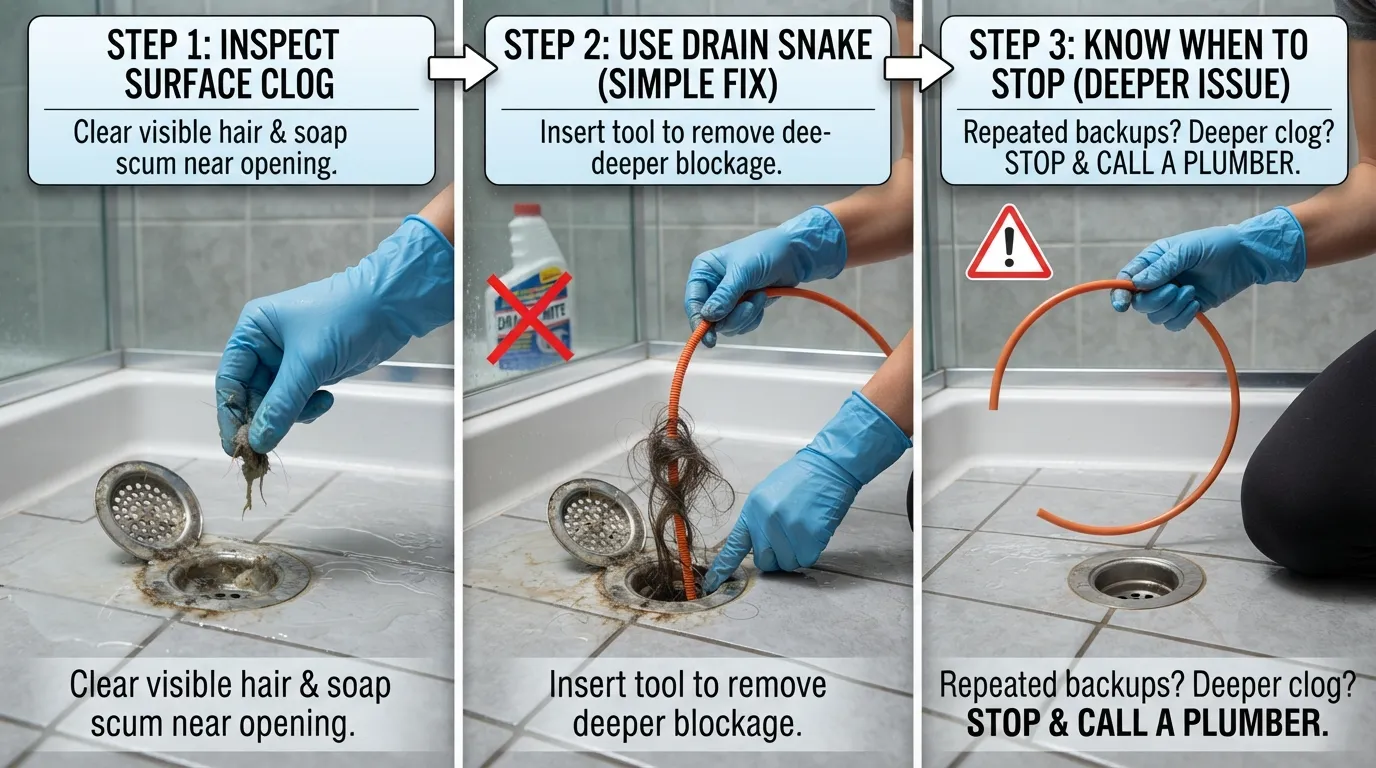
If your shower drain is not draining, start by removing visible hair and buildup from the drain opening. If the shower is still slow, use a plastic hair-removal tool, plunger, or hand drain snake depending on what the symptoms suggest. If the drain looks clear but water still will not go down, the restriction may be deeper in the pipe. Multiple slow drains, recurring backups, wastewater coming up, or a drain that stays blocked after reasonable DIY attempts are signs that the problem may need professional diagnosis rather than another home remedy.
A shower that will not drain can mean anything from a small clump of hair just below the cover to a blockage farther down the drainage system. That is why I would not start by randomly pouring products into the drain.
The better approach is to look at what the shower is doing, narrow down where the problem is likely to be, and then choose the safest fix that matches the symptoms.
This guide walks you through that process step by step, including what to do with standing water, how to plunge a shower drain, what it means when there is no visible blockage, what to try after a drain snake fails, and when it makes more sense to stop DIY troubleshooting.
First, Diagnose What Your Shower Drain Is Telling You
Before reaching for a drain cleaner or snake, take about a minute to answer four questions:
- Is the shower draining slowly or not draining at all?
- Is there visible hair or buildup around the drain opening?
- Is only the shower affected, or are sinks, tubs, or toilets also draining slowly?
- Did the problem develop gradually, or did the shower suddenly stop draining?
A partial restriction from hair, soap residue, product buildup, or debris near the fixture is a common possibility.
A more complete obstruction may be blocking the fixture drain or a section farther downstream.
The clog may be below the visible opening, inside the trap, or farther along the drain line.
The issue may extend beyond the shower and involve a shared branch drain or another part of the home’s drainage system.
If several fixtures are acting up at the same time, it helps to understand how your home drainage system works before treating the shower as an isolated clog.
How to Fix a Shower Drain That Is Not Draining
Start with the least aggressive method that matches what you can actually see. You do not need to use every method in this guide.
1. Stop Running the Shower and Inspect the Drain
If water is already pooling around your feet, stop adding more water. Look through or around the drain cover for:
- Hair wrapped around the strainer
- Soap and product residue
- Slime or buildup just inside the opening
- A small object that may have fallen into the drain
Put on gloves before touching material in the drain.
If the cover is held by screws, remove it carefully with the correct screwdriver. Some drain covers lift or snap out instead. If the cover does not move easily and you cannot see how it is secured, do not force it hard enough to damage the drain assembly or shower surface.
2. Pull Out Visible Hair and Debris
If you can see hair near the opening, mechanical removal is usually the most direct first step.
You can use:
- Gloved fingers for accessible debris
- Needle-nose pliers
- A flexible plastic hair-removal tool
- A small drain-cleaning tool designed for fixture drains
Insert the tool gently, pull the debris upward, and dispose of it in the trash rather than pushing it farther into the pipe.
If hair or debris is already reachable, pull it out. Repeatedly forcing it downward can turn an easy-to-reach clog into a harder blockage farther inside the drain.
3. Flush the Drain and Test the Flow
After removing accessible debris, run hot tap water and watch what happens.
You are looking for a clear difference:
- Does water immediately disappear through the drain?
- Does it still pool before slowly draining?
- Does the water level continue to rise?
If the flow is normal again, you may have solved the immediate clog. If it remains slow, move to a method that reaches slightly deeper.
I would avoid pouring extremely hot or boiling water into an unfamiliar plumbing system. Hot tap water is a more cautious choice when you do not know the pipe material or condition.
How to Unclog a Shower Drain With Standing Water
Standing water makes the job less convenient, but you can still troubleshoot it.
- Stop running water into the shower.
- Remove enough standing water with a cup, small container, sponge, or wet/dry vacuum if available so you can safely access the drain.
- Put on gloves.
- Remove accessible hair or debris from the drain opening.
- Use a plastic drain tool if the clog appears close to the surface.
- If appropriate, move to a plunger or hand snake.
If the shower immediately fills again during a short flow test, do not keep running water just to see whether the clog eventually clears.
Can You Use a Plunger on a Shower Drain?
Yes, a plunger can sometimes help with a shower drain, especially when the restriction is close enough for pressure changes to move it.
How to plunge a shower drain
- Remove loose hair and debris first.
- Use a cup-style plunger that can seal around the drain opening.
- Leave enough water in the shower to cover the edge of the plunger cup.
- Center the plunger over the drain and create the best seal you can.
- Use several firm, controlled plunges.
- Lift the plunger and see whether the standing water starts moving.
If you have a bathtub-and-shower combination with an overflow opening, blocking the overflow with a wet cloth can help create a better seal while plunging.
Do not plunge a drain that contains a chemical drain opener. Plunging can splash the chemical back toward you. Follow the product label and avoid mixing drain-cleaning chemicals with other household substances.
How to Unclog a Shower Drain With a Drain Snake
If the drain opening is clear but water still drains slowly, a hand-operated drain snake or auger can reach deeper than a plastic hair tool.
- Remove the drain cover if it can be removed normally.
- Feed the cable slowly into the drain.
- When you meet resistance, do not immediately assume you have reached the clog; drain fittings and bends can also create resistance.
- Work the cable carefully according to the tool’s instructions.
- Retrieve any debris that catches on the cable.
- Clean the tool and test the shower with a controlled amount of water.
Do not use excessive force. Aggressive snaking can damage some drain components or push an object farther into the system.
Shower Drain Still Not Draining After Snaking?
This is one of the most important situations to diagnose correctly.
If you ran a snake into the drain and the shower still will not drain, several possibilities remain:
- The snake did not reach the actual restriction.
- The cable passed through soft material without removing enough of it.
- The obstruction is farther down the branch drain.
- A foreign object is lodged where your tool cannot retrieve it.
- Buildup is reducing the inside diameter of the pipe rather than forming one simple plug.
- The problem involves more than the shower fixture drain.
A deeper local or branch restriction is more likely than a whole-house problem.
Stop treating it as only a shower clog and investigate the shared drainage path.
Temporary flow does not always mean the underlying restriction was fully removed.
Why Is My Shower Not Draining Even Though There Is No Visible Blockage?
A clear-looking drain opening does not mean the entire drain line is clear.
The restriction could be:
- Just below the point you can see
- Inside the trap
- Farther along the fixture or branch drain
- A combination of hair, residue, and mineral buildup coating the pipe
- A foreign object lodged deeper in the line
If the shower also gurgles, smells unusual, or changes behavior when another fixture drains, look at the symptoms together instead of assuming there is one specific cause. Gurgling is a clue that water and air are not moving normally, but it does not identify the exact problem by itself.
What Type of Clog Do You Probably Have?
Clues: Drain became slower over time and hair is visible or repeatedly comes out on a plastic tool.
Best first move: Mechanical removal.
Clues: Slippery residue around the drain and gradual slowing rather than an instant stop.
Best first move: Remove accessible buildup and flush after mechanical cleaning.
Clues: Drain stopped suddenly, especially after a cap, small item, or other object may have entered the drain.
Best first move: Retrieve it if safely reachable; avoid forcing it deeper.
Clues: Opening looks clear, DIY tools do not restore normal flow, or the problem keeps coming back.
Best first move: Stop guessing and locate the restriction before using more aggressive methods.
What Can You Pour Down a Shower Drain to Unclog It?
This is where a lot of shower-drain advice becomes less useful than it should be.
The important question is not, “What liquid is strongest?” It is, “What is actually blocking the drain?”
A liquid cannot grab and remove a thick mat of hair the way a physical tool can. Likewise, a plastic hair-removal strip cannot solve every deeper drainage problem.
Hot water
Hot tap water can help rinse away loose residue after accessible material has been removed. It is not a dependable solution for a tightly packed hair clog or a solid object.
Baking soda and vinegar
The fizzing reaction may help disturb light residue and can be useful as a mild cleaning step, but it should not be treated as a guaranteed drain-unclogging method. If hair is physically blocking the drain, removing the hair is usually more direct than trying to dissolve around it.
Do not mix baking soda and vinegar with commercial drain-opening chemicals.
Does Dawn dish soap unclog a shower drain?
Dish soap may help loosen or lubricate some residue, but it is not a reliable fix for a dense hair clog, trapped object, or deeper pipe obstruction.
If your shower drain is packed with hair, physically removing that material makes more sense than repeatedly adding soap to the drain.
Can salt unclog a shower drain?
Salt is sometimes suggested in household drain remedies, but I would not make it the main treatment for a shower that is not draining. It does not mechanically remove hair or retrieve an object, and adding more material to an already restricted drain is not a useful substitute for identifying the blockage.
Can Epsom salt unclog a drain?
I would not rely on Epsom salt as a primary shower-drain solution. If the drain is slow because of hair, soap buildup, an object, or a deeper restriction, diagnose and address that cause directly.
Should You Use a Strong Chemical Drain Unblocker?
A stronger chemical is not automatically a better solution.
Before using any drain-opening product, consider:
- Whether you know what is causing the blockage
- The pipe material and condition
- The product manufacturer’s instructions
- Whether another chemical has already been used
- Whether you may need to plunge or mechanically work on the drain afterward
Never mix different drain cleaners, and never combine a commercial drain opener with household cleaning chemicals unless the product instructions explicitly say it is safe.
For a typical hair obstruction, physical removal is often more targeted because you are actually taking the blockage out instead of trying to treat it chemically.
What Do Plumbers Use Instead of Just Pouring Drain Cleaner Down the Pipe?
Professional drain work is usually based on the location and nature of the restriction rather than one universal product.
Depending on the situation, a plumber may use:
- Professional drain-snaking equipment
- Drain augers suited to the pipe and blockage
- Camera inspection when the cause or location is unclear
- Drain-cleaning methods designed for buildup farther inside a line
For example, professional drain cleaning services may involve snaking, camera diagnostics, or other methods selected according to what the drain is actually doing rather than treating every blockage the same way.
What If the Shower Drain Cover Cannot Be Removed?
Do not damage the cover or shower floor trying to force it loose.
If the cover has accessible openings, you may still be able to:
- Pull visible hair with needle-nose pliers
- Insert a flexible plastic hair-removal tool through an opening
- Clean debris sitting directly on top of the strainer
If the design prevents safe access and the shower is completely blocked, forcing the cover is less attractive than having someone identify how that specific drain assembly is meant to be opened.
Why Did My Shower Stop Draining All of a Sudden?
A sudden complete stoppage can point to a different situation than a drain that has been getting slower for weeks.
Possibilities include:
- A mass of accumulated hair shifting into a tighter blockage
- A foreign object entering the drain
- An existing partial restriction becoming completely blocked
- A deeper drainage problem becoming severe enough to affect the fixture
If the shower suddenly stops and another nearby drain also begins backing up, that combination deserves more attention than an isolated slow shower.
How to Tell Whether the Clog Is Local or Deeper in the System
How Do You Know the Shower Drain Is Actually Clear?
Seeing the standing water disappear once is not always enough.
After clearing the drain, run the shower normally for a short period and look for these signs:
- Water drains as quickly as it reaches the shower floor.
- No pool forms around the drain.
- The drain does not begin slowing after a minute or two.
- No unusual gurgling appears.
- Nearby fixtures behave normally.
- The problem does not return shortly afterward.
If the drain only improves temporarily and then slows again, more material may remain inside the line.
When Should You Stop Trying DIY Shower Drain Fixes?
There is a point where trying another household remedy adds less value than finding out what is actually wrong.
- The shower remains blocked after accessible debris has been removed and reasonable mechanical clearing has failed.
- The clog keeps coming back.
- More than one fixture is draining slowly or backing up.
- Wastewater comes up through another drain.
- You suspect an object is lodged deeper in the pipe.
- Your drain snake meets hard resistance that you cannot safely identify.
- You have already used chemicals and need someone to work on the drain safely.
If you are in the Miami area and the problem has moved beyond a simple surface clog, a local plumbing professional can help determine whether the restriction is at the shower, farther down the branch line, or elsewhere in the drainage system.
How to Help Prevent Another Shower Drain Clog
Once the shower is draining normally again, prevention is easier than waiting for standing water to return.
- Use a hair-catching drain screen that fits your shower.
- Remove collected hair before it gets pulled into the drain.
- Clean residue from the drain cover regularly.
- Do not intentionally wash solid debris down the shower drain.
- Pay attention when the drain starts becoming slower instead of waiting for a complete backup.
- If the same drain repeatedly clogs despite routine cleaning, investigate the cause rather than repeatedly applying temporary fixes.
Frequently Asked Questions About a Shower That Will Not Drain
Why is my shower not draining if there is no blockage?
The visible opening can be clear while the restriction sits deeper in the trap, fixture drain, or branch line. If other fixtures are also slow, the problem may extend beyond the shower itself.
How do I get rid of standing water in my shower drain?
Remove enough water with a cup, sponge, or wet/dry vacuum so you can safely reach the drain. Then remove accessible hair and debris before trying a plunger or appropriate drain tool.
Can you plunge a shower drain?
Yes. A cup plunger can work when it seals around the drain and there is enough water to cover the plunger rim. Do not plunge after chemical drain opener has been poured into the drain.
What can I pour down a shower drain to unclog it?
That depends on what is causing the restriction. Hot tap water may help rinse loose residue, but a physical hair clog is better addressed by removing the hair. Household mixtures should not be treated as substitutes for mechanical clearing when material is physically blocking the pipe.
Why is my shower drain not draining after using a snake?
The snake may not have reached the blockage, may have passed through soft material without removing it, or the restriction may be farther down the line. If multiple drains are affected or the problem repeatedly returns, further diagnosis makes more sense than repeatedly forcing the same tool.
Does Dawn really unclog drains?
Dish soap may help with some residue, but it cannot reliably remove a dense mat of hair, retrieve a solid object, or clear every deeper drain obstruction.
Why should you not rely on baking soda and vinegar for every clog?
The reaction may help disturb light residue, but it does not physically remove a compact hair clog or retrieve an object. Use it, if appropriate, as a cleaning step rather than assuming it can solve every blocked shower drain.
What is the strongest drain unblocker for a shower?
The most effective approach depends on the blockage. Hair near the opening may respond best to physical removal, while a deeper restriction may require a drain snake or professional equipment. Choosing the correct method is more useful than automatically choosing the strongest chemical.
Why does my shower drain keep clogging?
Recurring clogs can mean that material is repeatedly entering the drain or that the previous cleaning restored flow without fully removing the restriction. If routine hair control does not prevent the problem, the drain may need a more complete inspection or cleaning.
If your shower drain is not draining, do not treat every case as the same clog.
Start by checking whether the problem is slow or completely blocked, visible or hidden, isolated to the shower or affecting multiple fixtures. Remove accessible hair and debris first, then move carefully to a plunger or drain snake if the symptoms support it.
If the drain looks clear but still will not move water, DIY snaking does not work, several fixtures are affected, or the problem keeps returning, the next useful step is diagnosis rather than another random drain remedy.
If the clog keeps returning, other drains are slowing down, or your DIY attempts have not restored normal flow, it may be time to locate and clear the restriction properly.