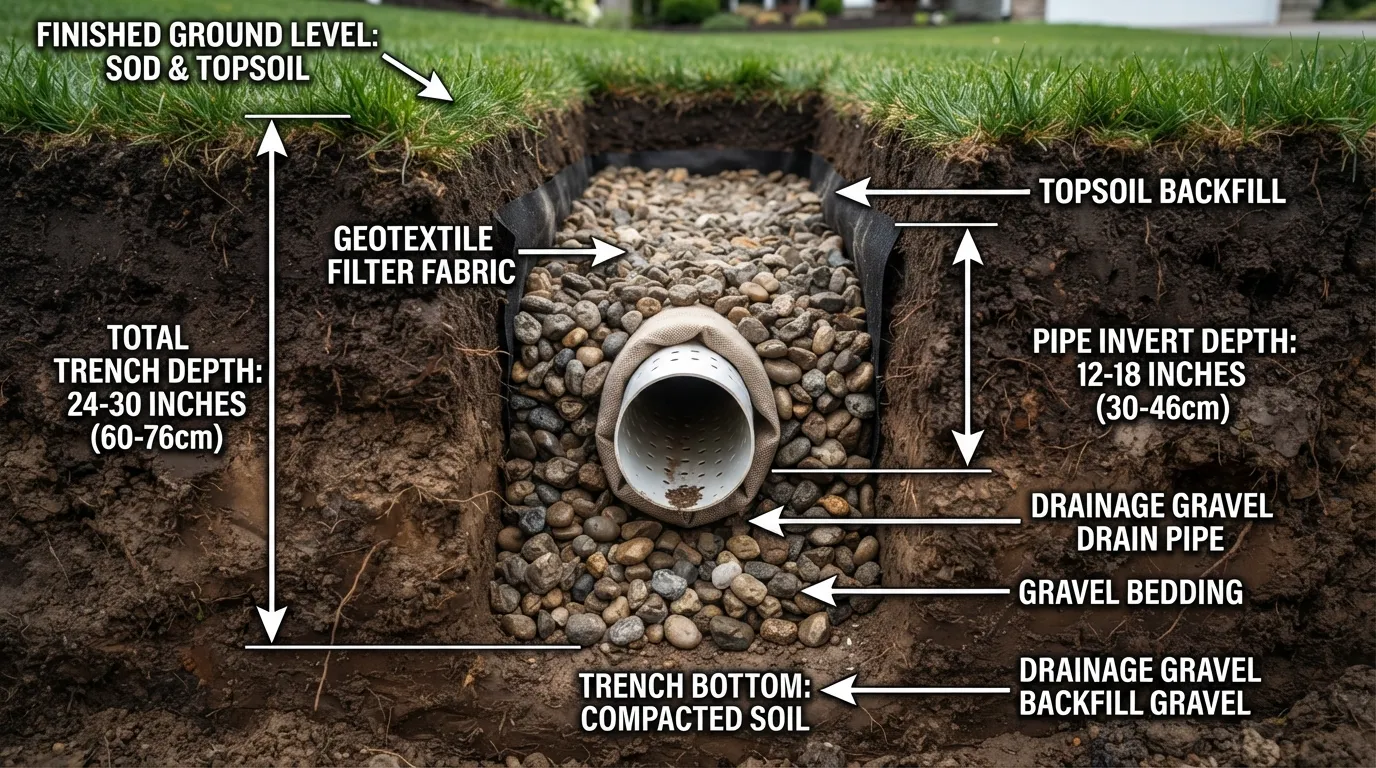
If you are trying to figure out how deep to dig a French drain, the most useful answer is not one universal number. For many typical yard drainage projects, an 18- to 24-inch-deep trench is a common starting range. Some simple, shallow yard drains may be shallower, while drainage beside foundations, retaining walls, or deeper groundwater problems can require a very different design.
A French drain is commonly about 18 to 24 inches deep for ordinary yard and shallow subsurface drainage. However, the correct depth is the depth that intercepts the water you are trying to manage while still allowing the pipe to slope toward a workable discharge point.
Do not choose depth by number alone. Water source, soil, groundwater, pipe and gravel space, trench width, slope, outlet elevation, nearby structures, and underground utilities can all change the final design.
That distinction matters because a 20-inch trench that catches shallow water and drains freely can work better than a much deeper trench that misses the real problem or has nowhere for the collected water to go.
French Drain Depth by Drainage Problem
I would start by identifying what water you want the drain to intercept. The drainage problem should determine the depth, not the other way around.
A common range when the goal is to intercept shallow surface or subsurface water in a lawn. Site conditions may justify a shallower or deeper trench.
Some simple yard-water applications can be shallow. The drain still needs enough space for the drainage assembly and a workable route to the outlet.
Foundation drainage should be designed around the footing, groundwater, building conditions, and safe excavation—not a generic lawn-drain depth.
The drain generally needs to intercept water where pressure or saturation develops, so structural details and outlet elevation become critical.
Published guidance illustrates why you will see different numbers online. NDS describes many French-drain trenches as roughly 18 to 24 inches deep and 6 to 12 inches wide, while its installation guidance notes that some water-diverting projects may fall within an approximately 8-inch-to-2-foot depth range. Home Depot uses an approximately 18-inch-deep, 9- to 12-inch-wide trench in its general installation example. Those are useful starting points, not substitutes for evaluating your site.
The Better Question: What Depth Will Intercept Your Water?
This is the part that gets missed when French drain depth is reduced to a single measurement.
Before digging, ask where the unwanted water is actually moving:
- Across the ground surface? Grading, a swale, catch basin, or surface-drainage solution may need to be considered alongside—or instead of—a French drain.
- Through shallow saturated soil? A conventional yard French drain may be able to intercept that subsurface movement.
- Toward a foundation below grade? The depth and placement become more sensitive because footing level, hydrostatic pressure, waterproofing, excavation safety, and discharge all matter.
- From a roof or downspout? Fixing the source or routing concentrated runoff correctly may be more effective than simply digging deeper.
- From a high groundwater condition? A deeper trench does not automatically solve the problem if the outlet, groundwater elevation, or site drainage cannot support the design.
Choose a depth that intercepts the unwanted water, leaves room for the pipe and drainage aggregate, and still allows a continuous workable path toward a safe outlet.
How to Determine the Right French Drain Depth
1. Identify the water source
Watch the property during and after rainfall. Note where water first appears, how it travels, where it collects, and whether the ground remains saturated after visible surface water disappears.
This tells you whether you are primarily dealing with runoff, shallow subsurface water, groundwater, or a different drainage problem entirely.
2. Find a viable discharge point before choosing the starting depth
A French drain collects water, but collection is only half of the system. The water also needs somewhere appropriate to go.
If you dig the beginning of a long trench very deep and the outlet is not low enough, you may lose the elevation needed to keep water moving downhill. That is why I would plan the outlet and elevations before committing to trench depth.
3. Account for the pipe and gravel assembly
The bottom of the trench is not necessarily the same thing as the bottom or center of the pipe. A traditional French drain normally includes drainage aggregate beneath and around a perforated pipe, with filter fabric separating the drainage material from surrounding soil.
That means a design calling for a pipe at a particular elevation needs additional trench depth for whatever bedding is specified below that pipe.
4. Check whether the required slope still works
Depth and slope cannot be planned independently. As the drain travels toward its outlet, the pipe needs a consistent positive fall unless the system has been specifically engineered another way.
5. Stop treating it as a simple DIY trench when the site becomes complex
Deep excavation, work beside a foundation, uncertain groundwater, buried utilities, difficult discharge conditions, recurring property flooding, retaining walls, or other structural concerns are good reasons to move beyond a generic online depth recommendation.
French Drain Trench Depth vs. Pipe Depth
One reason French drain measurements become confusing is that people use the word depth to mean several different things.
So when someone says, “My French drain is 18 inches deep,” clarify whether they mean the total trench depth or the pipe elevation below finished grade. Those measurements are not automatically identical.
How Wide Should a French Drain Be?
Depth is only one dimension. Many residential trench examples fall roughly in the 6- to 12-inch-wide range, with 9 to 12 inches commonly shown for a traditional yard installation.
The required width depends on the pipe diameter, aggregate envelope, drainage demand, soil conditions, and system design. A wider gravel column can provide more collection area, but simply making every trench wider and deeper is not a substitute for identifying the source of the water.
What Size Pipe Is Used in a French Drain?
A 4-inch perforated drain pipe is common in many residential applications, although larger or differently designed systems may be appropriate when drainage demand increases.
The pipe is only one part of the system. A properly selected pipe can still perform poorly if the trench is flat, the outlet is wrong, sediment is allowed into the aggregate, or the drain is positioned where it cannot intercept the water.
Should Gravel Go Under a French Drain Pipe?
In a traditional gravel-filled French drain, yes—the pipe is normally installed on drainage aggregate rather than directly on ordinary soil. Home Depot’s installation example, for instance, uses a layer of gravel bedding beneath the drain pipe before additional aggregate is placed around and over it.
Important:
Do not calculate your pipe depth and then forget the bedding below it. If the pipe needs to sit at a certain elevation, the trench has to be deep enough for the complete assembly.
French Drain Slope: Why Depth and Outlet Elevation Must Be Planned Together
For a gravity-drained French drain, the trench and pipe need a continuous path toward the discharge point. A commonly used planning guideline is approximately a 1% downward slope, although the correct slope can vary by pipe, system, manufacturer instructions, and site design.
This is why “How deep should I start?” cannot be answered without asking “How far is the drain running, and how low is the outlet?”
For example, starting a 100-foot drain unnecessarily deep can make the downstream end significantly deeper once you add the required fall. If the discharge point cannot accommodate that elevation, digging deeper at the beginning can create a worse design rather than a better one.
Is a Deeper French Drain Always Better?
No. The best French drain is deep enough to intercept the unwanted water and function as a complete drainage system. Extra depth by itself does not guarantee better performance.
A drain can be unnecessarily deep if:
- the water you need to intercept is shallow;
- the added depth makes a gravity outlet difficult or impossible;
- deeper digging introduces groundwater or excavation complications;
- the trench approaches foundations, utilities, or other structures;
- the actual problem is poor grading or concentrated surface runoff rather than subsurface water;
- there is no appropriate place for the collected water to discharge.
Delaware DNREC’s homeowner planning guidance makes a similar distinction: simple shallow yard French drains may be DIY projects, while deeper, more complex drains or drains near a building foundation call for professional drainage evaluation.
What Changes French Drain Depth in Miami and South Florida?
Miami-Dade County notes that the Biscayne Aquifer—the local groundwater table—is only a few feet below the ground surface, and groundwater can move closer to the surface during wetter conditions. That makes actual site elevations and groundwater conditions especially important when deciding how deep an exterior drain should be.
In a cold northern climate, an installer may spend significant time considering frost depth. In South Florida, I would put more emphasis on questions such as:
- How high does groundwater rise during wet periods?
- Is the problem caused by surface runoff, saturated soil, or groundwater?
- Is there enough elevation to discharge the water by gravity?
- Will the proposed outlet create water problems elsewhere?
- Will deeper excavation encounter groundwater or require dewatering?
- Are there local stormwater, drainage, outfall, or dewatering requirements that apply to the specific project?
Miami-Dade has permitting processes for certain stormwater drainage, outfall, and dewatering activities. That does not mean every small residential French drain requires the same permit; it means you should verify the requirements that apply to your property before significant excavation or drainage modification.
If you want to understand where an exterior French drain fits among sanitary, stormwater, and subsurface drainage, our guide to how a home drainage system works explains the differences.
How Shallow Can You Make a French Drain?
Some simple yard-water applications can be as shallow as roughly 8 inches, but that does not mean 8 inches is the correct target for every lawn.
A very shallow French drain only makes sense when it can still:
- intercept the water causing the problem;
- hold the required drainage assembly;
- maintain its intended slope;
- reach an appropriate discharge point; and
- remain protected from normal surface activity and disturbance.
If water is moving below the bottom of your trench, making the drain extremely shallow may leave the system above the layer it needs to intercept.
How Do You Know a French Drain Is Too Shallow?
Possible clues include:
- the yard remains saturated below or beside the trench;
- water continues flowing beneath the drainage layer;
- standing water returns even though the outlet remains open;
- the drain only catches visible surface water while the underlying soil stays waterlogged;
- the pipe and gravel assembly cannot fit at the required elevation.
Those symptoms do not automatically prove the trench needs to be deeper. A clogged outlet, inadequate slope, wrong location, poor grading, undersized drainage area, or unsuitable drainage solution can produce similar results.
How Do You Know You May Be Digging Too Deep?
More excavation is not automatically more drainage. Reconsider the plan if:
- you can no longer maintain a practical path to the outlet;
- you encounter groundwater that complicates excavation;
- the trench approaches the foundation or structural elements;
- buried utilities restrict the route;
- the depth substantially exceeds what is needed to intercept the water;
- the project now requires shoring, dewatering, structural judgment, or specialized excavation.
Have underground utilities located before excavation. Call 811 before you dig, and do not treat deep excavation or digging beside a foundation as a trial-and-error project.
Where Should You Not Put a French Drain?
A French drain should not be placed simply wherever digging is easiest. Avoid or reconsider locations where:
- the drain would intentionally send water onto a neighboring property;
- there is no viable or permitted discharge path;
- buried utilities conflict with the trench;
- the proposed excavation could affect a foundation or other structure without proper design;
- the property experiences flooding conditions that a small French drain cannot reasonably manage;
- the yard lacks the elevation needed for the planned gravity discharge;
- the actual problem is an indoor sanitary drain or sewer issue rather than exterior groundwater or runoff.
DNREC also cautions that French drains are not a universal solution for frequent or high-level flooding and that a poorly designed system can create unintended drainage problems.
Can You Use a Trencher for a French Drain?
Yes, a trencher can be useful for some French drain installations, particularly longer trenches where the required width and depth match the equipment.
Before renting one, determine:
- the full route of the drain;
- the trench width you need;
- the starting and ending elevations;
- the total required depth;
- the locations of underground utilities;
- whether the soil and site are suitable for the equipment;
- whether hand excavation will still be necessary near structures, utilities, or tight areas.
A trencher makes digging faster; it does not make a bad drainage design work.
Should a French Drain Be Covered With Dirt?
A traditional concealed yard French drain can be finished with topsoil or turf, but ordinary soil should not simply be mixed directly into the clean drainage aggregate around the perforated pipe.
A typical assembly uses filter fabric to separate surrounding soil from the gravel column. After the pipe is surrounded with drainage aggregate and the fabric is closed over the system, the upper part of the trench can be finished according to the design—such as with topsoil, sod, or decorative stone.
How Much Gravel Do You Need for a 100-Foot French Drain?
The answer depends on trench width, the depth actually filled with gravel, pipe diameter, and whether part of the upper trench will be restored with soil.
Length × average gravel-filled width × average gravel-filled depth = approximate cubic volume
Use all measurements in feet. Divide cubic feet by 27 to convert to cubic yards, then account for the volume occupied by the pipe and any section of the trench that will not contain aggregate.
This is more reliable than buying gravel based on trench length alone. A 100-foot trench that is narrow and shallow can require dramatically less material than a 100-foot trench that is wide and deep.
What Are the Most Common French Drain Mistakes?
Choosing Depth First
Digging to an arbitrary number before identifying the water source and outlet.
No Workable Outlet
Collecting water successfully but having nowhere appropriate for it to discharge.
Poor or Reverse Grade
Allowing low spots or back-pitched sections that prevent reliable gravity flow.
Ignoring Soil Separation
Allowing fine soil to migrate into the drainage aggregate and reduce open space.
Digging Too Deep
Creating outlet, groundwater, utility, or structural complications without gaining useful drainage.
Using the Wrong Drainage Solution
Trying to solve every puddle, foundation problem, plumbing clog, or major flooding condition with the same trench.
French Drain or Plumbing Drain Problem?
The word drain causes confusion because an exterior French drain and your home’s sanitary plumbing drains perform very different jobs.
- Water pooling in the lawn after rain: investigate yard grading, surface drainage, or subsurface drainage.
- Wet soil beside the foundation: investigate site and foundation drainage conditions.
- Sink, shower, or toilet backing up: investigate the sanitary plumbing system.
- Several indoor fixtures backing up together: that may indicate a shared drain or sewer restriction, not a French-drain depth problem.
If the symptoms are inside the plumbing system rather than in the yard, learn about professional drain cleaning in Miami instead of digging an exterior trench.
A Practical French Drain Depth Decision Checklist
- Identify the water. Surface runoff, shallow saturation, groundwater, or foundation water?
- Identify the collection zone. At what depth or location is the unwanted water moving?
- Choose the outlet. Where can the collected water safely and appropriately discharge?
- Measure elevation. Can the trench maintain a continuous positive fall to that outlet?
- Allow for the assembly. Include pipe diameter, gravel bedding, aggregate around the pipe, fabric, and surface finish.
- Check site constraints. Utilities, foundation, groundwater, access, soil, neighboring properties, and local requirements.
- Decide whether it is still a DIY project. Deep or structurally sensitive drainage work deserves professional evaluation.
Helpful French Drain Depth and Width Video
If you prefer seeing the trench dimensions and drainage concept visually, this video focuses specifically on French drain depth and width:
Note: This is a third-party educational video. Site conditions and local requirements should still determine the final design.
Frequently Asked Questions About French Drain Depth
How deep should a French drain be in a yard?
For many ordinary yard drainage projects, about 18 to 24 inches is a common starting range. Some simple shallow drains may be closer to 8 to 18 inches. The correct depth is the one that intercepts the unwanted water while allowing the pipe, aggregate, slope, and outlet to work together.
How deep do you bury French drain pipe?
Do not select pipe burial depth independently from the trench assembly. The pipe typically sits within drainage aggregate, so the total trench extends below the pipe to provide bedding. The finished pipe elevation should be based on the water you need to intercept and the slope needed to reach the outlet.
Can a French drain be only 12 inches deep?
It can be for some shallow drainage problems, but 12 inches is not universally sufficient. If the unwanted water is moving deeper in the soil or the drainage assembly cannot fit while preserving slope and cover, a 12-inch trench may be too shallow.
Is 2 feet deep enough for a French drain?
Two feet is within a common range for many yard-water applications. It may be unnecessarily deep for some shallow runoff problems and insufficient for some foundation or deeper groundwater applications. Purpose matters more than the round number.
How wide and deep should a French drain be?
A common residential starting point is roughly 18 to 24 inches deep and somewhere around 6 to 12 inches wide. Home Depot’s general installation example uses about 18 inches deep and 9 to 12 inches wide. Your dimensions should still be adjusted to pipe size, aggregate space, water volume, soil, and site elevations.
Does a French drain need a slope?
A gravity-drained French drain needs a positive path toward its discharge point. About 1% is a commonly referenced planning slope, but the appropriate grade should match the drainage system, pipe, manufacturer instructions, and site conditions.
Can you make a French drain too deep?
Yes. Going deeper can create an impossible outlet elevation, involve groundwater or utilities, increase excavation complexity, or approach a foundation without solving the actual source of the water. Deeper is only useful when the added depth helps intercept the water the system is designed to manage.
Should gravel be placed below the French drain pipe?
Traditional gravel-filled French drains normally include drainage aggregate below the pipe as bedding, along with aggregate around and above it. Filter fabric helps separate the drainage material from surrounding soil.
How much does a 200-foot French drain cost?
Length alone is not enough to give a reliable price. A 200-foot installation can vary substantially based on trench depth and width, pipe and aggregate, equipment access, excavation conditions, soil removal, outlet construction, groundwater, landscaping restoration, permits, and whether professional labor is needed. A site-specific estimate is more useful than a generic per-foot number.
What is the biggest mistake when installing a French drain?
One of the biggest mistakes is designing the trench before designing the water path. You should know what water you are intercepting and where it can discharge before choosing the final depth.
If you remember only one thing, remember this: the right French drain depth is determined by the water problem, not by a universal trench number.
An 18- to 24-inch trench is a useful starting range for many yard projects, but a good design also considers the water source, pipe position, gravel envelope, trench width, slope, discharge elevation, groundwater, soil, foundations, utilities, and local conditions.
In Miami and South Florida, shallow groundwater makes that site-specific evaluation especially important. Do not keep digging deeper just because deeper sounds safer. First determine what water you need to intercept and whether you have a workable path for that water to leave.
EZ Plumbing Repair Services serves Miami-Dade homeowners with plumbing and drainage-related diagnosis. If water around your property is accompanied by indoor backups, slow fixtures, sewer symptoms, or another plumbing concern, identifying the correct system first can save you from solving the wrong problem.
Visit our Miami plumbing team or talk with a local plumbing professional.
“`