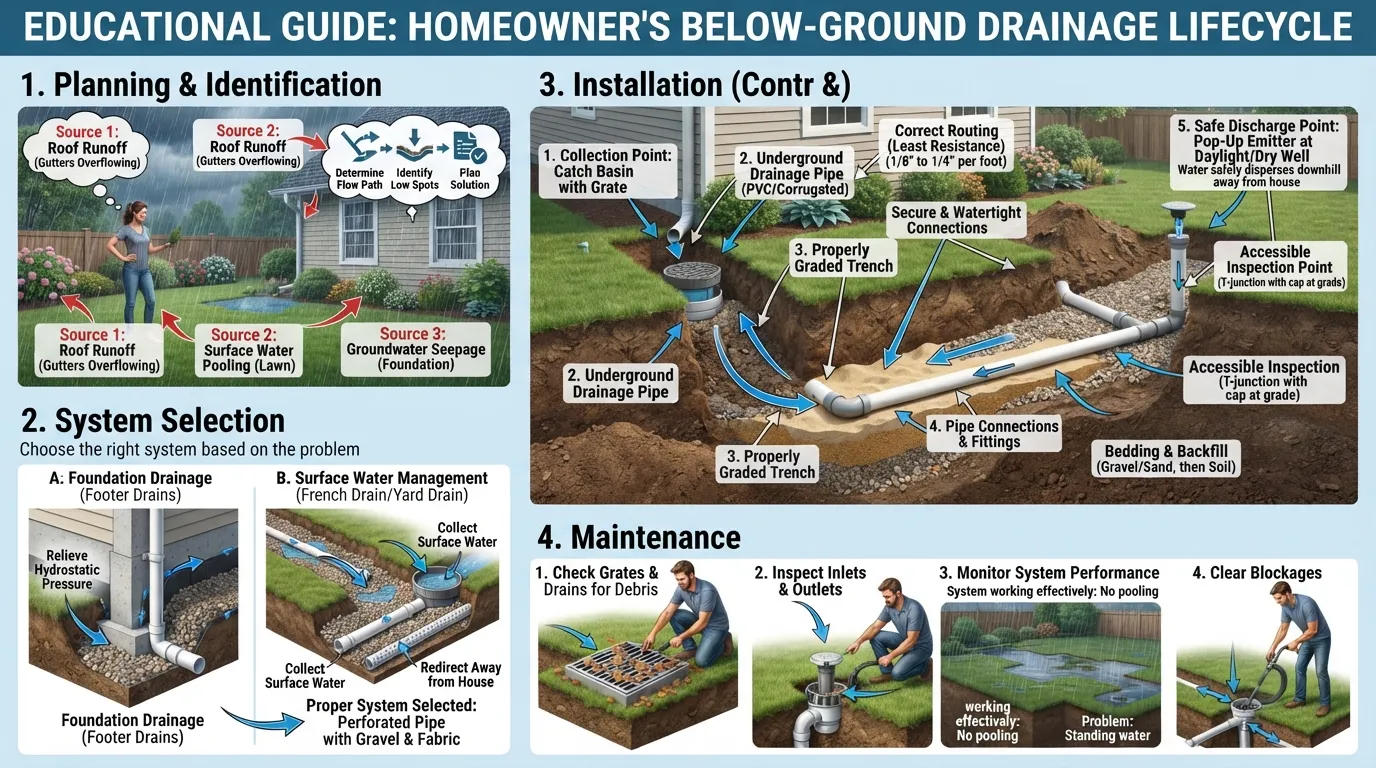
When water keeps pooling beside your foundation, collecting in a low spot in the yard, or pouring from a downspout faster than the ground can absorb it, a below-ground drainage system can move that water somewhere safer.
But the pipe itself is only one part of the solution. Before you dig, you need to answer three questions: Where is the water coming from? How should you collect it? Where will it safely go?
A below-ground drainage system collects unwanted rainwater, surface runoff, or groundwater and moves it through buried pipes to an appropriate discharge or infiltration point. Common components include catch basins, solid drain pipe, French drains, perforated pipe, gravel, geotextile fabric, dry wells, channel drains, cleanouts, and pop-up emitters. The right combination depends on the source of the water and the conditions on your property.
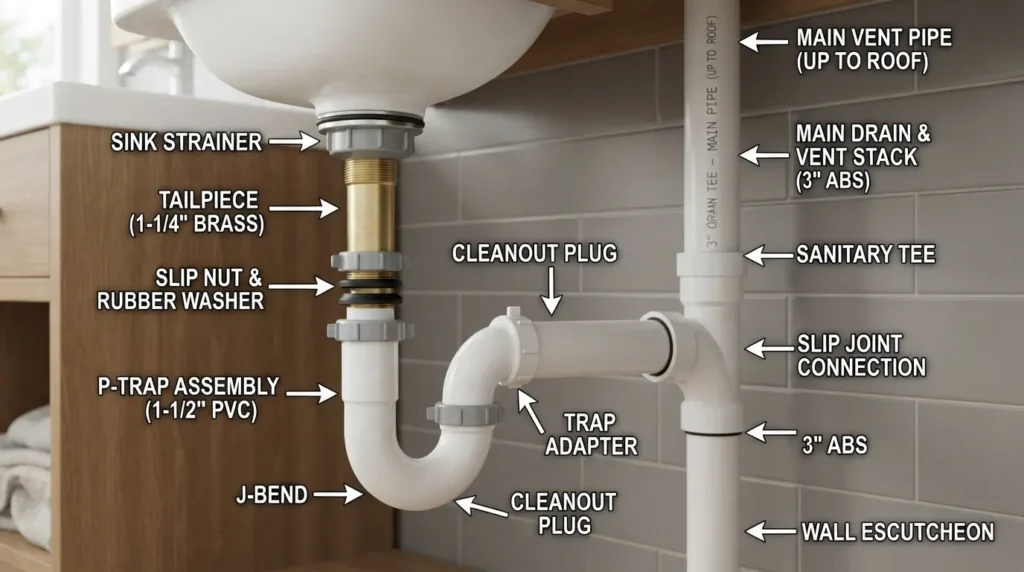
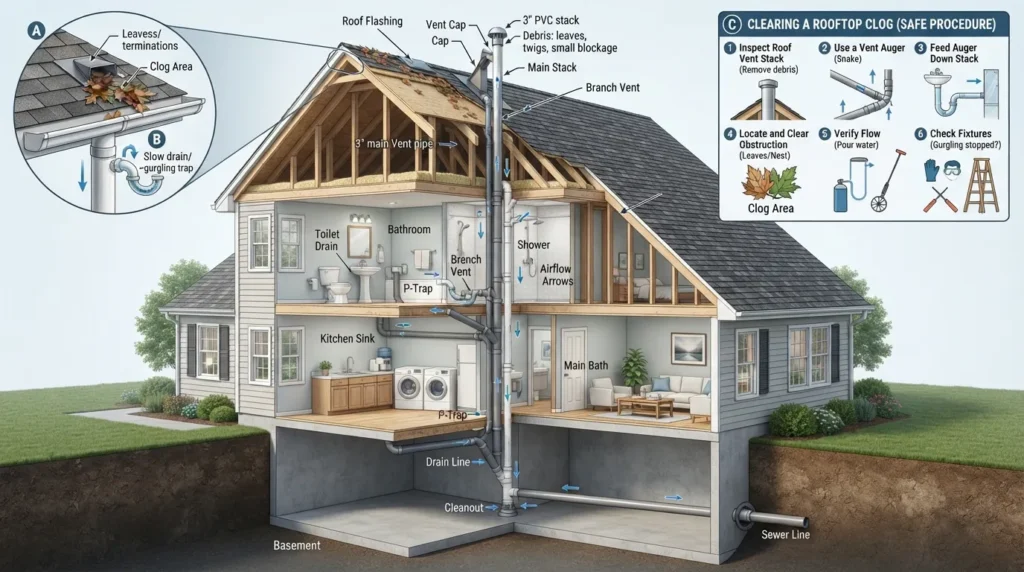
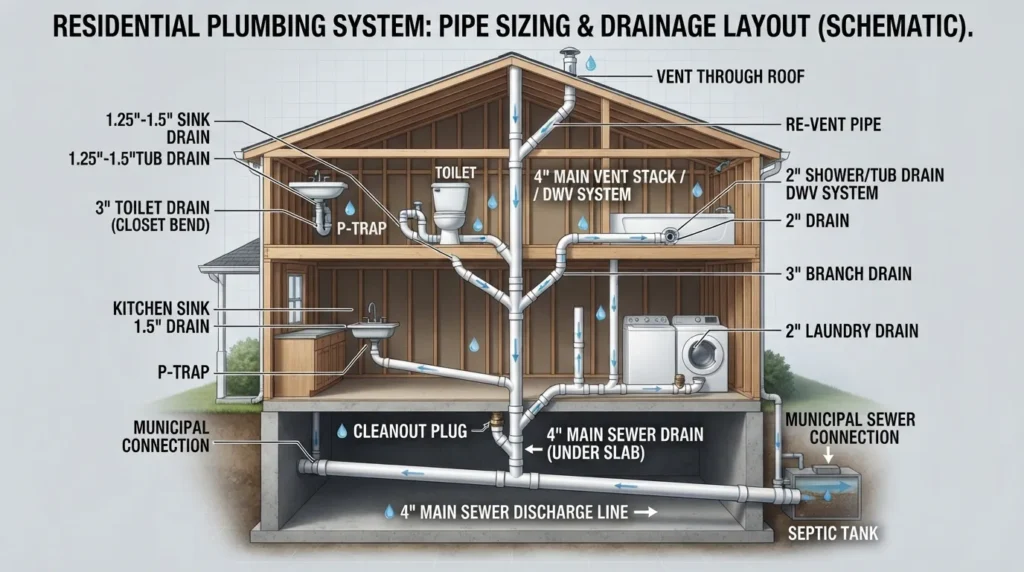
In this guide, I am using below-ground drainage to mean exterior residential systems for rainwater, yard runoff, and unwanted groundwater. That is different from the sanitary drain, waste, and vent piping inside a home. If you want to understand that broader plumbing network first, see our guide to how a home drainage system works.
Start With the Water Problem, Not the Drainage Product
One of the easiest mistakes to make is deciding that you need a French drain, catch basin, or buried pipe before identifying the actual source of the water.
I recommend thinking about drainage in this order:
Where is the unwanted water coming from?
What inlet or drainage method can capture it effectively?
What buried pipe will move the water?
Where can the water safely and appropriately leave the system?
How will you inspect or clean the system later?
A 60-Second Drainage Diagnosis
Walk outside during or shortly after a heavy rain and look for the pattern rather than only the puddle.
- Water collects directly below a downspout: roof runoff may not be getting far enough from the house.
- A single low spot fills with water: surface runoff may be concentrating at that point.
- A long strip of lawn stays wet: subsurface water or poor soil drainage may be involved.
- Water crosses a driveway, patio, or pool deck: a surface collection system such as a channel drain may be more appropriate.
- The buried system used to work but now backs up: the first question may be whether the existing line, catch basin, or outlet is obstructed.
- Water stays close to the foundation: grading, roof runoff, groundwater, or a combination of sources should be evaluated before choosing a fix.
The key idea
A technically well-installed drain can still fail to solve the problem if it is collecting the wrong type of water or has nowhere effective to discharge.
Which Below-Ground Drainage System Do You Need?
There is no single underground drainage design that works for every yard. Use the water problem to narrow the options.
Roof runoff at a downspout
Consider a properly planned solid buried downspout line that carries water toward an appropriate outlet.
One low area that floods
A catch basin connected to solid drain pipe may collect concentrated surface water.
Soggy soil along a wider area
A properly designed French drain or other subsurface collection system may help intercept water within the soil.
Driveway or patio runoff
A channel or trench drain can capture sheet flow before it reaches another part of the property.
No practical surface outlet
A dry well or engineered infiltration/storage solution may be considered only when soil, groundwater, capacity, and local requirements make infiltration appropriate.
Existing drain suddenly performs poorly
Inspect for debris, sediment, root intrusion, a blocked outlet, damaged pipe, or loss of grade before assuming the entire system must be replaced.
How a Below-Ground Drainage System Works
A useful way to understand underground drainage is to separate the system into three jobs: collect, convey, and discharge.
Buried Downspout Drainage
A typical roof-runoff path may look like this:
Roof → gutter → downspout → adapter or catch basin → solid buried pipe → suitable outlet
The main purpose of this line is transportation. You generally want the collected roof water to remain inside the pipe until it reaches the intended discharge point.
French Drain for Wet Soil
A subsurface drainage path is different:
Wet soil → gravel/geotextile drainage zone → perforated pipe → collector or solid conveyance pipe → suitable outlet
Here the system must first allow water in from the surrounding soil and then give that water somewhere to go.
Solid Pipe vs. Perforated Pipe: Do Not Confuse Their Jobs
This distinction prevents many design mistakes.
Solid Drain Pipe
Primary job: Move collected water from one location to another.
- Buried downspout lines
- Catch-basin discharge
- Carrier pipes
- Routing water toward an outlet
Perforated Drain Pipe
Primary job: Receive water from surrounding soil or aggregate.
- French drains
- Subsurface collection
- Groundwater interception
- Drainage zones surrounded by suitable aggregate
If you use perforated pipe where you really need to transport concentrated downspout water, some of that water may leave the pipe before reaching the intended endpoint. If you use solid pipe where you need to collect groundwater along a trench, the surrounding water has no direct way to enter it.
Common Components of an Underground Drainage System
Catch Basins
A catch basin is a grated inlet placed where surface water naturally collects. It gives runoff a defined entrance into the buried system and can also trap some larger debris before it travels farther into the pipe.
French Drains
A French drain is a subsurface collection system commonly built with perforated pipe, drainage aggregate, and geotextile or another appropriate separation method. Its job is to intercept water in the surrounding soil rather than simply capture water from one surface inlet.
Solid PVC or Polyethylene Drain Pipe
Solid pipe carries collected water. The correct pipe material and stiffness depend on the application, installation depth, loading conditions, fittings, serviceability, and local requirements.
Corrugated Pipe
Corrugated drainage pipe is flexible and commonly used in residential yard-drainage applications. Its flexibility can simplify routing, but installation quality matters. Poor bedding, crushing, low spots, sharp routing, and difficult-to-clean configurations can reduce long-term performance.
Channel and Trench Drains
These linear drains intercept surface water moving across hard surfaces such as driveways, patios, or walkways. They are collection devices and normally still need a properly planned pipe and discharge path.
Dry Wells
A dry well receives stormwater and allows it to infiltrate into surrounding soil over time. It is not automatically appropriate for every property. Available storage volume, soil infiltration, groundwater conditions, setbacks, overflow planning, and local rules all matter.
Pop-Up Emitters
A pop-up emitter is a surface outlet connected to a buried drain line. Flow pressure opens the emitter so water can discharge at the endpoint. Its usefulness depends on having enough elevation and a suitable location where released water will not simply flow back toward the problem area.
Cleanouts and Accessible Inlets
Drainage systems are easier to own when they can be serviced. Accessible catch basins, cleanouts, removable grates, and reachable outlets make future inspection and cleaning much easier than a completely sealed buried system.
Plan the Outlet Before You Dig the Trench
This may be the most important design lesson in the entire guide.
Outlet first. Trench second.
Before you buy pipe or start excavation, determine where the collected water can physically and appropriately go. A buried line without a workable endpoint can simply move the flooding problem somewhere else.
A possible endpoint might include a suitable lower-elevation discharge area, a properly designed emitter, an approved stormwater connection, or an infiltration/storage system where conditions allow it.
You should also think about what happens during a larger storm. If the primary outlet cannot keep up, where does the overflow go?
How Much Water Are You Actually Trying to Move?
Roof drainage can involve much more water than it looks like when you watch a single downspout.
Useful rainfall calculationOne inch of rain falling on 1,000 square feet is approximately 623 gallons of water.
So, as a simple example, two inches of rainfall over 1,500 square feet represents roughly 1,870 gallons falling on that area before accounting for losses or other site-specific factors.
The lesson is not that every homeowner needs an oversized underground system. It is that pipe size, inlet capacity, slope, outlet conditions, and runoff area should be treated as a system rather than selected independently.
How Deep Should Underground Drainage Be?
There is no single correct burial depth for every below-ground drainage system.
The required depth depends on factors such as:
- The elevation of the inlet
- The elevation of the discharge point
- The required fall along the pipe run
- The type and strength of pipe
- Whether vehicles or other loads will pass above it
- Existing underground utilities
- Soil and groundwater conditions
- The type of drainage system being installed
- Applicable local code, permit, or manufacturer requirements
A French drain intended to collect subsurface water may be designed differently from a buried downspout line whose main purpose is to convey roof runoff. That is why a universal answer such as “all yard drains should be buried X inches deep” can be misleading.
How Much Slope Does a Buried Drain Pipe Need?
Gravity drainage needs a reliable path from higher elevation to lower elevation, but I would not treat one slope percentage as a universal rule for every underground drainage application.
The necessary grade depends on the pipe, flow, system design, available elevations, outlet, and applicable requirements. What matters most to a homeowner is avoiding:
- Flat sections that hold standing water
- Unintentional uphill sections
- Bellies or low spots caused by poor trench preparation
- An outlet that is too high for the intended pipe route
Establish the elevations before excavation. Finding out halfway through the trench that the outlet cannot provide the needed fall is an expensive way to design a drainage system.
PVC vs. Corrugated Pipe: Which Is Better?
You will see both rigid PVC and corrugated polyethylene products used in drainage systems. Neither answer should be chosen just because one material appears more often in a DIY video.
Rigid Pipe
- Provides a defined, consistent pipe shape
- Can be easier to route with predictable fittings
- Smooth-wall options can make debris transport and cleaning easier
- Requires thoughtful layout and connections
Corrugated Pipe
- Flexible around obstacles
- Commonly available for landscape drainage
- Installation can be fast in suitable applications
- Needs proper support and routing to avoid dips, crushing, or difficult maintenance
Rather than asking which material is universally “best,” ask which material fits the loading, route, fittings, maintenance needs, and purpose of your system.
How to Install a Below-Ground Drainage System
The exact installation method changes by system type, but the planning sequence should usually look something like this.
- Identify the source of water. Determine whether you are managing roof runoff, surface runoff, groundwater, or an existing drainage failure.
- Choose the collection method. This could be a downspout adapter, catch basin, channel drain, French drain, or another inlet.
- Determine the final destination. Confirm the outlet or infiltration strategy before trenching.
- Check elevations and grade. Make sure gravity flow is physically possible where gravity drainage is intended.
- Locate underground utilities. Never assume an apparently empty yard is clear below the surface.
- Lay out the route. Minimize unnecessary turns and think about future service access.
- Excavate and prepare the trench. The trench must support the pipe and preserve the intended grade.
- Install the correct pipe for each job. Use solid pipe to convey water and perforated drainage where water must enter from surrounding soil.
- Connect collection points and fittings carefully. Loose or poorly aligned connections can introduce soil, roots, and debris.
- Verify flow before final backfill. Confirm that water reaches the intended endpoint rather than settling in hidden low spots.
- Backfill appropriately. Avoid shifting or damaging the installed pipe.
- Keep access points serviceable. Do not permanently bury every location you may need to inspect later.
Florida digging safety:
Sunshine 811 tells Florida homeowners to contact 811 at least two full business days before digging so member utility companies can mark underground public facilities. Private lines may require separate locating.
Helpful Video: A Buried Downspout Installation Example
The following video can help you visualize the basic idea of routing downspout runoff through an underground drainage line. Treat it as a visual example rather than a design specification for your property.
Can You Install an Underground Drainage System Yourself?
Sometimes. A straightforward project with a clear water source, accessible trench route, simple gravity outlet, and no complicated site constraints can be within the ability of an experienced DIY homeowner.
Professional help becomes more important when:
- You cannot determine why the property is flooding
- The required outlet is unclear
- Groundwater is affecting the site
- The project involves significant excavation
- You must cross utilities, hardscape, or heavily loaded areas
- The proposed drain affects neighboring property or a public drainage system
- You are unsure about local permits or discharge rules
- The existing system repeatedly clogs or backs up
- The elevation difference is too small to establish reliable gravity flow
Is Burying Your Downspouts a Good Idea?
It can be. Burying a downspout can create a cleaner yard and move roof runoff farther from the foundation, but only if the buried line has been designed as a complete drainage path.
A good buried downspout design should consider:
- A dependable connection at the downspout
- Solid pipe where the goal is to transport roof runoff
- Sufficient capacity for the roof area being drained
- A route that avoids hidden low spots
- A workable outlet
- Access for inspection or cleaning
- An overflow strategy if the underground system cannot accept water fast enough
Burying a pipe with no reliable outlet does not solve a drainage problem. It hides it.
Can You Dig a Hole and Fill It With Gravel for Drainage?
A gravel-filled excavation can temporarily create storage space and increase the contact area between water and surrounding soil, but it should not automatically be treated as a complete drainage system.
Whether infiltration works depends on:
- How quickly the surrounding soil can accept water
- How much runoff reaches the area
- Groundwater elevation
- Available storage volume
- Where overflow will go when the system fills
- Local drainage and environmental requirements
If the soil is already saturated or groundwater is high, simply creating a deeper gravel-filled hole may not provide the result you expect.
What Are the Disadvantages of Subsurface Drainage?
Underground drainage keeps components out of sight, but that creates trade-offs.
- Excavation: installing or repairing buried pipe can disturb lawns, landscaping, and hardscape.
- Hidden failures: you may not immediately see a crushed pipe, separated fitting, root intrusion, or low spot.
- Sediment and debris: catch basins and lines can accumulate material over time.
- Maintenance access: poor designs can be difficult to clean.
- Outlet dependence: the entire system can perform poorly if its endpoint becomes blocked or submerged.
- Wrong-system risk: a French drain will not automatically solve concentrated roof runoff, and a catch basin will not necessarily correct groundwater moving through saturated soil.
- Site limitations: high groundwater, limited elevation, utilities, neighboring lots, and discharge restrictions can limit available options.
Miami and South Florida Drainage Considerations
Drainage planning around Miami deserves more site-specific thinking than simply copying a generic yard-drain diagram.
Miami-Dade County describes stormwater management as a combination of flood protection, water-quality protection, and groundwater recharge. The County also notes that impervious surfaces such as rooftops, streets, and parking areas reduce the amount of rain that can soak directly into open ground. :contentReference[oaicite:1]{index=1}
Groundwater also matters. Miami-Dade planning and vulnerability work recognizes locations affected by very high groundwater levels, which is one reason an infiltration strategy should not be assumed to work equally well on every property. :contentReference[oaicite:3]{index=3}
For a Miami property, evaluate these before digging:
- Where roof and surface runoff currently travels
- Whether the proposed outlet remains usable during wet conditions
- Whether groundwater limits infiltration
- Whether runoff could affect a neighboring property
- Whether an existing stormwater connection or outfall is involved
- Utility locations
- Local permitting or environmental requirements for the specific project
Do You Need a Drainage Permit in Miami-Dade?
Do not assume that every small residential yard drain needs the same permit, but also do not assume that all drainage work is permit-free.
For example, Miami-Dade states that a Class II Environmental Permit is required for construction, installation, or alteration of an outfall or overflow system that discharges into a County water body. The County also notes that other approvals can apply depending on the location, size, and type of work. Check the requirements for your specific property and proposed discharge route before construction. :contentReference[oaicite:5]{index=5}
Common Underground Drainage Installation Mistakes
1. Choosing a Drain Before Diagnosing the Water
If roof runoff is causing the problem, an elaborate French drain may be unnecessary. If groundwater is the problem, a single surface catch basin may not address the source.
2. Digging Before Confirming the Outlet
The route only works if the endpoint works.
3. Using Perforated Pipe as a General-Purpose Carrier
Perforated pipe is useful when water needs to enter from surrounding soil. A solid line is generally the clearer choice when you want concentrated water to remain inside the pipe as it moves toward an outlet.
4. Creating Hidden Low Spots
A pipe that rises and falls through the yard can retain water and sediment even when the beginning and end of the line appear correctly positioned.
5. Ignoring Future Cleaning
A beautiful installation becomes frustrating when there is no way to open the catch basin, reach the outlet, or access the line.
6. Assuming a Dry Well Works Everywhere
An infiltration system needs conditions that allow stored water to move into the surrounding ground. Soil and groundwater conditions must be considered.
7. Sending the Water Toward Another Problem
Moving water away from your foundation is not enough if the new discharge point creates erosion, pooling, or an issue for another property.
What Is the Cheapest Drainage Method?
The cheapest effective solution is the one that fixes the actual source of the problem without adding unnecessary components.
Depending on the site, the solution may be as simple as:
- Correcting a downspout discharge point
- Extending roof runoff farther from the foundation
- Minor grading improvements
- Adding a catch basin at one low spot
- Cleaning an existing drainage line instead of replacing it
On another property, solving the same-looking puddle may require a longer buried system, subsurface collection, multiple inlets, or a more carefully designed outlet.
That is why comparing drainage solutions only by material price can be misleading.
What Determines Underground Drainage Installation Cost?
I would be cautious with a single national price range because the work can change dramatically from one property to another.
Important cost drivers include:
- Total trench length
- Excavation depth
- Pipe material and diameter
- Number and type of catch basins
- French-drain aggregate and fabric
- Dry-well or storage components
- Concrete, pavers, driveway, or patio cutting
- Utility conflicts
- Access for excavation equipment
- Disposal of excavated material
- Restoration of sod and landscaping
- Outlet complexity
- Groundwater or dewatering challenges
- Permit or engineering requirements where applicable
A useful estimate should describe the proposed drainage path and scope of work rather than simply quote a price for “an underground drain.”
Why an Existing Underground Drainage System Stops Working
If your drain worked for years and suddenly becomes slow, replacement should not always be the first step.
Possible causes include:
- Leaves and debris in a catch basin
- Sediment buildup
- A clogged buried line
- Roots entering damaged joints
- A crushed or shifted section of pipe
- A blocked pop-up emitter or outlet
- Landscape changes covering the discharge point
- Soil settlement creating a belly in the line
- A change in grading that sends more runoff into the system
If an existing catch basin or buried drain line used to drain correctly but now backs up, it can make sense to rule out blockage before redesigning the entire system. Our professional drain cleaning service in Miami is one option when the issue involves a clogged or slow drainage line.
How to Maintain a Below-Ground Drainage System
Good maintenance begins with keeping the system accessible.
- Remove leaves and sediment from catch basins and grates.
- Keep pop-up emitters and discharge areas visible and unobstructed.
- Check downspout connections after storms or landscaping work.
- Watch for new pooling that may indicate loss of grade or a blockage.
- Avoid allowing roots or dense plantings to cover critical access points.
- Inspect the system when performance changes rather than waiting for complete failure.
The best time to learn how your drainage system behaves is during rain. Observe where water enters, whether the inlet keeps up, and what happens at the outlet.
A Practical Below-Ground Drainage Planning Checklist
- Identify whether the source is roof runoff, surface runoff, or groundwater.
- Map the low points and natural direction of flow.
- Choose a collection method that matches the source.
- Decide where the water will ultimately go.
- Verify that your outlet remains useful during wet weather.
- Check elevations before trenching.
- Select solid or perforated pipe based on the job it must perform.
- Limit unnecessary bends and difficult-to-service connections.
- Contact Sunshine 811 before excavation in Florida.
- Check local permit and discharge requirements.
- Plan cleanouts, accessible basins, or other maintenance points.
- Test the system before completely covering the installation.
Frequently Asked Questions
A good below-ground drainage system is not simply a pipe buried in a trench. It is a complete path for water.
If you remember only one framework from this guide, use this:
That approach helps you avoid choosing a drainage product before understanding the problem. It also makes it easier to decide whether you need a simple downspout line, catch basin, French drain, channel drain, dry well, repair, or professional evaluation.
Need Help With a Drainage Problem in Miami?
If you are dealing with a slow, clogged, overflowing, or difficult-to-diagnose drainage issue, our Miami plumbing team can help you evaluate the plumbing side of the problem and determine the next practical step.
Related Drainage Resources
If you are still researching system types, products, installation approaches, or Miami-Dade requirements, these resources can help you compare options and verify project-specific details.
- Miami-Dade County Stormwater Management — local information about stormwater, flooding, water quality, and drainage.
- Miami-Dade Class II Environmental Permit Information — useful when a project may involve an outfall or overflow discharging into a water body.
- Sunshine 811 Homeowner Resources — Florida utility-marking and safe-digging guidance.
- NDS Drainage Product Reference — examples of catch basins, channel drains, French-drain components, dry wells, fittings, and outlets.
- Home Depot Drainage Product Categories — useful for comparing commonly available drainage pipe, basins, fittings, grates, and related components.
- Family Handyman In-Ground Drainage Installation Guide — an additional DIY installation reference.