A PVC pipe union is a fitting that connects two sections of PVC pipe while allowing you to disconnect the connection later without cutting the pipe. That makes a union especially useful around pumps, filters, valves, and other equipment that may need maintenance or replacement.
A PVC union joins two pipe sections but can be separated by loosening its center nut. Unlike a permanent glued coupling, a union is designed to make future disassembly easier. The right choice depends on your pipe size, connection type, pressure/application, and whether you need the joint to be serviceable later.
In this guide, I’ll show you how PVC unions work, explain the main types and sizes, cover the important 3 inch PVC union considerations, compare a union with a coupling, and walk you through the installation details that can help prevent leaks.
What Is a PVC Pipe Union?
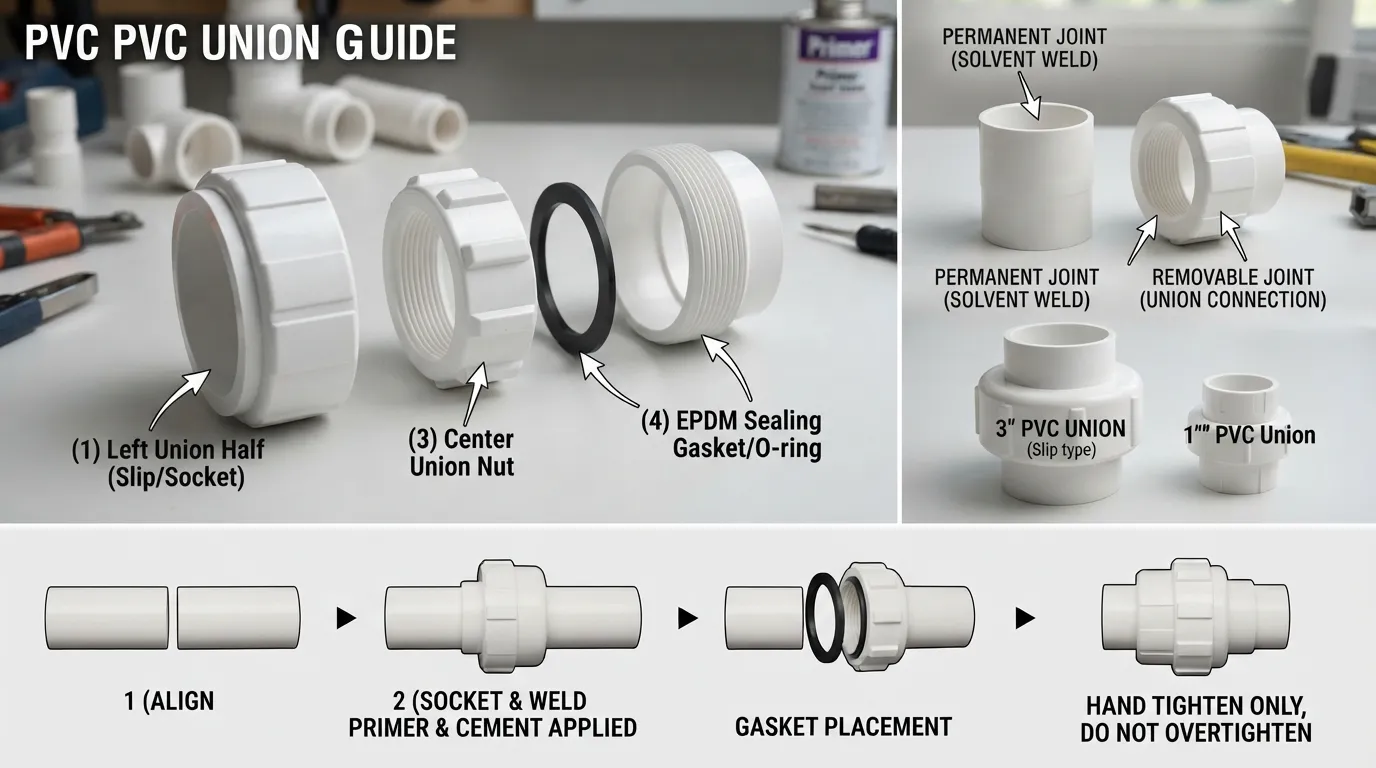
A PVC pipe union is a three-part fitting designed to connect two pipes while providing a removable connection. Instead of permanently joining the entire fitting, the union uses two connection ends and a center nut that draws the two sides together.
Inside the union, a gasket or O-ring provides the sealing surface when the two halves are tightened together. The result is a connection that can be opened later without cutting through the pipe.
This is the main reason you would choose a union instead of an ordinary coupling: future access.
What Does a PVC Union Do?
- Connects two sections of compatible pipe or equipment.
- Allows the connection to be separated for maintenance.
- Can make pump, filter, and valve servicing easier.
- Reduces the need to cut pipe when certain components need to be removed.
- Provides a sealed connection when the correct fitting, gasket, alignment, and installation method are used.
How Does a PVC Pipe Union Work?
A typical PVC union has two end pieces and a center nut or collar. Depending on the design, the ends may have socket connections for solvent welding, threaded connections, or another manufacturer-specific configuration.
- Each end connects to its pipe or equipment. Socket ends are typically solvent-welded, while threaded versions use compatible threads.
- The two union halves meet. Their sealing surfaces come together inside the fitting.
- The gasket or O-ring creates the seal. Tightening the center nut compresses the sealing element between the mating surfaces.
- The center nut holds the assembly together. When maintenance is required, you can loosen the nut and separate the union rather than cutting the pipe.
A coupling permanently joins two pipe ends after solvent welding. A union creates a connection that can be opened again.
PVC Union Parts Explained
Understanding the parts makes installation and troubleshooting much easier.
- First tailpiece: Connects to one side of the pipe or equipment.
- Second tailpiece: Connects to the other side.
- Center nut: Pulls the two halves together and allows future disassembly.
- O-ring or gasket: Provides the sealing surface between the union halves.
- Socket or threaded connection: Determines how the union connects to the pipe.
The exact construction varies by manufacturer and product design, so always check the fitting’s instructions when a particular union has a different sealing arrangement.
Types of PVC Pipe Unions
Slip or Socket PVC Union
A slip, or socket, union has socket ends designed to accept PVC pipe. The pipe connection is normally made with the appropriate PVC primer and solvent cement according to the product instructions.
The important point is that the pipe-to-socket connections are the parts that are solvent-welded. The removable center portion of the union is not glued together.
Threaded PVC Union
A threaded union uses threaded connections rather than socket connections on the applicable ends. This can be useful where a threaded connection is already part of the system, but you should match the thread type, size, material, and application to the fitting and equipment.
Do not assume every threaded PVC union can be used with every threaded component. Check the manufacturer’s specifications before making the connection.
Schedule 40 vs. Schedule 80 PVC Unions
Schedule 40 and Schedule 80 describe different PVC pipe and fitting specifications. When selecting a union, don’t choose between them simply because one sounds “stronger.” You need to consider the actual system requirements, pressure rating, dimensions, compatibility, and manufacturer’s specifications.
Schedule 80 products are commonly associated with heavier-duty applications, but the correct union is ultimately the one whose specifications match your system.
PVC Union Sizes: What Size Do You Need?
PVC unions are available in different nominal pipe sizes. The correct size must match the pipe or equipment connection you are working with.
Search results for PVC unions commonly include sizes such as 3/4 inch, 1 inch, 1-1/2 inch, 2 inch, and 3 inch, along with other sizes depending on the manufacturer and application.
When buying a union, don’t select a size based only on the outside appearance of the fitting. Check the pipe’s nominal size and verify the union’s connection specifications.
3 Inch PVC Union: What Should You Check?
If you’re specifically looking for a 3 inch PVC union, start by confirming that your pipe and the union use the same nominal size and compatible connection type.
Before buying a 3-inch union, check these points:
- Nominal pipe size: Confirm that the union is designed for 3-inch pipe.
- Connection style: Determine whether you need a slip/socket or threaded configuration.
- Schedule: Match the union to the pipe and system requirements.
- Pressure rating: Make sure the fitting’s rating is suitable for the application.
- Material compatibility: Confirm that the union is intended for your PVC system and the fluid being handled.
- Equipment connection: If the union connects to a pump, valve, filter, or other equipment, verify the connection specifications on both sides.
- Manufacturer instructions: Follow the fitting manufacturer’s installation and application requirements.
Don’t buy a 3-inch union based on size alone. The connection style, schedule, pressure/application requirements, and compatibility with the equipment matter just as much as the nominal pipe size.
PVC Union vs. Coupling: What’s the Difference?
The biggest difference is removability.
When Is a Union Better Than a Coupling?
A union makes the most sense when you expect to disconnect a component later. For example, a union can be useful around a pump, filter, valve, or other serviceable equipment.
A coupling may be the better choice for a straightforward permanent pipe connection where future disassembly is not a priority.
Choose a union when future access matters.
Choose a coupling when you simply need a permanent pipe-to-pipe connection.
When Should You Use a PVC Union?
A union is particularly useful where a component may need to be removed without cutting the surrounding pipe.
- Pumps that may require servicing or replacement.
- Filters that need periodic removal or maintenance.
- Valves that may eventually need replacement.
- Equipment connections where future disassembly is expected.
- Accessible sections of piping where a removable connection provides a practical maintenance advantage.
For example, if a pump is permanently glued into a piping system with no unions, replacing the pump may require cutting pipe and rebuilding part of the connection. A properly selected union can make that future task easier.
When Should You Not Use a PVC Union?
A union is not automatically the best fitting for every PVC connection. Adding a union where there is no maintenance benefit can introduce extra components and an additional sealing point without providing much value.
For buried, inaccessible, or permanent connections, don’t assume a union is appropriate simply because it can connect the pipes. Check the fitting manufacturer’s instructions, application limitations, local requirements where applicable, and whether future access is actually needed.
Do You Glue a PVC Union?
It depends on the type of union.
For a socket/slip PVC union, the pipe-to-socket connections are normally solvent-welded using the appropriate primer and solvent cement according to the product instructions. The removable center nut and union sealing interface are not glued together.
For a threaded union, the connection is made through the specified threads rather than solvent-welding the threaded portion.
Never glue the removable union nut or sealing surfaces just to stop a leak. If the union leaks at its sealing interface, inspect the gasket/O-ring, mating surfaces, alignment, and tightening rather than permanently gluing the union together.
Does It Matter Which Way a PVC Union Goes?
It can. The exact design of the union determines how its components fit together, and some products may have specific installation requirements.
Before installation:
- Read the manufacturer’s instructions.
- Identify the two union halves and sealing element.
- Confirm that the gasket or O-ring is correctly positioned.
- Check that the mating surfaces are clean.
- Make sure the pipe and fitting are properly aligned.
If the union has a directional marking or a design that requires a specific orientation, follow that requirement.
How Tight Should a PVC Union Be?
A PVC union should be tightened enough to create the manufacturer’s intended seal, but over-tightening is not a substitute for correct installation.
Excessive force can damage plastic components, distort a sealing element, or create problems that make the connection harder to service later.
The safest approach is to follow the manufacturer’s tightening instructions for the specific union. If the fitting uses a hand-tight design, don’t automatically add tools simply because you think tighter means better.
How to Install a PVC Pipe Union
The exact procedure varies by union design, but the general process for a socket-style union looks like this:
- Shut off and drain the system. Remove pressure before working on the pipe.
- Confirm the correct union. Match the nominal size, connection type, schedule, application, and pressure requirements.
- Dry-fit the components. Make sure the pipe reaches the proper socket depth and the union can be assembled correctly.
- Prepare the pipe and fitting. Use the appropriate preparation method and products specified for the PVC system.
- Solvent-weld the socket connections. Apply primer and solvent cement according to the product instructions where required.
- Keep the sealing surfaces clean. Avoid getting solvent cement on the union’s removable sealing interface.
- Allow the solvent-welded joints to cure. Follow the cement manufacturer’s instructions before pressurizing the system.
- Inspect the gasket or O-ring. Make sure it is seated correctly and free from damage or debris.
- Align the union. Avoid forcing the pipes into position or placing unnecessary stress on the fitting.
- Tighten the union nut correctly. Follow the manufacturer’s instructions rather than simply tightening as hard as possible.
- Pressure-test and inspect. Restore the system gradually and check the connection for leakage.
Common PVC Union Installation Mistakes
Many union leaks are not caused by the concept of the fitting itself. They can result from installation or sealing problems.
- Installing the wrong pipe size.
- Using an incompatible union type.
- Damaging or misplacing the gasket/O-ring.
- Leaving dirt or debris on the sealing surfaces.
- Misaligning the pipe and union.
- Over-tightening the union nut.
- Trying to glue the removable union section.
- Pressurizing a newly solvent-welded connection before the required cure time.
- Using a fitting outside its specified application or pressure rating.
- Assuming every PVC union is suitable for underground or buried installation.
Why Is My PVC Union Leaking?
If a PVC union is leaking, start with the sealing interface rather than immediately replacing the entire fitting.
1. Check the O-Ring or Gasket
Look for damage, incorrect positioning, contamination, or signs that the sealing element is not sitting properly.
2. Check the Mating Surfaces
Dirt, debris, solvent cement, or damage on the sealing surfaces can prevent the union from sealing correctly.
3. Check Alignment
If the connected pipes are pulling the union sideways, the fitting may not seat as intended. Correct the pipe support or alignment rather than trying to compensate by tightening the nut excessively.
4. Check the Tightening
Follow the manufacturer’s instructions. Both insufficient tightening and excessive tightening can create problems.
5. Inspect the Fitting
If the union, sealing element, or connection has been damaged, replacement may be necessary.
Can You Bury a PVC Union?
Don’t assume that every PVC union is suitable for burial.
A buried connection may be difficult to access later, which can remove one of the main advantages of installing a union in the first place. More importantly, the specific fitting may have application limitations that need to be followed.
If you’re considering burying a union, check the manufacturer’s installation instructions and application rating, and consider whether a permanent connection is more appropriate for that location. Local plumbing or installation requirements may also apply.
Advantages and Disadvantages of PVC Unions
Are All PVC Unions the Same?
No. PVC unions can differ in size, connection style, material, schedule, sealing design, pressure rating, and intended application.
That’s why choosing a union based only on the words “PVC union” is not enough. You should match the fitting to the pipe, connection, operating conditions, and equipment involved.
How Much Does a PVC Union Cost?
The price of a PVC union varies according to factors such as size, manufacturer, connection type, schedule, material, and application. Smaller standard unions can cost considerably less than larger or specialized versions.
Rather than relying on one fixed price range, compare the specifications of the exact size and type you need. A cheaper fitting that is incompatible with your pipe or application is not a better value.
How to Choose the Right PVC Union
If you’re standing in front of several PVC union options, use this checklist before buying:
- What is the nominal pipe size?
- Do you need a slip/socket or threaded connection?
- Does the union match the pipe’s schedule and system requirements?
- Is its pressure rating suitable for your application?
- Does it connect correctly to the equipment?
- Is the gasket or O-ring appropriate and replaceable if needed?
- Is the union approved or specified for the intended application?
- Will the union remain accessible if future maintenance is expected?
PVC Union vs. Other PVC Fittings
Union vs. Coupling
A union is designed for future disassembly, while a standard solvent-welded coupling is generally used for a permanent pipe connection.
Union vs. Adapter
An adapter is generally used to change a connection type or connect different components, such as transitioning between socket and threaded connections. A union’s defining feature is its removable connection between two sides.
Union vs. Repair Coupling
A repair coupling is intended for particular pipe-repair situations, while a union is primarily valuable when you want a serviceable, disconnectable connection. Choose based on the actual problem you are solving rather than treating the fittings as interchangeable.
What About CPVC and the Different Types of PVC?
One common search question is, “Why is CPVC no longer used?” That wording assumes CPVC has stopped being used, which is too broad. CPVC remains a distinct thermoplastic piping material used in appropriate applications.
Also, the phrase “four types of PVC” can mean different things depending on whether someone is talking about PVC material classifications, pipe products, schedules, or applications. For a union selection, the more useful questions are the actual pipe material, size, schedule, connection type, and application requirements.
Where a PVC Union Makes the Most Sense
Think about a union as an access point.
If you install a fitting next to equipment that you expect to remove later, the union can give you a practical way to separate the equipment from the piping.
For example:
- Pump + union: easier future pump removal.
- Filter + union: easier filter servicing.
- Valve + union: easier valve replacement.
- Permanent pipe run: a coupling may be more appropriate if no future disassembly is needed.
The goal isn’t to install as many unions as possible. The goal is to put them where future access provides a real benefit.
Frequently Asked Questions About PVC Pipe Unions
What is a PVC pipe union?
A PVC pipe union is a removable pipe fitting that connects two sections of compatible piping while allowing the connection to be separated later by loosening the union mechanism.
What is a union joint for PVC pipe?
A union joint is the removable connection created by a PVC union. It typically uses two mating halves, a center nut, and a gasket or O-ring to create the seal.
What is the difference between a PVC pipe union and a coupling?
A union is designed for future disassembly, while a standard PVC coupling is generally solvent-welded to create a permanent connection. Use a union when future maintenance access is valuable.
Are all PVC unions the same?
No. They can vary by size, socket or threaded connection, schedule, sealing design, pressure rating, material, and intended application.
Do you glue a PVC union?
For a socket-style union, the pipe-to-socket connections are normally solvent-welded. The removable center nut and sealing interface are not glued. Threaded unions use their specified threaded connections.
Does it matter which way a PVC union goes?
It can depend on the design. Follow the manufacturer’s instructions and make sure the gasket or O-ring, mating surfaces, and union halves are positioned correctly.
When should I use a PVC union?
Use one when you expect to disconnect a component later, such as a pump, filter, or valve. It is less useful when you simply need a permanent pipe connection.
Can I bury a PVC union?
Do not assume that every union is suitable for burial. Check the manufacturer’s application instructions and consider whether a permanent fitting is more appropriate for an inaccessible location.
How tight does a PVC union need to be?
Tighten it according to the manufacturer’s instructions. Avoid treating maximum force as the solution because over-tightening can damage plastic components or interfere with proper sealing.
What are the disadvantages of using union fittings?
Unions add components and a sealing interface to the system. The gasket or O-ring may eventually require attention, and adding a union where future access is unnecessary can add cost and complexity without a meaningful benefit.
What size PVC union do I need?
Choose a union that matches your pipe’s nominal size and connection type, then verify the schedule, pressure/application requirements, and equipment compatibility. If you’re working with 3-inch pipe, specifically verify that the fitting is designed for 3-inch PVC and matches the rest of the system.
Related Resources for PVC Union Selection
If you’re comparing actual PVC union sizes, fittings, or product specifications, these resources can help you review available options and technical information:
- Home Depot PVC Union fittings — useful for comparing available union sizes and product options.
- Lowe’s PVC Union fittings — another place to compare PVC union products and sizes.
- Sprinkler Warehouse union fitting guide — useful for visual understanding of union-style repair fittings.
- McMaster-Carr PVC pipe unions — useful for reviewing different PVC union configurations and specifications.
Watch a PVC Union Installation Video
Use the video as a visual supplement, but follow the installation instructions supplied with your specific PVC union because fitting designs can vary.
Need Help With a PVC Plumbing Project?
If you’re dealing with a PVC pipe connection, repair, replacement, or another plumbing issue, getting the fitting type and application right can save you from unnecessary rework.
Explore professional plumbing services or learn more about our plumbing team.
Final Takeaway
A PVC pipe union is most valuable when you need a connection that can be separated later. Its removable center section makes it especially useful around pumps, filters, valves, and other equipment that may require future maintenance.
When choosing one, don’t stop at the word “union.” Check the pipe size, connection type, schedule, pressure/application requirements, sealing design, and equipment compatibility. For a 3 inch PVC union, those checks are just as important as confirming the nominal 3-inch size.
If you’re deciding between a union and a coupling, ask yourself one simple question: Will I need to disconnect this connection later? If the answer is yes, a properly selected union may provide a valuable maintenance advantage. If the connection is simply a permanent pipe-to-pipe joint, a standard coupling may be the more straightforward choice.