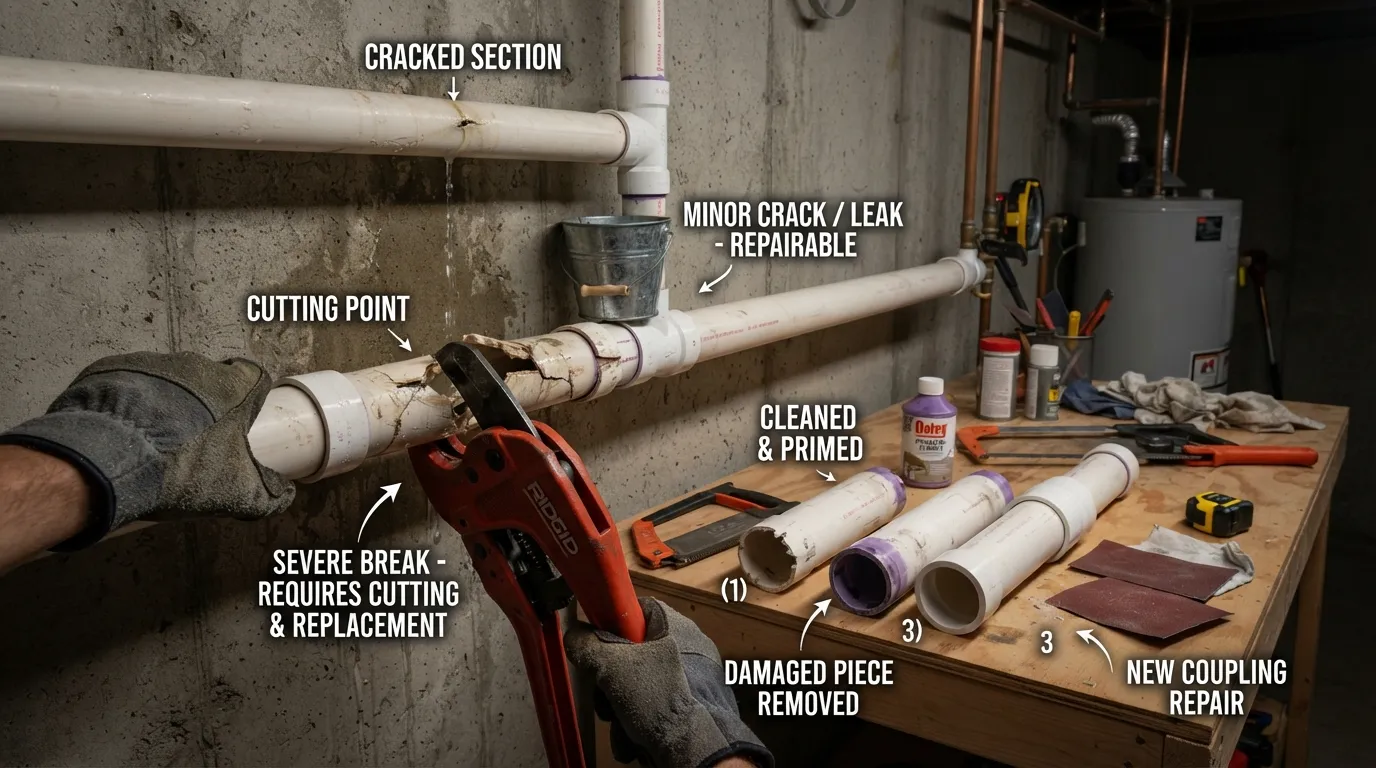
A cracked, leaking, or broken PVC pipe does not always mean you need to replace the entire line. In many cases, you can repair a localized damaged section by removing the bad portion and installing new PVC with the correct coupling. The right approach depends on where the damage is, how severe it is, and whether the pipe or a joint has failed.
What is the best way to repair PVC pipe?
For a cracked or broken section of PVC pipe, the most dependable repair is usually to shut off and drain the line, remove the damaged section, install a correctly sized replacement piece and coupling, and make the solvent-welded connections according to the product instructions. A suitable repair coupling can also be useful where cutting and replacing a section is difficult. Small sealants or epoxy products may have specific uses, but they should not automatically be treated as a permanent substitute for a properly repaired pipe section.
Before you start, identify the type of damage. A crack through the pipe wall, a completely broken pipe, and a leak at a fitting or joint can require different solutions. If the damaged pipe is inaccessible, buried, embedded in concrete, carrying an important pressurized water supply, or repeatedly failing, professional plumbing help may be the better option.
PVC Pipe Repair at a Glance
| Problem | Typical approach | What to consider |
|---|---|---|
| Small crack | Assess whether the damaged section should be removed and replaced. | Location, pressure, crack depth, and condition of surrounding PVC matter. |
| Broken PVC pipe | Cut out the damaged section and install replacement PVC with suitable fittings. | The replacement pipe and fittings must be the correct size and type. |
| Leaking joint | Inspect the fitting and surrounding pipe before deciding what to replace. | A joint failure is different from a crack in the pipe wall. |
| Underground leak | Locate and expose the damaged section before repairing it. | Access, excavation, testing, and safe backfilling become part of the repair. |
| PVC in concrete | Identify the leak and determine how the pipe can be safely accessed. | Access may be more difficult than the actual pipe repair. |
How to Identify the Type of PVC Pipe Damage
Before reaching for PVC glue, epoxy, or a repair coupling, look closely at the failure. Your repair method should match the actual problem.
Cracked PVC pipe
A crack through the pipe wall can allow water to escape and may become worse as the line remains under pressure. If the surrounding pipe is sound and the damage is localized, replacing the damaged section is often more dependable than simply covering the crack.
Broken PVC pipe
If the PVC has snapped or a section is missing, the damaged portion generally needs to be removed. A new piece of compatible PVC can then be joined to the remaining sound pipe with appropriate fittings.
Leaking PVC joint
A leak around a coupling, elbow, tee, or other fitting should not automatically be treated as a cracked pipe. Inspect the fitting, the joint, and the adjacent pipe. If the fitting itself is damaged or the connection has failed, replacing the affected connection may be more appropriate.
PVC pipe that is badly deteriorated
If you find multiple cracks, brittle material, or repeated failures along the same line, repairing one small section may not solve the underlying problem. In that situation, replacing a larger section or having the plumbing assessed can make more sense.
Repair or Replace PVC Pipe: Which Should You Choose?
Use this decision rule
Localized damage + healthy surrounding pipe + good access: a section repair may be practical.
Multiple failures + brittle pipe + extensive damage + difficult access: consider a larger replacement or professional assessment.
There is no universal rule that every crack can be sealed or that every damaged pipe requires a complete replacement. The condition of the surrounding PVC is just as important as the visible crack.
How to Repair a Broken or Cracked PVC Pipe
For a localized break or crack, the standard approach is to remove the damaged section and reconnect sound pipe with the appropriate replacement piece and fittings.
What you may need
- A PVC cutter or suitable saw
- Replacement PVC pipe of the correct size and type
- Appropriate PVC coupling or repair coupling
- PVC primer when required by the joining system and product instructions
- PVC solvent cement compatible with the pipe and fitting system
- A clean cloth
- Basic measuring tools
- Appropriate eye and hand protection
Step 1: Shut off the water
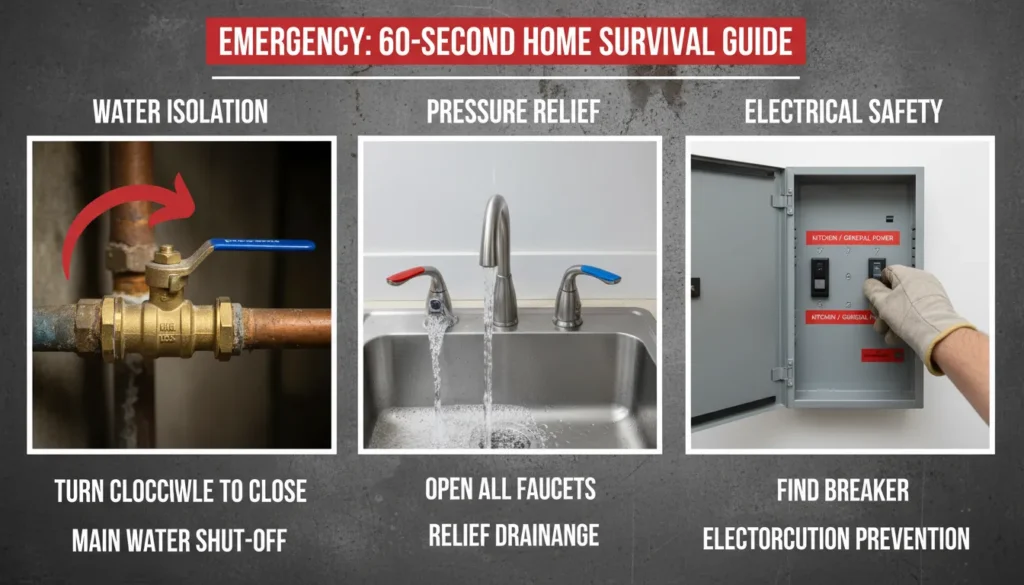
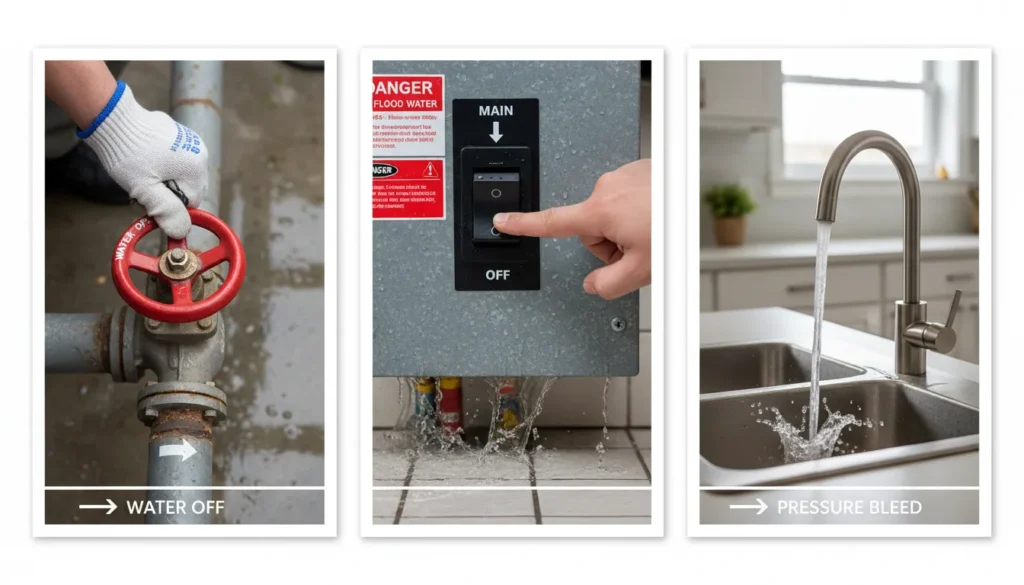
Turn off the appropriate water supply before cutting the pipe. Open a suitable downstream fixture or drain point if necessary so the line is no longer holding water where you will make the repair.
Do not rush this step: solvent-welded PVC connections need properly prepared surfaces. Water, dirt, or movement during assembly can interfere with the connection.
Step 2: Expose and inspect the damaged area
Make sure you can see enough of the pipe to understand what failed. Look for additional cracks, damage near fittings, or deterioration beyond the obvious break.
Step 3: Cut out the damaged PVC
Use a PVC cutter or suitable saw to remove the damaged portion. The goal is to leave sound, usable pipe for the new connections. Avoid leaving cracked or brittle material inside the repair area.
Step 4: Prepare the pipe and fittings
Clean the pipe ends and fitting surfaces. Where the selected PVC joining system calls for primer, apply it according to the product instructions. Proper preparation is important because solvent-welded PVC depends on correctly prepared mating surfaces.
Step 5: Apply PVC solvent cement
Apply the compatible solvent cement as directed by the manufacturer to the prepared pipe and fitting surfaces. Do not treat PVC cement like ordinary household glue; follow the specific product directions for application and assembly.
Step 6: Assemble the connection
Push the pipe fully into the fitting using the manufacturer’s recommended assembly procedure. A slight twisting motion may be appropriate for some solvent-welded connections, but always follow the instructions for the particular product. Hold the connection firmly long enough to prevent it from moving or backing out, then remove excess cement around the joint.
Step 7: Allow the repair to cure
Do not restore water pressure simply because the outside of the connection feels dry. Follow the solvent cement manufacturer’s specified handling and cure requirements. Cure time can depend on the product and installation conditions.
Step 8: Test the repair before closing access
Restore the water supply carefully and inspect the repaired area for leakage. For an underground repair, do not backfill until the connection has been properly checked.
PVC Pipe Repair Coupling vs. Replacing a Pipe Section
A repair coupling can be useful when you need to reconnect pipe in a confined area or when a standard coupling arrangement is difficult to install. Another common approach is to cut out the damaged section and install a new piece of PVC between suitable fittings.
| Approach | Best suited to | Main consideration |
|---|---|---|
| Standard coupling + replacement pipe | Accessible damaged sections where enough sound pipe remains. | You need enough access and appropriate pipe/fitting dimensions. |
| Repair coupling | Situations where a repair-style coupling makes reconnection easier. | The specific fitting must be compatible with the pipe and installation. |
| Sealant or epoxy | Certain product-specific repair situations. | Do not assume a sealant or epoxy is a permanent replacement for a properly restored pipe section. |
Can You Repair a PVC Pipe Without Replacing It?
Sometimes a repair product can help address a particular PVC leak or crack, but the correct answer depends on the damage and the product’s intended application. A surface-applied product should not automatically be considered equivalent to replacing a structurally damaged section of pipe.
If the pipe has a significant break, the crack extends through the wall, or the line is under pressure, a properly executed section repair is generally a more meaningful solution than simply covering the visible damage.
What Is the Best Epoxy or Sealant for PVC Pipe Repair?
There is no single epoxy or sealant that should be called the best for every PVC repair. The product has to be compatible with PVC and suitable for the particular application, exposure, and repair conditions.
Products such as epoxy repair compounds or water-resistant repair putties may appear in searches for PVC crack repair, but you should check the manufacturer’s instructions before relying on one. Pay particular attention to whether the product is intended for pressurized water, whether it is suitable for the specific PVC application, and whether the manufacturer describes the repair as temporary or permanent.
Important: “Waterproof” does not automatically mean “structurally equivalent to a new pipe.” If the PVC itself is broken, restoring the damaged pipe section and connection may be more appropriate than relying on an external seal.
Will JB WaterWeld Work on PVC?
A product such as JB WaterWeld may be marketed for water-related repairs, but whether it is appropriate for your PVC problem depends on the product’s current instructions and the specific application. Before using any epoxy or repair putty, verify that the manufacturer approves it for your PVC surface and intended use.
If the PVC pipe has a substantial break or structural failure, do not assume an epoxy patch provides the same result as cutting out the damaged section and making a proper pipe connection.
How to Repair an Underground PVC Pipe
An underground PVC pipe repair involves more than joining two pieces of pipe. First, you have to locate the damaged section and safely expose enough of it to determine what failed.
- Identify the likely leak location. Avoid excavating a large area without first narrowing down where the pipe is damaged.
- Expose the pipe carefully. Create enough working space to inspect the pipe and fittings.
- Shut off and drain the line. Do not cut a pressurized water line.
- Inspect the entire accessible section. Look for additional cracks or damaged fittings.
- Remove the damaged portion. Cut back to sound pipe as needed for the selected repair.
- Install the appropriate replacement section or repair coupling. Use compatible components and follow their installation instructions.
- Allow the connection to cure. Follow the cement manufacturer’s requirements before pressurizing the line.
- Test for leaks. Confirm the repair is sound before covering the pipe.
- Backfill only after the repair passes inspection.
How to Fix a Broken PVC Pipe in Concrete
PVC pipe embedded in concrete presents a different challenge because access may be harder than the actual repair. Breaking concrete unnecessarily can create additional work, so the first priority is to identify the damaged section as accurately as possible.
Once the pipe is accessible, the basic pipe-repair principles remain the same: isolate the water, expose enough sound pipe, remove the damaged portion, install the appropriate replacement or repair fitting, allow the connection to cure, and test it before restoring the finished surface.
If the pipe cannot be accessed without substantial concrete removal, or if you cannot confidently locate the leak, professional plumbing assistance can help prevent unnecessary demolition.
How to Repair a Broken PVC Water Pipe Outside
An exposed outdoor PVC water pipe is often easier to inspect because you can see the entire damaged area. Check whether the break is isolated or whether nearby sections and fittings also show signs of damage.
After shutting off the supply and draining the line, remove the damaged section and use compatible replacement PVC and fittings. Keep the pipe ends and fittings clean during preparation, follow the solvent cement instructions, allow the repair to cure, and test the connection before putting the line back into normal service.
Common PVC Pipe Repair Mistakes to Avoid
- Trying to glue a wet connection: Proper surface preparation matters for solvent-welded PVC.
- Repairing only the visible crack: The surrounding pipe may also be damaged or deteriorated.
- Using the wrong fitting size: Pipe and fitting compatibility is essential.
- Skipping surface preparation: Dirt and contamination can compromise the connection.
- Using ordinary glue: PVC solvent cement and compatible joining products are different from general-purpose adhesives.
- Pressurizing too soon: Follow the product’s specified cure requirements.
- Assuming every epoxy is permanent: Check the manufacturer’s intended application and limitations.
- Backfilling an underground repair immediately: Test the repaired line first.
- Ignoring repeated leaks: Multiple failures may indicate that replacing one small section is not enough.
- Working on an inaccessible or high-risk line without proper knowledge: Some repairs are better handled by a qualified plumbing professional.
Why Did My PVC Pipe Repair Fail?
If a repaired PVC connection continues to leak, do not simply add another layer of glue or sealant without finding the cause. Common possibilities include poor surface preparation, movement during assembly, incorrect component selection, insufficient curing, damaged surrounding pipe, or a problem elsewhere in the system.
A failed repair is often a signal to reassess the entire damaged area rather than repeatedly patching the same spot.
Can Glued PVC Be Unglued?
Once a PVC solvent-welded connection has properly bonded, it generally is not treated like a normal glued joint that can simply be pulled apart. In many repair situations, the practical solution is to cut out the affected fitting or section and rebuild the connection with new compatible components.
What Is the Best Way to Join PVC Pipes?
For many standard PVC applications, compatible pipe and fittings are joined using the solvent-welding process specified by the manufacturer. The important part is not simply choosing a “strong glue.” The pipe material, fitting type, primer requirements, solvent cement, preparation, assembly, and cure procedure all need to be compatible.
Can a Plastic Welder Repair PVC?
Plastic welding can be used with certain thermoplastic materials and applications, but that does not make it automatically the best solution for every PVC pipe repair. For a conventional PVC water-pipe repair, use the joining method and components specified for that particular pipe and fitting system rather than assuming a plastic welder is interchangeable with a standard PVC repair.
When Should You Call a Plumber for PVC Pipe Repair?
A straightforward, accessible PVC repair may be manageable when you understand the pipe and fitting system and can follow the manufacturer’s instructions. Professional help becomes more valuable when the situation is difficult to diagnose, difficult to access, or likely to cause significant water damage.
- The pipe is buried and you cannot locate the leak accurately.
- The pipe is embedded in concrete or another difficult-to-access structure.
- The line is repeatedly leaking after repairs.
- Multiple sections appear cracked or brittle.
- You are dealing with a significant pressurized water leak.
- You cannot identify the correct pipe, fitting, or repair method.
- The repair could cause substantial property or water damage if it fails.
If you need help with a PVC pipe problem or another plumbing issue, you can explore professional plumbing services or learn more about the company through its Miami Florida Plumbing website.
PVC Pipe Repair: Final Checklist
- Identify whether the problem is a crack, break, leak, or failed joint.
- Check the surrounding PVC for additional damage.
- Shut off and drain the water before cutting the pipe.
- Remove damaged or unsound pipe rather than simply hiding the damage.
- Use compatible PVC pipe, fittings, primer, and solvent cement.
- Follow the manufacturer’s assembly and cure instructions.
- Test the repair before closing walls, concrete, or underground access.
- Do not assume epoxy or sealant is a permanent structural replacement for damaged PVC.
- If the pipe has repeated or extensive failures, reassess whether replacement is more appropriate.
Frequently Asked Questions About PVC Pipe Repair
Watch PVC Pipe Repair Tutorials
If you prefer to see the basic repair process visually, these PVC pipe repair tutorials can help you understand how a damaged section is removed and how the replacement connection is assembled.
Need Help With a PVC Pipe Problem?
Don’t Let a Small PVC Leak Become a Bigger Plumbing Problem
If your PVC pipe is difficult to access, repeatedly leaking, buried underground, embedded in concrete, or part of a more complicated plumbing problem, professional assistance can help you determine the appropriate repair instead of repeatedly patching the same failure.
For broader plumbing needs, you can also review the available plumbing services or visit the Miami Florida Plumbing home page.