How to Become a Licensed Plumber: Requirements, Timeline, Costs & State Rules
How to Become a Licensed Plumber
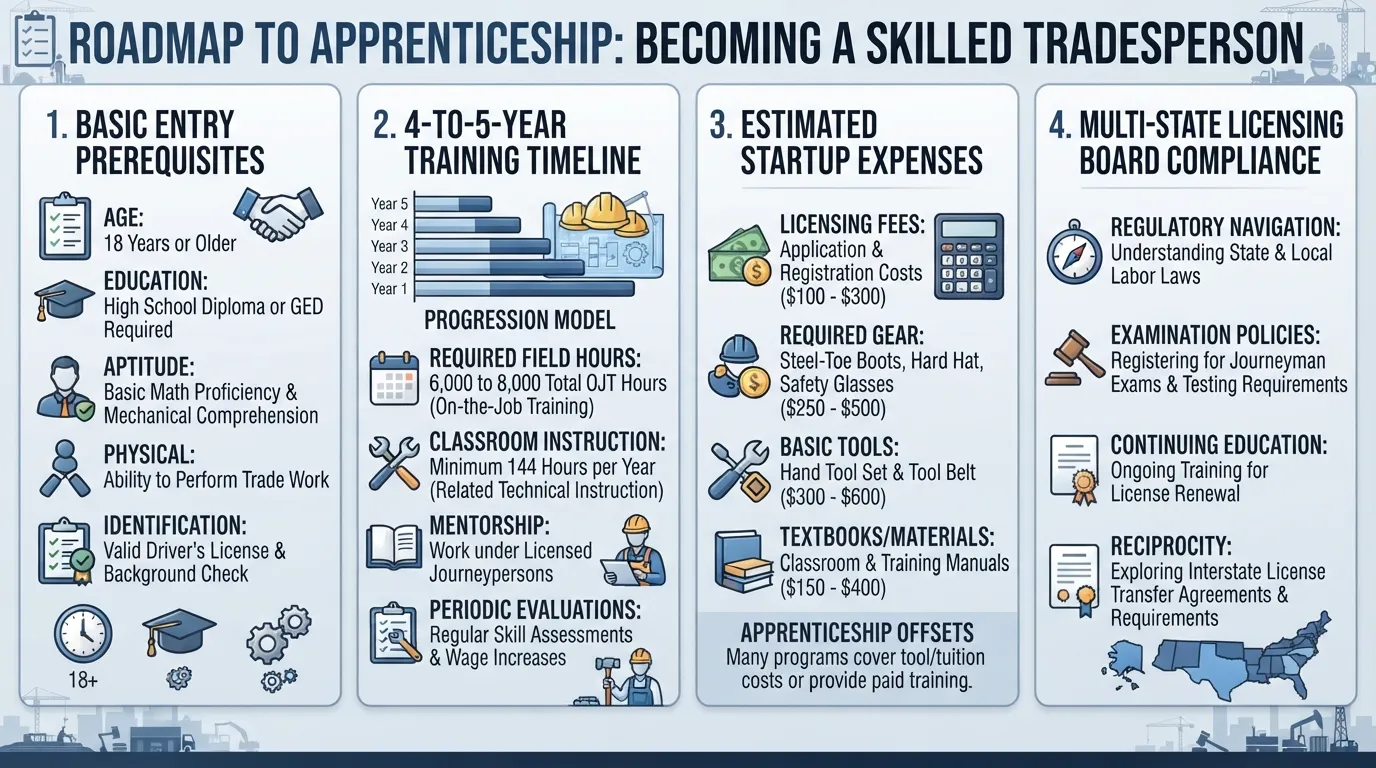
Becoming a licensed plumber requires a structured progression from entry-level training to state certification, combining hands-on field experience with technical education. Aspiring professionals typically navigate a 2- to 5-year pipeline that integrates registered apprenticeships, state board regulations, and rigorous credential exams.
The 4-Step Path at a Glance
1. Meet Prerequisites: Fulfill basic educational requirements (such as holding a high school diploma or GED) and apply for your official apprentice registration through your local state licensing board [00:19].
2. Complete an Apprenticeship: Work under the direct supervision of a licensed professional to log the mandatory 6,000 to 8,000 hours of practical on-the-job training alongside classroom instruction [01:54].
3. Pass the Journeyman Exam: Take and pass a comprehensive written exam covering national and local plumbing codes, pipe sizing, blueprint reading, and safety regulations [05:52].
4. Advance to Master or Contractor Status: Gain additional years of journeyman experience before testing for a master plumber license, which grants you the authority to pull permits, hire employees, and launch an independent plumbing contracting business [07:57].
How Long Does It Take?
The timeline to become a fully licensed journeyman plumber typically spans between 2 to 5 years. This duration is dictated by state mandates requiring accumulated field experience, translating to roughly 6,000 to 8,000 hours of documented on-the-job training.
How Much Does It Cost?
Initial costs are generally low, covering apprentice registration fees, basic hand tools, and optional trade school tuition. Total expenses vary depending on your choice of training path, as detailed further in the cost and tuition breakdown.
Is a Plumbing License the Same in Every State?
No, plumbing regulations and licensing requirements are not uniform across the country. Each state operates under its own state licensing board and Authority Having Jurisdiction (AHJ), meaning certification rules, exam formats, and reciprocity agreements differ significantly by region [00:54].
Plumber License Levels Explained: Apprentice, Journeyman, Master & Contractor
Understanding the hierarchy of plumbing credentials is essential for anyone navigating trade careers or hiring professional services. Each tier represents a distinct level of competence, autonomy, and legal responsibility governed by state licensing boards and local authorities.
Comparison Table: Apprentice vs. Journeyman vs. Master vs. Plumbing Contractor
| License Level | What They Can Do | Supervision Needed | Typical Experience | Exam Required |
| Apprentice | Learn foundational trades, handle basic prep work under direct guidance | Direct on-site supervision required at all times | 0 to 2+ years | Registration/Application only |
| Journeyman | Install, repair, and maintain plumbing systems independently | Works independently; no direct supervision needed | 2 to 5 years (6,000–8,000 hours) | Comprehensive Journeyman Exam |
| Master Plumber | Design complex plumbing systems, oversee projects, mentor staff | Autonomous | 5+ years total experience | Advanced Master Plumber Exam |
| Plumbing Contractor | Pull permits, hire employees, bid on commercial/residential contracts | Autonomous (Business entity) | Master level + business credentials | Contractor Exam + Bond & Insurance |
What Is a Registered Apprentice?
An apprentice is an entry-level worker learning the plumbing trade through a combination of paid on-the-job training and classroom instruction. To legally work in this tier, individuals must obtain an apprentice card from their state licensing board before touching tools on a job site. Apprentices must always work under the direct supervision of a licensed journeyman or master plumber while logging their mandatory training hours.
What Does a Journeyman Plumber Do?
A journeyman plumber has completed their apprenticeship and passed a rigorous state certification exam, allowing them to work without direct oversight. They are fully qualified to install, alter, and repair pipes, fixtures, and equipment like water heaters and drainage systems. While they can perform complex technical installations, they generally cannot pull official municipal permits or operate an independent contracting business on their own.
What Does a Master Plumber Do?
A master plumber represents the pinnacle of technical skill and experience in the trade, requiring several years of verified journeyman practice before testing. They hold a master plumber license, proving deep expertise in advanced blueprint reading, complex hydraulics, and local plumbing codes. Master plumbers often act as project supervisors, managing teams of apprentices and journeymen to ensure code compliance on large residential or commercial projects.
Plumber vs. Plumbing Contractor: Why the Difference Matters for Business Owners
While all plumbing contractors are usually master plumbers, not all master plumbers operate as contractors. A plumbing contractor holds the legal business designation required to pull official permits, bid on public and private projects, and hire employees. This distinction is critical for liability, insurance coverage, and workers’ compensation compliance when launching or scaling a trade business.
Licensed vs. Registered vs. Unlicensed Plumber: What The Terms Mean
Licensed Plumber: A certified professional (journeyman or master) who has successfully passed a state examination and holds an active credential to perform independent plumbing work.
Registered Plumber: Typically refers to a registered unlicensed plumber (an apprentice) who is legally registered with the state board to log training hours while under supervision, separating them completely from illegal uncertified labor.
Unlicensed Plumber: An individual working without state registration or credentials, which violates state laws, invalidates homeowner insurance claims, and risks severe fines or stop-work orders.
Step 1: Meet the Basic Requirements to Start
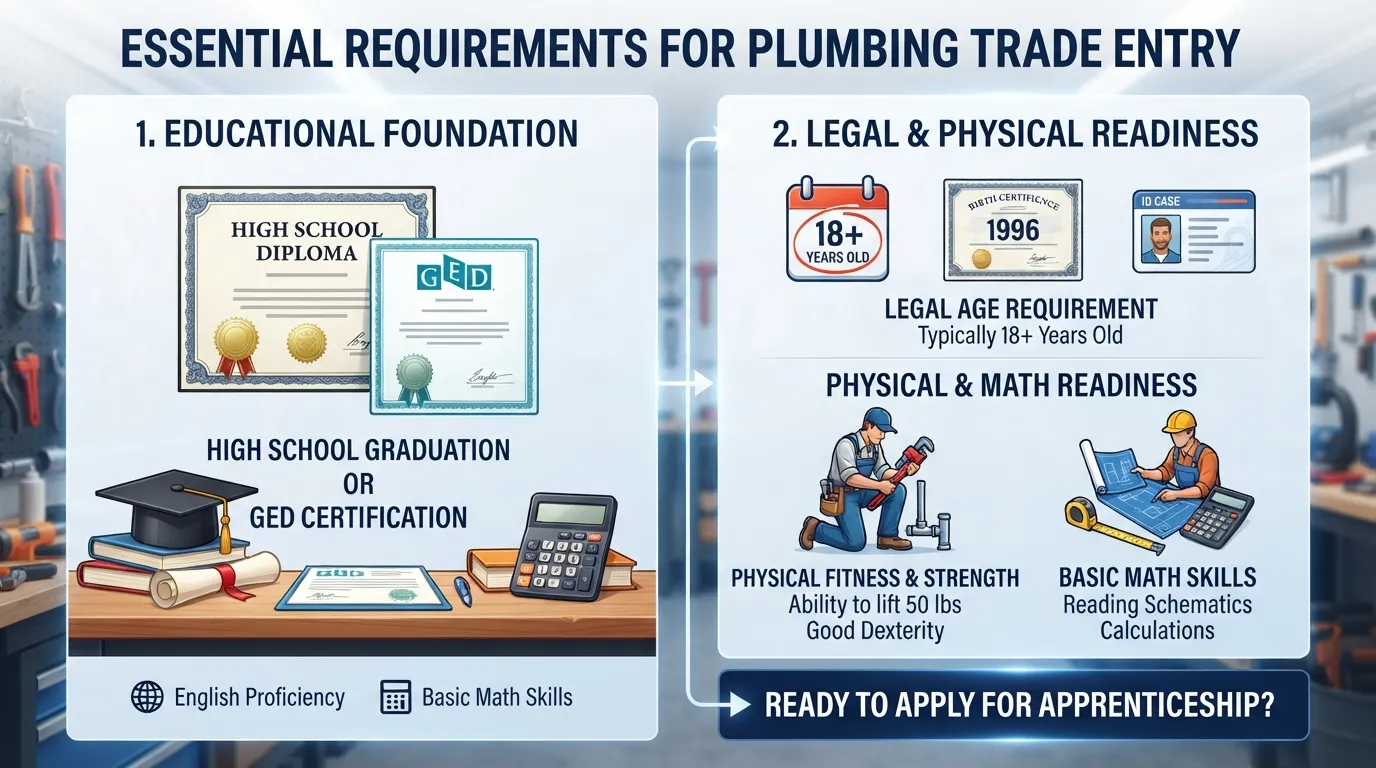
Entering the plumbing profession begins with meeting a few fundamental entry criteria that ensure you have the readiness and legal clearance to work on job sites. Most state boards and employers look for a baseline combination of education, physical capability, and clean documentation before issuing an apprentice registration.
Minimum Age and Education
Aspiring plumbers must meet standard baseline educational milestones to enter the trade.
Age Requirement: You must generally be at least 18 years old to work legally on commercial and residential construction sites due to labor laws and hazardous equipment operation.
Educational Credential: A high school diploma or equivalent GED is required by most apprenticeship programs and state licensing boards to prove foundational literacy and numerical competence.
Math and Technical Skills You Need
Plumbing is a precise, mathematically driven trade that relies heavily on applied mechanics and spatial reasoning.
Measurement & Geometry: You will regularly calculate pipe lengths, slopes for drainage, and angles for offsets using precise fractions and decimals.
Algebra & Pipe Sizing: Sizing water supply lines and gas pipes requires understanding basic algebraic formulas, pressure drops, and flow rates.
Mechanical Aptitude: A strong instinct for how tools, valves, and physical systems interact helps troubleshoot complex installation challenges.
Physical Requirements and Job Conditions
Plumbing demands high physical resilience, making stamina and daily comfort with tough working environments essential.
Expert Insight: Plumbing is far more than residential fixture repairs; it often involves tight crawl spaces, hot attics, heavy lifting of cast iron or PVC pipes, and occasional on-call emergency work during nights or weekends. Long-term success in the trade relies heavily on proper ergonomics, safety compliance, and physical conditioning.
Background Checks, Drug Tests, and Driver’s License Requirements
Because plumbers frequently enter private residences, schools, and commercial facilities, employers maintain strict screening standards.
Driver’s License: A valid driver’s license with a clean driving record is usually mandatory, as you will often drive company service vehicles to job sites.
Background & Substance Checks: Many plumbing contractors require passing a criminal background check and pre-employment drug screening to comply with commercial client contracts.
Registering as an Apprentice with Your State or Local Board
Before starting your hands-on training, you must formalize your status with the regulatory authority having jurisdiction.
Apprentice Registration: You must file paperwork with your state licensing board to obtain your official apprentice card.
Documenting Hours: This registration ensures that every hour of field experience counts toward your eventual journeyman exam eligibility.
Is 25 Too Old to Become a Plumber? Is 30 Too Late?
No, starting your plumbing career in your mid-20s, 30s, or even later is entirely common and often advantageous. Career changer professionals frequently excel in the trades because they bring mature work ethics, reliable communication skills, and dependable problem-solving abilities straight from previous industries.
Step 2: Choose Your Training Path: Apprenticeship, Trade School, Union or Non-Union
Selecting how you receive your training is the most critical career decision you will make in the plumbing industry. Aspiring professionals must weigh financial costs, learning styles, and long-term career goals when evaluating whether to enter an apprenticeship, attend a vocational program, or join organized labor.
Paid Apprenticeship: The “Earn While You Learn” Route
The most popular and direct route into the trade is an employer-sponsored apprenticeship, which offers an “earn while you learn” model.
Financial Advantage: Rather than accumulating student debt, you receive an hourly wage from day one while completing your mandatory on-the-job training hours.
Immediate Application: Practical field lessons learned under veteran mentors are reinforced daily, bridging theoretical plumbing codes with physical execution.
Trade School or Vocational Program: Pros, Cons, and Typical Costs
Formal technical schools offer structured classroom education before entering the field, though they come with distinct trade-offs.
Pros: Accelerated baseline theory, structured instruction schedules, and foundational familiarity with tools and safety before job-site placement.
Cons: Upfront tuition expenses can range from several thousand to over ten thousand dollars, and schooling alone does not fulfill state field-hour requirements.
Union vs. Non-Union Apprenticeships: An Honest Comparison
Choosing between a union apprenticeship (such as through the United Association) and a non-union contractor shapes your day-to-day work environment, compensation, and career trajectory.
Pay & Benefits: Union programs typically feature standardized wage increases, robust healthcare, and pension plans. Non-union shops may offer competitive starting pay and flexibility but vary widely in benefits.
Selectivity & Competition: Union programs are often highly competitive with rigorous entrance exams, whereas non-union contractors frequently hire eager entry-level applicants year-round.
Can You Become a Plumber Without an Apprenticeship?
In the vast majority of U.S. states and municipal jurisdictions, bypassing an apprenticeship entirely is legally impossible. State boards require verified documentation of thousands of hours worked under a licensed journeyman or master. However, some regions allow limited substitutions, such as granting partial credit for completed vocational school hours toward your total required experience.
How to Become a Licensed Plumber for Free: What Is and Isn’t Possible
While you cannot become licensed without putting in the required sweat equity and field hours, you can enter the trade with zero out-of-pocket education debt. Because paid apprenticeships cover your training costs and pay you a salary while you work, you effectively get educated for free. Avoid expensive for-profit certificate mills that promise instant licenses without proper state board oversight.
Which Path Is Best for You?
Fresh Out of High School: A structured union or large non-union apprenticeship provides long-term stability, guaranteed wage growth, and zero college debt.
Career Changer: Non-union open shops or merit-shop contractors often offer rapid hiring and flexible entry points for mature workers transitioning from other fields.
Military Veterans: Many union and registered apprenticeship programs actively recruit veterans and offer accelerated placement or GI Bill housing allowances during training.
How to Find and Land a Plumbing Apprenticeship
Landing your first role in the trade requires knowing where to source open positions and how to present yourself as a reliable, eager candidate. Because demand for skilled trade professionals remains exceptionally high, proactive applicants who follow a structured job search strategy can secure positions quickly.
Where to Look: Union Locals, Local Contractors, Trade Schools, and Job Boards
Finding an entry-level plumbing apprenticeship or plumber’s helper position requires looking beyond standard internet job portals.
Union Halls: Visit your local United Association (UA) local union hall to inquire about application windows, aptitude test dates, and registered training programs.
Local Independent Contractors: Search for local service and construction plumbing companies online, then call or visit their offices directly to express interest in apprentice openings.
Trade Schools & Job Boards: Check vocational school placement boards, regional career centers, and specialized construction job boards like Indeed or ZipRecruiter for open entry-level listings.
How to Prepare Your Application
Your application materials should emphasize reliability, a strong work ethic, and basic mechanical aptitude over extensive plumbing experience.
Targeted Resume: Highlight any previous mechanical work, construction background, customer service experience, or high school math coursework.
Character References: Secure 2 to 3 professional or educational references who can vouch for your punctuality, honesty, and safety habits.
Basic Portfolio or Readiness: Be ready to show proof of a valid driver’s license, your high school diploma or GED, and your state apprentice registration if already obtained.
What Plumbing Contractors Look For in an Apprentice
Contractors invest significant time and money into training newcomers, so they evaluate candidates through a very specific lens.
Expert Insight: Plumbing contractors care far less about your prior plumbing knowledge and much more about your attitude, attendance, and trainability. Employers look for apprentices who show up on time every day, possess a clean driving record, communicate clearly, and demonstrate a genuine willingness to do hard physical work without complaining.
Is It Hard to Get Hired as a Plumber?
No, securing an entry-level position is generally not difficult if you are persistent, dependable, and willing to start at the bottom. Due to an ongoing labor shortage across the construction and service sectors, contractors are constantly searching for motivated workers. Standing out is simple: show up prepared, follow up on your applications, and demonstrate a strong desire to learn the trade.
What Your First Year as an Apprentice Really Looks Like
Your first twelve months on the job will introduce you to the realities of daily trade work, setting the foundation for your career.
Daily Tasks: Expect to spend much of your time digging trenches, carrying materials, cleaning up job sites, organizing the service truck, and handing tools to journeymen.
Apprentice Wage: Starting pay is typically a percentage of the local journeyman rate (often 40% to 50%), with regular raises scheduled as you complete training hours and school benchmarks.
Initial Expenses: You will need to purchase a basic tool list specified by your employer or union, which usually includes hand tools like channel locks, tape measures, and a sturdy tool belt.
Step 3: Complete Your Required Work Hours and Classroom Training
Advancing from an entry-level beginner to a qualified professional requires completing a dual-track education combining extensive on-the-job experience with technical classroom study. State licensing boards enforce these rigorous requirements to ensure every certified plumber protects public health and safety.
How Many Hours Do You Need?
Most states require aspiring professionals to log between 6,000 to 8,000 hours of documented field experience before they are allowed to sit for the journeyman exam.
The Timeframe: This total translates to roughly 3 to 5 years of full-time work.
State Variance: Exact requirements differ significantly by region based on state board regulations, local municipal codes, and whether the jurisdiction mandates specific residential or commercial experience splits.
Classroom Instruction: What You Learn
Alongside practical field work, apprentices must complete theoretical classroom education to master the scientific and legal foundations of the trade.
Annual Minimums: Most formalized programs require a minimum of 144+ hours of annual classroom instruction.
Core Curriculum: Classes cover advanced pipe mathematics, reading complex architectural blueprints, OSHA-compliant safety training, and regional plumbing code standards.
Year-by-Year Timeline
| Career Stage | Primary Field Tasks | Core Skills Mastered |
| Year 1 | Material handling, trenching, site cleanup, supporting journeymen | Basic tool identification, safety protocols, job-site etiquette |
| Year 3 | Installing residential drain-waste-vent systems, water heaters, and supply lines | Intermediate pipe sizing, soldering/joining techniques, blueprint reading |
| Year 5 | Managing complex commercial layouts, troubleshooting system failures, mentoring apprentices | Advanced code compliance, independent diagnostics, exam preparation |
How to Document and Log Your Hours Correctly
Maintaining accurate records of your practical experience is essential for avoiding administrative delays when applying for your license.
Timesheets & Logs: Keep daily or weekly signed logs of your hours, categorized by task type (e.g., residential service, new construction, commercial installation).
Employer Verification: Ensure your supervising master plumber or contractor signs off on your documented experience regularly.
Common Rejection Pitfalls: State board applications are frequently rejected due to missing supervisor signatures, unverified out-of-state hours, or failing to match timesheets with official apprentice registration dates.
How Long Does It Take to Become a Plumber in PA, MI, IL, and WA?
Licensing timelines and prerequisite hours vary widely depending on the state where you practice. For instance, Pennsylvania and Michigan have unique local or state-specific criteria, whereas Washington and Illinois enforce strict state-regulated hour milestones. A complete breakdown of these regional timelines is detailed in the state-by-state guide below.
Step 4: Pass the Journeyman Plumber Exam
Passing the journeyman plumber exam is the definitive gateway to practicing your trade independently. State licensing boards design this rigorous evaluation to ensure that every licensed professional possesses the technical proficiency and code knowledge required to protect public health and safety.
How to Apply to Take the Exam
Getting seated for the examination requires careful administrative preparation and adherence to strict state board guidelines.
Documentation & Verification: Submit your approved application alongside documented proof of your completed apprenticeship hours and verified high school education or GED.
Fees & Deadlines: Pay the required examination fees and submit your paperwork well ahead of state board deadlines to secure your preferred testing window.
What the Exam Covers
The journeyman exam tests a comprehensive range of technical principles and operational standards.
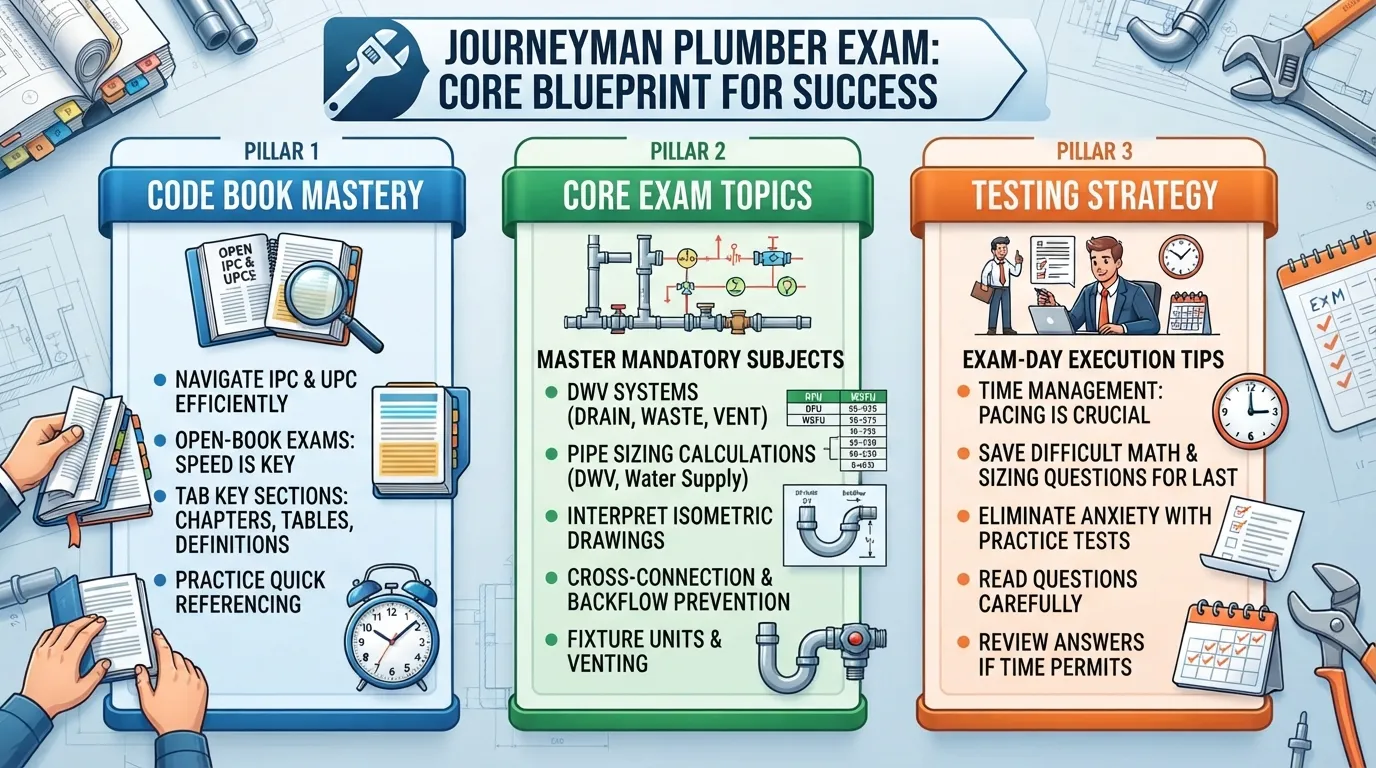
Plumbing Codes: Deep familiarity with national model codes such as the International Plumbing Code (IPC) or Uniform Plumbing Code (UPC).
Core Technical Systems: Detailed questions covering pipe sizing, sanitary drainage, fixture venting, potable water supply, and cross-connection control.
Safety & Blueprint Reading: Critical regulatory safety standards, OSHA rules, and the ability to interpret complex architectural schematics.
Written vs. Practical Exams
Depending on your state or local jurisdiction, the licensing evaluation may consist of one or both of the following testing formats:
Written Examination: A timed, multiple-choice test usually administered on a computer, heavily referencing your approved code book to solve sizing and layout calculations.
Practical Examination: A hands-on test requiring candidates to build, solder, or assemble a functional mock plumbing system according to exact blueprint specifications within a controlled testing facility.
Study Plan and Prep Resources
Expert Insight: Do not wait until the final month to study for your journeyman exam, and never rely solely on memorization. Dedicate at least 3 to 6 months to disciplined study by practicing code-lookup speed, working through pipe sizing math tables, and taking timed practice exams. Knowing how to navigate your code book quickly under time pressure is far more valuable than trying to memorize every single code section.
Common Reasons People Fail and How to Avoid Them
Failing to Manage Time: Running out of time on the written test because of slow code-book navigation. Solution: Practice index lookups daily until you can locate codes within seconds.
Misinterpreting Sizing Tables: Calculating incorrect pipe diameters or drainage slopes due to misreading complex code charts.
Lack of Practical Practice: Struggling with physical assembly tolerances on the practical exam due to infrequent hands-on shop work.
After You Pass: What the License Lets You Do
Earning your journeyman license grants you official certification to install, repair, and alter plumbing systems without direct on-site supervision. While you still cannot pull municipal permits or operate an independent contracting business (privileges reserved for master plumbers), you can work independently as a skilled field professional.
License Renewal and Continuing Education
Maintaining your active status requires ongoing compliance with state regulatory boards.
Renewal Cycles: Most states require you to renew your journeyman license annually or biennially.
Continuing Education: You must complete mandatory continuing education hours during each renewal period to stay current on updated model codes, safety regulations, and emerging green plumbing technologies.
Step 5: Advance to Master Plumber or Start Your Own Plumbing Business
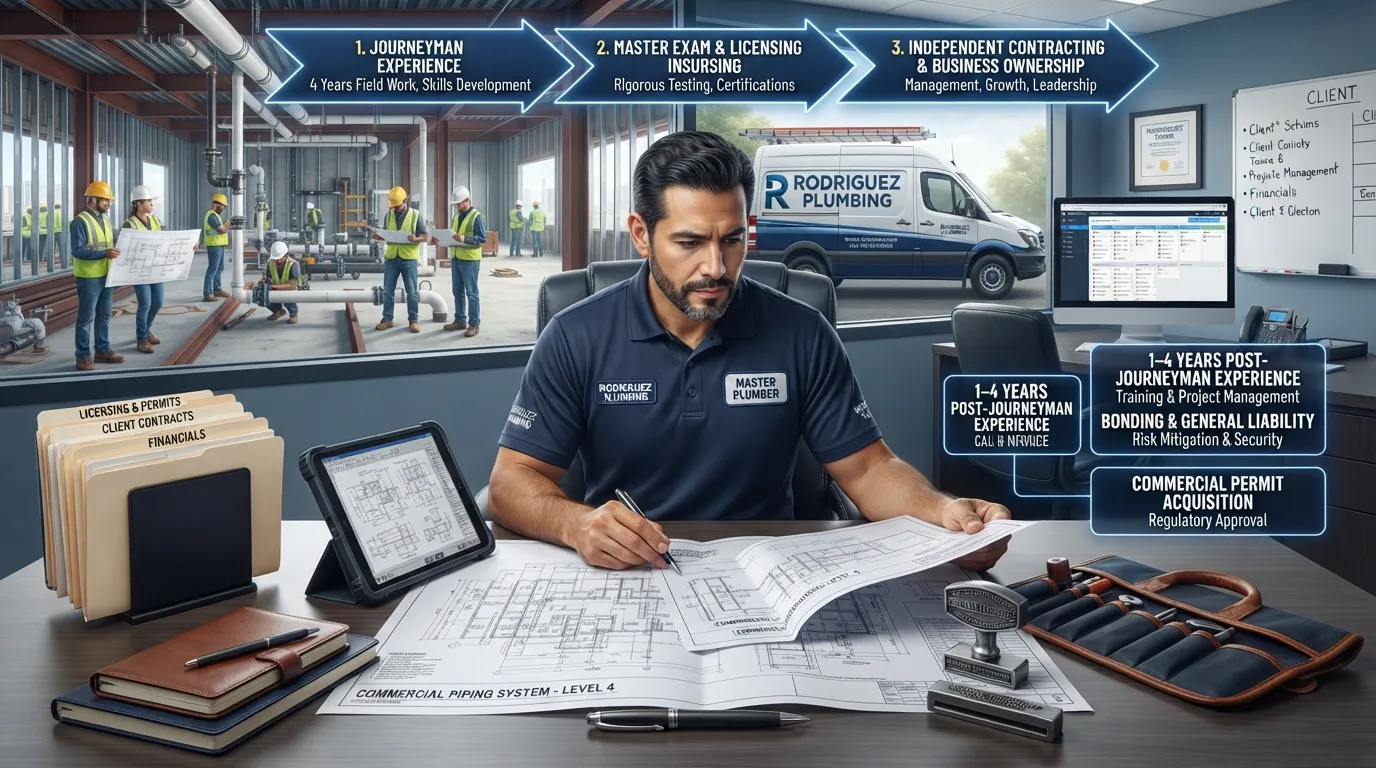
Reaching the master tier represents the ultimate professional milestone in the trade. This phase transitions a skilled technician into a business owner, contractor, or project leader capable of pulling permits, employing other tradespeople, and managing large-scale operations.
Experience Needed After Your Journeyman License
Advancing beyond the journeyman level requires accumulating additional verified field experience before you are eligible to test for a master plumber exam.
Time Commitment: Most state boards require between 1 to 4 additional years of active practice as a licensed journeyman.
Advanced Responsibilities: During this period, plumbers typically oversee job sites, direct apprentice training, and handle complex system diagnostics.
The Master Plumber Exam
The master plumber examination is significantly more rigorous than the journeyman test, focusing heavily on advanced engineering principles, administrative regulations, and business compliance.
Exam Focus: Tests advanced blueprint design, complex hydraulic sizing, cross-connection control, and local municipal codes.
Business Law: Many jurisdictions include regulatory questions covering construction law, employer responsibilities, and code enforcement protocols.
Insurance, Bonding, and Permits for Contractors
Operating legally as an independent plumbing contractor requires establishing financial protections and administrative authorization.
General Liability Insurance: Protects your business against property damage and third-party claims during service calls.
Surety Bonding: Guarantees to clients and municipalities that you will complete work according to local codes and contractual terms.
Permitting Authority: A master or contractor credential gives you the legal right to pull municipal permits for new construction and major system replacements.
Setting Up a Plumbing Business: Practical Basics
Launching your own contracting company requires careful operational planning beyond technical proficiency.
Business Registration: File your entity structure (e.g., LLC or corporation) with your state and obtain a federal employer identification number (EIN).
Equipment & Fleet: Invest in a fully stocked service truck, heavy-duty diagnostic gear, and specialized tools.
Hiring & Scaling: Establish payroll, workers’ compensation insurance, and safety compliance programs as you bring on your first employees.
Highest-Paying Plumbing Specializations
Earnings in the trade scale dramatically depending on your niche, technical complexity, and business model.
Commercial & Industrial Contracting: Large-scale commercial installations and industrial processing facilities offer some of the highest earning potentials in the industry.
Plumbing Contracting: Owning and operating an independent service or construction company allows successful professionals to scale earnings well into six figures.
Specializing: Why Plumbers Focus on Specific Services
Many licensed plumbers build a profitable niche by focusing on high-demand service segments rather than general repairs. For instance, focusing on specialized drain cleaning offers consistent residential service calls, while mastering water heater upgrades provides high-ticket installation opportunities. Similarly, tackling complex sewer line replacements or expanding into full-scale commercial plumbing allows contractors to diversify revenue and maximize long-term profitability.
Plumbing License Requirements by State
Navigating plumbing licensing requires understanding that regulations are set entirely at the state or local municipal level rather than nationally. Requirements for experience hours, examinations, and license classifications vary substantially across the United States.
State Comparison Table
| State | License Types | Hours / Experience | Exam Required? | Issuing Authority |
| Florida | Certified Contractor, Registered Contractor | 4 years (incl. 1 year as foreman) | Yes (Business & Trade) | Florida DBPR / CILB |
| Minnesota | Registered Apprentice, Journeyman, Master | 7,000–8,000 hours | Yes | Minnesota Department of Labor and Industry (DLI) |
| Pennsylvania | Local municipal levels (varies by city/county) | Varies locally (typically 4–5 years) | Varies by municipality | Local Municipal Boards |
| Michigan | Apprentice, Journeyman, Master | 4,000–6,000 hours | Yes | Michigan Department of Licensing and Regulatory Affairs (LARA) |
| Illinois | Apprentice, Licensed Plumber, Plumbing Contractor | 4–5 years (Registered Apprentice program) | Yes | Illinois Department of Public Health (IDPH) |
| Washington | Trainee, Journeyman, Specialty Plumber | 8,000 hours (over 4 years) | Yes | Washington State Department of Labor & Industries (L&I) |
| Connecticut | Apprentice, Journeyman (P-2, P-1), Contractor | 4 years (8,000 hours) | Yes | Connecticut Department of Consumer Protection (DCP) |
| Indiana | Apprentice, Journeyman, Plumbing Contractor | 4 years (8,000 hours) | Yes | Indiana Professional Licensing Agency (IPLA) |
How to Become a Licensed Plumber in Florida
Florida features a unique dual-licensing framework overseen by the Construction Industry Licensing Board (CILB) under the Department of Business and Professional Regulation.
Certified vs. Registered Contractors: A certified contractor license allows you to contract statewide and is issued directly by the state after passing the state exam. A registered contractor allows you to practice only within specific local municipalities where you have registered your competency card.
The Miami-Dade Angle: Major metropolitan hubs like Miami-Dade and Broward counties enforce local competency card requirements alongside state rules, meaning contractors working across county lines must secure local local approvals or state certification.
Experience & Exam Requirements: Florida requires 4 years of verified construction experience, with at least 1 year served in a foreman capacity. Candidates must pass two comprehensive exams: the Business and Finance test and the Plumbing Trade Knowledge exam. Detailed guidelines are outlined directly on the official Florida DBPR licensing requirements portal.
How to Become a Plumber in Minnesota
Minnesota licensing is managed uniformly by the Minnesota Department of Labor and Industry (DLI). To become a licensed journeyman, you must complete 8,000 hours of practical plumbing experience under a licensed master plumber, paired with approved technical training courses, followed by passing the state journeyman exam.
How Long Does It Take in Pennsylvania, Michigan, Illinois, and Washington?
Pennsylvania: Licensing is handled entirely at the municipal or county level, with timelines ranging between 4 to 5 years of practical field experience depending on local code board rules.
Michigan: Achieving a journeyman license takes approximately 3 years of active work (minimum 6,000 hours) combined with required classroom instruction supervised by LARA.
Illinois: State law requires a minimum of 4 to 5 years as a registered apprentice working under an IDPH-licensed plumber before qualifying to take the state plumbing examination.
Washington: Trainees must complete 8,000 hours of supervised experience over a minimum of 4 years, alongside 96 hours of classroom education, before testing for their journeyman card with Washington L&I.
Indiana and Connecticut: Quick Overview
Both Indiana and Connecticut enforce rigorous statewide standards. Indiana requires 4 years (8,000 hours) of apprenticeship before testing through the IPLA. Connecticut mandates a similar 4-year structured apprenticeship leading to the state’s P-2 journeyman exam administered by the Department of Consumer Protection.
What if I Move States? Licensing Reciprocity Basics
Plumbing licenses rarely transfer automatically across state lines because municipal plumbing codes and state statutes differ significantly.
Reciprocity Agreements: A few neighboring states maintain formal reciprocity agreements for journeymen who hold equivalent licenses and have passed comparable exams.
Verification & Upgrading: Most relocating plumbers must submit their documented out-of-state hours, pass the new state’s code exam, and pay applicable board fees to secure a local license.
How to Check Your Own State’s Requirements
To verify the exact, up-to-date regulations for your specific region, follow these steps:
Identify your state’s governing body (search for your state name followed by “Department of Labor” or “Construction Industry Licensing Board”).
Look for the contractor licensing portal or plumbing board division.
Review the candidate information bulletin for required apprentice registration forms, fee schedules, and approved testing providers.
How Much Does It Cost to Become a Licensed Plumber?
Entering the plumbing trade is one of the most financially efficient career paths available, allowing workers to bypass high college tuition and enter the workforce immediately. However, breaking into the industry still involves standard startup expenses, equipment purchases, and licensing fees.
Cost Breakdown Table
| Expense Category | Estimated Cost Range | Description |
|---|---|---|
| Trade School Tuition | $0 to $10,000+ | Free if via employer-sponsored apprenticeship; higher for private trade schools |
| Books & Study Materials | $200 to $600 | Required plumbing code books, textbooks, and workbook guides |
| Initial Tool List | $300 to $1,500 | Basic hand tools, channel locks, pipe wrenches, and durable tool belts |
| State Apprentice Registration | $20 to $100 | Annual or initial administrative filing fee with your state board |
| Journeyman Exam & Application Fees | $100 to $300 | Testing center registration and board processing fees |
| License Renewal Fees | $50 to $200 | Biennial renewal costs and continuing education fees |
| Insurance & Bonding (Contractors) | $1,000 to $3,500+ / year | General liability coverage and surety bonds required for master contractors |
Hidden Costs Beginners Overlook
While tuition-free apprenticeships eliminate massive educational debts, several everyday trade expenses catch beginners off guard.
Expert Insight: Beyond your initial tool investment, budget carefully for ongoing transportation fuel, durable work boots, specialized safety gear, and potential exam retake fees. Keeping a dedicated emergency fund for your first few months as an apprentice ensures that unexpected vehicle repairs or tool replacements will not derail your training.
How Apprenticeships Offsets the Cost
Employer-sponsored apprenticeships completely neutralize the financial barriers typical of traditional higher education. Because you earn an hourly wage from day one of your on-the-job training, your earnings rapidly offset your initial equipment and registration expenses. Over a 4-year training cycle, apprentices earn a steady income while receiving their technical instruction at little to no out-of-pocket cost.
Financial Aid, Scholarships, and Veteran Programs
For those attending formal vocational schools or community college trade programs, various financial avenues can minimize expenses.
Federal Financial Aid: Many community college plumbing programs qualify for federal Pell Grants and federal student loans.
Industry Scholarships: Trade organizations, labor unions, and plumbing manufacturing associations regularly offer tuition grants for dedicated students.
Veteran Assistance: Military veterans can leverage the GI Bill to cover housing allowances, book stipends, and certification costs during their registered apprenticeship training.
Is Becoming a Plumber Worth It? Salary and Job Outlook
Evaluating a career in the trades naturally comes down to earning potential, job security, and long-term viability. For individuals willing to master physical problem-solving and technical codes, plumbing stands out as one of the most financially rewarding career paths available.
How Much Does a Licensed Plumber Make?
Earning potential scales directly with experience, licensing tier, and geographic market. Because apprentices earn while they learn, early career financial stability sets this track apart from traditional academic routes.
Apprentice Level: Starting pay typically ranges between 40% and 50% of the local journeyman rate, with regular pay bumps tied to completed work hours and classroom milestones [08:15].
Journeyman Level: Fully licensed journeymen earn solid middle-class wages, often scaling significantly higher with overtime, prevailing wage projects, and on-call rotations [08:25].
Master Plumber / Contractor: Master-level professionals and independent business owners frequently clear six figures or multiple six figures annually as they scale teams and manage larger commercial contracts [08:40].
Journeyman vs. Master Plumber Salary
While a journeyman plumber earns a reliable hourly wage or salary based on skilled diagnostic and installation work, a master plumber unlocks ownership and management economics. Master plumbers can bid on large-scale commercial contracts, employ other tradespeople, and capture business profits well beyond standard technician wages.
Do Plumbers Make Good Money in Washington State?
Yes, Washington State is widely recognized as one of the highest-paying regions for plumbing professionals in the country. Driven by robust commercial construction, stringent state licensing standards, and high regional demand, journeymen and master plumbers in metropolitan areas like Seattle frequently command top-tier hourly rates and strong benefits packages.
What Is the Highest-Paid Plumbing Job?
Specialized niches and high-responsibility roles offer the greatest financial return in the trade.
Commercial & Industrial Superintendents: Managing multi-million-dollar commercial builds or industrial processing facilities.
Independent Plumbing Contractors: Owning a service or construction plumbing company with a fleet of trucks.
Specialized Technicians: Experts in high-pressure hydro-jetting, medical gas installations, or complex trenchless sewer replacement.
Job Outlook and Demand for Plumbers
The employment outlook for licensed plumbers remains exceptionally strong. According to labor market data and BLS employment projections, ongoing retirements among older tradespeople coupled with steady construction growth ensure that demand consistently outpaces the supply of incoming workers.
Pros and Cons of a Plumbing Career
Expert Insight: Plumbing offers unmatched job security, zero student loan debt, and rapid wage growth, but it demands physical stamina, resilience in adverse weather, and occasional uncomfortable emergency service calls. Weighing these realities helps ensure the trade matches your long-term lifestyle goals.
Is It Worth It? A Final Answer by Situation
For High School Graduates & Young Adults: Absolutely. Skipping student debt while earning an immediate income makes plumbing an accelerated pathway to financial independence and homeownership by age 30.
For Career Changers: Highly worth it for mature workers with strong soft skills, as professional reliability and discipline translate immediately into contractor trust and rapid advancement.
For Those Seeking Desk-Free Work: An ideal match for individuals who prefer physical engagement, mechanical problem-solving, and tangible daily results over office environments.
What Can You Legally Do Without a Plumbing License?
Understanding the legal boundaries between DIY home repairs and professional contracting is essential for every property owner. While minor cosmetic fixes are generally permitted, building codes and state laws strictly restrict complex installations to licensed professionals to protect public safety.
Minor Work Homeowners Can Often Do Themselves
Many municipal codes allow homeowners to perform basic plumbing maintenance on their own primary residences without holding a professional license.
Permitted Tasks: Replacing a kitchen or bathroom faucet, changing out showerheads, clearing simple drain clogs with a hand snake, or swapping a standard toilet flapper.
Important Caveat: Regulations vary significantly by municipality and state. Always verify local rules before starting any project, as multifamily properties, rentals, and commercial buildings almost never allow unlicensed work.
Work That Almost Always Requires a License
Any plumbing modification that alters structural water supply, sanitary drainage, or gas distribution requires a licensed professional and an approved municipal permit.
Restricted Systems: Installing or replacing water heaters, running or modifying gas line connections, altering main sewer lines, and performing major repiping projects.
Permitted Work: Any installation requiring inspection by local building code authorities must be executed and signed off by a licensed contractor.
Penalties for Unlicensed Plumbing Work
Attempting major plumbing modifications without a license or hiring an unlicensed handyman for restricted tasks carries severe legal and financial consequences.
Fines and Stop-Work Orders: Municipal code enforcement agencies can issue heavy fines, slap red stop-work tags on your property, or force you to tear out unpermitted installations at your own expense.
Insurance Denial: If unpermitted DIY work or unlicensed handyman repairs cause a catastrophic water leak or structural failure, your homeowners insurance provider may deny coverage entirely for resulting property damage.
Why Hiring a Licensed Plumber Protects Your Home
Licensed professionals undergo thousands of hours of rigorous training and code education to ensure systems operate safely and efficiently. Hiring certified experts guarantees that your repairs comply with current building codes, protecting your family from health hazards like cross-contamination, gas leaks, and sewage backups.
Whether you need routine maintenance or an urgent response from an experienced emergency plumber to mitigate sudden pipe bursts, partnering with insured professionals safeguards your investment. For complex issues such as hidden slab leaks or chronic malfunctions, professional leak detection and repair ensures the root cause is resolved correctly the first time. To explore professional assistance or schedule a service visit, you can review our full range of licensed plumbing services or book an appointment directly through our online booking portal.
Common Mistakes Aspiring Plumbers Make
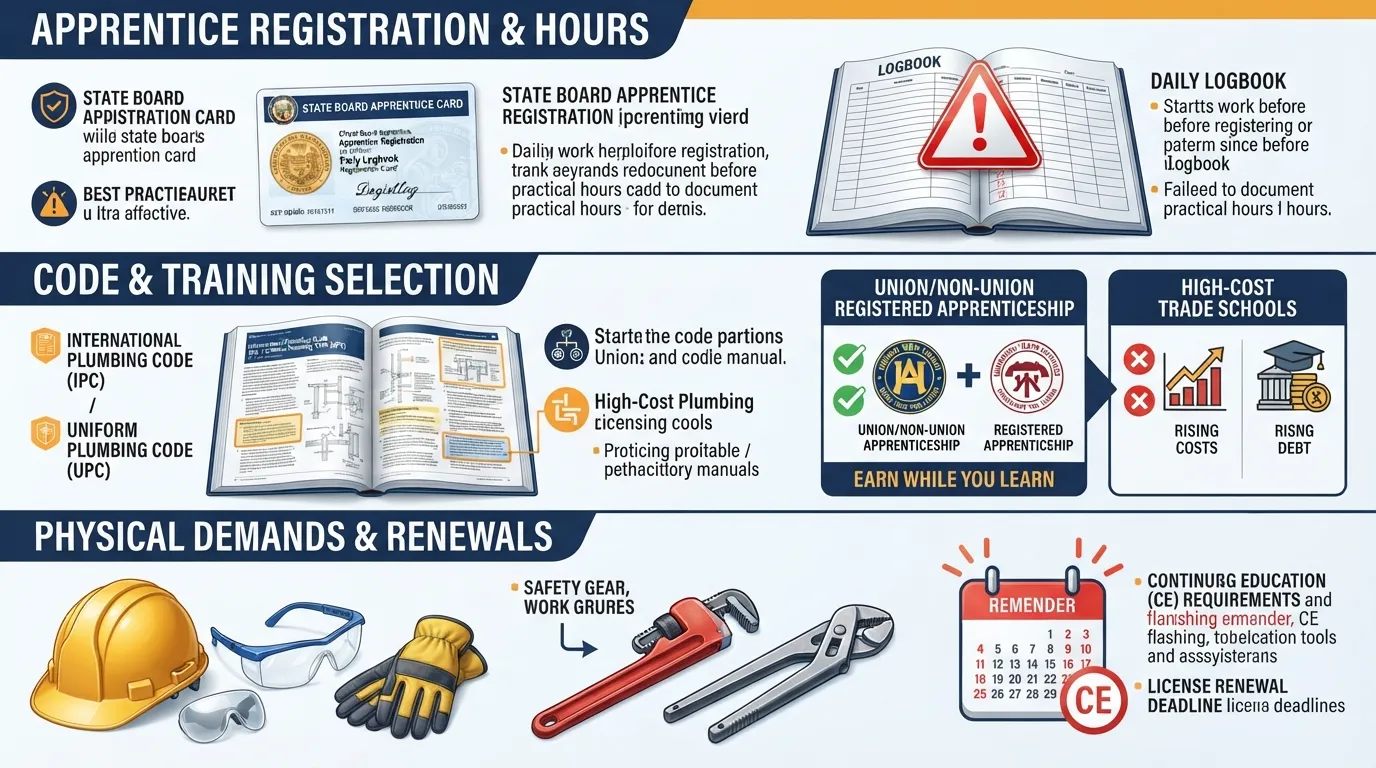
Launching a successful career in plumbing requires more than just mechanical aptitude; it demands careful administrative planning and professional discipline. Many ambitious newcomers unintentionally delay their licensing or damage their career progression by falling into common traps.
Starting Work Before Registering as an Apprentice
One of the most damaging mistakes beginners make is logging field hours before formally registering as an apprentice with their state or local licensing board.
The Risk: State boards frequently refuse to count retroactively worked hours if you were not officially registered from day one.
The Fix: Always confirm your official apprentice registration card is active and issued by your state department or plumbing board before your first official day on the job site.
Poorly Documented Work Hours
Licensing boards require strict, verifiable proof of your practical experience—typically 6,000 to 8,000 hours—before allowing you to sit for your journeyman exam.
The Risk: Relying on memory or informal notes leads to rejected applications if an employer goes out of business or fails to sign off on your logs.
The Fix: Maintain a detailed, daily logbook signed off monthly by your supervising master plumber, categorizing your hours across residential, commercial, and maintenance tasks.
Not Studying Local Codes for the Exam
Treating the journeyman exam like a standard test rather than an open-book code navigation test causes many otherwise skilled technicians to fail.
The Risk: Running out of time because you do not know how to efficiently look up sections in the International Plumbing Code (IPC) or Uniform Plumbing Code (UPC).
The Fix: Practice daily code lookups and math sizing problems under timed conditions months before your test date.
Choosing the Wrong Training Path
Jumping blindly into a non-structured non-union shop without verifying the quality of mentorship, or entering a high-cost private trade school without researching employer-sponsored paid alternatives, can severely limit your career growth.
The Risk: Accumulating unnecessary debt or receiving narrow, low-quality experience that leaves you unprepared for licensing evaluations.
The Fix: Evaluate both union and open-shop registered apprenticeship programs to find a path that offers comprehensive, well-rounded training at little to no out-of-pocket cost.
Underestimating the Physical and On-Call Demands
Many beginners enter the trade picturing standard 9-to-5 schedules, only to experience burnout when faced with rigorous physical labor and mandatory emergency rotations.
The Risk: Leaving the trade early due to physical exhaustion, poor ergonomics, or unexpected night and weekend emergency calls.
The Fix: Invest in proper personal protective equipment, prioritize ergonomics, and maintain physical conditioning to ensure long-term career longevity.
Skipping Continuing Education and License Renewal
Earning your license is not the end of your educational journey; maintaining active legal status requires ongoing compliance.
The Risk: Letting your license lapse or missing mandatory continuing education deadlines, which can result in heavy reinstatement fees or temporary suspension of your right to work.
The Fix: Track your state board’s license renewal cycle on your calendar and complete your required continuing education courses well in advance of your expiration date.
Frequently Asked Questions
How long does it take to get a plumbing license?
Earning a journeyman plumbing license typically takes between 4 to 5 years, requiring roughly 6,000 to 8,000 hours of supervised on-the-job field experience combined with 144 to 160 hours of annual classroom instruction. Afterward, advancing to a master plumber license requires an additional 1 to 4 years of active field practice depending on your state’s specific regulatory board rules.
How long does it take to become a plumber in Pennsylvania, Michigan, Illinois, and Washington?
Timelines vary significantly by jurisdiction:
Pennsylvania: Typically takes 4 to 5 years of practical experience, though exact durations depend on local municipal or county code boards.
Michigan: Requires approximately 3 years of active work (minimum 6,000 hours) combined with required classroom instruction supervised by LARA.
Illinois: Mandates a minimum of 4 to 5 years as a registered apprentice working under an IDPH-licensed plumber before qualifying for the state exam.
Washington: Requires 8,000 hours of supervised experience over a minimum of 4 years, alongside 96 hours of classroom education, before testing with Washington L&I.
How do you get your master plumber license?
Securing your master plumber license requires accumulating 1 to 4 years of verified experience as a licensed journeyman, passing a rigorous advanced code and business exam, and acquiring required surety bonds and general liability insurance. This credential gives you the legal authority to pull municipal permits, hire workers, and launch an independent plumbing contracting business.
Is 25 too old to become a plumber? Is 30 too late?
Neither age is too late to enter the trade. In fact, many individuals starting their apprenticeship at 25 or 30 excel rapidly because they bring mature work habits, reliability, and strong communication skills. By age 35, these career changers frequently own debt-free homes, manage profitable businesses, and outearn peers with traditional four-year college degrees.
Is it hard to get hired as a plumber?
It is not difficult to get hired if you possess basic reliability, a clean driver’s license, and a strong work ethic. Plumbing contractors and union halls face an ongoing labor shortage and actively seek motivated entry-level helpers, making entry into a paid apprenticeship program highly accessible for proactive applicants.
Is it worth becoming a plumber?
Yes, becoming a plumber is exceptionally worthwhile for individuals seeking job security, high earning potential, and zero student loan debt. While the work is physically demanding, the ability to earn an income while learning, combined with six-figure earning potential at the master level, makes it one of the most reliable career tracks available.
What is the highest-paid plumbing job?
The highest-paying roles in the industry include commercial and industrial plumbing superintendents, independent plumbing contractors who own and scale service fleets, and specialists in high-demand technical fields like medical gas installation, industrial pipefitting, and complex trenchless sewer replacement.
What plumbing can I do without a license?
Homeowners can generally perform basic cosmetic maintenance on their primary residences, such as replacing faucets, swapping showerheads, clearing simple drain clogs with a hand snake, or changing toilet flappers. However, any modification involving gas lines, water heaters, main sewer lines, or structural plumbing requires a licensed professional and a municipal permit.
Can I become a licensed plumber for free?
Yes, you can become a licensed plumber completely tuition-free by securing an employer-sponsored or union apprenticeship. In these programs, you earn an hourly wage from day one while your contractor or labor union covers the cost of your classroom instruction and technical training.
How much does a licensed plumber make?
Apprentices typically start making $15 to $20 per hour, while fully licensed journeymen earn solid middle-class wages ranging from $25 to $45+ per hour depending on geographic market and overtime. Master plumbers and independent contractors frequently scale their earnings into multiple six figures annually.
What are the benefits of having a plumbing license in the United States?
A plumbing license grants you legal autonomy to contract services, pull building permits, and command higher wages. It protects your income from unregulated handymen, ensures robust career security backed by essential public health demand, and provides a clear pathway to business ownership and financial independence.
If I can no longer do plumbing work, can I still earn money with my license?
Yes, holding a master or journeyman license opens up lucrative career avenues that do not require heavy physical labor. Depending on state regulations, experienced plumbers can transition into municipal plumbing inspection, trade school instruction, code consulting, expert witness work, or full-time business management and estimation.
Conclusion and Next Steps
Embarking on a career in plumbing offers an exceptional opportunity to bypass student debt, earn an immediate income, and build a secure, high-paying future in an essential trade. By following a structured pathway from apprentice registration to master licensing, you can transform technical proficiency into long-term professional independence.
Your Licensed Plumber Roadmap in Brief
Verify Basic Eligibility: Ensure you meet age and high school diploma or GED prerequisites, and prepare for basic math and safety demands.
Choose Your Entry Path: Secure a paid union or open-shop apprenticeship or enroll in a recognized vocational trade program.
Log Hours and Complete Training: Accumulate 6,000 to 8,000 hours of verified field experience paired with required technical classroom instruction.
Pass Exams and Get Licensed: Pass your state journeyman or master plumbing exam, maintain your continuing education, and unlock full professional autonomy.
Your Next Step Today
Do not let analysis paralysis stall your progress. Take one concrete action today: visit your local state licensing board website to review candidate information bulletins, reach out to local union halls or plumbing contractors to inquire about open apprentice positions, or research approved vocational programs in your area.
Need a Licensed Plumber Right Now?
If you landed on this guide because you are currently dealing with a plumbing emergency or property repair rather than a career change, professional help is just a click away. You can explore our full range of licensed plumbing services or schedule an immediate appointment directly through our online booking portal.
Main Services
Related Posts
Need a Plumber in Miami?
Schedule service online or speak directly with the EZ Plumbing team.
Owner-Led Local Service
Know who is behind the business before you request service. The owners, contact line and Miami service pages are published clearly.
- Named business owners
- Direct phone and social channels
- Local Miami service information
Clear Help Before You Book
Review the relevant service page, contact the team directly and use the booking page when you are ready—without relying on vague claims.
- Service-specific information
- Direct questions before scheduling
- Clear online booking route