What a Plumbing Union Apprenticeship Program Entails: Pay, Hours, Requirements, and How to Apply
Plumbing Union Apprenticeship: What to Expect and How It Works
Choosing a plumbing union apprenticeship offers a direct debt-free route to a high-paying skilled trade. By combining paid work experience with specialized classroom instruction, this path lets you earn a living wage from day one while building a secure career in the construction and service industry.
At a Glance: Plumbing Union Apprenticeship Overview
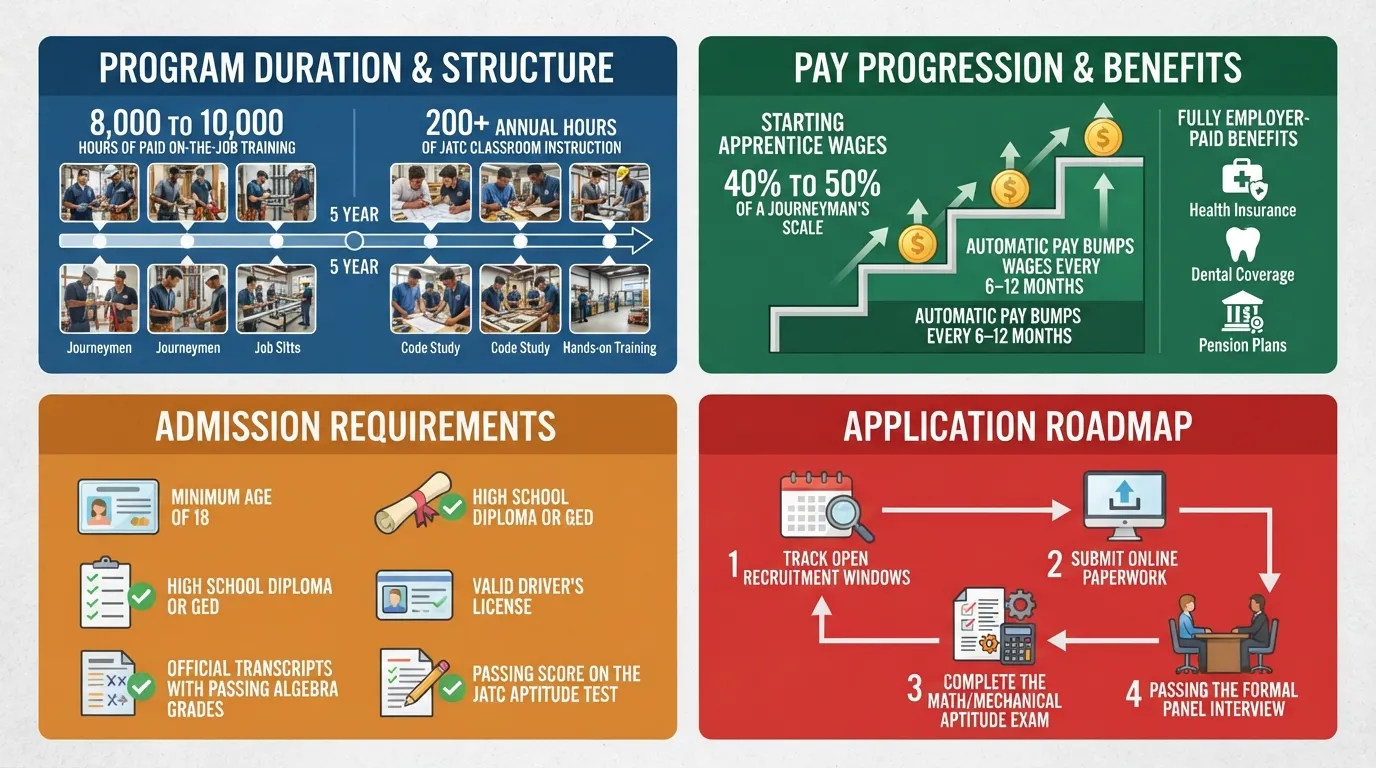
Program Length: Typically 4 to 5 years of comprehensive training administered through local Joint Apprenticeship and Training Committees (JATC).
On-the-Job Training: Around 1,700 to 2,000 hours of paid hands-on field experience per year under the direct mentorship of a certified journeyman.
Classroom Instruction: Roughly 144 to 240 hours per year of technical classroom education covering blueprint reading, mathematics, safety codes, and advanced pipefitting.
Starting Pay: Begins at a competitive percentage of the local journeyman wage (often 50% to 60%), with guaranteed pay increases at regular milestones as your skills advance.
Benefits Package: Full healthcare coverage, pension plans, and retirement annuities funded entirely or heavily subsidized by employers.
Career Outcome: Qualification as a certified journeyman plumber with full union membership, zero student loan debt, and high earning potential.
Who This Guide Is For
High School Graduates: Individuals looking to bypass traditional four-year college debt and step directly into a lucrative, high-demand career.
Career Changers: Professionals transitioning from retail, hospitality, or corporate desks who want hands-on stability and clear wage progression.
Veterans: Service members seeking to translate military discipline, mechanical aptitude, and technical training into a rewarding civilian trade.
Parents and Counselors: Advisors seeking accurate, data-backed insights on modern vocational training and union opportunities.
What You’ll Learn Here
This guide details the complete roadmap of a plumbing union apprenticeship, including application requirements, day-to-day expectations, and long-term career advancement opportunities.
What Is a Plumbing Union Apprenticeship Program?
A plumbing union apprenticeship is an earn-while-you-learn educational model combining full-time paid work experience under industry experts with structured technical classroom instruction. This rigorous program equips beginners with all the competencies needed to master the trade safely and efficiently without accumulating student loan debt.
How a Union Apprenticeship Works
Earn-While-You-Learn Structure: Apprentices earn a competitive hourly wage from day one while getting paid to learn critical trade skills on active job sites.
Dual Training Tracks: Programs seamlessly integrate real-world field hours with mandatory technical education classes to bridge theory and practice.
Progressive Wage Scaling: Pay rates automatically increase at regular milestones (typically every 6 to 12 months) as apprentices master new skill tiers.
Who Runs the Program?
UA Locals: United Association local unions organize workers and negotiate master agreements across specific geographic jurisdictions.
JATC / Training Centers: Joint Apprenticeship and Training Committees—comprising equal representation from union leadership and union contractors—oversee daily curriculum and administration.
Union Contractors: Partnering employers provide the actual employment, daily field supervision, and prevailing wages required for hands-on learning.
Registered Apprenticeship Explained
Department of Labor Recognition: Registered apprenticeships are officially certified and monitored by the U.S. Department of Labor or state apprenticeship agencies.
Standardized Excellence: Registration ensures rigorous national standards for safety training, supervision ratios, and progressive skill evaluations.
Guaranteed Credentials: Graduates receive a nationally recognized completion certificate that verifies full professional competence across all jurisdictions.
Plumbing vs. Pipefitting vs. Steamfitting: What’s the Difference?
Plumbers: Focus primarily on potable water systems, drainage, sanitation, and gas piping in residential, commercial, and light industrial buildings.
Pipefitters: Specialize in high-pressure industrial systems, including chemical manufacturing plants, power generation facilities, and refinery piping networks.
Steamfitters: Handle specialized high-pressure closed-loop systems that transport steam or high-temperature liquids for power generation and heavy industrial heating.
Quick Glossary of Core Terms
Apprentice: An entry-level worker enrolled in a formal training program learning a skilled trade under direct expert supervision.
Journeyman: A fully qualified, certified professional who has completed their apprenticeship and can work independently without supervision.
Master Plumber: An elite licensed plumbing professional who has passed state board exams, capable of designing complex systems and pulling permits.
OJT (On-the-Job Training): The mandatory hundreds of hours spent performing actual paid field work under veteran supervision.
RTI (Related Technical Instruction): The classroom component covering blueprints, mathematics, physics, and safety regulations.
JATC: The Joint Apprenticeship and Training Committee responsible for administering local educational standards and evaluating apprentice progress.
How Apprentice Pay Works
Apprentice pay scales are structured around a predetermined percentage of the prevailing journeyman wage in your local jurisdiction. Wages automatically increase by a set percentage every 6 to 12 months as you complete required on-the-job hours and classroom milestones. This built-in progression ensures that your take-home pay grows directly in tandem with your expanding technical competence.
Sample 5-Year Pay Progression
The following table illustrates a typical wage scale based on an assumed journeyman wage of $50.00 per hour (Note: This is an example only; actual wage rates vary significantly by geographic region, local union agreement, and economic market).
| Year in Program | Wage Percentage | Hourly Pay Rate (Example) | Annual Gross Pay (Approx. 2,000 Hours) |
| Year 1 (Starting) | 50% | $25.00 / hr | $50,000 |
| Year 2 | 60% | $30.00 / hr | $60,000 |
| Year 3 | 70% | $35.00 / hr | $70,000 |
| Year 4 | 80% | $40.00 / hr | $80,000 |
| Year 5 (Final Year) | 90% | $45.00 / hr | $90,000 |
Benefits From Day One
Comprehensive Health Coverage: Full medical, dental, and vision insurance for you and your dependents, typically funded entirely or heavily subsidized by employers without taking a bite out of your hourly paycheck.
Retirement Security: Immediate contributions made by employers into defined-benefit pension plans and tax-deferred annuity funds to secure your long-term future.
Paid Time Off and Vacation Funds: Supplemental vacation or holiday savings funds accumulated per hour worked, disbursed periodically to support time off.
Prevailing Wage and Overtime
Prevailing Wage Mandates: Union wage rates are legally protected on public projects through prevailing wage laws, guaranteeing fair compensation that matches local market standards.
Overtime Protections: Hours worked beyond standard shifts (typically over 8 hours a day or 40 hours a week) are compensated at premium overtime rates, such as time-and-a-half or double-time.
Market Stability: Collective bargaining agreements prevent wage undercutting and ensure predictable, transparent wage floors across all union contractors.
The Real Costs to Expect
Union Initiation Fees and Dues: Monthly working dues and local membership fees support union representation, administrative operations, and ongoing training facility maintenance.
Hand Tools and Gear: Initial investment in quality hand tools, safety boots, and personal protective equipment (PPE) required for daily fieldwork.
Books and Class Fees: Modest costs for semester textbooks, codebooks, and specialized training materials required during classroom instruction.
Transportation Costs: Reliable daily transportation to various job sites across your local union’s regional jurisdiction.
Earn While You Learn vs. Traditional Student Debt
Zero Debt Accumulation: Union apprentices earn a full-time living wage from day one, allowing them to graduate completely free of student loans.
Immediate Earning Power: Over a five-year training period, apprentices accumulate over $300,000 in gross earnings while simultaneously earning accredited college credits.
The College Comparison: Traditional four-year university students often graduate with thousands of dollars in student loan debt and zero years of verified, high-paying field experience.
Five-Year Earnings Comparison
Union Plumbing Apprentice: Earns steady, compounding income year-over-year, starting around $50,000 and scaling past $90,000 by the final year, totaling approximately $350,000+ in gross wages over five years.
Typical Entry-Level Job: General retail or administrative roles often remain stagnant near minimum wage or entry-level salaries, yielding significantly lower cumulative earnings over the same timeframe.
Basic Requirements Checklist
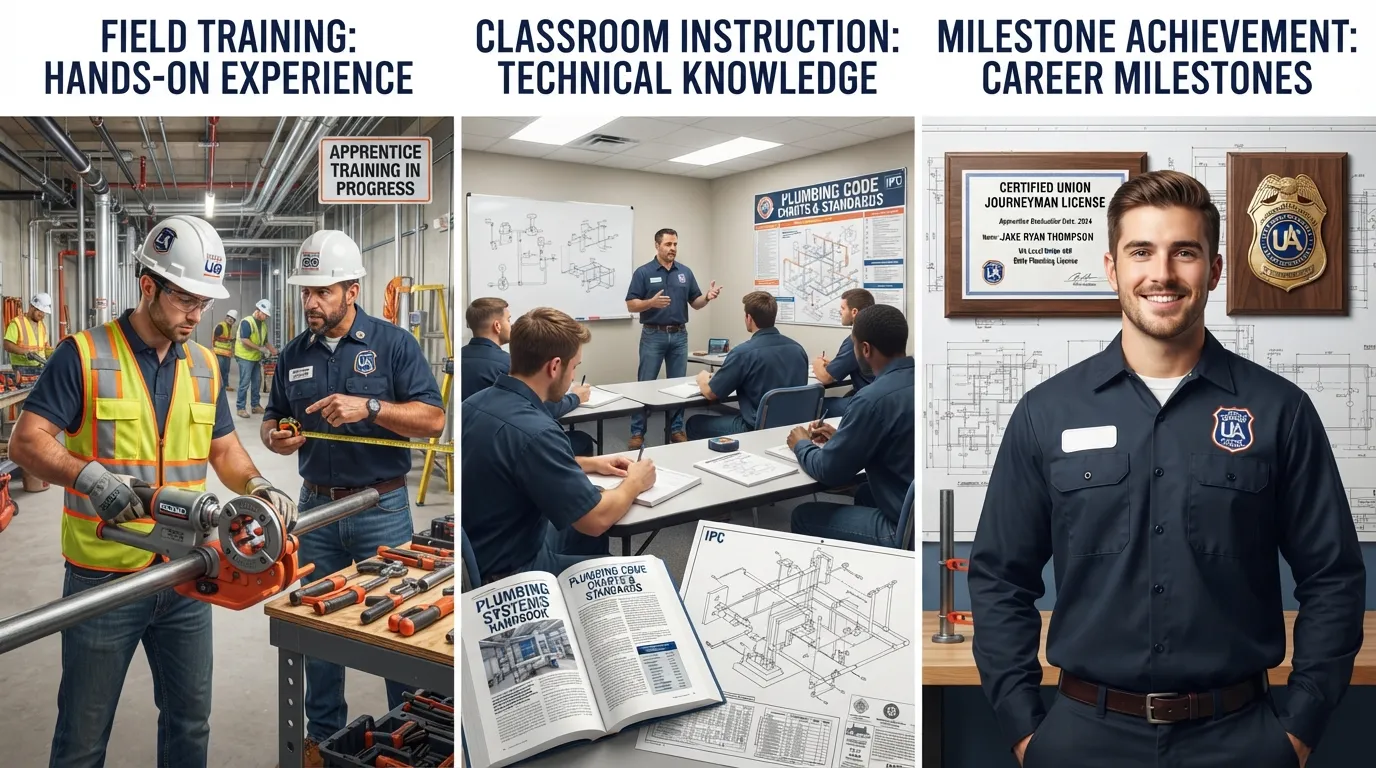
Age Requirement: Applicants must be at least 18 years of age at the time of indenture to comply with labor laws and safety regulations.
Educational Attainment: A high school diploma or state-issued GED certificate is mandatory, often accompanied by official transcripts showing passing grades in basic mathematics or algebra.
Driver’s License: A valid state driver’s license is required to travel independently to various field locations and job sites.
Reliable Transportation: Dependable personal transport is necessary to ensure punctual daily arrival at work sites and training facilities.
Residency and Jurisdiction: Candidates must reside within the geographic jurisdiction of the specific local union hall offering the apprenticeship program.
Screening and Selection Steps
Aptitude Testing: Standardized entrance examinations evaluate fundamental reading comprehension, spatial reasoning, and basic math skills.
Physical Evaluation: Candidates must pass a comprehensive physical exam to ensure they can safely handle the heavy lifting and demanding manual labor of the trade.
Drug Screening: A negative result on a mandatory pre-employment drug test is strictly enforced prior to program enrollment.
Formal Interview: A panel interview with the Joint Apprenticeship and Training Committee (JATC) assesses communication skills, work ethic, and overall dedication to the trade.
Can You Join With No Experience?
Zero Experience Welcome: No prior plumbing or construction experience is required to apply for a union apprenticeship program.
Earn While You Learn: Training programs are specifically designed to take raw beginners and teach them everything from scratch through paid field mentorship and related technical instruction.
The Entry Pathway: Local halls frequently offer pre-apprenticeship or helper pathways for individuals looking to build foundational familiarity while waiting for formal apprenticeship windows to open.
Requirements for Career Changers, Veterans, and Women in the Trades
Transferable Skills: Career changers find that corporate, retail, or military problem-solving skills translate seamlessly into mechanical proficiency and project execution.
Veterans Support: Programs like Helmets to Hardhats actively assist military veterans in transitioning their technical and leadership training directly into union apprenticeships.
Women in the Trades: Dedicated recruitment initiatives and supportive union networks encourage more women to enter plumbing and pipefitting with equal pay and growth pathways.
Florida and Miami-Dade Local Notes
Local Regulatory Compliance: Plumbing apprentices operating in Florida must coordinate their training hours to meet requirements overseen by local boards and the Florida Department of Business and Professional Regulation (DBPR).
Miami-Dade Standards: In regions like Miami-Dade County, local union programs (such as Plumbers Local 519) and institutional partners like Miami Dade College collaborate to ensure training aligns with county-specific licensing criteria and building codes.
Licensing Path: Accumulating verified on-the-job hours under a licensed master plumber sets up graduates to sit for state and county competency exams upon completing their program.
Step 1: Find Your Local Union and Training Center
Locate Your Nearest Hall: Search for the closest United Association (UA) local union hall or Joint Apprenticeship and Training Committee (JATC) training center serving your geographic area.
Explore Official Portals: Access official resources like the UA apprenticeship information page to identify local jurisdiction boundaries and contact details.
Step 2: Check the Application Window and Gather Documents
Track Application Timelines: Application windows open periodically based on local contractor demand; monitor official union websites closely to catch submission dates.
Assemble Required Paperwork: Gather your government-issued photo ID, valid driver’s license, birth certificate, and official high school transcripts or GED certificates.
Prepare Supporting Credentials: Collect letters of recommendation, proof of residency, or military discharge papers if applying through specialized veteran initiatives.
Step 3: Take the Aptitude Test
Preparation Focus: Schedule and complete the standardized entrance exam, which typically evaluates high-school-level math, reading comprehension, and mechanical reasoning.
Review Fundamentals: Brush up on basic algebra, fractions, decimals, and spatial visualization to maximize your score on the ranking matrix.
Step 4: Complete the Interview
Professional Presentation: Attend your scheduled panel interview with the JATC board dressed in clean, professional attire.
Demonstrate Commitment: Highlight your work ethic, reliability, mechanical aptitude, and genuine enthusiasm for building a long-term career in the trade.
Step 5: Ranking, Waiting Lists, and Placement
The Ranking Score: Your aptitude test score and interview results are combined to determine your position on the applicant ranking list.
Waiting List Dynamics: Local halls dispatch apprentices from the top of the list as contractors request new workers, meaning wait times can vary by market demand.
What If You’re Not Selected?
Reapplication Rights: Many programs allow you to reapply during the next open cycle, using feedback from your previous attempt to improve your standing.
Score Enhancement: Take college algebra courses or gain related construction experience to boost your ranking qualifications for future cycles.
Alternative Pathways: Consider starting as a union helper or general laborer (“jobber”) to build valuable job-site familiarity while waiting for the next apprenticeship opening.
Application Checklist
Valid driver’s license and reliable personal transportation
Official high school transcripts or state-issued GED certificate
Government-issued photo identification (passport or state ID)
Completed application form submitted during an active local window
Passing score on the standardized aptitude and math entrance exam
Completed panel interview with the local JATC committee
What's on the Aptitude Test?
Union apprenticeship entrance exams evaluate the fundamental academic and mechanical aptitudes needed to succeed in technical classroom instruction. While exact formats vary by local union, most exams are timed and cover three core domains:
Mathematics: Focuses on practical arithmetic, basic algebra, fractions, decimals, percentages, ratios, and geometric calculations.
Reading Comprehension: Measures your ability to read, analyze, and interpret technical manuals, safety guidelines, and multi-step written instructions.
Mechanical Reasoning: Assesses your intuitive understanding of basic physical principles, mechanical devices, gears, pulleys, and spatial relationships.
Sample Practice Questions
Question 1 (Fractions): Add the following lengths together: $3\frac{1}{4}\text{ inches}$, $5\frac{3}{8}\text{ inches}$, and $2\frac{1}{2}\text{ inches}$.
Answer: $11\frac{1}{8}\text{ inches}$ (Converted to common denominators: $\frac{2}{8} + \frac{3}{8} + \frac{4}{8} = \frac{9}{8} = 1\frac{1}{8}$, added to whole numbers $3 + 5 + 2 = 10$, total $11\frac{1}{8}$).
Question 2 (Algebra): Solve for $x$ in the equation: $3x – 5 = 16$.
Answer: $x = 7$ (Add $5$ to both sides to get $3x = 21$, then divide by $3$).
Question 3 (Ratios): If a pipe fitting requires a ratio of 3 parts solvent to 2 parts cleaner, how many ounces of solvent are needed for a total mixture of $20\text{ ounces}$?
Answer: $12\text{ ounces}$ (Total parts = $5$. Each part is $20 / 5 = 4\text{ ounces}$. Solvent = $3 \times 4 = 12$).
Question 4 (Mechanical Reasoning): If Gear A turns clockwise with 20 teeth and drives a smaller Gear B with 10 teeth, which direction does Gear B turn and at what speed relative to Gear A?
Answer: Gear B turns counter-clockwise at twice the speed of Gear A due to the 2:1 gear ratio.
How to Study in 2 to 4 Weeks
Week 1 (Diagnostic & Math Review): Take a baseline practice test, identify weak spots in fractions or algebra, and review core rules daily.
Week 2 (Reading & Mechanical Practice): Practice reading dense technical text quickly and answer mechanical comprehension concept questions.
Week 3 (Timed Mock Exams): Simulate real testing conditions by taking full-length timed practice exams to build pacing and stamina.
Week 4 (Final Review): Review missed questions, brush up on formulas, and ensure proper rest before test day.
Common Interview Questions and Model Answers
“Why do you want to become a plumber?”
Model Answer: “I want a hands-on career where I can solve complex physical problems, master a vital technical trade, and build long-term financial security through hard work.”
“Why do you want to join the union specifically?”
Model Answer: “I value structured safety standards, top-tier mentorship, and standardized training. Unions guarantee that I will learn the trade thoroughly from certified journeymen.”
“How do you handle working with someone whose personality clashes with yours?”
Model Answer: “I remain professional, focus on the task at hand, and keep communication clear and respectful to ensure the job gets done safely and efficiently.”
“Can you commit to early mornings and heavy physical labor for the next 5 years?”
Model Answer: “Yes. I understand the demands of the trade, keep myself physically prepared, and pride myself on punctuality and reliability.”
“Tell us about a time you had to learn a difficult technical concept quickly.”
Model Answer: “Describe a specific instance from school or past work where you broke a complex task down into steps, asked questions, and mastered it successfully.”
“What does safety mean to you on a construction job site?”
Model Answer: “Safety means looking out for myself and my crewmates, following OSHA and local codes strictly, and never cutting corners to save time.”
Interview Do’s and Don’ts
Do Dress Professionally: Wear clean business-casual attire (such as a collared shirt and pressed slacks) to show respect for the committee.
Do Arrive Early: Aim to arrive at the union hall at least 15 to 20 minutes before your scheduled interview slot.
Do Show Genuine Enthusiasm: Express a strong willingness to learn, listen, and accept constructive feedback from veteran mentors.
Don’t Be Overconfident: Avoid acting like you already know everything; apprenticeships are built on the premise that you are there to be trained.
Don’t Make Excuses: Take full accountability for your past experiences, punctuality, and work history.
Physical Evaluation and Drug Screening
Physical Capability Test: Expect a rigorous functional screening that tests your lifting capacity (often up to 50–75 lbs), balance, climbing ability, and stamina for repetitive overhead work.
Mandatory Drug Screening: Most local JATCs require a clean drug test immediately following your interview or prior to dispatch, with strict zero-tolerance policies regarding controlled substances.
A Typical Day for a First-Year Apprentice
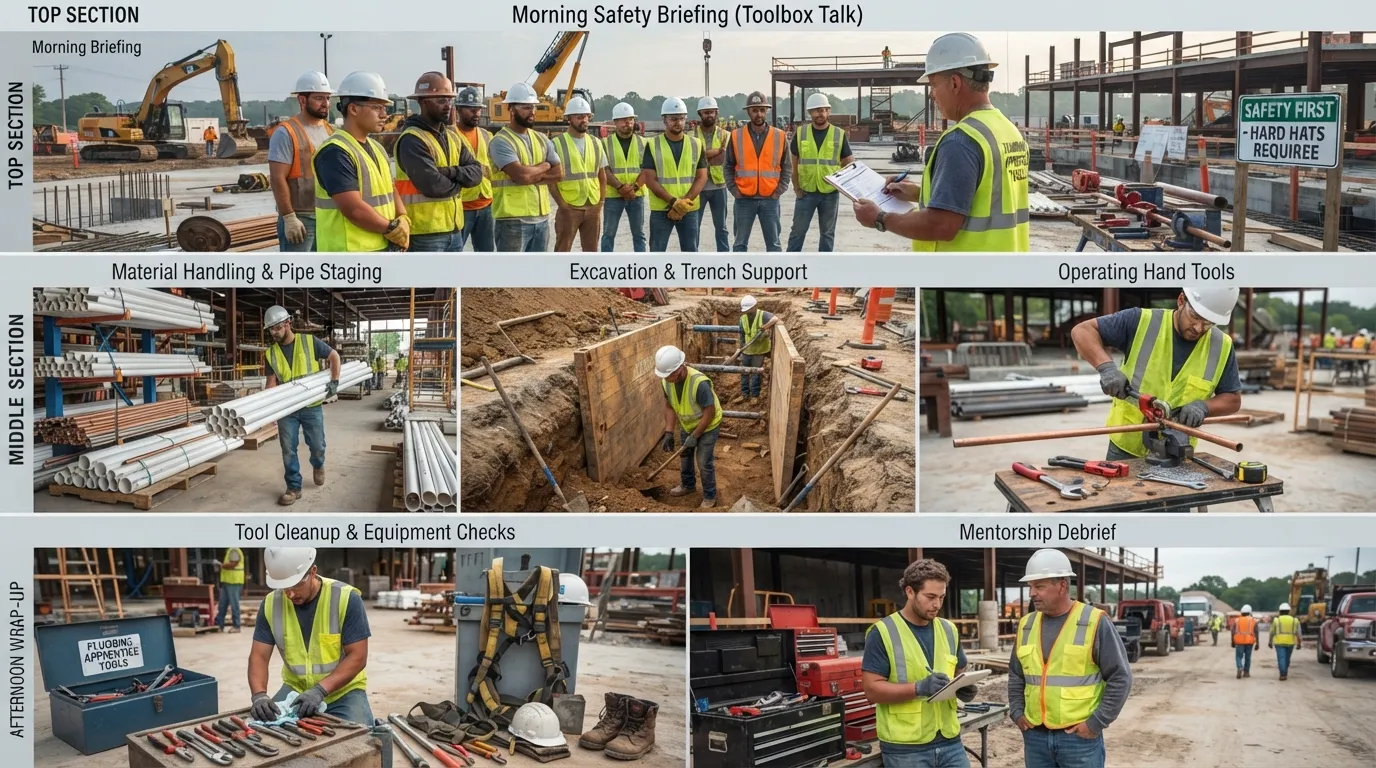
Early Morning Start: The workday typically begins around 6:00 AM or 7:00 AM with a mandatory morning safety briefing (toolbox talk) to review site hazards and daily objectives.
Core Jobsite Execution: First-year apprentices spend their hours assisting journeymen by staging materials, organizing tools, prepping pipe runs, and maintaining jobsite cleanliness.
End-of-Day Wrap-Up: The afternoon concludes with organizing equipment, securing tools, cleaning the work area, and debriefing with the lead journeyman on the next day’s goals.
Common First-Year Tasks
Material Handling and Staging: Transporting pipes, fittings, valves, and heavy equipment to exact installation zones across multi-story commercial or residential sites.
Trenching and Excavation Support: Assisting with digging, grading, and shoring trenches for underground water supply lines and sanitary drainage systems.
Cutting, Reaming, and Threading: Operating manual and power tools to measure, cut, ream, and thread steel, copper, or PVC piping to precise dimensions.
Tool Preparation and Maintenance: Ensuring that saws, threading machines, press tools, and safety gear are fully charged, calibrated, and ready for immediate use.
Year 3 vs. Year 5: How the Work Changes
Year 3 Proficiency: Apprentices transition to independent layout work, pipe hanging, testing pressure systems, and installing residential and commercial fixtures under general supervision.
Year 5 Mastery: Senior apprentices read complex isometric blueprints, coordinate multi-trade installations, troubleshoot advanced system failures, and mentor first-year helpers.
Real Residential Jobs You’ll Learn From
Drain Systems: Mastering commercial and residential drain cleaning techniques to clear stubborn blockages and root intrusions.
Water Heaters: Assisting with standard tank and tankless water heater installation and repair to ensure compliance with fuel and electrical codes.
Leak Diagnostics: Utilizing advanced acoustic and thermal equipment during leak detection procedures to locate hidden pipe failures behind walls or slabs.
Fixture Maintenance: Performing precision toilet repair and flush valve overhauls in high-use commercial and residential facilities.
Sump Pump Reliability: Installing and servicing sump pump systems to ensure proper below-grade groundwater management and prevent basement flooding.
Tips to Excel as an Apprentice
Be Early and Prepared: Arrive 15 minutes before shift starts with all required PPE and hand tools ready for action.
Ask Smart Questions: Never guess when handling high-pressure lines or electrical connections; always clarify instructions with your journeyman.
Carry a Pocket Notebook: Jot down fitting sizes, code rules, tool names, and step-by-step procedures to accelerate your learning curve.
What If Your Supervisor Isn’t Around?
Review Safety Protocols: Pause work and consult your blueprint or safety manual if an unexpected site condition arises while your journeyman is temporarily away.
Focus on Prep Work: Utilize unsupervised downtime to organize materials, clean up scrap, or prep upcoming pipe assemblies.
Journeyman Insights and What I Wish I Knew
Field Perspective: “The biggest shock for beginners is realizing that plumbing is 50% geometry, math, and code compliance, and 50% wrench work. Once you master the blueprints, everything clicks.” — Senior Miami Union Journeyman.
What I Wish I Knew Early:
Protect Your Body: Invest in high-quality ergonomic knee pads, supportive boots, and proper lifting mechanics from day one.
Build Relationships: Your journeymen are your greatest mentors; treat every criticism as a masterclass in craftsmanship.
Quick Comparison Table
| Feature | Union Apprenticeship | Non-Union (Open Shop) Apprenticeship |
| Pay Scale | Standardized hourly scale with automatic step increases tied to hours. | Variable based on employer discretion, market rates, and performance. |
| Benefits | Comprehensive, employer-funded health, dental, and pension packages. | Varies widely; some offer benefits, while smaller shops offer minimal coverage. |
| Training Structure | Rigorous JATC classroom hours combined with structured OJT. | Often on-the-job focused with optional or online evening classes (e.g., ABC). |
| Job Security | High stability through union hall dispatch lists during economic shifts. | Tied directly to the specific open shop contractor’s project backlog. |
| Entry Difficulty | Highly competitive selective application windows and aptitude exams. | Generally more accessible and faster to start with local independent contractors. |
| Costs and Dues | Monthly working dues, initiation fees, and minor book fees. | Typically no union dues, though out-of-pocket tool costs still apply. |
| Flexibility | Rigid scheduling and contractual obligations governed by collective bargaining. | Often offers greater schedule flexibility or easier switching between local employers. |
Pros of Union Apprenticeships
Guaranteed Wage Progression: Pay rates escalate predictably according to strict collective bargaining agreements, ensuring you never have to negotiate your own raises.
Comprehensive Total Compensation: Benefit packages, including robust retirement pensions and family health insurance, are fully funded by employers without shrinking your hourly take-home pay.
Standardized, High-Quality Training: State-certified Joint Apprenticeship and Training Committee (JATC) programs provide thousands of hours of rigorous, debt-free instruction.
Unmatched Job Mobility: If a project wraps up or your contractor slows down, the union hall dispatches you to a new job site, keeping your employment stable.
Pros of Non-Union (Open Shop) Apprenticeships
Faster Entry Options: Open shop contractors and merit-shop associations (such as the Associated Builders and Contractors) often hire helpers immediately without long waiting periods.
Flexible Career Growth: Merit-shop environments can allow high-performing apprentices to negotiate pay raises and career advancement directly with company owners.
Diverse Project Exposure: Smaller open-shop contractors may expose you to residential remodeling, light commercial work, and service plumbing earlier in your training.
Local Independence: Direct employment relationships give you autonomy over which company you work for without navigating union hall dispatch rules.
Trade School vs. Apprenticeship: Where Do They Fit?
The Theory-First Approach: Standalone trade schools and community colleges teach foundational plumbing theory, codes, and basic shop skills in a classroom setting.
The Missing Link: Trade schools require tuition payments and do not guarantee paid field hours or direct job placement upon completion.
The Ultimate Hybrid: Union and registered apprenticeship programs integrate classroom learning directly with paid on-the-job experience (Earn While You Learn), making standalone trade school largely redundant for serious trade candidates.
Which Path Fits You?
If you want maximum long-term pension security, guaranteed wage steps, and structured training: A union apprenticeship is the clear choice.
If you want to start working immediately without waiting for an annual union application window: A non-union open shop provides a faster pathway into the field.
If you prefer negotiating your own compensation based on individual merit: Open shop contractors offer direct flexibility that collective bargaining does not.
If you value safety, standardized standards, and lifelong journeyman backing: The union model provides an unmatched professional network and career protection.
How Hard Is the Program?
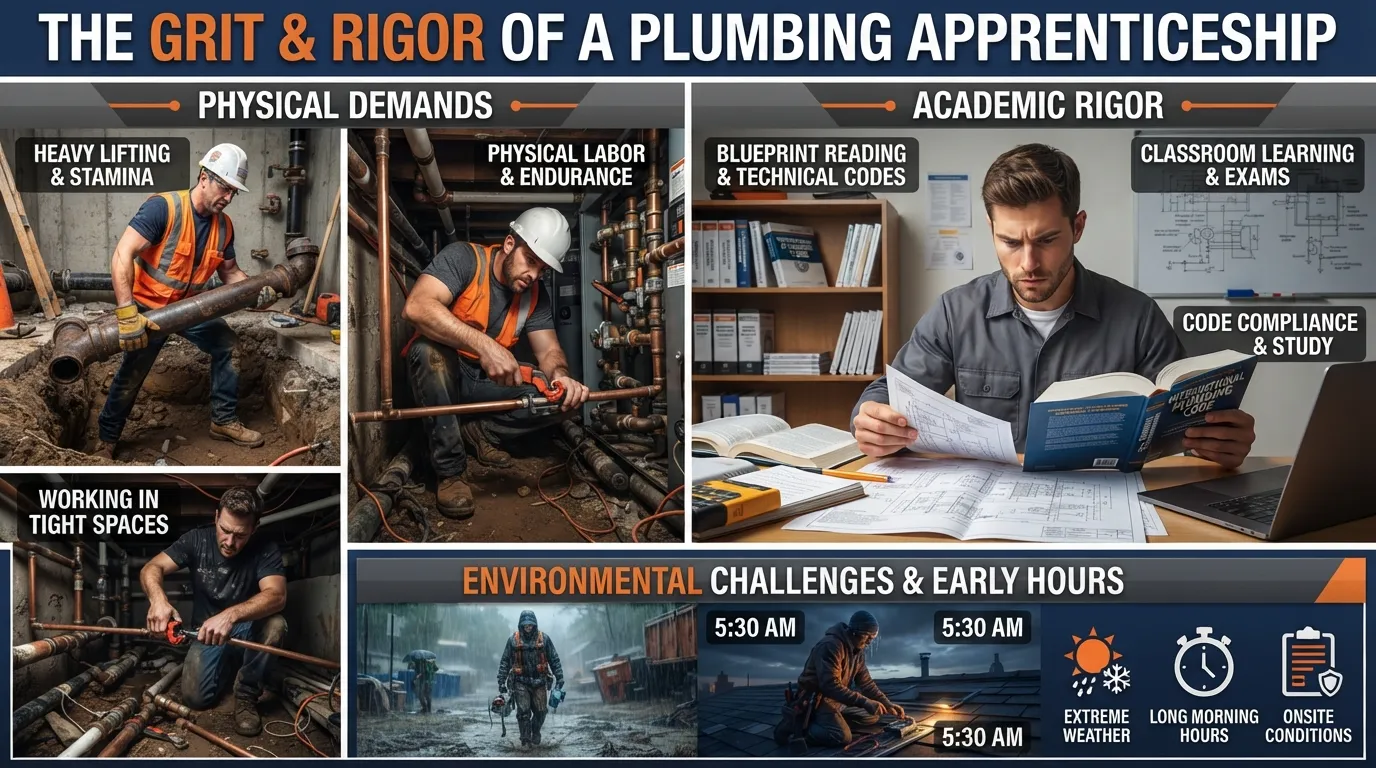
Entering a plumbing union apprenticeship is an immense test of resilience, time management, and grit. The difficulty stems from balancing rigorous academic requirements with demanding manual labor:
Physical Demands: Expect long hours of heavy lifting, bending, kneeling, overhead work, and crawling in tight or confined spaces.
Study Load: After a full 8-hour workday on the job site, apprentices must attend night classes 2 to 3 nights per week, completing complex math, drafting, and code study.
Environmental Elements: Work frequently occurs outdoors or in unconditioned, active construction sites exposed to extreme heat, cold, dust, and moisture.
How Competitive Is Admission?
Because union apprenticeships offer top-tier compensation and zero-debt training, applicant pools are fiercely competitive.
Selective Ratios: Local JATCs often receive hundreds of applications for only a few dozen available slots.
Ranking Matrices: Admission is entirely merit-based, determined by combining scores from your aptitude exam, panel interview, and high school transcripts. Standing out requires high test scores, professional presentation, and demonstrable work ethic.
Pros: The Rewards of the Union Path
Debt-Free Education: Learn a lucrative, high-demand trade while earning a paycheck, bypassing tens of thousands of dollars in traditional college student debt.
Comprehensive Benefits: Enjoy full employer-funded health insurance, dental coverage, and robust retirement pension and annuity accumulation.
Unshakeable Job Security: Union hall dispatch systems ensure continuous employment opportunities across major projects without hunting for work independently.
Guaranteed Wage Steps: Clear, contractual pay increases reward your progression every 6 to 12 months as you log field hours and classroom credits.
Cons: The Challenges and Realities
Physical Wear and Tear: Long-term trade work takes a physical toll on joints, knees, and backs if proper ergonomics and safety protocols are ignored.
Strict Schedules and Early Mornings: Job sites start early—often requiring 6:00 AM arrivals—with zero tolerance for tardiness or unexcused absences.
Travel and Commuting: Job sites change regularly; you may face lengthy daily commutes depending on your local union’s jurisdictional coverage area.
Market Fluctuation: Economic shifts can occasionally lead to brief layoffs or waiting periods between project dispatches.
Is It Worth It? A Realistic Look at 5-Year and 10-Year Outcomes
At Year 5 (Graduation): You graduate debt-free as a certified journeyman plumber earning full scale wages, with over 8,000 hours of documented field experience and college credit equivalents under your belt.
At Year 10 (Mid-Career): Many union journeymen transition into supervisory roles as foremen, project managers, or union instructors, with total compensation packages far exceeding average white-collar starting salaries.
Is It Right for You?
Review this short self-check list to determine if you are built for the trade:
Are you willing to wake up early and embrace physically demanding work in all weather conditions?
Can you commit to 5 years of steady evening classes and strict homework schedules?
Do you value structured rules, safety standards, and collective bargaining protections?
Are you looking for a debt-free career with guaranteed long-term pension growth?
Career Path After Your Apprenticeship: Journeyman and Beyond

Becoming a Journeyman: Certification and State Licensing
Completing your 5-year union apprenticeship marks the transition from a supervised trainee to a certified journeyman plumber. Upon graduation, you receive your official completion certificate, validating thousands of hours of combined on-the-job training and JATC classroom instruction.
State and Local Licensing: While union certification verifies your technical training, legal independent work often requires passing local or state board examinations. Journeyman status gives you the credentialed experience needed to test for municipal and regional certificates of competency.
Independent Execution: As a journeyman, you can run complex system installations, read detailed blueprints independently, and direct helper apprentices on active job sites.
Service Plumbing vs. Construction/Commercial Plumbing
As you step into your post-apprenticeship career, you generally choose between two primary paths:
Commercial & Construction Path: Focuses on large-scale builds, multi-story infrastructure, and heavy mechanical systems. Perfect for those who enjoy reading complex blueprints and handling heavy structural installations like commercial plumbing networks.
Service & Repair Path: Focuses on diagnostic work, troubleshooting, and direct client interaction. Ideal for plumbers who thrive on variety, resolving critical system failures, and executing emergency plumbing calls or everyday residential plumbing services. (Optional sub-specialty: heavy infrastructure and sewer line services).
Specializations
Journeymen can dramatically increase their market value and earning potential by earning specialized industry certifications:
Medical Gas Certification: Qualifies you to install and test specialized medical oxygen and vacuum lines in hospitals and surgical centers.
Backflow Prevention Certification: Authorizes you to test, inspect, and repair cross-connection backflow assemblies to protect public water supplies.
Sewer and Underground Specialist: Focuses on heavy excavating, trenchless pipe bursting, and municipal storm utility work.
Steamfitting & HVAC Crossover: Cross-training in high-pressure steamfitting, industrial chillers, and commercial HVAC systems.
Moving Up: Foreman, Superintendent, Estimator, Master Plumber, Contractor
The union ladder offers multiple pathways away from physical tool work into high-paying leadership and management roles:
Foreman: Directs crews on-site, manages daily material flow, and coordinates with general contractors.
General Superintendent: Oversees multiple job sites, manages labor allocations, and ensures large projects stay on schedule.
Estimator: Uses blueprint analysis and material cost data to bid on commercial and industrial projects.
Master Plumber / Contractor: Holds the top-tier credential required to start an independent plumbing contracting business, pull permits, and hire licensed staff.
Florida Licensing Note
If you are practicing in Florida, licensing is governed by the Florida Department of Business and Professional Regulation (DBPR) and its Construction Industry Licensing Board (CILB). While local jurisdictions handle municipal journeyman cards, operating an independent contracting business across the state requires a Certified Plumbing Contractor (CFC) license.
State Requirements: The DBPR requires at least four years of verified plumbing experience (including time as a worker and foreman) and passing scores on the Business and Finance exam and the rigorous Plumbing Trade Knowledge exam (which includes multi-hour isometric drawing evaluations). Always cross-reference your hours with your local union hall to ensure smooth state reciprocity and documentation.
Related Union Trades: Pipefitter and HVAC Apprenticeships
If you love mechanical systems but want to explore adjacent paths within the United Association (UA), consider these related programs:
Pipefitters Union Apprenticeship: Focuses on high-pressure industrial piping, power plants, refineries, and complex welding systems. Pipefitters union apprenticeship pay scales often mirror or exceed standard plumbing rates due to the specialized welding certifications required.
HVAC Union Apprenticeship Program: Concentrates on commercial heating, ventilation, air conditioning, and refrigeration (HVAC/R) controls, electrical troubleshooting, and automated climate systems.
Frequently Asked Questions FAQ
How much do union plumbing apprentices make?
Union plumbing apprentices start earning an hourly wage that is a predetermined percentage of a fully certified journeyman’s rate, typically beginning around 40% to 50%. Pay increases automatically every 6 to 12 months as you complete required on-the-job hours and classroom training milestones, accompanied by fully employer-paid health and retirement benefits.
How hard is a plumbing apprenticeship?
A plumbing apprenticeship is physically and mentally demanding, requiring five years of combined service. Apprentices work full-time days carrying heavy materials, kneeling, and crawling in tight spaces, followed by two to three nights per week of rigorous classroom instruction covering advanced math, blue-print reading, and local plumbing codes.
What does a first year plumbing apprentice do?
First-year plumbing apprentices assist journeymen plumbers on active job sites by organizing equipment, staging piping materials, prepping trenches, measuring and cutting pipes, maintaining job site safety, and handling cleanup duties while learning the foundational hand and power tools of the trade.
What should a first year plumbing apprentice know?
A first-year plumbing apprentice should understand fundamental math, basic fractions and algebra, safety protocols like OSHA guidelines, proper personal protective equipment (PPE) usage, and a willingness to accept direction, ask questions, and learn from experienced journeymen.
How easy is it to get a plumbing apprenticeship?
Getting a union plumbing apprenticeship is quite competitive rather than easy. Because programs provide debt-free training and high compensation, local JATC committees receive hundreds of applications for limited openings, requiring applicants to pass strict aptitude exams and panel interviews.
Is it hard to be a union plumber?
Being a union plumber is challenging due to the heavy physical labor, early morning schedules, strict adherence to safety and building codes, and ongoing technical education required. However, the structured support system and mentorship make mastering the trade achievable and deeply rewarding.
Is a plumbing apprenticeship worth it?
A plumbing apprenticeship is exceptionally worth it for individuals seeking a high-paying, recession-resistant career. It allows you to earn a full-time paycheck while learning, graduate completely debt-free, and secure lifelong medical and pension benefits that far outweigh traditional college paths.
How do you join the plumbing union?
Joining a plumbing union involves locating your nearest United Association (UA) local union hall or JATC training center, submitting an application during an open recruitment window, providing high school transcripts and ID, passing a standardized aptitude test, and completing a panel interview.
How to become a union plumber with no experience?
You can become a union plumber with no prior experience by applying directly to a JATC entry-level apprenticeship program. Local unions specifically train novices from scratch, combining paid on-the-job field experience with classroom instruction so you can learn the trade professionally from day one.
What is the lowest level of plumber?
The entry-level classification in the trade is a helper, pre-apprentice, or first-year apprentice. In this role, you work under the direct supervision of licensed journeymen and master plumbers while gaining foundational job site experience and completing initial safety training.
Do you get paid during a union plumbing apprenticeship?
Yes, union plumbing apprentices are paid for all hours worked on the job site under the “earn while you learn” model. Your hourly wages increase progressively every year as you accumulate field experience and advance through your classroom milestones.
Conclusion + Next Steps
Key Takeaways
Program Duration: A traditional plumbing union apprenticeship spans five years of combined, structured on-the-job training and night-school instruction.
Earn-While-You-Learn Pay: Apprentices receive regular hourly pay scales that increase automatically every 6 to 12 months, graduating completely debt-free.
Rigorous Entry Requirements: Admission to competitive programs requires a high school diploma or GED, a passing score on a standardized aptitude exam, and a formal panel interview.
The Career Outcome: Graduates step directly into certified journeyman roles with lifelong pension benefits, high earning potential, and elite craft mastery.
Your Next Steps
Locate Your Local Union: Visit the United Association (UA) directory to find your nearest local union hall or Joint Apprenticeship and Training Committee (JATC).
Prepare for the Aptitude Test: Brush up on basic algebra, reading comprehension, and mechanical reasoning to secure a high ranking on the entrance exam list.
Gather Your Documents: Prepare your transcripts, identification, and a professional resume to apply immediately during the next open recruitment window.
Need a Plumber, Not a Career?
If you need a licensed plumber today, you can book plumbing service here.
Main Services
Related Posts
Need a Plumber in Miami?
Schedule service online or speak directly with the EZ Plumbing team.
Owner-Led Local Service
Know who is behind the business before you request service. The owners, contact line and Miami service pages are published clearly.
- Named business owners
- Direct phone and social channels
- Local Miami service information
Clear Help Before You Book
Review the relevant service page, contact the team directly and use the booking page when you are ready—without relying on vague claims.
- Service-specific information
- Direct questions before scheduling
- Clear online booking route