Choosing a plastic water pipe is not simply about picking the cheapest pipe or the one that looks right. The best option depends on where the pipe will be installed, whether it carries hot or cold water, the required pressure and temperature rating, the joining method, and local plumbing requirements.
What Is the Best Plastic Water Pipe?
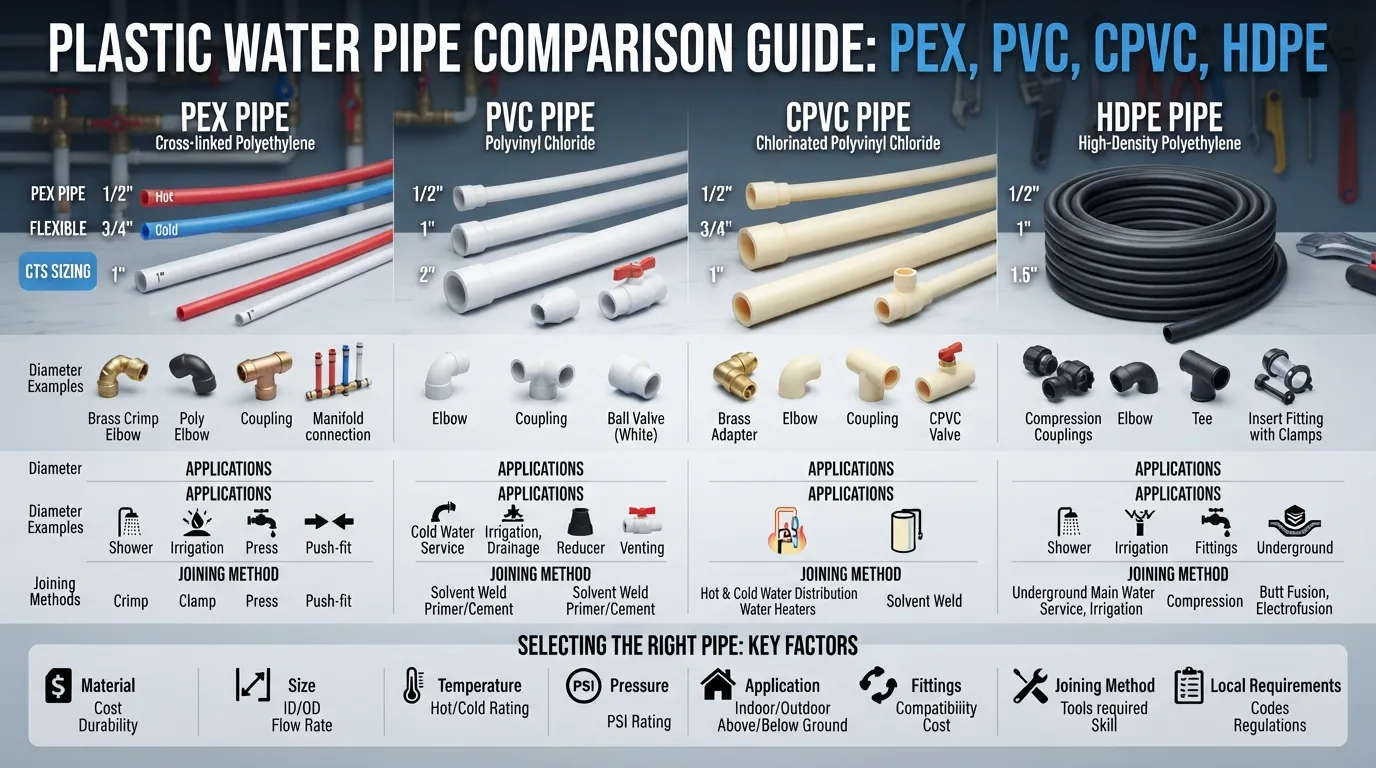
There is no single plastic water pipe that is best for every job. PEX, PVC, CPVC, and HDPE each have different characteristics and common applications. PEX is widely used for flexible indoor water-supply routing, PVC is commonly used for approved cold-water and irrigation applications, CPVC is designed for hot- and cold-water distribution when properly rated, and HDPE is valued for toughness and flexibility in applications such as underground water service. The right choice should always match the pipe’s intended use, rating, fittings, installation method, and applicable plumbing requirements.
If you are replacing a water line, planning new plumbing, or simply trying to identify the pipe already installed in your home, the material name is only the starting point. You also need to know what the pipe is designed to handle.
In this guide, I’ll walk you through the main types of plastic water pipe, where each is commonly used, how PEX compares with PVC and CPVC, how to identify plastic pipes, what to know about sizes and fittings, and how to choose a suitable pipe for your project.
What Is Plastic Water Pipe?
Plastic water pipe is tubing or pipe manufactured from polymer-based materials for applications such as water distribution, service lines, irrigation, and other plumbing systems. Unlike traditional metal piping, plastic systems are generally lightweight and are available in several materials with different properties.
The most commonly encountered materials in residential and water-service applications include PEX (cross-linked polyethylene), PVC (polyvinyl chloride), CPVC (chlorinated polyvinyl chloride), and HDPE (high-density polyethylene).
These materials are not interchangeable. A pipe that is suitable for cold water or irrigation should not automatically be assumed to be suitable for hot potable water, and a pipe designed for one joining system should not be connected using a method intended for another material.
Types of Plastic Water Pipe
The four materials below are the most important ones to understand when comparing plastic water pipes.
1. PEX Water Pipe
PEX stands for cross-linked polyethylene. Its flexibility is one of its biggest advantages because the tubing can often be routed around obstacles more easily than rigid pipe.
PEX is commonly used for indoor hot- and cold-water supply lines when the specific product is rated and approved for the intended application. Its flexibility can also reduce the number of fittings needed in some layouts.
PEX systems may use different connection methods, including crimp, clamp, press, or other manufacturer-approved systems. The fittings and tools must be compatible with the particular PEX system being installed.
2. PVC Water Pipe
PVC stands for polyvinyl chloride. PVC is rigid, lightweight, and commonly used for applications such as approved cold-water lines and irrigation systems, depending on the specific pipe classification and local requirements.
One important point is that ordinary PVC should not simply be assumed to be suitable for hot-water service. Always check the product’s temperature rating and intended application before using it.
PVC systems commonly use solvent-cement joining with compatible fittings and components.
3. CPVC Water Pipe
CPVC means chlorinated polyvinyl chloride. It is related to PVC but is formulated for applications involving higher water temperatures.
CPVC is commonly associated with hot- and cold-water distribution when the particular product is properly rated for that service. Like PVC, CPVC commonly uses compatible solvent-cement joining systems.
Because PVC and CPVC have different application characteristics, you should not treat the two materials as identical simply because their names are similar.
4. HDPE Water Pipe
HDPE stands for high-density polyethylene. It is known for toughness and flexibility and is commonly used in underground water-service and other application-specific systems.
HDPE joining methods can differ from the methods used for PEX or PVC. Depending on the system, mechanical connections or fusion-based joining may be used, so compatibility matters from the beginning of the project.
PEX vs. PVC vs. CPVC vs. HDPE: Which One Should You Choose?
The best material depends on the application rather than the material name alone. Use the comparison below as a starting point, then verify the specific product rating and local requirements.
Important: “Best” Depends on the Job
Don’t choose a pipe solely because someone says one material is universally better. Temperature, pressure, location, water type, exposure, installation method, fittings, manufacturer requirements, and local plumbing code can all affect the correct choice.
Plastic Water Pipe by Application
A much better way to select plastic pipe is to start with the application.
Indoor Plumbing
For indoor residential water distribution, PEX and CPVC are common materials to evaluate, provided the specific products are approved and rated for the intended service. The layout, temperature, pressure, connection system, and local requirements still matter.
Hot Water
Hot-water applications require particular attention to temperature ratings. A plastic pipe being labeled “water pipe” does not automatically mean it is suitable for hot water. Check the manufacturer’s specifications and the applicable plumbing requirements.
Cold Water
Cold-water systems offer more material options, but the pipe still needs to be appropriate for the intended water service. PVC, PEX, CPVC, and HDPE can all appear in different water applications, but their suitability depends on the particular product and installation.
Outdoor or Irrigation Lines
PVC and HDPE are commonly encountered in outdoor and underground applications, while the correct choice depends on the installation conditions and the specification of the pipe. Exposure, burial depth, pressure, fittings, and local requirements should be considered before installation.
Underground Water Service
Underground systems have different demands from exposed indoor plumbing. Flexibility, soil conditions, mechanical protection, pressure rating, connection method, and local requirements all matter. HDPE can be an important option for suitable underground applications, but the exact product specification should be verified.
How to Choose the Right Plastic Water Pipe
Before buying pipe, I recommend answering these questions first:
- Is the pipe for indoor, outdoor, or underground use?
- Will it carry hot water, cold water, or both?
- Is the system for potable water, irrigation, or another application?
- What pressure and temperature ratings are required?
- What joining method will the system use?
- Are the pipe and fittings designed to work together?
- What does your local plumbing code require?
- Does the manufacturer’s documentation approve the pipe for your intended application?
A Simple Selection Rule
Indoor + flexible routing: Evaluate properly rated PEX systems.
Cold-water/approved rigid applications: PVC may be appropriate depending on the exact product.
Hot- and cold-water distribution: Evaluate properly rated PEX or CPVC systems, among other approved options.
Underground/service applications: Evaluate HDPE or other approved systems based on the project specifications.
How Do I Tell If I Have PEX or PVC?
If you are trying to identify a pipe already installed in your home, don’t rely on color alone. Plastic pipe can have different colors depending on the manufacturer and application.
Instead, look for several clues together:
- Printed markings on the pipe wall.
- Whether the pipe is flexible or rigid.
- The type of fittings or connections attached to it.
- Where the pipe is installed.
- Whether it serves hot or cold water.
- Any visible manufacturer, standard, size, or rating information.
PEX is generally flexible tubing, while PVC is generally rigid pipe. However, the safest identification method is to read the markings and confirm the material rather than making a decision from appearance alone.
Plastic Water Pipe Sizes Explained
Plastic water pipe comes in a range of sizes, and the correct size depends on the system design rather than simply choosing the largest or smallest pipe available.
When selecting a size, pay attention to the pipe’s nominal size, actual dimensions, pressure rating, flow requirements, fittings, and the requirements of the overall plumbing system.
You may also see searches for 4-inch plastic water pipe, 5-foot or 10-foot pipe sections, and other size-specific products. These searches can refer to very different applications, so the physical size alone does not tell you whether a particular pipe is suitable for a water-supply system.
Don’t size a water line by outside diameter alone. Confirm the pipe standard, nominal size, wall dimensions, pressure rating, and compatible fittings before purchasing materials.
Common Plastic Water Pipe Fittings
Pipe and fittings are part of the same system. Choosing the correct pipe but pairing it with incompatible fittings can create installation and reliability problems.
Common fitting categories include:
- Elbows: change the direction of the pipe.
- Tees: create a branch connection.
- Couplings: connect compatible pipe sections.
- Reducers: connect different pipe sizes where the system allows it.
- Adapters: transition between compatible connection types.
- Unions: provide a disconnectable connection where the system design permits one.
The fitting must match the pipe material, size, connection method, pressure and temperature requirements, and intended application. A fitting that physically fits is not necessarily a fitting that is approved for the system.
How Are Plastic Water Pipes Connected?
Different plastic piping systems use different joining methods. Common methods include solvent cement, mechanical connections, clamps, press connections, push-fit systems, and fusion methods, depending on the material and product system.
For example, PVC and CPVC commonly use solvent-cement systems, while PEX may use several mechanical or press-style connection systems. HDPE may use application-specific mechanical or fusion-based connections.
Never choose a joining method simply because it works on another type of plastic pipe. Follow the manufacturer’s installation instructions and use fittings and tools approved for that particular system.
How Long Does Plastic Water Pipe Last?
There is no single lifespan that applies to every plastic water pipe. Service life can vary significantly depending on the material, product design, temperature, pressure, water chemistry, installation quality, ultraviolet exposure, physical damage, and the conditions under which the pipe operates.
For that reason, I would not use one generic lifespan number to decide whether an entire plumbing system needs replacement.
If you are evaluating an older system, look at the pipe markings and material first. Then consider visible deterioration, leaks, repeated failures, changes in water service, previous repairs, and the conditions in which the pipe has been operating.
How Much Does Plastic Water Pipe Cost?
Pipe price can vary by material, diameter, length, pressure class, manufacturer, connection system, and where the product is purchased. A retail price for a section or coil also does not represent the total cost of a plumbing project.
For a replacement or installation project, the overall cost may include:
- Pipe and tubing.
- Fittings and adapters.
- Valves and other components.
- Required tools or equipment.
- Access to existing plumbing.
- Excavation or restoration for underground work, when applicable.
- Professional labor, permits, or inspections where required.
That is why comparing only the price per foot can give you a misleading picture of the final project cost.
PVC vs. PEX: Which Is Better?
Neither is universally better. The better option depends on what you are trying to accomplish.
Consider PEX When…
- Flexible routing is important.
- The system is for indoor water distribution.
- The selected product is properly rated for the intended hot- or cold-water service.
- The connection system and fittings are compatible.
Consider PVC When…
- A rigid pipe system is appropriate.
- The application is an approved cold-water or irrigation use.
- The product’s rating matches the operating conditions.
- The solvent-cement system and fittings are compatible.
The important point is to compare the actual application, not simply ask which material is “better.”
Before You Buy Plastic Water Pipe, Check These 7 Things
- Material: Confirm whether you need PEX, PVC, CPVC, HDPE, or another approved material.
- Application: Verify whether it is intended for indoor, outdoor, underground, potable-water, irrigation, hot-water, or cold-water service.
- Size: Confirm the nominal size and actual dimensions required by the system.
- Pressure and temperature: Make sure the product rating matches the operating conditions.
- Fittings: Use fittings specifically compatible with the pipe and joining method.
- Installation: Follow the manufacturer’s instructions rather than mixing connection methods.
- Local requirements: Verify applicable plumbing codes, approvals, permits, and inspection requirements before installation.
When Should You Hire a Plumber?
A small, accessible repair may be straightforward for an experienced DIYer, but whole-house water-line work is different. If you are replacing multiple lines, changing pipe materials, working on an underground service line, dealing with hidden leaks, or unsure about sizing and code requirements, professional help can prevent an incorrect installation from becoming a larger problem.
If you need help with a plumbing project, you can learn more about professional plumbing services and determine what type of plumbing assistance fits your situation.
For broader information about the company and the plumbing resources available, you can also visit the Miami Florida Plumbing home page.
Frequently Asked Questions About Plastic Water Pipe
Key Takeaways
- PEX, PVC, CPVC, and HDPE are important plastic pipe materials, but they serve different purposes.
- The right pipe depends on temperature, pressure, location, application, size, fittings, and local requirements.
- PEX is valued for flexibility, while PVC is rigid and commonly used for approved cold-water and irrigation applications.
- CPVC is designed for higher-temperature water applications when properly rated.
- HDPE is tough and flexible and is commonly considered for suitable underground and water-service applications.
- Do not identify or select pipe based on color alone.
- Do not assume that a pipe, fitting, or joining method is compatible simply because it physically fits.
Related Resources for Choosing Plastic Water Pipe
If you are comparing products before starting a project, manufacturer and industry resources can help you verify the intended application, product specifications, and installation requirements. Always use the manufacturer’s current documentation for the exact product you plan to install.
Fresh Water Systems: Types of Plastic Water Pipe
A&C Plastics: Types of Plastic Pipes for Plumbing
PVC Pipe Product Reference
Not Sure Which Plastic Water Pipe You Need?
If you’re dealing with a water-line replacement, leak, new installation, or a pipe material you cannot identify, getting the application and pipe specifications right is more important than simply choosing the most popular material.