If you are trying to replace, extend, or repair a PVC drain line, choosing the fitting by shape or pipe size alone can cause problems. A fitting also has to match the drainage system, connection style, direction of flow, and intended application.
In this guide, I’ll help you identify common PVC drain fitting types, understand sizes and connection terms, distinguish PVC DWV from sewer-and-drain systems, and decide what to check before connecting two pieces together. If you want to understand how these fittings relate to traps, drain pipes, cleanouts, and other components, see our complete guide to plumbing drain parts.
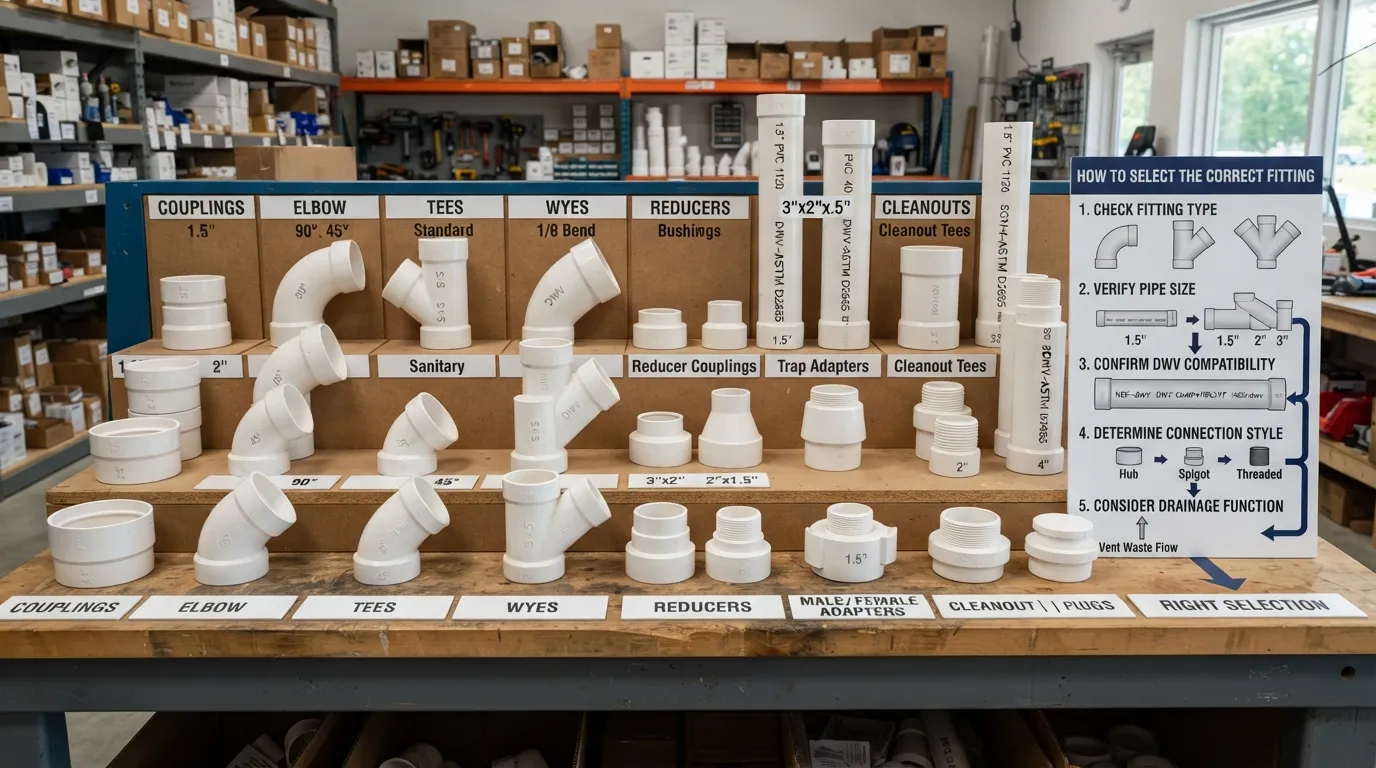
A PVC drain fitting is a connector used to join, turn, branch, transition, terminate, or provide access to compatible PVC drainage piping. To choose the right one, check four things before buying: the pipe system, nominal size, connection type, and the job the fitting must perform. A fitting marked “4 inch” is not automatically compatible with every other 4-inch PVC drainage product.
Choose Your PVC Drain Fitting by What You Need It to Do
If you already know what you need the pipe to do, this is the fastest way to narrow down the fitting type.
Usually: Coupling
Usually: Elbow, bend, or long-sweep bend appropriate for the drainage layout
Usually: Wye, combination fitting, or sanitary tee depending on orientation and application
Usually: Approved increaser, reducer, or reducing fitting
Usually: Purpose-made transition adapter
Usually: Cleanout fitting, cleanout adapter, and removable plug
This is a starting point, not a substitute for checking the fitting’s markings, manufacturer instructions, installation orientation, and applicable plumbing requirements.
What Is a PVC Drain Fitting?
PVC stands for polyvinyl chloride. In drainage systems, rigid PVC pipe can be connected with purpose-built fittings that change the way the piping system runs.
A PVC drainage fitting may be used to:
- Join two sections of drain pipe
- Turn the drainage line
- Create a branch connection
- Transition between approved pipe sizes
- Transition between compatible drainage systems
- Connect a fixture drain to rigid piping
- Provide access for drain cleaning or inspection
- Terminate an unused pipe end where appropriate
The important word is drainage. A PVC fitting designed for a pressurized piping application is not automatically the right fitting pattern for a gravity DWV drain simply because the material and nominal diameter appear to match. DWV systems use fitting geometries intended for drainage flow.
Common PVC Drain Fitting Types and What They Actually Do
PVC Coupling
A coupling joins two compatible sections of straight PVC pipe. It is one of the simplest sewer pipe connectors, but you still need to match the correct pipe system and nominal size.
If you are repairing an existing line where neither pipe end can move enough to enter a standard coupling, the repair may require a different approved connection method rather than forcing the pipe into place.
PVC Elbows and Bends
Elbows change the direction of a drain pipe. Common patterns include 22.5-degree, 45-degree, and 90-degree changes, along with long-sweep or long-radius drainage bends.
The angle is only part of the decision. Drainage fitting geometry matters because gravity drainage needs appropriate flow through directional changes. For DWV work, use the fitting pattern intended for that drainage application rather than assuming any sharply angled PVC pressure elbow is interchangeable.
Standard Elbow vs. Street Elbow
A standard solvent-weld elbow commonly has hubs on both ends. A street elbow has a spigot end on one side and a hub on the other. The spigot end can fit into a compatible hub, which can make a street fitting useful when space or fitting arrangement requires that connection style.
Look at the actual end configuration instead of judging the fitting only by its outside shape.
PVC Wye
A wye creates an angled branch, commonly at about 45 degrees. Its sweeping branch geometry makes it an important fitting in many drainage layouts.
If you are choosing between a tee and a wye, do not treat them as interchangeable versions of the same connector. Their geometry and permitted orientation can serve different purposes in a DWV system.
Sanitary Tee
A sanitary tee connects three lines and is a familiar fitting in drain, waste, and vent systems. However, the fact that a sanitary tee physically connects three pipes does not mean it is appropriate for every horizontal or vertical branch arrangement.
When branch direction matters, verify the required fitting pattern and orientation instead of selecting a sanitary tee solely because its openings line up with the pipes.
Both fittings create branches, but their internal sweep and intended orientation differ. If the fitting will carry wastewater and solids, the direction of flow and drainage configuration matter. Check the applicable plumbing requirements and fitting manufacturer’s intended use before substituting one for the other.
Combination Wye and Bend
A combination fitting joins a wye-type branch with a bend to create a more gradual directional transition. These fittings can be useful where a drainage branch must merge into another line with smoother geometry.
Reducer or Increaser
A reducing or increasing fitting transitions between approved pipe diameters. The direction and location of a size change matter in drainage design, so do not reduce a drain line simply because a smaller pipe would be easier to install.
PVC Adapter
An adapter changes connection styles or transitions between compatible pipe systems. This becomes especially important when Schedule 40 DWV piping meets sewer-and-drain piping that follows different dimensions.
Cleanout Adapter and Plug
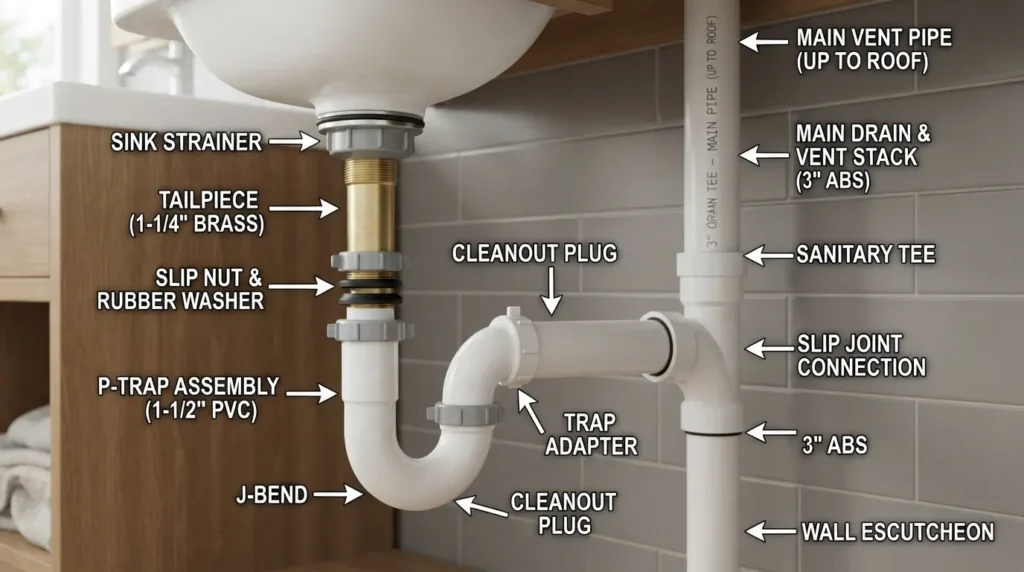
A cleanout provides an accessible opening into a drain line so the piping can be serviced without cutting the system apart. Cleanout assemblies may combine a solvent-weld or spigot connection with a threaded plug.
If you are planning a drain system, future service access is worth considering while the pipe is accessible—not after a clog develops behind a finished wall or underground.
Cap
A cap closes the end of a compatible pipe. It is different from a removable cleanout plug, so decide whether that location needs permanent termination or future service access before choosing one.
PVC Drain Fitting Sizes: There Is No Single “Standard” Size
One of the most common questions is, “What size is standard drain PVC?” The practical answer is that there is no single PVC drain size for an entire plumbing system.
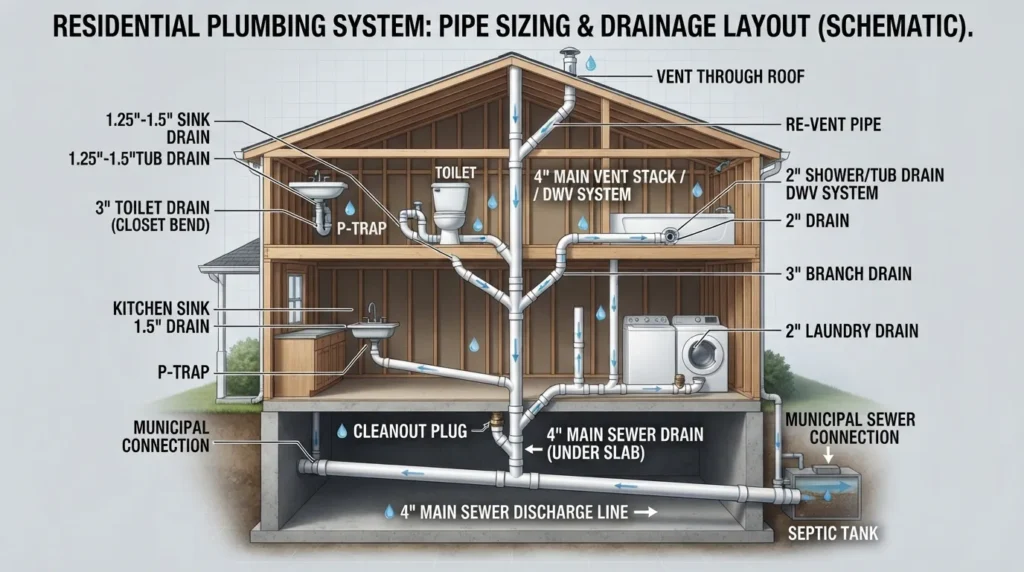
Drainage piping is manufactured in multiple nominal diameters. Residential DWV products commonly include sizes such as 1 1/4 inch, 1 1/2 inch, 2 inch, 3 inch, 4 inch, 6 inch, and other sizes. Exterior sewer and drainage product families frequently include 3-inch, 4-inch, 6-inch, and larger fittings.
The correct size depends on the section of the system, what it serves, its drainage load, the existing pipe, and applicable plumbing requirements.
Why Nominal Size Can Be Confusing
A pipe labeled “4 inch” does not necessarily measure exactly four inches across its outside diameter. Plumbing pipe uses nominal sizing, and different PVC pipe standards can have different actual outside dimensions even when their nominal size sounds the same.
Published Charlotte Pipe dimensions show why the words “4-inch PVC” are not enough to confirm compatibility:
- 4-inch Schedule 40 DWV PVC: published average outside diameter of 4.500 inches.
- 4-inch DR35 sewer PVC: published average outside diameter of 4.215 inches.
That is why a purpose-made transition fitting may be necessary even though both pipes are called 4 inch.
This is one of the most useful checks you can make before buying 4-inch PVC drain pipe fittings or sewer plumbing fittings: identify the pipe standard or system marking, not just the nominal number.
PVC vs. DWV Fittings: What Is the Difference?
This question is often phrased as “PVC vs. DWV,” but PVC and DWV are not opposite materials.
PVC describes the material: polyvinyl chloride.
DWV describes a drain, waste, and vent application/system.
Therefore, a fitting can be both PVC and DWV. In fact, PVC Schedule 40 DWV pipe and fittings are widely manufactured specifically for non-pressure sanitary drainage, waste, vent, sewer, and storm-drainage applications.
The more useful question is:
“Is this particular PVC fitting approved and dimensionally compatible with the drainage system I am working on?”
Schedule 40 DWV vs. Sewer & Drain vs. SDR: Why the Label Matters
Several products can all be described casually as “PVC drainage pipe,” but that does not make them interchangeable.
Rigid PVC drain, waste, and vent piping and fittings intended for compatible non-pressure DWV applications.
A category commonly used for non-pressurized underground sewer, drainage, and stormwater piping. Its connection dimensions may differ from Schedule 40 DWV.
Pipe identified by a dimensional-ratio specification. Do not assume an SDR/DR sewer pipe shares the same outside diameter or fitting connection as Schedule 40 merely because the nominal size matches.
Can Schedule 40 DWV Connect to Sewer & Drain Pipe?
Yes, transitions are possible when the correct compatible adapter is available for the two systems. Manufacturers sell DWV/Schedule 40-to-S&D adapters specifically for this purpose.
That is a better solution than trying to force an S&D fitting over Schedule 40 pipe, enlarging a hub, filling a loose joint with excessive cement, or improvising a connection that was never designed for the two dimensions.
Read the markings on the existing pipe and fitting. Confirm material + system + nominal size + connection type. If one of those four is unknown, do not assume that a fitting is compatible just because it looks close.
Hub, Spigot, Threaded, and Solvent-Weld Connections Explained
The abbreviations printed on a fitting often tell you more than its shape.
Hub or Socket
A hub is the enlarged female end of a fitting that receives the compatible pipe or spigot end. On product descriptions, you may see connections written as Hub x Hub or H x H.
Spigot
A spigot end is sized to enter a compatible hub. Street elbows are a useful example because they commonly combine one hub with one spigot connection.
Threaded Connections
Some adapters and cleanout fittings transition to female or male pipe threads. You may see abbreviations such as FPT for female pipe thread and MPT for male pipe thread.
A threaded cleanout plug is useful because it creates removable access rather than permanently sealing the opening.
Solvent-Weld Connections
Many compatible PVC DWV fittings are joined using PVC primer and solvent cement. Solvent welding is not simply “gluing” two pieces together; the primer and cement prepare and fuse the mating PVC surfaces according to the product’s installation instructions.
How to Join PVC Drain Pipes
If the pipe and fitting are designed for a solvent-weld connection, the basic process is straightforward—but the details matter.
- Confirm compatibility first. Verify PVC material, pipe system, nominal size, and fitting connection.
- Cut the pipe square. An angled cut reduces the mating area inside the fitting.
- Remove burrs and debris. Deburr the inside edge and prepare the outside edge as directed so loose plastic does not remain in the pipe.
- Dry-fit and plan the alignment. Check pipe length, fitting orientation, and branch direction before cement is applied.
- Prepare the mating surfaces. Follow the PVC primer requirements and the instructions supplied with the pipe, fitting, and solvent cement.
- Apply the correct PVC solvent cement. Coat the pipe and fitting socket as directed by the cement manufacturer.
- Assemble immediately. Insert the pipe fully into the fitting and use the assembly motion specified by the cement manufacturer; a quarter-turn during insertion is commonly specified for solvent-weld PVC joints.
- Hold the connection to prevent push-out. Do not release the joint immediately if the pipe is trying to move back out.
- Allow the required set and cure time. Cure time varies with the cement, pipe diameter, temperature, humidity, and application, so use the product-specific instructions rather than guessing.
Important:
Not every PVC sewer or drainage connection is solvent-welded. Some piping systems use gasketed connections or specialized adapters. Always identify the system before choosing the joining method.
Watch a Real PVC Drain-Line Repair
Seeing how an existing PVC drain is evaluated and realigned can make connection and fitting choices easier to understand. This video demonstrates a real-world PVC drainage repair and discusses alignment considerations.
How I Would Check a PVC Drain Fitting Before Installation
If you have a fitting in one hand and an existing drain pipe in the other, use this order instead of starting with diameter alone:
- Material: Is the existing pipe actually PVC?
- System: Is it Schedule 40 DWV, S&D, SDR/DR sewer pipe, or another drainage product?
- Nominal size: Do the marked sizes match the intended connection?
- End type: Hub, spigot, threaded, gasketed, or another connection?
- Function: Is the fitting pattern appropriate for joining, turning, branching, transitioning, or providing service access?
If all five are clear, you are much less likely to buy a connector that looks right on the shelf but is wrong for the drainage system.
Common PVC Drain Fitting Mistakes to Avoid
1. Assuming Every 4-Inch PVC Product Fits Every Other 4-Inch Product
This is one of the biggest compatibility traps. Nominal size is only one part of the identification. Schedule 40 DWV and sewer-pipe systems can have different actual dimensions.
2. Using a Pressure Fitting Pattern as a Drainage Fitting
PVC pressure fittings and PVC DWV fittings may share a material and nominal size, but their fitting geometry and intended service can differ. For DWV drainage, use the appropriate gradual drainage fitting pattern.
3. Treating Every Tee Like a Wye
A tee, sanitary tee, wye, and combination fitting are not interchangeable simply because all of them can create branches. The correct fitting depends on flow direction, orientation, and the drainage configuration.
4. Ignoring Hub and Spigot Ends
Two fittings that look almost identical can connect differently. Check whether the product is Hub x Hub, Hub x Spigot, threaded, or another configuration before planning the layout.
5. Forcing Misaligned Pipe Into a Fitting
A joint should not have to correct major pipe misalignment. Excessive stress can leave the connection under constant mechanical strain and make assembly difficult. Correct the alignment and use the fitting configuration intended for the repair.
6. Forgetting Future Cleanout Access
A drain may work perfectly when it is new, but clogs can occur later. Where cleanout access is required or appropriate, planning it during installation makes future service much easier.
7. Using the Wrong Joining Product
Use primer, solvent cement, gasket lubricant, transition components, or threaded-sealing methods only when they are specified for that pipe and fitting system. More cement does not make an incompatible joint compatible.
PVC Drainage for Sanitary Waste vs. Stormwater and French Drains
The phrase “PVC drainage” can describe more than one type of system.
Sanitary DWV piping carries waste from plumbing fixtures and works with the building’s vent system. Exterior stormwater drainage manages rainwater, surface water, downspouts, yard drains, catch basins, French drains, and similar applications.
Both systems may use PVC components, but the fittings and pipe standards are not automatically the same.
For example, exterior drainage products may be designed to connect S&D pipe, corrugated drainage pipe, channel drains, grates, downspouts, or pop-up emitters. An adapter may be needed when one drainage product must connect to another pipe system.
So if you are searching for stormwater connectors, French drain pipe fittings, PVC sewer fittings, or drainage pipe connectors, first decide what type of water the system is handling and what pipe standard is already installed.
Why Is PVC Used for Underground Drain Lines?
Where PVC is approved for the application, it offers several practical characteristics that make it useful in underground drainage systems:
- It does not rust like ferrous metal piping.
- Rigid PVC provides a smooth interior drainage path.
- It is comparatively easy to cut, transport, and assemble.
- A wide range of elbows, wyes, couplings, adapters, cleanouts, and sewer fittings is available.
- Different PVC systems are manufactured for sanitary drainage, sewers, and stormwater applications.
That does not mean every PVC pipe can be buried in every situation. Pipe type, bedding, support, depth, loading, joint method, and local requirements still have to match the installation.
When the Problem Is Not the Fitting
If you are researching PVC drain fittings because a sink, shower, floor drain, or main line is draining slowly, replacing a visible fitting may not solve the underlying problem.
Warning signs that the issue may be deeper in the drainage system include:
- A clog that repeatedly returns after being cleared
- Multiple fixtures draining slowly at the same time
- Water backing up from another drain when a fixture is used
- Drain flow that remains poor even when the accessible trap or fitting is clear
- A suspected blockage farther inside the branch or sewer line
In those situations, the next step may be diagnosis and professional drain cleaning in Miami rather than replacing PVC fittings at random.
PVC Drain Fitting FAQs
How do you join PVC drain pipes?
For compatible solvent-weld PVC drain pipe, cut and deburr the pipe, dry-fit the layout, prepare the mating surfaces, apply the specified primer and PVC solvent cement, fully assemble the joint, hold it against push-out, and allow the required cure time. Other sewer and drainage systems may use gasketed or specialized connections, so identify the pipe system first.
What is the difference between PVC and DWV fittings?
PVC is a material, while DWV stands for drain, waste, and vent. A fitting can therefore be both PVC and DWV. What matters is whether the particular fitting is designed and approved for the drainage application you are working on.
What are the different types of PVC drain fittings?
Common PVC drainage fittings include couplings, elbows, long-sweep bends, street elbows, sanitary tees, wyes, combination fittings, reducers or increasers, adapters, trap adapters, cleanout fittings, plugs, and caps. The correct fitting depends on what the drain line needs to do and how it is oriented.
What size is standard drain PVC?
There is no single standard size for all PVC drains. DWV piping is available in multiple nominal sizes, and the required diameter depends on the fixture or drainage section, system design, existing pipe, and applicable plumbing requirements.
Can you mix DWV and PVC?
The question is slightly misleading because PVC can itself be a DWV material. If you mean connecting PVC Schedule 40 DWV to another PVC drainage system such as S&D pipe, it may be possible with a purpose-made compatible transition adapter. Do not assume direct compatibility from nominal size alone.
What does DWV stand for?
DWV stands for Drain, Waste, and Vent. Drain and waste piping carries wastewater away, while the associated vent system helps the drainage system operate correctly and protects trap seals.
Why do contractors use PVC for underground drain lines?
Where it is approved for the application, PVC is corrosion-resistant, relatively easy to handle and assemble, and available in many drainage fittings and pipe systems. Underground installation still has to follow the requirements for the specific PVC product and project.
What are the four types of PVC?
There is no universal plumbing rule that divides PVC drain fittings into exactly four types. For drainage work, it is more useful to identify PVC by its intended piping system and fitting function—for example, Schedule 40 DWV, sewer-and-drain products, SDR/DR sewer piping, and the specific connectors designed to transition between compatible systems.
Match the System Before You Match the Shape
If you remember only one thing from this guide, make it this: a PVC drain fitting should never be chosen by appearance and nominal size alone.
First identify the pipe material and drainage system. Then confirm the nominal size and connection type. Only after those details match should you choose the coupling, elbow, wye, sanitary tee, adapter, cleanout, or other fitting that performs the required job.
That approach is especially important with 3-inch and 4-inch PVC drain fittings, where Schedule 40 DWV, sewer-and-drain, and SDR/DR products can look similar while using different dimensions or connections.
If you are in Miami and an existing drain connection is leaking, misaligned, repeatedly clogging, or difficult to identify, the local Miami plumbing team at EZ Plumbing Repair Services can help you determine the right next step.
Pipe dimensions, fitting patterns, connection terminology, and installation procedures can vary by product. Technical details in this guide were cross-checked against current manufacturer information from Charlotte Pipe, NDS, and Oatey. Always follow the markings and current installation instructions supplied with the exact pipe, fitting, primer, cement, or transition product you are using, along with applicable local plumbing requirements.