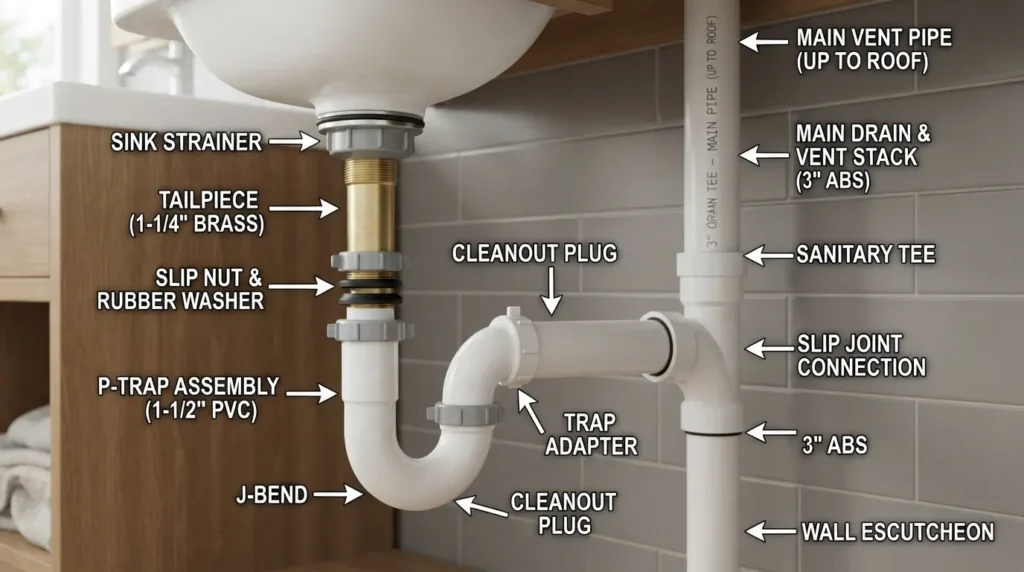
Plumbing drain parts are the components that move wastewater safely from sinks, tubs, showers, toilets, and other fixtures into the building’s drainage and sewer system. A typical drainage path starts at the fixture drain, passes through a trap, enters a drain pipe, connects to a larger branch drain, and then flows toward the main sewer line. The vent system works alongside these pipes to balance air pressure and help protect trap seals from siphoning.
Common drain parts include:
- Strainers and drain flanges
- Tailpieces and extension tubes
- Slip nuts and sealing washers
- P-traps and trap arms
- Elbows, wyes, and couplings
- PVC and other plumbing drainage fittings
- Vent pipes and vent stacks
- Cleanouts and sewer plumbing fittings
Each part must match the pipe material, diameter, connection type, and drainage application. Incorrect sizing or poorly matched fittings can lead to leaks, odors, slow drainage, and recurring clogs.
Need professional plumbing drain parts installation or emergency drain repair in Miami? Call +1 786 239 6529 for expert plumbing assistance.
Essential Sink and Basin Drain Parts
Kitchen and bathroom sinks rely on several connected sink drainage parts to move wastewater from the basin into the building drain without leaking or allowing sewer gases to escape. At the top of the assembly, a basket strainer or drain flange creates the opening through the sink. Below it, the tailpiece carries water downward and may connect to an extension tube when additional length is needed.
The lower assembly typically includes:
- Slip-joint nuts
- Cone washers
- P-trap
- Trap arm
- Trap adapter
- Wall drain connection
The slip-joint nut and cone washer create a removable seal between tubular drain sections, while the P-trap holds a small amount of water to help block sewer gases.
Kitchen plumbing drain parts are often more complex because a kitchen sink drain pipe kit may include double-bowl connections, dishwasher branches, or garbage disposal fittings. Bathroom plumbing drain parts are usually simpler and may include a pop-up drain assembly.
When replacing sink drain replacement parts, always match the component diameter, material, and connection type before installation.
Drain Parts Sink
A typical sink drain assembly connects the basin outlet to the wall drainage system through a series of removable and fixed components. Understanding the basic layout makes it easier to identify leaks, clogs, or damaged parts without replacing the entire assembly.
The main drain parts sink components include:
- Drain flange or basket strainer
- Tailpiece
- Extension tube where required
- Slip-joint nuts
- Cone or slip-joint washers
- P-trap
- Trap arm
- Trap adapter
- Wall drain connection
Common leak points include the seal beneath the drain flange, slip-joint connections around the trap, cracked plastic nuts, worn washers, and poorly aligned tubes. A drip at one connection does not always mean the entire drain assembly needs replacement.
The P-trap and trap arm also provide accessible points for inspecting localized blockages. However, deeper clogs may be located farther inside the branch drain.
For a complete component-by-component breakdown, identification tips, and repair guidance, read our drain parts sink guide.
PVC Drain Fitting
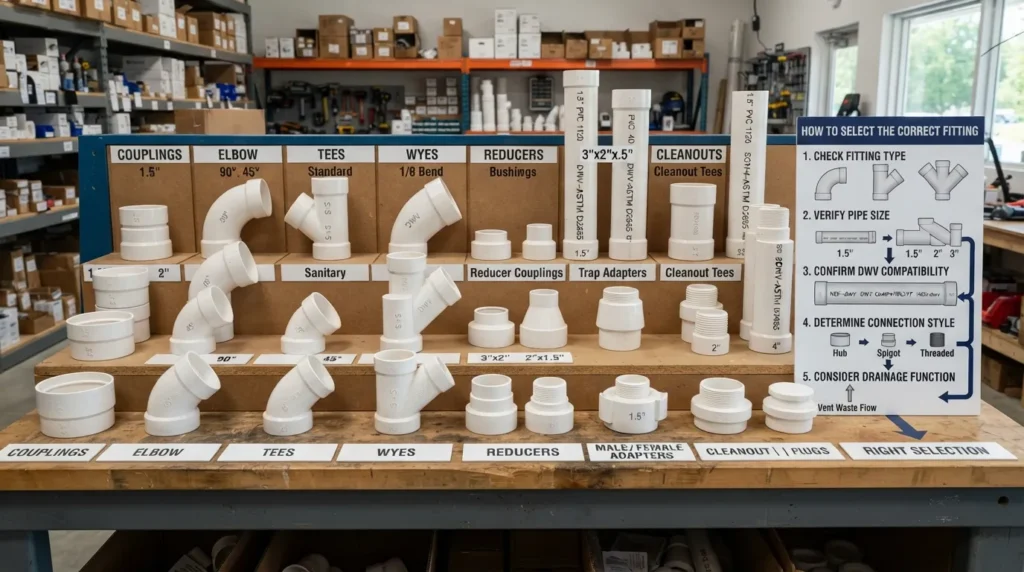
A PVC drain fitting connects, redirects, branches, reduces, or provides access to rigid PVC drainage piping. The correct fitting must match both the pipe diameter and the function of that section of the drainage system. Choosing a fitting based only on whether it physically fits the pipe can result in poor flow or an incorrect drainage configuration.
Common PVC drainage fittings include:
- Couplings for joining straight pipe sections
- Elbows and bends for changing direction
- Wyes for creating angled branch connections
- Sanitary tees for specific drainage and vent configurations
- Reducers for transitioning between approved pipe sizes
- Trap adapters for connecting tubular fixture drains to rigid piping
- Cleanouts for future drain access and maintenance
Drainage fitting geometry is important because wastewater and solids need to move smoothly through directional changes. Long-sweep fittings, wyes, and other DWV-specific components are designed for particular drainage applications.
Pipe size, material compatibility, fitting orientation, and connection method should all be verified before installation.
For a deeper breakdown of connectors, bends, branches, and applications, see our detailed PVC drain fitting guide.
Understanding Drain Pipes, Sizes, and Materials
Drain pipe performance depends on three factors: material, diameter, and application. A fixture drain carries wastewater away from an individual sink, tub, shower, or toilet. A branch drain receives discharge from one or more fixtures, while larger building and sewer drains carry wastewater toward the municipal sewer or private disposal system.
Common drainage materials include:
- PVC
- ABS
- Cast iron
- Copper DWV
- Polypropylene
- Corrugated plastic drainage pipe
Pipe diameter matters because each section must provide enough capacity for the fixtures it serves. Drainage systems also use nominal pipe sizing, so the stated pipe size may not exactly match a simple outside-diameter measurement.
Material compatibility is equally important. PVC, ABS, cast iron, copper, and tubular plastic components use different fittings, joining methods, and transition connectors. A fitting should never be selected by size alone.
Before replacing any drain pipe or fitting, identify:
- Existing pipe material
- Nominal size
- Drainage application
- Connection type
- Required transition method
Correct identification prevents leaks, poor alignment, restricted drainage, and incompatible repairs.
Drain Pipe Size
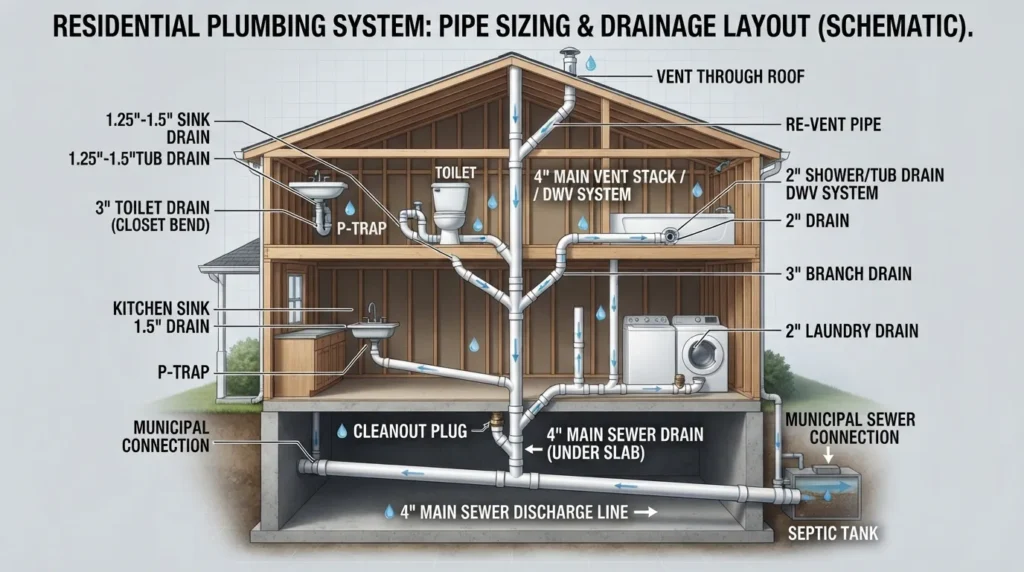
Choosing the correct drain pipe size is essential because fixture drains, branch lines, toilet waste piping, and building drains handle different wastewater volumes. Pipe size also determines which traps, fittings, reducers, couplings, and adapters can be used.
Commonly encountered residential sizes include:
| Application | Commonly Encountered Size |
|---|---|
| Bathroom sink | 1¼–1½ inch |
| Kitchen sink | Around 1½ inch |
| Shower | Commonly 2 inch |
| Larger branch drain | 2–3 inch |
| Toilet drain | Commonly 3–4 inch |
| Main/building drain | Typically larger sizes |
These dimensions are useful for identifying an existing system, but they should not be treated as universal installation rules. Pipe sizing can vary according to fixture type, drainage load, system configuration, and local plumbing requirements.
Also remember that tubular under-sink components and rigid DWV piping may use different sizing conventions. Always confirm the actual connection before purchasing replacement parts.
Actual required size depends on fixture load, system design, and applicable plumbing requirements.
For fixture-specific dimensions and sizing considerations, see the complete drain pipe size guide.
Plastic Drainage Pipe
The term plastic drainage pipe includes several different products, and they are not automatically interchangeable. The correct type depends on whether the pipe is carrying household wastewater, connecting an accessible sink trap, or managing exterior surface water.
The main categories include:
- Smooth rigid plastic pipe: Common in permanent drain, waste, and vent systems. PVC and ABS are typical examples.
- Tubular sink pipe: Lightweight plastic components used beneath sinks for tailpieces, extensions, traps, and removable slip-joint connections.
- Corrugated drainage pipe: Flexible ribbed pipe commonly associated with exterior drainage applications such as surface-water management.
Smooth interior walls generally make rigid DWV pipe suitable for controlled wastewater flow, while tubular components provide convenient access around fixtures. Corrugated pipe offers flexibility but serves a different purpose and may have greater internal resistance because of its ribbed construction.
Indoor and outdoor drainage systems also face different installation requirements. Do not substitute one plastic drainage product for another simply because the diameter appears similar.
Learn more about materials, applications, and limitations in our plastic drainage pipe guide.
3 Inch Drain Pipe Fittings
3 inch drain pipe fittings are commonly used in larger residential drainage systems where greater wastewater capacity is required. They may appear around toilet branches, soil and waste stacks, larger branch drains, and other sections carrying discharge from multiple fixtures.
Common 3-inch drainage fittings include:
- Couplings for joining straight pipe sections
- Wyes for creating angled branch connections
- Bends for changing direction
- Reducers for transitioning to another approved diameter
- Cleanouts for maintenance and blockage access
The fitting shape must match its drainage function. For example, a branch connection may require a wye or another approved directional fitting rather than a sharp turn that disrupts wastewater flow.
Material also matters. A 3-inch PVC fitting is not automatically compatible with ABS, cast iron, or another piping system without an appropriate transition method.
Before replacing a fitting, verify the pipe material, nominal size, direction of flow, and purpose of the connection.
For a more detailed overview of common configurations and applications, explore our 3 inch drain pipe fittings guide.
Flex Pipe Drain
A flex pipe drain can be useful where a drainage product needs to follow a curved path, accommodate limited movement, or route water through certain exterior drainage areas. Flexible and corrugated pipe is particularly common in landscaping, yard drainage, downspout extensions, and other surface-water applications.
Possible uses include:
- Exterior drainage runs
- Downspout discharge routing
- Landscape drainage
- Specialized offset connections
- Temporary or application-specific drainage configurations
Flexibility is convenient, but it also creates limitations. Corrugated interiors can collect sediment and debris more easily than smooth-wall piping, and sharp bends can reduce effective flow.
Flexible drainage products should therefore not automatically replace rigid DWV piping inside a building. Permanent plumbing drainage systems typically require fittings and pipe designed for predictable wastewater flow, cleaning access, and approved connections.
Under-sink corrugated tubing can also create low spots or debris-catching surfaces when used as a makeshift substitute for a properly configured trap assembly.
For appropriate applications, limitations, and product differences, read our flex pipe drain guide.
Kinds of Pipes in Plumbing
Different kinds of pipes in plumbing serve different purposes, and the material determines how the pipe is cut, joined, supported, repaired, and transitioned to another system.
| Pipe Material | Key Characteristics |
|---|---|
| PVC | Lightweight, corrosion-resistant, commonly used for DWV piping |
| ABS | Commonly black plastic pipe used in drain, waste, and vent systems |
| Cast iron | Durable, heavy, and quieter during wastewater flow |
| Copper DWV | Found in some older or existing drainage systems |
| Polypropylene | Common in accessible under-sink tubular components |
Material selection affects more than durability. It determines:
- Required fittings
- Joining method
- Solvent cement or connector type
- Cutting and preparation method
- Transition requirements when materials change
For example, solvent-welded plastic systems require products compatible with the specific pipe material, while cast-iron-to-plastic repairs typically require an appropriate mechanical transition.
Always identify the existing material before purchasing fittings or connectors. Mixing incompatible components can cause leaks or premature failure.
For a broader comparison of plumbing materials and their typical applications, compare all kinds of pipes in plumbing.
Venting and Trap Systems Explained
Drainage systems need both wastewater flow and controlled airflow. Traps create a water barrier between plumbing fixtures and the drainage network, while vents help balance pressure as wastewater moves through the pipes. Without these functions working together, a drainage system may develop slow flow, gurgling, trap-seal loss, or sewer-gas odors.
A typical fixture connection follows this sequence:
- Fixture drain
- Fixture trap
- Trap arm
- Branch drain
- Vent connection
- Waste stack
- Building drain
The trap retains a small amount of water after a fixture drains. This water seal helps prevent gases from the drainage system from entering the room through the fixture opening.
The vent system allows air movement within the drainage network. As water flows through a branch drain or waste stack, changing pressure can affect nearby traps. Proper venting helps protect those trap seals and supports reliable drainage.
Traps and vents should therefore be viewed as connected parts of the same drain-waste-vent system rather than separate plumbing components.
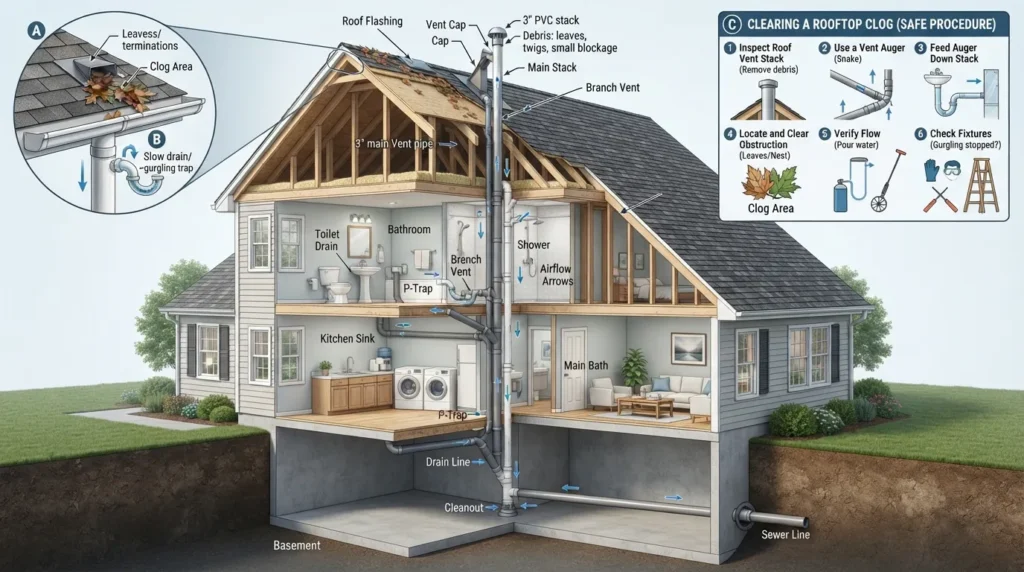
Plumbing Vent Pipe
A plumbing vent pipe provides an air pathway for the drainage system. It helps balance pressure as wastewater moves through fixture drains, branch lines, and stacks, reducing the risk of pressure changes disturbing the water held inside fixture traps.
Common vent-system terms include:
- Plumbing air vent
- Drain vent
- Branch vent
- Vent stack
- Stack vent
- Vent connection
A vent stack typically serves the broader drainage network, while branch vents connect individual fixture groups or drain sections to the venting system. The exact configuration depends on the building layout and plumbing design.
Possible signs of a drainage or venting problem include:
- Gurgling after a fixture drains
- Slow drainage
- Recurring sewer odors
- Water movement in nearby traps
However, these symptoms do not automatically confirm a blocked or incorrectly installed vent. A partial drain clog, poor pipe slope, damaged trap, or other drainage problem can produce similar symptoms.
For vent-stack layouts, troubleshooting, and system details, learn how a plumbing vent pipe works.
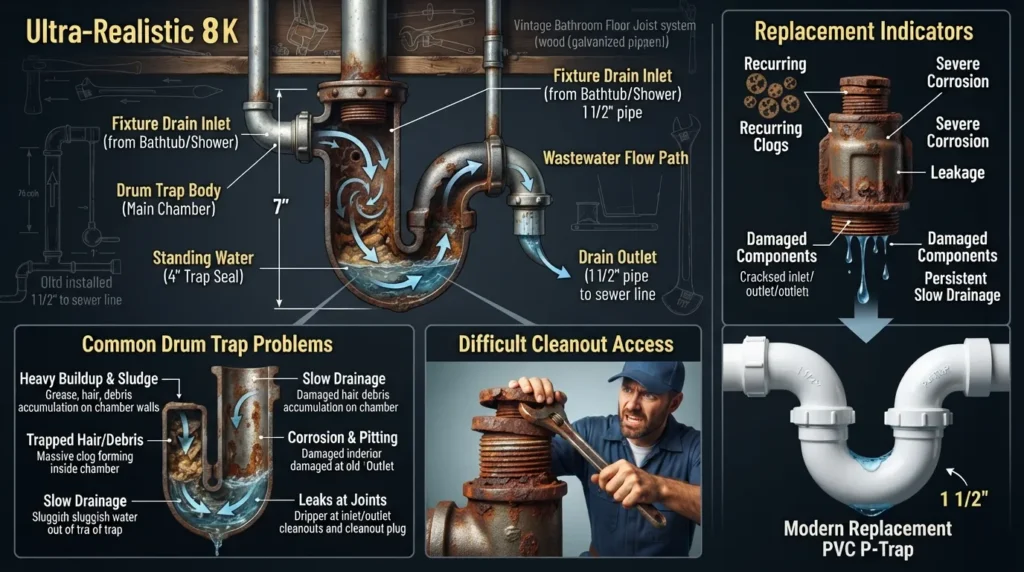
What Is a Drum Trap in Plumbing?
If you are researching what is a drum trap in plumbing, you are likely dealing with an older drainage system. A drum trap is a legacy trap design that uses a larger cylindrical or container-shaped chamber to retain water and create a seal against sewer gases.
Drum traps may be found in older properties, particularly around bathtub and other fixture drainage systems. Unlike a modern P-trap, their internal shape can make debris removal and routine cleaning more difficult.
Typical concerns include:
- Accumulated hair and sediment
- Difficult access
- Corroded covers
- Aging connections
- Older surrounding pipe materials
- Limited serviceability
A drum trap should not be removed simply because it looks outdated. Its relationship to the fixture drain, branch piping, and existing vent system needs to be understood before modification.
Replacing one may involve more than changing the trap itself, especially when the surrounding plumbing uses older materials or configurations.
For identification, replacement considerations, and a detailed comparison with modern traps, read what is a drum trap in plumbing.
Bathroom Drain Pipe
A bathroom drain pipe system combines wastewater from several fixtures, often within a compact area. The bathroom sink, shower, bathtub, and toilet each begin with their own fixture connection before joining larger branch drainage.
At a system level, bathroom drainage commonly includes:
- Sink drain and trap
- Shower drain and trap
- Tub drain and overflow assembly
- Toilet waste connection
- Branch drainage piping
- Vent connections
- Soil or waste stack connection
The sink, tub, and shower typically discharge through trapped connections. The toilet uses its own built-in trapway before connecting to the drainage branch.
As fixture drains merge, the branch piping must be sized and configured to carry the combined wastewater load toward a larger stack or building drain. Vent connections support pressure balance and help protect fixture trap seals.
Actual bathroom layouts vary by property type, floor level, pipe material, and building design. A slab-on-grade home may route drains differently from a multi-story residence.
For a deeper look at bathroom drainage routing and components, see our bathroom drain pipe guide.
Plumbing Drain Diagram
A plumbing drain diagram helps show how individual drain parts connect into one complete wastewater system. Although layouts vary, the basic drainage path can be simplified as:
Fixture → Trap → Trap Arm → Branch Drain → Waste Stack → Building Drain → Sewer
Several supporting components fit around that main flow.
A useful drain diagram should also identify:
- Vent connection
- Vent stack
- Cleanout
- Main waste stack
- Branch drain
- Building drain
- Sewer connection
The fixture trap sits immediately downstream of the fixture and maintains the water seal. The trap arm connects that trap to the branch drainage system. Branch lines then carry wastewater toward larger vertical or horizontal drainage piping.
Cleanouts provide access points for maintenance and blockage removal. Vent connections run separately from the wastewater path but support the same drainage network by balancing pressure.
A diagram is especially useful when trying to understand concealed plumbing behind walls or beneath floors.
For detailed layouts, multi-fixture configurations, and system illustrations, see the full plumbing drain diagram guide.
Troubleshooting Common Drainage Issues & FAQ
Drain problems are easier to diagnose when the symptom is matched to the most likely section of the system. Start with the accessible fixture components before assuming the entire drain line has failed.
| Symptom | First Area to Check |
|---|---|
| Leak under sink | Slip joints, washers, trap, tailpiece |
| Slow single sink | Stopper, drain opening, P-trap |
| Multiple drains backing up | Larger branch or main drain |
| Sewer odor | Trap seal, drain connection, vent system |
| Repeated clogs | Branch drain or deeper drainage problem |
A single slow sink may only need local cleaning, while several fixtures backing up at the same time can indicate a restriction farther downstream.
Likewise, a small leak at a slip nut may involve a washer or alignment problem rather than a complete drain replacement.
Troubleshooting should therefore move from the simplest accessible component toward the larger drainage system. Stop DIY work when concealed piping, sewer backups, recurring blockages, or material transitions are involved.
Why Is My Under-Sink Drain Leaking at the Plastic Slip Nut?
A plastic slip nut usually leaks because the washer is damaged, installed incorrectly, or unable to seal against a properly aligned fitting. The threads primarily tighten the joint; the cone washer creates the seal.
Common causes include:
- Cone washer installed backward
- Hardened or damaged washer
- Cracked plastic slip nut
- Cross-threaded nut
- Misaligned drain tube
- Wrong-size washer
- Tube not seated correctly
- Damaged sealing surface
For a standard slip-joint connection, the order is:
Slip nut → cone washer → fitting
The tapered or beveled side of the cone washer should face toward the fitting and sealing surface.
To correct the leak:
- Remove the joint.
- Clean the mating surfaces.
- Inspect the nut and washer.
- Install the washer in the correct direction.
- Align the drain tubes.
- Hand-tighten the nut.
- Snug it slightly only if necessary.
- Run water and check the connection.
Do not keep tightening a leaking plastic nut. Overtightening can distort the washer or damage the fitting.
What Is the Difference Between PVC and ABS Pipe?
PVC and ABS are both commonly used in drain, waste, and vent systems, but they are different materials and require compatible fittings and joining products.
| Feature | PVC | ABS |
|---|---|---|
| Common color | Usually white; some products vary | Usually black |
| Material | Polyvinyl chloride | Acrylonitrile butadiene styrene |
| Joining | PVC-compatible solvent cement | ABS-compatible solvent cement |
| Typical use | Drain, waste, vent | Drain, waste, vent |
The most important rule is to identify the pipe material before buying fittings, cement, or connectors. A solvent cement intended for one plastic system should not automatically be used on another.
When a drainage repair changes from one pipe material to another:
- Confirm both pipe materials
- Verify nominal pipe sizes
- Use compatible fittings
- Select an approved transition method
- Follow applicable plumbing requirements
Color is useful for initial identification but should not be the only factor used to determine pipe material.
For a broader comparison of drainage and plumbing materials, see kinds of pipes in plumbing.
How Do I Clear a Smelly or Clogged P-Trap?
A dirty or clogged P-trap can cause slow drainage, standing water, and unpleasant odors. If only one sink is affected, the accessible trap is a logical place to inspect before assuming the blockage is deeper in the system.
Use this basic process:
- Stop using the sink.
- Remove visible debris from the drain opening.
- Place a bucket beneath the P-trap.
- Loosen the slip-joint nuts.
- Remove the curved J-bend.
- Empty trapped water and debris.
- Clean the inside of the trap.
- Inspect the washers and nuts.
- Reinstall the washers correctly.
- Hand-tighten the connections.
- Run water and check for leaks.
After reassembly, the trap should hold water. If it repeatedly dries out or sewer odor remains, the problem may involve more than debris inside the P-trap.
Call a plumber when:
- Several fixtures are backing up
- Sewage appears
- The wall drain remains clogged
- The blockage repeatedly returns
- Sewer odor continues
- Concealed piping may be damaged
For professional drain troubleshooting in Miami, call +1 786 239 6529.
When to Call a Professional for Plumbing Drain Parts
Simple accessible components such as slip-joint washers or removable P-traps can sometimes be serviced without altering the building’s permanent drainage system. Professional plumbing help becomes more important when the problem extends beyond an obvious replaceable part.
Consider calling a plumber when:
- Drain piping must be cut or rerouted
- A leak is inside a wall, floor, or ceiling
- Multiple fixtures back up
- A main drain blockage is suspected
- Drain pipe size is uncertain
- Sewer odors continue after basic troubleshooting
- Old plumbing needs modification
- PVC, ABS, and cast-iron transitions are involved
- Drain fittings repeatedly leak after replacement
- DIY repairs do not solve the underlying problem
These situations may involve concealed damage, incorrect pipe configuration, deeper blockages, or incompatible materials rather than a single failed drain part.
For Miami properties, professional diagnosis can also help determine whether a repair involves more extensive drainage-system work rather than routine fixture maintenance.
Need help identifying, replacing, or installing plumbing drain parts in Miami?
Call +1 786 239 6529 for professional plumbing repair, drain troubleshooting, and installation assistance.
Explore Our Plumbing Drain Guides
Use the guides below to move from this plumbing drain parts overview into a specific component, material, size, or system question. Each supporting guide covers its topic in greater detail without repeating the full drainage-system overview provided on this pillar page.
Drain Pipes and Materials
- drain pipe size — Review commonly encountered drain diameters and learn how fixture type, drainage load, and system configuration affect sizing.
- plastic drainage pipe — Compare rigid plastic DWV piping, tubular sink components, and corrugated drainage products.
- 3 inch drain pipe fittings — Explore couplings, wyes, bends, reducers, and cleanouts used with larger drainage lines.
- flex pipe drain — Learn where flexible drainage products can be useful and where rigid piping is generally more appropriate.
- kinds of pipes in plumbing — Compare PVC, ABS, cast iron, copper DWV, and other plumbing pipe materials.
- bathroom drain pipe — Understand how sink, shower, tub, and toilet drainage connects within a bathroom system.
Drain Fittings and Fixture Parts
- drain parts sink — Identify the flange, strainer, tailpiece, slip-joint washers, P-trap, trap arm, and other components beneath a sink.
- PVC drain fitting — Learn how couplings, elbows, wyes, reducers, sanitary tees, adapters, and cleanouts are used within PVC drainage systems.
- what is a drum trap in plumbing — Understand how legacy drum traps work, where they may be found, and why replacement may require professional evaluation.
Drainage System and Venting
- plumbing vent pipe — Learn how drain vents, branch vents, and vent stacks help balance pressure and protect fixture trap seals.
- plumbing drain diagram — See how fixtures, traps, branch drains, vents, stacks, cleanouts, building drains, and sewer connections fit into one drainage network.