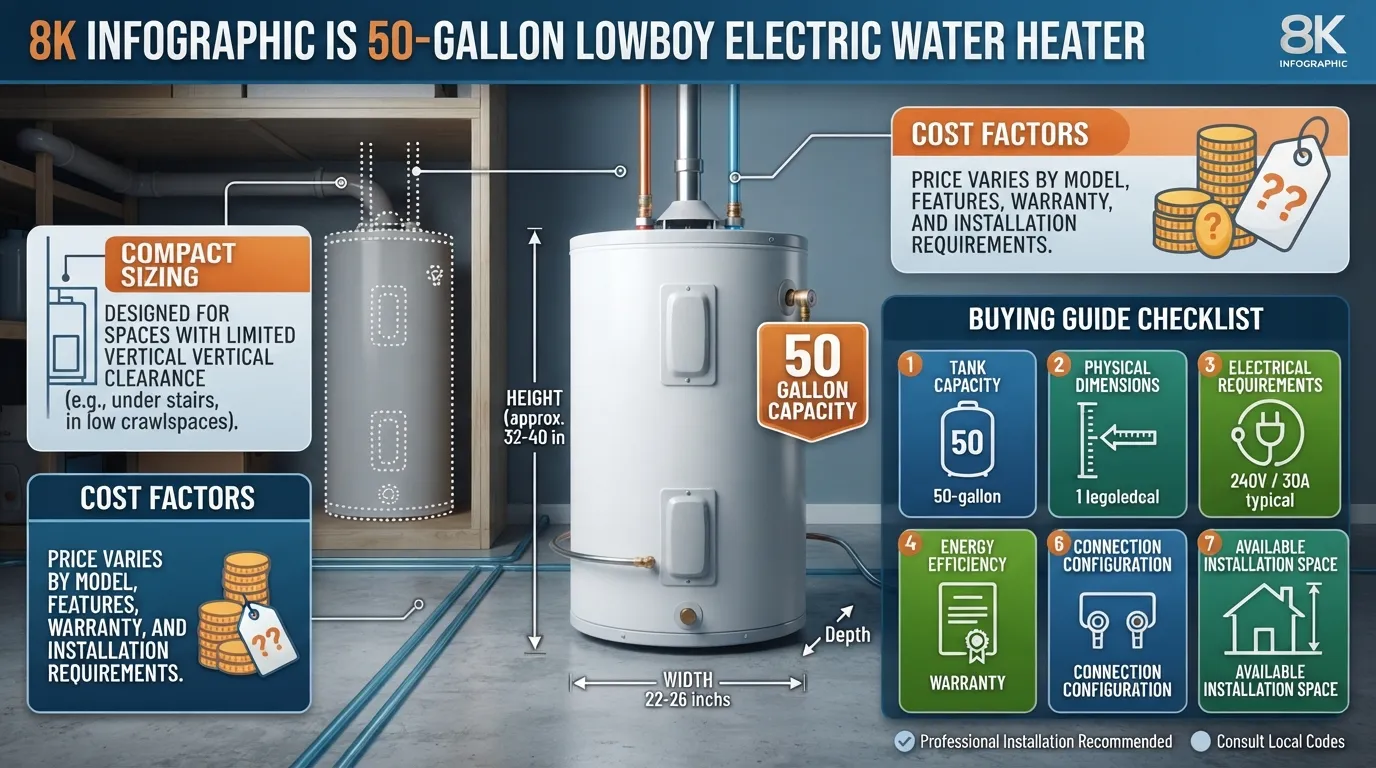
If you need a 50 gallon lowboy electric water heater, the biggest question is not simply which tank holds about 50 gallons. You also need to know whether the lowboy design will fit your available space, whether the tank can meet your household’s hot-water demand, and whether its electrical and plumbing connections match your existing setup.
A 50 gallon lowboy electric water heater is a shorter, wider tank-style electric water heater designed for locations where a traditional tall tank may not fit. The right model depends on more than nominal capacity: check the actual dimensions, first-hour rating, voltage, element wattage, connection location, efficiency, warranty, and available service clearance before buying.
In this guide, I’ll walk you through the practical details that matter when you’re comparing a 50-gallon lowboy water heater for a new installation or replacement. I’ll also show you how to compare models without getting distracted by a single specification.
What Is a 50 Gallon Lowboy Electric Water Heater?
A lowboy electric water heater is a residential storage-tank water heater built with a shorter and wider profile than many traditional tall models. That shape can make it useful in locations with limited vertical clearance, such as some utility areas, basements, garages, crawl-space applications, or other low-clearance spaces where a taller tank is impractical.
The important point is that “50 gallon” does not mean every model has identical specifications. Manufacturers use different tank designs, connection layouts, dimensions, efficiency ratings, heating elements, warranties, and first-hour ratings.
For example, A. O. Smith’s current EELBU-50 lowboy model lists a 48-gallon nominal capacity, 4,500 watts, a 55-gallon first-hour rating, 0.92 Uniform Energy Factor (UEF), 240-volt operation, 34-inch height, and 26.5-inch diameter. State’s comparable lowboy model also lists 4,500 watts, a 55-gallon first-hour rating, 0.92 UEF, 34-inch height, and 26.5-inch diameter. These are examples of specific models—not universal specifications for every 50-gallon lowboy water heater.
50 Gallon Does Not Tell the Whole Story
One of the easiest mistakes when shopping for a water heater is assuming that the number on the product category tells you exactly how much usable hot water the heater will deliver.
Manufacturers can list a nominal capacity alongside a different rated storage volume and first-hour rating. For example, the A. O. Smith EELBU-50 is marketed as a 50-gallon-class lowboy but lists 48 gallons of nominal capacity and 44 gallons of rated storage volume, with a 55-gallon first-hour rating.
Important buying point
Do not compare water heaters by gallon capacity alone. Look at capacity together with first-hour rating, recovery performance, dimensions, electrical requirements, connection location, efficiency, and warranty.
How Much Hot Water Does a 50 Gallon Lowboy Provide?
The answer depends on the specific model and how your household uses hot water. Tank capacity tells you about the water stored in the tank, while the first-hour rating (FHR) gives you a better indication of how much hot water the heater can deliver during a period of heavy use.
What Is First-Hour Rating?
First-hour rating is the amount of hot water a water heater is expected to deliver during the first hour of use under the test conditions used for the rating. It reflects both the hot water stored in the tank and the heater’s ability to recover as hot water is being used.
That is why you may see a 50-gallon-class water heater with a first-hour rating higher than its nominal tank capacity.
Think of the specifications this way
- Nominal capacity: the tank’s stated capacity category.
- Rated storage volume: the storage volume reported for the particular model.
- First-hour rating: a more useful measure of hot-water delivery during concentrated use.
- Recovery: how quickly the heater can replace hot water as it is consumed.
Is a 50 Gallon Lowboy Water Heater Right for You?
A 50-gallon lowboy can be a good choice when you need substantial storage capacity but have a height limitation. However, I would not choose one based only on the number of people in the home.
Your actual demand can change considerably depending on whether you regularly use showers, a bathtub, a dishwasher, a washing machine, or several hot-water fixtures close together.
Before You Buy, Ask Yourself:
- How many people regularly use hot water?
- How many showers are likely to occur close together?
- Do you regularly fill a bathtub?
- Will laundry and dishwashing overlap with showers?
- Is your current heater running out of hot water?
- Is your main limitation tank height rather than total floor space?
- What first-hour rating does the replacement model provide?
A useful rule: If your existing heater frequently runs out of hot water, replacing it with another tank of the same nominal capacity may not solve the problem. Look at your actual usage and compare first-hour ratings and recovery performance before choosing the replacement.
50 Gallon Lowboy Water Heater Dimensions: Will It Fit?
If you’re shopping for a lowboy, physical fit is usually one of the most important reasons you’re considering this design in the first place. Do not measure only the old tank and assume the new one will fit.
As one current example, the A. O. Smith EELBU-50 lists a 34-inch height and 26.5-inch diameter. State’s comparable model also lists 34 inches by 26.5 inches. Other manufacturers and configurations can have different dimensions, so always verify the exact model’s specifications before ordering.
Measure More Than Height and Diameter
- Available height: Measure from the floor to the lowest obstruction.
- Available width: Check the full diameter or footprint of the replacement tank.
- Top clearance: Leave enough room for connections and servicing where required.
- Service access: Make sure technicians can reach the controls and serviceable components.
- Water connections: Check where the hot and cold connections are located.
- Electrical connection: Confirm that the electrical setup can accommodate the selected model.
- Drain and relief-valve arrangement: Confirm that these can be installed correctly.
- Path to the installation location: Measure doors, stairways, gates, and other access points before delivery.
The “it fits” test has two parts
A tank can physically fit into a space and still be a poor replacement if the plumbing connections, electrical supply, service clearance, or required installation components do not work with that location.
Lowboy vs. Tall Water Heater: What’s the Difference?
The main difference is the physical configuration. A lowboy is shorter and wider, while a traditional tall water heater uses more vertical space and generally has a narrower footprint.
Also, don’t automatically treat “lowboy” and “short” as the same configuration. Manufacturers can distinguish lowboy, short, and tall height classifications within their product ranges.
Top-Connect vs. Side-Connect Lowboy Water Heaters
Connection location can become especially important when you’re replacing an existing water heater. A replacement can have the right capacity and still require plumbing changes if its connections are positioned differently.
For example, the A. O. Smith EELBU-50 lists top water connections, while American Standard offers a lowboy side-connect product line with side connections for the inlet and outlet. American Standard’s lowboy side-connect range is available in 30-, 40-, and 50-gallon configurations and lists up to 0.93 UEF and up to a 55-gallon first-hour rating.
Before Choosing a Connection Type
- Look at where your existing hot and cold lines enter the tank.
- Check whether the replacement uses top or side connections.
- Compare connection size and orientation.
- Consider whether moving the connections would require additional plumbing work.
- Verify the exact manufacturer’s installation instructions for the model you choose.
Electrical Requirements: 240V, Wattage and Heating Elements
Electric water heaters need the correct electrical supply for the specific model. Many residential lowboy models use 240-volt power and dual heating elements, but you should never assume that every model has identical electrical requirements.
For example, the A. O. Smith EELBU-50 lists 240 volts, two elements, and a maximum wattage of 4,500 watts. American Standard’s lowboy side-connect range supports 208 or 240 volts and lists models with up to 6,000 watts.
Don’t guess the electrical setup
The correct circuit, conductor sizing, overcurrent protection, disconnecting means, grounding, and installation requirements depend on the specific equipment and applicable electrical code. Before replacing a heater, have the existing setup checked against the new model’s installation instructions and local requirements.
What Does UEF Mean on a Water Heater?
Uniform Energy Factor (UEF) is an efficiency metric used for water heaters. In simple terms, it helps you compare the energy performance of different models under standardized conditions.
A higher UEF can indicate better energy performance, but it should not be the only number you consider. A model with a slightly different efficiency rating may still be the better choice if its dimensions, first-hour rating, connection layout, warranty, or installation requirements better match your home.
Features Worth Comparing in a 50 Gallon Lowboy Electric Water Heater
Once you’ve confirmed the physical and electrical fit, compare the features that affect ownership and performance.
- First-hour rating: Useful for comparing hot-water delivery.
- UEF: Helps compare energy performance.
- Heating elements: Check element wattage and configuration.
- Tank protection: Look for the manufacturer’s glass lining and anode-rod system.
- Heat traps: Some models use factory-installed heat-trap nipples to reduce standby heat loss.
- Connection location: Top and side configurations can make a major difference during replacement.
- Warranty: Compare tank and parts warranties separately.
- Controls and diagnostics: Some models provide digital controls or diagnostic features.
- Availability: A model that is difficult to source or service may be less practical for a replacement.
Popular 50-Gallon-Class Lowboy Water Heater Brands to Compare
The current product landscape includes several established manufacturers with lowboy electric models or product lines. That doesn’t mean one brand is automatically best for every installation. Compare the actual model specifications instead.
50 Gallon Lowboy vs. 40 Gallon vs. 60 Gallon
If you’re not committed to 50 gallons yet, compare the capacity options against your actual hot-water demand and the space available.
Don’t automatically move from 50 to 60 gallons just because you want “more hot water.” A larger tank can change the physical footprint, installation requirements, cost, and recovery characteristics. Size the system around actual demand and the available installation space.
How Much Does a 50 Gallon Lowboy Electric Water Heater Cost?
The purchase price varies by manufacturer, model, warranty level, retailer, availability, and location. Installation is a separate cost and can vary substantially depending on the existing plumbing and electrical setup.
Instead of relying on a single online price, I recommend looking at the total replacement cost:
- Water heater purchase price
- Professional installation
- Removal and disposal of the existing tank
- Possible plumbing modifications
- Possible electrical modifications
- Required drain, relief, or other installation components
- Permits or code-related work where applicable
Price tip: The cheapest tank is not necessarily the lowest-cost replacement. A model that matches your existing connections and installation requirements may reduce additional work, while a model with a better warranty or efficiency rating may provide different long-term value.
Can You Replace an Existing Water Heater With a 50 Gallon Lowboy?
Possibly, but the existing heater should be evaluated before you order the replacement. A 50-gallon lowboy can be an excellent replacement when the space, capacity, plumbing, electrical system, and model specifications all line up.
Replacement Compatibility Checklist
- Record the existing tank’s nominal capacity.
- Measure the existing tank and available installation area.
- Check the existing hot and cold connection locations.
- Confirm the voltage and electrical configuration.
- Compare the new model’s wattage and heating-element setup.
- Check the new tank’s diameter and height.
- Verify service and maintenance access.
- Review drain and temperature-and-pressure relief requirements.
- Check whether an expansion-control device is required for the installation.
- Verify local plumbing and electrical requirements.
- Compare the manufacturer’s installation instructions before installation.
Remember: A replacement heater that physically fits is not automatically a compatible replacement. Electrical, plumbing, connection, clearance, safety, and code requirements all matter.
If you’re replacing an existing unit and want the installation evaluated professionally, you can learn more about water heater replacement services before selecting the final model.
Maintenance Tips for a Lowboy Electric Water Heater
A lowboy tank still needs the same basic attention as other storage-tank water heaters. Maintenance should follow the manufacturer’s instructions for your exact model.
- Watch for signs of leaking around the tank and connections.
- Inspect the area around the temperature-and-pressure relief discharge for signs of a problem.
- Follow the manufacturer’s recommendations for inspecting or replacing the anode rod.
- Flush or drain the tank only according to the manufacturer’s instructions and applicable safety requirements.
- Pay attention to changes in hot-water performance.
- Have electrical components checked by a qualified professional when troubleshooting electrical faults.
- Keep the installation area accessible for inspection and service.
Common 50 Gallon Electric Water Heater Problems
No Hot Water
A complete loss of hot water can involve the electrical supply, heating elements, thermostats, safety controls, or another component. Because the heater uses high-voltage electricity, electrical diagnosis should be handled safely by a qualified professional.
Not Enough Hot Water
Running out of hot water can result from demand exceeding the heater’s delivery capability, a problem with a heating element or control, or another issue affecting recovery. Compare actual household demand with the model’s first-hour rating rather than assuming the gallon number is the whole story.
Breaker Trips
A repeatedly tripping breaker should not simply be reset over and over. It can indicate an electrical problem involving the circuit, wiring, heating element, thermostat, or another component. Have the system inspected before continuing to operate it.
Water Around the Heater
Water can originate from a connection, valve, drain, relief system, or the tank itself. The source should be identified rather than assuming the tank needs replacement immediately.
What Should You Check Before Buying?
Where Does a Lowboy Water Heater Make the Most Sense?
The lowboy design is most useful when vertical space is the limiting factor. If you have a low ceiling or another height restriction, a shorter tank can solve a problem that a traditional tall water heater cannot.
However, remember that the shorter profile generally comes with a wider footprint. Before buying, make sure you have enough floor space and that the wider tank will not interfere with walls, doors, equipment, access paths, or service areas.
How to Choose the Right 50 Gallon Lowboy Electric Water Heater
- Start with your space. Measure height, diameter, access and service clearance.
- Check your hot-water demand. Look at how much hot water your household actually uses.
- Compare first-hour ratings. Don’t rely on nominal gallon capacity alone.
- Match the connection layout. Check top versus side connections and connection sizes.
- Verify electrical compatibility. Compare voltage, wattage, elements and the manufacturer’s requirements.
- Compare efficiency. Use UEF as one part of the decision.
- Compare warranty coverage. Look separately at tank and parts warranties.
- Consider serviceability. Choose a configuration that can be properly accessed and maintained.
- Get the installation requirements confirmed. The exact model instructions and local code should determine the final installation.
My practical recommendation
If you’re replacing an existing heater, don’t order a 50-gallon lowboy based on a product title alone. Take the measurements, photograph or document the existing connection layout, check the electrical information on the existing unit, and compare those details with the exact replacement model. That small amount of preparation can prevent an expensive compatibility problem.
When Should You Call a Professional?
Professional help makes sense when you’re replacing a tank, changing connection locations, dealing with electrical issues, troubleshooting repeated breaker trips, or working in a location where clearance and code requirements are difficult to determine.
If you need broader plumbing help, you can also explore the plumbing services available for your home.
Need Help Choosing or Replacing Your Water Heater?
If you’re unsure whether a 50-gallon lowboy is compatible with your space, plumbing, or existing electrical setup, getting the installation evaluated before you buy can help you avoid the wrong model.
You can also learn more about Miami Florida Plumbing and the plumbing services available for your home.
Frequently Asked Questions
What is a 50 gallon lowboy electric water heater?
It is a shorter, wider, tank-style electric water heater in the 50-gallon product class. Lowboy models are designed for installations where vertical clearance is limited. Exact capacity, dimensions, efficiency and electrical specifications vary by model.
What are the typical dimensions of a 50 gallon lowboy water heater?
There is no single universal dimension. For example, A. O. Smith’s EELBU-50 lists a 34-inch height and 26.5-inch diameter, while other manufacturers and configurations can differ. Always verify the exact model’s specification sheet before ordering.
Is a 50 gallon lowboy enough for a family?
It can be, but household size alone isn’t enough to determine the answer. Shower frequency, simultaneous hot-water use, bathing, laundry and dishwashing all affect demand. Compare your usage with the model’s first-hour rating and recovery characteristics.
Are all 50 gallon lowboy water heaters actually 50 gallons?
No. “50 gallon” is commonly used as a product category, while individual models can list different nominal capacity and rated storage volume figures. For example, A. O. Smith’s EELBU-50 lists 48 gallons of nominal capacity and 44 gallons of rated storage volume.
What is the difference between tank capacity and first-hour rating?
Tank capacity describes the storage capacity of the particular heater, while first-hour rating describes expected hot-water delivery during the first hour under standardized test conditions. FHR accounts for both stored hot water and the heater’s recovery capability.
Can I replace a tall water heater with a lowboy?
Possibly. The replacement must be checked for physical dimensions, plumbing connections, electrical requirements, service clearance, safety components and local installation requirements. A lowboy’s shorter height does not automatically make it a drop-in replacement.
Are lowboy and short water heaters the same thing?
Not necessarily. Manufacturers can use separate height classifications for lowboy, short and tall models. Always use the exact model dimensions rather than relying only on the label.
Does a 50 gallon lowboy water heater need 240 volts?
Many residential electric models use 240 volts, but requirements vary by model. Check the exact manufacturer’s specifications and installation instructions instead of assuming every lowboy uses the same voltage or wattage.
What should I compare besides price?
Compare first-hour rating, actual dimensions, connection location, voltage, wattage, UEF, tank and parts warranty, tank protection, availability and service requirements. The lowest purchase price isn’t always the lowest total replacement cost.
How do I know if a 50 gallon lowboy will fit my space?
Measure the available height and width, then check top clearance, service access, connection locations, electrical access and the path needed to move the tank into position. Compare those measurements with the exact manufacturer’s specifications.
Final Takeaway
A 50 gallon lowboy electric water heater can be an excellent solution when you need substantial tank capacity but don’t have enough vertical space for a traditional tall unit. The best choice, however, is the model that fits your space, hot-water demand, plumbing connections, electrical setup, efficiency goals and installation requirements.
If you’re comparing models, start with the dimensions and first-hour rating, then verify the connection layout and electrical requirements. Once those basics are right, compare UEF, warranty, tank protection, controls and overall replacement cost.
That approach gives you something much more useful than a list of product specifications: a clear way to decide whether a 50-gallon lowboy electric water heater is actually the right fit for your home.
Related Resources
Product information note
Water-heater specifications can change by model, configuration and manufacturer. Always verify the current manufacturer’s specification sheet and installation instructions for the exact unit you plan to purchase or install. Installation should comply with applicable local plumbing and electrical requirements.