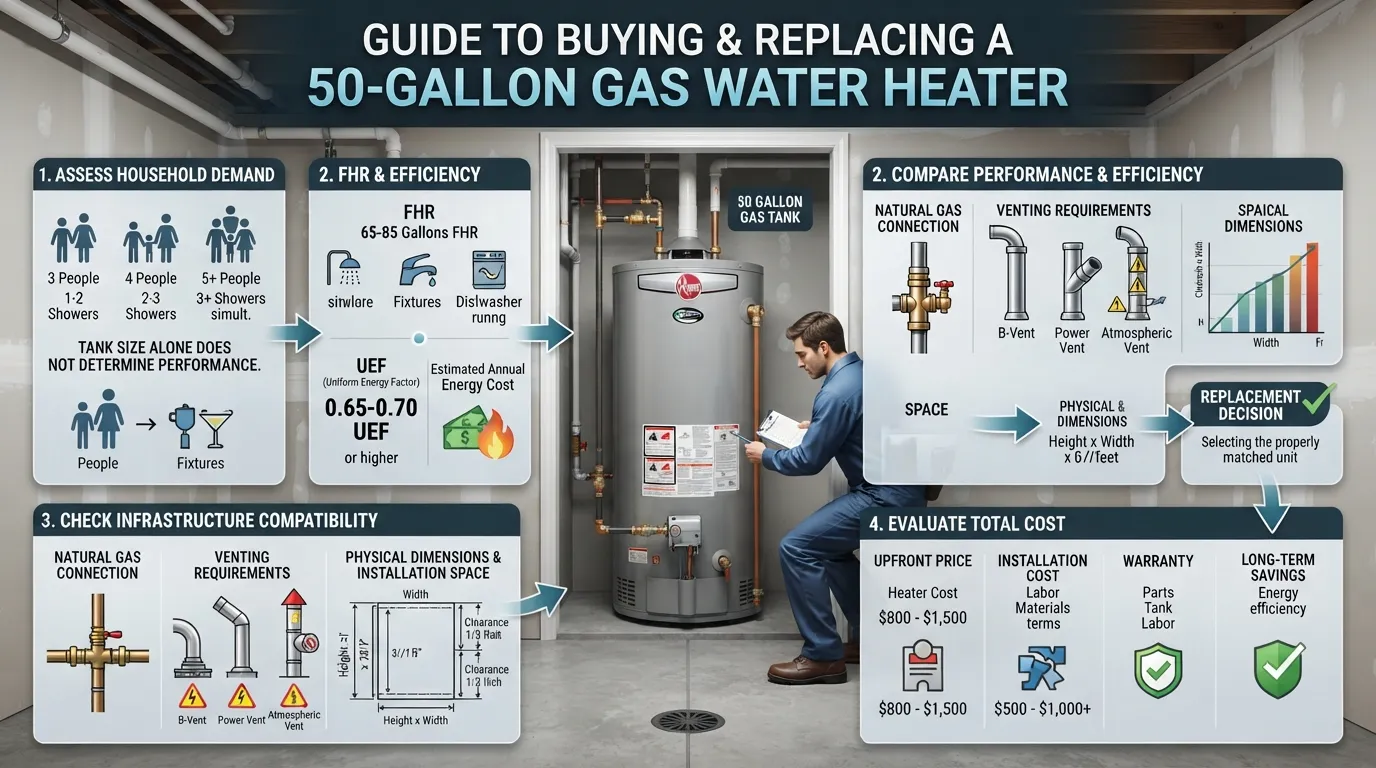
If you are shopping for a 50 gallon gas water heater, the tank size is only the starting point. The right choice also depends on your household’s hot-water demand, first-hour rating, BTU input, efficiency, venting, fuel type, installation space, and the condition of your existing plumbing system.
For a Miami home, there is another important consideration: replacing a gas water heater can involve plumbing, gas, venting, safety, and permitting requirements. So rather than choosing a heater because it simply says “50 gallon” on the label, you want to make sure the complete system is appropriate for your home.
Is a 50-Gallon Gas Water Heater Right for You?
A 50-gallon gas water heater can be a strong choice for a medium-to-large household, but tank capacity alone does not determine how much hot water the system can deliver. Compare the first-hour rating, recovery performance, BTU input, efficiency, vent type, fuel compatibility, and installation requirements before choosing a model.
What Is a 50 Gallon Gas Water Heater?
A 50-gallon gas water heater is a tank-style water heating system designed to store and heat water using natural gas or, with the correct compatible model, propane. The tank keeps heated water available for showers, baths, sinks, appliances, and other household uses while the burner reheats water as needed.
The important point is that 50 gallons is the nominal storage capacity, not necessarily the amount of hot water you can use in one hour. A storage water heater can continue recovering as hot water is drawn from the tank. That is why the first-hour rating is such an important specification when comparing gas water heaters.
50 Gallons Does Not Mean Only 50 Gallons of Hot Water Per Hour
This is one of the most common points of confusion. Suppose a heater has approximately 50 gallons of storage. During a long shower, hot water leaves the tank and cold water enters. At the same time, the gas burner continues heating water. The amount of hot water the system can actually deliver during a busy period therefore depends on more than the tank volume.
The four numbers that matter
- Tank capacity: how much water the tank stores.
- First-hour rating: an estimate of how much hot water the system can supply during the first hour from a fully heated condition.
- BTU input: the rate at which the burner consumes gas to produce heat.
- Recovery performance: how effectively the heater replaces heat as hot water is used.
How Many People Can a 50 Gallon Gas Water Heater Serve?
A 50-gallon gas water heater is often considered for households in the roughly three-to-five-person range, but there is no universal household-size rule. Your actual hot-water habits matter more than the number of people living in the house.
For example, four people who take showers at different times may have very different hot-water needs from four people who shower back-to-back while a dishwasher and washing machine are also using hot water.
| Household situation | What to consider |
|---|---|
| 1–2 people | A smaller tank may be sufficient depending on usage. A 50-gallon unit may provide extra capacity but is not automatically necessary. |
| 3–4 people | A 40- or 50-gallon tank may work well. Compare first-hour rating and usage patterns before deciding. |
| 5+ people | A 50-gallon heater may still work, but heavy simultaneous demand may require a higher first-hour rating, faster recovery, a larger tank, or another system configuration. |
The better sizing question
Don’t ask only, “How many people live here?” Ask, “How much hot water do we need during our busiest hour?” That question leads you toward a much better heater choice.
50 Gallon vs. 40 Gallon vs. 60 Gallon Gas Water Heater
Choosing a tank size is a balance between hot-water demand, available installation space, operating requirements, and budget. Bigger is not automatically better.
| Tank size | May make sense when | Main consideration |
|---|---|---|
| 40 gallon | Hot-water demand is moderate and usage is spread throughout the day. | May run short during consecutive high-demand use. |
| 50 gallon | You need a common middle-ground capacity for a household with moderate-to-heavy demand. | Choose based on first-hour rating and recovery, not capacity alone. |
| 60 gallon | Hot-water demand is consistently high and the installation space supports a larger system. | More storage does not solve every sizing problem; system performance and demand still matter. |
What Is First-Hour Rating and Why Does It Matter?
First-hour rating (FHR) estimates how many gallons of hot water a storage water heater can deliver during the first hour, beginning with a fully heated tank. It accounts for both stored hot water and the heater’s ability to recover while water is being used.
This makes FHR particularly useful when you are comparing two 50-gallon gas water heaters. Two heaters can have similar storage capacity but different performance during periods of heavy demand.
Example
A 50-gallon tank with a stronger recovery profile can potentially deliver more hot water during a busy period than another 50-gallon tank with weaker recovery performance. That’s why looking only at the number “50” can lead to the wrong purchase.
What Does BTU Mean on a 50 Gallon Gas Water Heater?
BTU stands for British thermal unit. On a gas water heater, the BTU input indicates how much energy the burner is designed to consume over time.
You may see 50-gallon natural gas water heaters with inputs around 40,000 BTU and other models with higher inputs. A higher BTU rating can support faster recovery, but higher BTU does not automatically mean a better water heater.
The burner input needs to be considered together with efficiency, first-hour rating, venting, gas supply, installation requirements, and the manufacturer’s specifications. A qualified professional should verify that the selected appliance is appropriate for the home’s existing system.
What Is a High-Efficiency Gas Water Heater?
If you are searching for a high-efficiency gas water heater or energy-efficient gas water heater, look beyond marketing language. One of the specifications used to compare water-heater energy performance is the Uniform Energy Factor (UEF).
UEF provides a standardized way to compare the energy performance of compatible water-heating products. When comparing models, look at the actual UEF listed for the specific model rather than assuming that every 50-gallon gas water heater has the same efficiency.
| Specification | What it tells you |
|---|---|
| Capacity | How much water the tank stores. |
| UEF | A standardized efficiency measure used to compare water-heating products. |
| FHR | Estimated hot-water delivery during the first hour. |
| BTU input | The burner input rating that helps determine heating and recovery performance. |
| Vent type | How combustion gases are exhausted and, depending on design, how combustion air is supplied. |
Atmospheric, Power Vent, or Direct Vent: What’s the Difference?
When replacing a gas water heater, you cannot choose the tank in isolation. The venting arrangement is part of the installation.
Atmospheric Vent
An atmospheric gas water heater uses natural draft to move combustion gases through an appropriate venting system. If you are replacing an existing atmospheric unit, the existing vent configuration should be evaluated rather than assuming the new heater can simply be connected to it.
Power Vent
A power-vented model uses a fan-assisted exhaust system. Depending on the model and installation, electrical power is required for the venting system, so the installation requirements differ from a conventional atmospheric unit.
Direct Vent
Direct-vent designs use a configuration intended to manage combustion air and exhaust through the designated venting system. The exact requirements depend on the model, so the manufacturer’s installation instructions should always control.
Do not treat venting as a DIY detail.
Gas combustion and exhaust gases create safety risks when equipment is installed incorrectly. Venting, combustion air, gas connections, and clearances should be evaluated according to the specific appliance and applicable requirements.
Natural Gas vs. Propane: Which One Should You Choose?
A 50-gallon natural gas water heater is designed for natural gas service. A propane-compatible water heater is designed and configured for propane. These fuel systems should not be treated as interchangeable simply because both use gas.
If your home currently uses natural gas, replacing the heater with another compatible natural gas model may be straightforward from a fuel perspective. If you are considering changing fuel type, the gas supply, controls, venting, plumbing, electrical requirements, and applicable approvals may all need to be evaluated.
How Much Does a 50 Gallon Gas Water Heater Cost?
The cost depends on whether you mean the water heater itself or the complete replacement. Those are not the same thing.
| Cost factor | Why it can affect the final price |
|---|---|
| Water heater | Brand, model, efficiency, warranty, vent type, and features can change the equipment price. |
| Labor | The location and complexity of the replacement affect labor requirements. |
| Venting | A change in venting configuration can add work or materials. |
| Gas connections | Existing gas piping and appliance compatibility may need to be evaluated. |
| Plumbing connections | Old valves, fittings, connections, or other components may need attention. |
| Code or permit requirements | Requirements vary by jurisdiction and by the nature of the replacement. |
| Removal and disposal | The old water heater must be safely removed and handled. |
That is why an online product price should not be treated as the price of a complete installed system. A simple like-for-like replacement can be very different from a project that requires venting changes, gas work, difficult access, or other upgrades.
50 Gallon Gas Water Heater Price in Miami: What Should You Ask?
If you are comparing replacement quotes in Miami, don’t compare only the number at the bottom. Ask what is actually included.
- What exact water heater model is included?
- Is the listed price for equipment only or complete installation?
- Is removal of the old heater included?
- Are standard plumbing connections included?
- Does the quote include required gas or venting work?
- Are permit and inspection requirements included where applicable?
- What warranty applies to the tank and components?
- What happens if the existing installation does not meet current requirements?
- Is the new heater actually sized for my household’s hot-water demand?
A useful rule when comparing quotes
Compare scope of work, not just price. Two quotes can have very different totals because one includes additional plumbing, venting, safety, disposal, or permitting work.
What About Cheap 50 Gallon Gas Water Heaters?
If your search starts with “cheap gas hot water heaters,” it is tempting to choose the lowest equipment price. But the cheapest purchase price is not necessarily the lowest-cost option over the life of the system.
Compare the total value of the model, including:
- Energy efficiency
- First-hour rating
- Recovery performance
- Warranty
- Available parts and service support
- Tank and component construction
- Installation requirements
- Expected operating costs
A lower-priced heater that is poorly matched to your household can be a false economy if you continue running out of hot water or encounter installation problems.
What Size Is a 50 Gallon Gas Water Heater?
There is no single universal physical dimension for every 50-gallon gas water heater. Height, width, depth, tank design, vent configuration, and connection layout vary by model.
Before buying a replacement, measure more than the old tank’s width. Check the available height, diameter or footprint, access route, vent connection, water connections, gas connection, service clearance, and the surrounding installation area.
Will a New 50-Gallon Heater Fit in the Same Space?
Not necessarily. A replacement model can have a different height, diameter, vent arrangement, connection position, or clearance requirement. This is especially important in closets, garages, utility rooms, attics, or other restricted spaces.
How Heavy Is a 50 Gallon Gas Water Heater?
The empty weight varies by model. Once the tank is full, the water itself adds roughly 8.34 pounds per gallon. That means 50 gallons of water alone weighs about 417 pounds, before adding the weight of the tank and components.
This is one reason water-heater replacement is more than simply moving an appliance into place. Access, floor conditions, installation location, and safe handling all matter.
50 Gallon Gas Water Heater Safety: What You Should Know
Gas water heaters combine combustible fuel, high temperatures, water pressure, combustion air, and exhaust gases. Proper installation and maintenance are therefore important for both performance and safety.
- Use a water heater that is compatible with your home’s fuel supply.
- Follow the manufacturer’s installation and clearance requirements.
- Make sure combustion air and venting requirements are properly addressed.
- Keep required safety and pressure-relief components in place.
- Do not modify gas piping or venting based on a generic online guide.
- Have suspected gas leaks, combustion problems, or damaged venting evaluated promptly by a qualified professional.
Safety first
If your water heater involves gas piping, combustion, or venting, don’t use a generic “how-to” article as a substitute for the appliance’s installation instructions and a proper professional evaluation.
50 Gallon Gas Water Heater Installation in Miami
A gas water heater replacement in Miami can involve more than disconnecting one tank and connecting another. The existing plumbing, gas supply, venting, installation location, safety components, and applicable local requirements should be evaluated before the replacement is completed.
Local requirements can also depend on the specific municipality and the scope of work. For that reason, it is smart to confirm the applicable permit and inspection requirements for your property rather than assuming every replacement follows the same process.
If you are replacing an existing heater, an experienced plumber can also identify issues that may not be obvious from the product label, such as incompatible venting, deteriorated connections, inadequate clearances, or an installation that needs to be brought into compliance.
Can You Replace a Gas Water Heater Yourself?
A gas water heater is not an ordinary plug-in appliance. Installation can involve gas connections, combustion, venting, water pressure, temperature, and local requirements. Because mistakes can create serious safety hazards, gas and venting work should be handled according to the manufacturer’s requirements and applicable codes by an appropriately qualified professional.
If you are in Miami-Dade County, check the current requirements applicable to your property and municipality before starting work. The permitting process can vary depending on where the property is located and what type of work is being performed.
When Should You Repair a 50 Gallon Gas Water Heater Instead of Replacing It?
A water heater problem does not automatically mean you need a new tank. Some problems can be repairable, while others indicate that replacement is the more sensible long-term option.
| Situation | What it may indicate |
|---|---|
| Pilot or ignition problem | Could be a component or control issue that requires diagnosis. |
| Not enough hot water | Could involve sizing, recovery, thermostat settings, sediment, or a system problem. |
| Water leaking from the tank | A tank leak can indicate a replacement is needed, but the exact source should be identified first. |
| Rust or corrosion | The severity and location matter when deciding between repair and replacement. |
| Repeated repairs | Frequent failures can make replacement more practical than continuing to repair an aging system. |
How Long Does a 50 Gallon Gas Water Heater Last?
There is no guaranteed service life that applies to every gas water heater. Actual longevity depends on the model, installation, water conditions, usage, maintenance, and other factors.
Instead of replacing a heater based only on age, pay attention to warning signs such as recurring failures, tank leakage, corrosion, deteriorating components, declining hot-water performance, or repair costs that no longer make sense for the condition of the system.
50 Gallon Gas Water Heater Maintenance
Regular attention can help identify problems before they become emergencies. Depending on the heater and manufacturer’s requirements, maintenance considerations can include:
- Checking for signs of leakage or corrosion.
- Inspecting visible connections and valves.
- Checking the condition of the venting system.
- Watching for unusual burner or ignition behavior.
- Following the manufacturer’s recommendations for sediment and tank maintenance.
- Checking components such as the anode rod when applicable.
- Addressing repeated hot-water or performance problems instead of ignoring them.
What Should You Compare When Buying a 50 Gallon Gas Water Heater?
If you are comparing A. O. Smith, State, Rheem, Bradford White, or another manufacturer, don’t choose based on brand name or tank capacity alone. Use the same checklist for every model.
- Fuel type: Is the model designed for your home’s fuel?
- Tank capacity: Is 50 gallons actually appropriate for your demand?
- First-hour rating: Can it handle your busiest hour?
- BTU input: Does the heating input fit the system and intended performance?
- UEF: How does its efficiency compare with other suitable models?
- Vent type: Does the venting configuration work with your installation?
- Physical dimensions: Will the unit fit with the necessary clearances?
- Warranty: What protection is provided for the tank and components?
- Installation requirements: What additional work may be necessary?
- Total installed cost: What will the complete project actually cost?
50 Gallon Gas Water Heater Buying Checklist
Before you order a new heater, use this quick checklist:
- ☐ Confirm natural gas or propane compatibility.
- ☐ Check your household’s peak hot-water demand.
- ☐ Compare first-hour ratings.
- ☐ Compare BTU input and recovery performance.
- ☐ Compare UEF and other efficiency information.
- ☐ Confirm vent type and installation requirements.
- ☐ Measure the available installation space.
- ☐ Check access for removing the old heater and bringing in the new one.
- ☐ Compare warranty coverage.
- ☐ Get a complete installed quote rather than comparing equipment prices only.
- ☐ Confirm applicable local permitting and inspection requirements.
50 Gallon Gas Water Heater: Frequently Asked Questions
Is a 50 gallon gas water heater enough for a family of four?
It can be, but household size alone does not determine the answer. Compare your peak hot-water demand, first-hour rating, recovery performance, and simultaneous usage.
Is a 50 gallon gas water heater better than a 40 gallon model?
Not automatically. A 50-gallon model provides more stored capacity, but the better choice depends on demand, first-hour rating, recovery, efficiency, installation space, and total cost.
Is a 50 gallon gas water heater better than a 60 gallon model?
A 60-gallon heater may provide additional storage, but bigger is not automatically better. The right system should match actual demand and the home’s installation conditions.
What is the best 50 gallon gas water heater?
There is no single best model for every home. A good choice is one that has the right fuel type, capacity, first-hour rating, efficiency, venting configuration, dimensions, warranty, and installation compatibility for your specific home.
What is the difference between a 50 gallon gas water heater and a gas hot water heater?
In everyday use, the terms usually refer to the same type of appliance: a gas-fired water heater that stores heated water in a tank. “Hot water heater” is common language, although “water heater” is technically more precise.
What does high efficiency mean for a gas water heater?
Efficiency describes how effectively the appliance uses its fuel to provide hot water. UEF is one standardized specification used to compare compatible models. Always compare the actual rating for the specific model you are considering.
Can I replace my old 40 gallon gas water heater with a 50 gallon model?
Possibly, but the new heater must fit the available space and be compatible with the home’s fuel, plumbing, venting, and installation requirements. A larger tank is not a simple drop-in upgrade in every installation.
How do I know whether I need a 50 gallon or 60 gallon water heater?
Start with your busiest hour of hot-water use. If the household regularly uses several fixtures or showers close together, compare first-hour ratings and recovery performance rather than choosing strictly by tank capacity.
Does a higher BTU water heater always heat water faster?
Higher input can support stronger heating performance, but actual recovery depends on the complete appliance design. BTU should be evaluated together with efficiency, first-hour rating, tank design, and installation requirements.
Should I repair or replace my 50 gallon gas water heater?
It depends on the problem and the condition of the tank. A component issue may be repairable, while tank leakage, severe corrosion, repeated failures, or an aging system may make replacement more practical.
Do I need a permit to replace a gas water heater in Miami?
Permit requirements depend on the property’s jurisdiction and the scope of work. Before replacing a gas water heater, confirm the current requirements applicable to your specific Miami-area property.
Is a 50 Gallon Gas Water Heater Right for Your Home?
A 50-gallon gas water heater can be an excellent fit when its capacity and performance match your household’s hot-water demand. But the smartest purchase is not simply the heater with the biggest tank or the lowest price.
Look at the complete picture: capacity, first-hour rating, recovery, BTU input, UEF, fuel type, venting, dimensions, warranty, installation requirements, and total installed cost.
If your current water heater is failing or you are unsure whether 40, 50, or 60 gallons is the right size, getting the existing system evaluated before buying the replacement can prevent an expensive mismatch.
Need Help Choosing or Replacing a Gas Water Heater?
If you are not sure which 50-gallon gas water heater fits your home, a professional evaluation can help you compare the existing installation, hot-water demand, fuel system, venting, space, and replacement requirements.
Related Plumbing Resources
If you are comparing water-heater options or need help with another plumbing issue, you can explore our plumbing services or visit our Miami plumbing page for more information.
Useful Manufacturer & Energy-Information Sources
- U.S. Department of Energy — consumer water-heater information and efficiency guidance.
- ENERGY STAR — water-heater efficiency and product criteria.
- A. O. Smith — manufacturer specifications and installation information for applicable gas water-heater models.
- State Water Heaters — manufacturer specifications, ratings, and installation documentation for applicable gas models.
Important: Product specifications, availability, prices, warranties, code requirements, and permit requirements can change. Always verify the current manufacturer’s documentation and applicable local requirements for the specific water heater and property before installation.