If you are searching for a 30 gallon propane water heater, you are probably trying to answer a more important question than simply “What is a 30-gallon heater?” You want to know whether 30 gallons is enough for your home, what specifications actually matter, whether you need a short or tall model, what it may cost, and whether your existing installation can support it.
The short answer is this: a 30-gallon LP water heater can be a good fit for a small household, but tank size alone does not determine whether it will meet your hot-water demand. First-hour rating, recovery rate, burner input, household usage, available space, fuel configuration, venting, and the specific installation requirements all matter.
Is a 30-Gallon Propane Water Heater Right for You?
A 30-gallon propane water heater may work well for a smaller household when its first-hour rating and recovery performance match your peak hot-water demand. Do not choose one based only on the number of people in the home. Before buying, also check the unit’s fuel type, dimensions, venting requirements, installation location, and whether the specific model is approved for your application.
In this guide, I will walk you through those decisions so you can compare a 30-gallon propane water heater intelligently instead of choosing a tank simply because the label says “30 gallons.”
What Is a 30 Gallon Propane Water Heater?
A 30-gallon propane water heater is a storage-tank water heater designed to heat and store hot water using liquid propane (LP) as its fuel. The “30 gallon” designation refers to the heater’s nominal tank capacity, but the amount of hot water you can actually receive over an hour depends on more than storage capacity.
For example, current 30-gallon propane models from major manufacturers show different combinations of burner input, first-hour rating, recovery performance, dimensions, and efficiency. A.O. Smith’s ProLine 30-gallon short LP model, for example, is listed with a 29,000 BTU input and a 55-gallon first-hour rating, while GE’s current 30-gallon short LP model is listed as a 30-gallon unit with a 34K BTU burner and a 67-gallon first-hour rating. Those are model-specific specifications, not universal numbers for every 30-gallon propane heater.
The Key Buying Insight
Do not ask only, “How many gallons is the tank?” Ask, “How much hot water can this specific model deliver during my busiest hour?” That is why first-hour rating and recovery performance are so important.
Is a 30 Gallon Propane Water Heater Enough for a House?
Sometimes, yes. But I would not use a simple “one gallon per person” or “30 gallons equals two people” rule to make the decision.
Your actual demand depends on how and when you use hot water. Two people who take short showers and rarely use multiple fixtures at the same time can have very different requirements from two people who take long showers, run a dishwasher, wash clothes with hot water, and use a bathtub during the same peak period.
Think About Peak-Hour Hot-Water Demand
Instead of counting household members alone, think about your busiest one-hour period.
- How many showers happen close together?
- How long are those showers?
- Are multiple bathrooms used at the same time?
- Will the dishwasher or washing machine run during that period?
- Do you regularly fill a bathtub?
- Do you have guests who increase hot-water demand?
A 30-gallon tank can be perfectly reasonable for one household and undersized for another household with the same number of people.
A Simple Real-World Fit Check
1. Household
How many people regularly need hot water?
2. Peak Demand
How much hot water do you use during your busiest hour?
3. First-Hour Rating
Does the model provide enough first-hour delivery for your demand?
4. Installation Space
Will the height, width, diameter, and required clearances work?
5. Compatibility
Does the fuel, venting, location, and application match the model?
If those five factors line up, a 30-gallon propane water heater may be a sensible choice. If they do not, a larger tank or a different water-heating configuration may make more sense.
30 Gallon Tank Capacity vs. First-Hour Rating
This is one of the most important concepts to understand before buying a propane water heater.
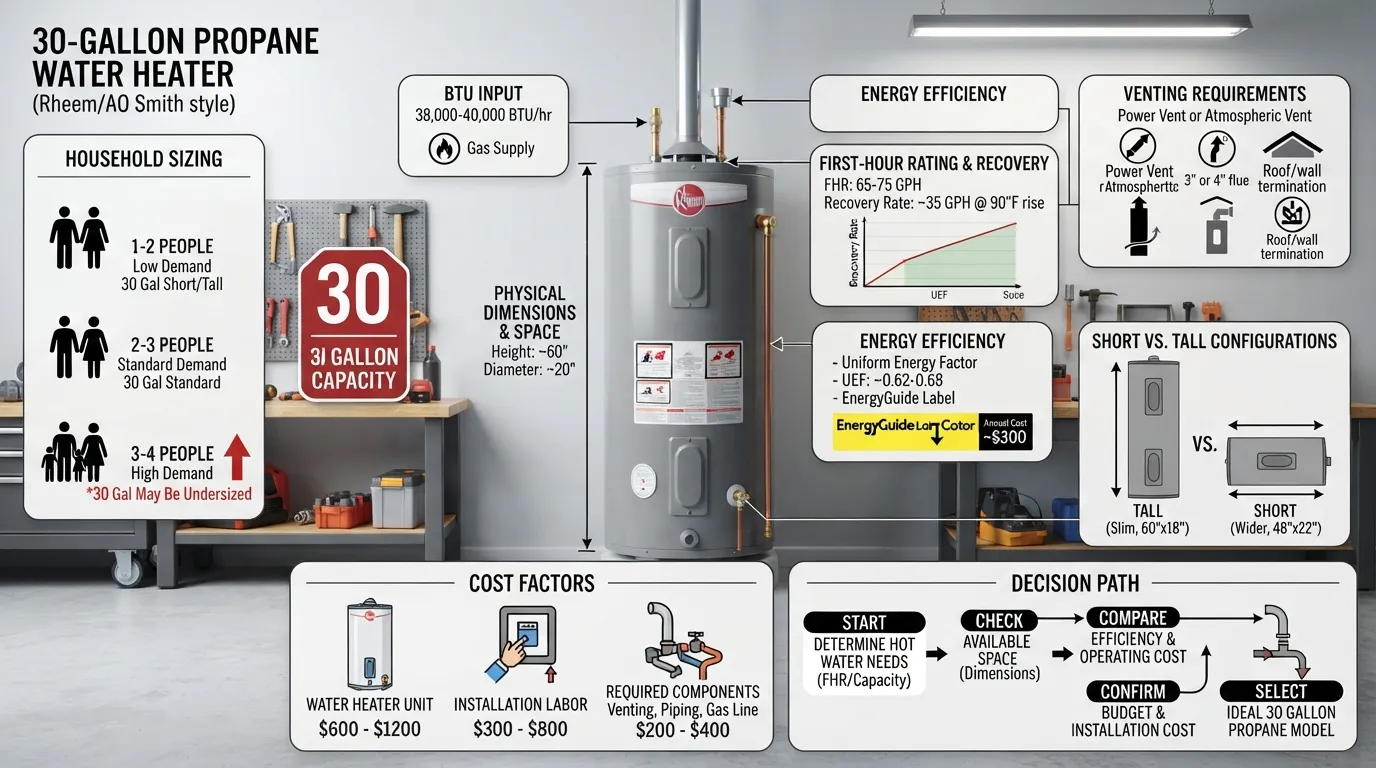
Tank capacity tells you how much water the storage tank is designed to hold. First-hour rating (FHR) estimates how much hot water the unit can deliver during the first hour of use under the manufacturer’s test conditions. The first-hour number accounts for both stored hot water and the heater’s ability to recover as hot water is used.
That is why you may see a 30-gallon water heater with a first-hour rating substantially higher than 30 gallons.
Do Not Make This Common Mistake
A 30-gallon tank does not mean you only have 30 gallons of usable hot water during an entire hour. Recovery performance allows the heater to replenish hot water while you are using it. Always compare the manufacturer’s first-hour rating and recovery information when evaluating different models.
30 Gallon Propane Water Heater Specifications to Compare
When you compare models, I would focus on the following specifications rather than treating every number on the product label as equally important.
1. Fuel Source
Look specifically for liquid propane (LP) compatibility. A natural-gas appliance and a propane appliance are not automatically interchangeable.
Some models are designed for a specific fuel, while others may be designed for conversion according to the manufacturer’s instructions. Never assume a natural-gas unit can simply be connected to a propane supply.
2. BTU Input
BTU input describes the amount of fuel energy the burner is designed to use over time. A higher BTU input can contribute to faster recovery, but it should not be viewed in isolation.
For example, current 30-gallon LP models can have different burner inputs. A.O. Smith lists 29,000 BTU for its ProLine GCRL-30R-401 model, while GE’s GP30S08BXR is listed with a 34K BTU burner in its product literature. That difference is one reason you should compare the complete performance specification rather than choosing solely by tank size.
3. First-Hour Rating
The first-hour rating is one of the most useful numbers for comparing storage water heaters. It gives you a better idea of how much hot water a particular model can deliver during a high-demand period.
Current manufacturer examples demonstrate why this matters. A.O. Smith lists a 55-gallon first-hour rating for its GCRL-30R-401 30-gallon LP model, while State’s GS6-30-HOCT page lists a 67-gallon first-hour rating for that specific model. The State model is also marked as discontinued, which shows why model availability and current manufacturer documentation should be checked before purchasing.
4. Recovery Rate
Recovery rate tells you how quickly the heater can replace hot water after it has been used, under the specified test conditions.
Two 30-gallon heaters can therefore feel very different in actual use if their burner input, recovery performance, and first-hour ratings differ.
5. Uniform Energy Factor (UEF)
UEF is a useful efficiency specification for comparing compatible water heaters. Do not assume that every 30-gallon propane water heater has the same efficiency.
For example, A.O. Smith lists up to a 0.60 UEF for its ProLine GCRL-30R-401 model. Other products can have different efficiency ratings, so always check the exact model rather than applying one manufacturer’s number to every heater.
6. Physical Dimensions
Measure the actual installation area before ordering.
Check:
- Overall height
- Diameter or width
- Required service and installation clearances
- Vent connection requirements
- Water connection locations
- Access for future maintenance or replacement
A heater can have the correct gallon capacity and still be the wrong choice if it does not physically fit your location.
Short vs. Tall 30 Gallon Propane Water Heater
One of the most useful choices to make is whether a short or tall configuration fits your installation.
Short Model
A short tank can be useful when vertical space is limited or when the existing installation is designed around a shorter configuration.
- Lower overall height
- Often wider than a comparable tall unit
- Useful where vertical clearance is restricted
- Still requires model-specific installation clearances
Tall Model
A tall tank can make sense when you have enough vertical room and need a narrower footprint, depending on the model.
- Greater overall height
- Often uses a narrower footprint
- Useful when vertical space is available
- Must match the existing installation requirements
Do not choose a short or tall model simply because it is advertised as a 30-gallon heater. Measure your space and compare the exact manufacturer’s dimensions and installation requirements.
What About Mobile or Manufactured Homes?
This is an area where you need to be especially careful.
Not every 30-gallon propane water heater is automatically appropriate for a mobile or manufactured home. Certain models are specifically designed or approved for those applications, while ordinary residential models may have different requirements.
If the heater will be installed in a manufactured or mobile home, verify the exact model’s application, certification, venting requirements, installation instructions, and applicable local requirements before purchasing.
Important
“30 gallons” and “propane” do not automatically tell you whether a heater is approved for a particular housing type. For manufactured or mobile homes, verify the exact model and installation documentation.
30 Gallon Propane Water Heater vs. 40 or 50 Gallon
If you are unsure whether 30 gallons is enough, compare capacities before you buy.
20 Gallon
Smaller storage capacity. More appropriate for limited-demand applications when the specific system is properly sized.
30 Gallon
A useful middle ground for smaller households when first-hour demand and the model’s performance are a good match.
40 Gallon
Provides more stored capacity and may be worth considering when hot-water demand is higher.
50 Gallon
More storage for higher-demand households, although physical space, fuel use, cost, and installation requirements also need to be considered.
The correct capacity is not necessarily the largest tank you can fit. A properly selected heater should match your household’s peak demand without paying for capacity you do not need.
How Much Does a 30 Gallon Propane Water Heater Cost?
The purchase price varies significantly by manufacturer, model, efficiency, availability, location, and retailer. Installation cost can vary even more because an easy replacement is very different from a job requiring changes to gas piping, venting, water connections, permits, or the installation location.
For that reason, I would not use one generic “30 gallon propane water heater installation cost” number as your budget.
Your Total Replacement Cost Can Include
- The water heater itself
- Professional installation labor
- Required fittings and installation materials
- Gas connection work when required
- Venting modifications when required
- Drain or discharge-related work when required
- Removal and disposal of the old heater
- Permits or inspections where applicable
- Corrections required to bring an existing installation into compliance
As an example of why retail prices should be treated as model-specific, GE currently lists its GP30S08BXR 30-gallon short liquid-propane model on its product page with a displayed retail price, but that price can change and does not represent the installed cost in your home.
If you are replacing an existing unit, the best way to establish a realistic budget is to identify the exact replacement model and have the existing installation evaluated.
What Installation Requirements Should You Check?
A propane water heater involves fuel, combustion, hot water, pressure, and venting, so installation is not simply a matter of connecting two water lines.
Before installation, the applicable requirements can include:
- Correct LP fuel configuration
- Proper gas supply and connection
- Approved venting arrangement
- Required combustion air
- Manufacturer-specified clearances
- Temperature and pressure relief protection
- Correct water connections
- Drain and discharge provisions
- Location-specific safety requirements
- Applicable building, plumbing, fuel-gas, and local requirements
Gas and Venting Work Deserves Professional Attention
Do not treat a propane water heater replacement as a generic DIY plumbing project. Gas connections, combustion air, venting, safety controls, and local code requirements need to be handled according to the exact manufacturer’s instructions and applicable requirements. If you are replacing a unit, have the existing installation evaluated before selecting the replacement.
If you are already dealing with an aging or leaking unit, you may also want to review your water heater replacement options before deciding on the exact tank size.
How to Choose a 30 Gallon LP Water Heater
Here is the decision process I would use if I were comparing models today.
- Confirm that propane is the correct fuel. Check the existing system and the manufacturer’s model information.
- Estimate your peak hot-water demand. Focus on your busiest period rather than household size alone.
- Compare first-hour ratings. This is more useful than comparing tank capacity alone.
- Compare recovery and BTU input. Look at the complete performance specifications.
- Check UEF. Compare efficiency between the actual models you are considering.
- Measure the installation space. Check height, diameter, connections, venting, and required clearances.
- Determine whether short or tall is appropriate. Match the physical configuration to your location.
- Check special applications. Manufactured homes and other non-standard installations may require specifically approved models.
- Check the warranty and manufacturer documentation. Make sure you can access the installation and owner’s information for the exact model.
- Get the installation evaluated. A professional can identify compatibility issues before the new heater is purchased.
30 Gallon Propane Water Heater Buying Checklist
- Confirm the fuel type is liquid propane (LP).
- Compare first-hour rating.
- Compare recovery rate.
- Check BTU input.
- Compare UEF between models.
- Measure available height and diameter.
- Confirm short or tall configuration.
- Check venting requirements.
- Check water and gas connection locations.
- Verify application approval for manufactured/mobile homes if applicable.
- Review the exact manufacturer’s installation instructions.
- Consider the total installed cost, not just the retail tank price.
- Make sure replacement work complies with applicable local requirements.
What Is the Best 30 Gallon Propane Water Heater?
There is no single model that is automatically “best” for every home.
A good choice is the model that matches your hot-water demand, available space, fuel configuration, application, performance requirements, installation conditions, warranty expectations, and budget.
For example, current manufacturer offerings show why comparing specifications matters. A.O. Smith offers a 30-gallon short LP model with a 55-gallon first-hour rating and 29,000 BTU input, while GE’s GP30S08BXR is a short 30-gallon LP model with a 34K BTU burner and a 67-gallon first-hour rating in its product literature. State’s GS6-30-HOCT page lists a 67-gallon first-hour rating but identifies that series as discontinued.
Those differences do not mean one brand is automatically better. They show why the exact model and its current documentation matter more than simply choosing the most recognizable brand.
30 Gallon Propane Water Heater Manual: Where Should You Look?
If you already own a 30-gallon propane water heater and need the manual, start with the manufacturer’s support page rather than using a generic manual found elsewhere.
You will usually need the exact model number, and sometimes the serial number, to find the correct documentation.
For example, GE provides an Owner Center and installation/support resources for its GP30S08BXR model. This is useful when you need the manufacturer’s own maintenance, troubleshooting, installation, and parts information.
Do not assume that two heaters with the same tank size use the same manual. A 30-gallon LP heater from one manufacturer can have completely different controls, venting requirements, parts, and installation instructions from another model.
Common Mistakes to Avoid When Buying a 30 Gallon Propane Water Heater
Choosing by Gallons Alone
A 30-gallon label tells you storage capacity, not the complete performance of the heater.
Assuming Two People Always Need 30 Gallons
Household size is only one part of sizing. Peak demand and first-hour delivery matter.
Ignoring Physical Dimensions
Always measure before ordering. A replacement unit may have a different height or diameter even when the nominal tank size is the same.
Assuming Every Propane Heater Is Mobile-Home Approved
Application-specific requirements matter. Verify the exact model.
Comparing Retail Price Only
The least expensive tank is not necessarily the least expensive replacement if it requires additional installation modifications.
Using the Wrong Fuel Configuration
Natural gas and LP are not interchangeable without a model specifically designed and approved for the applicable configuration.
Trying to Solve a Venting or Gas Problem With a Different Tank
If the existing installation has a venting, gas-supply, clearance, or code issue, changing the tank size does not automatically solve the underlying problem.
When Should You Replace Your Existing Propane Water Heater?
A replacement may be worth considering when the tank is leaking, hot-water performance has declined, the unit is repeatedly experiencing problems, or the heater is approaching the end of its useful service life.
However, a symptom does not always mean the entire water heater needs replacement. Depending on the problem, a qualified professional may be able to identify whether the issue involves a component, burner, control, connection, sediment, venting, or the tank itself.
If replacement is necessary, do not automatically buy the same gallon capacity. Use the replacement opportunity to reassess your current hot-water demand and installation conditions.
You can also explore the broader plumbing services available from Miami Florida Plumbing if your water-heater replacement is part of a larger plumbing issue.
Frequently Asked Questions
Is a 30 gallon propane water heater enough for two people?
It can be, especially when hot-water demand is moderate, but two people do not automatically mean a 30-gallon tank is the correct size. Compare your peak demand with the model’s first-hour rating and recovery performance.
How many people can use a 30 gallon propane water heater?
There is no universal household limit. Manufacturer sizing guidance varies by model, and actual demand depends on shower length, fixture flow, simultaneous use, and other hot-water consumption.
Is a 30 gallon propane water heater better than a 40 gallon heater?
Not automatically. A 30-gallon model may be the better choice when it meets demand and fits the installation space. A 40-gallon model may be more appropriate when peak hot-water demand is higher. Compare first-hour ratings rather than gallons alone.
What does LP mean on a water heater?
LP means liquid propane. An LP water heater is designed for propane fuel according to the manufacturer’s specifications.
What BTU should a 30 gallon propane water heater have?
There is no single BTU number that applies to every 30-gallon LP water heater. Current models use different burner inputs, so compare BTU input together with first-hour rating, recovery rate, efficiency, and the manufacturer’s specifications.
What is the difference between a short and tall 30 gallon propane water heater?
The main difference is the physical configuration. Short models have less height and can be useful where vertical space is limited, while tall models use more vertical space and may have a narrower footprint. The exact dimensions and installation requirements vary by model.
Can I use a natural gas water heater with propane?
Do not assume you can. Only use a configuration specifically designed and approved by the manufacturer for the applicable fuel. If a model supports conversion, follow the manufacturer’s requirements and applicable installation rules.
How much does a 30 gallon propane water heater cost?
The price depends on the exact model and retailer, while the installed replacement cost also depends on labor, connections, venting, permits, disposal, and any modifications required at the installation location. Get a model-specific and installation-specific quote rather than relying on one generic price.
Where can I find a 30 gallon propane water heater manual?
Use the manufacturer’s support or owner center for the exact model number. This is safer and more reliable than assuming a manual for another 30-gallon heater applies to your unit.
Is a 30 gallon propane water heater suitable for a mobile or manufactured home?
Only if the specific model is appropriate for that application. Check the manufacturer’s documentation and applicable requirements before purchasing. Do not assume that every residential 30-gallon LP heater is approved for manufactured or mobile-home installation.
Should I install a propane water heater myself?
Propane water-heater installation can involve gas connections, combustion, venting, pressure relief, and local requirements. For safety and compliance, have the installation performed or evaluated by a qualified professional familiar with the applicable requirements and the manufacturer’s instructions.
Final Takeaway: Is a 30 Gallon Propane Water Heater Right for You?
Use this five-question test before you buy:
- Does your household’s peak hot-water demand fit the model’s first-hour rating?
- Is the heater designed for liquid propane and your specific application?
- Will the short or tall configuration physically fit your installation area?
- Do the venting, gas, water, clearance, and safety requirements match the installation?
- Does the total installed cost make sense compared with a larger tank or another water-heating option?
If the answer to all five is yes, a 30-gallon propane water heater can be a practical solution. If one or more answers are uncertain, it is better to solve the sizing or installation question before purchasing the tank.
Replacing an Existing Propane Water Heater?
Before choosing a replacement, have the existing setup checked so you can confirm the correct size, fuel configuration, installation conditions, and replacement requirements.
Related Resources
If you are comparing products before a replacement, these manufacturer resources can help you verify specifications and documentation for individual models:
- A.O. Smith ProLine 30-Gallon Atmospheric Vent Short Liquid Propane Water Heater — manufacturer specifications for a 30-gallon LP model, including first-hour rating, BTU input, UEF, and configuration.
- GE RealMAX Choice 30-Gallon Short Liquid Propane Water Heater — manufacturer product information and model specifications.
- GE GP30S08BXR Owner Support — manufacturer manual, installation, maintenance, troubleshooting, and parts resources.
- State GS6-30-HOCT Specifications — manufacturer information for the specific model; the manufacturer currently identifies this series as discontinued.
Understanding Propane Water Heater Installation
Use installation videos for general education only. Always follow the exact manufacturer’s instructions and applicable requirements for your water heater.