If you are searching for a 15 gallon water heater, you are probably trying to answer more than one question: Is 15 gallons enough for my hot-water needs? Should I choose electric or gas? How much does a 15-gallon water heater cost? And is it better to replace my existing unit or choose a different size?
The short answer is that a 15-gallon water heater can be a practical choice for small hot-water demands, point-of-use applications, and certain compact spaces. But tank capacity alone does not tell you how well a water heater will perform. The unit’s first-hour rating, recovery capability, energy source, installation requirements, and your actual hot-water demand all matter.
A 15-gallon water heater is a small storage water heater that can make sense when your hot-water demand is limited. Before buying one, compare the actual storage capacity, first-hour rating, energy source, available power or fuel, physical dimensions, and installation requirements. If several fixtures or people need hot water at the same time, a larger tank or another water-heating system may be a better fit.
What Is a 15 Gallon Water Heater?
A 15 gallon water heater is a storage-type water heater with a nominal tank capacity of 15 U.S. gallons. It heats water and stores it so hot water is available when you need it.
In the U.S. market, 15-gallon units are commonly associated with compact or point-of-use applications. Current retail listings include 15-gallon electric point-of-use models, including units designed for different voltage and wattage configurations.
That makes a 15-gallon water heater different from the larger storage heaters commonly used for higher household demand. It can be useful where the hot-water load is limited, but it should not automatically be treated as the right size for an entire home.
15 Gallons vs. 15 Liters: Don’t Confuse Them
Important Buying Check
15 gallons is not the same as 15 liters. A U.S. 15-gallon tank holds approximately 56.8 liters. If you are comparing listings from different markets, always confirm the actual tank capacity before ordering.
This distinction is especially important because online search results can mix products described as “15 gallon” and “15 liter” water heaters. They are dramatically different capacities and should not be treated as interchangeable.
Is a 15 Gallon Water Heater Big Enough?
This is one of the most important questions to answer before buying.
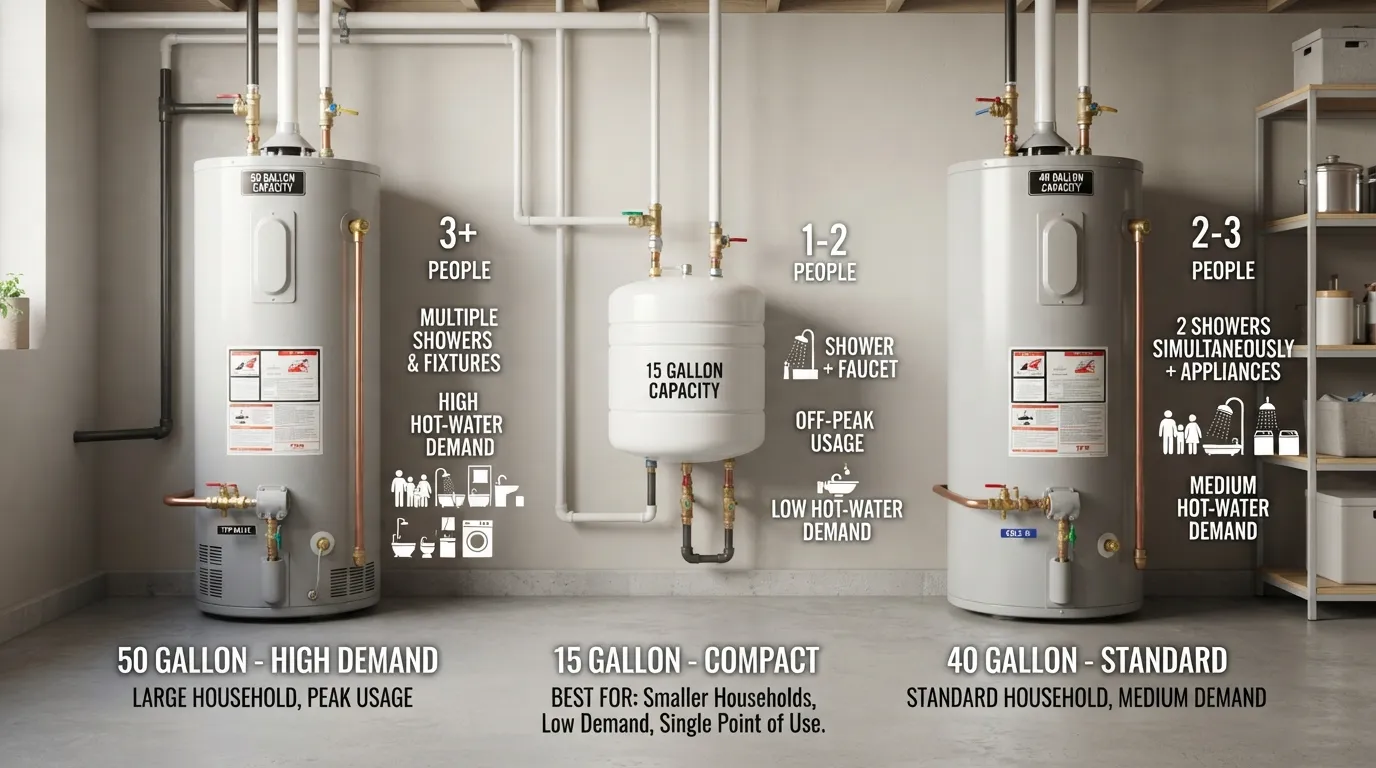
There is no single household-size rule that makes a 15-gallon heater correct for everyone. The right capacity depends on how much hot water you use, when you use it, how many fixtures operate at the same time, and how quickly the heater can recover.
A 15-Gallon Water Heater May Make Sense For
- Small hot-water applications
- Point-of-use installations
- Compact spaces where a larger tank is impractical
- A dedicated fixture or limited hot-water demand
- Situations where the existing hot-water demand is known to be low
A 15-Gallon Water Heater May Be Too Small When
- Several people regularly need hot water at the same time
- Multiple showers or fixtures have overlapping demand
- Your household frequently runs out of hot water
- You need a high first-hour hot-water supply
- The existing system already struggles to meet demand
- You are trying to supply a larger home with substantial simultaneous hot-water use
A Better Way to Size Your Water Heater
Don’t choose a tank based only on the number printed on the front. Look at the rated storage volume and first-hour rating, then compare those numbers with your actual hot-water demand. A heater with a higher first-hour rating can sometimes deliver better real-world performance than you might expect from tank size alone.
What Is First-Hour Rating and Why Does It Matter?
The first-hour rating (FHR) tells you approximately how much hot water a storage water heater can supply during a busy hour when the tank starts fully heated. It takes both stored water and the heater’s ability to recover into account.
That makes FHR an important specification when comparing water heaters.
For example, two heaters may have similar storage capacities but different heating inputs or recovery characteristics. The unit with the more suitable first-hour performance may better match your usage pattern.
When shopping for a 15 gallon electric water heater, don’t stop at “15 gallons.” Check the manufacturer’s specifications for:
- Rated storage volume
- First-hour rating
- Input wattage
- Voltage and electrical requirements
- Recovery information, when provided
- Energy-efficiency information
- Dimensions and installation clearances
- Warranty
15 Gallon Electric Water Heater vs. Gas Water Heater
One of the first decisions you may face is whether you need an electric, gas, or another type of water-heating system.
15 Gallon Electric Hot Water Heater: What Should You Check?
If you are specifically looking for a 15 gallon electric hot water heater, pay close attention to the electrical specifications. A model’s wattage and voltage are not interchangeable details.
1. Voltage
Confirm the voltage required by the exact model and compare it with the electrical service available at the installation location.
2. Wattage
Wattage affects heating input and electrical demand. A higher-wattage element may provide different recovery characteristics, but it also has different electrical requirements.
3. First-Hour Rating
Use the first-hour rating to understand how much hot water the unit can deliver during a busy period rather than assuming the tank’s nominal capacity tells the entire story.
4. Physical Size
A compact water heater still needs appropriate installation space, connections, access, and service clearance. Measure the available space before purchasing.
5. Warranty and Parts
Compare the warranty and consider whether replacement parts and service support are readily available for the model you choose.
How Much Does a 15 Gallon Water Heater Cost?
The cost of a 15 gallon water heater varies significantly by model, energy source, specifications, manufacturer, retailer, and installation requirements.
Online listings can show very different prices for compact water heaters because the products may differ in:
- Voltage
- Wattage
- Tank construction
- Controls
- Warranty
- Commercial vs. residential application
- Installation requirements
- Brand and model
More importantly, the purchase price is not necessarily the installed price.
What Can Be Included in the Total Installation Cost?
- Water heater
- Professional labor
- Plumbing connections or modifications
- Electrical work when required
- Valves or other required components
- Changes needed to accommodate the replacement unit
- Removal and disposal of the old heater
- Permit or inspection requirements when applicable
That is why I would not recommend choosing a water heater based solely on the lowest online product price. The cheapest unit can become the wrong purchase if it does not match your existing plumbing, electrical service, demand, or installation conditions.
How to Choose a 15 Gallon Water Heater
Use this checklist before you buy.
- Confirm the capacity. Make sure the product is actually 15 U.S. gallons and not 15 liters.
- Identify your energy source. Determine whether electric, gas, or another configuration is appropriate for the location.
- Check your hot-water demand. Think about how many people and fixtures need hot water during your busiest periods.
- Compare first-hour rating. Don’t judge the unit only by tank size.
- Check electrical requirements. For electric models, verify voltage, amperage, wattage, and circuit requirements.
- Measure the installation space. Check dimensions and access before ordering.
- Review the manufacturer’s specifications. Look at warranty, safety features, efficiency information, and serviceability.
- Consider installation requirements. A professional should evaluate the existing connections and installation conditions.
- Compare alternatives. If your demand is higher, a larger tank or different water-heating technology may be a better solution.
15 Gallon Water Heater Features That Actually Matter
Tank Construction
Tank materials and construction affect durability, corrosion resistance, and long-term serviceability. Instead of choosing a model simply because a listing says “heavy duty,” review the manufacturer’s actual specifications and warranty.
Thermostat and Temperature Control
Temperature controls help the heater maintain the selected water temperature. The exact control system varies by model.
Safety Components
Look for the safety components specified by the manufacturer and applicable installation requirements. Never remove, bypass, or modify safety devices to make an installation work.
Heating Element
For electric models, the heating element is a key component that determines how the heater converts electrical energy into heat. Element type, wattage, voltage, and serviceability can all matter when comparing models.
Warranty
A warranty is useful, but don’t evaluate a water heater on warranty length alone. Compare the warranty with the manufacturer’s support, replacement parts, specifications, and the actual needs of your installation.
Should You Repair or Replace a 15 Gallon Water Heater?
If you already have a 15 gallon water heater, replacing it is not always the only option.
A repair may make sense when the tank itself is in good condition and the problem is related to a serviceable component. However, a leaking or severely corroded tank is a different situation because the tank itself may no longer be a practical repair candidate.
Repair or Replace?
Repair may be worth considering:
- The tank is structurally sound.
- The failure involves a replaceable component.
- The repair is reasonable compared with replacement.
Replacement may make more sense:
- The tank is leaking.
- There is significant corrosion or deterioration.
- The unit has recurring failures.
- The existing capacity no longer meets your needs.
- The required repair is no longer economical or practical.
The best choice depends on the condition of the existing unit and the cost and suitability of the available replacement.
Can a 15 Gallon Water Heater Supply an Entire Home?
It can, in some very low-demand applications, but you should not assume that a 15-gallon tank is appropriate for an entire home simply because it is technically connected to the home’s plumbing.
If your household uses several hot-water fixtures during the same period, the tank’s limited storage volume can become a bottleneck. In that situation, you may be better served by a larger storage tank or a properly sized alternative system.
The important question is not:
“How many gallons is the heater?”
It is:
“Can this system reliably meet my peak hot-water demand?”
15 Gallon Water Heater vs. a Larger Tank
What About a 15 Gallon Water Heater in Miami?
If you are in Miami, the right water heater should be selected based on your actual property and existing system rather than simply ordering a generic 15-gallon model online.
Your plumber should consider the existing plumbing configuration, available electrical or gas service, installation location, water-heating demand, equipment specifications, and applicable local requirements.
Miami-Dade County’s permitting guidance also shows why you should verify the requirements for the specific property and type of work before assuming that every water-heater replacement follows the same process. Permit requirements can differ depending on the jurisdiction and the nature of the work.
If you’re replacing an existing unit and you’re unsure whether a 15-gallon model is appropriate, having the installation evaluated first can prevent you from buying a heater that doesn’t match the system.
How Long Does a 15 Gallon Water Heater Take to Heat?
There isn’t one heating time that applies to every 15 gallon water heater.
Heating performance depends on factors such as:
- Heating element or burner input
- Voltage and wattage for electric models
- Incoming water temperature
- Target water temperature
- Tank design and insulation
- Amount of water already consumed
For that reason, be careful with product descriptions that promise a universal heating time for every 15 gallon water heater. The manufacturer’s specifications for the exact model are the better source.
How Much Electricity Does a 15 Gallon Electric Water Heater Use?
Energy use depends on how much hot water you use and how much energy the heater needs to maintain and heat the tank.
For an electric model, the basic relationship is:
Energy Cost ≈ Electricity Used × Your Utility Rate
Actual consumption changes with hot-water demand, incoming water temperature, thermostat settings, standby losses, heater efficiency, and local electricity rates. That is why a single “monthly cost” number can be misleading without knowing the installation and usage pattern.
15 Gallon Water Heater: Common Buying Mistakes
Mistake 1: Buying by Gallon Size Alone
Tank volume matters, but first-hour rating and recovery performance matter too.
Mistake 2: Confusing 15 Gallons With 15 Liters
Always verify the unit of measurement before buying.
Mistake 3: Choosing the Cheapest Product
The lowest purchase price does not necessarily mean the lowest total cost. Installation requirements, compatibility, warranty, serviceability, and required modifications can change the overall value.
Mistake 4: Ignoring Electrical Requirements
For an electric water heater, verify the exact voltage, wattage, circuit requirements, and installation instructions for the model.
Mistake 5: Assuming 15 Gallons Is Enough for Everyone
A small tank can be perfectly suitable for one application and completely inadequate for another.
Mistake 6: Installing a Gas or Electrical System Without Proper Evaluation
Gas and electrical work can create serious safety risks when performed incorrectly. Use qualified professionals and follow the applicable manufacturer’s and local requirements.
What Should You Ask Before Buying a 15 Gallon Water Heater?
- Is 15 gallons actually enough for my peak hot-water demand?
- Is this a 15-gallon tank or a 15-liter tank?
- What is the first-hour rating?
- Is the unit electric, gas, or another configuration?
- What voltage and wattage does the electric model require?
- Will it fit the available installation space?
- Are the existing plumbing and electrical or gas connections compatible?
- What warranty does the manufacturer provide?
- Are replacement parts and service support available?
- What will the total installed cost be?
- Would a larger tank or different water-heating technology be a better fit?
15 Gallon Water Heater FAQ
Is a 15 gallon water heater good for a small home?
It can be suitable for a small or limited-demand application, but home size alone does not determine the correct water-heater capacity. Your peak hot-water demand and the heater’s first-hour performance are more useful factors.
Is a 15 gallon electric water heater enough for one person?
It may be enough in some low-demand applications, particularly where hot-water use is limited. The exact answer depends on how much hot water you use and how quickly the heater can recover.
Is 15 gallons the same as 15 liters?
No. A 15 U.S.-gallon tank holds approximately 56.8 liters. Always confirm the unit of measurement before purchasing.
Can I use a 15 gallon water heater for a shower?
It may work for a limited-demand application, but you should evaluate the shower flow, shower duration, incoming water temperature, tank temperature, first-hour rating, and recovery performance before assuming it will provide enough hot water.
What is better: a 15 gallon or 20 gallon water heater?
Neither is automatically better. A 15-gallon unit may be preferable where demand is low and space is limited, while a larger tank may be more appropriate when hot-water demand is higher.
Should I choose electric or gas?
Choose based on the available utility service, installation conditions, equipment requirements, operating priorities, and local requirements. For a compact point-of-use application, an electric model may be practical, but the exact installation should be evaluated first.
How do I know if my existing water heater should be replaced?
A leaking tank, significant corrosion, repeated failures, poor performance, or an inadequate capacity can all be reasons to consider replacement. If the problem is limited to a serviceable component and the tank is otherwise sound, repair may be possible.
Does a 15 gallon water heater save money?
Not automatically. A smaller tank can be appropriate for a low-demand application, but choosing a heater that is too small can create performance problems. Compare the actual energy use, equipment cost, installation cost, and your hot-water demand.
Can I install a 15 gallon water heater myself?
Water-heater installation can involve plumbing, electrical, gas, safety, and local-code considerations. The safest approach is to have the installation evaluated and completed by a qualified professional, particularly when gas or electrical modifications are involved.
When a 15 Gallon Water Heater Is the Right Choice
My Bottom Line
A 15 gallon water heater can be a smart solution when your hot-water demand is genuinely limited and the unit’s specifications match your installation. But if you’re replacing a heater because you frequently run out of hot water, don’t automatically buy another 15-gallon model. That problem may be telling you that the system needs a different capacity or configuration.
The best purchase is not necessarily the smallest heater, the cheapest heater, or the heater with the longest feature list. It’s the one that matches your actual hot-water demand, utilities, space, installation requirements, and long-term needs.
Need Help Choosing or Replacing a 15 Gallon Water Heater?
If you’re unsure whether a 15 gallon water heater is right for your property, a professional evaluation can help you avoid buying the wrong unit.
For a replacement or installation, you can learn more about our water heater replacement service and get help determining which type and capacity best fit your existing system.
You can also explore our full range of plumbing services if your water-heater project involves other plumbing issues.
Not Sure Which Water Heater You Need?
Don’t guess based on gallon size alone. Have your current system, hot-water demand, and installation requirements evaluated before you buy.
Related Resources
If you’re comparing a 15 gallon water heater, it can also help to review current compact water-heater options and official sizing guidance before making a purchase.
- Compare current compact water heater options
- Review ENERGY STAR water-heater efficiency and performance criteria
- Learn how the U.S. Department of Energy describes residential water heaters
- Check Miami-Dade permitting information for applicable work
One Final Tip
If you’re shopping for a 15 gallon water heater, start with your hot-water demand and installation conditions—not the product listing. The right capacity and configuration can save you from replacing the wrong heater twice.