If you are searching for a 120V electric water heater, you probably have a practical reason for choosing 120 volts. You may have a standard 120V electrical supply, limited space, an RV or garage application, or simply need hot water at one sink instead of heating an entire home.
The important thing to know is that a 120V water heater is not one single type of appliance. You can find 120V mini-tank, point-of-use tankless, RV tank, and even modern 120V heat pump water heater options. The right choice depends on how much hot water you need, where you want it, how quickly you need recovery, and what electrical service the specific model requires.
A 120V electric water heater is usually a good fit for point-of-use, low-demand, compact, or specialty applications. Small 120V mini-tanks are commonly used near sinks, while 120V tankless models are generally intended for low-flow point-of-use fixtures. However, 120V does not automatically mean “small” or “whole-house impossible.” Modern 120V heat-pump water heaters can provide substantially more storage and are a separate category from conventional resistance heaters.
What Is a 120V Electric Water Heater?
A 120V electric water heater uses a nominal 120-volt electrical supply to heat potable water. Depending on the design, it may store hot water in a small tank or heat water as it flows through the unit.
The key point is that voltage alone does not tell you how much hot water a heater can deliver. You also need to consider wattage, amperage, tank capacity, recovery rate, flow rate, incoming water temperature, and the manufacturer’s installation requirements.
For example, Stiebel Eltron’s SHC mini-tank line includes 2.5-, 4-, and 6-gallon models that plug into 120V service and are designed for applications such as bathroom and kitchen sinks, RVs, cabins, and other point-of-use installations.
How Does a 120V Water Heater Work?
The basic principle is straightforward: electrical energy is converted into heat, and that heat raises the temperature of the water.
A storage-style heater heats water inside a tank and keeps it available for later use. A tankless heater uses an electric heating element to heat water as it moves through the unit. A heat-pump water heater works differently by moving heat from the surrounding air into the water rather than relying only on electric resistance heating.
The simple electrical relationship
Amps ≈ Watts ÷ Volts
For example, a 1,500-watt load at 120 volts is approximately 12.5 amps. Actual circuit requirements must always be based on the specific heater’s nameplate, installation instructions, applicable code, and the electrical installation—not on voltage alone.
Types of 120V Electric Water Heaters
Before you choose a model, identify which type of 120V heater fits your application.
1. 120V Mini-Tank Water Heater
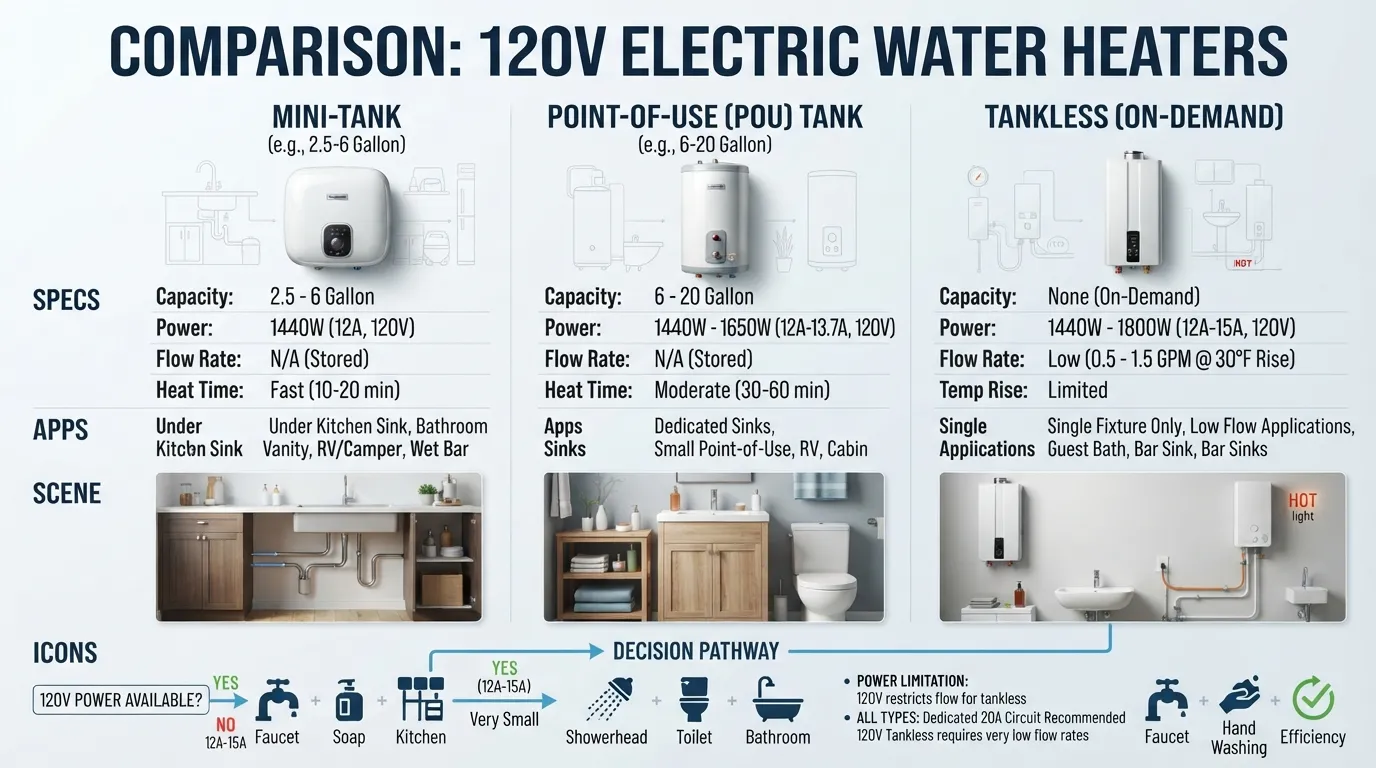
A mini-tank stores a relatively small amount of hot water close to the fixture where you need it. This can be useful when a sink is far from the main water heater or when installing a large central system would not make sense.
Rheem’s 120V mini-tank products, for example, are available in small capacities up to 6 gallons and are designed for point-of-use applications including sinks, handwashing stations, RVs, food trucks, boats, pool houses, and garages.
A mini-tank can be a strong choice when your priority is compact storage, quick access to hot water, and a relatively simple point-of-use installation.
2. 120V Point-of-Use Tankless Water Heater
A point-of-use tankless heater does not store a large volume of hot water. Instead, it heats water as it flows through the unit.
The major limitation is available heating power. A 120V tankless unit can be excellent for a low-flow fixture, but that does not mean every 120V tankless heater can supply a high-flow shower or multiple fixtures simultaneously.
For example, Rheem’s 120V 3.5 kW point-of-use tankless model is specifically described for one low-flow faucet such as a small sink.
3. 120V RV Water Heater
RV water heaters are designed around the electrical and space limitations found in recreational vehicles and campers.
Suburban’s E-Series, for example, is a fully electric 120V RV water heater with a 7-gallon storage capacity and a 120VAC/15-amp service requirement.
If your application is an RV, make sure you choose a model specifically designed and approved for that environment rather than assuming any residential 120V heater will be a suitable replacement.
4. 120V Heat Pump Water Heater
This is an important category that is easy to miss when researching 120V water heaters.
Some modern heat-pump water heaters are designed for 120V, 15-amp circuits. ENERGY STAR’s current criteria include a specific category for integrated 120V/15-amp heat-pump water heaters, and certified products now exist with substantially larger storage capacities than typical 120V mini-tanks.
For example, the ENERGY STAR database currently lists a 120V Rheem integrated heat-pump water heater with a 36-gallon storage volume, while another certified 120V model from A. O. Smith is listed at 68 gallons.
That changes the common assumption that every 120V water heater must be a tiny point-of-use appliance.
120V vs. 240V Water Heater: What’s the Difference?
This is one of the most important questions to answer before buying a water heater.
120V
- Common for point-of-use applications
- Small resistance heaters are widely available
- Useful where electrical capacity is limited
- 120V tankless options are generally best suited to low-flow applications
- 120V heat-pump models are now also available
240V
- Allows higher electrical power on many conventional electric systems
- Common for larger traditional electric resistance heaters
- More suitable for many higher-demand tankless applications
- May require a dedicated electrical circuit and different wiring
- Always check the specific product requirements
The important lesson is that 120V versus 240V is not simply a question of which voltage is “better.” You need to match the heater’s power, capacity, recovery, flow requirements, and electrical installation to your actual hot-water demand.
Can a 120V Water Heater Run a Shower?
Short answer: Sometimes, but you should never decide based on voltage alone.
A shower can demand considerably more hot water than a bathroom or kitchen sink. Whether a 120V system can serve a shower depends on the specific heater, tank capacity or flow capability, incoming water temperature, desired outlet temperature, shower flow rate, and recovery performance.
A small 120V mini-tank may provide useful hot water for a short or low-demand shower, but its stored capacity can be quickly depleted. A low-power 120V tankless heater may also be limited by the amount of water it can heat to your desired temperature at the required flow rate.
For example, Rheem specifically positions its 120V 3.5 kW point-of-use tankless model for one low-flow faucet rather than a general whole-home hot-water supply.
If your goal is a dependable shower for a household, have the system sized around your actual demand instead of choosing a heater simply because it is labeled “120V.”
Can You Get a 30- or 40-Gallon 120V Water Heater?
Yes, larger-capacity 120V solutions exist, but you need to distinguish between traditional electric resistance storage heaters and 120V heat-pump water heaters.
A conventional resistance heater with limited electrical input can take longer to recover after a large hot-water draw. A heat-pump water heater is a different technology and can use substantially less electrical input while storing a larger volume of hot water.
The U.S. Department of Energy has specifically researched 120V heat-pump water heaters as a potential replacement solution for 30- to 40-gallon gas water heaters.
Capacity is not the same as heating power
A larger tank gives you more stored hot water, but it does not automatically mean faster recovery. When comparing 120V systems, look at tank capacity, wattage or heat-pump input, first-hour rating, recovery information, and your expected hot-water demand.
How Many Watts and Amps Does a 120V Water Heater Use?
There is no single wattage or amperage number for every 120V water heater. Different designs use different amounts of electrical power.
For a simple example, a 1,500W resistance heater operating at 120V draws approximately 12.5 amps:
1,500W ÷ 120V = 12.5A
However, some 120V products have different wattages. Stiebel Eltron’s SHC mini-tanks, for example, list 1,300W and approximately 11.3A for their 120V models.
There are also higher-power 120V point-of-use tankless products. Rheem’s 3.5 kW 120V model is listed at 29 amps and a 30-amp single-pole breaker with 10 AWG wire.
Important: Never select a breaker or wire size from a generic “120V water heater” rule. Use the exact model’s electrical specifications and have the installation completed according to applicable electrical and plumbing requirements.
Does 120V Mean Lower Electricity Costs?
Not necessarily.
Voltage by itself does not determine how much electricity a water heater consumes. Electrical energy use depends on power and operating time. A lower-powered heater may run longer to heat the same amount of water.
For example, a 1,500W heater running for two hours uses approximately 3 kWh. That is why you should compare the heater’s efficiency, usage pattern, capacity, recovery, and operating conditions rather than assuming that 120V automatically means lower operating cost.
Heat-pump water heaters are a different story because they move heat rather than relying only on resistance heating. ENERGY STAR uses UEF as an efficiency metric and has separate criteria for 120V/15-amp integrated heat-pump water heaters.
120V Mini-Tank vs. 120V Tankless
Mini-Tank
- Stores hot water
- Useful for sinks and point-of-use applications
- Good when you want hot water close to the fixture
- Limited by tank capacity
- Needs recovery time after the stored hot water is used
Tankless
- No large storage tank
- Heats water as it flows
- Compact point-of-use design
- No conventional tank standby storage
- 120V models can have significant flow limitations
If you need predictable stored hot water for a sink, a mini-tank can be easier to match to the application. If space is extremely limited and your demand is low, a point-of-use tankless heater may make sense. The correct choice comes down to your fixture, flow rate, demand pattern, and electrical capacity.
Which 120V Water Heater Is Best for Your Situation?
Kitchen or Bathroom Sink
A 120V mini-tank or appropriately sized point-of-use tankless heater can be a practical starting point.
RV or Camper
Choose an RV-rated 120V water heater designed for the vehicle’s electrical system and installation environment.
Garage or Detached Space
A compact point-of-use heater can make sense when you need hot water at one fixture without extending a long hot-water line.
Whole-Home Demand
Do not assume a small 120V resistance heater can meet whole-home demand. Evaluate storage, first-hour rating, recovery, flow and available electrical service.
Limited Electrical Capacity
A 120V heat-pump water heater may be worth investigating when you need larger storage without installing the same type of high-power resistance circuit.
What Size 120V Water Heater Do You Need?
Do not choose capacity based only on the phrase “120V.” Instead, start with the fixture or household demand.
- Identify where the heater will be installed. A kitchen sink has very different demand from a whole house.
- Estimate how much hot water you actually need. Think about simultaneous fixtures and consecutive use.
- Choose tank or tankless. Decide whether stored hot water or on-demand heating better fits your use.
- Check electrical requirements. Look at voltage, wattage, amperage, breaker and wiring requirements for the exact model.
- Check recovery or flow performance. A larger tank does not automatically mean faster recovery, and a tankless heater does not automatically provide unlimited hot water.
- Consider efficiency. For larger residential applications, compare UEF and other applicable performance information rather than looking only at voltage.
120V Water Heater Installation: What Should You Check?
A water heater is both a plumbing appliance and an electrical appliance. Correct installation matters for safety, performance, and reliability.
- Confirm the exact voltage and electrical load on the manufacturer’s specification sheet.
- Use the required circuit, breaker, wiring, receptacle, or hardwired connection specified for the model.
- Follow the manufacturer’s water connection and installation instructions.
- For storage heaters, verify the required temperature-and-pressure protection and discharge arrangement.
- Make sure the heater is installed in the correct orientation and location.
- Check water pressure and any required expansion-control equipment according to the installation requirements.
- Follow applicable plumbing and electrical codes.
Manufacturer documentation should always take priority over generic online advice. For example, Rheem mini-tank products include a temperature-and-pressure relief valve, while Stiebel Eltron’s SHC documentation specifies its 120V electrical connection and included T&P valve.
Safety first: If the installation requires new wiring, circuit changes, or electrical work you are not qualified to perform, use a qualified professional. Water-heater electrical work should follow the appliance instructions and applicable electrical requirements.
Common Mistakes to Avoid When Buying a 120V Water Heater
Mistake 1: Assuming every 120V heater is the same
They are not. A 120V mini-tank, a 120V tankless unit, an RV heater, and a 120V heat-pump water heater can have very different capabilities.
Mistake 2: Choosing by gallon capacity alone
Capacity matters, but so do recovery, input power, first-hour rating, temperature rise and your actual demand.
Mistake 3: Assuming 120V automatically means cheaper operation
Energy consumption depends on power, operating time and system efficiency. Voltage by itself is not an operating-cost rating.
Mistake 4: Buying a 120V tankless heater for high-flow demand
Check the manufacturer’s flow and temperature-rise specifications first. Some 120V tankless models are explicitly designed for a single low-flow faucet.
Mistake 5: Ignoring 120V heat-pump options
If you need substantially more storage but have concerns about installing a conventional high-power resistance circuit, investigate whether a qualified 120V heat-pump option fits your application. ENERGY STAR’s current product database confirms that certified 120V integrated heat-pump models are available.
When Is a 120V Water Heater Not the Right Choice?
A 120V water heater may not be the best solution when your application requires high simultaneous flow, rapid recovery from repeated large draws, or a large amount of hot water from a conventional resistance system.
That does not mean you should automatically move to 240V. Instead, compare the available options—including larger storage, higher-power systems, and 120V heat-pump technology—against your actual hot-water demand.
A simple decision rule
Need hot water at one low-demand fixture? Start by looking at point-of-use options.
Need stored hot water in a compact space? Compare mini-tank options.
Need on-demand hot water at low flow? Compare 120V point-of-use tankless models.
Need larger residential storage while keeping a 120V circuit? Investigate 120V heat-pump water heaters.
Need high-flow, high-demand hot water? Have the entire system sized before choosing the voltage.
120V Electric Water Heater FAQ
Is a 120V electric water heater good?
Yes, when it matches the application. 120V heaters can be excellent for sinks, point-of-use applications, RVs, garages, detached spaces, and other situations where compact equipment or existing 120V service is important.
What is the difference between a 120V and 120-volt water heater?
There is no practical difference in the terminology. “120V,” “120 volt,” and “120-volt” all describe the nominal electrical voltage. Product specifications should still be checked because wattage and amperage can vary significantly between models.
Can I plug a 120V water heater into a normal outlet?
Some small 120V heaters are specifically designed to plug into a grounded 120V receptacle. Others require a dedicated circuit or different electrical arrangement. Never assume a standard outlet is acceptable without checking the exact product requirements. Rheem and Stiebel Eltron both document plug-in 120V configurations for certain mini-tank models.
How long does a 120V water heater take to heat?
There is no universal answer. Heating time depends on tank size, heater input, starting water temperature, target temperature and other design factors. For example, Stiebel Eltron’s published SHC specifications show different recovery times for its 2.5-, 4-, and 6-gallon models.
Can a 120V water heater heat water instantly?
A tankless heater can heat water as it flows, but “instant” does not mean unlimited flow. A 120V tankless heater still has a finite heating capacity and must be matched to the required flow and temperature rise. Some 120V point-of-use models are designed specifically for low-flow fixtures.
Is there a 30-gallon 120V water heater?
120V larger-capacity solutions do exist, particularly in the heat-pump category. ENERGY STAR currently lists certified 120V integrated heat-pump water heaters with storage volumes including 36 and 68 gallons.
Is there a 40-gallon 120V water heater?
Larger 120V heat-pump systems are available, and the U.S. Department of Energy has specifically studied 120V heat-pump water heaters as a replacement solution for 30- to 40-gallon gas water heaters. The exact capacity, electrical requirements and performance depend on the model.
Is 120V enough for a whole house?
It depends on the technology and system design. A small 120V mini-tank or low-power tankless unit should not be assumed to provide whole-house capacity. However, modern 120V heat-pump water heaters can provide much larger storage, so the answer should be based on the specific product and household demand rather than voltage alone.
Need Help Choosing or Replacing a 120V Water Heater?
Choose the system around your actual hot-water needs
If you are unsure whether you need a mini-tank, tankless unit, larger storage heater, or a 120V heat-pump system, the best starting point is to evaluate your fixtures, hot-water demand, available electrical service, installation location, and the specifications of the heater you are considering.
For water-heater installation, replacement, or professional plumbing help, talk with a water heater replacement professional or explore our plumbing services.
You can also learn more about our plumbing company or speak with our team about your water-heater needs.
Related Water Heater Resources
Because 120V water heater searches often have a buying or replacement intent, these manufacturer and government resources can help you verify specifications before choosing a model:
- Rheem MiniTank Water Heaters — manufacturer specifications and point-of-use applications.
- Stiebel Eltron SHC Mini-Tank Water Heaters — 120V specifications, capacities, electrical requirements and applications.
- Rheem 120V Point-of-Use Tankless — useful for understanding the flow limitations of a 120V tankless design.
- Suburban E-Series 120V RV Water Heater — 120V storage-water-heater example for RV applications.
- ENERGY STAR Water Heater Criteria — current efficiency and 120V/15-amp heat-pump requirements.
- ENERGY STAR Certified Heat Pump Water Heater Database — examples of currently certified 120V heat-pump models and their specifications.
- U.S. Department of Energy: 120V Heat Pump Water Heater Research — background on larger 120V heat-pump replacement applications.
A 120V electric water heater can be an excellent solution when it is properly matched to the application. Small mini-tanks and point-of-use tankless units are especially useful for low-demand fixtures, while 120V heat-pump technology has expanded the possibilities for larger residential storage. Before you buy, look beyond the voltage and compare capacity, wattage, amperage, flow rate, recovery, efficiency, installation requirements, and your actual hot-water demand.