If you’re looking for a 110 volt water heater, the most important question isn’t simply which model has the highest wattage or the most features. You first need to know how much hot water you need, where you’ll use it, how much electrical power is available, and whether a mini-tank or tankless design makes more sense for you.
A 110V water heater is generally used for lower-demand, point-of-use applications such as a sink, small bathroom fixture, RV, or another limited hot-water application. The right heater depends on wattage, electrical current, water flow, temperature rise, tank capacity, and the manufacturer’s installation requirements. A small 110/120V tankless heater should not automatically be assumed to provide enough hot water for a typical shower or whole house.
In this guide, I’ll walk you through the different types of 110V water heaters, 110V versus 120V terminology, 1500W versus 3000W models, how power affects flow and temperature, mini-tank versus tankless systems, RV applications, shower limitations, electrical considerations, and the questions you should ask before buying one.
What Is a 110 Volt Water Heater?
A 110 volt water heater is an electric water-heating appliance designed for a nominal electrical supply in the 110/120V range, depending on the specific product and its electrical rating.
You may see products described as:
- 110 volt water heater
- 110V water heater
- 110V hot water heater
- 110 electric hot water heater
- 110/120V water heater
- 120V water heater
The voltage rating is only one part of the equation. You also need to consider wattage, which tells you how much electrical power the heating element is designed to use.
For example, a 1500W heater and a 3000W heater may both be marketed for 110/120V applications, but they have very different electrical demands and heating capabilities.
Important: 110V does not automatically mean “use any regular outlet”
Always check the heater’s actual voltage rating, wattage, current requirements, plug configuration, circuit requirements, installation instructions, and applicable local code. Voltage alone does not tell you whether an existing electrical circuit can safely support the appliance.
How Does a 110V Water Heater Work?
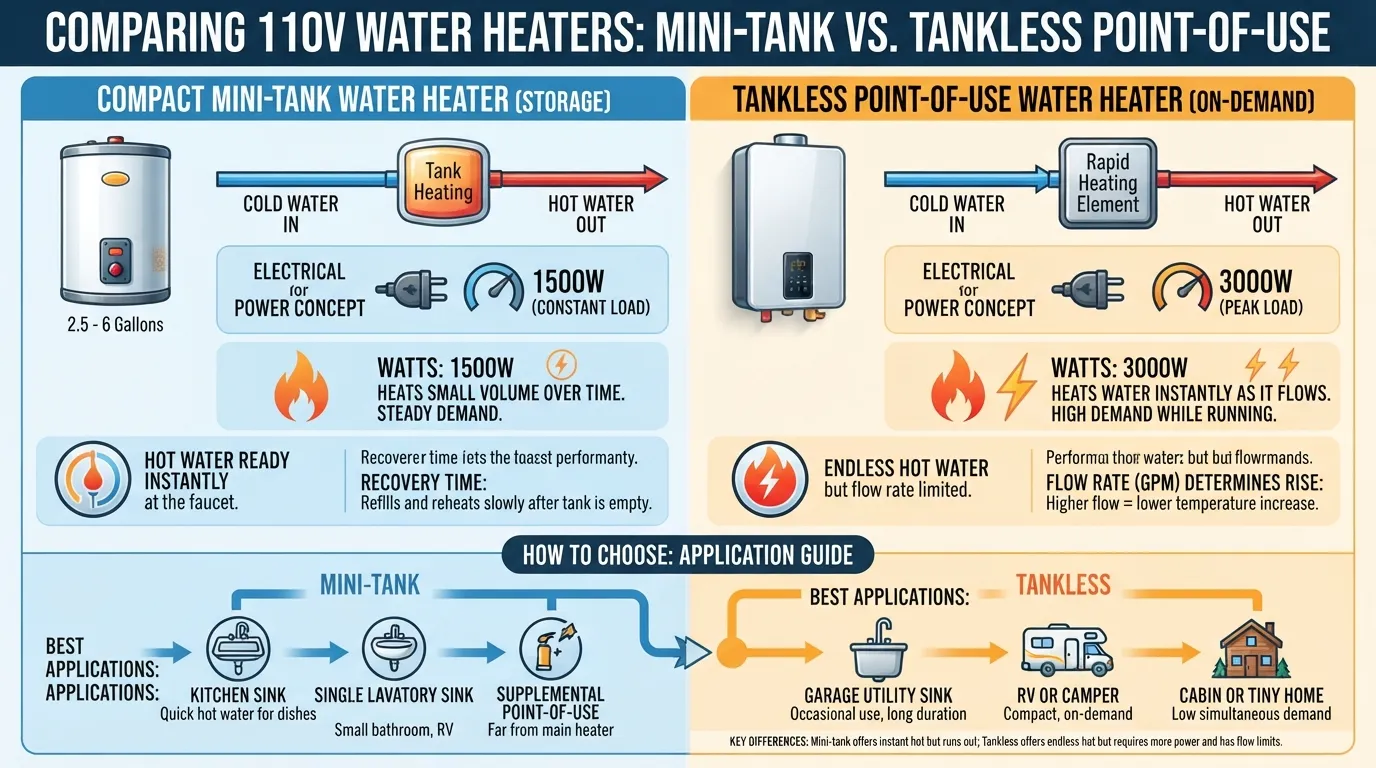
There are two main ways a compact electric water heater can provide hot water: it can store heated water in a small tank, or it can heat water as it flows through the unit.
Mini-Tank Water Heater
A mini-tank stores a relatively small amount of heated water. Because the water is already heated and stored, the heater does not have to create all of the temperature rise at the exact moment you open the faucet.
This can make a mini-tank practical for a small point-of-use application such as a kitchen or bathroom sink.
110V Tankless Water Heater
A 110V tankless hot water heater heats water as it passes through the heating element. It can save space and provide hot water on demand, but the amount of heat it can add is limited by its available electrical power.
That is why a tankless heater’s flow rate and temperature-rise specifications are just as important as its wattage.
How Much Power Does a 110V Water Heater Use?
A simple way to understand electrical demand is to compare watts, volts, and amps.
Amps ≈ Watts ÷ Volts
Using 120V as an example, the approximate current for several common wattages looks like this:
These are simple electrical calculations, not installation recommendations. A qualified professional should determine whether the appliance is compatible with the electrical system and whether the installation meets the manufacturer’s instructions and applicable code.
1500W vs. 3000W 110V Water Heater: Which Is Better?
If you’re comparing a 110V 1500W water heater with a 110V 3000W water heater, the 3000W model is not automatically the better choice.
It has twice the nominal heating power of a 1500W model, but it also creates a much higher electrical load. The useful question is whether you actually need that additional heating capacity for your application.
110V 1500W Water Heater
- Lower electrical demand than a 3000W unit.
- Commonly suited to small point-of-use or mini-tank applications.
- Can work well where hot-water demand is limited.
- Has less instantaneous heating capacity than a higher-wattage unit.
- A storage tank can provide a reserve of heated water even when the heating element has limited instantaneous capacity.
110V 3000W Water Heater
- Provides substantially more electrical heating power than a 1500W model.
- May provide greater temperature-rise capability for certain point-of-use applications.
- Requires significantly more electrical current.
- Still has practical flow limitations because the available heating power is finite.
- Must be installed according to the manufacturer’s electrical requirements.
The important difference
More watts generally provide more heating capacity, but the final water temperature still depends on flow rate, incoming water temperature, desired outlet temperature, and the heater’s design.
Why Flow Rate Matters With a 110V Tankless Water Heater
This is one of the most important concepts to understand before buying a mini tankless water heater or 110V point-of-use tankless unit.
A tankless heater does not have a large reservoir of already-heated water. It has to transfer heat to the water while the water is moving through the appliance.
That creates a relationship between four important factors:
- Water flow rate
- Incoming water temperature
- Desired outlet temperature
- Available heating power
If you increase the amount of water flowing through the heater without increasing the available heating power, the heater has less energy available for each unit of water. The achievable temperature rise can therefore decrease.
Likewise, reducing the flow can give a limited-power heater more opportunity to raise the water temperature.
The simple rule
Higher flow + larger temperature rise = more heating power required.
That is why a small 110V tankless heater can be practical for a sink while being a poor match for a much higher-flow application.
Can a 110V Water Heater Run a Shower?
You should not assume that a small 110/120V point-of-use heater can provide enough hot water for a typical shower.
The issue isn’t simply that the heater is “110V.” The bigger issue is whether the heater has enough heating capacity to raise the incoming water to the desired temperature at the required shower flow.
A sink may require a relatively low flow rate. A shower can demand considerably more water. If the heater cannot add enough heat at that flow, the outlet temperature may be lower than expected unless the flow is reduced.
Before using a 110V tankless heater for a shower
- Check the manufacturer’s rated flow range.
- Check the published temperature-rise information.
- Consider the incoming water temperature.
- Compare the required shower flow with the heater’s stated performance.
- Confirm the electrical requirements before installation.
This is also why product listings that simply advertise “instant hot water” should not be interpreted as meaning unlimited hot-water flow.
110V Mini-Tank vs. Tankless Water Heater
If you need hot water for a single fixture, the choice between a mini-tank and tankless water heater can be more important than the brand or extra features.
Where Is a 110 Volt Water Heater Most Useful?
Kitchen Sink
A compact point-of-use heater can make sense when you need hot water at a single kitchen fixture and don’t need to supply a large amount of hot water simultaneously.
Bathroom Sink
A bathroom sink can also be a practical application for a small mini-tank or point-of-use tankless heater, depending on the available electrical capacity, space, and desired flow.
RV
If you’re searching for the best 110 volt tankless water heater for an RV, don’t choose based on voltage alone.
Check:
- The RV’s available electrical capacity.
- The heater’s current requirement.
- The intended fixture.
- Water flow requirements.
- Available installation space.
- Whether the particular heater is designed and approved for the intended RV application.
A unit that works for an RV sink may not provide the same performance for an RV shower.
Small Point-of-Use Applications
110V heaters can be useful when you want hot water close to a particular fixture instead of attempting to supply an entire building with a small point-of-use appliance.
What Should You Look for in a 110V Hot Water Heater?
Before buying a 110V hot water heater, look beyond the product title. I recommend checking these specifications first:
- Rated voltage: Confirm whether the appliance is specified for 110V, 110–120V, or 120V.
- Wattage: Higher wattage generally means greater heating capacity but also greater electrical demand.
- Current draw: Confirm the manufacturer’s stated electrical load.
- Flow rate: Find out how much water the unit can heat at its published temperature-rise conditions.
- Temperature rise: Don’t assume a particular outlet temperature without checking the performance specifications.
- Tank capacity: For a mini-tank, check how much hot water it can store.
- Intended application: Make sure the appliance is suitable for your sink, bathroom, RV, or other use.
- Installation requirements: Follow the manufacturer’s plumbing and electrical instructions.
- Safety features: Review the protection features specified by the manufacturer.
- Dimensions: Make sure the unit physically fits the intended installation location.
110V Water Heater Buying Decision: Which Type Is Right for You?
I only need hot water at one sink.
A small mini-tank or point-of-use tankless heater may be worth considering, depending on your electrical supply, available space, desired flow, and temperature requirements.
I want hot water without storing it in a tank.
A tankless design may fit your needs, but pay close attention to flow rate and temperature-rise specifications.
I need hot water for an RV.
Evaluate the RV’s electrical capacity, intended fixture, water demand, physical space, and the heater’s application requirements.
I want to supply a shower or multiple fixtures.
Don’t assume a small 110/120V point-of-use heater is adequate. The required flow, temperature rise, and electrical capacity should be evaluated before choosing the system.
Can a 110V Water Heater Be Used for the Whole House?
Most small 110/120V point-of-use heaters are not designed to replace a properly sized whole-house water-heating system.
The reason is straightforward: whole-house demand can involve multiple fixtures operating at the same time. A small heater has a finite amount of electrical heating power, so increasing the flow through the heater can reduce the temperature rise it can provide.
If you need hot water for multiple showers, several fixtures, or a complete home, the system should be sized around your actual peak hot-water demand rather than selected solely because it is labeled “110V.”
If you’re replacing an existing water heater, you can review our water heater replacement service for help evaluating the appropriate system.
110V vs. 120V Water Heaters: Are They the Same?
You will often see the terms 110V water heater and 120V water heater used within the same product category. However, you should not assume that every appliance labeled 110V has exactly the same electrical specifications as every appliance labeled 120V.
The safest approach is to check the actual rating plate and the manufacturer’s specifications for the specific heater you’re considering.
Most importantly, the appliance’s rated voltage must be compatible with the electrical supply. Never connect a heater to a higher-voltage supply simply because the product title says “110V” or “120V.”
Is a 110V Water Heater Energy Efficient?
It’s tempting to assume that a tankless water heater automatically uses less energy simply because it doesn’t store hot water. That’s too broad a conclusion.
A tankless unit heats water when there is demand, while a storage heater keeps a quantity of water heated and can experience standby heat loss. Actual energy use depends on the heater, usage pattern, incoming water temperature, desired temperature, flow, and operating time.
For that reason, don’t choose a 110V heater based on the word “efficient” alone. Compare the actual specifications and select a system that matches your hot-water demand.
110V Water Heater Electrical Safety and Installation
Water and electricity require careful installation. Your water heater should be installed according to the manufacturer’s instructions and applicable local plumbing and electrical requirements.
Before installation, verify:
- The appliance’s rated voltage.
- The appliance’s wattage and current requirements.
- The required circuit and wiring specifications.
- The correct connection and protection requirements.
- The plumbing connections and water-pressure requirements specified by the manufacturer.
- Any required safety devices and installation clearances.
- That the installation complies with applicable local codes.
Don’t size an installation from wattage alone
A calculation such as 3,000W ÷ 120V ≈ 25A tells you the approximate electrical load. It does not by itself tell you which breaker, wire size, receptacle, or installation method is appropriate. Those requirements depend on the appliance, installation, code, and manufacturer’s instructions.
Common Mistakes When Buying a 110 Volt Water Heater
1. Choosing by Voltage Alone
“110V” tells you the electrical voltage category. It does not tell you how much hot water the heater can provide.
2. Ignoring Flow Rate
A tankless heater can have an attractive wattage specification and still be unsuitable if your required water flow is too high.
3. Assuming 3000W Means Whole-House Capability
3,000W provides more heating power than 1,500W, but it still has a finite capacity. Compare the available power with your actual flow and temperature-rise requirements.
4. Choosing an RV Heater Without Checking Electrical Capacity
Your RV’s available electrical capacity matters just as much as the heater’s voltage rating.
5. Installing a Heater Without Checking Its Requirements
Electrical and plumbing installation should be based on the actual appliance documentation and applicable code, not on a generic online recommendation.
110V Water Heater Quick Comparison
Frequently Asked Questions About 110 Volt Water Heaters
What is the best 110 volt water heater?
There isn’t one best 110V water heater for every situation. The right choice depends on whether you need hot water for a sink, bathroom, RV, shower, or another application. Compare voltage, wattage, current draw, flow rate, temperature-rise performance, tank capacity, physical size, and installation requirements.
Is a 110V water heater enough for a shower?
A small 110/120V point-of-use heater may not provide enough heating capacity for a typical shower at a comfortable flow rate. Check the manufacturer’s flow and temperature-rise specifications before using one for a shower.
Is 1500W enough for a 110V water heater?
It can be suitable for certain low-demand point-of-use or mini-tank applications. Whether 1500W is enough depends on the amount of water you need, incoming water temperature, desired outlet temperature, and whether the heater stores hot water or heats it instantly.
Is a 3000W 110V water heater better than a 1500W model?
Not automatically. A 3000W model has greater electrical heating power, but it also has a substantially higher current demand. If your application only needs a small amount of hot water, a lower-power mini-tank may be more appropriate.
How many amps does a 1500W water heater use?
At 120V, a 1500W heater draws approximately 12.5 amps using the simple watts-divided-by-volts calculation. The actual installation must follow the manufacturer’s electrical specifications and applicable code.
How many amps does a 3000W water heater use?
At 120V, a 3000W heater draws approximately 25 amps. At 110V, the simple calculation is approximately 27.3 amps. These calculations describe approximate electrical load and should not be treated as a breaker or wiring recommendation.
Can I use a 110V water heater on a 120V supply?
Do not assume compatibility from the product name. Check the appliance’s actual rated voltage and manufacturer’s specifications. Some products are specifically designed for a 110–120V range, while others have different requirements.
What is the difference between a 110V tankless water heater and a mini-tank heater?
A tankless heater heats water as it flows through the unit, while a mini-tank stores a limited amount of heated water. Tankless models can save space and provide heating on demand, while mini-tanks can be useful when a small stored supply of hot water is more practical.
Can a 110V water heater heat water instantly?
Some 110V point-of-use tankless heaters are designed for on-demand heating. However, “instant” does not mean unlimited hot-water flow. The heater still has a finite heating capacity, so flow and temperature rise must be considered.
What should I check before buying a 110V hot water heater?
Check the voltage rating, wattage, current draw, flow rate, temperature-rise data, tank capacity if applicable, intended use, physical dimensions, installation requirements, and manufacturer’s safety instructions.
110V Water Heater Buying Checklist
Before you buy, check these items
- Rated voltage
- Wattage
- Approximate or manufacturer-specified current draw
- Flow rate
- Temperature-rise performance
- Tank capacity, if applicable
- Intended fixture or application
- Physical dimensions
- Electrical installation requirements
- Plumbing requirements
- Manufacturer’s safety instructions
- Applicable local plumbing and electrical requirements
Final Takeaway: Choose the Heater Around Your Water Demand
If you remember only one thing from this guide, make it this:
Don’t choose a 110V water heater by voltage or wattage alone.
Choose it based on the amount of hot water you need, flow rate, required temperature rise, available electrical capacity, and the application you’re installing it for.
A 110V mini-tank can be a practical solution for a small point-of-use application. A 110V tankless unit can make sense where space is limited and the required flow is modest. But if you’re trying to supply a shower, multiple fixtures, or an entire home, the system needs to be evaluated around actual demand rather than the label on the heater.
If you’re replacing an existing system or you’re unsure whether a particular heater is appropriate for your plumbing and electrical setup, professional evaluation can help you avoid buying a unit that doesn’t match your needs.
Need help choosing or replacing a water heater?
A properly sized water-heating system should match your home’s hot-water demand, plumbing setup, and electrical requirements.
Explore Water Heater Replacement
Talk With a Plumbing Professional
For broader plumbing needs, you can also explore our plumbing services or visit our Miami Florida Plumbing home page.
Related Product Research & Resources
Because this keyword has strong buying intent, it can be useful to compare current product listings after you understand the specifications that matter. The resources below can help you research available 110V and 110–120V water-heater options. Product availability and specifications can change, so always verify the manufacturer’s current documentation before purchasing or installing a unit.
- :contentReference[oaicite:0]{index=0}
- :contentReference[oaicite:1]{index=1}
- :contentReference[oaicite:2]{index=2}
- :contentReference[oaicite:3]{index=3}
- :contentReference[oaicite:4]{index=4}
Helpful Resources
Visual demonstrations can help you understand how compact tankless and mini-tank water heaters are designed and installed. The videos below are included as supplementary resources; always follow the specific manufacturer’s instructions for the appliance you are considering.
Final note: Product listings and videos are useful for research, but they should not replace the manufacturer’s current specifications or professional evaluation of an electrical and plumbing installation.