If you need hot water but do not have room for a large tank, a small water heater can be a practical solution. The challenge is choosing the right one. A heater that is perfect for a bathroom sink may be completely inadequate for a shower, while the smallest model is not always the best model for your actual needs.
In this guide, I’ll walk you through the different types of compact water heaters, how capacity affects real-world use, what to consider for kitchens and bathrooms, how small tank and tankless models differ, and what to check before buying or installing one.
What Is the Best Small Water Heater?
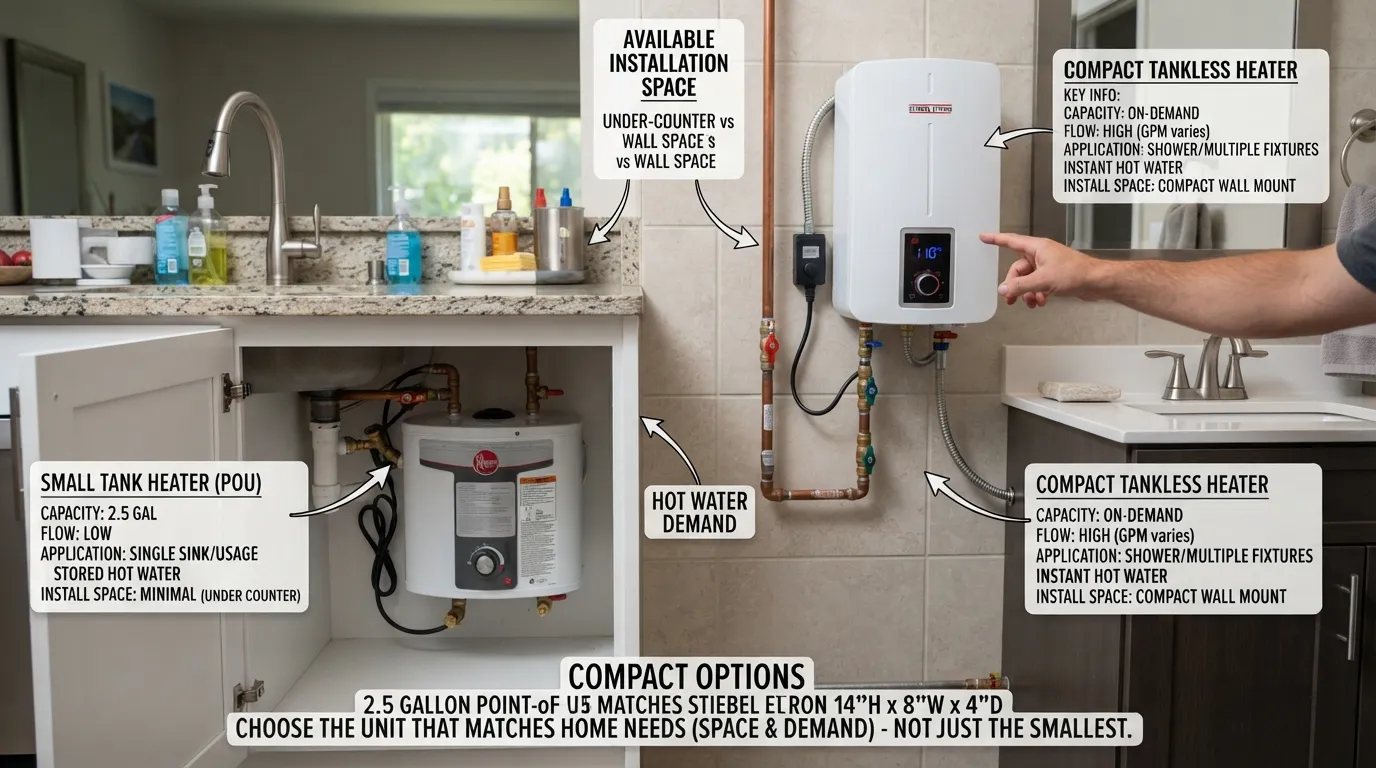
The best small water heater depends on where you need hot water, how much you use, how much physical space you have, and whether you want stored or on-demand hot water. A compact point-of-use tank can work well for a sink or other single fixture, while a small tankless unit may make more sense where space is extremely limited. For shower use or multiple users, choosing solely by the word “small” can leave you with insufficient hot water.
What Is a Small Water Heater?
A small water heater is a compact system designed to provide hot water where a full-size residential water heater would be unnecessary, impractical, or too large. You may also see these products described as mini water heaters, compact water heaters, small hot water heaters, point-of-use water heaters, mini-tank water heaters, or compact electric water heaters.
“Small” does not describe one exact capacity. Compact models can range from very small point-of-use units to larger compact tanks. The important question is not simply, “What is the smallest water heater I can buy?” It is:
What is the smallest practical water heater that can comfortably handle my specific hot-water demand?
Small Water Heater Sizes: How Much Capacity Do You Need?
Capacity is one of the first things to consider when choosing a small hot water heater. However, capacity should always be considered together with the application. A small tank that works well for handwashing is not necessarily suitable for a shower.
Very Small / Point of Use
Best suited to individual fixtures or limited hot-water needs where space is the main concern.
Small Tank
Useful when you want a reserve of hot water close to the fixture instead of heating water only when it is needed.
Compact Larger Capacity
More appropriate when your hot-water demand is greater but you still need a smaller footprint than a conventional full-size system.
For example, current U.S. point-of-use product listings include compact mini-tank models around 2.5, 4, and 6 gallons, along with other small point-of-use options. The right capacity depends on the fixture, usage pattern, recovery time, and installation requirements rather than capacity alone. :contentReference[oaicite:0]{index=0}
Is the Smallest Water Heater Always the Best Choice?
No. The smallest physical unit may save valuable space, but it can also have limited hot-water capacity or flow performance. If you choose a unit that is too small for the application, you may experience inadequate hot water, frequent cycling, or a need to wait for the unit to recover.
Think of “small” as a space requirement, not a performance requirement. Your heater still needs to match the job.
Small Tank Water Heater vs. Tankless Water Heater
One of the most important decisions is whether you want a small tank water heater or a tankless water heater.
A small tankless unit is not automatically the better choice just because it takes up less space. Before choosing one, check the required flow rate, incoming water temperature, desired outlet temperature, voltage, amperage, and manufacturer installation requirements.
Small Water Heater for a Kitchen
A kitchen is one of the situations where a compact water heater can make a lot of sense. If the main goal is hot water at a sink rather than supplying an entire home, a point-of-use heater can reduce the need for a large tank in the same location.
When choosing a kitchen unit, consider:
- How frequently you use hot water at the sink.
- How much cabinet or wall space is available.
- Whether the unit is designed for the intended installation position.
- Electrical requirements and available circuit capacity.
- Whether you need stored hot water or on-demand heating.
- Access for future maintenance or replacement.
Small Water Heater for a Bathroom
Bathroom applications require more careful planning because “hot water for a sink” and “hot water for a shower” are very different demands.
Important
Do not choose a bathroom water heater solely because it is marketed as a “mini” or “small” model. Shower demand depends on factors such as flow rate, desired temperature, incoming water temperature, heater capacity, and recovery or heating performance.
For a bathroom sink or handwashing point, a compact point-of-use heater may be appropriate. For a shower, you should verify that the selected system can actually deliver the required hot-water performance before buying it.
Under-Sink vs. Wall-Mounted Small Water Heaters
Physical dimensions matter just as much as capacity when you have limited space. Two heaters with similar capacities can have very different dimensions, mounting requirements, and installation orientations.
Under-Sink Water Heater
An under-sink model can be useful when you want hot water close to a kitchen or bathroom fixture while keeping the equipment out of normal sight. Before choosing one, confirm the available cabinet space, plumbing connections, ventilation requirements if applicable, and electrical access.
Wall-Mounted Water Heater
A wall-mounted compact heater can preserve cabinet space, but the wall and mounting method must be suitable for the equipment. The manufacturer’s required clearances, orientation, weight, and connection specifications should always be followed.
The point is simple: a small capacity does not necessarily mean the smallest physical footprint. Measure the actual installation area before you buy.
How to Choose the Right Small Water Heater
If you are comparing compact water heaters, I recommend working through these questions in order.
- Where will you use it? Kitchen sink, bathroom sink, shower, utility area, office, guest space, or another point of use?
- How many people will use it? A single fixture used occasionally has different requirements from a shower used by several people.
- Do you need stored or on-demand hot water? This determines whether a mini-tank or tankless design makes more sense.
- How much physical space do you have? Measure height, width, depth, and access space—not just the available volume.
- What electrical supply is available? Check voltage, wattage, amperage, circuit requirements, grounding, and manufacturer specifications.
- What hot-water performance do you need? For showers especially, consider flow rate and temperature rise rather than tank size alone.
- What maintenance will be required? Make sure the heater can be inspected and serviced without creating an impossible access problem.
A Simple Decision Guide
Need hot water for one sink? → Consider a compact point-of-use model.
Need stored hot water in a small space? → Compare mini-tank options.
Have almost no room for a tank? → Investigate an appropriately sized tankless option.
Need hot water for a shower? → Size the system around flow and temperature requirements rather than choosing the smallest unit.
Need hot water for multiple fixtures? → A point-of-use mini heater may not be enough; evaluate the whole system.
What Should You Look for in a Compact Electric Water Heater?
When comparing a small electric hot water heater, do not stop at capacity and price. Look at the complete specification sheet.
- Capacity: How much water does the tank actually store?
- Dimensions: Will it physically fit where you plan to install it?
- Wattage: What electrical power does the heater require?
- Voltage: Does it match the available electrical supply?
- Temperature control: Can the temperature be controlled appropriately?
- Safety features: Check the manufacturer’s listed protection and installation requirements.
- Recovery or heating performance: How quickly can the system provide additional hot water?
- Installation orientation: Is it designed for the position you need?
- Warranty: Understand what is covered and for how long.
- Serviceability: Can a qualified professional access the components later?
How Much Does a Small Water Heater Cost?
There is no single reliable price for a small water heater because the total cost can vary significantly by capacity, technology, brand, electrical requirements, installation complexity, location, and current market pricing.
For example, current U.S. retail listings show compact point-of-use electric heaters in several small capacities and at different price points, demonstrating why capacity and purchase price alone are not enough for a meaningful comparison. :contentReference[oaicite:1]{index=1}
Think Beyond the Sticker Price
When comparing two compact water heaters, consider the purchase price + installation + electrical work if required + expected maintenance + operating considerations. The cheapest unit to buy is not necessarily the cheapest or most suitable system to own.
Does a Small Water Heater Use Less Electricity?
Not necessarily. A smaller heater can have a lower total energy demand because it is serving a smaller application, but electricity use depends on the heater’s power, how much water you heat, the temperature increase required, how often you use it, and how efficiently the system operates.
A small tankless heater can also require substantial electrical power while operating. That is why you should never assume that “tankless,” “mini,” or “small” automatically means low electrical demand.
If you are replacing or adding a heater, have the electrical requirements reviewed by an appropriately qualified professional rather than choosing a model based only on its physical size.
Installation: What You Should Check Before Buying
A compact water heater still needs proper plumbing and electrical connections. The installation should follow the manufacturer’s instructions and applicable local requirements.
- Confirm the heater is approved for the intended installation location.
- Check the required water connections and pressure conditions.
- Confirm electrical voltage, wattage, circuit, grounding, and protection requirements.
- Allow the manufacturer’s required clearances.
- Make sure the unit can be accessed for inspection and service.
- Do not improvise electrical or plumbing connections simply because the heater is small.
Safety First
Water and electricity require careful installation. If you are unsure whether your existing plumbing, wiring, breaker, grounding, or installation location is suitable, have the system evaluated by a qualified professional. A smaller heater does not eliminate electrical or plumbing safety requirements.
Small Water Heater Maintenance
A compact heater still needs attention after installation. The exact maintenance schedule depends on the model, water conditions, manufacturer recommendations, and installation.
Keep an eye out for:
- Water leaks around connections or the tank.
- Unexpected changes in hot-water performance.
- Unusual noises.
- Temperature problems.
- Electrical tripping or other electrical issues.
- Visible corrosion or deterioration.
If you notice a leak, electrical problem, repeated breaker trips, or another potentially unsafe condition, stop using the equipment when appropriate and arrange for professional assessment.
Small Water Heater vs. Regular Water Heater
Choose Compact When…
- You have limited installation space.
- You mainly need hot water at one point of use.
- You want a localized hot-water solution.
- Your hot-water demand is relatively limited.
Consider a Larger System When…
- Several fixtures need hot water at once.
- You have significant shower demand.
- Multiple people regularly use hot water.
- A point-of-use heater cannot meet the required flow or capacity.
Common Mistakes When Buying a Mini Water Heater
- Choosing the smallest model without checking the application. Smaller is not automatically better.
- Comparing price without comparing specifications. Capacity, power, installation, and warranty all matter.
- Ignoring physical dimensions. Measure the actual space, including connection and service access.
- Assuming tankless means low power. Check the electrical requirements of the exact model.
- Using a sink-sized heater for a shower. These applications can have very different hot-water demands.
- Ignoring installation requirements. Plumbing and electrical connections must be suitable for the equipment.
- Choosing based only on brand name. Compare the actual model specifications and suitability for your application.
Frequently Asked Questions About Small Water Heaters
What is the smallest useful water heater?
The smallest useful water heater depends on what you want it to do. Very small point-of-use units can be suitable for limited fixture applications, but the smallest physical heater may not provide enough hot water for a shower or higher-demand application.
Is a small water heater good for a shower?
It can be, but you should not choose one based on size alone. Shower applications require you to consider flow rate, incoming water temperature, desired temperature, heating capacity, recovery, and the manufacturer’s performance specifications.
Is a mini-tank water heater better than tankless?
Neither is universally better. A mini-tank provides stored hot water and can work well for point-of-use applications. A tankless unit can save physical space but may have different flow and electrical requirements. The right choice depends on your application.
Can I install a small water heater under a sink?
Some compact water heaters are specifically designed for under-sink or point-of-use installation. Always verify the exact model’s installation orientation, clearances, plumbing connections, electrical requirements, and manufacturer’s instructions before installation.
How much does a small water heater cost?
The price varies by capacity, heater type, brand, features, and market. Installation can add to the total cost. For a useful comparison, look at the complete installed cost rather than comparing product prices alone.
Does a small electric water heater save space?
Yes, compact models are designed for applications where space is limited, but the actual footprint varies considerably. Always compare the unit’s height, width, depth, mounting requirements, and required service clearances.
What size water heater do I need for one person?
There is no single capacity that is right for every one-person household. A person using hot water only at a sink has very different requirements from someone taking long showers. Start with the fixture and usage pattern, then compare the manufacturer’s capacity and performance specifications.
Should I buy a small hot water tank or an instant heater?
Choose based on your space, hot-water demand, electrical supply, and whether you prefer stored hot water or on-demand heating. A small tank can be convenient for point-of-use storage, while an appropriately sized tankless unit can be useful where space is extremely limited.
Need Help Choosing or Replacing a Water Heater?
Choosing the right compact water heater is only part of the job. The unit also needs to be compatible with your home’s plumbing, electrical supply, installation location, and actual hot-water demand.
If you are unsure which system fits your home, it can be useful to have a professional evaluate the application before you purchase equipment. For broader plumbing needs, you can also explore our plumbing services.
Not Sure Which Water Heater Fits?
Get professional guidance before choosing a unit that may be too small, too large, or unsuitable for your installation.
Water Heater Resources
If you are comparing products before buying, it is worth checking current manufacturer and retailer specifications because availability, pricing, capacities, and product models can change.
- View compact point-of-use water heaters at Home Depot — useful for comparing current U.S. compact and mini-tank options. :contentReference[oaicite:2]{index=2}
- Compare wall-mounted point-of-use water heaters — useful when physical installation space is a major consideration. :contentReference[oaicite:3]{index=3}
- Explore U.S. Department of Energy water-heating guidance — a useful reference for understanding water-heating efficiency and energy considerations.
One Last Tip
The best small water heater is not necessarily the smallest, cheapest, or most powerful model. It is the one that gives you the right combination of capacity, hot-water performance, physical size, electrical requirements, installation compatibility, and long-term practicality for the way you actually use hot water.
If you are considering a water heater replacement rather than simply adding a compact point-of-use unit, see our guide to water heater replacement for the next step.
For general plumbing assistance, visit our Miami plumbing services page.