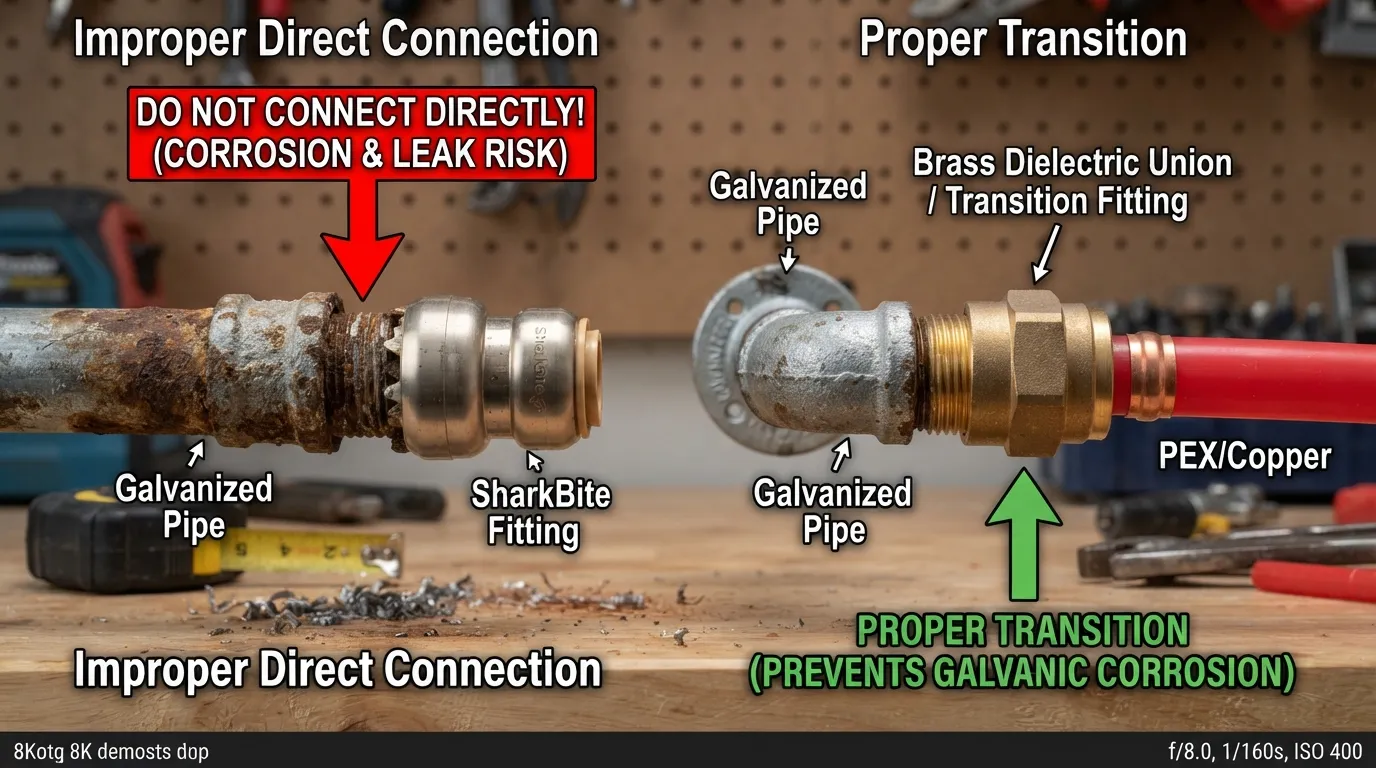
If you have an older galvanized water line and want to connect modern PEX or copper using a SharkBite fitting, the first thing to know is that a standard SharkBite push-to-connect fitting should not be installed directly onto galvanized pipe. The safer approach is to create a proper compatible transition point, usually at a suitable threaded connection, and then connect the SharkBite side to an approved tubing material.
Quick Answer: Does SharkBite Work Directly on Galvanized Pipe?
No. You should not push a standard SharkBite push-to-connect fitting directly onto galvanized pipe. SharkBite’s installation guidance specifically says its push-to-connect fittings are not for direct installation on galvanized pipe. :contentReference[oaicite:0]{index=0}
If you want to transition from galvanized pipe to PEX, copper, or another approved tubing material, the connection needs to be designed around a compatible transition point rather than treating the galvanized pipe like copper or PEX.
Why Can’t You Put a SharkBite Directly on Galvanized Pipe?
It is easy to assume that a push-to-connect fitting should work on any pipe with the right nominal size. That is not how these fittings work.
A push-to-connect fitting is designed around specific pipe and tubing materials, dimensions, and surface conditions. Galvanized steel does not provide the same type of connection surface as the approved tubing materials used with SharkBite push-to-connect fittings.
SharkBite’s published installation guidance says its push-to-connect fittings should not be installed on galvanized tubing or directly on galvanized pipe.
The important distinction
A SharkBite fitting being able to connect to modern tubing does not mean it can grip bare galvanized pipe. The practical solution is to create a compatible transition instead of forcing a push-to-connect fitting onto galvanized steel.
How Do You Transition From Galvanized Pipe to SharkBite?
If your existing galvanized line has a usable threaded connection, the basic concept is straightforward: use the threaded side to create the transition, then use the SharkBite-compatible side for the modern tubing.
That does not mean every threaded SharkBite adapter is automatically correct for every galvanized pipe. You still need to match the thread configuration, size, application, and tubing compatibility.
Possibly, but the “3/4-inch” label by itself is not enough to select the fitting.
Galvanized steel plumbing is commonly identified using nominal pipe sizing, while many modern tubing and push-to-connect systems are based on tubing dimensions and specific compatibility standards. That is why you should verify the actual pipe material, nominal size, thread configuration, and the requirements of the transition fitting before purchasing parts.
Before buying a “3/4-inch” fitting, check:
- Whether the existing pipe is actually galvanized steel.
- The nominal pipe size.
- Whether the galvanized end is male-threaded, female-threaded, or unthreaded.
- Whether the threads are clean and in usable condition.
- The material and outside diameter of the new PEX or other tubing.
- The exact compatibility information for the transition fitting.
- The pressure, temperature, and application requirements of the plumbing system.
This sizing check is one of the easiest ways to avoid buying a fitting that appears to have the right size printed on the package but does not match the actual connection you are trying to make.
Can You Connect SharkBite to Galvanized Pipe Without Threads?
You should not solve an unthreaded galvanized-pipe connection by simply pushing a SharkBite fitting onto the bare galvanized pipe. SharkBite’s current guidance specifically says its push-to-connect fittings should not be installed directly on galvanized pipe.
An unthreaded section needs to be evaluated differently. The condition of the pipe, the amount of accessible pipe, the location of the connection, and the intended repair all affect which transition method is appropriate.
Do not improvise the connection
If the galvanized pipe has no usable threads, is badly corroded, is difficult to access, or begins moving when you try to work on it, forcing a connection can turn a small repair into a larger leak. In that situation, the appropriate transition method should be determined from the actual pipe condition and plumbing configuration.
How Do You Connect Copper Pipe to Galvanized Pipe?
Connecting copper to an existing galvanized line also requires a proper transition rather than treating the galvanized pipe as if it were copper tubing.
The practical sequence is generally to work from the existing galvanized connection, establish a compatible threaded transition where appropriate, and then connect the copper side using a fitting approved for that application.
Material compatibility matters here. A transition should be selected according to the fitting manufacturer’s instructions and the plumbing system’s requirements rather than assuming that any brass or copper fitting will automatically be suitable.
For threaded SharkBite connections, the manufacturer specifies compatible thread types and recommends using the appropriate thread seal tape for threaded connections.
What Is a Dielectric Union, and Do You Need One?
A dielectric union is designed to separate dissimilar metals in certain plumbing connections and reduce the potential for galvanic corrosion. Whether one is required depends on the specific materials, connection design, and applicable plumbing requirements.
The important point is not to assume that every galvanized-to-modern-pipe transition requires exactly the same fitting. The correct transition depends on the actual materials and connection configuration.
Think about the whole connection, not just one fitting
When galvanized steel meets another plumbing material, consider the complete transition assembly: the existing threads, adapter type, joining materials, sealing method, tubing compatibility, and the requirements of the plumbing system. A single fitting name is not enough to determine whether a connection is appropriate.
Galvanized Pipe to PEX: A Practical Decision Guide
If your goal is to keep part of an existing galvanized system while converting a section to PEX, start by identifying the condition of the galvanized pipe rather than immediately buying an adapter.
That depends on whether you are dealing with one connection problem or a larger condition issue throughout the plumbing system.
Replacing an entire galvanized system is a substantially different project from making one transition. If you are seeing repeated failures, it is worth evaluating the condition of the overall system rather than treating every leak as an isolated fitting problem.
What to Check Before Buying a SharkBite Fitting
- Confirm the pipe material. Make sure you are dealing with galvanized steel rather than copper, CPVC, PEX, or another material.
- Identify the connection type. Determine whether the galvanized pipe has male threads, female threads, or no usable threads.
- Check the condition of the threads. Old galvanized threads can be corroded or weakened.
- Confirm the nominal size. Do not rely on appearance alone.
- Identify the new tubing. PEX, copper, CPVC, PE-RT, and HDPE are not interchangeable simply because they have similar nominal sizes.
- Check the fitting’s approved applications. The specific product instructions control compatibility.
- Verify the thread type. SharkBite threaded adapters use specified thread configurations, so the mating connection must be compatible.
- Check the installation requirements. Follow the manufacturer’s instructions and applicable plumbing requirements for the application.
Common Mistakes When Connecting SharkBite to Galvanized Pipe
- Pushing a SharkBite fitting directly onto galvanized pipe. This is specifically excluded by SharkBite’s installation guidance.
- Choosing a fitting based only on nominal size. The connection also has to match the actual material, thread configuration, and tubing dimensions.
- Ignoring damaged threads. A fitting cannot make severely deteriorated threads reliable.
- Assuming every SharkBite adapter is interchangeable. Different adapters have different connection types and approved tubing applications.
- Forcing an old galvanized connection. Old pipe can be fragile, particularly when corrosion has weakened the connection.
- Stopping at the immediate leak. Repeated failures may indicate a larger problem with the galvanized plumbing system.
- Skipping the final leak check. Any completed plumbing connection should be inspected after water pressure is restored.
Can You Use a Compression Fitting on Galvanized Pipe?
A compression fitting is not automatically a universal solution for galvanized pipe. Compatibility depends on the specific fitting, pipe dimensions, connection design, and application.
If you are considering a compression fitting because the galvanized pipe has no usable threads, do not assume that the fitting will safely grip the pipe simply because its listed size appears to match. Verify that the fitting is specifically intended for the pipe and application.
Is Galvanized Steel Still Good for Plumbing?
Galvanized steel can remain part of an older plumbing system for many years, but age and condition matter. The practical question is often not whether galvanized steel exists in the home, but whether the particular section is still in suitable condition for the repair you are planning.
Watch for recurring leaks, visible corrosion, reduced flow, or multiple failing connections. If those problems are widespread, repeatedly adapting individual sections may not address the underlying condition of the system.
For a small, isolated transition, the appropriate repair may be very different from the right approach for an aging system with multiple problem areas.
When Is It Better to Call a Plumber?
You may be dealing with a simple transition if the pipe is accessible, the connection is in good condition, and the correct compatible fitting is clear. But some galvanized-pipe repairs are not good candidates for trial-and-error installation.
Professional help is particularly useful when:
- The galvanized pipe is heavily corroded.
- The threads are damaged or difficult to identify.
- The pipe moves when you attempt to loosen a fitting.
- You cannot isolate the section safely.
- The pipe is concealed or difficult to access.
- There are several leaks or signs of system-wide deterioration.
- You are considering replacing galvanized plumbing with PEX throughout the property.
If you need help evaluating the larger plumbing problem, you can explore our plumbing services for additional options.
A Simple SharkBite-to-Galvanized Pipe Decision Tree
Can the SharkBite fitting be pushed directly onto it?
No. Direct installation on galvanized pipe is not approved by SharkBite’s installation guidance.
Is there a suitable threaded connection?
If yes, evaluate a compatible threaded transition and verify the size, thread type, tubing material, and fitting instructions.
No usable threads or poor pipe condition?
Do not force a push-to-connect fitting onto the galvanized pipe. Evaluate the appropriate repair or replacement method for the actual condition.
Frequently Asked Questions About SharkBite and Galvanized Pipe
Can you connect a SharkBite to galvanized pipe?
Not directly with a standard SharkBite push-to-connect fitting. SharkBite’s installation guidance says these fittings should not be installed directly on galvanized pipe. A suitable transition must be used where appropriate.
Is there a SharkBite fitting specifically for galvanized pipe?
SharkBite does not approve its standard push-to-connect fittings for direct installation on galvanized pipe. Its threaded adapters are designed to provide specified threaded and compatible tubing connections, so the complete transition must be evaluated rather than treating the adapter as a direct galvanized-pipe fitting.
Can I connect PEX to galvanized pipe?
Yes, a galvanized-to-PEX transition can be made when the correct compatible connection is used. A common approach is to transition from a suitable threaded galvanized connection to a fitting compatible with PEX. The exact fitting depends on the pipe size, thread configuration, and PEX connection method.
How do I connect galvanized pipe to PEX without threads?
Do not simply push a SharkBite fitting onto unthreaded galvanized pipe. A suitable transition method must be selected for the pipe’s condition and configuration. If the pipe has no usable threads or is heavily corroded, professional evaluation may be the safer option.
Can I connect 3/4-inch galvanized pipe to PEX?
A 3/4-inch galvanized line can potentially be transitioned to PEX, but you need to verify the nominal pipe size, thread configuration, transition fitting, and PEX size rather than selecting a fitting based on the “3/4-inch” label alone.
What’s the best way to connect copper pipe to galvanized pipe?
Use a compatible transition designed for the two materials and the actual connection configuration. Do not assume that a standard push-to-connect fitting can be placed directly on galvanized pipe.
Should I replace galvanized pipes with PEX?
Not every galvanized-pipe connection requires full replacement. If the problem is isolated and the existing pipe is in suitable condition, a properly designed transition may be enough. If leaks, corrosion, restriction, or failures are widespread, replacing larger sections or the system may make more sense.
Is galvanized steel okay for plumbing?
Galvanized steel can still be found in older plumbing systems, but the condition of the existing pipe matters. Recurring leaks, corrosion, reduced flow, or multiple failing sections are reasons to evaluate whether continued repairs are the best long-term approach.
Key Takeaways
- Do not install a standard SharkBite push-to-connect fitting directly on galvanized pipe.
- A proper transition can allow an existing galvanized line to connect to compatible modern tubing.
- Thread condition, thread type, pipe size, tubing material, and fitting compatibility all matter.
- Unthreaded or badly corroded galvanized pipe needs a different evaluation than a clean threaded connection.
- A single repair and a whole-house galvanized-pipe replacement are two different decisions.
- When the existing pipe is deteriorated or the connection is uncertain, avoid forcing a fitting and have the plumbing condition evaluated.
Need Help With an Older Galvanized Plumbing System?
If you are not sure whether your galvanized pipe can be safely transitioned, or you are dealing with corrosion, recurring leaks, damaged threads, or multiple problem areas, getting the condition evaluated can help you avoid an unreliable repair.
For additional help, you can also connect with our plumbing team and discuss the condition of your existing pipe and the type of transition you need.
Related Manufacturer Resources
For product-specific compatibility, always verify the current manufacturer’s instructions before installation. SharkBite’s official resources explain its threaded adapters, approved tubing applications, and restrictions on installing push-to-connect fittings directly on galvanized pipe.