If you are planning to drain your water heater, the first thing you probably want to know is simple: how long will it actually take?
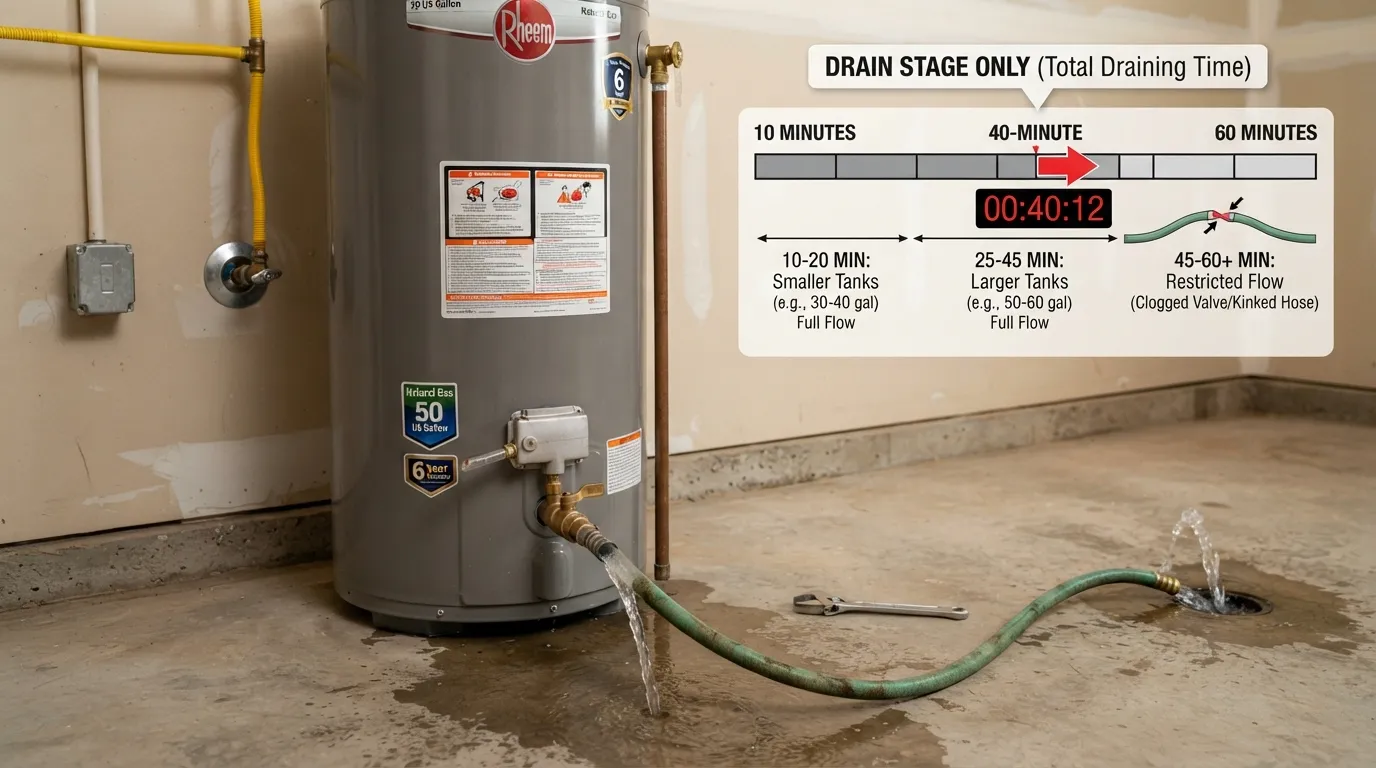
For a typical tank-style water heater, the actual draining step can take roughly 10 to 60 minutes, depending on the tank size and how freely water can leave the tank. A 40- to 60-gallon tank may drain relatively quickly when the drain valve, hose, and flow path are clear, while heavy sediment, a restricted valve, or other flow problems can make the process much slower.
For many standard tank water heaters, expect the drain-only portion to take somewhere around 10–60 minutes. Do not confuse that with the entire maintenance job. Flushing, refilling the tank, and waiting for the water to heat again can add considerably more time.
In this guide, I’ll show you how tank size affects draining time, why some water heaters drain painfully slowly, the difference between draining and flushing, how long a 50-gallon water heater may take, and what you should expect before you have hot water again.
How Long Does It Take to Drain a Water Heater by Tank Size?
Tank capacity is one of the most obvious factors. A larger tank simply contains more water, but capacity is not the only thing that determines how quickly it drains. The condition of the drain valve, sediment inside the tank, hose size and routing, and the overall drainage path can make a noticeable difference.
Important: these are practical ranges rather than a stopwatch guarantee. Published estimates vary because different sources measure different conditions. Some estimates describe only the time for water to leave the tank, while others include flushing, setup, refilling, or recovery time.
How Long Does It Take to Drain a 50-Gallon Water Heater?
A 50-gallon water heater can often drain in roughly 15–60 minutes when the drainage path is working normally. The wide range is intentional because two 50-gallon tanks can behave very differently.
If your 50-gallon tank has a clear drain valve, a suitable hose, and little restriction, water may leave relatively quickly. If sediment has accumulated around the drain opening or the valve is partially restricted, the same tank can take much longer.
A better way to judge your 50-gallon tank
- Is water coming out with a steady flow?
- Does the flow suddenly become a trickle?
- Is the drain valve difficult to open?
- Does sediment or debris appear in the discharge?
- Is the hose kinked, unusually long, or restricting flow?
If the tank is draining unusually slowly, the problem may be the drainage path rather than the tank’s capacity.
Why Do Water Heater Drain Times Vary So Much?
If you have seen different websites give different answers, you are not necessarily looking at contradictory information. The word “drain” can describe different parts of the job, and real-world flow conditions vary.
1. Tank capacity
A larger storage tank contains more water, so all else being equal, it needs more time to empty.
2. Sediment buildup
Minerals and sediment can accumulate inside a tank over time. Heavy buildup may restrict the drain opening or interfere with the flow of water and debris out of the tank.
3. Drain valve condition
A partially blocked, damaged, or restricted drain valve can turn a normally straightforward job into a slow one.
4. Hose restrictions
The hose becomes part of the drainage path. Kinks, restrictions, excessive length, elevation changes, or a poorly positioned discharge point can affect how quickly water leaves the tank.
5. Airflow into the tank
A tank is easier to drain when air can enter the system as water leaves. Opening an appropriate hot-water faucet can help admit air and allow the tank to drain more smoothly.
Why Is My Water Heater Taking So Long to Drain?
This is one of the most useful questions to ask if your water heater seems to be taking forever.
If the water starts flowing strongly and then slows to a trickle, sediment or a restriction around the drain valve is worth investigating. If the flow is weak from the beginning, look at the valve, hose, discharge route, and whether the tank is getting enough air.
Drain vs. Flush: Are They the Same Thing?
No. Draining and flushing are related, but they are not exactly the same.
Draining means removing the water from the tank.
Flushing goes further. After draining, fresh water can be used to help move sediment and debris out of the tank until the discharge is clearer.
That distinction explains why one website might say a water heater drains in 20 minutes while another says the overall process takes much longer. They may not be measuring the same task.
How Long Does the Whole Water Heater Maintenance Process Take?
Think of the job as several separate stages instead of one single timer:
Remove the stored water.
Move sediment and debris out when maintenance calls for it.
Allow the tank to fill completely.
Allow the heater to heat the water again.
So if you are asking, “When can I expect my hot shower again?”, the answer cannot be based on drain time alone.
How Long Does It Take to Fill a Water Heater Back Up?
Refill time depends on your tank size and the water flow entering the system. A 50-gallon tank does not necessarily refill in exactly the same amount of time at every home because inlet flow conditions can differ.
More importantly, do not assume the tank is ready simply because water has entered it. After draining and maintenance, you need to make sure the tank is properly filled before restoring the heating source according to the manufacturer’s instructions.
Important after draining
A tank-style water heater should be completely filled before its heating source is turned back on. Running an electric water heater without the tank properly filled can damage the heating elements. Follow your specific manufacturer’s instructions before restarting the unit.
How to Drain a Water Heater Safely
If you are draining a conventional tank-style water heater yourself, safety comes before speed. The water inside the tank may be hot enough to cause serious burns.
- Turn off the heating source. Follow the manufacturer’s instructions for shutting down an electric or gas water heater.
- Allow the water to cool. Giving the water time to cool reduces the risk of scalding.
- Shut off the cold-water supply. Close the cold-water inlet valve supplying the tank.
- Open an appropriate hot-water faucet. This can allow air into the system and help the tank drain.
- Connect a suitable hose to the drain valve. Make sure the other end is directed to a safe discharge location that can handle the water.
- Open the drain valve. Let the tank discharge through the hose.
- Monitor the flow. Watch for a sudden drop in flow or signs of sediment and blockage.
- Flush if appropriate. Follow the water heater manufacturer’s maintenance instructions if flushing is part of the job.
- Close the drain valve and refill the tank. Make sure the tank fills properly.
- Restore the heating source only after the tank is full. Follow the manufacturer’s restart procedure.
Your owner’s manual should take priority over generic instructions because water heaters differ by manufacturer, model, fuel type, and design.
Do I Need to Drain My Water Heater?
Draining and flushing can be part of routine maintenance on conventional tank water heaters, particularly when sediment buildup is a concern. It can also be necessary when the tank needs to be emptied for repair, replacement, or another service procedure.
However, the right maintenance schedule depends on the water heater, manufacturer’s recommendations, water conditions, and the condition of the system. Hard-water areas can experience more mineral buildup, but you should follow the maintenance guidance for your particular unit rather than relying on a universal schedule.
Can Sediment Make a Water Heater Drain Slowly?
Yes. Sediment buildup can interfere with drainage, particularly when debris collects around the drain opening or valve.
Sediment can also be associated with other water-heater symptoms, including unusual popping or rumbling noises and reduced heating performance. If you open the drain and barely any water comes out, do not automatically assume that the tank is simply taking longer because it is large.
A restricted drain valve or heavy sediment buildup may require professional attention rather than repeatedly forcing the valve or using an improvised method.
What If the Water Heater Drain Valve Is Clogged?
A clogged or restricted drain valve can make the tank appear almost impossible to empty. This is one reason a very slow drain should not be judged only by the tank’s gallon capacity.
If the valve is not flowing properly, avoid aggressive force that could damage the valve or create a leak. If the valve is stuck, leaking, severely restricted, or surrounded by corrosion, professional service is the safer option.
Gas vs. Electric Water Heater: Does the Drain Time Change?
The physical draining process is primarily determined by tank capacity and the drainage path, not simply by whether the heater uses gas or electricity.
Where gas and electric models can differ is in the shutdown and restart procedure and how quickly the unit recovers after the tank is refilled. Always follow the manufacturer’s instructions for your specific model.
What About Tankless Water Heaters?
A tankless water heater is different because it does not store a large tank of hot water. The maintenance process is therefore not the same as simply draining a 40-, 50-, or 80-gallon storage tank.
Tankless systems may require a manufacturer-specific descaling or flushing procedure, often involving isolation valves, hoses, a circulation pump, and an appropriate cleaning solution. If you have a tankless system, use the manufacturer’s service instructions rather than applying a conventional tank-draining procedure.
When Should You Stop DIY Water Heater Draining?
Draining a tank may look simple, but there are situations where continuing the job yourself can create a bigger problem.
- The drain valve is stuck and will not open normally.
- The drain valve begins leaking and will not shut properly.
- The water barely flows despite a correctly connected hose.
- You see significant corrosion around the tank or valve.
- The tank itself appears to be leaking.
- You are unsure how to safely shut down the gas or electrical supply.
- You are uncomfortable working around hot water, gas, electricity, or the water heater’s safety controls.
Do not trade a few minutes for a bigger repair
If the drain valve is damaged, the tank is leaking, or you are dealing with a gas or electrical safety concern, stop and get qualified professional help rather than forcing the process.
Drain Time vs. Total Job Time: The Difference Matters
This is probably the most important distinction to remember.
So when someone asks, “How long does it take to drain a water heater?” the answer should describe the draining stage. If they are asking how long until the water heater is fully serviced and hot water is available again, the answer needs to include the other stages too.
Quick Decision Guide: Is Your Drain Time Normal?
Use the flow, not just the clock
- Steady, reasonably strong flow: the tank is generally draining as expected; allow time for the remaining water to leave.
- Flow becomes much weaker: investigate possible sediment or a restriction around the drain path.
- Almost no flow: check whether the valve and hose are actually allowing water to leave, and consider professional help if the restriction cannot be safely resolved.
- Tank is empty but hot water is unavailable: remember that refill and heating recovery are separate from drain time.
Key Takeaways
- A typical tank-style water heater may take roughly 10–60 minutes to drain, depending on size and drainage conditions.
- A 50-gallon water heater can drain in a broad range because sediment, valve condition, hose restrictions, and other factors affect flow.
- Drain time is not the same as total maintenance time. Flushing, refilling, and heating the water again are separate stages.
- A water heater that drains unusually slowly may have a restricted drain valve, sediment buildup, or another flow problem.
- Draining and flushing are related but different processes.
- Always follow the manufacturer’s instructions for shutdown, maintenance, refill, and restart.
- If the drain valve is stuck, leaking, badly corroded, or the tank itself is leaking, professional help is the safer choice.
Frequently Asked Questions
How long does it take to drain a 40-gallon water heater?
A 40-gallon tank may drain in roughly 10–30 minutes when the drain path is clear. Sediment, valve restrictions, hose conditions, and other flow limitations can make it take longer.
How long does it take to drain a 50-gallon water heater?
A 50-gallon tank may take roughly 15–60 minutes to drain. The actual time depends heavily on how freely water can leave the tank.
How long does it take to drain an 80-gallon water heater?
An 80-gallon tank generally takes longer than a smaller tank, with roughly 30–60 minutes or more being a reasonable practical range. A restricted drain path can extend the process considerably.
How long does it take to flush a water heater?
Flushing usually takes longer than simply opening the drain and waiting for the tank to empty because the process can include additional water flow to move sediment out. The exact time depends on the tank and the amount of sediment present.
Why is my water heater taking so long to drain?
Common possibilities include sediment buildup, a restricted drain valve, a kinked or restrictive hose, poor drainage routing, or insufficient airflow into the tank. If the flow is extremely weak or stops, the drain path may need attention.
Do I need to drain my water heater?
Draining and flushing can be part of maintenance for conventional tank water heaters and may also be necessary for repairs or replacement. Follow the maintenance instructions for your specific model and consider your local water conditions.
Should I drain my hot water heater if it has sediment?
Sediment is one reason tank water heaters are periodically drained and flushed. If buildup is heavy or the drain valve is restricted, professional service may be safer than trying to force the issue yourself.
How long does it take for a water heater to fill back up?
Refill time varies with tank capacity and incoming water flow. It is a separate stage from draining, and the tank should be properly filled before the heating source is restored according to the manufacturer’s instructions.
Can I turn my water heater back on immediately after draining it?
Do not restore the heating source until the tank has been properly refilled. An electric water heater can be damaged if its heating elements operate without being adequately submerged. Follow your model’s restart instructions.
Can I use a transfer pump to drain a water heater?
A pump can be useful in some situations, particularly when gravity drainage is difficult, but the method should be appropriate for the equipment and the water heater. For routine homeowner maintenance, follow the manufacturer’s instructions and use a safe drainage setup rather than improvising around a restricted or damaged valve.
Is draining the same as water heater cleaning?
Not exactly. Draining removes the stored water. Flushing can help move sediment and debris out. More extensive cleaning or descaling may involve additional procedures, especially on tankless water heaters.
Need Help With a Water Heater That Won’t Drain Properly?
If your tank is draining unusually slowly, the drain valve is leaking or stuck, or you are not comfortable handling the shutdown and restart procedure, it may be time to have the system checked by a plumbing professional.
You can also explore our Miami plumbing services for help with water heaters and other plumbing needs.
If your water heater is approaching the end of its service life and replacement is becoming a better option than continued repairs, see our water heater replacement service.
For direct assistance, you can speak with a plumbing professional.
For a broader look at available plumbing solutions, you can also visit our full plumbing services page.
If you only need to know how long it takes to drain a water heater, a practical expectation for many residential tank systems is about 10–60 minutes. But the better question is whether the water is flowing normally. A slow drain can point to sediment or a restriction, while the time needed to flush, refill, and heat the tank again is separate from the actual draining time.