If you’re looking at a hot water heater and a furnace in your home, it’s easy to wonder whether they’re the same appliance, whether they work together, or whether one of them can heat both your home and your water.
The Short Answer
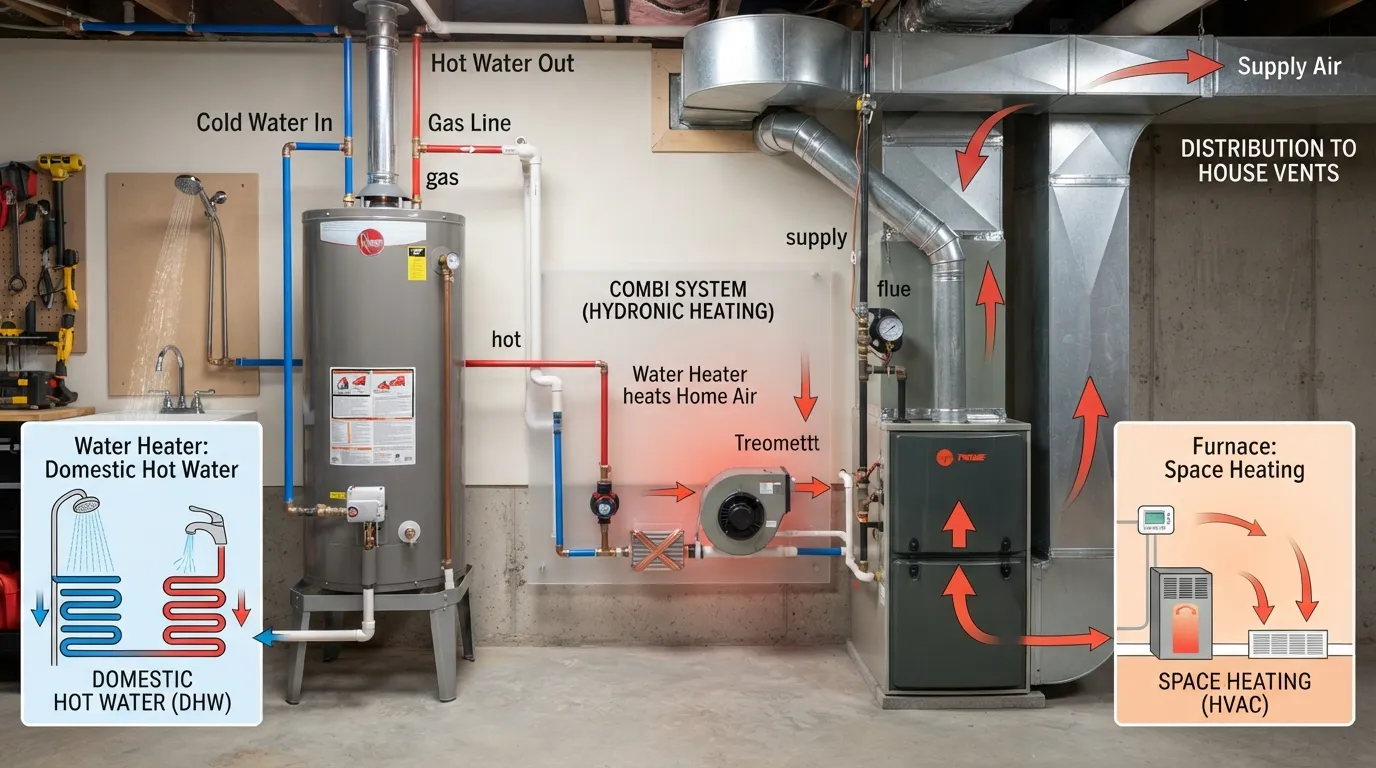
A water heater and a furnace normally do two different jobs. A water heater heats water for showers, faucets, washing, and other household uses. A furnace is normally part of an HVAC system that heats the air inside your home and distributes that warm air through ductwork.
They can be separate appliances while still sharing parts of the home’s infrastructure, such as fuel or electrical services, depending on the installation. Some homes also use combination systems designed to provide both space heating and domestic hot water from one heat source.
The important distinction is this: different appliances do not necessarily mean completely unrelated systems. Understanding that difference can help you identify what equipment you have and what may be happening when your heating or hot water isn’t working as expected.
Water Heater vs. Furnace: What Does Each One Do?
The easiest way to understand a hot water heater and furnace is to start with their primary jobs.
So if you’re asking, “Is a water heater the same thing as a furnace?” the answer is no. They are normally designed around different heating loads and different ways of delivering heat.
Water Heater vs. Furnace at a Glance
These roles are the starting point, but there are important exceptions. That’s where boilers and combination heating systems come into the picture.
How Does a Water Heater Work?
The exact process depends on the type of water heater, but the basic purpose remains the same: transfer heat to water that will be used around the home.
A conventional storage water heater keeps a quantity of hot water in a tank. A gas model uses a burner, while an electric model uses electric heating elements. Other technologies, including tankless and heat pump water heaters, use different methods of heating water.
With a typical tankless gas water heater, opening a hot-water tap causes cold water to enter the unit. A flow sensor can activate the burner, which heats a heat exchanger as water passes through it. The heated water then leaves the unit for the fixture. :contentReference[oaicite:0]{index=0}
Common Water Heater Types
- Storage water heater: Heats and stores a supply of hot water in a tank.
- Tankless water heater: Heats water as it flows through the unit instead of keeping a large stored supply hot.
- Electric water heater: Uses electricity to heat the water, commonly through resistance elements.
- Gas water heater: Uses a gas-fired burner to provide heat.
- Heat pump water heater: Uses electricity to move heat from the surrounding air into the water rather than generating all of the heat directly. :contentReference[oaicite:1]{index=1}
If you’re trying to understand the parts inside a conventional water heater, the thermostat, heating element or burner, tank, water connections, temperature-and-pressure relief valve, and other components each have a specific role.
How Does a Furnace Work?
A typical forced-air furnace works differently because its main job is to heat the indoor air.
When the thermostat calls for heat, the heating system starts its heating sequence. The furnace produces heat, and a blower moves air across the heated components or heat exchanger. The warmed air is then distributed through supply ducts and registers throughout the home.
The result is space heating rather than domestic hot water.
Think of It This Way
Water heater: Heat goes into water that you use.
Furnace: Heat goes into air that is distributed around your home in a typical forced-air system.
Are a Water Heater and Furnace Connected?
They can be related without being the same appliance.
In a home with a conventional standalone furnace and standalone water heater, the two appliances normally perform separate jobs. However, their broader installation can involve shared infrastructure or coordinated equipment, depending on the design.
For example, two fuel-burning appliances may both use the home’s fuel supply, while their electrical requirements and venting arrangements depend on the specific equipment. Modern combustion appliances can also use different venting designs, including sealed direct-vent systems. :contentReference[oaicite:2]{index=2}
Important: “Connected” Does Not Always Mean “One System”
A water heater and furnace can be separate appliances even when they are installed near each other or rely on some of the same home infrastructure. Never assume that two appliances share a vent, control, fuel connection, or other component simply because they are next to each other. The actual equipment and installation determine how the systems are connected.
Can a Water Heater Heat Your House?
A standard water heater is primarily designed to provide domestic hot water, but certain combination system designs can use a water-heating heat source for space heating as well.
This distinction matters.
A conventional water heater that simply supplies hot water to your shower and faucets should not automatically be treated as a whole-home heating system. But combination systems have been designed to use one heat source for both domestic hot water and space heating.
The U.S. Department of Energy has documented combination systems that provide both space heating and domestic hot water. Examples include systems using a gas-fired storage water heater with a hydronic coil in a fan-coil unit, combination boilers, and other configurations. :contentReference[oaicite:3]{index=3}
Can a Furnace Heat Your Water?
A typical standalone forced-air furnace is designed to heat air for the home, not to provide domestic hot water.
However, some heating system designs combine functions or use a separate indirect water-heating arrangement. In an indirect system, a boiler or other heat source can transfer heat to domestic water through a heat exchanger rather than heating the household water in the same way as a conventional standalone water heater.
That’s why the answer isn’t simply “never.” The equipment configuration matters.
What Is a Combination or Combi Heating System?
A combination, or combi, system is designed to provide more than one heating function from a shared heat source.
Depending on the design, a combination system may provide:
- Space heating for the home
- Domestic hot water
- Forced-air heating through a hydronic coil and air handler
- Hydronic heating through radiators, baseboards, or radiant-floor systems
The U.S. Department of Energy describes combi systems as systems that can provide both space heating and domestic water heating from a single heat source. :contentReference[oaicite:4]{index=4}
There are several ways this can be accomplished. A boiler, for example, can provide heated water for space heating and can also supply an indirect storage tank for domestic hot water. Another design can use a water-heating appliance with a hydronic coil connected to a central fan-coil unit. :contentReference[oaicite:5]{index=5}
The Key Idea
A combination system does not mean that every ordinary water heater suddenly becomes a furnace. It means the heating equipment and distribution components have been specifically designed to serve both domestic hot water and space-heating loads.
Water Heater vs. Furnace vs. Boiler
Boilers are worth discussing because they are one of the biggest sources of confusion when people compare water heaters and furnaces.
A boiler is not simply another name for a household water heater. A boiler is designed to provide heat for a building through a heating distribution system, although some boiler systems can also supply domestic hot water. Hot water from a boiler may circulate through floor loops, radiators, baseboards, or a coil in an air handler. :contentReference[oaicite:6]{index=6}
How to Tell Which System You Have
If you’re standing in front of your home’s heating equipment and aren’t sure what you’re looking at, you can start with the system’s function and distribution method.
A Simple Identification Guide
Do you see a tank or tankless unit connected to the home’s hot-water plumbing?
That points toward a water-heating appliance.
Do you see large air ducts connected to a heating cabinet with a blower?
That is consistent with a forced-air furnace or another forced-air heating system.
Does your home use radiators, hydronic baseboards, or radiant-floor tubing?
A boiler or another hydronic heat source may be involved.
Does one heating appliance appear to serve both the home’s space heating and domestic hot water?
You may have a combination system or another integrated design.
This is only an identification guide, not a substitute for inspecting the equipment or its installation. Gas-fired appliances, combustion systems, electrical components, and venting should be evaluated by a qualified professional when there is a safety or operating concern.
What If the Furnace Works but You Have No Hot Water?
If your furnace is heating the home but your faucets are producing cold water, don’t automatically assume the furnace is the problem.
In a conventional home with separate appliances, the furnace and water heater have different jobs. A problem with the water heater may therefore occur while the furnace continues to operate normally.
On the other hand, if your home has an integrated or combination heating system, the relationship can be different. A problem affecting the shared heat source or controls may potentially affect more than one function.
Don’t Guess With Gas or Combustion Equipment
If you notice a gas smell, unusual combustion behavior, damaged venting, repeated equipment shutdowns, or another potentially dangerous condition, stop troubleshooting the appliance yourself and contact an appropriately qualified professional.
Why Might a Furnace and Water Heater Be Near Each Other?
Location alone doesn’t tell you whether two appliances are part of the same system.
Mechanical rooms often contain several pieces of equipment because that’s a practical place to locate heating and plumbing equipment. A furnace, water heater, boiler, air handler, or other equipment may therefore be installed close together even when each appliance has a different function.
Some combustion appliances can also have specific venting requirements. Modern direct-vent equipment, for example, can bring combustion air directly from outside and exhaust combustion products directly outdoors through a sealed vent arrangement. :contentReference[oaicite:7]{index=7}
So rather than judging the relationship by appearance, look at the actual equipment and system design.
Gas vs. Electric Water Heaters
The phrase “water heater” describes the job the appliance performs, not necessarily the energy source it uses.
Gas Water Heaters
Gas water heaters use a fuel-fired burner to provide heat. Depending on the model, they can have different combustion and venting arrangements.
Electric Water Heaters
Electric water heaters use electricity rather than a gas burner. Conventional electric storage models commonly use electric resistance heating elements, while heat pump water heaters move heat from surrounding air into the water. :contentReference[oaicite:8]{index=8}
Tankless Water Heaters
Tankless units do not maintain a conventional storage tank full of heated water. Instead, they heat water as it flows through the unit. Gas tankless systems can use a burner and heat exchanger, while electric tankless systems use electrical heating technology. :contentReference[oaicite:9]{index=9}
The right choice depends on the home’s hot-water demand, available utilities, installation requirements, and the equipment’s design—not simply on whether a system is newer or smaller.
Water Heater Thermostat and Other Important Components
If you’re searching for a water heater thermostat or wondering how a water heater works internally, it helps to understand a few basic components.
- Thermostat: Helps control the water temperature in applicable water-heating systems.
- Heating element or burner: Provides the heat used to warm the water.
- Tank: Stores heated water in a conventional storage-type water heater.
- Cold-water inlet: Allows incoming cold water into the system.
- Hot-water outlet: Sends heated water toward the home’s fixtures.
- Temperature-and-pressure relief valve: Provides an important safety function on applicable storage water heaters.
- Anode rod: A component used in many storage water heaters to help protect the tank from corrosion.
- Venting: Required in certain fuel-burning water-heating systems to manage combustion products.
You don’t need to memorize every component to understand the difference between a furnace and water heater. The important point is that a water heater is built around heating and delivering domestic water, while a furnace is built around space heating.
Can One System Heat Both the House and the Water?
Yes, certain systems can.
This is one of the most important exceptions to the simple “water heater versus furnace” explanation.
Combination heating systems can use a shared heat source to meet both space-heating and domestic-hot-water demands. Depending on the design, the system may use a combination boiler, an indirect water heater, a hydronic coil, or another arrangement. :contentReference[oaicite:10]{index=10}
For example, a boiler can produce hot water for a home’s hydronic heating system while also supplying heat to an indirect storage tank for domestic hot water. Another configuration can use a water-heating appliance to supply a hydronic coil in a fan-coil unit, which then distributes warm air through ducts. :contentReference[oaicite:11]{index=11}
That means the correct answer to “Can a water heater and furnace work together?” depends on what equipment your home actually has.
Water Heater and Furnace: A Simple Decision Guide
What Are You Trying to Figure Out?
If your question is “What provides hot water to my shower?”
Look at the home’s water-heating equipment.
If your question is “What heats the air in my rooms?”
Look at the furnace or other space-heating system.
If your home uses radiators, baseboards, or radiant floors?
A boiler or hydronic heating system may be responsible for space heating.
If one heat source appears to provide both hot water and space heating?
You may have a combination system or an indirect-water-heating arrangement.
Frequently Asked Questions
Are a hot water heater and furnace the same thing?
No. A water heater normally provides domestic hot water, while a furnace normally provides space heating by heating air in a forced-air system.
Does a furnace heat the water in my house?
A typical standalone furnace does not provide domestic hot water. Some integrated heating configurations can provide both space heating and domestic hot water, but those are specific system designs rather than the normal function of a standalone furnace.
Can a water heater heat my house?
A standard water heater is designed primarily for domestic hot water. Certain combination systems can use a shared heat source for both domestic hot water and space heating, so the equipment configuration matters.
What is the difference between a boiler and a furnace?
A typical furnace heats air and distributes it through ductwork. A boiler heats water or produces steam for a hydronic distribution system such as radiators, baseboards, or radiant-floor heating. Some boilers can also supply domestic hot water. :contentReference[oaicite:12]{index=12}
Can a boiler provide hot water for my faucets?
Yes, some boiler-based systems can provide domestic hot water, including systems that use an indirect storage tank or another heat-transfer arrangement.
Why are my water heater and furnace next to each other?
They may simply be located together for convenience. Their physical proximity does not automatically mean they are the same system or share every connection.
Can a water heater and furnace share a vent?
Venting depends on the specific appliances, vent category, installation, and applicable requirements. Modern equipment can use sealed direct-vent arrangements, so you should not assume that two appliances can share a vent simply because they are nearby. :contentReference[oaicite:13]{index=13}
What if my furnace works but my water heater doesn’t?
If the appliances are separate, a water-heater problem can occur while the furnace continues working normally. If you have a combination or integrated system, the relationship may be different. A qualified professional can identify the equipment and diagnose the system safely.
Is a tankless water heater the same as a furnace?
No. “Tankless” describes how the water heater supplies hot water; it does not turn the appliance into a furnace. A tankless water heater heats domestic water as it flows through the unit.
What is an indirect water heater?
An indirect water heater stores domestic hot water and receives heat from another heat source, such as a boiler, through a heat exchanger. This is one way a heating system can also be used to provide domestic hot water.
When Should You Call a Professional?
If you’re only trying to identify whether you have a furnace, water heater, boiler, or combination system, learning the basic differences can be useful.
But professional help is appropriate when the issue involves gas, combustion, electrical components, venting, repeated equipment failures, leaks, or an appliance that isn’t operating correctly.
If you think your problem may involve the water-heating side of your home’s plumbing system, you can learn more about water heater replacement through the service information on our site: :contentReference[oaicite:14]{index=14}
Need Help With a Water Heater or Plumbing System?
Let’s Get the Right System Identified
If you’re dealing with a water-heater issue or aren’t sure which plumbing service you need, getting the system properly identified is the first step. You can also explore our broader plumbing services to see where your issue fits.
:contentReference[oaicite:15]{index=15}
Final Takeaway
A hot water heater and furnace are normally different appliances with different primary jobs. The water heater supplies domestic hot water, while a typical furnace provides space heating by warming air and distributing it through the home’s ducts.
But that’s only the starting point. Boilers, indirect water heaters, hydronic systems, and combination heating systems can connect these functions in different ways. That’s why two appliances can be separate while still being related to the home’s broader heating and plumbing infrastructure.
If you’re trying to identify your own system, don’t rely only on the equipment’s location or appearance. Look at what the equipment actually heats, where that heat goes, and whether your home uses ducts, radiators, baseboards, radiant flooring, domestic hot-water piping, or a combination of these.
The One-Line Answer
A water heater is primarily for your hot water, a furnace is primarily for heating your home’s air, and specialized combination systems can be designed to provide both.
Technical information in this article is intended for general educational purposes. Heating and water-heating equipment, fuel connections, combustion systems, electrical components, and venting vary by installation and should be evaluated by a qualified professional when service or safety concerns are involved.