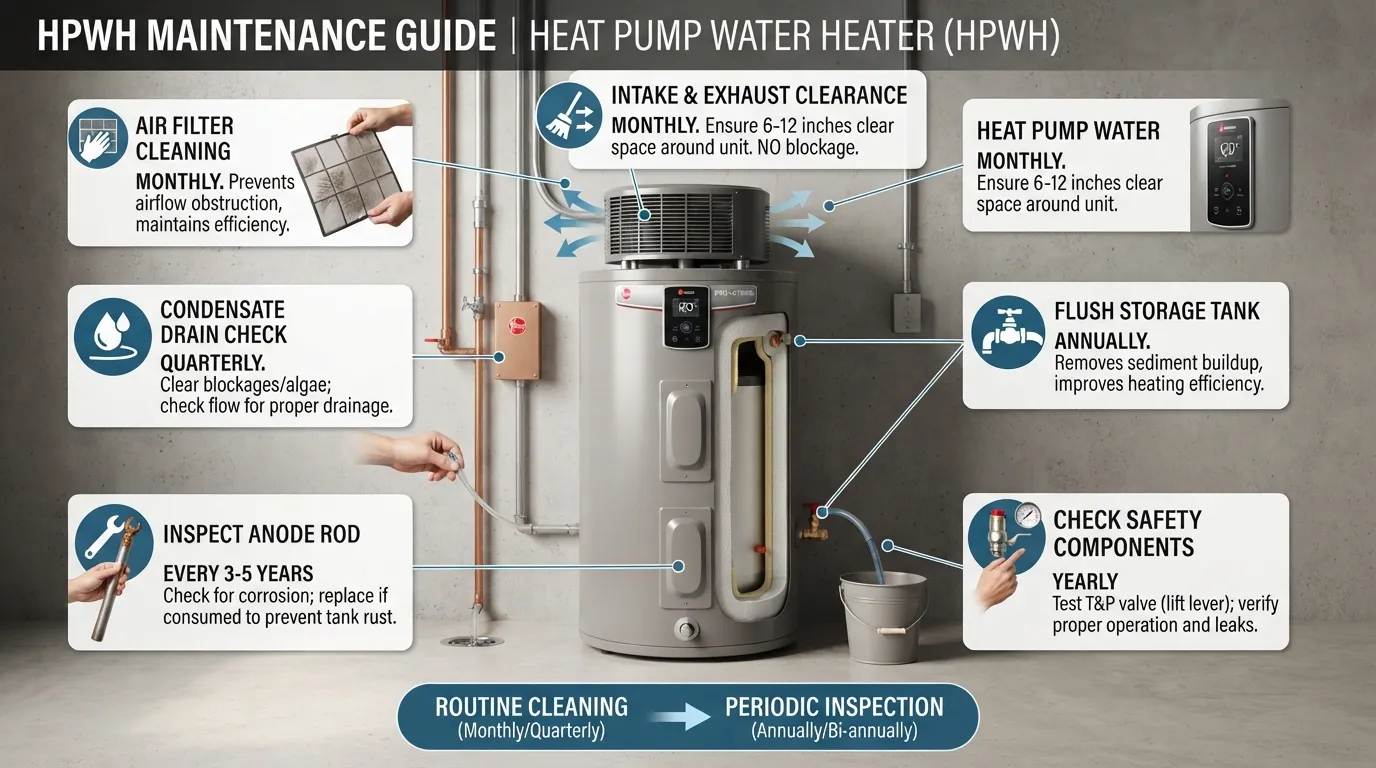
The best way to maintain a heat pump water heater is to follow your exact model’s owner manual while keeping the air filter clean, airflow unobstructed, the condensate drain clear, and the tank and plumbing under regular observation. Your maintenance frequency can change with the model, dust, pets, water quality, household usage, and installation conditions. Homeowner maintenance should stay within the tasks your manufacturer allows; electrical, refrigerant, serious leak, and other specialized repairs should be handled by a qualified professional.
If you own a heat pump water heater, you have a system that combines a storage tank with a heat-pump section, airflow, condensate drainage, plumbing, controls, and often electric resistance backup. That means maintenance is a little different from maintaining a conventional electric water heater.
The good news is that routine care does not have to be complicated. What matters most is knowing what to check, how often to check it, why it matters, and when a maintenance task has crossed into repair territory.
In this guide, I’ll walk you through a practical heat pump water heater maintenance routine, including filter care, airflow, condensate drainage, tank maintenance, settings, hard-water considerations, troubleshooting, DIY limits, and the warning signs that mean you should call a professional.
Heat Pump Water Heater Maintenance at a Glance
Maintenance intervals are not universal. Manufacturer instructions take priority because heat pump water heater designs and required procedures vary.
Why Heat Pump Water Heater Maintenance Matters
A heat pump water heater depends on moving heat from surrounding air into the stored water. If airflow becomes restricted, the condensate system cannot drain correctly, or the water-heating side develops a problem, performance can suffer.
Routine maintenance is therefore less about performing dozens of complicated tasks and more about preventing small problems from becoming expensive ones.
Think of maintenance as four simple checks
- Can the unit breathe? Check the filter and airflow path.
- Can the unit drain? Check the condensate system and visible drainage.
- Is the water-heating system healthy? Watch the tank, plumbing, temperature, and performance.
- Is anything unsafe or beyond DIY work? Stop and call a qualified professional when necessary.
1. Check and Clean the Air Filter
The air filter is one of the most important routine maintenance points on an integrated heat pump water heater. Dust and debris can restrict airflow, which can make the system work harder and contribute to poor performance.
The exact cleaning interval depends on the manufacturer and the environment. ENERGY STAR guidance gives a general range of 6 to 12 months, with more frequent cleaning in high-dust locations. Some manufacturers provide shorter inspection or cleaning intervals, especially in homes with pets, dust, or heavy usage.
How to Clean the Filter Safely
- Check your owner’s manual for the correct filter location and cleaning procedure.
- Follow the manufacturer’s power-isolation instructions before removing the filter if the manual requires power to be off.
- Remove the filter carefully so you do not damage the screen or housing.
- Clean or rinse it only as the manufacturer instructs.
- Allow a washable filter to dry completely before reinstalling it if the manual calls for washing.
- Reinstall it in the correct orientation and make sure it is seated properly.
- Reset any maintenance reminder or app notification if your model requires it.
Important: Don’t use a generic filter schedule blindly
If your manufacturer says to clean the filter monthly, quarterly, or when an alert appears, follow that instruction. Your home’s dust level, pets, laundry area, garage conditions, and other environmental factors can also change how quickly the filter becomes dirty.
2. Keep the Airflow Around the Unit Clear
A heat pump water heater needs an appropriate air path to operate properly. Boxes, clothing, storage bins, lint, dust, and other objects should not block the intake, exhaust, grille, or required service space.
Do not assume that a clearance number from another model applies to yours. The installation and owner’s manuals should determine the required clearance and access.
Also avoid wrapping an integrated heat pump water heater in a conventional insulation blanket. The U.S. Department of Energy warns that blankets can interfere with airflow and may reduce efficiency or affect warranty coverage.
A Simple Airflow Check
- Look for dust or lint around the air intake.
- Move stored items away from the manufacturer’s required clearance area.
- Make sure vents or grilles are not covered.
- Check whether a recent change in storage, shelving, or nearby equipment has restricted access.
- Do not remove covers or internal components simply to improve airflow.
3. Inspect the Condensate Drain
Heat pump water heaters produce condensate as part of their operation. That water needs a properly routed drainage path.
A clogged or poorly draining condensate line can lead to standing water, overflow, or other problems. ENERGY STAR recommends regular condensate-line maintenance and notes that standing water in a lower drain pan can indicate a clogged condensate pan or line.
What You Can Check
- Look at the visible condensate drain tubing.
- Check for obvious kinks or disconnections.
- Look for standing water where it should not be.
- Watch for signs of overflow or repeated drainage problems.
- Follow your manufacturer’s instructions for cleaning the line.
Do not make this assumption
Water beside the water heater is not automatically “just condensate.” It could come from the condensate system, a plumbing connection, a valve, the drain pan, or the tank itself. If you cannot identify the source safely, get professional help.
4. Inspect the Tank and Plumbing for Leaks or Corrosion
Take a few minutes during routine checks to look around the water heater rather than waiting until you have a puddle on the floor.
Look for:
- Active dripping
- Water stains
- Rust or corrosion around connections
- Damp insulation
- Moisture around the tank base
- Leaks around valves or fittings
- Repeated water appearing in the drain pan
A leaking connection may be a plumbing issue, while moisture from the tank body can indicate a much more serious problem. Do not open electrical compartments to investigate a leak.
5. Should You Flush a Heat Pump Water Heater?
Potentially, yes—but there is no universal flushing procedure or interval that should be applied to every heat pump water heater.
Sediment and minerals can accumulate in storage tanks, and manufacturers may recommend periodic flushing. However, the correct procedure depends on the model, plumbing arrangement, valves, water temperature, and manufacturer instructions.
If your owner’s manual calls for flushing and you are comfortable following the procedure exactly, use that procedure. If the drain valve is stuck, corroded, difficult to access, or you are not confident working with hot water and plumbing connections, use a qualified plumber.
Never guess your flushing procedure
A generic “flush every year” instruction may be appropriate for some systems, but your manufacturer’s instructions take priority. Do not open a drain valve, disconnect plumbing, or work around hot water simply because another water heater model uses that procedure.
6. What About the Anode Rod?
Many tank-style water heaters use an anode rod to help protect the tank from internal corrosion. The exact design, access method, and inspection interval vary by product.
Water chemistry also matters. Homes with harder water or higher mineral content may need closer attention to sediment and corrosion-related maintenance.
If your model has an accessible anode rod and the manufacturer provides an inspection procedure, follow it. If accessing the rod requires removing components, dealing with seized fittings, or working beyond your experience, have a qualified professional inspect it.
7. Check the Temperature and Operating Mode
Heat pump water heaters may offer several operating modes, such as heat pump/efficiency, hybrid, electric resistance, high-demand, or vacation mode. Manufacturers can use different names and combinations.
For most residential applications, the U.S. Department of Energy references 120°F as a typical water-heater temperature setting. Your specific installation, manufacturer instructions, household needs, and safety equipment can change what is appropriate.
If your heat pump water heater suddenly uses much more resistance heat, loses recovery performance, or behaves differently from its normal operating pattern, do not assume that changing modes has fixed the underlying problem.
8. Hard Water and Heat Pump Water Heater Maintenance
Water quality can affect maintenance needs. Mineral deposits and sediment can accumulate more quickly in some water conditions, which may make tank care more important.
Instead of assuming that every home needs the same flushing or anode schedule, look at the combination of:
- Your manufacturer’s maintenance instructions
- Your local water conditions
- Visible sediment or corrosion
- Changes in hot-water performance
- Household hot-water demand
- The age and condition of the water heater
If you repeatedly see sediment-related symptoms, unusual water quality, or corrosion, a professional assessment can help determine whether the problem is maintenance, plumbing, water quality, or a component issue.
9. Your Personalized Heat Pump Water Heater Maintenance Schedule
Rather than memorizing one universal schedule, I recommend using a model-first schedule. Start with the owner’s manual, then adjust your attention based on your home’s conditions.
Every month or during routine home checks
- Look at the filter and follow your model’s cleaning reminder or schedule.
- Check that the area around the unit remains clear.
- Look for visible leaks, corrosion, or water.
- Check the display or connected app for unusual alerts.
- Pay attention to changes in noise or hot-water recovery.
Every few months
- Clean the filter if required by your model or if it is visibly dirty.
- Check airflow and service clearance.
- Inspect the visible condensate drain path.
- Review temperature and operating mode.
- Look for changes in water quality or sediment-related symptoms.
Annually or according to the manufacturer
- Follow the manufacturer’s condensate maintenance instructions.
- Review the tank flushing requirements.
- Review anode-rod requirements if your model uses one.
- Review safety-device maintenance instructions.
- Consider professional inspection for tasks outside normal homeowner maintenance.
- Update your maintenance log with any service performed.
This is a planning framework, not a substitute for the manufacturer’s schedule. Your owner’s manual should always win when it specifies a different interval or procedure.
10. What Can You Safely Do Yourself?
One of the biggest mistakes homeowners make is treating every maintenance task as either completely DIY or completely professional. The better approach is to separate routine observation and manufacturer-approved care from specialized service.
11. When Heat Pump Water Heater Maintenance Becomes a Repair
Maintenance should help you identify problems early, not encourage you to keep troubleshooting something that needs professional diagnosis.
Call a qualified professional if you notice:
- Active or unexplained water leakage
- Water near electrical components
- Repeated breaker trips
- Burning or electrical odors
- Persistent error codes
- Major or unexplained loss of hot water
- Repeated abnormal noises
- Evidence of a tank leak
- Problems involving electrical components, controls, sensors, compressors, or refrigerant systems
- A safety valve or other safety component that is leaking, damaged, or not operating correctly
Before calling, take a photo of the model/serial label and display any error code exactly as it appears. Note the operating mode, recent changes in household hot-water use, where you see water, and when the problem started. That information can make diagnosis easier.
12. Troubleshooting: Symptom → Possible Cause → Next Step
Instead of asking only, “What maintenance does my water heater need?”, use the symptom as a starting point. The goal is not to diagnose a complex failure yourself; it is to recognize the safe next step.
13. What You Should Not Do
- Do not apply another model’s maintenance schedule to your water heater without checking your manual.
- Do not open electrical or refrigerant compartments just to investigate a symptom.
- Do not assume water near the unit is harmless condensate.
- Do not block the intake, exhaust, or required service clearance with storage.
- Do not use harsh chemicals on a filter unless the manufacturer specifically allows them.
- Do not wrap the heat pump water heater in an insulation blanket.
- Do not permanently switch to resistance-only operation simply to hide an underlying heat-pump problem.
- Do not ignore repeated error codes, breaker trips, electrical odors, or unexplained leaks.
- Do not alter safety-valve discharge piping or other safety components without following the manufacturer and applicable code requirements.
14. A Simple Heat Pump Water Heater Maintenance Log
One of the easiest ways to improve long-term maintenance is to keep a simple record. You do not need complicated software. A note on your phone or a small spreadsheet is enough.
Record these details
- Manufacturer and model number
- Installation date, if known
- Filter cleaning dates
- Condensate maintenance dates
- Tank flushing or inspection dates
- Anode inspection or replacement, if applicable
- Error codes and when they appeared
- Unusual sounds or performance changes
- Professional service visits
- Parts replaced
Keep the owner’s manual, warranty information, installation documentation, and service records together. If you eventually need professional diagnosis or replacement, these records can give the technician a much clearer history of the system.
15. Heat Pump Water Heater Maintenance vs. Tankless and Conventional Water Heaters
A heat pump water heater is not maintained exactly like a tankless water heater or a conventional electric storage water heater.
A conventional storage heater may focus heavily on tank sediment, anode protection, temperature, and plumbing. A tankless system has different priorities, including its heat exchanger, flow, ignition or electrical components depending on the model, and manufacturer-specific descaling requirements.
A heat pump water heater combines storage-tank maintenance with an air-side heat-pump system. That is why filter condition, airflow, condensate drainage, operating mode, and tank care all belong in the maintenance conversation.
If you are comparing systems because your current water heater is nearing the end of its useful life, you can review our water heater replacement options before deciding whether continued maintenance or replacement makes more sense.
16. When Maintenance Is No Longer the Best Option
Maintenance is designed to keep a healthy system operating properly. It is not meant to keep an aging or damaged system alive indefinitely.
Replacement may deserve consideration when you are dealing with a major tank leak, repeated expensive repairs, persistent performance problems, obsolete or difficult-to-source components, or a system that no longer meets your household’s hot-water needs.
The right decision depends on the actual condition of the unit—not simply its age. A professional diagnosis can help you compare repair and replacement rather than guessing.
17. A Practical Decision Tree for Homeowners
Start here
- Is the unit operating normally?
If yes, continue your model-specific maintenance schedule. - Is the filter dirty?
Clean it according to the manufacturer’s instructions. - Is airflow blocked?
Clear safe, visible obstructions and restore the required clearance. - Is there water near the unit?
Identify the source without opening electrical panels. If unclear or continuous, call a professional. - Is hot-water performance declining?
Check safe basics such as filter condition, airflow, operating mode, and household demand. - Is there a persistent error, breaker trip, electrical odor, serious leak, or specialized component problem?
Stop troubleshooting and arrange qualified service. - Is the system repeatedly failing or becoming uneconomical to repair?
Compare repair with replacement using the actual diagnosis and condition of the unit.
18. How to Prepare for Professional Heat Pump Water Heater Service
You can make a service visit more productive by giving the plumber or technician useful information before they arrive.
- Have the model and serial number available.
- Take a photo of any error code.
- Write down when the problem started.
- Note whether the issue happens continuously or only during high hot-water demand.
- Describe any unusual noise and when you hear it.
- Photograph visible leaks, stains, corrosion, or condensate problems.
- Tell the technician about recent plumbing, electrical, or storage changes around the unit.
- Keep previous service records available.
If you need help with a heat pump water heater, repair, replacement, or a related plumbing issue in Miami, you can speak with a local plumbing professional and explain the symptoms before deciding what service you need.
19. Final Heat Pump Water Heater Maintenance Checklist
- ✓ Filter: Check and clean it according to your model’s instructions.
- ✓ Airflow: Keep intake, exhaust, and service areas clear.
- ✓ Condensate: Watch the drain path for blockage, overflow, or standing water.
- ✓ Plumbing: Look for leaks, corrosion, staining, or damaged connections.
- ✓ Tank: Follow the manufacturer’s instructions for flushing and tank care.
- ✓ Anode: Follow model-specific inspection and replacement guidance where applicable.
- ✓ Settings: Check temperature and operating mode if performance changes.
- ✓ Water quality: Pay attention to sediment, mineral buildup, and corrosion.
- ✓ Safety: Treat electrical problems, serious leaks, and specialized components as professional-service issues.
- ✓ Records: Keep a simple log of maintenance, symptoms, and service.
Frequently Asked Questions About Heat Pump Water Heater Maintenance
Final Takeaway
Good maintenance is not about doing more. It is about doing the right things at the right time.
Keep the filter clean, protect airflow, maintain proper condensate drainage, watch the tank and plumbing, follow model-specific tank and anode guidance, use appropriate operating settings, and recognize the point where a maintenance task becomes a repair. If you do those things consistently, you give your heat pump water heater a much better chance of delivering reliable hot water without unnecessary service calls or preventable problems.
For broader plumbing help in Miami, you can also explore our plumbing services. If your water heater is showing symptoms that need attention, speak with a local plumbing professional so the problem can be evaluated before a small issue becomes a bigger one.
Important: This guide is general educational information. Your heat pump water heater’s owner and installation manuals, applicable plumbing/electrical codes, and qualified on-site professionals take priority whenever they provide different instructions.