The Benefits of a Roto-Rooter Plumbing Specialist: Costs, Pros and When It's Worth It
What Are the Benefits of a Roto-Rooter Plumbing Specialist?
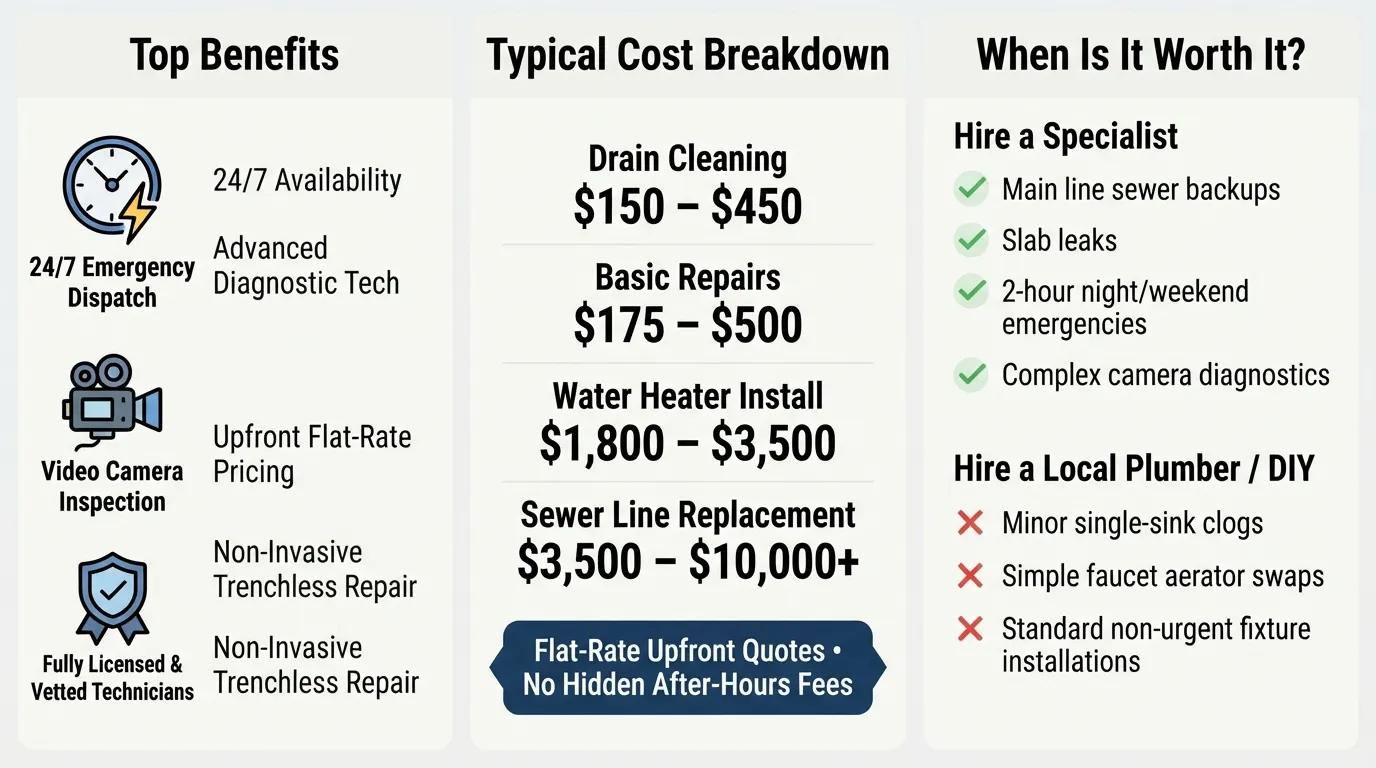
Hiring a Roto-Rooter plumbing specialist provides immediate access to 24/7 emergency response, advanced camera-based drain diagnostics, and fully licensed, background-checked technicians. With transparent upfront pricing and comprehensive residential and commercial services, Roto-Rooter delivers reliable, standardized plumbing solutions designed to resolve complex drainage and pipe issues quickly.
24/7 Emergency Availability: Round-the-clock dispatch with no extra charge for night, weekend, or holiday service calls.
Advanced Video Diagnostics: High-definition fiber-optic camera inspections that pinpoint clogs, root intrusions, and pipe collapses accurately.
Vetted & Licensed Technicians: Professional plumbers who undergo rigorous background checks, drug testing, and ongoing technical certification.
Upfront, Transparent Pricing: Clear written estimates provided before any work begins, eliminating hidden fees and billing surprises.
Comprehensive Service Capabilities: Full-spectrum solutions ranging from routine drain cleaning and hydro-jetting to complete sewer line replacements.
Benefits Overview for Property Owners
When facing severe plumbing disruptions or routine maintenance needs, selecting a nationally established specialist offers distinct operational advantages over unverified local contractors. A specialized Roto-Rooter plumber brings industrial-grade equipment, standardized safety protocols, and robust service guarantees directly to your doorstep.
Whether dealing with a sudden mainline sewer backup, an overflowing toilet, or a hidden slab leak, working with certified drain and plumbing experts ensures your property’s plumbing infrastructure is restored safely and efficiently.
Who This Guide Is For
This guide is specifically crafted for residential homeowners, commercial property managers, and real estate owners seeking to evaluate the service quality, technical capabilities, and cost efficiency of hiring a national drain and plumbing specialist.
Looking for Roto-Rooter employee benefits, career opportunities, or job info? Jump to Section 10.
What Does a Roto-Rooter Plumbing Specialist Actually Do?
A Roto-Rooter plumbing specialist diagnoses, repairs, replaces, and maintains complex residential and commercial plumbing systems. Trained to manage both routine plumbing issues and full-scale emergencies, these technicians utilize specialized machinery to clear blockages, restore pipe integrity, and restore water flow across property infrastructure.
System Diagnostics: Deploying fiber-optic cameras and electronic locators to assess internal pipe health and identify underlying defects.
Mechanical Clearing: Utilizing specialized blades, augers, and high-pressure water streams to strip severe buildup from drainage networks.
Component Replacement: Installing and repairing fixtures, water heaters, backflow preventers, and main water lines.
Environmental Mitigation: Executing professional water extraction, structural drying, and sewage cleanup during flooding events.
Drain Cleaning and Clog Removal
Specialists handle stubborn clogs that standard plunger attempts or consumer chemical drain cleaners cannot clear. Over time, drain pipes collect accumulating layers of grease, hair, soap scum, paper products, flushable wipes, and foreign objects.
To resolve recurring backups, technicians use heavy-duty electromechanical drain cleaning equipment—including the iconic blades designed to scour the full inner walls of the pipe—or high-pressure hydro-jetting systems to flush out stubborn debris. Explore our specialized drain cleaning service for complete line restoration options.
Sewer Line Inspection, Repair and Trenchless Replacement
When main sewer lines back up into lower-level fixtures, technicians perform high-definition video camera inspections to locate tree root intrusions, offset pipe joints, cracked clay, or collapsed cast iron lines.
Rather than executing disruptive excavation across lawns and driveways, specialists often utilize modern trenchless replacement methods. Through pipe lining (cured-in-place pipe) or pipe bursting, technicians rehabilitate underground sewer infrastructure with minimal surface disturbance. Schedule an evaluation through our sewer line service.
Water Heater Installation and Repair
Roto-Rooter technicians evaluate, service, and replace traditional tank-style and modern tankless water heaters powered by gas or electricity. Common failure points such as broken heating elements, faulty thermostats, failing pressure relief valves, and heavy sediment buildup are addressed rapidly.
When water heaters reach the end of their operational lifespan, specialists guide property owners through energy-efficient replacements and execute full code-compliant installations. Learn more about system sizing and replacements on our water heater service page.
Leak Detection and Pipe Repair
Hidden leaks behind drywall, beneath concrete foundation slabs, or within underground service lines can cause severe structural decay and inflated utility bills. Roto-Rooter specialists employ non-invasive electronic leak detection equipment, acoustic sensors, and thermal imaging to pinpoint sub-surface leaks accurately without unnecessary demolition.
Once located, plumbers perform targeted pipe repairs or complete copper, PEX, or PVC line repiping to protect the structural integrity of your building. Access dedicated help via our leak detection and repair portal.
Water Damage and Flood Cleanup
Major plumbing failures, burst supply lines, or sewer line backups frequently result in standing water and biohazard contamination. Roto-Rooter provides end-to-end water damage restoration, handling everything from immediate water extraction to structural dehumidification.
Extraction: Industrial-grade pumps and submersible units rapidly extract clean, grey, or black water from the premises.
Sanitization: Contaminated surfaces are treated with antimicrobial solutions to prevent bacterial growth and mold formation.
Drying & Restoration: High-velocity air movers and heavy-duty dehumidifiers dry out walls, floors, and subflooring completely.
Residential vs. Commercial Plumbing Needs
While residential plumbing focuses on single-family home systems, commercial plumbing environments involve complex, high-demand infrastructure requiring specialized compliance standards.
| Feature | Residential Plumbing | Commercial Plumbing |
| System Scale | Standard multi-fixture layouts, domestic lines | High-capacity, multi-story drainage networks |
| Code Compliance | Standard municipal housing codes | Strict OSHA, ADA, and health department regulations |
| Specialized Hardware | Standard toilets, garbage disposals, tank heaters | Commercial grease traps, heavy-duty flushometers, backflow preventers |
| Service Scheduling | On-demand repairs and scheduled appointments | Planned preventative maintenance to eliminate operational downtime |
For multi-family properties, industrial sites, or corporate facilities, explore our tailored commercial plumbing solutions.
For a full overview of what a professional plumber can handle, see our plumbing services hub.
The 6 Key Benefits of Hiring a Plumbing Specialist
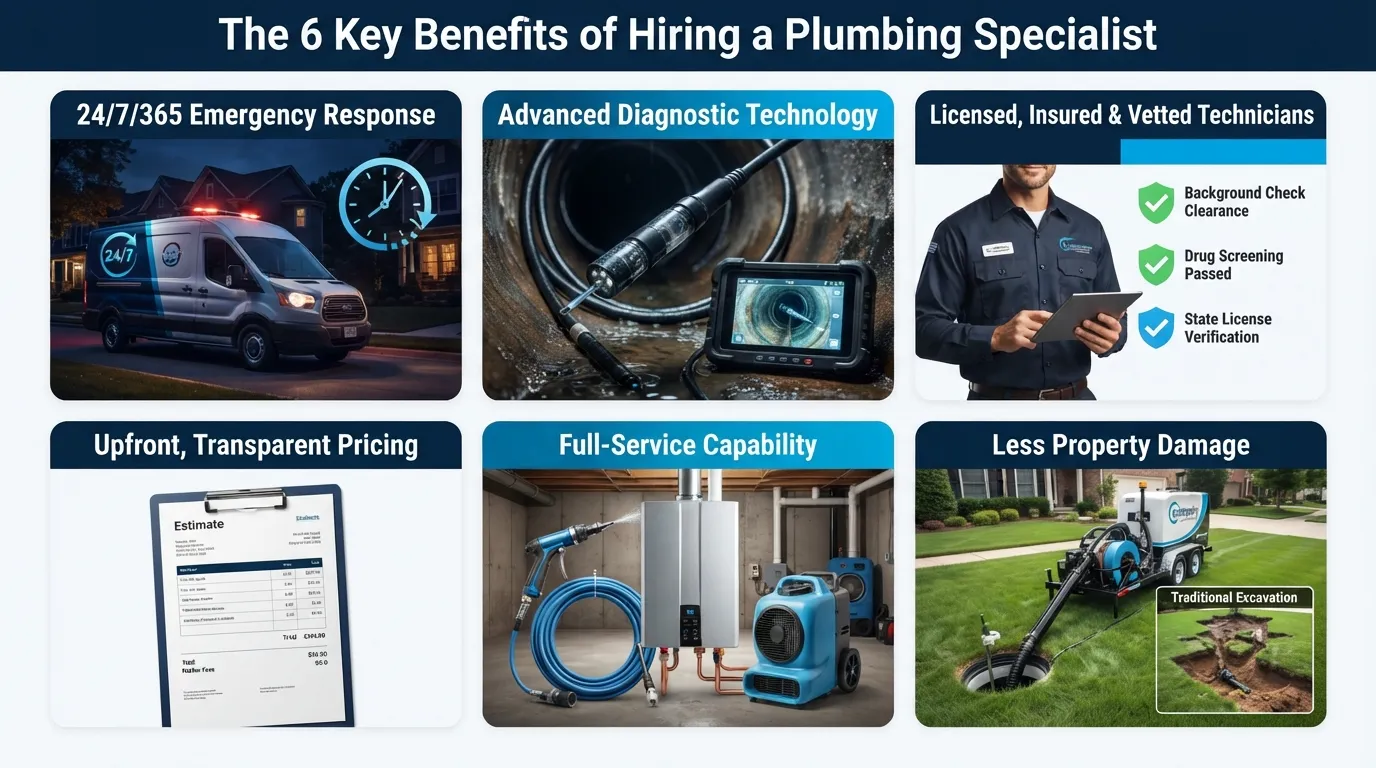
Hiring a dedicated plumbing specialist ensures complex utility failures are addressed with professional precision, high-grade machinery, and verified safety standards. Unlike general handymen, specialized plumbers bring structured diagnostic tools, transparent billing models, and immediate emergency response capabilities directly to your property.
Immediate Emergency Dispatch: Rapid deployment during sudden mainline backups, severe leaks, or burst pipes.
Precision Diagnostics: Modern camera technology pinpoints internal pipe damage without unnecessary demolition.
Fully Vetted Workforce: Licensed, background-checked, and drug-screened professionals entering your property safely.
Upfront Written Estimates: Complete cost transparency provided before any physical work begins.
End-to-End Solutions: Comprehensive handling of every service, from routine drain clearing to full excavation.
Property Protection: Advanced non-invasive techniques preserve structural integrity, flooring, and landscaping.
1. 24/7/365 Emergency Response
Plumbing emergencies—such as main sewer line backups, ruptured water lines, or overflowing toilets—rarely occur at convenient hours. Unattended water damage can trigger structural rot and mold growth within 24 to 48 hours, making immediate intervention essential.
Roto-Rooter maintains round-the-clock dispatch services every day of the year, including nights, weekends, and holidays. For urgent calls, dispatchers prioritize immediate field routing, with technicians typically providing same-day response windows nationwide to halt active flooding and contain severe damage. If you are experiencing an active flood or severe drain backup, connect with a 24/7 emergency plumber right away.
2. Advanced Diagnostic Technology
Specialized plumbers rely on state-of-the-art diagnostic machinery rather than costly guesswork. High-definition inline sewer cameras, acoustic pipe locators, and digital flow-testing equipment locate hidden obstructions, broken joints, and underground pipe defects rapidly and precisely.
This technological advantage eliminates unnecessary exploratory cutting into walls, concrete slabs, or manicured lawns.
3. Licensed, Insured and Vetted Technicians
Allowing service technicians into your home or business requires complete trust and verification. Roto-Rooter mandates that technicians are fully licensed, insured, and certified according to state and local regulatory standards.
According to brand standards, candidates undergo comprehensive pre-employment criminal background checks, motor vehicle record reviews, and mandatory drug screenings prior to field deployment. This rigorous vetting process protects property owners from liability and ensures exceptional service quality.
4. Upfront, Transparent Pricing
Surprise fees and hourly rate markups create unnecessary friction during stress-filled plumbing repairs. A specialized plumbing provider operates on a clear, flat-rate or standardized job-pricing structure.
Initial On-Site Assessment: The technician evaluates the fixture, line, or damage directly.
Written Estimate: A fully itemized price quote is presented to the client covering parts and labor.
Client Approval: Work begins only after the property owner reviews and approves the written estimate—guaranteeing no hidden add-ons on the final invoice.
5. Full-Service Capability Under One Roof
Managing multiple sub-contractors during a major plumbing crisis is inefficient and stressful. A specialized service provider manages every phase of the repair process internally.
From initial video camera diagnostics and hydro-jetting to structural water extraction, pipe replacement, and final sanitation, a single dedicated team executes the entire scope of work. This end-to-end approach ensures seamless communication, single-source accountability, and robust work warranties.
6. Less Property Damage Through Non-Invasive Methods
Traditional pipe repair methods often required digging destructive trenches through driveways, gardens, and interior floors. Modern plumbing specialists prioritize non-invasive, trenchless restoration techniques whenever structurally feasible.
Pipe Lining (CIPP): Epoxy-saturated liners are inserted into existing damaged pipes, creating a smooth, durable new pipe inside the old one.
Pipe Bursting: A specialized breaking head fractures the damaged legacy pipe outwardly while pulling a brand-new HDPE pipe directly into place behind it.
Directional Drilling: Precision subterranean boring allows underground line installation without disturbing surface structures or landscaping.
From the Field: Avoiding Unnecessary Demolition
“We were called out for a suspected slab leak where the owner was advised by another handyman to jackhammer a 6-foot trench through their newly renovated kitchen tile. Before touching a sledgehammer, we ran an electronic acoustic detector and a 100-foot fiber-optic camera through the line. We located the issue—a simple crushed cleanout fitting—just two feet outside the exterior foundation wall. A two-hour exterior repair saved the client over $8,000 in kitchen restoration costs.”
— Senior Roto-Rooter Field Technician
How Modern Plumbing Technology Finds Problems Without Tearing Up Your Property
Modern plumbing diagnostics eliminate destructive guesswork by using advanced inspection and repair technologies. By deploying specialized electronic locators, fiber-optic video feeds, and trenchless machinery, specialists pinpoint and resolve underlying plumbing failures with minimal disturbance to your home, landscaping, or interior finishes.
Fiber-Optic Cameras: Real-time interior pipe visualization to identify cracks, roots, and blockages.
Electronic Locators: Radio-frequency transimitters that map underground pipe routes and precise depth coordinates.
Hydro-Jetting: High-pressure water scrubbing that restores pipe diameter completely without mechanical scraping.
Trenchless Rehabilitation: Structural pipe renewal executed from inside the line without digging up yards or driveways.
Fiber-Optic Video Pipe Inspection, Step by Step
A video camera inspection provides a direct visual feed of the interior condition of your drainage and sewer lines. A flexible rod equipped with a high-resolution, waterproof camera head is inserted through an existing cleanout or plumbing fixture.
Insertion & Real-Time Viewing: The camera travels through the pipe while transmitting high-definition imagery to an external monitor viewed by the technician.
Defect Identification: Technicians spot root intrusion, grease buildup, offset joints, structural collapses, or foreign objects instantly.
Client Documentation: Homeowners receive a clear explanation of findings, and video recordings or still images can be provided for insurance claims or permanent records.
Caption: Watch an overview of professional plumbing advantages and emergency response standards [00:28].
Video Summary: This video outlines the core advantages of working with certified plumbing specialists, highlighting 24/7 emergency dispatch availability [00:38], written upfront cost estimates [00:48], rigorous technician background checks [01:08], and advanced equipment utilization for complex residential and commercial issues [01:00].
Electronic Pipe Locating
When an issue is identified underground or behind a concrete slab, exact positioning is critical to prevent unnecessary destruction. Electronic pipe locating pairs an in-line camera sonde (a small radio transmitter at the tip of the camera snake) with an above-ground surface receiver.
The surface technician sweeps a digital wand across floors or yards, tracking the precise radio frequency emitted by the sonde. This technology determines the exact horizontal coordinates and burial depth of the problem area within inches, ensuring that any necessary digging is strictly localized.
Hydro-Jetting vs. Traditional Snaking
Selecting the correct clearing method depends on the nature of the blockage and the condition of the pipe network. While traditional snaking punches a hole through a clog to restore basic flow, hydro-jetting scours the entire interior surface clean.
| Feature | Drain Snake / Auger | Hydro-Jetting |
| Mechanism | Rotating steel cable with cutting blades | High-pressure water stream (up to 4,000 PSI) |
| Primary Use | Breaking through localized solid clogs and hair | Stripping grease, scale, and heavy root buildup |
| Pipe Impact | Clears a narrow path matching the cable head | Scours 360 degrees of the inner pipe walls |
| Best Suited For | Simple toilet or secondary sink clogs | Main sewer lines with heavy grease or root intrusion |
Trenchless Sewer Repair: Lining vs. Pipe Bursting
When main sewer lines are structurally compromised, traditional excavation requires digging deep, destructive trenches across property lines. Trenchless sewer repair modernizes this process by repairing or replacing pipes from the inside out.
Cured-in-Place Pipe (CIPP) Lining:
Process: An epoxy-resin-saturated liner is pulled or inverted into the damaged pipe and inflated. The resin cures in place, forming a seamless, jointless new structural pipe within the old one.
Pros & Disadvantages: Preserves landscaping and paving completely; slightly reduces internal diameter by a fraction of an inch.
Pipe Bursting:
Process: A steel bursting head is pulled through the old underground pipe, fracturing the legacy pipe outward into the surrounding soil while simultaneously pulling a new, high-density polyethylene (HDPE) pipe into its exact footprint.
Pros & Disadvantages: Ideal for completely collapsed or heavily offset pipes; requires small entry and exit access pits.
To explore full replacement methodologies and planning options, visit our dedicated guide on sewer line repair and replacement.
From the Field: Diagnostic Precision in Action
“A commercial property manager faced a recurring main line backup that multiple handymen blamed on ‘heavy usage,’ recommending a complete $15,000 parking lot excavation. We deployed an inline camera and electronic locator, discovering that a discarded construction tool had lodged vertically inside a hidden elbow joint 4 feet beneath the asphalt drive. Using a specialized retrieval tool through an existing cleanout, we removed the obstruction in 30 minutes, saving the client thousands of dollars in paving restoration.”
— Master Plumber & Field Supervisor
Is Roto-Rooter More Expensive Than a Regular Plumber? Typical Costs Explained
Understanding overall plumbing costs requires evaluating flat-rate national service models against local hourly rates. While national specialists may carry higher base rates than independent solo plumbers, their standardized pricing, specialized equipment, and non-invasive methods often offset potential long-term expenses.
Predictable Pricing Structure: Most locations utilize flat-rate job estimates rather than unpredictable hourly billing.
No After-Hours Surcharges: Emergency service response is typically offered 24/7 without night or weekend add-on rates.
Diagnostic Savings: Advanced camera locator tech pinpointing exact defects prevents unnecessary wall or lawn destruction.
Upfront Written Quotes: On-site assessments ensure exact cost approval before physical work commences.
Short Answer First (Is Roto-Rooter More Expensive?)
Pricing for a Roto-Rooter specialist is often comparable to or slightly higher than an independent local plumber due to national brand overhead, commercial-grade equipment, and 24/7 emergency availability. However, total project costs depend heavily on your specific location, job complexity, and time of service. Because national brands generally charge flat rates per job rather than open-ended hourly fees, simple repairs may carry higher minimums, while complex emergencies often prove more cost-effective.
Typical Cost Ranges
The following table provides average cost ranges for standard residential services provided by national plumbing specialists.
| Service | Typical Cost Range |
| Drain Cleaning | $150 – $450 |
| Basic Plumbing Repairs | $175 – $500 |
| Water Heater Installation | $1,800 – $3,500 |
| Sewer Line Repair / Replacement | $3,500 – $10,000+ |
Note: Data figures represent national service averages compiled from industry cost surveys and market data (Updated 2026). Exact local pricing varies based on regional labor rates and physical access conditions.
5 Factors That Change Your Plumbing Bill
Plumbing cost estimates fluctuate based on distinct operational factors encountered on site. Understanding these variables helps property owners anticipate total job expenses accurately.
Emergency & After-Hours Timing: While national specialists typically do not charge extra for nights or weekends, immediate emergency dispatches requiring priority routing during extreme weather events may affect overall availability and labor allocation.
Pipe Material & Age: Legacy plumbing systems made of galvanized iron, cast iron, or clay require delicate handling, specialized fittings, and custom adaptors compared to modern PEX or PVC lines.
Access Difficulty: Clogs or pipe breaks situated deep beneath concrete foundation slabs, behind finished drywall, or under paved driveways demand specialized equipment and additional labor hours.
Clearing Method Required: Standard mechanical auger clearing (snaking) carries lower base costs than high-pressure hydro-jetting or structural trenchless pipe lining.
Local Municipal Labor Rates: Geographic location dictates baseline labor rates, permit fees, and disposal costs dictated by regional municipal regulations.
How to Avoid Surprise Charges
Property owners can protect themselves against billing discrepancies by following standard pre-service protocols.
Request a Written Upfront Estimate: Ensure the technician evaluates the problem in person and provides an itemized written quote before turning a wrench.
Verify Service Call & Diagnostic Fees: Confirm whether the initial diagnostic fee is waived or credited directly toward the repair cost if you accept the estimate.
Review Warranty Terms: Inquire about specific labor and parts warranties covering the completed work to avoid paying twice for recurring line blockages.
Want an upfront quote for a Miami-area plumbing job? Book a service visit.
Roto-Rooter vs. Mr. Rooter vs. a Local Plumber vs. DIY
Choosing between national corporate networks, regional independent contractors, or a do-it-yourself approach requires balancing speed, cost, long-term warranties, and project complexity. While major national brands excel in rapid emergency response and specialized heavy machinery, independent local plumbers often offer personalized service and lower rates for standard repairs.
National Corporate Chains: Ideal for major off-hours emergencies, deep mainline clogs, and large-scale water restoration.
Independent Local Plumbers: Best for scheduled remodels, minor fixture installations, and personalized ongoing service relationships.
DIY (Do-It-Yourself): Suitable strictly for low-risk, superficial tasks such as replacing faucet washers or clearing minor sink trap clogs.
Side-by-Side Comparison Table
The following matrix compares national franchise networks, independent plumbing businesses, and DIY attempts across key operational metrics.
| Metric / Feature | Roto-Rooter | Mr. Rooter | Independent Local Plumber | DIY (Do-It-Yourself) |
| Cost Level | Moderate to High (Flat-rate pricing) | Moderate to High (Flat-rate pricing) | Low to Moderate (Hourly or job rates) | Material / Tool cost only |
| 24/7 Availability | Extensive nationwide coverage | Widespread franchise availability | Varies; limited off-hours availability | Anytime (Self-managed) |
| Technology | Fiber-optic cameras, hydro-jetting, trenchless | Advanced diagnostics, hydro-jetting, lining | Varies; basic to advanced equipment | Hand tools, retail chemical/manual snakes |
| Warranty & Guarantees | Varies by franchise / location | “Neighborly Done Right Promise” warranty | Independent business workmanship warranty | None (100% self-liable) |
| Local Knowledge | Standardized national protocols | Standardized national protocols | Deep regional code and neighborhood history | Limited to personal experience |
| Best For | Off-hours emergencies, main line blockages | Scheduled residential repairs, flat-rate quotes | Fixture installs, routine maintenance, remodels | Simple surface clogs, minor washer leaks |
Pros and Cons of Hiring a National Plumbing Brand
National plumbing networks bring massive resource backing, but property owners should weigh organizational advantages against potential drawbacks before booking.
Pros:
Rapid Emergency Response: Extensive fleets and 24/7 central dispatch ensure faster response times during sudden flooding or main line backups.
Advanced Industrial Equipment: Access to high-cost machinery, such as heavy-duty hydro-jetters, camera locators, and trenchless lining rigs.
Strict Vetting Standards: Standardized background checks, drug screenings, and corporate insurance policies reduce property owner risk.
Cons:
Higher Overhead Pricing: Flat-rate national models must cover major brand marketing and dispatch infrastructure, raising minimum service call fees.
Variable Franchised Experience: Service quality, specific warranty terms, and local code familiarity can vary between individually owned franchise locations.
Less Personal Continuity: You are unlikely to get the same individual technician on subsequent service calls.
When a Local Licensed Plumber May Be the Better Fit
While national brands dominate urgent off-hours emergencies and complex main line replacements, hiring an independent, locally owned plumbing company is often advantageous for routine projects.
Independent local plumbers offer deep familiarity with specific municipal codes, historic local building practices, and neighborhood soil or water table conditions. They rely heavily on community word-of-mouth reputation, which frequently translates into flexible scheduling, direct communication with the business owner, and lower overhead costs for non-emergency work.
For routine fixture upgrades, home remodels, or non-urgent repairs, explore our guide to professional plumbing services.
DIY, General Plumber or Specialist? How to Decide
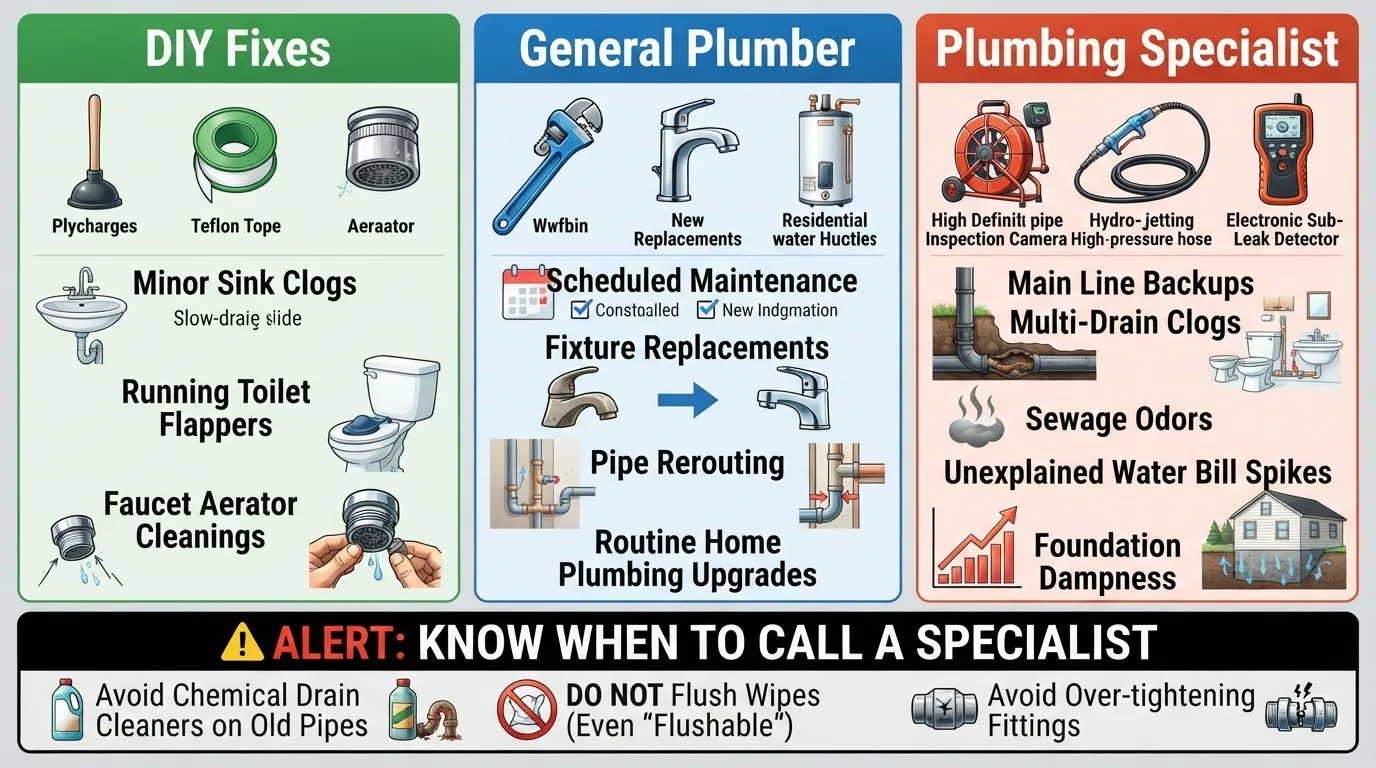
Deciding whether to attempt a home repair, call a general plumber, or hire a specialized drainage expert depends on the severity, location, and systemic risk of the issue. While surface-level cosmetic fixes are manageable for handy homeowners, complex mainline obstructions or hidden leaks require specialized equipment to prevent catastrophic structural damage.
DIY Candidate: Minor surface clogs, basic fixture upgrades, or simple toilet tank flapper replacements.
General Plumber: Scheduled fixture installations, visible pipe re-routing, or routine gas line service.
Specialized Plumber: Mainline sewer backups, recurring multi-drain clogs, slab leaks, and severe flood damage.
Problems You Can Often Handle Yourself
Simple plumbing annoyances isolated to a single fixture can often be resolved safely using basic household hand tools without hiring a contractor.
Minor Sink or Tub Clogs: Clearing hair traps, cleaning under-sink P-traps, or using a simple manual hand plunger.
Running Toilet Flappers: Replacing worn rubber flappers or adjusting the fill valve float mechanism inside the tank.
Clogged Faucet Aerators: Unscrewing mineral-encrusted faucet tips and soaking them in white vinegar to restore water pressure.
If basic troubleshooting fails to resolve constant running or bowl overflows, consult our guide on toilet repair to prevent ongoing water waste.
Warning Signs You Need a Specialist Now
When plumbing symptoms affect multiple fixtures or originate deep within sub-surface lines, immediate specialist intervention is required.
Multi-Drain Backups: Water backing up into showers or tubs when a toilet is flushed or washing machine drains.
Persistent Sewage Odors: Foul sewer gas smells escaping from floor drains, sinks, or exterior yards indicating broken vent pipes or cracked sewer lines.
Gurgling Fixtures: Air bubbles gurgling up through toilet bowls or sink traps, signifying negative pressure created by a main line blockage.
Unexplained Water Bill Spikes: Sudden increases in monthly water utility charges without changes in household consumption.
Foundation Dampness & Wet Spots: Warm or damp areas appearing on concrete slab floors, basement walls, or spongy green patches in outdoor lawns.
Why Hidden Leaks Cost More the Longer You Wait
Minor plumbing leaks hidden behind drywall or under concrete foundation slabs rarely self-correct; they escalate exponentially over time. Unchecked sub-surface leaks erode structural soil support, cause wood framing rot, destroy flooring, and create ideal breeding grounds for hazardous toxic mold.
Beyond structural decay, the financial cost of continuous water loss accumulates rapidly. According to the EPA WaterSense: Fix a Leak initiative, average household leaks can waste more than 10,000 gallons of water annually—equivalent to the amount needed to wash nearly 270 loads of laundry. Utilizing non-invasive electronic sound detection and thermal imagery through specialized leak detection and repair services catches sub-surface breaks early before structural restoration becomes necessary.
Plumbing Mistakes That Make Problems Worse
Well-intentioned DIY attempts frequently convert minor maintenance tasks into costly emergency repairs. Avoid these four common operational mistakes:
Overusing Chemical Drain Cleaners: Pouring corrosive chemical drain cleaners down slow drains damages legacy copper, cast iron, and PVC pipes while failing to clear heavy root or grease blockages.
Flushing Non-Flushable Wipes: Disposing of non-flushable wipes, paper towels, or feminine hygiene products creates severe ragging blockages inside main sewer lines.
Over-Tightening Pipe Fittings: Applying excessive force when tightening metallic supply lines or plastic threaded connections cracks fixture valves and strips threads, triggering pressurized leaks.
Ignoring Minor Drips & Slow Drains: Delaying maintenance on slow-draining sinks or weeping valves allows hidden corrosion to weaken line integrity, culminating in sudden pipe bursts.
What Our Technicians See Most Often
“Over 40% of our emergency night calls stem from homeowners using harsh chemical drain openers on completely blocked main lines. The chemical sits trapped inside the pipe without clearing the obstruction, creating a caustic reservoir that eats through pipe joints and poses severe chemical burn hazards to the plumbers who arrive to cable the line manually.”
— Roto-Rooter Master Service Technician
Florida and Miami Plumbing Factors That Change the Equation
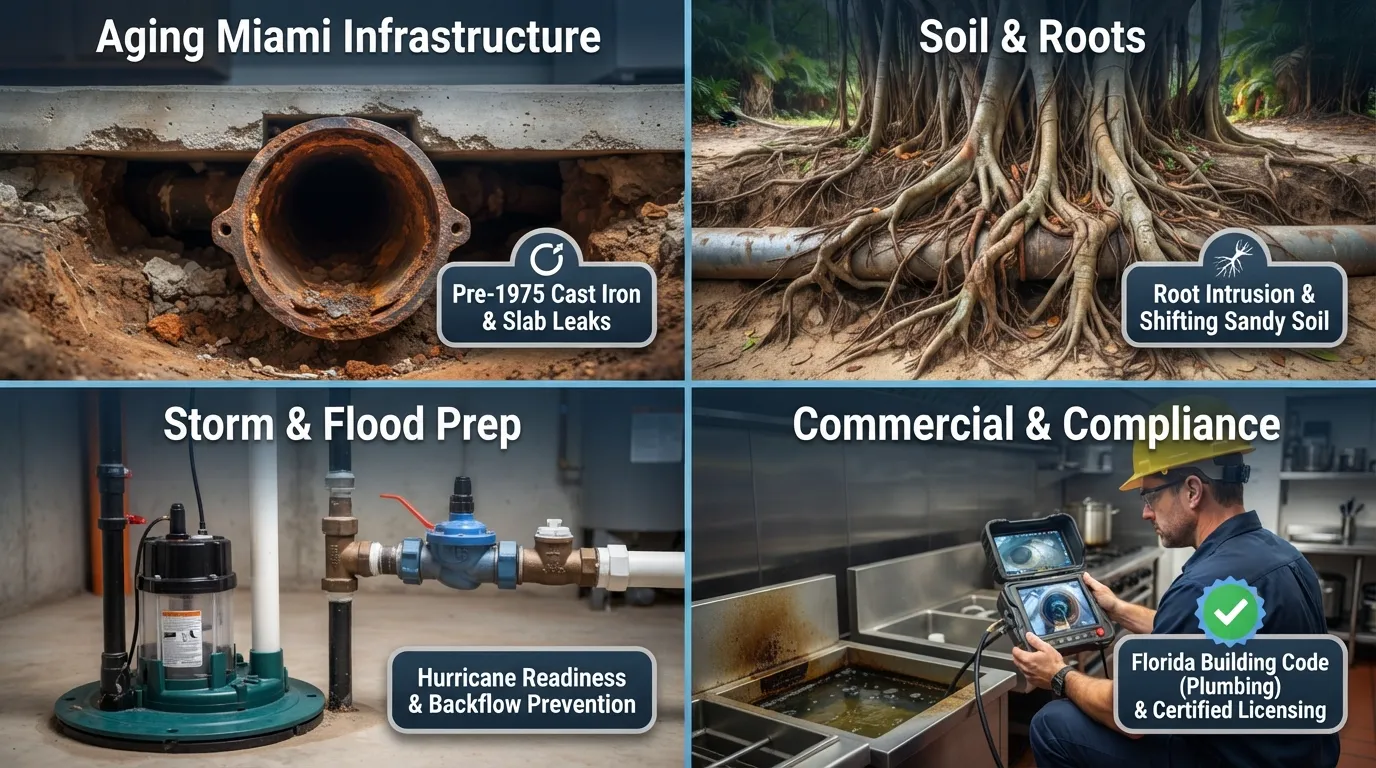
South Florida’s unique coastal geography, high water tables, and sub-tropical weather present specific structural challenges for residential and commercial plumbing systems. Standard plumbing practices applied in other regions often fail to address the aggressive internal and external pipe corrosion common across Miami-Dade and Broward counties.
Coastal Salinity & High Water Tables: Accelerated exterior corrosion and sub-surface hydrostatic pressure on underground lines.
Legacy Cast Iron Deterioration: Widespread bottom-channel rot inside pre-1975 concrete slab foundations.
Tropical Storm Vulnerabilities: Heavy rainfall overwhelms municipal sewer mains and causes storm drain back-up risks.
Strict Regional Compliance: Stringent South Florida building codes requiring Hurricane-rated structural penetration sealants.
Older Miami Homes and Aging Pipes
Homes built across South Florida prior to 1975 typically rely on cast iron drain lines buried directly underneath poured concrete slab foundations. Over decades, exposure to coastal soil moisture, salty groundwater, and acidic wastewater causes internal pitting and channel erosion along the bottom of cast iron pipes.
As cast iron deteriorates, it develops jagged inner scale that catches debris, leading to recurring main line backups, sewer gas emissions, and sub-slab leaks. Because breaking concrete floor slabs inside a home destroys interior finishes, local specialists utilize non-invasive video camera inspections and epoxy pipe lining (CIPP) to rehabilitate legacy lines without structural demolition.
Tree Roots, Sandy Soil and Sewer Line Problems
Miami’s tropical vegetation—including aggressive root systems from Ficus, Banyan, and Royal Poinciana trees—actively seeks out moisture sources underground. Tree roots penetrate tiny joints or hair-line cracks in exterior sewer pipes, expanding internally until they completely block wastewater flow.
Compounding this risk, South Florida’s sandy soil shifts continuously during wet and dry cycles. Soil displacement weakens structural support around underground lines, causing sewer pipes to belly, sag, or separate at the joints. Hydro-jetting paired with root-inhibiting treatments restores line capacity without destabilizing sandy trenches.
Hurricane Season Plumbing Readiness
During South Florida’s tropical storm and hurricane season (June 1 through November 30), sudden heavy rainfall rapidly saturates surrounding soil, driving groundwater levels above sub-surface drainage lines.
Backflow Valve Checks: Installing and testing backflow preventers prevents municipal storm mains from surcharging back through low-lying residential floor drains and toilets.
Sump Pump Maintenance: Verifying that sub-surface pit pumps and battery-backup power systems operate reliably before storm landfall extracts rising groundwater automatically.
Lift Station Operations: Commercial properties and residential complexes require routine pump clearing to handle severe storm runoff.
To ensure your property’s flood mitigation hardware is operational before tropical weather arrives, explore our dedicated sump pump services.
Commercial Properties: Restaurants, Offices and Multi-Unit Buildings
High-density commercial environments across Miami face strict municipal enforcement regarding wastewater discharge and operational hygiene.
Commercial kitchens must maintain functioning grease traps to capture fats, oils, and grease (FOG) before wastewater enters the city sewer grid. Failure to maintain grease interceptors results in severe municipal fines, health department shutdowns, and catastrophic interior flooding. Commercial plumbing specialists provide scheduled hydro-jetting, backflow prevention testing, and off-hours emergency service to keep regional businesses running without costly operational downtime. Learn more about customized maintenance agreements via our commercial plumbing portal.
Florida Licensing and Code
Plumbing work across the state of Florida is strictly regulated under the Florida Building Code (Plumbing) and overseen by the Department of Business and Professional Regulation (DBPR).
State Certified Plumbing Contractor (CFC): Fully licensed by the Florida Construction Industry Licensing Board to execute unlimited commercial and residential plumbing services statewide.
State Registered Plumbing Contractor (RG): Authorized to perform plumbing services strictly within specific local municipal jurisdictions and counties.
Code Compliance: All major line replacements, water heater installations, and structural repairs require municipal permits and formal building department inspections to verify backflow safety, code-compliant venting, and proper pipe sizing.
Local Field Insights: Miami-Dade County
“During monsoon season in Coral Gables, our emergency calls for main line backups jump over 60%. Property owners usually assume it’s just a simple clog, but our camera inspections frequently reveal legacy cast iron pipes under the home that have lost their bottom invert entirely due to age and high groundwater exposure. Soil shifts during heavy rain cause the pipe to collapse inward. Having specialized cameras and trenchless lining equipment on site allows us to save the property’s historic tile floors by relining the pipe from an exterior cleanout.”
— Miami-Dade Lead Service Specialist
How to Choose Any Plumbing Company: A 7-Point Checklist
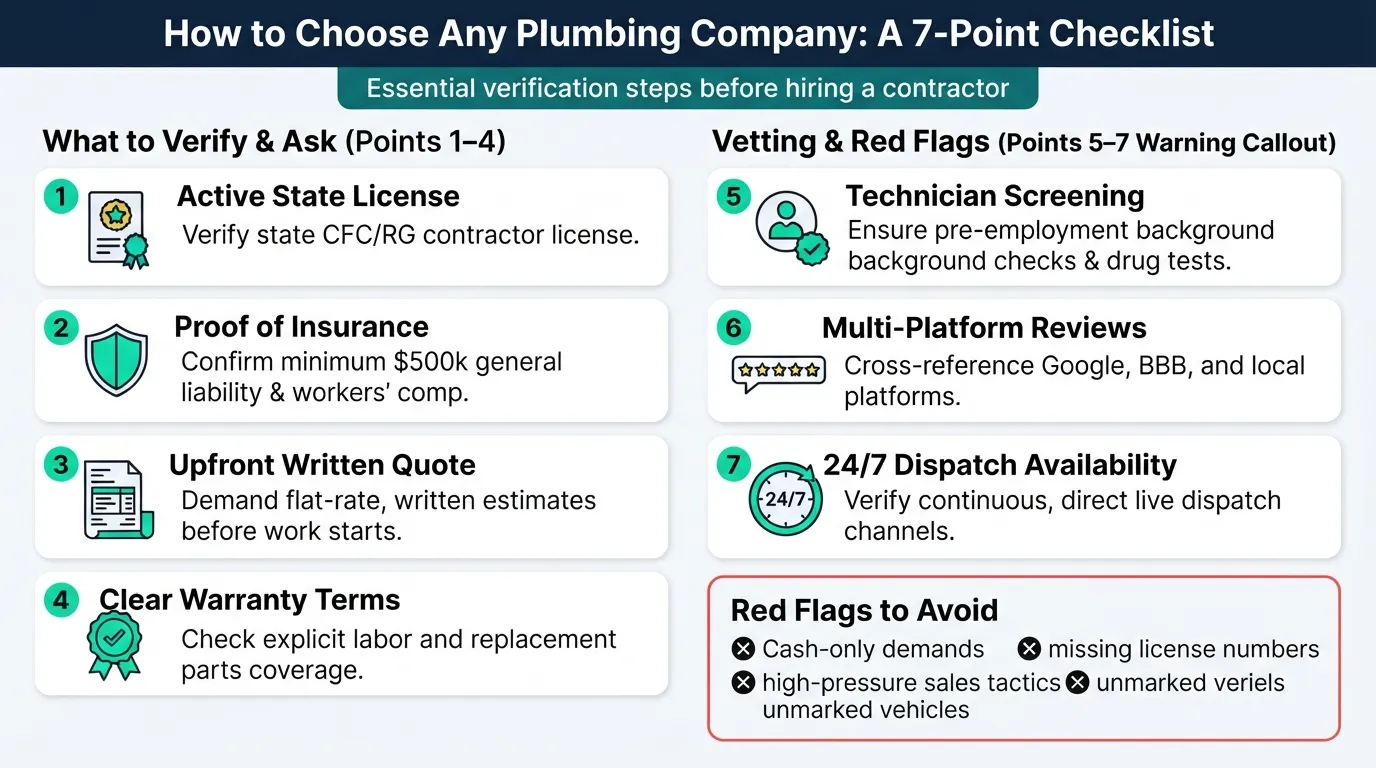
Selecting a qualified plumbing contractor requires evaluating technical credentials, insurance coverage, and customer satisfaction metrics before allowing work to begin on your property. Utilizing a structured vetting checklist ensures you hire a reputable professional who adheres to local building codes and delivers durable repairs.
Verified State Licensure: Active registration on official state licensing databases (such as Florida DBPR).
Comprehensive Liability & Workers’ Comp: Valid certificate of insurance protecting property owners from on-site injuries.
Itemized Upfront Estimates: Written price quotes delivered prior to physical work commencing.
Documented Warranties: Explicit coverage terms protecting both labor and installed replacement parts.
Vetted Technicians: Pre-employment criminal background checks and mandatory drug testing protocols.
Multi-Platform Reviews: Verified customer feedback across Google, Better Business Bureau (BBB), and local review sites.
True 24/7 Availability: Responsive dispatch channels operating continuously without voicemail fallbacks.
What to Verify Before You Book
Before scheduling a service call or agreeing to non-emergency pipe repairs, confirm these seven fundamental criteria with the service provider:
State License Status: Verify that the plumbing contractor holds an active license with state regulatory bodies (e.g., State Certified Contractor status in Florida).
Certificate of Insurance: Request proof of general liability insurance (minimum $500,000 to $1,000,000 coverage) and active workers’ compensation coverage for all field personnel.
Written Cost Scope: Ensure the company provides flat-rate or itemized written estimates rather than verbal over-the-phone guesses.
Labor and Parts Warranty: Ask for explicit duration terms (e.g., 30-day drain clearing guarantees or 1-year labor warranties on major fixture installs).
Employee Background Screening: Confirm whether technicians undergo rigorous pre-employment background checks and routine drug testing.
Cross-Platform Reputation: Look for a minimum 4.5-star rating across independent review platforms to gauge real-world service consistency.
Permit Handling Capabilities: Verify that the plumbing company secures required municipal permits and schedules formal code inspections for major structural installations.
Questions to Ask on the First Call
When contacting a plumbing provider during a scheduled maintenance need or unexpected emergency, use this brief 5-question script to evaluate their professionalism immediately:
“Can you provide your state license number and a copy of your certificate of insurance?”
“Do you charge a flat service call or diagnostic fee, and is that fee applied toward the total repair cost if I accept the quote?”
“Will I receive a binding, written estimate before your technician turns a wrench or begins work?”
“What specific warranty or guarantee covers the parts and labor for this repair?”
“Are your service technicians direct employees who are background-checked and drug-screened?”
Red Flags to Walk Away From
Protect your property and personal finances by recognizing critical warning signs that indicate an unqualified or unethical contractor.
Demands for Cash-Only Payments: Refusal to accept credit cards or official checks, or demanding full payment upfront before work commences.
Missing License Numbers: Inability or reluctance to provide an official state license number on business cards, service vehicles, or printed contracts.
High-Pressure Sales Tactics: Urging immediate, costly main line replacements without providing camera inspection footage or a second opinion option.
Vague Overhead Pricing: Refusing to state diagnostic fees, trip charges, or base hourly rates before dispatching a technician to your home.
Unmarked Vehicles & Lack of Uniforms: Technicians arriving in unmarked personal vehicles without professional identification or company badges.
Plumber Hiring Checklist (PDF)
Keep this 7-point decision framework handy during plumbing emergencies or planned home renovations.
Download the Printable Plumber Hiring Checklist (PDF)
Ready to talk to a licensed plumber? Schedule your appointment.
Looking for Roto-Rooter Job Benefits? A Quick Note for Job Seekers
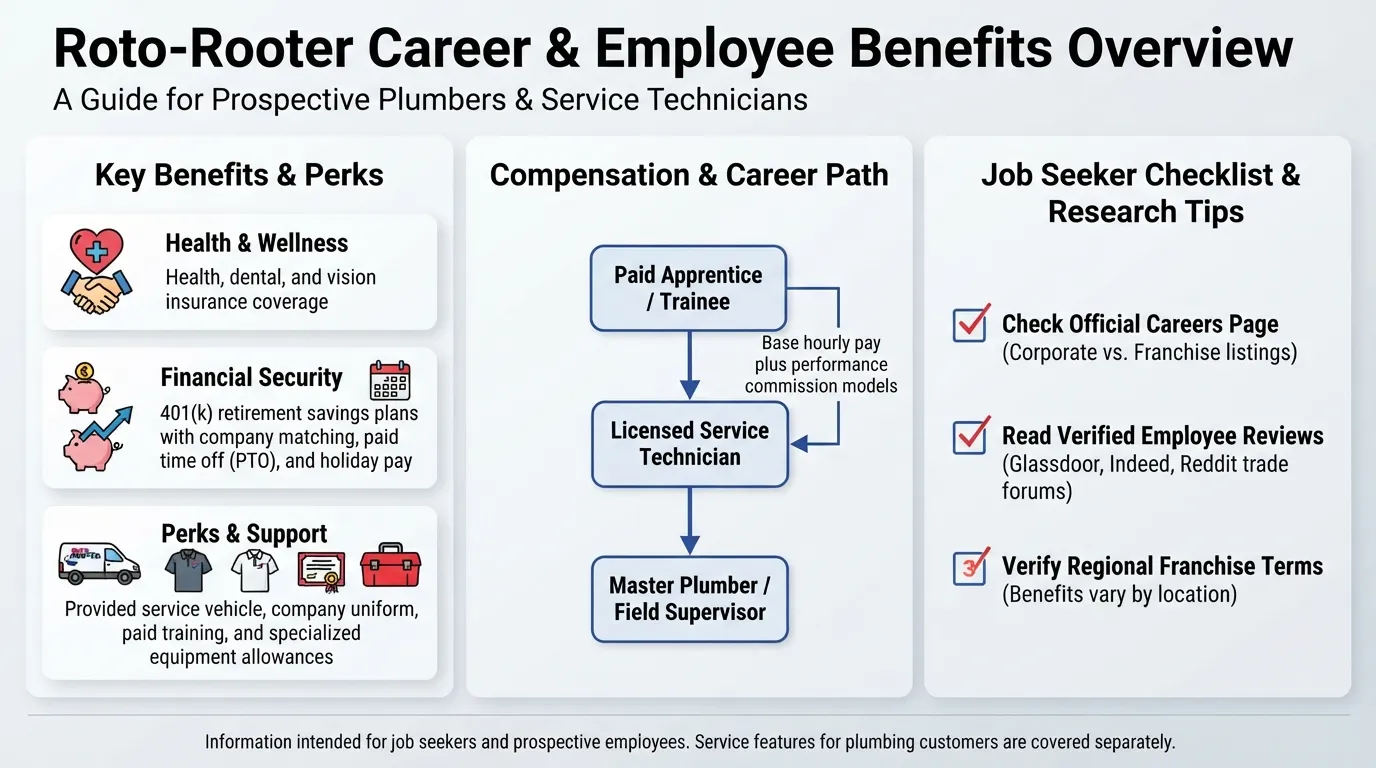
Understanding employee compensation, career advancement opportunities, and corporate culture is essential when evaluating trade employers. However, employment packages for national plumbing brands vary depending on whether you work for a corporate-owned branch or an independently operated franchise location.
Primary Purpose: This guide focuses strictly on service features, costs, and performance benefits for property owners hiring a plumbing contractor.
Corporate Careers: Official employment details are maintained directly on employer career portals.
Franchise Variance: Benefits, commission structures, and tool allowances differ across regional franchise territories.
Is This Page About Employee Benefits?
No. This article is designed as an informational resource for residential homeowners, commercial managers, and real estate operators evaluating plumbing and drain cleaning service options.
If you searched for employee compensation, health coverage, or career information, note that corporate benefits, paid time off, 401(k) matching, and tuition reimbursement policies are managed exclusively by corporate human resources and individual franchise owners.
What Plumbers Typically Earn and How to Research an Employer
Tradespeople evaluating employment options at national service chains should research verified career data across multiple independent recruitment platforms before applying.
Compensation Structure: Plumber earnings at major national chains often combine base hourly wages with commission incentives, production bonuses, or overtime pay during emergency dispatch shifts.
Paid Apprenticeships: Many branches offer paid entry-level apprenticeship programs where trainees receive technical instruction and safety certifications while earning a baseline wage.
Review Employer Portals: For accurate job listings, compensation metrics, and verified employee reviews, evaluate corporate job boards alongside third-party review platforms such as Glassdoor, Indeed, and relevant trade forums on Reddit.
Frequently Asked Questions
Is Roto-Rooter more expensive than a regular plumber?
Roto-Rooter pricing is often comparable to or slightly higher than independent plumbers due to national overhead and 24/7 staffing. However, flat-rate pricing models, no extra fees for emergency or weekend dispatches, and advanced diagnostic machinery frequently offset overall long-term repair expenses.
Does Roto-Rooter offer 24/7 emergency service?
Yes, Roto-Rooter provides 24/7/365 emergency plumbing response across its corporate and franchise locations nationwide. Technicians are available on nights, weekends, and holidays to address severe sewer backups, burst pipes, and unexpected flooding emergencies without requiring after-hours surcharge fees.
Are Roto-Rooter plumbers licensed and insured?
Yes, all Roto-Rooter technicians operate under state and local licensing regulations and carry comprehensive general liability and workers’ compensation insurance. Furthermore, brand standards dictate that field personnel undergo rigorous pre-employment criminal background checks, motor vehicle background checks, and routine drug screenings before dispatch.
What do plumbers wish homeowners knew?
Plumbers wish homeowners knew that chemical drain openers severely corrode pipes, flushing “flushable” wipes causes main line blockages, and ignoring minor leaks leads to structural decay. Addressing slow drains early with mechanical augers prevents catastrophic line ruptures and costly emergency water damage restoration.
What are the most common plumbing mistakes to avoid?
The most common plumbing mistakes include pouring grease down kitchen sinks, over-tightening threaded supply fittings, failing to locate the main water shut-off valve, and attempting complex DIY gas or drain line repairs without proper licensing, permits, or specialized equipment.
What are the main plumbing codes in the U.S.?
The primary model codes in the U.S. are the International Plumbing Code (IPC) and the Uniform Plumbing Code (UPC), which establish health and safety standards for pipe sizing, venting, and backflow prevention nationwide. State jurisdictions frequently modify these model frameworks; for instance, local contractors in Florida must adhere strictly to the specialized Florida Building Code, Plumbing.
What is the “135 rule” in plumbing?
The 135 rule dictates that horizontal drain lines must not exceed 135 degrees of aggregate directional change—such as a 90-degree bend combined with a 45-degree bend—without installing an accessible cleanout fitting or vent connection. Standardized by major plumbing codes, this rule prevents water velocity loss, turbulence, and chronic waste accumulation at sharp pipe junctions.
Where can I find a reliable plumber without overpaying?
You can find reliable, fairly priced plumbers by cross-referencing state licensing databases, checking independent review platforms, and requiring binding, itemized written estimates before any physical work begins. For transparent, flat-rate pricing backed by verified licensing, view our plumbing services.
Final Verdict: Is a Roto-Rooter Plumbing Specialist Worth It?
Hiring a Roto-Rooter plumbing specialist is worth the investment when speed, heavy machinery, and continuous emergency availability are required to protect property from severe damage. While baseline costs may run higher than hiring an independent handyman, flat-rate pricing, 24/7/365 response without holiday surcharges, and advanced diagnostic capabilities provide substantial value during complex crises.
High-Value Scenarios: Off-hours main line sewer backups, major water line ruptures, and sub-slab leak detection.
Risk Reduction: Standardized technician background checks, full insurance coverage, and corporate service guarantees protect property owners from liability.
Cost Predictability: Binding upfront written quotes eliminate open-ended hourly labor charges.
Who Benefits Most from a National Plumbing Specialist
Selecting a national plumbing specialist provides the greatest return on investment for property owners facing high-risk, time-sensitive plumbing failures.
After-Hours & Holiday Emergencies: Homeowners experiencing midnight pipe bursts or weekend sewer line backups benefit from 24/7 dispatch without after-hours surcharge markups.
Complex Diagnostics & Trenchless Repairs: Properties requiring advanced fiber-optic video inspections, hydro-jetting, or cured-in-place pipe (CIPP) lining gain access to specialized heavy equipment.
Commercial & Multi-Family Facilities: Business operators and property managers needing continuous uptime, commercial grease trap cleaning, and standardized liability compliance across multiple regional locations.
When a Local Licensed Plumber Is the Smarter Choice
While specialized national networks dominate urgent crises, an independent local plumber is often the better option for planned household projects.
For non-emergency tasks—such as replacing kitchen faucets, remodeling a bathroom, or installing new water lines during routine construction—a local independent contractor often provides lower overhead pricing. Building a long-term relationship with a neighborhood plumber ensures personalized service, flexible scheduling, and deep familiarity with local municipal water conditions.
Your Next Step
When evaluating plumbing options for your home or business, follow these simple steps to ensure a fast, cost-effective resolution:
Assess the Urgency: Shut off your main water valve immediately if you face active flooding, or isolate fixture shut-off valves for localized leaks.
Verify Qualifications: Confirm that any responding contractor holds an active state license, carries full liability insurance, and provides a written estimate before starting work.
Schedule an Inspection: Address recurring slow drains or hidden leaks early using video camera diagnostics before structural damage occurs.
Facing an active plumbing emergency or planning a system upgrade? Book a plumber online or connect with a 24/7 emergency plumber to secure a flat-rate upfront estimate today.
Main Services
Related Posts
Need a Plumber in Miami?
Schedule service online or speak directly with the EZ Plumbing team.
Owner-Led Local Service
Know who is behind the business before you request service. The owners, contact line and Miami service pages are published clearly.
- Named business owners
- Direct phone and social channels
- Local Miami service information
Clear Help Before You Book
Review the relevant service page, contact the team directly and use the booking page when you are ready—without relying on vague claims.
- Service-specific information
- Direct questions before scheduling
- Clear online booking route