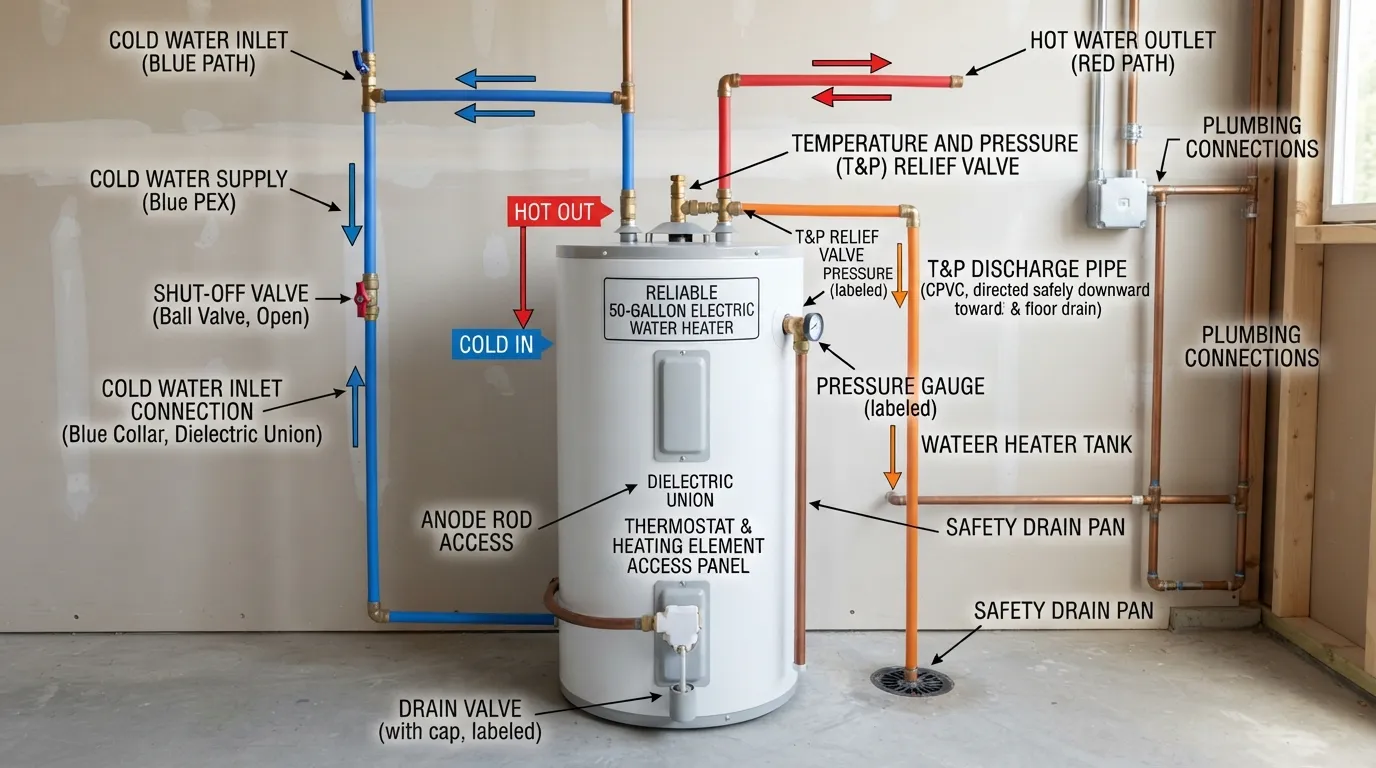
Understanding water heater connections is much easier when you know what each pipe, valve, and safety component actually does. Whether you have a standard electric or gas storage water heater, the basic plumbing system has a clear flow: cold water enters the heater, heated water leaves through the hot outlet, and safety components protect the system from excessive temperature or pressure.
What Are the Main Water Heater Connections?
A typical storage water heater has a cold-water inlet that supplies the tank and a hot-water outlet that sends heated water to the home’s fixtures. It also has safety components such as a temperature and pressure (T&P) relief valve, and some systems require thermal-expansion control such as an expansion tank.
Important: Gas and electrical connections involve additional safety requirements. Always follow the water heater manufacturer’s installation instructions and applicable local plumbing, gas, and electrical requirements.
In this guide, I’ll walk you through the complete connection system, show you what connects where, explain why each connection matters, cover common mistakes, and help you recognize when a connection problem needs professional attention.
Water Heater Connection Diagram: What Connects Where?
The simplest way to understand hot water tank connections is to follow the water’s path through the system.
Allows the water supply to be isolated for service
Water is heated inside the tank
Carries heated water to faucets, showers, appliances, and other fixtures
That is the basic water path. However, a properly installed water heater involves more than two pipes. Safety and service connections are also important.
Water Heater Connections at a Glance
1. Cold-Water Inlet Connection
The cold-water inlet is the connection through which incoming water enters the water heater. On many storage water heaters, the inlet is identified by a blue marking, although you should always confirm the markings and installation diagram for your specific model.
The incoming supply is connected to the home’s cold-water system. A shutoff valve is commonly provided on the supply so the heater can be isolated when it needs maintenance or replacement.
How Do You Identify the Cold-Water Inlet?
- Look for the manufacturer’s inlet marking.
- Many units use blue to identify the cold side.
- Check the installation manual if the markings are unclear.
- Do not assume the location is identical on every model.
The most important concept is simple: cold water enters the heater through the inlet; it does not leave through it.
2. Hot-Water Outlet Connection
The hot-water outlet carries heated water away from the water heater and into the home’s hot-water distribution system.
On many storage water heaters, the hot outlet is marked red. From there, the hot-water piping supplies fixtures such as showers, sinks, tubs, and other points of use.
How Do You Identify the Hot-Water Outlet?
- Look for the manufacturer’s hot outlet marking.
- Many models use red to identify the hot side.
- Confirm the connection against the manufacturer’s diagram.
- Do not rely only on pipe color if the installation has been modified.
Reversing the hot and cold connections can cause poor performance and confusing temperature behavior. If you’re unsure which pipe is which, verify the heater markings and installation documentation instead of guessing.
3. What Is the Shutoff Valve Used for?
A shutoff valve on the water supply allows the heater to be isolated from the plumbing system during service. This is useful when the unit needs inspection, repair, draining, or replacement.
A shutoff valve is a service component, not a replacement for the heater’s required safety devices. The temperature and pressure relief system has a different purpose and should remain capable of performing its safety function.
4. Temperature and Pressure Relief Valve (T&P Valve)
The temperature and pressure relief valve, often called the T&P valve, is one of the most important safety components on a storage water heater.
Its purpose is different from the ordinary water-supply shutoff valve. A relief valve is designed to provide protection against excessive temperature and pressure conditions.
The 2024 International Plumbing Code requires qualifying storage water heaters operating above atmospheric pressure to have an approved pressure relief and temperature relief valve or combination valve. It also states that the relief valve should not be used as a means of controlling thermal expansion. :contentReference[oaicite:0]{index=0}
Why the T&P Valve Matters
- It provides temperature and pressure protection.
- It is installed in the water heater/tank in accordance with the applicable requirements.
- It requires appropriate discharge piping.
- Its function must not be blocked or defeated.
One particularly important point is that you should not treat the relief valve as an ordinary valve that can simply be shut off. The applicable plumbing requirements prohibit a check valve or shutoff valve between the relief valve and the heater or tank served. :contentReference[oaicite:1]{index=1}
5. T&P Relief Valve Discharge Pipe
The relief valve needs an appropriate discharge arrangement. The exact requirements can depend on the applicable plumbing code and installation, so the discharge piping should be installed according to the manufacturer’s instructions and local requirements.
Under the 2024 International Plumbing Code, relief-valve discharge piping has specific requirements concerning its sizing, routing, termination, and ability to drain by gravity. :contentReference[oaicite:2]{index=2}
Do Not Treat the Relief Discharge as Ordinary Plumbing
Do not cap, plug, or otherwise obstruct a relief-valve discharge. Do not improvise a termination that conflicts with the applicable code or manufacturer’s instructions. If a relief valve is repeatedly discharging, don’t simply block it—have the underlying temperature, pressure, or installation issue investigated.
6. Does a Water Heater Need an Expansion Tank?
An expansion tank is used to help manage thermal expansion in systems where it is required. Water expands as it is heated, and a closed plumbing system may need a means of accommodating that expansion.
This is different from the T&P relief valve.
T&P Valve vs. Expansion Tank
A safety device that provides temperature and pressure relief.
A component used to accommodate thermal expansion where the system and applicable requirements call for it.
The 2024 International Plumbing Code specifically states that the relief valve is not to be used as the means of controlling thermal expansion. :contentReference[oaicite:3]{index=3}
7. Electric Water Heater Connections
An electric storage water heater has the same basic water connections—cold inlet and hot outlet—but it also requires an electrical connection to provide energy for heating.
Electrical installation is safety-critical. The exact electrical requirements depend on the heater model, rating, installation, and applicable electrical code. The 2024 International Plumbing Code also requires a means of disconnecting an electric hot-water supply system from its energy source in accordance with NFPA 70. :contentReference[oaicite:4]{index=4}
What Does an Electric Water Heater Connect To?
- Cold-water supply
- Hot-water distribution piping
- T&P relief and discharge arrangement
- Thermal-expansion control where required
- Electrical supply and disconnecting means
Because electrical work can present shock, fire, and equipment-damage hazards, I would not recommend guessing at wire sizes, breakers, grounding, or connection points from a generic online diagram. Use the specific manufacturer’s instructions and applicable electrical requirements.
8. Gas Water Heater Connections
A gas water heater adds another set of connections beyond the plumbing system. In addition to the cold-water inlet and hot-water outlet, the unit has a gas supply connection and combustion/venting requirements.
Typical Gas Water Heater Connection Areas
- Cold-water inlet
- Hot-water outlet
- T&P relief valve and discharge arrangement
- Gas supply and shutoff components
- Venting system appropriate for the appliance
Gas and venting work should not be treated as a generic DIY connection exercise. The correct configuration depends on the appliance, venting system, fuel requirements, manufacturer’s instructions, and applicable local codes.
9. Water Heater Pipe Materials: PEX, Copper and Other Options
You may see water heater connections made with different piping materials, including copper and approved polymer piping systems. The correct material and connection method depend on the product, temperature rating, local requirements, and manufacturer’s instructions.
When different metals are joined, appropriate fittings or transition methods may be necessary to address compatibility and corrosion concerns. Do not choose a fitting simply because it physically fits the pipe; it also needs to be suitable for the application.
Can PVC Be Used for Water Heater Connections?
Do not assume that any plastic pipe is automatically suitable for a hot-water connection. Material temperature ratings, product approvals, connection methods, and local plumbing requirements matter. Always verify the permitted material for the specific application before installation.
10. What Are the Most Common Water Heater Connection Mistakes?
A connection can look simple while still being incorrectly installed. Here are some problems worth watching for:
- Hot and cold lines are reversed. The heater may not perform as expected.
- The wrong fitting is used. Physical compatibility does not necessarily mean the fitting is approved for the application.
- The relief-valve discharge is obstructed. A safety component should never be deliberately blocked.
- Thermal expansion is misunderstood. An expansion tank and a T&P relief valve do different jobs.
- Manufacturer instructions are ignored. Connection details can vary between models.
- Gas or electrical work is improvised. These systems require appropriate technical and safety requirements.
- Leaks are treated as normal. A leaking connection deserves attention rather than being ignored.
- Local requirements are overlooked. Plumbing, gas, and electrical requirements can vary by jurisdiction.
11. Water Heater Connection Problems and What They May Mean
These symptoms do not identify a single cause by themselves. If you’re seeing a leak, repeated relief-valve discharge, gas odor, electrical problem, or another safety concern, stop guessing and have the system evaluated appropriately.
12. How Do You Connect Water Lines to a Hot Water Heater?
If you’re trying to understand the installation sequence, the plumbing side can be thought of in this order:
- Identify the heater’s cold-water inlet and hot-water outlet using the manufacturer’s markings.
- Identify where the incoming cold-water supply will connect.
- Confirm the required shutoff arrangement.
- Connect the hot-water outlet to the home’s hot-water distribution piping using approved materials and fittings.
- Verify the T&P relief valve and discharge arrangement.
- Determine whether thermal-expansion control is required for the system.
- Check every connection against the manufacturer’s installation instructions and applicable local requirements.
- Only then address the appropriate energy connection for an electric or gas model.
Understanding the connection sequence is not the same as having enough information to safely install every water heater. Electrical, gas, venting, pressure-relief, and code requirements can make professional installation appropriate.
13. Do Water Heater Connections Differ by Heater Type?
This is why a generic diagram should be treated as a conceptual guide rather than a substitute for the installation manual for your exact heater.
14. When Should You Call a Professional?
You do not need to be an expert to identify the basic parts of a water heater, but some situations are better handled by a qualified professional.
- You have a gas connection or venting issue.
- You need electrical work on an electric water heater.
- The T&P relief valve is repeatedly discharging.
- You discover a significant water leak.
- You are unsure whether the plumbing connections are correctly configured.
- You are replacing a water heater and need the new installation adapted to the existing plumbing.
- You are unsure about local plumbing, gas, or electrical requirements.
- The manufacturer’s installation instructions conflict with assumptions based on an older installation.
If you’re dealing with a water-heater replacement rather than simply trying to understand the connections, you can also explore our water heater replacement service for the next step.
15. A Simple Water Heater Connection Checklist
- Identify the cold-water inlet.
- Identify the hot-water outlet.
- Confirm the water-flow direction.
- Check the required shutoff arrangement.
- Verify the T&P relief valve.
- Verify the relief-valve discharge arrangement.
- Determine whether thermal-expansion control is required.
- Confirm pipe and fitting compatibility.
- Follow the manufacturer’s installation instructions.
- Verify applicable local plumbing, gas, and electrical requirements.
- Do not block or disable safety devices.
16. Frequently Asked Questions About Water Heater Connections
What are the two main connections on a water heater?
The two main plumbing connections on a typical storage water heater are the cold-water inlet and hot-water outlet. Cold water enters the tank through the inlet, while heated water leaves through the outlet and travels to the home’s hot-water fixtures.
Which pipe is the inlet on a water heater?
The inlet is the connection marked for incoming cold water. Many storage water heaters use a blue marking for the cold side, but you should confirm the markings on your specific unit and its installation documentation.
Which side of a water heater is hot and which is cold?
Many units identify the cold connection in blue and the hot connection in red. However, the safest approach is to follow the manufacturer’s markings rather than relying solely on color or the position of the pipes.
What is the water heater connection diagram used for?
A connection diagram helps you understand the relationship between the cold-water supply, hot-water outlet, safety components, and other connections. It is useful for identifying components and understanding the system, but the exact installation should follow the heater’s own documentation and applicable requirements.
Do all water heaters need an expansion tank?
Not necessarily in exactly the same configuration. Thermal-expansion requirements depend on the plumbing system and applicable requirements. An expansion tank, where required, serves a different purpose from the T&P relief valve.
Why is my water heater relief valve leaking?
A relief valve that is discharging should not simply be capped or blocked. It can indicate a temperature, pressure, thermal-expansion, valve, or installation issue. The system should be evaluated to determine why the valve is operating.
Can I use any pipe for a hot-water heater connection?
No. The piping material and connection method need to be suitable for the temperature, pressure, application, product requirements, and applicable plumbing requirements. Always verify compatibility before installation.
Can I connect a water heater myself?
The answer depends on the heater type, the work involved, your local requirements, and your ability to perform the work safely and correctly. Gas, electrical, venting, and pressure-relief work can involve significant safety considerations, so professional installation may be appropriate.
What happens if the hot and cold water heater connections are reversed?
Reversed connections can cause abnormal hot-water performance and confusing temperature behavior. If you suspect the connections are reversed, verify the inlet and outlet markings and have the plumbing configuration checked rather than relying on guesswork.
What should I do if a water heater connection is leaking?
A small leak should not be ignored because a fitting or connection can deteriorate further. If the leak is significant, the heater is damaged, or you are unsure how to safely isolate the system, contact a qualified plumbing professional.
Key Takeaways
Remember These Six Things
- Cold water enters through the cold-water inlet.
- Heated water leaves through the hot-water outlet.
- The shutoff valve and T&P relief valve have completely different purposes.
- An expansion tank, when required, addresses thermal expansion rather than replacing the relief valve.
- Gas and electrical connections require additional safety considerations.
- The exact installation should always be checked against the manufacturer’s instructions and applicable local requirements.
Need Help With a Water Heater or Plumbing Connection?
If you can identify the cold inlet, hot outlet, and basic safety components but you’re still unsure whether your existing setup is correct, getting the system evaluated is often the safest next step.
For broader plumbing needs, you can learn more about our plumbing services. If you’re planning a replacement, our water heater replacement service can help you move from an aging or problematic unit to the appropriate replacement.
Not Sure Your Water Heater Connections Are Correct?
A professional can help identify leaks, connection problems, safety concerns, and replacement needs before a small issue becomes a bigger plumbing problem.
Related Resources
If you are researching water heater installation or connections, these resources can provide additional technical and visual context:
- 2024 International Plumbing Code — Water Heaters
- Water Heater Installation Video
- Water Heater Expansion Tank Video
- Water Heater Supply Line and Fitting Video