If you’re thinking about replacing a traditional water heater with a tankless system, the installation is more than simply taking down the old tank and mounting a smaller heater on the wall. Your home’s hot-water demand, gas or electrical capacity, plumbing, venting, installation location, manufacturer requirements, and local permitting can all affect the project.
In this guide, I’ll walk you through what you need to know about tankless water heater installation, including electric and gas systems, sizing, installation requirements, tank-to-tankless conversions, location, cost factors, Miami permitting, and what a professional installation should look like.
A tankless water heater should be sized and installed according to your home’s peak hot-water demand, the specific heater’s requirements, and applicable local codes. Gas models may require adequate gas capacity and dedicated venting, while electric models can require substantial electrical capacity. Before installation, verify the unit, location, connections, clearances, and permitting requirements rather than assuming your existing tank setup can be reused.
What Is Tankless Water Heater Installation?
A tankless water heater, also called an on-demand water heater, heats water as you use it instead of continuously storing a tank of heated water. Because there is no large storage tank, the unit can be much more compact, but its installation requirements can be very different from those of a conventional water heater.
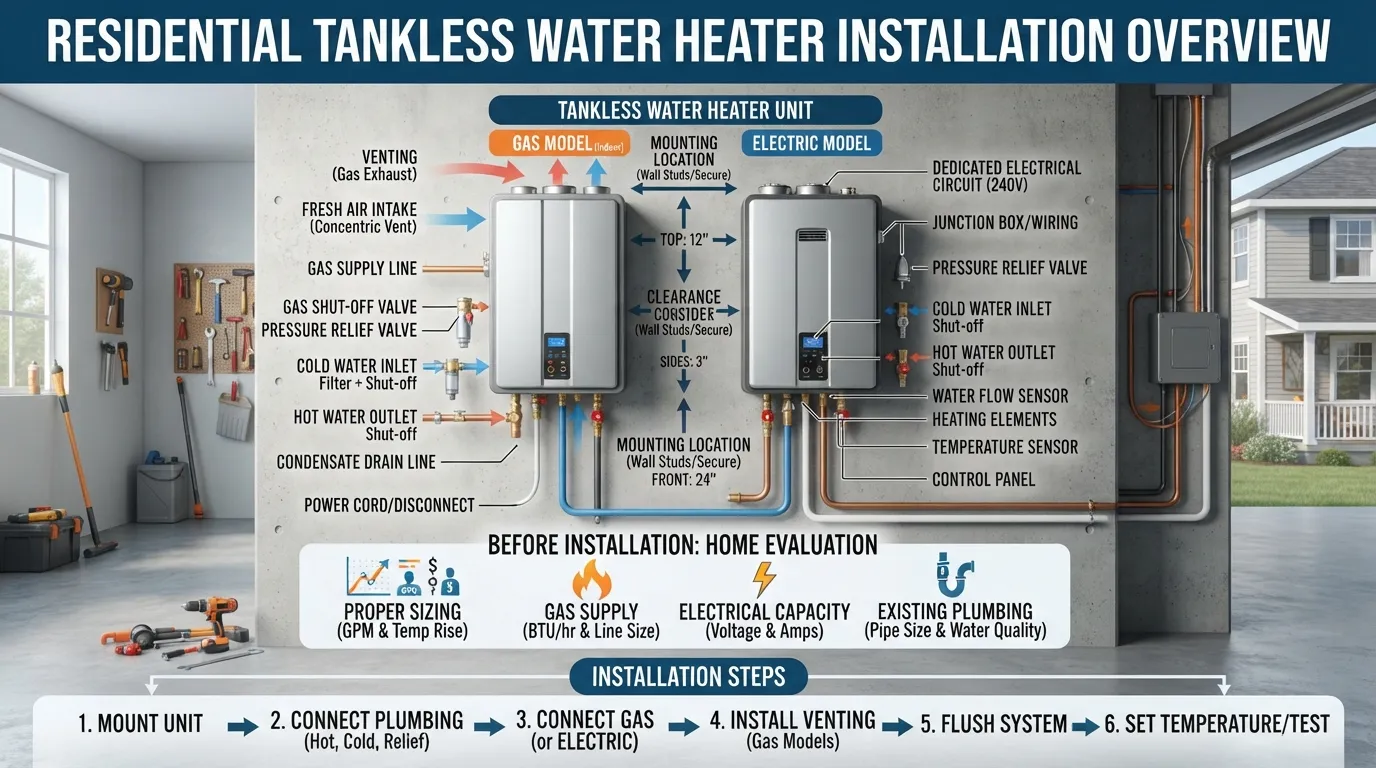
The installation may involve several systems at once:
- Cold-water and hot-water connections
- Gas supply and combustion requirements for gas models
- Electrical supply and appropriate circuits for electric models
- Venting for applicable gas appliances
- Pressure-relief and isolation components
- Condensate management on applicable condensing systems
- Mounting and service clearances
- Startup, leak checks, and operational testing
- Permits and inspections where required
That is why a tankless installation should be planned around the specific model and your home’s existing infrastructure, not around a generic installation diagram.
Can You Replace a Regular Water Heater With a Tankless Model?
Yes, a traditional tank water heater can often be replaced with a tankless system, but it is not necessarily a like-for-like replacement.
The existing water connections may be adaptable, but the new system can have different requirements for gas supply, electrical service, venting, mounting, drainage, and controls. A gas tankless unit, for example, can have a much higher instantaneous gas demand than a conventional storage water heater. Some electric tankless models can also require significant electrical capacity.
Important Before You Convert
Don’t choose a tankless heater based only on the physical space occupied by your old tank. First determine whether your home’s gas supply or electrical service can support the new unit and whether the proposed location meets the manufacturer’s installation and clearance requirements.
Tankless Water Heater Installation Requirements
Before installation begins, I recommend looking at the project as a checklist rather than jumping straight into the installation steps.
1. Determine Your Hot-Water Demand
Tankless systems are generally sized around flow rate and temperature rise. The important question is not simply how many people live in your home. You also need to consider how many fixtures may use hot water at the same time.
For example, imagine that someone is taking a shower while another shower is running and a sink or appliance is also demanding hot water. Your heater needs enough capacity to handle the expected peak demand.
The basic sizing concepts are:
- GPM: the flow of hot water the system needs to supply.
- Temperature rise: the difference between incoming water temperature and the desired hot-water temperature.
- Heating capacity: the amount of energy the unit can deliver to produce the required temperature rise at the required flow.
A unit that is too small may struggle when multiple fixtures operate at once. A properly sized system is selected around the home’s actual demand and the manufacturer’s performance specifications.
2. Check the Installation Location
The best location is not simply the place where your old water heater sits. The location needs to work with the heater’s plumbing, electrical or gas connections, venting, service access, and manufacturer-specified clearances.
Depending on the model and installation configuration, possible locations can include a utility area, garage, exterior wall, closet, or another approved location. Indoor and outdoor units have different requirements, so always follow the specific installation manual.
3. Verify Gas Capacity for a Gas Tankless Water Heater
Gas tankless water heaters can require significantly more gas during operation than conventional storage heaters. That means an existing gas line that worked for the old water heater is not automatically adequate for the new one.
The required gas supply depends on the specific unit, available gas pressure, pipe sizing, pipe length, fittings, and other appliances sharing the gas system. A qualified professional should verify the complete gas supply before installation.
4. Check Electrical Capacity for an Electric Tankless Water Heater
Electric tankless installation can look simpler because there is no combustion venting, but that does not mean every home’s electrical system can support every electric tankless model.
Depending on the model, electrical tankless systems can require high wattage, substantial amperage, dedicated circuits, and appropriately sized conductors and breakers. For example, A. O. Smith’s published installation information shows that electric tankless requirements vary considerably by model and output capacity.
Never choose breaker or wire sizes from a generic internet diagram. The exact requirements must come from the selected unit’s specifications and applicable electrical requirements.
5. Plan the Venting for Gas Models
Gas tankless water heaters require proper exhaust and combustion-air arrangements according to the appliance design. Vent material, termination, clearances, routing, and combustion requirements vary by model.
One important point is that you should not assume an existing conventional water-heater vent can simply be reused. The selected tankless model’s installation manual determines the approved venting system.
Electric vs. Gas Tankless Water Heater Installation
There is no universal winner. The right choice depends on the infrastructure available at your home, your hot-water demand, the model you select, and the total installation work required.
How to Install a Tankless Water Heater
The exact procedure varies by manufacturer and model. Gas, electric, condensing, non-condensing, indoor, outdoor, whole-house, and point-of-use systems can all have different requirements.
For that reason, the following is a professional installation overview, not a substitute for the manufacturer’s installation manual, local code, or qualified electrical/gas/plumbing work.
- Assess the home. Determine hot-water demand, fuel type, available utilities, installation location, and existing infrastructure.
- Select and size the unit. Match the heater to expected flow rate and temperature-rise requirements.
- Verify the location. Confirm mounting, service access, water connections, venting where applicable, and required clearances.
- Confirm permits and code requirements. Determine which jurisdiction handles the work and what permits or inspections apply.
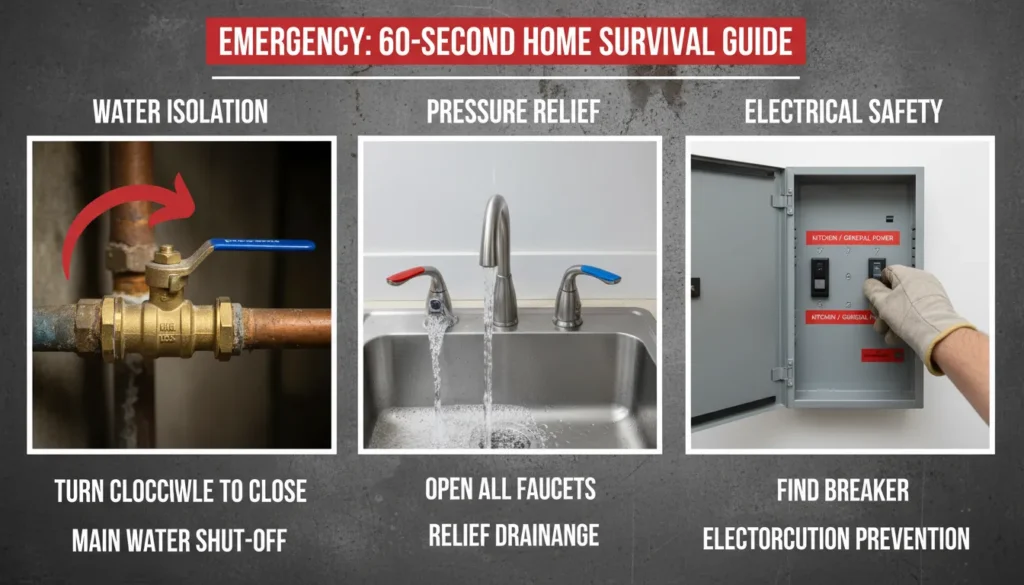
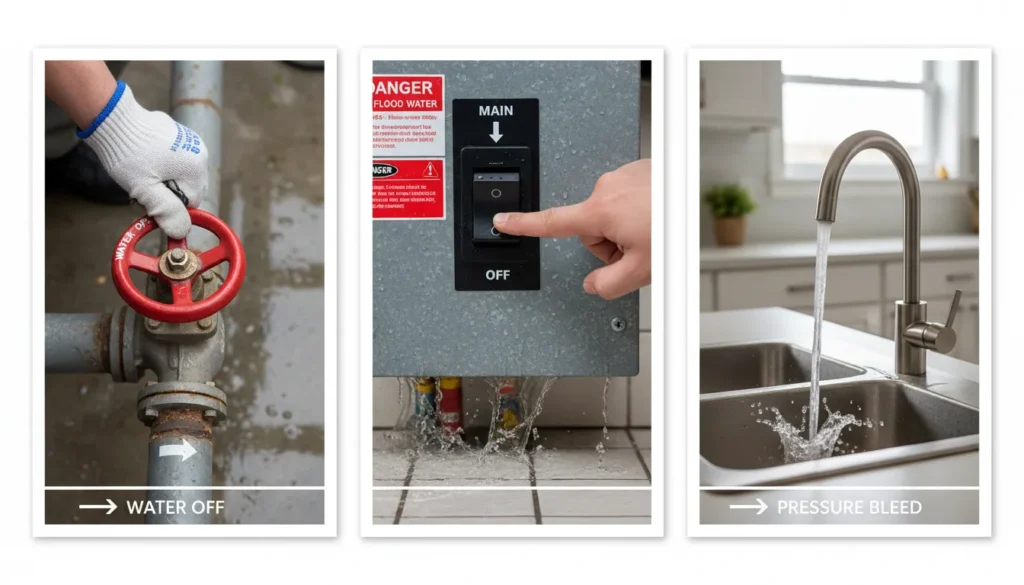
- Shut down and remove the existing system. When replacing a tank, the water, fuel, and electrical supplies must be safely isolated before removal.
- Modify the infrastructure. This may include plumbing changes, gas-line work, electrical work, venting, drainage, or other modifications depending on the system.
- Mount the tankless unit. Secure it according to the manufacturer’s specifications.
- Make water connections. Connect the cold-water inlet and hot-water outlet according to the unit’s requirements.
- Complete fuel and vent connections. Gas and venting work must follow the appliance manufacturer’s instructions and applicable code.
- Complete electrical connections. Follow the model-specific electrical requirements and applicable code.
- Install required safety components. This may include pressure-relief, isolation, purge, expansion, condensate, or other components depending on the system.
- Test the installation. Check for water leaks, gas leaks where applicable, proper electrical operation, venting, ignition, temperature control, and error conditions.
- Complete startup. Follow the manufacturer’s startup procedure and verify proper operation under normal demand.
Why Professional Installation Matters
Tankless installation can involve gas, electricity, combustion, venting, water pressure, and code requirements. Gas and electrical work can create serious safety hazards when performed incorrectly. If your project involves modifying a gas supply, electrical service, venting, or other regulated systems, use a qualified professional and follow the selected heater’s installation instructions.
Tankless Water Heater Installation in a Bathroom: Is It Possible?
A tankless water heater can sometimes be installed near a bathroom or other point of use, but the fact that a unit physically fits in a bathroom does not automatically make the location acceptable.
You need to consider the specific unit’s approved location, electrical and plumbing requirements, moisture exposure, service access, ventilation or combustion requirements for gas models, and applicable code.
For a point-of-use electric heater, proximity to the fixture can sometimes make sense. For a whole-house system, the best location is determined by the complete installation rather than simply placing the heater closest to one bathroom.
Where Is the Best Place to Install a Tankless Water Heater?
There is no single best location for every home. A good location balances several requirements:
- Easy access for maintenance and service
- Appropriate water-line routing
- Available electrical capacity for electric models
- Adequate gas supply for gas models
- Approved vent routing for applicable gas systems
- Required clearances around the unit
- Protection from conditions the model is not designed to tolerate
- Practical access for future replacement or servicing
- Compliance with local code and the manufacturer’s instructions
Don’t choose a location based on generic clearance numbers found online. Clearance requirements vary by model and installation configuration.
How High Should a Tankless Water Heater Be Mounted?
There is no single universal mounting height that applies to every tankless water heater.
The correct mounting position depends on the model’s installation manual, required clearances, venting configuration, service access, connection layout, and applicable code. The controls should remain reasonably accessible for operation and service, while the unit must maintain all required clearances.
Best practice: Measure the actual heater and installation area, then compare those dimensions with the specific manufacturer’s clearance and mounting requirements. Avoid treating a generic “12-inch” or similar clearance figure as a universal rule.
Tankless Water Heater Installation Cost: What Actually Changes the Price?
There is no honest single installation price that applies to every home. The total cost depends heavily on whether you are performing a straightforward replacement or converting an existing system that needs infrastructure upgrades.
Common Cost Factors
- The tankless water heater itself
- Standard installation labor
- Removal and disposal of the old water heater
- Gas-line modifications or upgrades
- Electrical panel, circuit, or wiring work
- New or modified venting
- Plumbing modifications
- Condensate drainage for applicable systems
- Permitting and inspection requirements
- Installation location and accessibility
- Additional valves, fittings, or required components
- Complexity of converting from a traditional tank system
This is why two homes installing similar tankless heaters can receive very different project estimates. The heater model is only one part of the installation.
Do You Need a Permit for Tankless Water Heater Installation in Miami?
In Miami-Dade County, permit requirements can apply to plumbing, electrical, and mechanical work. The County’s permit guidance specifically lists replacement of a hot water heater and gas appliances among work that requires a permit.
There is an important local detail: municipalities within Miami-Dade County have their own Building Officials. If your property is inside a particular city, the correct permitting authority can depend on your location.
Before starting a tankless installation, confirm the requirements for your specific property and jurisdiction rather than assuming that a permit is or is not required.
Miami Permit Reminder
Permit requirements can depend on where the property is located and what work is being performed. Check the applicable Miami-Dade or municipal building department before work begins.
What Should a Professional Tankless Installation Include?
If you’re hiring a plumber for tankless installation, you should expect more than simply mounting the unit and connecting two water pipes.
A Proper Installation Assessment Should Look At:
- Your household’s expected hot-water demand
- Tankless unit type and capacity
- Gas availability and capacity, if applicable
- Electrical capacity, if applicable
- Water-line routing and connection requirements
- Venting requirements for gas systems
- Installation location and service access
- Manufacturer clearances
- Required safety components
- Permit and inspection requirements
- Startup and performance testing
This assessment is particularly important when converting from a conventional tank water heater because the existing infrastructure may have been designed around a very different appliance.
Common Tankless Water Heater Installation Mistakes
Many installation problems begin before the heater is even mounted. These are some of the mistakes worth avoiding:
- Choosing the heater before calculating demand. A compact unit is not necessarily the right unit for your home.
- Assuming the old gas line is adequate. Gas tankless units can have substantially different input requirements.
- Ignoring electrical capacity. Some electric tankless systems place significant demand on the electrical service.
- Reusing an unsuitable vent. Gas tankless systems have model-specific venting requirements.
- Installing the unit where it cannot be serviced easily. A heater should remain accessible for maintenance.
- Using generic clearance numbers. Always verify the exact model’s requirements.
- Ignoring local permitting. Regulated work may require permits and inspections.
- Skipping final testing. A finished installation should be checked for leaks, proper operation, and manufacturer-required startup procedures.
- Buying based only on GPM. Flow rate alone does not tell you whether a heater can meet the required temperature rise for your home.
What About Water Quality and Tankless Maintenance in Miami?
Miami-Dade publishes annual drinking-water quality reports, and the County reports that its drinking water meets applicable local, state, and federal regulatory standards. Your home’s water chemistry and the specific heater’s maintenance requirements should still be considered when selecting and maintaining a tankless system.
Tankless heaters contain heat exchangers and water passages that can be affected by mineral deposits over time. The appropriate maintenance schedule depends on the unit, water conditions, usage, and manufacturer’s instructions.
Rather than assuming every Miami home needs the same maintenance schedule, check the manufacturer’s recommendations for the exact model installed at your property.
What Should You Check After Installation?
The installation is not finished just because the heater turns on. A proper startup should include appropriate checks for the system that was installed.
- Water connections and visible fittings are free of leaks.
- Gas connections are checked appropriately on gas systems.
- Electrical connections and operation are verified on electric systems.
- Venting is installed according to the model’s requirements on gas systems.
- Required safety devices are installed correctly.
- The heater starts and operates as intended.
- Temperature settings are configured appropriately.
- Error codes or abnormal operation are addressed before the job is considered complete.
- The homeowner understands basic operation and maintenance requirements.
Frequently Asked Questions About Tankless Water Heater Installation
How do you install a tankless water heater step by step?
A professional installation generally starts with sizing and site assessment, followed by utility and location checks, permitting where required, removal of the old system if applicable, plumbing and gas or electrical modifications, mounting, connections, safety components, testing, and manufacturer-specific startup procedures. The exact sequence depends on the model and installation type.
How do you install an instant water heater?
“Instant water heater” is commonly used for an on-demand or tankless water heater. Installation depends on whether the system is electric or gas and whether it is a point-of-use or whole-house model. The unit must be connected according to its manufacturer requirements and applicable plumbing, electrical, gas, and building requirements.
Can you install a tankless water heater in a bathroom?
It may be possible for an approved model and installation configuration, but you must verify the unit’s approved location, clearances, electrical or gas requirements, service access, and local code. Do not assume that because a heater physically fits, the location is automatically suitable.
Do tankless water heaters need a gas line?
Gas tankless water heaters require an appropriate gas supply. Electric tankless water heaters do not use a gas line, but they can require significant electrical capacity depending on the model.
Can I use my existing gas line for a tankless water heater?
Sometimes, but it must be verified against the new heater’s input requirements, gas pressure, pipe sizing, length, fittings, and other connected appliances. Never assume an existing line is adequate simply because it supplied your old water heater.
Does an electric tankless water heater need 240 volts?
Many residential electric tankless models use 240-volt service, but the exact voltage, amperage, circuit, breaker, and wiring requirements depend on the specific model. Always use the manufacturer’s specifications rather than a generic wiring diagram.
Do tankless water heaters need venting?
Gas tankless water heaters require an appropriate exhaust and combustion-air arrangement according to the model. Electric tankless water heaters do not produce combustion exhaust and therefore do not require a combustion vent.
How do I know what size tankless water heater I need?
Start with your expected peak simultaneous hot-water flow and required temperature rise. Then compare those requirements with the manufacturer’s performance specifications. Household size alone is not enough to accurately select a tankless heater.
Is tankless water heater installation expensive?
The total cost depends on the heater, labor, location, removal of the existing system, plumbing changes, gas or electrical upgrades, venting, permits, and other site-specific work. A simple installation can be very different from a full tank-to-tankless conversion.
Do I need a permit for a tankless water heater in Miami?
Miami-Dade County’s permit guidance states that replacement of a hot water heater and gas appliance work require permits, while the applicable authority can depend on the municipality where the property is located. Confirm the requirements for your specific property before work begins.
Can I install a tankless water heater myself?
A tankless installation can involve gas, electrical, plumbing, venting, and safety requirements. Gas and electrical work can be hazardous and regulated. If the project requires these systems to be modified, using a qualified professional is the safer approach.
A Simple Tankless Installation Decision Checklist
- Know your expected peak hot-water demand.
- Determine whether gas or electric makes sense for your home.
- Verify gas capacity or electrical capacity before choosing the unit.
- Check the proposed installation location.
- Review the exact manufacturer’s installation manual.
- Plan water, fuel, electrical, and vent connections as applicable.
- Confirm local permit and inspection requirements.
- Make sure the heater can be accessed for future service.
- Use qualified professionals for regulated or hazardous work.
- Complete startup and safety testing before considering the installation finished.
Need Help With Tankless Water Heater Installation in Miami?
If you’re replacing an old water heater or considering a new on-demand system, the best first step is to evaluate the home before selecting a unit. The right installation depends on your hot-water demand, available utilities, installation location, and the requirements of the specific heater.
You can also explore our water heater replacement services if you’re replacing an existing system, or visit our plumbing services page to see the broader plumbing services available.
Planning a Tankless Water Heater Installation?
Before choosing a unit, make sure the sizing, utilities, location, installation requirements, and local requirements all work together.
Related Resources
- A. O. Smith Tankless Water Heater Installation Guide — model-specific installation considerations for gas and electric tankless systems.
- Home Depot Tankless Gas Water Heater Installation Guide — an overview of gas-line, water-line, venting, and installation considerations.
- Miami-Dade County Permit Information — check local permit requirements before beginning regulated work.
- Miami-Dade Water Quality Reports — official drinking-water quality information for Miami-Dade County.
A final note: Tankless water heater requirements vary by model, fuel type, installation configuration, property, and local jurisdiction. Always use the selected manufacturer’s current installation instructions and verify applicable local requirements before installation.