If you are searching for a plug in water heater, you are probably asking a very practical question: can you simply connect a water heater to a wall outlet and start getting hot water?
The short answer is yes, some water heaters are specifically designed to plug into an electrical outlet. But not every electric water heater is a plug-in water heater. The correct connection depends on the heater’s design, voltage, wattage, electrical requirements, plumbing configuration, and the manufacturer’s installation instructions.
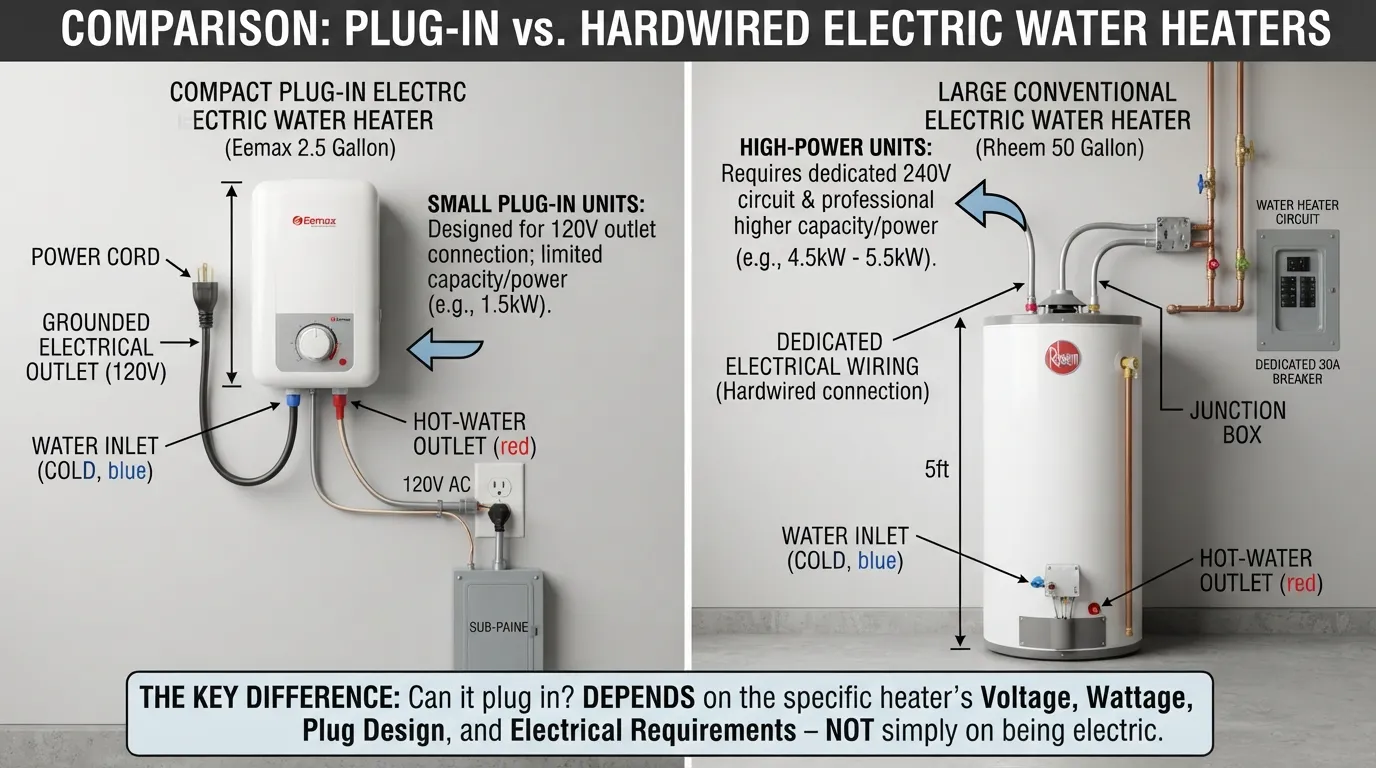
Yes, plug-in water heaters exist. They are commonly found among compact point-of-use, mini-tank, and certain low-power electric tankless models. However, a standard wall outlet is not automatically suitable for every heater. Always match the heater’s rated voltage and electrical load to the required circuit and follow the manufacturer’s instructions.
In this guide, I will show you how plug-in water heaters work, which types are available, how 110V/120V and 240V systems differ, whether you can use an existing outlet, where these heaters make sense, and what to check before installation.
What Is a Plug-In Water Heater?
A plug-in water heater is an electric water-heating unit that is manufactured to receive electrical power through a plug and compatible outlet rather than being permanently hardwired to the electrical system.
Most products described this way are designed for point-of-use applications. That means the heater supplies hot water close to where you need it, such as a kitchen sink, bathroom sink, utility sink, or another individual fixture.
There is an important distinction, though: “electric water heater” and “plug-in water heater” are not interchangeable terms. A large residential electric tank or a high-power electric tankless system may require a dedicated electrical connection rather than a standard plug.
Are There Plug-In Water Heaters?
Yes. Plug-in water heaters are available, particularly in compact point-of-use designs.
You may see them sold as:
- Plug-in water heaters
- Plug-in hot water heaters
- Point-of-use water heaters
- Under-sink water heaters
- Mini-tank water heaters
- Compact electric water heaters
- Certain electric tankless water heaters
- Instant water heaters
The key is not the product name. Check the actual electrical specification and installation instructions for the specific model.
Can a Water Heater Have a Plug?
Yes, but only when the water heater is designed for plug-in operation.
Some compact water heaters are manufactured with a power cord and plug. Other electric water heaters are designed to be hardwired or connected to a dedicated circuit. You should never assume that an electric heater can be converted to plug-in use simply because an outlet is nearby.
Important Safety Point
Do not use an adapter, extension cord, modified plug, or improvised wiring to make a water heater fit an outlet. If the heater’s required electrical connection does not match your existing supply, have the setup evaluated rather than improvising a connection.
What Kind of Plug Does a Hot Water Heater Use?
There is no single plug that every hot water heater uses. The appropriate plug and electrical connection depend on the heater’s voltage, wattage, amperage, design, and manufacturer requirements.
For a plug-in model, check the product label and installation manual for:
- Rated voltage
- Power or wattage
- Required amperage
- Plug configuration
- Grounding requirements
- Circuit requirements
- Required electrical protection
If the manufacturer’s instructions call for hardwiring, do not substitute a plug just because the unit physically could be connected to one.
Plug-In Water Heater Types
The phrase “plug-in water heater” can describe more than one type of system. Understanding the difference helps you avoid buying a heater that is too small or electrically unsuitable for your application.
1. Plug-In Mini-Tank Water Heater
A mini-tank water heater stores a relatively small amount of heated water so it can be available close to the fixture. This type can be useful under a sink or at another point of use where you want hot water without relying entirely on a remote central water heater.
Best suited to: sinks, small point-of-use applications, kitchens, bathrooms, and situations where localized hot water is the goal.
2. Plug-In Tankless Water Heater
A tankless unit heats water as it flows through the heater instead of storing a tank of hot water. Some compact models are designed for plug-in operation, but others require a different electrical connection because their power demand is substantially higher.
Best suited to: point-of-use applications when the model’s flow rate, temperature-rise capability, and electrical requirements match the intended fixture.
3. Larger Electric Tank or Tankless Water Heater
Larger residential systems should not be treated like small plug-in appliances. Their electrical requirements can be much higher and may call for dedicated circuits or hardwired installation.
For example, a large electric water heater can have a 240V electrical requirement. That is fundamentally different from assuming that a small 120V plug-in heater can perform the same job.
110V vs. 120V vs. 240V: What Does It Mean?
You may see water heaters described as 110V, 120V, or 240V. The exact rating matters because voltage is only one part of the electrical picture.
Do not choose a heater based on voltage alone. Wattage, amperage, circuit capacity, grounding, protection, and the manufacturer’s installation instructions all matter.
Why Wattage Matters When You Want a Plug-In Heater
One of the easiest ways to understand why you cannot simply plug any water heater into any outlet is to look at electrical load.
A basic relationship is:
For example, a hypothetical 3,000-watt heater operating at 120V would draw about 25 amps under that simple calculation. That is why a heater’s wattage cannot be ignored simply because it comes with a plug.
The actual installation must follow the manufacturer’s electrical specifications and applicable requirements. The presence of a physical outlet does not prove that the circuit is suitable for the heater.
Can I Plug a Water Heater Into a Standard Wall Outlet?
Only if the specific water heater is designed for that type of outlet and your electrical supply meets its requirements.
Before connecting a heater, I would check these five things:
- Heater type: Is it actually manufactured for plug-in operation?
- Voltage: Does the electrical supply match the heater’s rated voltage?
- Power demand: Is the circuit appropriate for the heater’s wattage and amperage?
- Electrical protection: Does the installation require specific grounding or protective equipment?
- Manufacturer instructions: Does the installation manual specifically permit the proposed connection?
Do Not Assume “Plug-In” Means “Plug It Into Any Outlet”
A water heater can have a cord and still have specific electrical requirements. If the outlet, circuit, voltage, or protection does not match the manufacturer’s specifications, stop and have the installation evaluated rather than trying to make the connection work.
Plug-In Water Heater for Under a Sink
An under-sink water heater is one of the clearest use cases for compact point-of-use heating.
Instead of heating water far away and waiting for it to travel through a long hot-water line, a point-of-use heater can be installed close to the fixture when the particular model and plumbing arrangement permit it.
A typical concept looks like this:
Cold Water Supply
↓
Point-of-Use Water Heater
↓
Hot Water Outlet
↓
Faucet
The exact plumbing arrangement varies by heater and fixture. Some installations require the existing hot-water line to be connected to the heater outlet, while other point-of-use arrangements are configured specifically for a local faucet. Always follow the product’s plumbing diagram rather than assuming every under-sink heater connects in exactly the same way.
Are Plug-In Water Heaters Good for a Shower?
This is where many buyers can make the wrong assumption.
A compact plug-in heater designed for a sink does not automatically have enough heating capacity for a shower. Shower applications can require significantly more hot-water flow and temperature rise than a handwashing or sink application.
If you are considering a plug-in tankless water heater for a shower, check the manufacturer’s specifications for:
- Maximum flow rate
- Temperature-rise capability
- Required electrical power
- Voltage
- Required circuit
- Minimum and maximum water flow
- Intended application
If a small heater is intended for a sink, do not assume it can provide the same performance for a shower simply because both applications use hot water.
Plug-In Tankless vs. Mini-Tank Water Heater
How to Choose the Right Plug-In Water Heater
Instead of choosing a heater just because its product title contains “plug-in,” use this compatibility check.
The 5-Point Plug-In Water Heater Compatibility Check
- Choose the application. Decide whether you need hot water for a sink, kitchen, bathroom, shower, utility area, or whole house.
- Choose the heater type. Compare mini-tank, tankless, point-of-use, and larger central systems.
- Check the electrical rating. Confirm voltage, wattage, amperage, plug configuration, and circuit requirements.
- Check the plumbing requirements. Confirm the inlet, outlet, water flow, connections, mounting location, and any required valves or accessories.
- Check the manufacturer’s installation instructions. This is the final authority for the specific model.
Pros and Cons of a Plug-In Water Heater
Potential Advantages
- Compact options are available for point-of-use applications.
- Can place hot-water production close to the fixture.
- Some models are designed for straightforward plug-in electrical connection.
- Can be useful where a full-size water heater would be excessive for the application.
- Under-sink models can be convenient for localized hot-water demand.
Potential Disadvantages
- Not every electric water heater is plug-in.
- Compact models may have limited flow or heating capacity.
- A heater suitable for a sink may not be suitable for a shower.
- Electrical requirements can limit where a unit can be installed.
- Plumbing installation is still required even when the electrical connection uses a plug.
- Some higher-power units require dedicated circuits or hardwired installation.
How Is a Plug-In Water Heater Installed?
The exact procedure depends on the model, but a typical installation involves both a water side and an electrical side.
Water-Side Installation
- Select an appropriate mounting location according to the manufacturer’s instructions.
- Shut off the water supply before making plumbing connections.
- Connect the cold-water supply to the heater’s designated inlet.
- Connect the heater outlet according to the manufacturer’s plumbing diagram.
- Restore water flow and inspect all connections for leaks.
- Follow the manufacturer’s instructions for filling, purging air, and initial operation.
Electrical-Side Installation
- Confirm the heater’s rated voltage and power requirements.
- Confirm that the intended electrical supply matches the manufacturer’s specifications.
- Verify grounding and required electrical protection.
- If the unit is designed for a plug, use the manufacturer’s supplied or specified connection.
- If the unit requires hardwiring, follow the required installation method rather than adding a plug.
Water First, Power Second
For water heaters with heating elements that must be immersed in water, energizing the unit before the manufacturer’s required filling procedure has been completed can damage the heating element. Follow the specific startup procedure in the owner’s manual before applying power.
Can You Install a Plug-In Water Heater Yourself?
A plug-in electrical connection does not automatically make the entire installation a simple DIY project.
You are still dealing with pressurized water, plumbing connections, electrical equipment, grounding, potential leakage, and the requirements of the specific heater. If you are unsure whether your existing electrical circuit or plumbing configuration is suitable, professional evaluation is the safer approach.
For a Miami home, you can also review the available plumbing services if the installation involves broader plumbing work.
Plug-In Water Heater Installation Diagram: What You Should Understand
When you look at an installation diagram, do not focus only on where the pipes go. A correct installation has two separate systems that must work together:
Water System
- Cold-water inlet
- Hot-water outlet
- Water supply
- Fixture connection
- Leak inspection
Electrical System
- Correct voltage
- Correct circuit capacity
- Grounding
- Required protection
- Manufacturer-specified connection
A diagram is a useful way to understand the system, but it should not be used as a substitute for the installation manual or applicable electrical and plumbing requirements for your specific model.
Can a 110V Plug-In Water Heater Heat Water Fast Enough?
It depends on the heater’s power, water flow, incoming water temperature, desired outlet temperature, and the manufacturer’s rated performance.
This is why two heaters that both operate from a similar voltage can provide very different results. A small point-of-use heater may be appropriate for a sink while a higher-demand application may require substantially more heating capacity and a different electrical installation.
If your goal is a shower or multiple fixtures, evaluate the required flow and temperature rise before buying a compact plug-in model.
Plug-In Water Heater vs. Whole-House Water Heater
What Are the Main Parts of a Water Heater?
The exact components vary by design, but common water-heater components can include:
- Water tank or heating chamber
- Heating element
- Cold-water inlet
- Hot-water outlet
- Thermostat or temperature controls
- Temperature and safety controls
- Electrical connection or power cord
- Pressure and safety components where applicable
- Mounting hardware and plumbing connections
Tankless models have a different internal design from storage-tank models, so the parts and service requirements are not identical.
What Should You Check Before Buying a Plug-In Water Heater?
- Where will you use it? Sink, kitchen, bathroom, shower, utility area, or another location?
- What water flow do you need? A heater for handwashing may not meet the demand of a shower.
- What voltage does the heater require? Confirm the exact rating from the manufacturer.
- How much power does it consume? Look at wattage and amperage, not just voltage.
- Is it genuinely plug-in? Check the installation manual rather than relying only on the product title.
- What plumbing connections are required? Confirm inlet, outlet, fittings, valves, and mounting requirements.
- Does the location have the required electrical protection? This should be verified before installation.
- Does the heater fit your local requirements? Follow applicable electrical, plumbing, and building requirements.
When a Plug-In Water Heater May Be the Wrong Choice
A plug-in heater may not be the right solution if you need:
- High hot-water flow for a shower
- Hot water for several fixtures simultaneously
- Whole-house hot-water production
- A heater whose electrical requirements exceed your available circuit
- A model that specifically requires hardwiring
In those situations, a different water-heating system or electrical upgrade may be more appropriate.
Frequently Asked Questions About Plug-In Water Heaters
Are there plug-in water heaters?
Yes. Compact point-of-use, mini-tank, and certain tankless water heaters can be designed for plug-in operation. The manufacturer’s electrical specifications determine whether a particular model can be plugged into an outlet.
Can a water heater have a plug?
Yes, if the heater is specifically designed for a plug-in electrical connection. Other electric water heaters require hardwiring or another specified connection.
What kind of plug does a hot water heater use?
There is no universal plug for all water heaters. The correct plug or connection depends on the heater’s voltage, amperage, wattage, grounding requirements, and manufacturer’s specifications.
Can I plug a water heater into a normal outlet?
Only when the specific heater is designed for that outlet and the circuit meets all of its electrical requirements. Never assume that an available outlet is automatically suitable.
Can I use a plug-in water heater for a shower?
Possibly, but a compact sink heater should not automatically be used for a shower. Check the model’s flow rate, temperature-rise capability, power demand, and intended application before choosing it for a shower.
Are plug-in tankless water heaters available?
Yes, some compact tankless models are designed for plug-in operation. Others require hardwiring because of their electrical requirements. Always check the individual model.
What is the difference between a plug-in water heater and a tankless water heater?
“Plug-in” describes the electrical connection, while “tankless” describes how the heater produces hot water. A tankless heater may be plug-in or hardwired depending on its design.
What are the main parts of a water heater?
Depending on the design, common parts include the heating element or heating chamber, water inlet, hot-water outlet, temperature controls, electrical connection, safety components, and plumbing connections.
When Should You Call a Professional?
If you are replacing an existing water heater, changing the plumbing configuration, unsure about the electrical circuit, or considering a higher-power tankless system, professional evaluation can help prevent an unsafe or unsuitable installation.
If your project involves replacing a water heater rather than simply researching your options, see our water heater replacement service for more information.
Is a Plug-In Water Heater Right for You?
Use this simple rule:
A plug-in water heater can be a practical solution when the specific heater is designed for plug-in use, its electrical requirements match the available supply, and its water-heating capacity matches your fixture.
If any of those three conditions is uncertain, do not guess. Check the manufacturer’s specifications and have the installation evaluated.
For a small point-of-use application, a compact plug-in water heater may be exactly what you need. For a shower, multiple fixtures, or whole-house demand, you may need a substantially different system.
The important thing is to choose the water heater based on application, flow, temperature rise, electrical load, plumbing requirements, and manufacturer instructions—not simply because the product title says “plug-in.”
Need Help Choosing or Replacing a Water Heater?
If you are in Miami and are unsure whether a plug-in, tankless, or replacement water heater is appropriate for your home, get the plumbing and installation requirements evaluated before making a purchase.
Related Resources
If you are comparing water-heating options, these resources can help you research product specifications, installation requirements, and different hot-water systems:
- GE Appliances water heater resources — manufacturer information for electric and heat-pump water-heating systems.
- Zip Water hot-water systems — examples of point-of-use and commercial hot-water equipment.
Final reminder: Product specifications and installation requirements can differ significantly between models. Before buying or installing a plug-in water heater, verify the manufacturer’s current instructions, electrical requirements, plumbing requirements, and applicable local requirements for your installation.