If you are researching a direct vent water heater, the first thing to know is that “direct vent” describes how a gas water heater gets combustion air and sends exhaust outdoors. It is not simply another name for a tankless heater, power-vented heater, or atmospheric-vented heater.
A direct vent water heater is a gas-fired water heater designed to bring combustion air from outside and discharge combustion gases outside through a dedicated venting system. Many direct-vent designs use sealed combustion and a sidewall termination, which can make them useful where conventional chimney venting is not practical. The exact vent arrangement, pipe requirements, clearances, ignition system, and electrical needs depend on the specific model and its installation instructions.
The important part is that direct vent, power vent, power direct vent, and atmospheric vent are different configurations. If you are replacing an existing heater, choosing among them requires looking at your home’s venting, fuel, available space, electrical supply, hot-water demand, and the manufacturer’s requirements.
In this guide, I’ll walk you through how direct vent water heaters work, how they compare with other venting types, what installation actually involves, how to think about 40- and 50-gallon options, what to check before replacing an existing unit, and how to decide whether a direct vent system makes sense for your home.
What Is a Direct Vent Water Heater?
A direct vent water heater is a gas storage water heater that uses a venting arrangement designed to handle combustion air and exhaust without relying on the home’s indoor air in the same way a conventional atmospheric appliance does.
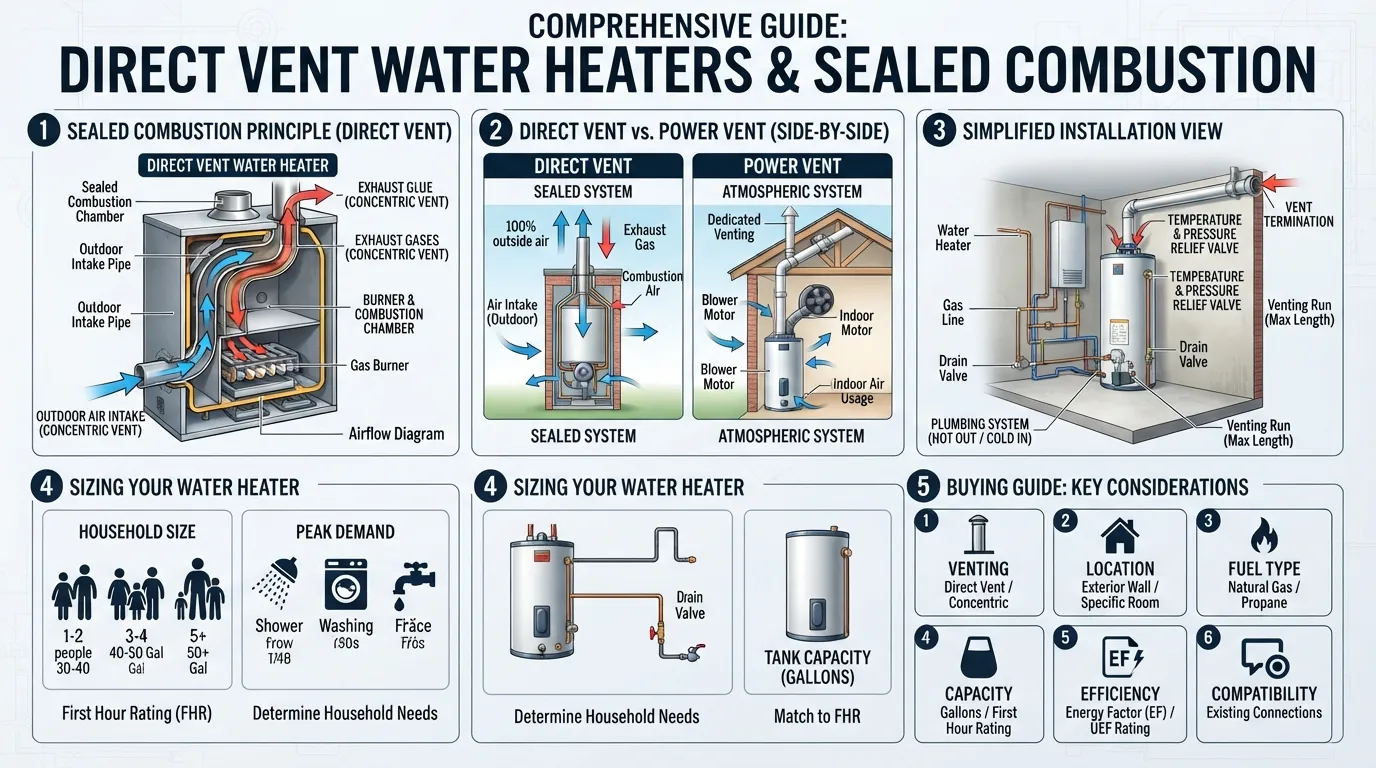
In a typical sealed-combustion direct-vent design, combustion air is brought in from outdoors and combustion products are discharged outdoors. The U.S. Department of Energy describes direct-vent combustion equipment as using outdoor air for combustion and a sealed vent path for exhaust. :contentReference[oaicite:0]{index=0}
Depending on the model, the vent may use a coaxial “pipe within a pipe” arrangement or separate intake and exhaust pipes. Some manufacturers also describe balanced-flue designs with sidewall termination.
The simplest way to picture it
Outdoor air → combustion chamber → water is heated → exhaust is sent outdoors.
The exact pipe arrangement and operating method vary by manufacturer and model, so the installation manual always takes priority over a generic diagram.
How Does a Direct Vent Water Heater Work?
The easiest way to understand a direct vent system is to follow the air and combustion gases.
1. Combustion air comes from outdoors
The burner needs air for combustion. In a sealed direct-vent configuration, that combustion air is supplied from outside rather than depending on air from the room where the heater is installed.
2. Gas is burned inside the appliance
The gas burner heats the water stored inside the tank. The combustion chamber is designed around the particular venting and combustion system specified by the manufacturer.
3. Combustion gases leave through the vent
The products of combustion are routed outdoors through the heater’s approved venting system.
4. The vent terminates outside
Many direct-vent designs are intended for sidewall termination, particularly when conventional chimney venting is unavailable. For example, current GSW and John Wood product information describes direct-vent configurations intended for locations without conventional chimney venting. :contentReference[oaicite:1]{index=1}
However, you should never choose a vent termination location from a generic article alone. The required clearances, pipe arrangement, termination location, maximum vent length, fittings, and materials depend on the exact heater and applicable code.
Does a Direct Vent Water Heater Need a Chimney?
Not necessarily.
One of the reasons homeowners consider direct vent water heaters is that certain models are specifically designed for installations where conventional chimney venting is not an option. Some current direct-vent products use a sidewall vent termination instead. :contentReference[oaicite:2]{index=2}
That does not mean every gas water heater labeled “direct vent” can be installed anywhere without a chimney. The appliance’s listed venting system and installation instructions determine what is permitted.
Important distinction
“No conventional chimney” does not mean “no venting requirements.” A direct vent water heater still needs a properly designed, approved venting system and a compliant termination location.
Direct Vent vs. Power Vent vs. Atmospheric Vent vs. Power Direct Vent
This is where many water-heater articles become confusing. The four terms sound similar, but they describe different ways of handling combustion air and exhaust.
This table is a conceptual comparison, not an installation specification. Manufacturer designs differ, and some products combine characteristics in ways that make the product manual essential.
For example, Bradford White currently lists separate Direct Vent and Power Direct Vent gas water-heater categories. Its direct-vent products use natural airflow for combustion and exhaust, while its power-direct-vent products use a blower and bring outside air into the appliance. :contentReference[oaicite:3]{index=3}
Direct Vent vs. Power Vent: Which Is Better?
There is no universal winner. The better choice depends on the property and the specific equipment you are considering.
Choose direct vent when the installation favors sealed combustion
A direct vent configuration may make sense when you have an appropriate exterior wall, want combustion air supplied from outdoors, and are considering a model designed to operate without a powered exhaust blower.
GSW, for example, describes its current 40- and 50-US-gallon direct-vent gas water heaters as options for situations where conventional chimney venting is not available and an electrical source is not close by. The listed design uses an exterior-wall location and coaxial venting. :contentReference[oaicite:4]{index=4}
Choose power vent when powered exhaust fits the installation
A power vent water heater uses a motorized blower to move exhaust outdoors. This can provide vent-routing options that are different from a natural-draft direct-vent appliance.
The trade-off is that the blower and associated controls require the electrical arrangement specified by the manufacturer.
Consider power direct vent when you need both sealed combustion and powered exhaust
Power direct vent systems bring combustion air from outdoors while using a blower to exhaust combustion products. Current Bradford White and John Wood product lines show that power-direct-vent equipment is a distinct category rather than simply another name for standard direct vent. :contentReference[oaicite:5]{index=5}
A practical decision rule
- Start with the existing fuel and water-heater setup.
- Check whether an exterior wall and compliant termination location are available.
- Determine whether the proposed appliance requires electricity for its controls or venting.
- Compare the manufacturer’s allowed vent materials, lengths, fittings, and termination requirements.
- Only then compare capacity, efficiency, features, and installed cost.
Direct Vent vs. Atmospheric Vent
The biggest conceptual difference is how combustion air and exhaust are handled.
An atmospheric water heater generally relies on natural draft and takes combustion air from the surrounding installation space. A direct-vent sealed-combustion system is designed to obtain combustion air from outdoors and send combustion products outdoors through its dedicated venting system.
This distinction matters in homes where indoor air movement, building tightness, or the location of the combustion appliance makes relying on room air undesirable. The U.S. Department of Energy’s building-science guidance specifically describes direct-vent equipment as sealed-combustion equipment that draws combustion air from outside and exhausts combustion products outside. :contentReference[oaicite:6]{index=6}
What Is Power Direct Vent?
Power direct vent combines two ideas:
- Combustion air is supplied from outdoors.
- A blower assists the exhaust process.
That makes it different from a standard direct vent system that may rely on natural airflow through its approved venting arrangement.
Current manufacturer examples make this distinction clear. Bradford White describes its power-direct-vent products as using a blower to pull outside air into the water heater, while John Wood describes its ProLine XE Power Direct Vent as having a sealed combustion chamber and blower. :contentReference[oaicite:7]{index=7}
Do not assume that a power-direct-vent model can use the same venting as an older direct-vent heater. The vent materials, pipe diameter, maximum equivalent length, termination requirements, and electrical connections must be checked against the new model’s documentation.
Can a Direct Vent Water Heater Be Installed in a Closet?
Sometimes, yes. But the answer depends on the specific model and the closet’s dimensions, access, clearances, combustion system, vent routing, and termination location.
A compact direct-vent design can be attractive for a tight installation because outdoor combustion air reduces dependence on room air. Some manufacturers specifically market direct-vent or power-direct-vent products for compact or closet installations. :contentReference[oaicite:8]{index=8}
Still, “it fits physically” is not enough. You need to verify:
- Required service clearances
- Required vent clearances
- Combustion-air arrangement
- Vent termination location
- Access for maintenance
- Gas and water connections
- Electrical requirements, if applicable
- Applicable code and permitting requirements
Direct Vent Water Heater Installation: What You Need to Check
Installation is where a generic product description stops being enough. A direct vent water heater is a gas combustion appliance, so the installation needs to match the listed appliance and applicable requirements.
1. Exterior wall and termination location
Many direct-vent models are designed for sidewall termination. Before selecting a model, confirm that the property actually has a suitable location for the intake/exhaust arrangement and that the required clearances can be maintained.
2. Vent pipe and configuration
Never assume that an existing vent pipe can simply be reused. The new heater may require a different pipe material, diameter, fitting configuration, termination kit, or maximum vent length.
3. Gas connection
The gas supply, shutoff, connector, regulator requirements, and appliance input must be compatible with the selected heater and fuel type.
4. Water connections
The hot and cold connections, shutoff arrangement, temperature-and-pressure protection, drain provisions, and other plumbing components need to meet the appliance and applicable requirements.
5. Electrical requirements
A standard direct-vent design should not automatically be assumed to be electrically independent. Some models can operate their venting without a powered blower, while their ignition or controls may have different requirements.
Always check the specific model. A GSW direct-vent product, for example, is described as operating without an external power supply for its venting design, while power-direct-vent products use a blower. :contentReference[oaicite:9]{index=9}
6. Manufacturer installation manual
The installation manual is the final authority for the model’s permitted venting configuration, pipe materials, lengths, clearances, termination, gas setup, electrical requirements, and commissioning procedure.
Do not copy installation dimensions from another heater
Two water heaters can both be called “direct vent” while having different vent kits, clearances, pipe requirements, and termination instructions. Use the documentation for the exact model being installed.
Can You Replace an Existing Water Heater With a Direct Vent Model?
Possibly, but do not assume a direct replacement is automatically compatible.
If your existing water heater is being replaced, first determine:
- What type of heater is installed now?
- Is it natural gas or propane?
- What is its tank capacity?
- How is it currently vented?
- Where does the existing vent terminate?
- Is the existing vent compatible with the new model?
- Is the new heater physically compatible with the available space?
- Does the new model require electricity?
- Will the gas, water, drain, or vent connections need modification?
- Are permits or inspections required for the exact property and scope of work?
If the tank itself is leaking, the heater is repeatedly failing, or the current system no longer meets your hot-water demand, replacement may make more sense than another repair. But diagnosis should come before buying a new unit.
When you’re comparing replacement options, you can review our water heater replacement services for the broader repair-versus-replacement decision and installation considerations.
What Size Direct Vent Water Heater Do You Need?
Direct vent describes the venting configuration; it does not determine the correct tank size.
You should size the water heater around your actual hot-water demand rather than simply replacing a 40-gallon tank with another 40-gallon tank because that is what you had before.
40-Gallon Direct Vent Water Heater
A 40-gallon tank can be appropriate for some households and applications, but the correct choice depends on demand, recovery performance, fuel, incoming-water temperature, and the specific model.
Current GSW product information includes a 40-US-gallon direct-vent gas water heater as one example of this category. :contentReference[oaicite:10]{index=10}
50-Gallon Direct Vent Water Heater
A 50-gallon direct vent water heater can provide more stored hot water than a smaller tank, but gallons alone do not tell you how well a heater will meet peak demand.
Current GSW and Bradford White product information includes 50-gallon direct-vent configurations, illustrating that this is a common capacity category for gas storage equipment. :contentReference[oaicite:11]{index=11}
Look Beyond Gallons
When comparing storage water heaters, consider the first-hour rating and the household’s actual draw pattern rather than capacity alone. The U.S. Department of Energy has published sizing guidance that considers tank size, first-hour demand, draw patterns, and water temperatures. :contentReference[oaicite:12]{index=12}
For example, a household with multiple showers occurring close together may have very different requirements from a household with the same number of people but lower simultaneous demand.
Is a Direct Vent Water Heater More Efficient?
Not automatically.
Direct vent describes a combustion and venting arrangement. Overall efficiency depends on the particular water heater’s design and performance characteristics.
Some direct-vent and power-direct-vent models are designed for high efficiency, but that does not mean every direct vent water heater has the same efficiency.
A useful example is John Wood’s Envirosense Power Direct Vent, which is a specific condensing product advertised at 96% thermal efficiency and available in 50- and 75-US-gallon configurations. That performance figure belongs to that product line; it should not be applied to direct-vent water heaters generally. :contentReference[oaicite:13]{index=13}
Compare the right things
- Fuel type
- Tank capacity
- First-hour rating
- Thermal efficiency or applicable efficiency rating
- Recovery performance
- Venting requirements
- Electrical requirements
- Physical dimensions
- Installation requirements
- Warranty and manufacturer support
Does a Direct Vent Water Heater Need Electricity?
It depends on the model.
This is one of the easiest questions to answer incorrectly with a blanket statement.
A direct-vent appliance may not need an electrically powered exhaust blower, while the appliance itself may still have electronic ignition, controls, sensors, or other electrical components. Conversely, a power-direct-vent heater uses a blower and therefore has different electrical requirements.
For this reason, do not choose a water heater based only on the words “direct vent” if your goal is operation during a power outage. Check the exact model’s ignition and control system.
What Are the Benefits of a Direct Vent Water Heater?
Outdoor combustion air
A sealed-combustion direct-vent design can draw combustion air from outside instead of relying on the room’s air supply. :contentReference[oaicite:14]{index=14}
Useful where conventional chimney venting is unavailable
Many direct-vent products are specifically designed for applications where conventional chimney venting is not practical. :contentReference[oaicite:15]{index=15}
Can work well in certain tight installations
Because the combustion system is designed around outdoor air, direct vent can be a useful option for some compact or tightly enclosed installations, subject to the model’s clearance and installation requirements.
Potentially simpler venting than a chimney-based setup
For an appropriate model and property, sidewall venting can avoid the need for a conventional vertical chimney route.
What Are the Disadvantages?
Direct vent is not automatically the right answer for every home.
- The heater needs an appropriate vent termination location.
- The venting must be compatible with the exact appliance.
- Sidewall termination has clearance requirements that must be followed.
- The existing vent may not be reusable when changing models.
- Availability of specific direct-vent models can vary by market.
- A direct-vent configuration may not provide the vent-routing flexibility of a powered system in every installation.
- Installation can involve gas, plumbing, combustion venting, and potentially electrical work.
Direct Vent Water Heater Safety: What Should You Know?
Any gas water heater deserves careful attention to combustion and venting.
One reason sealed direct-vent combustion is attractive is that it reduces the appliance’s dependence on indoor combustion air and can reduce the risk associated with backdrafting when properly installed. The U.S. Department of Energy’s building-science material explains that direct-vent sealed-combustion appliances bring combustion air from outdoors and exhaust combustion products outdoors. :contentReference[oaicite:16]{index=16}
That does not mean a direct vent heater is automatically safe if it is installed incorrectly.
Do not modify the venting, change pipe materials, relocate a termination, or improvise combustion-air arrangements without following the manufacturer’s instructions and applicable requirements.
If you notice a gas or combustion-related safety problem
Do not dismantle gas controls or venting yourself. If you smell gas or have an immediate safety concern, follow your local emergency and utility procedures and have the appliance inspected by a qualified professional.
Common Direct Vent Water Heater Problems
A direct-vent water heater can experience many of the same water-heating problems as other gas storage heaters, but venting and combustion components add another layer of potential issues.
No Hot Water
Possible causes can include ignition or control problems, gas-supply issues, thermostat/control faults, or other appliance-specific problems. Do not assume the vent is the cause without diagnosis.
Water Is Not Hot Enough
The problem could involve temperature settings, recovery capacity, burner operation, household demand, sediment, or another component.
Repeated Burner or Ignition Problems
Repeated ignition failures deserve proper diagnosis rather than repeated resets. The cause can involve gas supply, ignition components, controls, combustion conditions, or other model-specific issues.
Vent or Termination Problems
Blocked, damaged, incorrectly assembled, or improperly terminated venting can affect combustion and safety. Never modify the venting to “make it work” without using the manufacturer’s approved configuration.
Tank Leakage
If the tank itself is leaking, repair may not be practical. A leaking connection or valve can be a different problem from a failed tank, so identifying the actual source matters.
Can You Install a Direct Vent Water Heater Yourself?
You can research the installation process yourself, but gas water heater installation is not simply a matter of connecting two water pipes.
The work may involve:
- Gas connections
- Combustion venting
- Water connections
- Temperature-and-pressure protection
- Drain and discharge provisions
- Electrical components, depending on the model
- Vent termination
- Testing and commissioning
- Local permit or inspection requirements
If you are replacing a gas appliance, have the installation evaluated and performed according to the manufacturer’s instructions and the requirements applicable to your property.
What Should You Check Before Buying a Direct Vent Water Heater?
Before-You-Buy Checklist
- Confirm whether you use natural gas or propane.
- Identify your existing water heater and venting type.
- Measure the available installation space.
- Confirm whether an exterior wall is available for the required vent termination.
- Check the manufacturer’s required vent materials and configuration.
- Check maximum vent length and permitted fittings.
- Confirm service and installation clearances.
- Determine whether the proposed model needs electricity.
- Compare tank capacity and first-hour rating with your actual hot-water demand.
- Check the manufacturer’s efficiency information for the exact model.
- Confirm whether the existing gas, water, vent, and electrical connections can be reused.
- Verify local code, permit, and inspection requirements.
- Compare the complete installed cost rather than appliance price alone.
Direct Vent Water Heater: A Simple Decision Guide
A direct vent system may be worth considering if:
- You need a gas storage water heater.
- You want a sealed-combustion configuration that draws combustion air from outdoors.
- Your installation has a suitable exterior-wall termination location.
- Conventional chimney venting is unavailable or undesirable for the selected model.
- The model’s venting and clearances work with your property.
You may need to consider another configuration if:
- The required direct-vent termination cannot be located compliantly.
- Your preferred model does not fit the available space.
- Your installation requires a different venting arrangement.
- The required gas, electrical, or plumbing infrastructure is incompatible.
- A power-direct-vent or power-vent design better fits the actual vent route.
Direct Vent Water Heater Brands and Product Research
When you start comparing brands, use the manufacturer information as a starting point rather than assuming one brand’s terminology applies identically to every other manufacturer.
Current manufacturer information shows that direct vent and power-direct-vent categories are used distinctly across product lines. Bradford White lists both direct-vent and power-direct-vent gas water heaters, while John Wood lists Direct Vent, Power Direct Vent, and Power Vent categories. :contentReference[oaicite:17]{index=17}
That means the most useful question is not simply “Which brand is best?” Instead, ask:
- Does this exact model fit my fuel type?
- Does its venting work with my property?
- Can the required termination be installed correctly?
- Does its capacity and first-hour rating match my demand?
- What electrical requirements does it have?
- What installation clearances are required?
- What does the manufacturer’s installation manual require?
- What will the complete installed project cost?
Direct Vent Water Heater Installation in Miami: What Changes?
If you are installing or replacing a gas water heater in Miami, the appliance selection is only one part of the project. Existing infrastructure, property layout, venting, fuel source, and applicable local requirements all matter.
Local requirements can also vary by jurisdiction and project scope. Before work begins, verify the requirements for the exact property rather than relying on a generic statement about whether every water heater installation requires a permit.
If you need help evaluating the plumbing side of the project, you can also explore our broader plumbing services.
How Much Does a Direct Vent Water Heater Cost?
There is no responsible single price for every direct vent water heater installation.
Your total project cost can change based on:
- The heater itself
- Tank capacity
- Efficiency and product features
- Existing venting
- New vent materials or termination components
- Gas-line modifications
- Water-line modifications
- Electrical work, if required
- Installation access
- Removal and disposal of the existing heater
- Permit or inspection requirements
- Any code-related upgrades needed for the installation
For that reason, comparing the sticker price of two heaters does not necessarily tell you which one is less expensive to install.
cost question
Instead of asking only, “How much does the heater cost?” ask, “How much will it cost to supply, install, vent, connect, test, and complete this exact water-heater replacement?”
Watch: Water Heater Replacement and Installation
Visual demonstrations can make the replacement process easier to understand. The videos below are included as educational resources; your actual direct-vent installation must follow the instructions for the specific appliance being installed.
Video content is provided for general educational value. Always follow the installation manual and applicable requirements for the exact water heater being installed.
Frequently Asked Questions About Direct Vent Water Heaters
What is the main advantage of a direct vent water heater?
The main advantage is the way the system handles combustion air and exhaust. A sealed-combustion direct-vent design can draw combustion air from outdoors and discharge combustion products outdoors, which can be useful for certain installations and can reduce reliance on indoor combustion air. :contentReference[oaicite:18]{index=18}
Does a direct vent water heater need a chimney?
Not necessarily. Many direct-vent models are specifically designed for sidewall venting where conventional chimney venting is not available. The exact venting arrangement must follow the manufacturer’s requirements. :contentReference[oaicite:19]{index=19}
What is the difference between direct vent and power vent?
Direct vent generally uses outdoor combustion air and an approved venting system, while power vent uses a blower to force exhaust outdoors. The combustion-air arrangement can also differ. Always compare the exact models rather than relying only on the category names.
What is the difference between direct vent and power direct vent?
A power-direct-vent water heater combines outdoor combustion air with powered exhaust. A standard direct-vent configuration may use natural airflow rather than a powered exhaust blower. Current Bradford White and John Wood products illustrate these as distinct categories. :contentReference[oaicite:20]{index=20}
Can a direct vent water heater be installed in a closet?
Some models are designed for compact or closet installations, but the answer depends on the exact appliance, available clearances, vent route, termination location, and service access. :contentReference[oaicite:21]{index=21}
Can I replace an atmospheric water heater with a direct vent water heater?
Possibly, but it should be treated as a new appliance-selection and installation assessment rather than a simple like-for-like swap. The venting, combustion-air arrangement, termination, gas connections, clearances, and applicable requirements may all change.
Is a 50-gallon direct vent water heater better than a 40-gallon model?
Not automatically. A 50-gallon tank stores more water, but the right size depends on household demand, recovery performance, first-hour rating, available space, and the selected model.
Can a direct vent water heater work during a power outage?
It depends on the exact model. Some direct-vent designs do not use a powered exhaust blower, but the heater can still have electrical ignition or electronic controls. Check the manufacturer’s documentation for the exact appliance.
Does direct vent mean the water heater is more efficient?
No. Direct vent describes the combustion and venting arrangement, not a universal efficiency rating. Efficiency varies by model and technology. Some specific power-direct-vent products are high-efficiency condensing appliances, but their performance should not be generalized to every direct-vent heater. :contentReference[oaicite:22]{index=22}
Can I reuse my existing direct vent pipe?
Do not assume that you can. The new appliance may require different pipe materials, dimensions, termination components, clearances, or vent lengths. Verify compatibility with the new manufacturer’s installation manual.
Should I choose direct vent or power vent?
Choose based on the property rather than the label. Compare the available vent route, combustion-air requirements, electrical supply, termination location, installation constraints, hot-water demand, and the exact equipment options available for your home.
Key Takeaways
- A direct vent water heater is a gas water heater designed around outdoor combustion air and outdoor exhaust.
- Direct vent is different from power vent, power direct vent, and atmospheric vent.
- Many direct-vent models are designed for sidewall termination and installations where conventional chimney venting is not practical.
- The exact vent pipe, termination, clearances, electrical requirements, and installation method depend on the specific model.
- Do not assume that direct vent automatically means higher efficiency or no electricity.
- Choose tank size based on actual hot-water demand and first-hour performance, not gallons alone.
- When replacing an existing heater, verify the entire installation rather than assuming the old venting and connections can be reused.
- For a gas appliance, correct venting and installation are safety issues, not merely performance considerations.
Need Help Choosing or Replacing a Direct Vent Water Heater?
If you are not sure whether a direct vent, power vent, power direct vent, or another water-heating configuration fits your property, start with the existing installation. The right decision depends on your fuel source, hot-water demand, available space, vent route, electrical supply, and the requirements of the equipment you are considering.
If your current heater is leaking, repeatedly failing, or simply no longer meeting your household’s needs, you can learn about water heater replacement options in Miami and have the installation requirements evaluated before choosing a replacement.
Not sure which water heater fits your home?
A professional assessment can help you compare the existing setup, venting, capacity, connections, and replacement options before the work begins.
Related Water Heater and Plumbing Resources
If your direct-vent question is part of a larger replacement or plumbing project, these resources can help you continue your research:
- Miami plumbing and water-heater services — explore the broader local plumbing resource.
- Plumbing services and resources — useful when your water-heater project involves another plumbing issue.
- Water heater replacement in Miami — review repair-versus-replacement considerations and installation factors.
Manufacturer & Technical Resources
If you are comparing specific products, always check the manufacturer’s current product page and installation documentation for the exact model. These resources are particularly useful for verifying venting, capacities, product categories, and installation requirements.
- GSW Water Heaters Product Selector — current direct-vent and power-vent product information.
- Bradford White Gas Water Heaters — direct-vent and power-direct-vent product categories.
- John Wood Water Heater Products — direct vent, power direct vent, power vent, and atmospheric product information.
- John Wood Literature & Installation Manuals — useful when checking model-specific installation requirements.
- U.S. Department of Energy: Direct Vent Equipment — technical background on sealed-combustion direct-vent systems.
Final note: Product specifications, venting requirements, codes, permits, and installation requirements can change and can vary by model and jurisdiction. Use this guide to understand your options, but verify the current manufacturer’s documentation and requirements that apply to your specific installation before purchasing or installing a gas water heater.