
Flat Rate Plumbing Pricing: What It Covers and Why It Beats Hourly
What Is Flat Rate Plumbing Pricing?
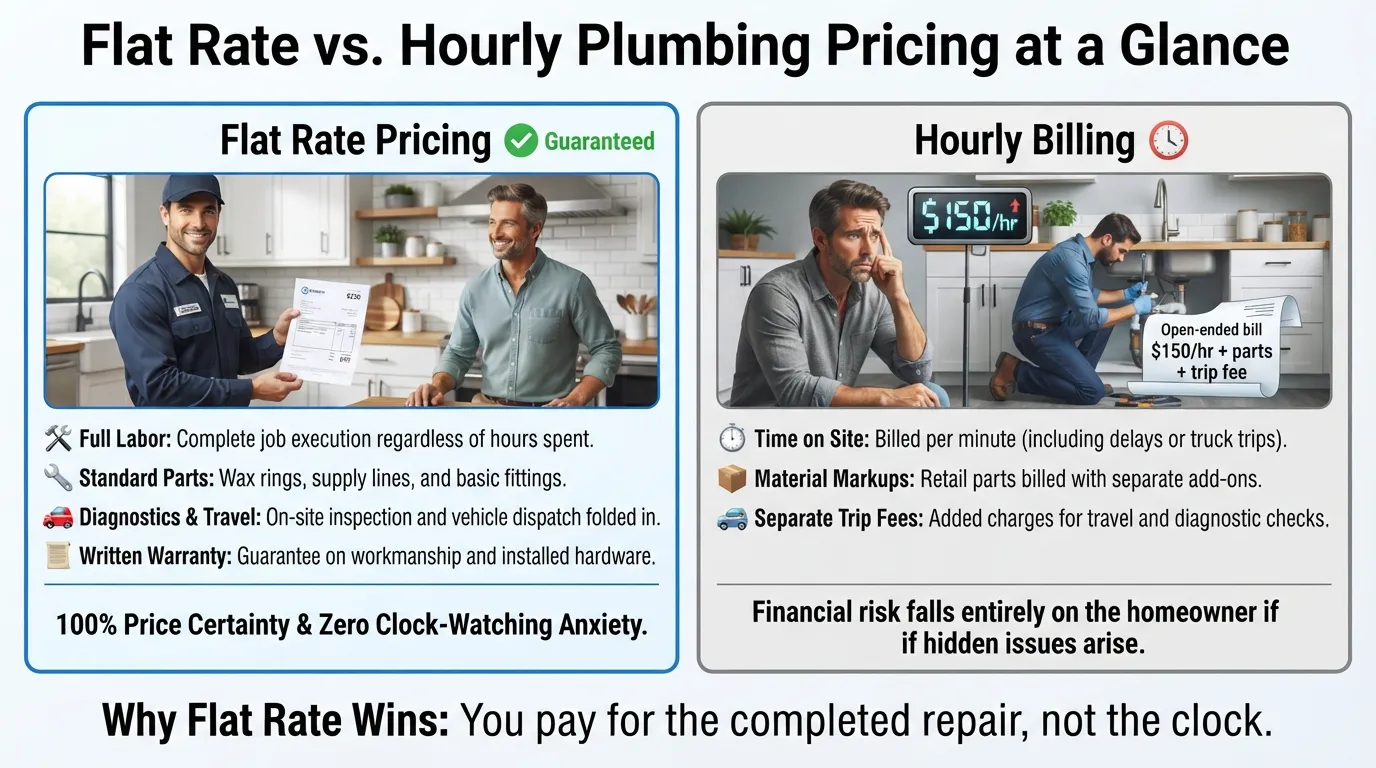
Flat-rate plumbing pricing is a modern billing system where homeowners pay a fixed total price for a specific repair or installation service. Instead of charging an unpredictable hourly wage, a professional plumber inspects the issue and gives you an exact, upfront estimate before any work starts.
Flat Rate Pricing in Plain English
Flat-rate plumbing pricing guarantees one fixed total cost for your job, quoted upfront before any tools touch your pipes, regardless of how many hours the repair ultimately takes. Under this model, the quote includes both labor and standard material costs required to complete the specific scope of work.
In contrast, traditional hourly billing charges an unpredictable rate per hour plus material markups, leaving you exposed to open-ended costs if a job encounters unexpected complications or delays.
Who This Guide Is For
This guide is designed for property owners who want clear, predictable cost structures without billing surprises:
Homeowners Comparing Quotes: Anyone looking to evaluate service estimates accurately across local contractors.
Property Owners Burnt by Hourly Billing: Individuals who have previously received inflated final invoices due to extended labor hours or slow work.
Landlords and Property Managers: Real estate investors who need reliable, upfront numbers to maintain consistent operating budgets.
If you are looking for transparent, upfront pricing from top-rated professionals, turning to reliable licensed plumbing services in Miami ensures your project stays on budget with no hidden hourly charges.
Key Takeaways: How Flat-Rate Pricing Works
What Is Included: Comprehensive diagnostic evaluation, all necessary standard labor, specialized tools, and basic repair materials required for the agreed scope.
What Is Excluded: Unforeseen structural complications, extensive wall or slab access, additional code compliance upgrades, or extra parts requested mid-job.
When Flat Rate Wins: Complex repairs, drain line clearing, major fixture installations, or jobs where labor time can easily stretch due to hidden pipe corrosion.
What to Ask Before Hiring: Always confirm if the upfront quote includes parts, ask if there is a separate dispatch or diagnostic fee, and clarify how unexpected scope changes are handled before work begins.
What Does Flat Rate Plumbing Pricing Cover?
Flat-rate plumbing pricing covers the complete scope of a repair or installation under a single upfront cost, protecting homeowners from unexpected hourly overages. A transparent fixed-rate quote bundles labor, essential standard materials, diagnostics, job site protection, and written warranty coverage into one clear line item.
Labor and Installation Done to Code
Flat-rate pricing includes all labor required to complete your repair or installation according to local building regulations and safety codes. Whether a straightforward pipe repair takes ninety minutes or four hours due to stubborn fittings, your agreed price remains unchanged.
Complete Scope Coverage: Labor is billed by the task, not the clock, eliminating extra charges for slow progress or unforeseen technical delays.
Code Compliance: Professional execution ensures installations meet current local codes, preventing safety hazards and costly re-work down the line.
Licensed Expertise: Work is performed by licensed and insured technicians trained to execute complex diagnostic and assembly procedures safely.
Standard Parts and Materials
A comprehensive flat-rate quote incorporates all basic plumbing components necessary to execute the specific service call.
Standard Parts Included: Basic fittings, supply lines, wax rings, standard shutoff valves, sealant, and hardware are fully covered in the initial estimate.
Specialty Parts Excluded: Custom-ordered fixtures, commercial-grade filtration systems, or high-end designer trim kits are billed as separate line items and agreed upon in writing beforehand.
No Secret Markups: Standard hardware fees are locked into the upfront total, avoiding hidden retail markups after the work begins.
Travel, Dispatch, and Assessment
Traditional plumbers often charge separate fees for driving to your location and evaluating the problem, but a flat-rate model folds these initial expenses directly into your service agreement.
Dispatch and Travel: Fuel, drive time, and vehicle maintenance costs are built into the fixed rate rather than added as an extra travel charge.
On-Site Assessment: The technician performs a thorough diagnostic evaluation to identify the root cause of the issue before presenting your fixed quote.
Single Upfront Total: Once the diagnostic assessment is complete, you receive a clear, written quote with zero surprise line items for mileage or trip fees.
Site Cleanup
Professional flat-rate service includes restoring your home’s work zone to a clean, usable condition once repairs are finished.
Property Protection: Technicians utilize drop cloths, floor coverings, and shoe covers to prevent dirt and water damage during service.
Debris Removal: Old parts, worn fittings, packaging materials, and discarded piping are hauled away and properly disposed of.
Surface Wipe-Down: Work areas around sinks, toilets, or utility closets are wiped down and dried before final sign-off.
Written Warranty or Guarantee
A key component of a reliable flat-rate service is the inclusion of explicit written guarantees covering both craftsmanship and installed parts.
Workmanship Guarantee: Professional plumbers back their labor with a written warranty—typically ranging from 30 days to 1 full year depending on the service—promising free follow-up repairs if an issue recurs.
Manufacturer Parts Warranty: Installed fixtures and factory parts carry their own manufacturer warranties, which are fully documented and handed over upon completion.
Total Peace of Mind: Written guarantees ensure that if a repair fails under normal operating conditions within the warranty window, the contractor rectifies it at zero additional cost to you.
Sample Flat Rate Quote, Line by Line
To understand how a professional flat-rate breakdown looks in practice, review this line-item recreation of an authentic, standardized service estimate:
| Line Item / Service Scope | Included in Flat Rate? | Notes & Coverage Details |
| Dispatch & Diagnostic Fee | Yes | Applies toward the final repair total upon quote approval. |
| Standard Toilet Removal & Replacement | Yes | Covers full labor for unmounting, resetting, and testing fixture. |
| Wax Ring & Mounting Bolts | Yes | Includes standard heavy-duty wax seal and corrosion-resistant bolts. |
| Braided Stainless Supply Line (3/8″) | Yes | Replaces old flexible supply tube with new code-compliant line. |
| Shutoff Valve Replacement (Angle Stop) | Optional Add-On | Discovered seized during assessment; quoted and approved prior to work. |
| Worksite Floor Protection & Cleanup | Yes | Protective tarps applied; old fixture hauled off and area disinfected. |
| 1-Year Workmanship Warranty | Yes | Full written coverage on labor and seals against leakage. |
What Flat Rate Pricing Does NOT Cover
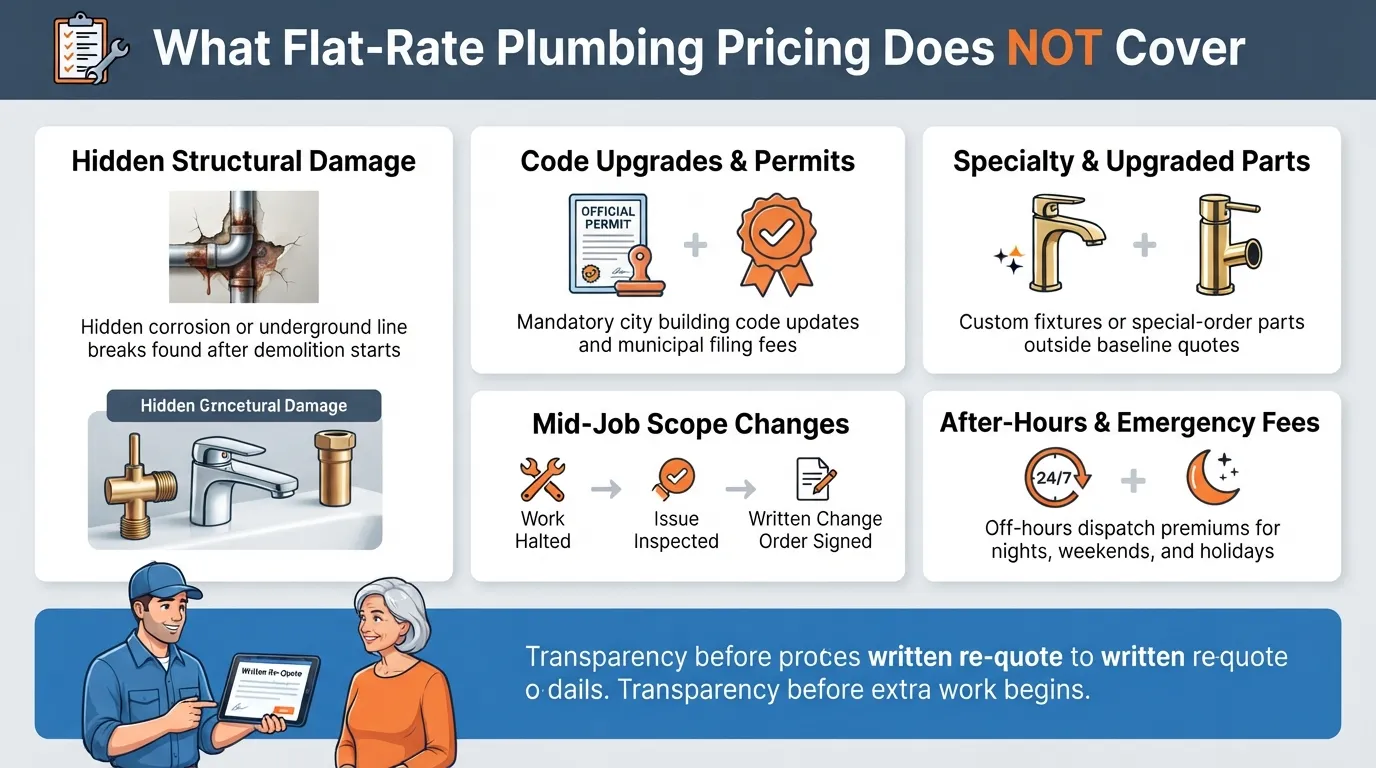
While flat-rate pricing provides excellent cost predictability, it does not mean an initial quote covers every unforeseen variable. Understanding standard exclusions prevents misunderstandings and ensures you know exactly when and why an initial estimate might require a scope update.
Hidden Damage Found Once the Work Starts
A flat-rate quote covers the specific, visible problem identified during the initial assessment. However, concealed issues behind walls, under floorboards, or underground cannot be fully evaluated until demolition or teardown begins.
Concealed Deterioration: Severely corroded pipes, dry rot, structural mold, or rusted fittings hidden inside structural cavities require secondary repairs.
Undiscovered Leaks: Uncovering an unexpected secondary line break while opening a wall requires specialized leak detection and repair services to isolate the issue before proceeding.
Underground Structural Failures: Deep line collapses or heavy root intrusion found during main line servicing often necessitate a full video camera inspection and dedicated sewer line inspection and repair solutions that go beyond standard drain clearing.
Code Upgrades and Permit-Required Work
If your home’s plumbing infrastructure is outdated, replacing a single component may trigger mandatory code upgrades mandated by local municipal laws.
Mandatory Upgrades: Installing a modern water heater or main line shutoff valve may require upgrading undersized piping, adding expansion tanks, or fitting pressure-reducing valves to satisfy current building codes.
Permitting Fees: Municipal permit fees, official city inspection costs, and required filing paperwork are separate administrative expenses that cannot be bundled into a standard flat repair rate.
Safety Compliance: A licensed contractor cannot legally bypass active code requirements, meaning necessary safety upgrades must be added to the overall scope.
Specialty or Upgraded Parts
Flat-rate estimates are calculated using reliable, commercial-grade standard replacement parts. High-end, custom, or specialized components fall outside these standard baseline figures.
Custom Fixtures: Designer faucets, imported tile trim, commercial-grade garbage disposals, or smart home water shutoff valves incur higher material costs.
Special Orders: Non-stocked or vintage-matching fittings that require custom shipping or manufacturer delays will adjust the project price accordingly.
Client Upgrades: Deciding to upgrade from a standard fixture to a luxury alternative mid-project will change the total material cost on your invoice.
Scope Changes Mid-Job
Professional plumbers follow strict protocols when unexpected issues arise to ensure complete financial transparency and eliminate surprise charges.
Immediate Work Stoppage: The technician halts work immediately upon discovering an unforeseen structural issue or hidden defect.
On-Site Explanation: The plumber shows you the physical issue firsthand (or provides camera inspection footage) and explains why additional steps are required.
Written Change Order: A formal written re-quote or change order detailing the exact added cost is presented for your review.
Explicit Approval: No additional work is performed, and no extra charges are added until you review and sign the revised agreement.
After-Hours and Emergency Premiums
Flat-rate pricing scales apply to standard operating hours. Requesting immediate service outside regular business times involves extra operational costs.
After-Hours Service: Calls dispatched late at night, on weekends, or during major holidays incur an standard emergency dispatch premium or adjusted flat emergency rate.
Immediate Response Costs: Emergency rates cover off-hours staffing, priority dispatching, and rapid delivery of specialized equipment to stabilize urgent residential flooding or main line backups.
Real-World Case Study: Uncovering Hidden Pipe Corrosion
Initial Scope & Quote: A technician was called for a routine toilet reset. The flat-rate quote of $195 covered removing the old unit, replacing the wax ring, installing new mounting bolts, and testing the system.
The Discovery: Upon unmounting the toilet, the plumber found that the underlying cast-iron closet flange was completely rusted through, and the subfloor below was saturated from a long-term concealed leak. A simple wax ring replacement was impossible because the new toilet could not securely anchor to the disintegrated flange.
How It Was Handled: The plumber stopped work immediately and walked the homeowner to the bathroom to inspect the corroded flange and rotting subfloor. The technician explained that completing the job required cutting out the rotted cast-iron section, installing a new PVC flange adapter, and reinforcing the mounting area. A written change order for $240 was drafted on the spot. The homeowner approved the revised scope in writing, and the repair was completed safely to code with zero billing surprises.
Flat Rate vs Hourly vs Time and Materials vs Upfront Quote
Navigating plumbing service agreements can be confusing when contractors use overlapping terminology. Understanding the distinct differences between flat rate, hourly, time and materials, and upfront quote billing models ensures you choose the right financial structure for your home repair project.
Pricing Models Compared at a Glance
| Pricing Model | How You’re Billed | Best For | Main Risk for Homeowner |
| Flat Rate | Fixed total price per specific job task. | Standard repairs, replacements, and predictable installations. | Paying more if the job goes faster than expected (trades speed for certainty). |
| Hourly Rate | Billed per hour of labor plus separate parts. | Simple, fast diagnostic checks or quick minor adjustments. | Open-ended final invoices if the plumber encounters unexpected delays. |
| Time & Materials (T&M) | Actual hours worked plus exact cost of parts and material markups. | Complex, multi-day remodeling projects with evolving scopes. | Zero cost predictability; bills can escalate rapidly without strict caps. |
| Upfront Quote | Guaranteed fixed price presented in writing before work begins. | Any residential plumbing service to eliminate financial surprises. | Ensuring all necessary parts and potential variables are explicitly listed. |
Flat Rate vs Hourly: The Core Difference
The fundamental difference between flat-rate and hourly billing lies in who absorbs the financial risk of job complexity. Under a flat-rate model, you pay a guaranteed fixed fee for the completed result, meaning the plumber absorbs the cost if the repair takes longer than anticipated.
Conversely, hourly billing places 100% of the financial risk on the homeowner. If an inexperienced technician struggles with a seized valve or corroded fitting, every extra hour spent troubleshooting directly increases your final bill.
How Time and Materials Billing Works
Time and materials (T&M) is an open-ended pricing structure commonly reserved for large-scale plumbing renovations, major repiping projects, or commercial retrofits where the full scope cannot be determined in advance.
Labor Calculation: You are billed for every hour worked by every technician on-site, often multiplied by a blended labor rate.
Material Markups: Parts, fittings, and specialized equipment are billed to you at retail cost plus an agreed-upon percentage markup for handling and procurement.
Risk Management: To protect yourself under T&M, always request a “not-to-exceed quote” or a maximum expenditure cap in writing before authorizing work.
Is an “Upfront Quote” the Same as Flat Rate?
While an upfront quote is a prerequisite for flat-rate pricing, the two terms are not always identical. An upfront quote simply means the contractor tells you the total cost before starting work, but that quote could theoretically be calculated using an hourly projection or a time-and-materials estimate.
True flat-rate pricing combines an upfront quote with a fixed-task price book, ensuring your price is based on the standardized value of the completed repair rather than an arbitrary estimate of how long the technician expects to be on-site.
Why Flat Rate Usually Beats Hourly and When It Doesn’t
Flat-rate plumbing pricing delivers financial predictability by setting a fixed total before work begins. While this upfront certainty protects homeowners from unexpected labor charges on complex jobs, hourly billing can occasionally be more economical for simple, low-effort repairs.
Upfront Certainty: You Know the Price Before Work Starts
The primary benefit of flat-rate pricing is absolute billing transparency. You receive a guaranteed price quote prior to authorizing any work, allowing you to manage your budget without worrying about an inflated invoice at the end of the day.
Clear Decision Making: You evaluate and approve the full repair cost before any work begins.
Budget Security: Fixed pricing eliminates the financial stress of unmanaged labor hours and unexpected invoice line items.
No Haggling: Pricing is standard across every service call, removing guesswork and high-pressure negotiations.
Risk Shifting: Who Pays When the Job Gets Complicated?
Every plumbing repair carries inherent technical risks, such as frozen fittings, hidden corrosion, or tight physical spaces. Flat-rate billing shifts these financial risks entirely from the homeowner to the service provider.
Homeowner Risk Protection: If a technician encounters a stubborn pipe that turns a 45-minute valve replacement into a 3-hour job, your price remains fixed.
Contractor Accountability: The plumbing company absorbs the added labor costs associated with technical delays or complex troubleshooting.
Guaranteed Results: You pay for a completed, working repair rather than the number of hours a technician spends on-site.
Skill Is Rewarded, Not Penalized
Hourly billing creates a subtle conflict of interest: an inefficient plumber earns more by working slowly, while a highly skilled technician earns less by completing the job quickly. Flat-rate pricing aligns contractor incentives with quality service delivery.
Efficiency Focus: Experienced plumbers utilize specialized diagnostic tools to complete repairs safely and swiftly.
Fair Compensation: Experienced tradespeople are rewarded for their expertise and advanced equipment rather than time spent on site.
Quality Execution: Technicians focus on doing the job right the first time rather than extending their billable hours.
No Clock-Watching Anxiety
Hourly plumbing bills often create tension, leaving homeowners feeling forced to monitor the technician’s every move. Flat-rate pricing removes this discomfort completely.
Stress-Free Service: You won’t feel compelled to track trips to the service truck, phone calls, or material runs.
Open Communication: Technicians can take the necessary time to explain the repair and answer your questions without adding to your bill.
Focus on Quality: Plumbers can work carefully and double-check their work without feeling rushed by a client watching the clock.
When Hourly Can Actually Be Cheaper
Despite the advantages of flat-rate pricing, hourly billing can sometimes cost less for quick, straightforward tasks.
Minimal Labor Scope: Replacing a basic toilet flapper or swapping an exposed hose bib line may take an experienced technician under 15 minutes. A flat-rate quote for these tasks includes a built-in risk buffer to cover worse-case scenarios, which might make it higher than a 15-minute hourly rate.
Minimum Trip Charges: While hourly rates might seem lower for quick jobs, most contractors apply a minimum 1-hour service call or dispatch fee. This minimum charge often closes the price gap between hourly and flat-rate pricing.
Case Comparison: Complex Repair vs. Quick Fix
Scenario A (Complex Main Line Clearing): A homeowner hired a flat-rate contractor to clear a main sewer line clog for a fixed price of $325. Due to heavy tree root intrusion 60 feet out, the job took nearly 3.5 hours and required multiple heavy cutter heads. Under an hourly structure ($150/hr plus diagnostic fees), the total would have reached $575. The flat-rate model saved the homeowner $250.
Scenario B (Simple Sink Stopper Adjustment): A client requested service to adjust a disconnected pop-up sink drain rod. The technician fixed the linkage in 10 minutes. A standard flat-rate drain assembly quote was $145, whereas an hourly billing structure (charged at $95/hr plus a $35 service charge) would have totaled $130. In this case, hourly billing would have saved $15.
Quick Decision Guide
Choose Flat Rate When:
The repair scope involves concealed piping, main drain lines, or aged fixtures.
You are replacing major equipment such as water heaters, garbage disposals, or main shutoff valves.
You require exact budget control and want guaranteed upfront certainty before work starts.
Consider Hourly When:
The job is a simple, highly visible fix (e.g., tightening an exposed compression nut or replacing a showerhead).
You need a technician for open-ended diagnostic troubleshooting on an isolated issue.
The plumbing company offers low minimum trip charges without heavy risk-buffer markups.
Common Plumbing Jobs Quoted at Flat Rate and What Affects the Price
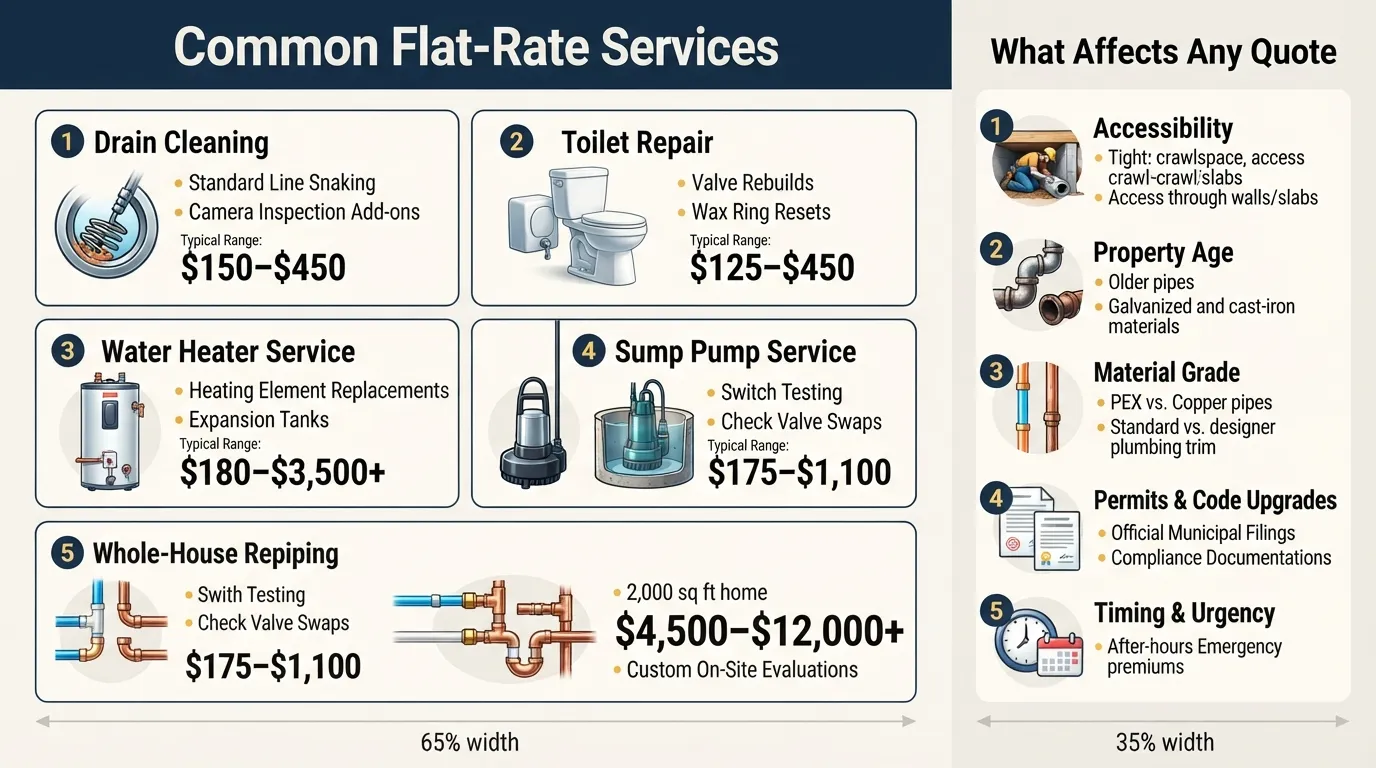
Flat-rate pricing simplifies budgeting for common residential plumbing needs by standardizing task fees. While base flat rates apply to routine jobs, specific property conditions and equipment choices influence the final quote.
Drain Cleaning
Standard flat-rate drain clearing covers snaking or augering primary fixtures to restore normal wastewater flow through routine clogs.
What Is Included: Clearing local blockages in sinks, showers, or main drain lines using standard mechanical snakes or augers.
Cost Drivers: Severe main line blockages requiring heavy-duty hydro-jetting, limited cleanout access points, or performing an integrated video camera inspection to locate tree roots.
Service Directives: For persistent backups, professional drain cleaning services utilize specialized line-clearing equipment to ensure long-term flow restoration.
Verified Price Range: Typical local service ranges from $150 to $450 depending on clog depth and line access.
Clogged or Running Toilet Repair
Toilet repairs are ideal for flat-rate pricing because the components and mechanisms are highly standardized.
What Is Included: Diagnostic evaluation, rebuild or replacement of internal fill/flush valves, flappers, wax ring seals, mounting hardware, and bowl reset.
Cost Drivers: Cracked porcelain requiring full fixture replacement, damaged subflooring beneath a leaking flange, or upgrading to specialized high-efficiency models.
Service Directives: Timely toilet repair prevents water waste and eliminates silent tank leaks that inflate monthly utility bills.
Verified Price Range: Minor internal valve overhauls range from $125 to $275, while full toilet removal and resets typically range from $220 to $450.
Water Heater Repair and Replacement
Water heater servicing ranges from simple element replacements to full system retrofits under a structured flat price.
What Is Included: Heating element or thermostat replacements, anode rod swaps, flushing sediment, or complete removal and installation of tank/tankless units.
Cost Drivers: System fuel type (gas vs. electric), tank capacity (40-gal vs. 80-gal), upgrading from traditional tanks to tankless models, and mandatory thermal expansion tank additions.
Service Directives: Expert water heater services ensure your hot water infrastructure meets local code and thermal expansion requirements.
Verified Price Range: Standard repairs range from $180 to $450; full replacement installations range from $1,200 to $3,500+ depending on unit specifications.
Sump Pump Repair and Installation
Sump pump maintenance utilizes flat pricing to guarantee reliable basement flood protection and groundwater management.
What Is Included: Testing float switches, clearing check valves, replacing basin pumps, or installing dedicated battery backup units.
Cost Drivers: Horsepower requirements (1/3 HP vs. 1/2 HP), basin excavation needs, dual-pump redundancy systems, and long discharge line routing.
Service Directives: Relying on dedicated sump pump services protects below-grade areas from unexpected storm surges and equipment failure.
Verified Price Range: Basic switch or check valve replacements range from $175 to $350; complete pump replacements range from $450 to $1,100.
Whole-House Repiping: Why It’s Quoted as a Project
A common question among homeowners is: “How much does it cost to replace the plumbing in a 2,000 sq ft house?” Whole-house repiping cannot be quoted with a single flat rate off a price sheet because it is managed as an extensive custom project.
Layout and Accessibility: A 2,000 sq ft single-story home on a crawlspace requires far less wall demolition than a two-story home built on a concrete slab.
Material Selection: Outfitting a 2,000 sq ft property with flexible PEX piping is significantly less labor-intensive and costly than installing rigid copper lines.
Fixture Count: Total cost depends on bathroom counts, wet bars, outdoor hose bibs, and laundry configurations rather than square footage alone.
Verified Price Range: Whole-house repiping for a 2,000 sq ft home generally ranges from $4,500 to $12,000+ following an on-site structural evaluation.
What Affects Any Plumbing Quote
Regardless of the repair type, five core structural variables influence flat-rate quote calculations across residential properties:
Accessibility: Concealed pipe lines behind drywall, under concrete slabs, or in tight crawlspaces increase labor intensity.
Age of the Home: Older properties with legacy galvanized or cast-iron piping require delicate handling and specialized adapters.
Materials Used: Upgrading from standard PVC/PEX to high-grade copper or custom designer trim alters baseline material costs.
Permits & Inspections: Municipal permitting requirements and municipal filing fees add mandatory compliance costs.
Urgency & Timing: Emergency dispatches during off-hours, weekends, or holidays carry necessary operational premiums.
Why Do Plumbers Charge $200+ an Hour When Their Wage Is Much Lower?
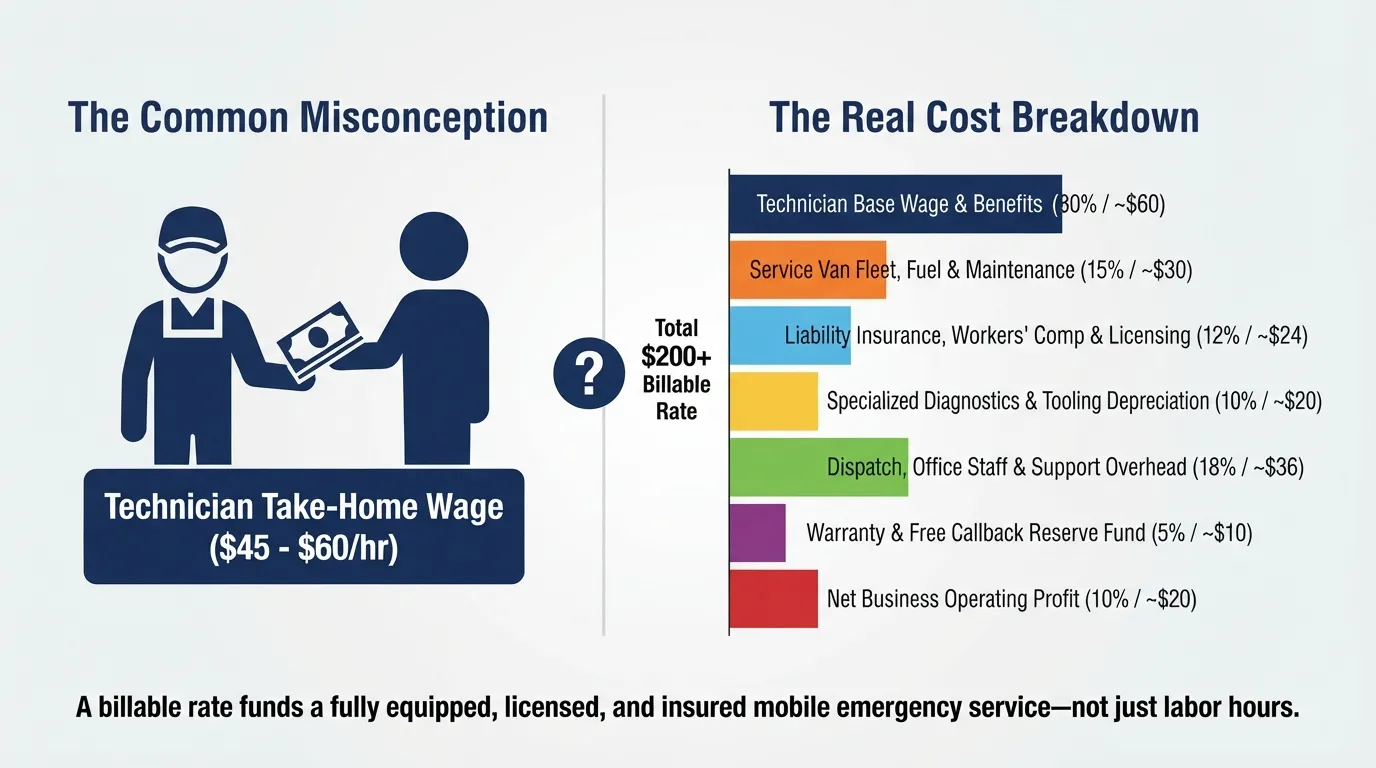
When homeowners see a labor charge or billable rate of $200 or more per hour, they often wonder why the fee is so much higher than a technician’s hourly take-home pay. A plumber’s hourly billing rate reflects the total cost of operating a licensed, insured, and fully equipped mobile service business, rather than a single employee’s wage.
Hourly Wage vs What You’re Actually Paying For
A journeyman plumber’s hourly wage represents only a fraction of the total cost required to bring a skilled trade professional to your doorstep. The billable hourly rate covers essential operational overhead, specialized equipment, administrative support, and ongoing liability protection.
Take-Home Pay vs. Operational Overhead: While an experienced technician may earn a competitive wage, the company must cover taxes, health benefits, and retirement plans.
Capital and Tooling Costs: Professional plumbing requires tens of thousands of dollars in specialized machinery, diagnostics, and continuous technical training.
Business Sustainability: Rates must generate enough margin to keep the business solvent, maintain active licenses, and support customer service staff year-round.
Where the Money Goes: The Cost of Doing Business
Every service call must absorb a share of the total overhead required to run a compliant, safe, and reliable trade operation:
Truck, Fuel, and Fleet Maintenance: Outfitting a modern service van with hundreds of parts, tools, and fuel costs thousands of dollars monthly per vehicle.
Licensing and Liability Insurance: Commercial vehicle insurance, general liability policies, workers’ compensation, and state trade licensing fees protect homeowners against site damage.
Unbillable Time: Technicians spend significant portions of their day driving between locations, stocking vehicles, writing estimates, and completing mandatory safety training—hours that cannot be billed directly to a customer.
Administrative and Dispatch Support: Customer service representatives, dispatchers, bookkeepers, and warehouse managers keep field technicians scheduled and stocked.
Warranty Callbacks: Professional companies reserve a portion of every service fee to cover labor and materials if a warranty follow-up is needed at zero cost to the client.
Breakdown of a Standard Hourly Service Rate
To understand how a typical $200 hourly billing rate is distributed across business operations, consider this representative industry allocation:
Technician Wages & Benefits: ~$45 – $60 (30%)
Vehicle Operations & Fuel: ~$25 – $35 (15%)
Insurance, Licensing & Compliance: ~$20 – $30 (12%)
Specialized Tools & Equipment Depreciation: ~$15 – $25 (10%)
Dispatch, Support Staff & Office Overhead: ~$30 – $40 (18%)
Warranty Reserve & Callback Fund: ~$10 – $15 (5%)
Net Business Operating Profit: ~$15 – $25 (10%)
Why Plumbing Prices Have Risen
Plumbing rates reflect broad economic factors across the trade and manufacturing sectors:
Rising Material Costs: Prices for raw copper, PVC fittings, brass valves, and water heaters have increased due to supply chain dynamics and raw material inflation.
Vehicle and Fuel Costs: Commercial vans, specialized fleet insurance, and vehicle maintenance expenses have grown significantly in recent years.
Skilled Trade Shortages: As senior technicians retire, the high demand for certified, licensed master plumbers drives up competitive wages for experienced trade professionals.
Do Plumbers Charge for Estimates and Service Calls?
Navigating service call costs can be confusing, especially when terms like “free estimates” and “diagnostic fees” are used interchangeably. Understanding how different charges work ensures you know exactly what to expect before a technician arrives at your door.
Free Estimate vs Diagnostic Fee vs Service Call
Different billing structures apply depending on whether your project requires basic pricing or complex troubleshooting:
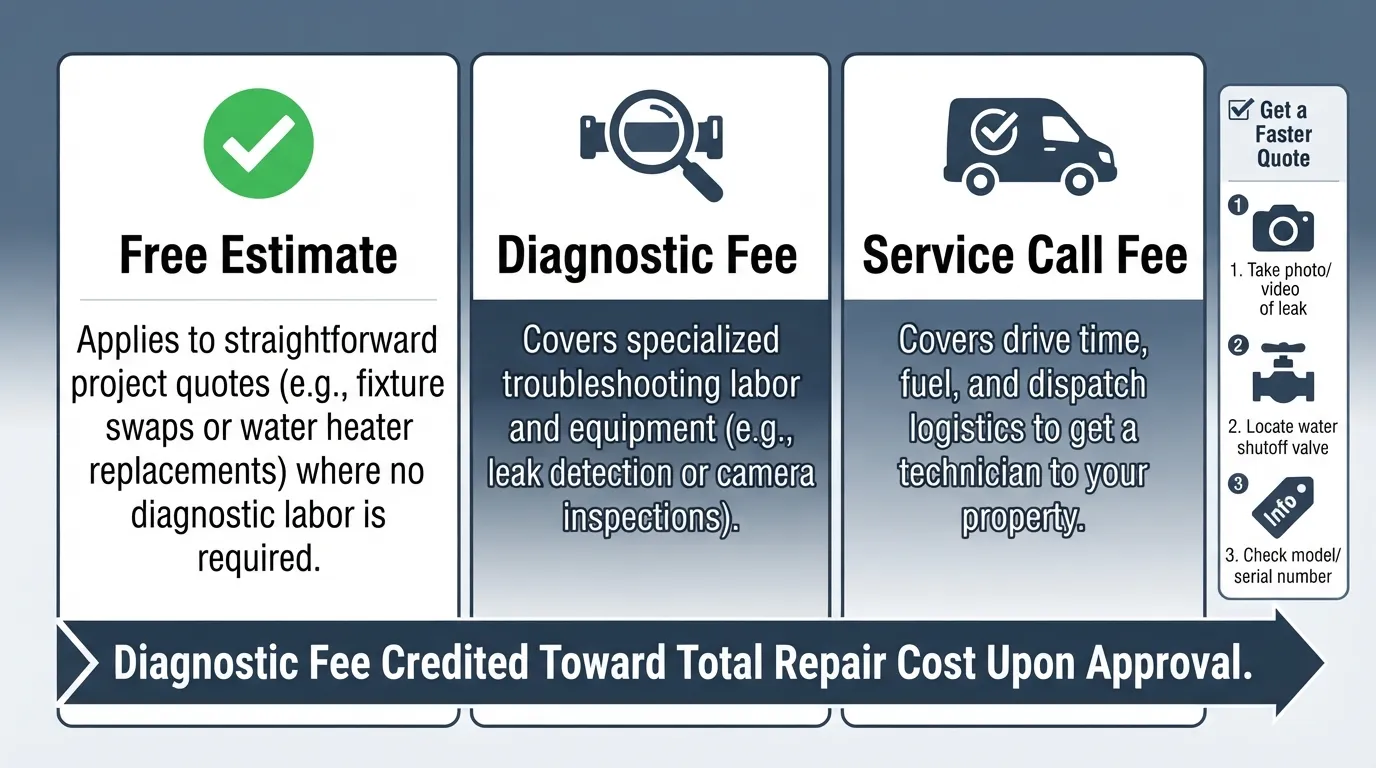
Free Estimate: A price quote given for straightforward projects where the scope is already clear—such as replacing an existing water heater, installing a customer-provided faucet, or repiping an accessible basement.
Diagnostic Fee: A charge for the skilled labor and specialized equipment needed to investigate an unknown issue, such as finding the exact location of a hidden slab leak or identifying an intermittent electrical fault in a tankless system.
Service Call Fee (Trip Charge): A baseline fee covering the technician’s transit time, fuel, and vehicle dispatch to your property, regardless of whether you proceed with the recommended repair.
Why Some Plumbers Charge to Diagnose
Identifying the root cause of a plumbing problem requires years of professional experience and specialized diagnostic technology.
Skilled Labor: Finding a leak behind a wall or diagnosing a main line drainage failure requires non-invasive acoustic sensors, video inspection cameras, and technical expertise.
Time and Resource Allocation: Driving to your property, parking, bringing equipment on-site, and conducting a thorough safety evaluation takes substantial billable time and vehicle resources.
Accurate Scope Protection: A detailed diagnostic evaluation ensures that the fixed flat-rate quote you receive covers the actual problem, preventing scope surprises halfway through the repair.
Does the Fee Get Credited Toward the Job?
Most reputable plumbing companies apply the initial diagnostic fee toward the total cost of the repair if you approve the work during the same visit.
For example, if a company charges a $75 diagnostic fee to evaluate a running toilet and quotes a flat repair price of $225, the initial $75 is applied directly toward the total. You pay a remaining balance of $150 upon completion. If you choose not to proceed with the repair after the assessment, you simply pay the diagnostic fee for the technician’s time and evaluation report.
How to Get an Accurate Quote Faster
You can help streamline the diagnostic process and secure a fast, precise estimate by gathering a few key details before calling:
Take Clear Photos and Videos: Capture well-lit photos of the leaking pipe, fixture, or water heater dataplate (including model and serial numbers), along with a short video of the issue in action.
Note the Problem’s History: Be prepared to explain when the issue started, whether it occurs continuously or intermittently, and if any previous repairs were attempted.
Locate Your Main Shutoff Valve: Know where your main water shutoff valve is located in case the technician needs to isolate the water supply quickly upon arrival.
Identify Accessibility Issues: Inform the service team beforehand if the problem area is in a tight crawlspace, attic, or locked utility closet so they bring the appropriate equipment.
Ready to resolve your plumbing issue with transparent, upfront pricing? You can easily book a plumber online to schedule an on-site diagnostic evaluation today.
How Flat Rate Works for Emergency and After-Hours Plumbing
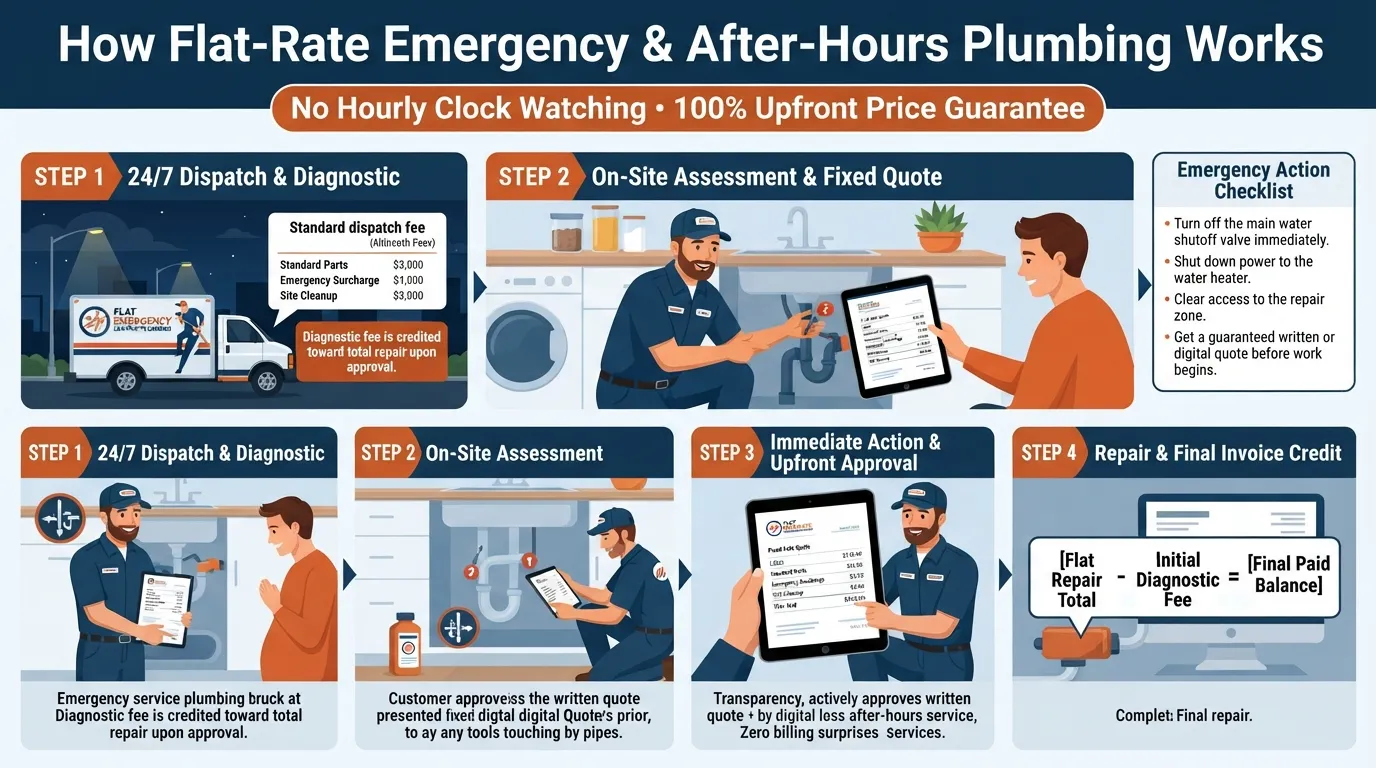
Plumbing emergencies often happen at inconvenient times, like late at night or over the weekend. Understanding how flat-rate pricing operates during after-hours service calls helps you secure immediate assistance while protecting yourself from unexpected charges.
Is Emergency Plumbing Priced Differently?
Flat-rate emergency pricing maintains the same core benefit as standard pricing: you receive a fixed, guaranteed quote before any work begins. However, the base flat rate for an emergency call is generally higher than during standard business hours.
Fixed Scope Protection: Even during an urgent midnight repair, a flat-rate quote guarantees that labor overages or stubborn fittings will not increase your agreed total.
Operational Readiness: Emergency flat rates cover the operational costs of maintaining dispatch staff, fully stocked service vehicles, and active technicians around the clock.
Transparent Approval: You review and approve the exact price on-site before the technician touches a pipe or begins repairs.
Nights, Weekends, and Holidays: What to Expect
Requesting service outside normal operating hours incurs a standard emergency dispatch or after-hours rate to cover off-hours logistics.
After-Hours Dispatch Fees: Emergency calls typically feature a higher initial diagnostic or dispatch fee to send a service vehicle after standard hours.
Adjusted Flat Rates: Standard task costs (such as clearing a clogged main line or repairing a broken valve) are scaled to an after-hours rate sheet.
24/7 Availability: Contacting a dedicated emergency plumber ensures rapid response times to stabilize active flooding, sewer backups, or major system failures.
What to Do Before the Plumber Arrives
Taking immediate steps to protect your property while waiting for an emergency technician can minimize water damage and streamline the repair process:
Shut Off the Water Supply: Locate your home’s main shutoff valve or the fixture’s local stop valve and turn it clockwise to stop incoming water immediately.
Turn Off the Water Heater: If you shut off your main water supply, turn off the power at the breaker panel (for electric heaters) or set the gas valve to “Pilot” to prevent tank damage.
Clear Access to the Work Area: Move furniture, stored items, rug runners, and personal belongings away from the affected pipe, drain, or fixture so the plumber can start work instantly.
Drain Residual Water: Open an outdoor hose bib or the lowest faucet in the house to drain remaining pressure and water from your supply lines.
Ask Before You Agree
Even in high-stress emergency situations, maintaining clear communication before authorizing work ensures complete billing transparency:
Request a Written or Digital Estimate: Ensure the technician provides the complete quote via text, email, or a physical signature pad before starting work.
Confirm What Is Included: Ask if the quoted price covers complete diagnostic work, temporary stabilization, or full permanent repair.
Clarify Potential Scope Changes: Inquire how hidden secondary damage (such as water-logged drywall or collapsed lines) will be quoted if discovered during the job.
Real Emergency Case Study: Weekend Burst Pipe
The Situation: On a Sunday evening, a homeowner experienced a burst supply pipe beneath their kitchen sink, sending water across the hardwood flooring.
The Dispatch: The homeowner contacted a 24/7 emergency service. The dispatcher clearly explained that Sunday dispatches carry a $120 emergency diagnostic fee, which would be credited toward the final repair if the quote was approved.
The Flat Quote: Upon arrival, the technician isolated the supply line and presented a flat-rate quote of $340 to replace the damaged copper section with a new quarter-turn valve and flexible stainless supply line. The quote included the emergency labor surcharge, all materials, and a site cleanup.
The Outcome: The homeowner approved the $340 quote in writing. The technician completed the repair in 45 minutes, tested the line under pressure, and applied the $120 diagnostic fee toward the total, leaving a final balance of $220. The homeowner received immediate relief without worrying about an open-ended hourly clock.
How to Tell If a Plumber Is Overcharging You
Distinguishing between fair professional rates and inflated charges requires knowing what a legitimate plumbing quote looks like. Spotting common red flags and evaluating written estimates based on scope rather than price alone ensures you get full value for your investment.
Red Flags in a Quote
While quality plumbing work requires proper compensation, dishonest pricing practices usually leave distinct clues:
Vague or Unitemized Estimates: Quotes that list broad, generic descriptions like “Plumbing Repairs – $850” without specifying labor, materials, or diagnostic findings.
Refusal to Provide a Written Quote: A contractor who insists on verbal estimates or refuses to email/hand you a physical, signed quote before starting work.
High-Pressure Urgency Tactics: Claims that a price is “only good for the next 10 minutes” or forcing immediate decisions on non-emergency maintenance.
Fluctuating Prices On-Site: Raising the baseline rate mid-job without discovering new, verifiable structural complications or hidden pipe damage.
Off-the-Books “Cash Discounts”: Pushing for unrecorded cash transactions to avoid providing written warranties, invoices, or official receipts.
Green Flags of an Honest Plumber
Reputable contractors build long-term client trust through complete transparency and professional business standards:
Clear Scope of Work: Detailed line items explaining exactly what is included, what parts are being installed, and what warranty applies.
Upfront Price Guarantees: Clear explanation of flat-rate structures, diagnostic credit policies, and potential change-order protocols before any work begins.
Active Licensing and Proof of Insurance: Readily providing state plumbing license credentials, general liability documentation, and workers’ compensation coverage upon request.
Clean, Professional Conduct: Arriving in branded vehicles, wearing identification, utilizing drop cloths to protect property, and cleaning up the workspace thoroughly upon completion.
What Plumbers Rarely Explain Up Front
As trade professionals, we know that clear communication prevents misunderstandings. Here is what we wish every customer asked us before work begins:
“What is your warranty policy if this part fails in six months?” Ask whether the warranty covers both replacement parts and the labor required to reinstall them.
“What potential hidden issues could increase this estimate once walls or floors are opened?” Knowing worst-case scenarios ahead of time removes the stress of unexpected mid-job change orders.
“Does this quote include municipal permit and inspection fees?” Clarifying administrative fees early prevents extra line items from appearing on your final bill.
“Are these standard replacement parts or custom fixtures?” Understanding whether specialized materials are required helps explain higher baseline pricing.
How to Compare Two Quotes Fairly
Comparing two plumbing quotes based strictly on the bottom-line number can be misleading. A lower quote often excludes essential services, warranties, or code compliance steps that a comprehensive estimate includes.
CHECKLIST FOR COMPARING TWO QUOTES
- Equal Scope of Work: Do both quotes cover the exact same repair steps?
- Material Quality: Are both contractors using identical pipe materials?
- Warranty Coverage: Is there a written guarantee on labor and materials?
- Code & Permits: Are required municipal permits built into the total cost?
- Overhead & Protection: Is the contractor fully licensed and insured?
Lorem ipsum dolor sit amet, consectetur adipiscing elit. Ut elit tellus, l
Evaluate the Material Grade: Ensure both contractors quote identical hardware (e.g., comparing brass valves to plastic valves or PEX lines to copper).
Verify Warranty Terms: A $400 quote with a 1-year labor warranty provides far better long-term security than a $300 quote with zero written warranty.
Check Scope Completeness: Confirm whether cleanup, hauling away old equipment, drywall access repairs, or site restoration are included in both estimates.
uctus nec ullamcorper mattis, pulvinar dapibus leo.
Can You Negotiate Plumbing Prices?
Negotiating flat-rate plumbing prices directly is rarely effective because standard fixed rates account for non-negotiable business overhead, technician wages, and insurance. However, while a contractor’s unit pricing is generally firm, you can often lower your overall invoice by adjusting the project scope, timing, or material selections.
Is a Flat Rate Price Negotiable?
Professional flat-rate pricing relies on a standardized task manual (or price book) designed to deliver consistent, predictable quotes across all customers. Consequently, asking a licensed plumber to simply slash 20% off an established flat rate is usually unsuccessful.
Firm Base Rates: Fixed pricing structures ensure fairness and prevent arbitrary price hikes, meaning baseline task fees are non-negotiable.
Flexible Scope and Options: While the rate per task is set, the total price can change if you adjust the complexity, component tier, or accessibility of the job.
Valuing Expertise: Reputable companies do not discount labor rates because doing so compromises the quality of materials, technician safety, or warranty coverage.
Legitimate Ways to Lower Your Bill
Instead of asking for a direct discount on labor, utilize strategic approaches to reduce your overall service costs legitimately:
Bundle Multiple Repairs: Plumbers already have a vehicle and equipment on-site. Combining a toilet rebuild with a faucet repair during a single visit eliminates duplicate dispatch or diagnostic charges.
Opt for Flexible Scheduling: If your issue is non-urgent, request to be placed on a non-peak or fill-in schedule when service volume is lower, avoiding emergency or priority fees.
Select Standard Material Tiers: Choose commercial-grade standard fixtures and fittings rather than high-end or custom designer trim lines.
Enroll in a Preventive Maintenance Plan: Joining a contractor’s annual service membership often grants automatic discounts (typically 10% to 15%) on all flat-rate repairs, alongside waived dispatch fees.
How to Ask Politely (Example Wording)
Polite, practical communication helps you explore cost-saving options without insulting the contractor’s professional expertise. You can use these two straightforward scripts during your quote evaluation:
“Is there a more economical material or repair option available that still solves this issue safely and meets local building codes?”
“I have two other small fixture repairs in the house—if I approve all of them today, can we bundle the dispatch fees into a single invoice?”
What Not to Do
Attempting to force a price reduction through improper methods can backfire, resulting in compromised safety or poor workmanship:
Never Ask to Skip Permits: Requesting a plumber to bypass mandatory municipal building permits to save money creates legal liabilities, voids home insurance coverage, and compromises safety.
Don’t Press for Cut Corners: Pushing a contractor to reuse old seals, worn valves, or damaged fittings increases the likelihood of catastrophic water leaks later.
Avoid High-Pressure Haggling: Threatening negative online reviews or demanding off-the-books cash arrangements damages professional trust and often results in contractors declining service altogether.
Flat Rate Plumbing Pricing FAQs
What is flat-rate pricing for plumbing?
Flat-rate plumbing pricing is a fixed-fee billing system where you receive a guaranteed total quote before work starts. The quoted price covers all necessary labor, standard materials, diagnostic evaluation, and cleanup for a specific repair task, ensuring your cost remains unchanged even if the job takes longer than expected.
How much should I pay for a plumber?
Plumbing costs vary depending on the complexity of the repair and local market rates. As covered in Section 6, routine flat-rate repairs like drain clearing or toilet rebuilds typically range from $125 to $450, while major equipment installations range from $1,200 to $3,500+.
Do plumbers usually give free estimates?
Plumbers often provide free estimates for straightforward, predictable projects like fixture replacements or water heater installs where the scope is obvious. However, if troubleshooting is required—such as diagnosing a hidden slab leak or tracing an electrical fault—contractors usually charge a diagnostic fee, which is typically credited toward your final repair bill.
Why are plumbers so expensive now?
Plumbing rates reflect the total operational overhead required to run a licensed, insured mobile business. Higher prices stem from increased raw material costs (like copper and PVC), rising commercial vehicle insurance, ongoing specialized tooling investments, and a growing national shortage of certified master technicians.
Can you negotiate plumbing prices?
While base flat-rate task fees are generally non-negotiable because they cover fixed operational costs, you can still lower your invoice. You can reduce your total expense by bundling multiple repairs into a single service visit, scheduling non-urgent work during regular hours, or choosing standard commercial-grade fixtures.
How can I tell if I’m being overcharged?
You can spot potential overcharging if a plumber refuses to provide a written, itemized quote, pushes high-pressure decisions, or changes the price mid-job without uncovering hidden structural damage. Honest contractors provide transparent scope details, upfront warranties, and proof of licensing before work begins.
What is the “135 rule” for plumbing?
The 135 rule is a plumbing code requirement that limits horizontal drain pipe direction changes to 135 degrees (such as a 90-degree bend plus a 45-degree bend) before requiring a cleanout access point or vent connection. This prevents sharp waste flow restrictions, reducing chronic clogs and backpressure.
Is flat rate pricing available for commercial properties?
Yes, flat-rate pricing is available for routine commercial repairs, though complex facilities often use custom project pricing for extensive repiping or industrial line installations. Relying on specialized commercial plumbing services ensures accurate upfront quotes that comply with commercial building codes and minimize business downtime.
Choosing the Right Pricing Model
Choosing between flat-rate and hourly billing comes down to balancing financial risk with project transparency. For the vast majority of residential plumbing repairs, flat-rate pricing provides the peace of mind that comes with knowing the exact cost before work begins.
The Bottom Line
Flat-rate pricing is the clear winner for most residential plumbing needs because it delivers upfront financial certainty and protects homeowners from unexpected labor charges. While hourly billing may occasionally offer small savings on fast, 10-minute diagnostic checks, fixed pricing eliminates clock-watching anxiety and ensures risk remains with the contractor. By securing a written quote before work starts, you ensure a fair price without billing surprises.
Get a Clear, Upfront Price for Your Plumbing Problem
Don’t let unpredictable hourly rates turn a routine pipe repair into a stressful financial surprise. Partnering with a licensed plumber ensures your home gets expert, code-compliant service backed by complete billing transparency.
Ready to get started? Book Your Plumber Now to receive a guaranteed, upfront quote for your home, or explore our full range of plumbing services in Miami today.
Main Services
Related Posts
Need a Plumber in Miami?
Schedule service online or speak directly with the EZ Plumbing team.
Owner-Led Local Service
Know who is behind the business before you request service. The owners, contact line and Miami service pages are published clearly.
- Named business owners
- Direct phone and social channels
- Local Miami service information
Clear Help Before You Book
Review the relevant service page, contact the team directly and use the booking page when you are ready—without relying on vague claims.
- Service-specific information
- Direct questions before scheduling
- Clear online booking route