Pros and Cons of a Water Softener: Is It Worth It for Your Home?
What Are the Pros and Cons of a Water Softener?
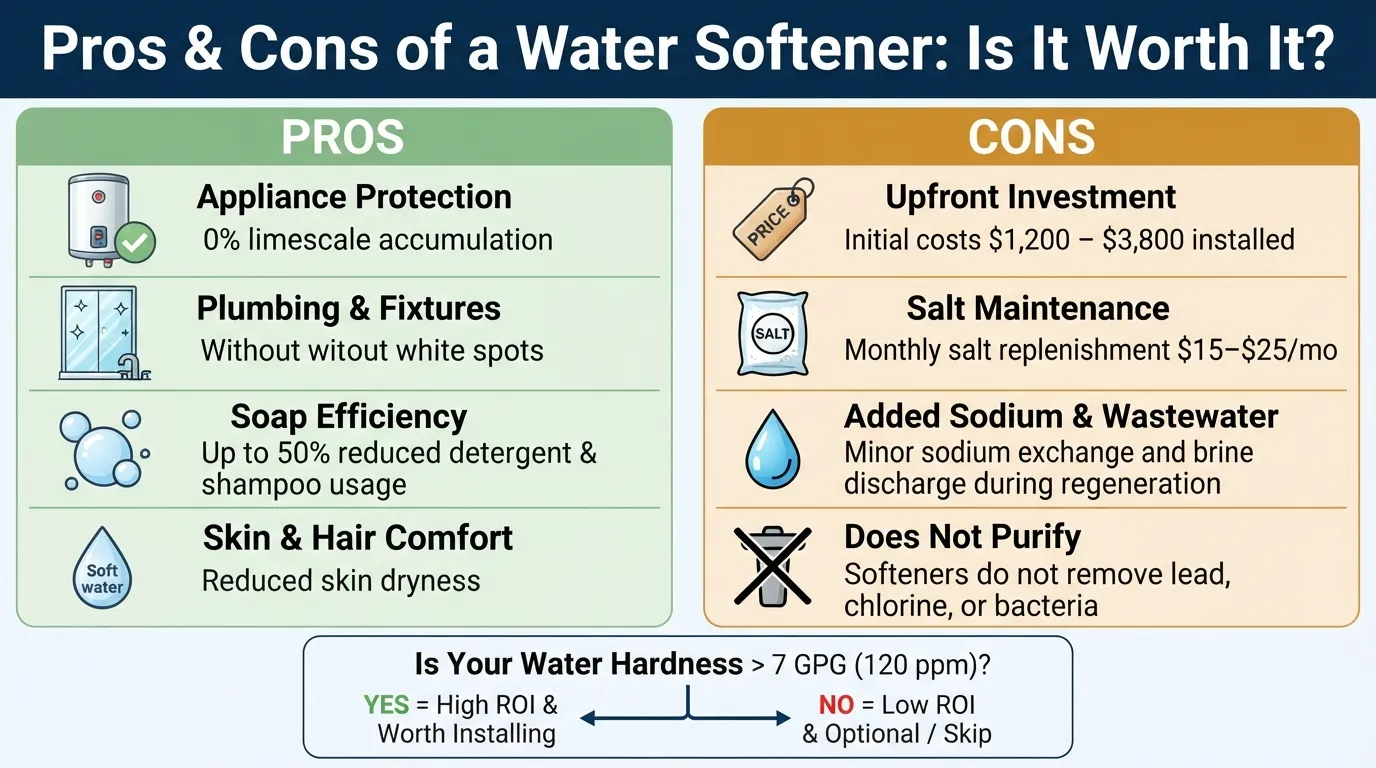
A water softener uses ion exchange to remove hard minerals like calcium and magnesium, preventing limescale buildup, extending appliance lifespan, and enhancing soap efficiency. However, it requires initial investment, ongoing salt replenishment, and produces brine wastewater while adding minor amounts of sodium. It improves water feel and protects plumbing, but it does not purify water or remove chemical contaminants.
Pros and Cons at a Glance
| Benefit / Drawback | What It Means in Real Life | Who It Matters Most To |
| Limescale Prevention | Eliminates crusty white mineral buildup on faucets, showerheads, and glass doors. | Homeowners with severe mineral buildup in bathrooms and kitchens. |
| Appliance Protection | Prevents internal scaling in water heaters, dishwashers, and washing machines, extending their service life. | Property owners wanting to avoid premature replacement costs for major appliances. |
| Lather & Soap Efficiency | Enables soaps and detergents to lather easily, requiring up to 50% less product per wash. | Families seeking lower monthly spending on cleaning supplies and toiletries. |
| Skin & Hair Comfort | Reduces mineral residue left on skin and hair, helping prevent dryness and irritation. | Individuals sensitive to skin dry-out or hair stiffness caused by hard water. |
| Upfront & Maintenance Costs | Requires an initial equipment purchase ($500–$3,000+) plus continuous salt bag refills. | Budget-conscious buyers evaluating short-term expenses against long-term savings. |
| Added Sodium & Brine | Replaces hardness minerals with low levels of sodium and discharges saltwater brine during regeneration. | Individuals on strict sodium-restricted diets and eco-conscious households. |
Who Benefits Most and Who Should Think Twice
Who Benefits Most:
Homeowners with Very Hard Water ($>7$ GPG / $>120$ mg/L): Properties experiencing heavy mineral crusting on fixtures and heating elements get immediate functional and financial relief.
Large Households with High Water Usage: Families using high daily volumes of water maximize savings on detergent, soap, and appliance longevity.
Owners of High-End Plumbing & Appliances: Protecting tankless water heaters, custom showers, and premium appliances prevents costly plumbing repairs.
Who Should Think Twice:
Residents in Areas with Soft or Slightly Hard Water ($<3$ GPG): Low mineral concentrations rarely justify the purchase price, maintenance effort, or operating overhead.
Individuals on Ultra-Strict Sodium-Restricted Diets: While added sodium is minimal, sensitive individuals may require an additional reverse osmosis system for drinking water.
Homes in Municipalities with Brine Discharge Bans: Local environmental regulations in certain regions prohibit traditional salt-based softeners due to wastewater concerns.
How a Water Softener Works
A water softener operates through an ion exchange process that replaces dissolved hardness minerals like calcium and magnesium with sodium or potassium ions. Understanding this mechanism clarifies how these systems protect household infrastructure, differ from general water filters, and require regular regeneration cycles to maintain peak performance.
Hard Water vs. Soft Water: What’s the Difference?
Hard water contains a high concentration of dissolved minerals, primarily calcium and magnesium, absorbed as water travels through underground rock and soil formations. Soft water, by contrast, has had these minerals stripped away or replaced.
Hard Water Effects: Leaves crusty mineral scale (limescale) on faucets, clogs plumbing lines, reduces water heater efficiency, and prevents soaps from lathering properly.
Soft Water Effects: Eliminates stubborn mineral residue, protects appliances from scale accumulation, extends the lifespan of plumbing fixtures, and allows soaps to lather efficiently with minimal product usage.
Key Distinction: Unlike a standard water filter designed to remove chemical contaminants, a water softener is specifically engineered to target mineral hardness.
The Ion Exchange Process in Simple Steps
The core mechanism of a water softener relies on a mineral tank filled with specialized plastic resin beads. As hard water flows through this resin bed, the process unfolds seamlessly:
Attracting Hardness Minerals: Tiny plastic resin beads carry a negative electrical charge.
Swapping Ions: Dissolved calcium and magnesium ions carry a positive electrical charge, causing them to cling magnetically to the negatively charged resin beads as water passes through.
Releasing Sodium/Potassium: As the hardness minerals stick to the beads, harmless sodium or potassium ions (sourced from salt) are released into the water stream in exchange.
Delivering Soft Water: The treated water exiting the mineral tank is free of calcium and magnesium, protecting downstream pipes and appliances.
What Happens During Regeneration
Over time, the resin beads become completely coated with accumulated calcium and magnesium, exhausting their capacity to soften water. To restore functionality, the system undergoes an automatic regeneration cycle:
Backwash & Flushing: The system reverses water flow to flush out accumulated physical debris and dirt trapped in the mineral tank.
Brine Draw: Concentrated saltwater solution from the brine tank (utilizing sodium chloride or potassium chloride) is slowly pulled through the resin bed.
Recharging the Beads: The high concentration of sodium ions forces the calcium and magnesium off the resin beads, washing the hardness minerals down the drain.
Rinse & Fill Cycle: The system performs a final clean water rinse to flush out leftover brine, then adds fresh water back into the brine tank to dissolve salt for the next cycle. This entire process typically takes about 90 minutes [00:56] and uses roughly 40 to 80 gallons of wastewater depending on unit size.
What a Softener Does Not Do
Homeowners frequently confuse water softeners with comprehensive whole-home water purification systems. It is critical to recognize that a standard water softener is not a water filter or purifier:
Heavy Metals & Lead: Softeners do not remove lead, copper, or other toxic heavy metals from drinking water.
Chlorine & Chemicals: Disinfectants like chlorine, chloramines, VOCs, and industrial chemical runoff pass right through an ion exchange resin bed.
Pathogens & Bacteria: Bacteria, viruses, and microbiological contaminants remain completely unaffected by the softening process.
Dissolved Solids: While hardness minerals are swapped out, total dissolved solids (TDS) remain present unless paired with a secondary reverse osmosis drinking water system.
Do You Actually Have Hard Water? How to Tell and How Hard Is Too Hard
Determining whether you need a water softener starts with assessing physical symptoms in your home and measuring your precise mineral levels. Water hardness varies dramatically by geographic region and source, making local testing essential before investing in conditioning equipment.
Signs of Hard Water in Your Home
Hard water reveals itself through distinct physical signs around the house long before you perform a formal test:
White Chalky Limescale: Crusty mineral deposits forming on showerheads, faucet aerators, glass shower doors, and inside kettles.
Cloudy or Spotted Glassware: Dishes and drinking glasses emerging from the dishwasher with a stubborn, milky haze or white spots.
Stiff, Faded Laundry: Clothes feeling rough or scratchy after washing, accompanied by dulling fabric colors due to mineral trapping.
Dry Skin and Brittle Hair: Persistent skin dryness, scalp irritation, or hair feeling stiff and unmanageable after bathing.
Reduced Water Pressure: Slow drop in flow rate across plumbing fixtures caused by internal mineral scale restricting pipe diameters.
Water Hardness Levels Explained
Water hardness is measured in parts per million (ppm), milligrams per liter (mg/L), or grains per gallon (gpg), where $1\text{ gpg} = 17.1\text{ ppm}$ (or mg/L).
| Hardness Classification | Hardness in ppm / mg/L | Hardness in gpg | Is a Water Softener Recommended? |
| Soft | $0 – 60$ | $0 – 3.5$ | No. Softening is unnecessary and provides no practical benefit. |
| Moderately Hard | $61 – 120$ | $3.5 – 7.0$ | Optional. May benefit homes with sensitive skin or high appliance usage. |
| Hard | $121 – 180$ | $7.0 – 10.5$ | Recommended. Softening prevents visible scaling and extends appliance lifespans. |
| Very Hard | $180+$ | $10.5+$ | Strongly Recommended. Necessary to prevent severe pipe scaling and equipment damage. |
Note: Mineral classifications align with official water quality guidelines established by the USGS Water Science School.
How to Test Your Water Hardness
Accurately measuring your home’s hardness level requires one of three standard methods:
At-Home Test Strips: Inexpensive test strips dip into a tap water sample to yield a rapid color-coded estimate within seconds.
Municipal Consumer Confidence Report (CCR): Residents on city water can review their municipal utility’s annual water quality report (available online) to check average local hardness levels.
Certified Laboratory Testing: Well water owners should send a sample to a state-certified lab for precise mineral profiling, which also tests for iron, manganese, and total dissolved solids (TDS).
Hard Water in South Florida
Homes in South Florida draw water primarily from shallow, limestone-based aquifers like the Biscayne Aquifer. Because limestone consists chiefly of calcium carbonate, groundwater in this region is naturally saturated with heavy mineral concentrations.
Heavy Limescale Accumulation: South Florida homeowners routinely see rapid crusting on shower enclosures, fixtures, and water heater heating elements.
Utility Variability: Hardness varies across municipal supply lines, making it advisable to check your local utility’s annual water quality report for exact local grains per gallon before sizing a system.
Is 450–500 ppm Too Hard?
Yes, water testing at $450 – 500\text{ ppm}$ ($26 – 29\text{ gpg}$) is categorized as extremely hard water—nearly three times the threshold where “Very Hard” begins. At this level, unconditioned water will rapidly destroy water heaters, clog plumbing fixtures with dense limescale, severe soap lathering failures, and leave heavy mineral residues on skin and surfaces. Installing a salt-based water softener or high-capacity conditioning system is strongly advisable to protect household plumbing infrastructure.
Pros of a Water Softener
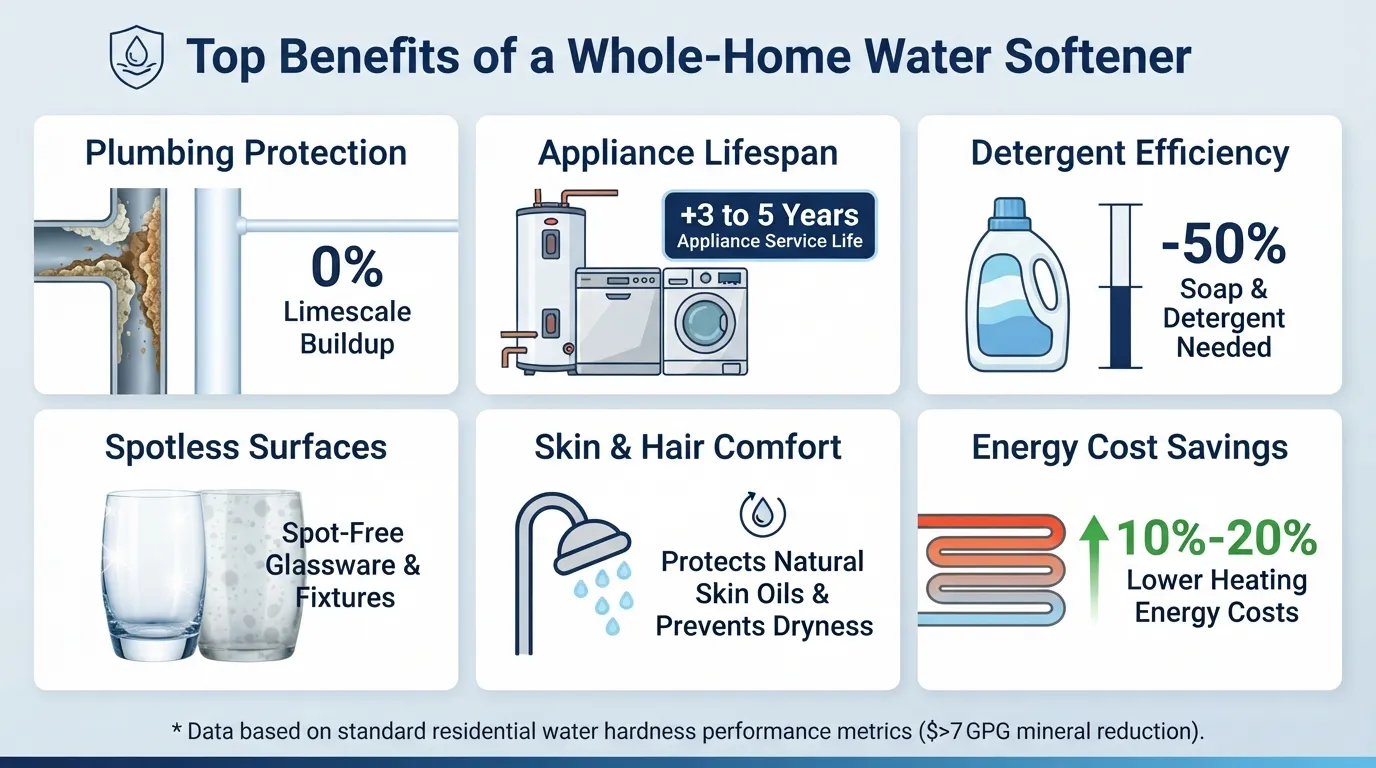
Installing a water softener delivers significant financial, operational, and practical benefits across a home. By continuously stripping out dissolved calcium and magnesium, soft water protects expensive plumbing infrastructure, enhances everyday cleaning efficiency, and optimizes energy performance.
1. Protects Pipes and Plumbing Fixtures from Scale Buildup
Dissolved minerals in hard water precipitate out of solution over time, creating a hard, crusty layer known as limescale. This buildup steadily restricts internal pipe diameters and corrodes plumbing components:
Restores Water Flow: Preventing internal scale accumulation maintains full volume and optimal pressure across all faucets, showerheads, and valves.
Extends Plumbing Lifespan: Shielding pipe interiors from mineral cragging reduces risk of premature pipe leaks, corrosion, and costly repiping projects.
Protects Fixtures: Prevents severe mineral encrustation inside toilets and faucets, preserving their aesthetic appearance and internal seal mechanisms.
2. Extends the Life of Water Heaters and Appliances
Hard water is uniquely destructive to heat-generating water appliances. As water heats up, calcium and magnesium drop out rapidly, forming an insulating layer of mineral scale on heating elements and heat exchangers.
Protects Equipment: Keeping heating elements completely free of scale extends the functional lifespan of dishwashers, washing machines, and standard water heaters by years.
Essential for Tankless Units: Soft water is particularly vital for any tankless water heater, where ultra-narrow heating channels easily clog and fail under unconditioned water conditions.
What We See in the Field: In the Miami area, untreated local water frequently scales up a tankless water heater’s copper heat exchanger within just 18 to 24 months. We routinely pulled failed heating elements encrusted in over an inch of solid calcium carbonate—a completely preventable issue that soft water completely eliminates.
3. Improves Soap, Shampoo, and Detergent Performance
Hard water minerals react directly with soap molecules, binding them into an insoluble curd rather than allowing them to create a rich lather.
Requires Less Product: Soft water enables detergents, hand soaps, and shampoos to foam effortlessly, allowing households to use up to 50% less product per wash cycle.
Eliminates Soap Curd: Preventing mineral-soap binding ensures cleaning products rinse away completely rather than leaving slippery or sticky residues behind.
4. Cleaner Dishes, Glass, Tiles, and Fixtures
Without hardness minerals present, water evaporates cleanly off non-porous surfaces without leaving behind chalky spots or milky haze.
Spot-Free Glassware: Drinking glasses, dishware, and silverware emerge from the dishwasher crystal clear without requiring chemical rinse aids.
Reduces Soap Scum: Bathroom shower glass, ceramic tiles, and porcelain tubs remain free of dingy soap scum film, making regular household cleaning substantially faster.
5. Softer Feeling Skin and Hair
While individual results vary, switching to soft water significantly reduces the drying effects that hard minerals exert on skin and hair shaft cuticles.
Rinses Clean: Soft water leaves no sticky mineral or soap residue, allowing skin to retain its natural oils and moisture barrier.
Relief for Sensitivity: Many individuals prone to dry skin, flaky scalps, or conditions like eczema report noticeable reductions in post-shower irritation and redness.
6. Can Lower Energy Costs
Mineral scale acts as an thermal insulator. When scale coats a heating element, the system must burn significantly more energy to heat the same volume of water.
Restores Thermal Transfer: Removing hard minerals maintains peak heat transfer efficiency inside tank and tankless systems.
Saves on Utility Bills: Keeping heating elements clean ensures water heating appliances consume only their rated energy usage, avoiding the $10\%$ to $30\%$ energy penalty associated with severe mineral scaling.
Cons of a Water Softener
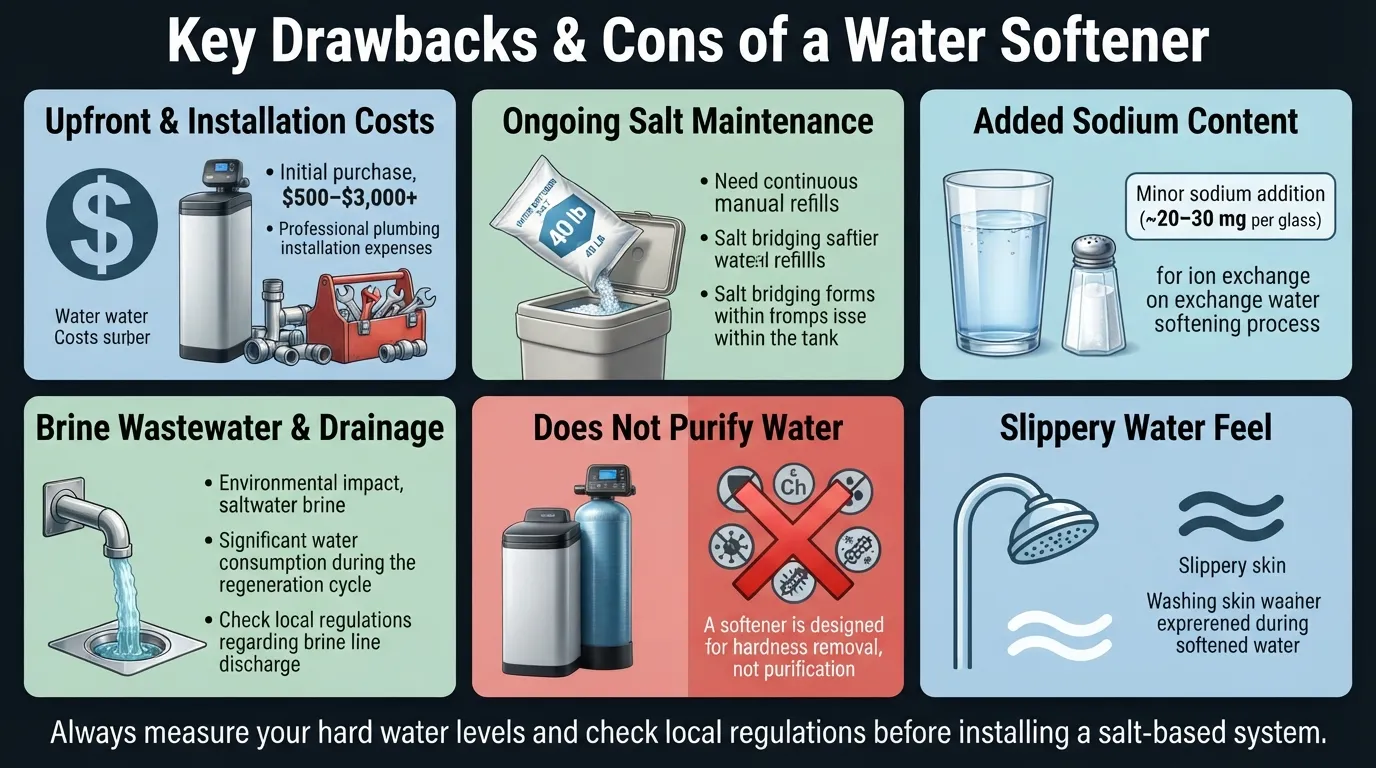
While water softeners offer significant plumbing and cleaning benefits, they also introduce distinct trade-offs. Understanding these potential drawbacks—ranging from ongoing maintenance and added sodium to upfront expenses and wastewater generation—ensures you can make an informed purchasing decision.
1. High Upfront Cost and Installation
Investing in a quality water softener requires substantial capital before the system ever starts protecting your home.
Equipment and Labor Expenses: Standard whole-home softeners range from $500 for entry-level units up to $3,000+ for high-end, high-capacity systems with professional plumbing installation.
Professional Plumbing Fees: Improper DIY installations can lead to pipe leaks or warranty voids, making professional plumber setup an additional upfront investment.
2. Ongoing Salt Refills and Maintenance
Water softeners are not “set-and-forget” appliances; they demand active and consistent upkeep from homeowners.
Regular Salt Replenishment: Homeowners must manually check and refill the brine tank with salt bags every few weeks depending on household water consumption.
Maintenance Complications: Neglecting upkeep can cause “salt bridging”—a hard crust layer forming inside the brine tank that blocks salt from dissolving. Resin beds also occasionally require cleaner additives to prevent fouling.
3. Added Sodium in Your Water
The fundamental ion exchange process swaps hardness minerals for sodium ions, slightly increasing the sodium content of your treated water.
Dietary Impact: While the amount of sodium added is generally minimal (roughly 20 to 30 milligrams per 8-ounce glass, depending on water hardness), it can be a concern for individuals managing hypertension or severe low-sodium diets.
Alternatives and Medical Guidance: Households concerned about sodium can substitute sodium chloride with potassium chloride pellets or install a dedicated reverse osmosis drinking water tap. Individuals with specific medical conditions should consult a doctor regarding dietary sodium adjustments.
4. Wastewater and Environmental Impact
Conventional salt-based softeners generate waste byproducts during their automatic cleaning cycles.
Brine Discharge: Regeneration cycles flush concentrated saltwater brine down household drains into municipal sewer systems or septic fields.
Environmental Restrictions: Because high chloride levels in wastewater can harm local ecosystems and agricultural soil, certain municipalities and eco-conscious communities restrict or ban traditional salt-based softeners.
5. Does a Softener Raise Your Water Bill?
Yes, water softeners consume water during their regeneration cycles, but the financial impact on your utility bill is usually minimal.
Regeneration Usage: A standard system uses roughly 40 to 80 gallons of water per cleaning cycle to flush and recharge the resin beads.
Efficiency Gains: Modern demand-initiated softeners track actual water usage and only regenerate when necessary, keeping wastewater volume and utility cost increases extremely low.
6. Soft Water “Slippery” Feel and Other Drawbacks
The sensory change from hard to soft water takes time to get used to for first-time owners.
Slippery Skin Texture: Because soft water rinses soap completely off the skin without leaving a mineral residue, many users initially feel a “slimy” or slippery sensation in the shower.
Adjustment Period: Most households quickly adapt to this clean-rinsing feel within a few days of installation.
7. It Is Not a Water Purifier
A common misconception is that softening water also purifies it for drinking.
Contaminants Remain: Ion exchange targets exclusively calcium and magnesium; it does not eliminate lead, heavy metals, chlorine, volatile organic compounds, or bacteria.
Secondary Filtration Needed: To achieve true drinking water purity, homes typically require a secondary whole-house carbon filter or an under-sink reverse osmosis system.
8. Not Ideal for Every Home
Certain property types and water profiles make standard water softeners impractical or unfeasible.
Septic System Concerns: Frequent heavy brine discharge can disrupt the bacterial balance in some sensitive septic tank drain fields.
Rental Properties: Tenants often cannot install plumbed-in whole-home equipment without landlord approval and costly modifications.
Very Soft Water Areas: Homes receiving naturally soft municipal water gain zero practical value from installing a softening system.
How Much Does a Water Softener Cost, and Is It Worth It?
A whole-home water softener represents both an initial capital investment and a long-term property protection strategy. Evaluating system costs alongside operational expenses and verified utility savings reveals how quickly an efficient system pays for itself in hard water environments.
Upfront Costs
Initial expenses vary depending on household size, hardness levels, grain capacity, and structural plumbing needs:
Equipment Unit Price: Standard single-tank salt-based softeners cost between $500 and $1,500, while high-efficiency dual-tank models run from $1,500 to $3,000+.
Installation Labor: Hiring a licensed plumber to integrate the system into your main water line typically costs $550 to $1,200.
Plumbing & Permit Modifications: Older homes requiring drain line additions, hard water loop installations, or municipal plumbing permits can add $200 to $600 to total setup costs.
Total Average Outlay: Most homeowners spend between $1,200 and $3,800 for a fully installed, turnkey softening system.
Ongoing Costs
Operating a water softener incurs minor recurring operational costs:
Evaporated Salt Pellets: A standard family consumes 1 to 2 bags of salt per month ($10 to $25 monthly).
Regeneration Water: Automatic cleaning cycles use $2 to $5 in additional water per month, depending on municipal utility rates.
Electrical Consumption: Digital control heads run on minimal electricity, adding roughly $1 to $3 per month to utility bills.
Resin Bead Replacement: High-quality ion exchange resin lasts 10 to 15 years; re-bedding costs around $200 to $400 when capacity degrades.
Water Softener Lifespan
The average lifespan of a well-maintained salt-based water softener ranges from 10 to 15 years, with premium units lasting up to 20 years.
Signs of Aging: Declining performance often presents as gradual limescale return, salty-tasting tap water, or constant salt bridging inside the brine tank.
Replacement Triggers: If a unit older than 10 years requires frequent mechanical repairs or experiences resin breakdown (yellow debris in aerators), replacing the system is more cost-effective than piecemeal repairs.
Simple ROI Example
(Note: All monetary figures below are estimates based on average U.S. household water usage and moderate-to-severe hard water conditions.)
| Cost / Savings Category | Annual Estimated Value | 10-Year Cumulative Total |
|---|---|---|
| Initial Purchase & Installation | $-$1,800 (Year 1) | $-$1,800 |
| 10-Year Salt & Power Expenses | $-$240 / year | $-$2,400 |
| Appliance & Plumbing Lifespan Protection | $+$350 / year | $+$3,500 |
| Detergent, Soap, & Cleaner Savings | $+$200 / year | $+$2,000 |
| Water Heating Energy Efficiency Gains | $+$120 / year | $+$1,200 |
| Estimated Net Financial Return | $+$430 / year | $+$2,500 Net Savings |
Is a Water Softener Worth It? A 5-Question Checklist
Ask these five practical questions to determine if a water softener is the right investment for your property:
What is your measured water hardness? If your water tests above 7 gpg (120 ppm), a softener delivers immediate structural and financial benefits.
How old are your major water appliances? Protecting new water heaters, dishwashers, and washing machines prevents premature replacement costs.
Does your household experience skin or hair dryness? Soft water eliminates mineral crusting, offering noticeable comfort for sensitive skin.
Does your budget allow for initial installation and monthly salt refills? Ensure you can comfortably cover the upfront outlay and modest monthly salt maintenance ($15–$25).
Do you have dedicated physical space and a nearby drain/outlet? Softeners require a small footprint near your main water line, an electrical outlet, and a drain connection for brine disposal.
Who Should and Shouldn’t Get a Water Softener
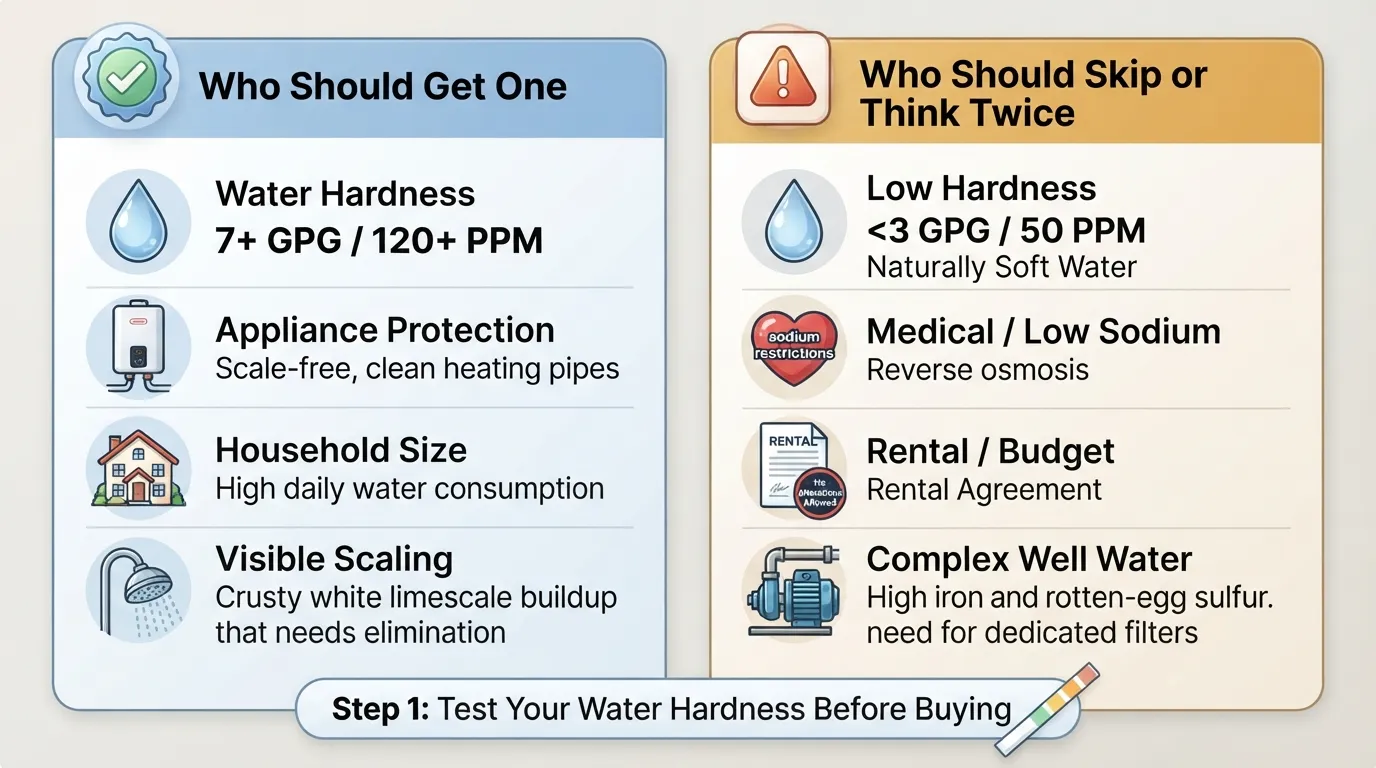
Deciding whether to install a water softener comes down to matching system capabilities with your home’s water chemistry, plumbing setup, and household health requirements. Evaluating these factors ensures you select the right solution without investing in unnecessary equipment.
A Softener Is Probably Worth It If…
A traditional salt-based water softener delivers high value when hard water minerals actively disrupt daily household operations:
Your Water Tests at 7+ GPG (120+ ppm): High concentrations of calcium and magnesium cause rapid limescale buildup, making conditioning essential to protect your home.
You Own High-End or Tankless Water Heaters: Protecting modern heating elements and narrow heat-exchanger pathways prevents catastrophic scale failure and maintains energy efficiency.
You Notice Constant Soap Scum and Fixture Crust: Recurring white mineral deposits on shower glass, faucets, and dishware require constant scrubbing and accelerate fixture wear.
You Have a Large Household with High Daily Water Usage: Families using large volumes of water maximize savings on soaps, laundry detergents, and appliance maintenance.
You May Want to Skip It If…
Installing a water softener may offer minimal benefits or introduce unwanted complications under certain circumstances:
Your Hardness Level Is Low (Under 3 GPG / 50 ppm): Slightly hard or soft municipal water does not contain enough mineral content to justify equipment and maintenance costs.
You Are on a Strict Sodium-Restricted Diet: Homeowners managing severe hypertension who prefer not to install a secondary reverse osmosis unit may want to avoid ion-exchange softeners.
You Live in a Short-Term Rental: Plumbed whole-home equipment requires permanent alterations that landlords typically do not permit.
You Have a Very Tight Maintenance Budget: If adding $15 to $25 in monthly salt costs and handling 40-pound salt bags presents an issue, a softener may become a burden.
Special Cases: Well Water, Septic Systems, and Iron
Private well water presents complex chemistry that standard water softeners cannot handle alone:
Iron and Manganese: Softeners can remove low levels of clear-water (ferrous) iron, but high iron levels or red-water (ferric) iron will permanently foul the resin bed. Dedicated iron filters or air-injection systems are required first.
Hydrogen Sulfide (Rotten Egg Odor): Gas contaminants pass right through softener resin beads, requiring specialized active-carbon or oxidation treatment systems to eliminate odor.
Septic System Compatibility: While modern demand-initiated softeners generate less wastewater, discharging heavy brine into older or delicate septic drain fields requires proper sizing to prevent soil compaction.
Special Case: Babies, Pregnancy, and Medical Conditions
Ion exchange adds small amounts of sodium to tap water, which warrants special attention for vulnerable family members:
Infant Formula Preparation: Formula powders already contain carefully balanced mineral levels. Using softened water can introduce extra sodium that is unsuitable for an infant’s developing kidneys.
Pregnancy and Hypertension: Expectant mothers and individuals advised by physicians to restrict sodium intake should avoid drinking softened tap water directly.
Simple Workaround: Install an under-sink reverse osmosis system or maintain a dedicated hard-water cold line at the kitchen sink specifically for drinking and cooking.
What’s Better Than a Water Softener? Alternatives Compared
While traditional salt-based ion exchange softeners are the gold standard for eliminating hard minerals, they are not the only choice. Depending on your water chemistry, health preferences, budget, and structural constraints, several alternative systems and low-cost maintenance strategies offer distinct advantages.
Salt-Free Water Conditioners (Template-Assisted Crystallization)
Salt-free water conditioners use a physical process known as template-assisted crystallization (TAC) to alter the behavior of hard minerals.
How They Work: Instead of removing calcium and magnesium, TAC transforms dissolved minerals into microscopic, neutral crystals that cannot adhere to pipes or heating elements.
Pros & Cons: They require zero electricity, produce no wastewater brine, use no salt bags, and maintain healthy minerals in drinking water. However, they do not physically remove minerals, meaning you will still see water spots on glass, and they do not create soapy lathers.
Reverse Osmosis (RO) Systems
Reverse osmosis systems are the ultimate solution for high-purity drinking water, though they are not designed for whole-house softening.
How They Work: Water is forced through a semi-permeable membrane that filters out up to 99% of all dissolved solids, including heavy metals, lead, chlorine, and hardness minerals.
Pros & Cons: Delivers exceptionally clean, great-tasting bottled-quality water right from a dedicated kitchen tap. However, they have low production speeds, waste water during filtration, and are too small to treat whole-house plumbing lines.
Whole-House Filters
Whole-house filtration systems target general chemical contamination and sediment rather than mineral hardness.
How They Work: Utilizes multi-stage carbon, KDF, or sediment cartridges installed on the main water line to trap chlorine, VOCs, rust flakes, and sand.
Pros & Cons: Improves taste, removes chemical smells, and protects plumbing from particulate abrasion. However, they have zero effect on calcium and magnesium and will not prevent limescale buildup.
Electronic Descalers and Magnetic Units
Electronic descalers wrap wires around your main water pipe to emit low-frequency radio waves or magnetic fields.
How They Work: Purports to alter mineral crystallization via electromagnetic force without plumbing modifications.
Pros & Cons: Extremely inexpensive ($150–$300), compact, and simple to install yourself. However, scientific evidence backing their effectiveness is mixed, and plumbing experts generally consider them a weak alternative in areas with very hard water.
Cheapest Ways to Reduce Hard Water Problems
If investing in a whole-home system is outside your current budget, several budget-friendly manual maintenance habits help mitigate hard water damage:
Vinegar Descaling: Soak removable showerheads and faucet aerators in white vinegar overnight to dissolve crusty mineral buildup.
Inline Showerhead Filters: Install inexpensive multi-stage filters directly onto shower arms to reduce chlorine and moderate mineral drying effects on skin and hair.
Water Heater Flushing: Drain and flush your water heater tank annually to clear out accumulated bottom sediment and maintain heating efficiency.
Comparison Table: Softener vs Salt-Free vs RO vs Descaler
| Technology Type | Estimated Cost | Maintenance Effort | Removes Hardness? | Best Suited For |
| Salt-Based Softener | $1,200 – $3,800 | Moderate (monthly salt refills) | Yes (removes minerals) | Homes with very hard water ($>7\text{ gpg}$) wanting total scale prevention. |
| Salt-Free Conditioner (TAC) | $900 – $2,500 | Low (annual media replacement) | No (neutralizes scale potential) | Eco-conscious homes wanting scale prevention without salt or wastewater. |
| Reverse Osmosis (RO) | $300 – $900 | Low-Moderate (annual filter changes) | Yes (at point-of-use) | Families seeking pure drinking water free of chemicals, lead, and minerals. |
| Electronic Descaler | $150 – $300 | None (set-and-forget) | No (inhibits adhesion only) | Budget-conscious DIYers dealing with moderately hard water. |
Sizing, Installation, and Maintenance: Avoid These Common Mistakes
Installing a water softener without proper sizing, correct drainage, or an accurate maintenance routine leads to premature system failure and unnecessary operating costs. Avoiding common technical errors ensures your investment delivers consistent soft water for its entire service life.
How to Size a Water Softener
Properly sizing a water softener requires calculating your daily household mineral load to select an appropriate grain capacity rating (e.g., 32,000, 48,000, or 64,000 grains).
Calculate Daily Household Water Usage: Multiply the number of people living in your home by 75 gallons (the average daily per-person consumption).
Determine Daily Hardness Load: Multiply your daily water usage by your water hardness level in grains per gallon (GPG).
Determine Weekly Regeneration Capacity: Multiply the daily hardness load by 7 days to find the total grain capacity needed per week.
Select System Size: Choose a unit with a rated grain capacity that comfortably handles your weekly requirement without regenerating more than once or twice a week.
Is It Bad to Buy a Water Softener That’s Too Big?
Yes, purchasing an oversized water softener is problematic and actively damages system performance over time.
When a unit is too large for your household’s daily consumption, water sits stagnant in the resin tank for extended periods between regeneration cycles. This prolonged inactivity leads to bacterial growth inside the resin bed and causes “channeling,” where water carves paths through the resin without undergoing proper ion exchange. An oversized unit also wastes excess salt and water when it eventually regenerates.
Where Does a Softener Drain?
During the regeneration cycle, a water softener must discharge its backwash water and concentrated brine solution into an approved drainage connection:
Floor Drains & Standpipes: The most common setup connects the softener drain line to a dedicated laundry standpipe or floor drain via a code-compliant air gap fitting to prevent back-siphonage.
Sump Pump Systems: In basements lacking a nearby gravity drain line, wastewater can discharge into a basin serviced by a reliable sump pump setup to pump effluent out to the sewer or septic line.
Can I Flush the Toilet or Use Water During Regeneration?
Yes, you can flush toilets and run taps while your softener regenerates, but doing so is generally discouraged.
Most single-tank water softeners automatically open a internal bypass valve during regeneration, supplying unconditioned, hard water directly to your fixtures while the resin bed cleanses itself. Using water during this 90-minute window draws hard water into your plumbing lines and water heater, which can cause temporary scale buildup and spotty dishes.
Can I Pour Bleach in the Brine Tank?
No, you should never pour household bleach carelessly into your water softener’s brine tank.
While bleach is occasionally used in specialized “sanitizing cycles” to kill bacteria, concentrated household chlorine bleach damages and degrades cross-linked resin beads, stripping their ability to swap hard minerals. To clean and restore a fouled resin bed safely, use only manufacturer-approved resin cleaners or specialized iron-out products designed specifically for water softeners.
Basic Maintenance Checklist
Following a routine maintenance schedule keeps your softening system functioning efficiently year-round:
Check Salt Levels Monthly: Keep the brine tank filled at least half full, ensuring the salt level remains 2 to 3 inches above the standing water line.
Break Up Salt Bridges: Inspect the brine tank every few months for hard crusts or hollow domes of salt, using a broom handle to break them up gently.
Sanitize and Clean the Resin Bed: Run a specialized resin cleaner through the system once or twice a year to remove trapped iron and organic buildup.
Inspect the Pre-Filter: If your setup includes an inline sediment filter, replace the cartridge every 3 to 6 months to maintain optimal water pressure.
When to Call a Professional Plumber
While minor salt additions are simple DIY tasks, certain technical issues require an experienced technician to protect your home’s infrastructure:
Persistent Pressure Drops or Low Flow: If your home experiences a severe drop in water pressure immediately following installation, the resin bed may be fouled or incorrectly plumbed.
Active Water Leaks Around Fittings: Call a technician immediately to resolve external leaks at bypass valves or pipe connections. If a line bursts or floods your utility space, contact an emergency plumber to prevent structural damage.
Complete Loss of Soft Water: If tap water remains hard despite an adequate salt supply and regular regeneration, your control valve or internal sensors may require professional diagnosis.
Mistakes We See on Service Calls: The most frequent error we diagnose is improper drain line installation. Homeowners often jam the flexible discharge tubing directly down a drain pipe without an air gap, creating a serious cross-connection hazard where sewage can back up directly into the home’s water softener and drinking supply.
Water Softener Myths vs. Facts
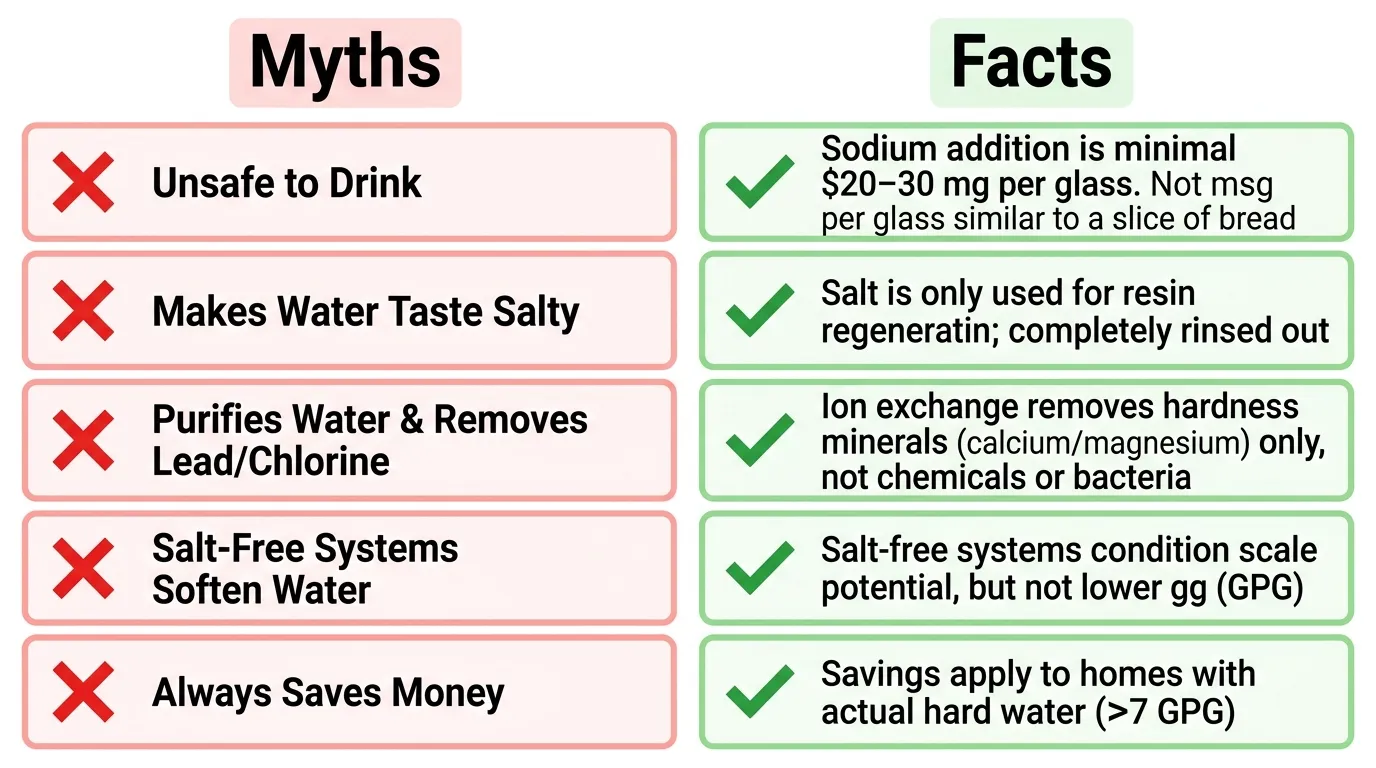
Misconceptions about water softeners often lead homeowners to make costly mistakes—either by avoiding a necessary system or expecting a softener to solve water quality issues it was never designed to address. Debunking these common hard water myths helps set realistic expectations for system performance.
Myth: Soft Water Is Unsafe to Drink
Fact: Softened water is safe to drink for the vast majority of adults and children.
The ion exchange process adds only a small amount of sodium to your water—typically around $20\text{ to }30\text{ mg}$ per 8-ounce glass, depending on the initial hardness level. This is roughly equivalent to the sodium found in a single slice of white bread. However, individuals on medically mandated ultra-low-sodium diets, people managing severe hypertension, or parents preparing infant formula should consult a doctor or use a reverse osmosis system for drinking tap water.
Myth: A Softener Makes Water Salty
Fact: Properly functioning softeners do not make tap water taste salty.
Salt added to the brine tank is used strictly to recharge the resin beads during the regeneration cycle. Once the hard minerals are stripped from the resin, a final rinse cycle flushes out leftover saltwater brine before the system returns to service. If your tap water tastes noticeably salty, it indicates an equipment malfunction, such as a clogged drain line or a stuck control valve failing to complete the rinse cycle.
Myth: A Softener Purifies Your Water
Fact: A water softener is an ion exchanger, not a water purifier or filter.
Standard softeners target calcium and magnesium exclusively to reduce hardness. They do not eliminate heavy metals like lead or copper, disinfect against bacteria and viruses, or filter out chemical additives like chlorine, chloramines, and volatile organic compounds (VOCs). Achieving comprehensive water purification requires pairing a softener with a whole-house carbon filter or an under-sink reverse osmosis unit.
Myth: Salt-Free Systems Work the Same Way
Fact: Salt-free conditioners do not remove minerals or actually “soften” water.
Salt-free systems use template-assisted crystallization (TAC) to condition minerals, changing their structure so they do not stick to pipes and heating elements as limescale. However, because calcium and magnesium remain in the water stream, these systems do not lower measured grains per gallon (GPG), improve soap lathering, or prevent water spotting on glassware and shower doors the way a traditional salt-based softener does.
Myth: Soft Water Always Saves Money
Fact: A water softener generates a positive return on investment only in homes with actual hard water.
While softening hard water ($>7\text{ Gpg}$) extends appliance lifespans, lowers water heating energy costs, and cuts detergent usage, installing a system in an area with naturally soft or slightly hard water ($<3\text{ Gpg}$) provides zero financial return. In those cases, the upfront purchase price, plumbing installation fees, and ongoing salt purchases outweigh any operational savings.
Frequently Asked Questions
Is there a downside to a water softener?
Yes, the main downsides include high upfront equipment and installation costs, ongoing salt refills, minor water usage during regeneration, and slightly elevated sodium levels in drinking water. Additionally, salt-based softeners generate brine wastewater and require a dedicated drain line, making them unsuitable for certain eco-restricted areas or rental properties.
What’s the average lifespan of a water softener?
The average lifespan of a well-maintained salt-based water softener ranges from 10 to 15 years. High-end systems with durable control valves and regular maintenance can last up to 20 years. Signs that a system needs replacement include declining water softness, continuous mechanical breakdowns, or resin bead breakdown.
What is the average cost of having a water softener installed?
The total average cost to purchase and install a whole-home water softener ranges from $1,200 to $3,800. Equipment prices typically run between $500 and $3,000 depending on capacity and design, while professional plumbing installation labor adds $550 to $1,200 depending on home layout and drain requirements.
What’s better than a water softener?
No single system is universally better, as the best choice depends on your specific needs. For pure drinking water, a reverse osmosis system is superior because it removes heavy metals, lead, and chemicals. For eco-friendly scale prevention without salt or wastewater, a template-assisted crystallization (TAC) salt-free conditioner is a strong alternative.
Can I flush the toilet when my water softener is regenerating?
Yes, you can flush the toilet or use faucets during a regeneration cycle without damaging the system. However, single-tank softeners open an internal bypass valve during regeneration, supplying unconditioned hard water to your plumbing, which can temporarily draw mineral scale into your water heater and household fixtures.
Is it bad to buy too big of a water softener?
Yes, buying an oversized water softener causes water to sit stagnant in the resin tank between long, infrequent regeneration cycles. This stagnant environment promotes bacterial growth inside the resin bed, leads to water channeling, reduces softening efficiency, and wastes excessive amounts of salt and water when regeneration finally occurs.
Can I pour bleach in my water softener brine tank?
No, you should not routinely pour household chlorine bleach into your brine tank. Concentrated bleach degrades cross-linked resin beads over time, ruining their capacity to remove hard minerals. To safely sanitize or clean a fouled resin tank, use only manufacturer-approved resin cleaners or specialized iron-out products.
What is the most affordable way to soften hard water?
The most affordable way to achieve true whole-home softening is installing a single-tank, demand-initiated salt softener ($500 to $1,000 unit cost). For tight budgets, low-cost alternatives include using white vinegar to manually descale fixtures, installing inline showerhead filters, and flushing your water heater tank annually to manage mineral buildup.
Do water softeners make your water bill go up?
Yes, water softeners slightly increase your water bill because they consume water to flush and recharge resin beads during regeneration. However, a standard system uses only 40 to 80 gallons per cycle, which typically adds just $2 to $5 per month to municipal water utility bills.
Is a water softener worth it?
Yes, a water softener is highly worth the investment if your home tests at or above $7\text{ gpg}$ ($120\text{ ppm}$) of water hardness. In hard water regions, a softener pays for itself by preventing premature appliance failures, reducing detergent consumption by up to 50%, and maintaining heating efficiency.
Final Verdict: Should You Get a Water Softener?
Deciding whether to invest in a whole-home water softener ultimately depends on your measured water hardness, household plumbing needs, and long-term property protection goals. In homes experiencing moderate-to-severe hard water, the financial benefits of appliance protection and lower detergent consumption far outweigh the initial equipment and salt upkeep expenses.
Key Takeaways
Target Severe Mineral Hardness: Water softeners deliver their highest return on investment in homes with hardness levels exceeding $7\text{ gpg}$ ($120\text{ ppm}$).
Unmatched Infrastructure Protection: By removing calcium and magnesium, softeners eliminate limescale buildup, extending the lifespan of water heaters, dishwashers, and internal plumbing lines.
Conditioning, Not Purification: Ion exchange softeners target mineral hardness strictly; they do not remove chemical contaminants, heavy metals, or pathogens.
Routine Maintenance Is Required: Operating a system requires regular salt replenishment, periodic resin cleaning, and periodic monitoring to prevent salt bridging.
Not Sure Which Option Fits Your Home?
Evaluating your home’s water quality and existing plumbing setup is the first step toward preventing costly limescale damage. If you are experiencing cloudy glassware, low water pressure, or scale crusting around your fixtures, a professional assessment can help determine the exact system size and configuration required for your property.
To explore customized installation options or inspect your current setup, explore our plumbing services or book a plumbing visit with our experienced team today.
Main Services
Related Posts
Need a Plumber in Miami?
Schedule service online or speak directly with the EZ Plumbing team.
Owner-Led Local Service
Know who is behind the business before you request service. The owners, contact line and Miami service pages are published clearly.
- Named business owners
- Direct phone and social channels
- Local Miami service information
Clear Help Before You Book
Review the relevant service page, contact the team directly and use the booking page when you are ready—without relying on vague claims.
- Service-specific information
- Direct questions before scheduling
- Clear online booking route