Sewer Line Spot Repair: When It Works and When It Doesn't
What Is a Sewer Line Spot Repair?
A sewer line spot repair is a targeted trenchless plumbing method designed to fix isolated pipe damage, such as a localized crack, root intrusion, or structural offset, without replacing the entire plumbing system. By addressing only the damaged segment, property owners can restore full structural integrity and flow capacity at a fraction of the cost and disruption associated with traditional excavation.
Targeted Intervention: Focuses exclusively on the exact point of failure rather than excavating the entire yard or driveway.
Cost Efficiency: Significantly reduces labor, material, and property restoration expenses compared to full replacements.
Minimal Disruption: Preserves landscaping, hardscaping, and daily routines through trenchless or low-impact access techniques.
What Makes Spot Repair Different From Full Sewer Line Replacement
Sewer line spot repair isolates and resolves localized damage within a specific section of the pipe, whereas a full sewer line replacement involves upgrading or completely substituting the entire run from the home to the municipal main. Choosing between a point repair and a full system overhaul depends entirely on the extent, frequency, and severity of the structural degradation found during a professional camera inspection.
Scope of Work: Spot repairs fix meters or feet of compromised pipe, while full replacements remove aging, heavily corroded, or heavily collapsed systems entirely.
Durability vs. Longevity: A spot repair extends the lifespan of a generally healthy plumbing network, whereas a full replacement resets the lifespan clock for the entire lateral line.
Ideal Use Cases: Spot repairs excel at correcting localized root intrusion, isolated bellies, or single joint cracks, while full replacements are mandatory when pipe material has completely disintegrated across multiple sections.
Signs You May Need a Sewer Line Repair
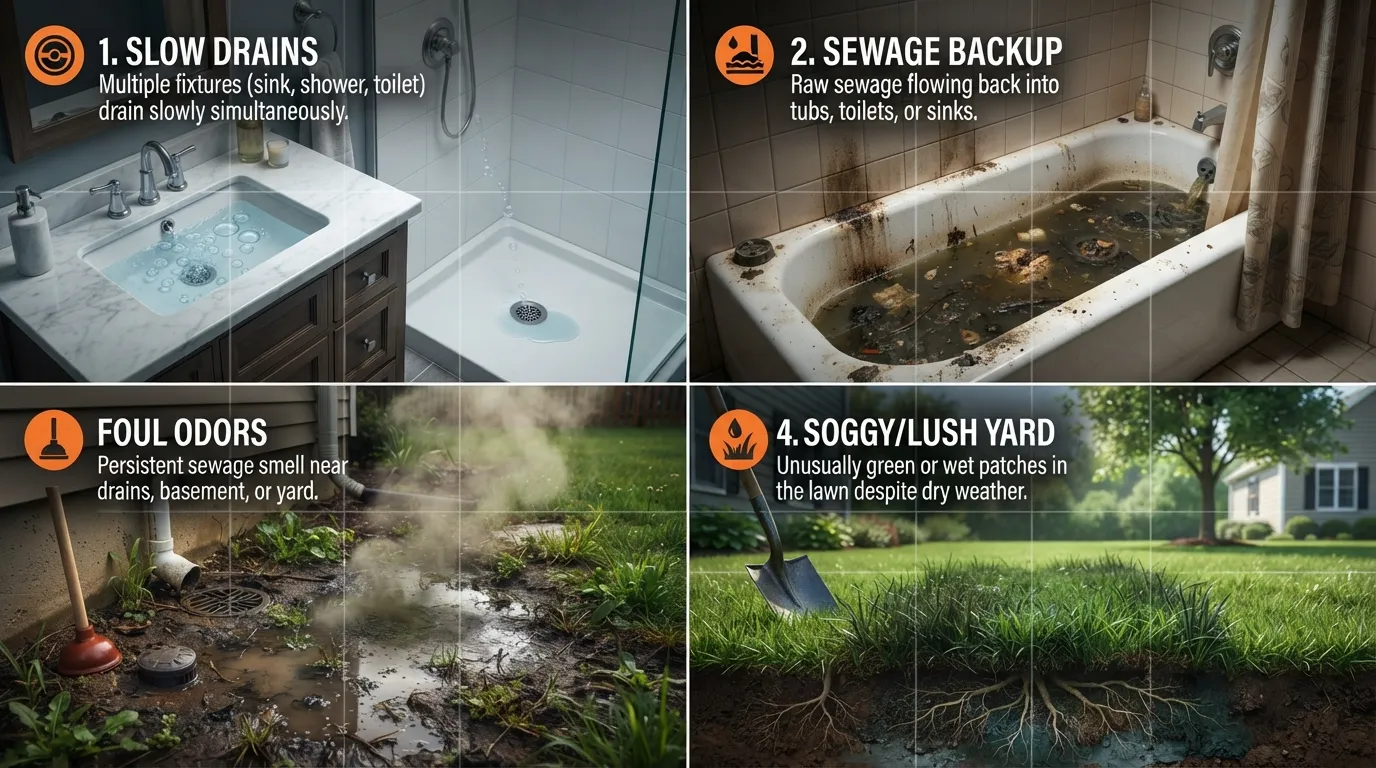
Recognizing early warning signs of a compromised sewer line helps prevent catastrophic property damage, expensive structural repairs, and severe health hazards. Identifying indicators such as recurring backups, unusual odors, and unexpected yard changes allows homeowners to address pipe failures before they require a full replacement.
Proactive Identification: Catching symptoms early lets you utilize targeted spot repairs instead of invasive trenching.
Property Protection: Immediate intervention stops wastewater from undermining your home’s foundation or ruining interior flooring.
4 Warning Signs of a Damaged Sewer Line
A broken, cracked, or collapsed sewer line typically exhibits distinct physical symptoms throughout your property. Tracking these warning signs helps homeowners self-diagnose plumbing failures and determine when it is time to call professionals for thorough drain cleaning services to clear simple clogs or investigate deeper structural damage.
Slow Drains Across Multiple Fixtures: If sinks, showers, and toilets throughout the house drain sluggishly at the same time, the issue usually stems from the main sewer line rather than a single branch pipe.
Frequent Sewage Backups: Wastewater bubbling up into your bathtub or floor drains signals a severe obstruction or a structural collapse in the underground pipe.
Unpleasant Foul Odors: Persistent sewer gas smells lingering around your yard, basement, or indoor drains indicate cracks or venting failures within the drainage system.
Soggy or Over-Green Yard Patches: Unusually lush, bright green grass or persistently wet, sunken spots in your yard often point to an underground pipe leak feeding the soil.
Why a Camera (CCTV) Inspection Is the Only Way to Confirm Damage
Visual symptoms alone cannot pinpoint the exact depth, severity, or precise location of an underground failure. Professional leak detection and repair services rely on specialized closed-circuit television (CCTV) cameras threaded directly through the cleanout to visually inspect the interior condition of the pipe.
Pinpoint Accuracy: CCTV inspection eliminates guesswork by revealing the exact footage mark of cracks, root intrusion, or pipe offsets.
Distinguishing Damage Types: Cameras clearly differentiate between simple organic buildup that requires routine hydro-jetting and structural cracks that demand a trenchless spot repair.
Preventing Unnecessary Digging: Visual confirmation ensures that contractors only excavate or repair the exact segment of pipe that has failed.
When a Sewer Line Spot Repair Works
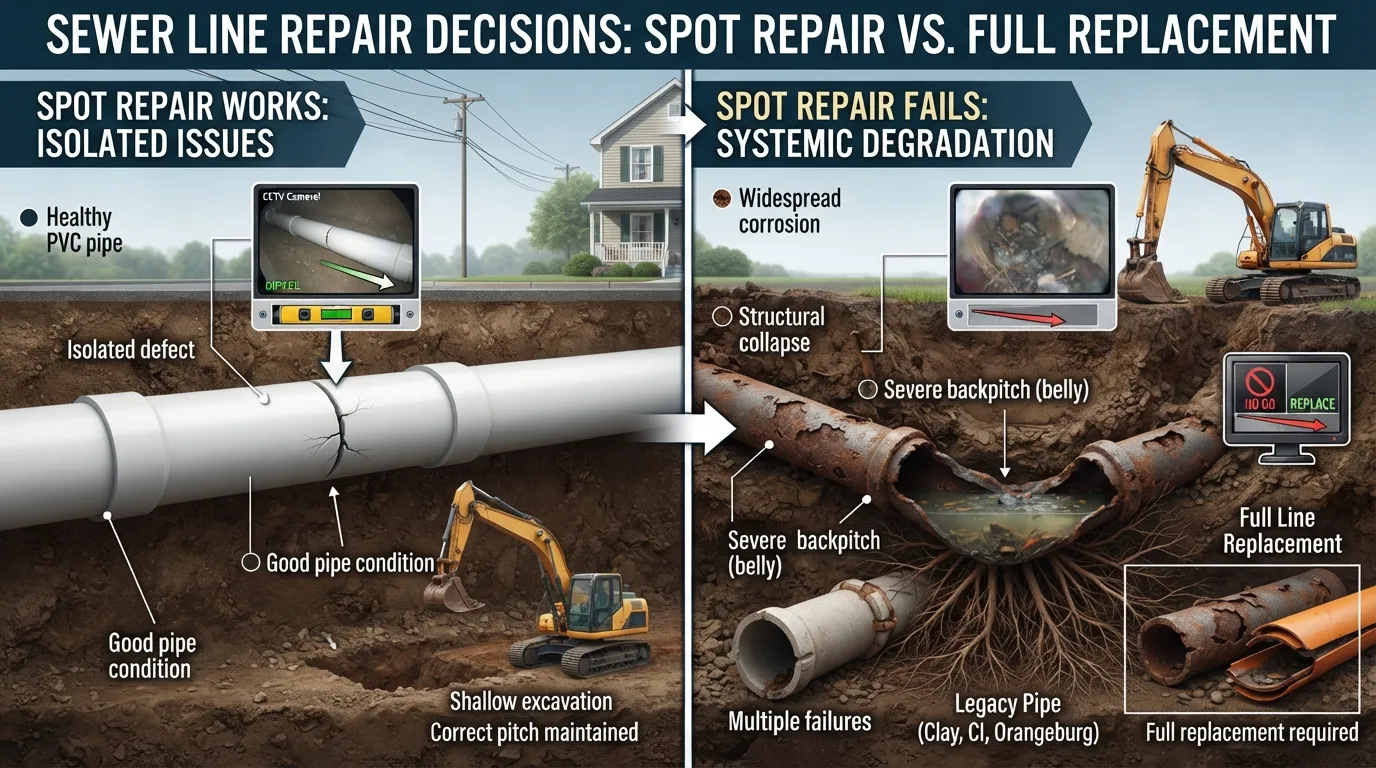
A sewer line spot repair is highly effective when property damage is strictly confined to a single, localized location rather than systemic failure across the entire lateral. This targeted point repair approach restores full hydraulic performance quickly, minimizing overall labor costs and ground disruption.
Ideal Candidates: Perfect for properties where structural damage is isolated to a span of a few feet.
Operational Efficiency: Allows contractors to complete the intervention as a single-day repair, getting your plumbing back online immediately.
Isolated Damage: Single Crack, Offset Joint, or Root Intrusion
Spot repairs excel when a CCTV inspection reveals that the vast majority of your sewer line is intact, but a specific flaw has compromised the pipe. Pinpointing an isolated crack, a shifting offset joint, or aggressive root intrusion allows plumbers to target only the damaged section.
Localized Cracks: Structural fractures caused by settling soil or heavy vehicle loads above can be cut out and replaced with a matching section of PVC or SDR pipe.
Offset Joints: When pipe sections slip out of alignment, a spot repair stabilizes the joint to prevent raw sewage leakage and future root penetration.
Root Infiltration: Tree roots entering through a vulnerable joint can be excised, and the surrounding pipe section reinforced or clamped to block re-entry.
Structurally Sound Pipe With Proper Slope (Grade)
For a point repair to succeed long-term, the rest of the existing sewer line must maintain adequate structural integrity and proper pipe grade. If the surrounding pipe is severely corroded, flattened, or exhibiting negative pitch, a spot repair will only serve as a temporary band-aid.
Maintaining Fall: The pipe must retain its continuous downward slope (typically an eighth to a quarter-inch per foot) to ensure proper wastewater drainage.
Overall Material Health: Neighboring pipe segments must be free of widespread cracking, severe bellies, or complete structural disintegration.
Shallow, Easily Accessible Damage
Depth and accessibility heavily dictate whether a spot repair is practical compared to trenchless pipe lining or bursting. When a damaged sewer section is buried at a shallow depth and located away from major architectural structures, a rapid point excavation becomes highly cost-effective.
Direct Access: Shallow burial depths reduce the heavy machinery and extensive shoring required for deep trench excavations.
Clearance from Structures: Repair sites situated away from home foundations, driveways, or municipal utility lines make targeted spot digging significantly faster and safer.
Real Example: What a Successful Spot Repair Job Looks Like
Reviewing practical fieldwork demonstrates how plumbers handle snapped pipes, heavy root masses, and alignment adjustments during an actual point repair.
Clearing Obstructions: Technicians pump out accumulated water and remove thick root masses that packed tightly into the snapped PVC pipe [00:15], [00:48].
Precision Fitting: Plumbers chamfer and bevel the exposed pipe edges to ensure smooth transitions [01:15], utilizing flexible heavy-duty rubber banded couplings tightened with a torque wrench [04:14].
Verifying Flow: Post-repair internal camera checks confirm that the transition remains smooth, maintaining proper fall without losing slope [04:47], [05:03].
When a Sewer Line Spot Repair Doesn't Work
A sewer line spot repair fails to provide a permanent solution when structural issues are systemic rather than isolated. Attempting a localized patch on a fundamentally compromised plumbing network often leads to recurring failures, repeated excavation costs, and eventual system failure.
Systemic Failure: Spot fixes cannot correct widespread material degradation or structural collapse spanning large sections of the pipe.
Long-Term Economics: Investing in repeated point repairs on an aging line frequently costs more over time than replacing the compromised run entirely.
Widespread Deterioration, Corrosion, or Scaling
When interior pipe surfaces experience widespread structural thinning, severe scaling, or pervasive corrosion, a spot repair is ineffective. Clamping or patching one segment leaves adjacent weakened sections vulnerable to collapse under normal soil loads.
Compromised Structural Integrity: Thinning pipe walls lack the rigidity required to hold mechanical clamps or new joint fittings securely.
Continuous Failure Risk: Once a pipe material reaches the end of its lifespan, new cracks will quickly develop just inches away from the recent patch.
Collapsed Pipe Sections
A completely collapsed pipe eliminates the structural pathway required for both spot repairs and trenchless pipe lining. When sections cave inward, physical excavation and total replacement of the collapsed span become mandatory.
Total Obstruction: Complete structural collapse stops wastewater flow entirely and prevents insertion of lining equipment.
Surrounding Soil Saturation: Cave-ins often allow surrounding earth to fill the pipe void, destabilizing the trench and requiring engineered shoring.
Severe Belly or Backpitch (Sagging Line)
A pipe belly occurs when soil shifts and causes a section of the sewer line to dip, creating a low point that collects standing water and solid waste. Spot repairs cannot correct the grade of a sagging line; lifting the pipe requires re-excavating and re-bedding the entire affected run.
Pooling Waste: Low spots prevent proper wastewater drainage, leading to chronic, recurring clogs regardless of how clean the pipe walls are.
Grade Correction: Restoring proper pitch requires adjusting the slope across the entire shifted span to ensure gravity drainage functions correctly.
Multiple or Recurring Failure Points
If a CCTV inspection reveals numerous cracks, multiple root intrusion sites, and shifting joints spread across the entire lateral, spot repairs become financially impractical. Patching four or five separate locations costs nearly as much as a full replacement while leaving old pipe in between.
Diminishing Returns: Multiple point excavations destroy your lawn and landscaping just as much as trenching the entire line.
Comprehensive Upgrade: Replacing the full run eliminates all vulnerable legacy joints in a single installation.
Why Pipe Material & Home Age Matter (Clay, Cast Iron, Orangeburg Pipes in Pre-1970 Homes)
The underlying material and age of your plumbing system heavily dictate whether a spot repair will hold. Pre-1970 homes frequently contain legacy materials that deteriorate structurally, making spot interventions risky or impossible.
Clay Pipes: While durable, older vitrified clay pipes are prone to root penetration at every brittle joint, leading to widespread cracking.
Cast Iron Pipes: Decades of wastewater flow cause interior bottom-piping to rust away completely, leaving pipe walls too thin for reliable clamping.
Orangeburg Pipes: Constructed from bituminized fiber, these compressed wood-pulp pipes installed mid-century tend to absorb moisture, soften, and deform completely over time, requiring total replacement.
Spot Repair vs. Full Sewer Line Replacement – Cost & Time Comparison
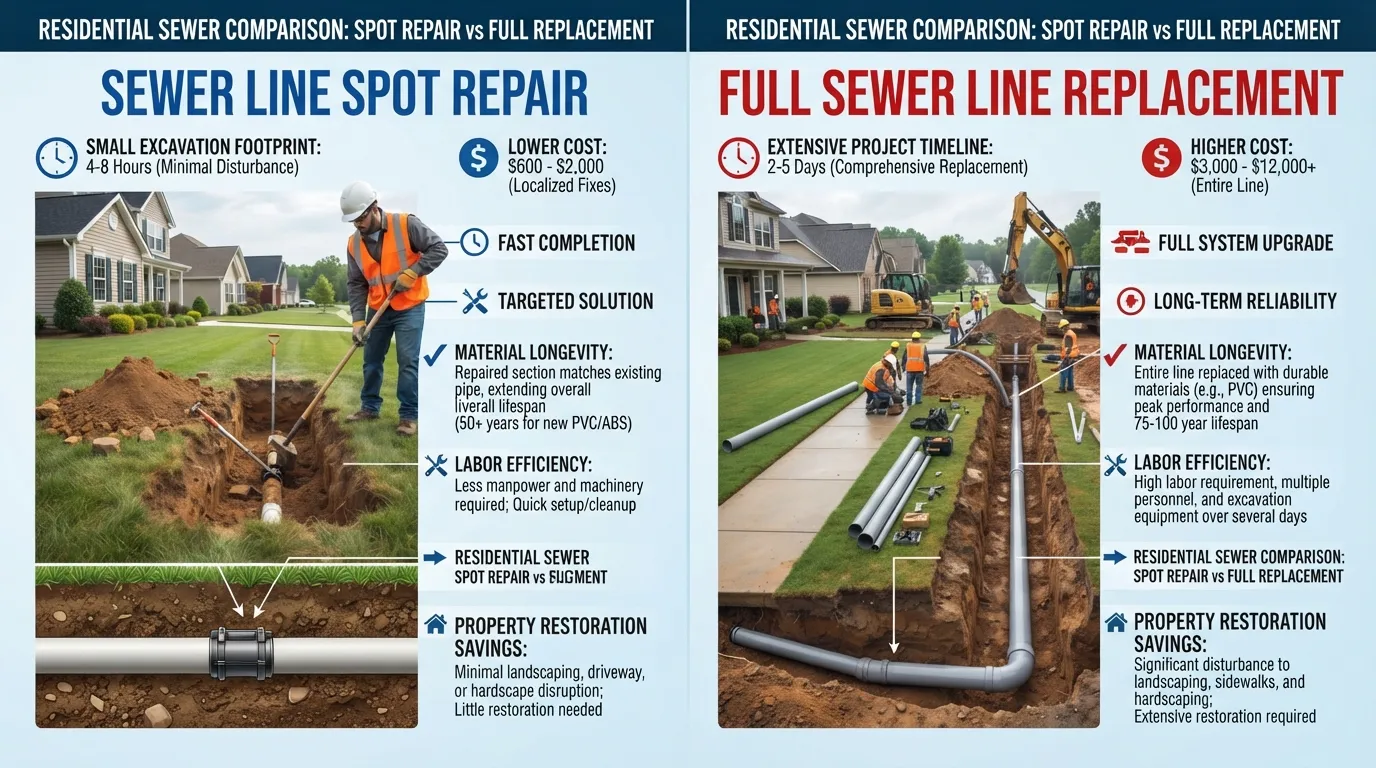
Choosing between a targeted sewer line spot repair and a full system replacement requires balancing immediate expenses against long-term durability. Understanding average project costs, technique differences, and labor timelines helps property owners select the most economical and structurally sound solution for their plumbing layout.
Financial Strategy: Spot repairs minimize upfront material and labor expenses by focusing exclusively on isolated points of failure.
Timeline Expectations: Most localized spot repairs wrap up within a single day, whereas full replacements demand extensive excavation across several days.
Average Cost of Spot Repair vs Full Replacement
Project pricing varies significantly based on whether a contractor is fixing a single compromised section or installing a completely new lateral. Evaluating typical market rates helps homeowners budget accurately for unexpected underground plumbing failures.
Spot Repair Pricing: Small crack patches or isolated point repairs typically range from $600 to $2,000, depending on pipe depth and accessibility.
Full Replacement Pricing: Total system replacements or comprehensive trenchless upgrades (such as pipe bursting and CIPP lining cost variables) generally range from $3,000 to $12,000 depending on total linear footage.
Is Trenchless Repair Cheaper Than Traditional Excavation?
While trenchless methods and point repairs often feature higher specialized equipment costs, they frequently save money overall by eliminating heavy landscaping and hardscape restoration. Traditional open-trench digging can carry hidden ancillary expenses that drive up the final invoice.
Restoration Savings: Trenchless point fixes preserve expensive custom driveways, sidewalks, and mature lawns, avoiding thousands of dollars in post-construction property repairs.
Labor Efficiency: Reduced manual trenching and backfilling lower total labor hours, offsetting the specialized technology fees.
How Long Does Each Option Take?
Labor and equipment timelines dictate how long your household will experience water shutoffs or property disruption. Knowing the average replacement timeline and repair timeline helps families plan accordingly.
Spot Repair Timeline: Most isolated point repairs are completed in 4 to 8 hours, allowing full water usage to resume by the end of the same day.
Full Replacement Timeline: Complete traditional or trenchless replacements typically span 2 to 5 days, depending on municipal permits, soil conditions, and the total length of the lateral line.
Can You Repair a Sewer Line Without Digging It Up? Trenchless Methods
Yes, modern no-dig repair technologies allow professional plumbers to rehabilitate or replace damaged sewer lines entirely from underground, avoiding massive excavation trenches across your lawn, driveway, or patio. Trenchless sewer repair methods use existing access points like cleanouts or small entry pits to restore structural integrity quickly and cleanly.
Property Preservation: Protects expensive landscaping, concrete flatwork, and hardscaping from destructive trenching.
Long-Term Durability: Modern trenchless materials often carry 50- to 100-year lifespans, matching or exceeding traditional pipe installations.
CIPP (Cured-in-Place Pipe) Lining
Cured-in-Place Pipe (CIPP) lining—often called trenchless pipe lining—creates a seamless “pipe within a pipe” without removing the old, damaged infrastructure. Plumbers saturate a flexible felt or fiberglass liner with specialized epoxy resin, insert it into the compromised sewer line, and inflate it so it conforms snugly against the interior walls of the host pipe before curing.
Seamless Rehabilitation: Hardens into a jointless, corrosion-resistant polymer shell that permanently bridges cracks, seals root entry points, and stops leaks.
Minimal Footprint: Requires only small access entry points rather than continuous digging along the entire length of the pipe run.
Pipe Bursting
Pipe bursting is a trenchless replacement method used when a sewer line is too severely damaged, collapsed, or offset for CIPP lining. Technicians pull a heavy-duty steel bursting head through the old underground pipe using a high-strength pulling cable, simultaneously shattering the legacy conduit outward into the surrounding soil while dragging a brand-new, high-density polyethylene (HDPE) or ABS pipe directly into its place.
Complete Upgrades: Instantly replaces aging, undersized, or structurally failed pipes with a brand-new run boasting a century-long life expectancy [00:51].
Real-World Execution: Field footage demonstrates how specialized pulling equipment shatters old subterranean lines and pulls fresh conduit into position [00:24], [14:48].
When Trenchless Methods Aren’t an Option
While trenchless solutions handle most residential plumbing failures, certain structural site conditions make no-dig repairs impossible. Traditional open-trench excavation remains mandatory when physical obstructions or severe geometric failures prevent lining or bursting equipment from passing safely through the line.
Severe Structural Collapse: Completely crushed pipes block the passage of pulling cables, lining bladders, and bursting heads.
Extreme Grade Offsets & Bellies: If a massive dip or backpitch prevents gravity drainage, the pipe must be physically re-excavated, lifted, and re-bedded with proper slope.
Unaligned Branch Connections: Complex network junctions or unmapped layout anomalies sometimes require targeted exploratory digging to reconnect branch lines safely.
How Deep Are Sewer Lines Buried?
Residential sewer lines are typically buried between 18 inches and 10 feet deep, depending on local frost lines, regional soil conditions, and the slope required for proper gravity drainage. In warmer climates with minimal ground freezing, sewer pipes often run relatively shallow at depths of 18 to 24 inches near the home. However, as the lateral line travels toward the municipal main in colder regions, it must drop below the local frost line—frequently reaching depths of 4 to 6 feet or deeper—to prevent freezing and structural cracking. Excavation depth also increases significantly for properties built on sloping terrain or those requiring deep basement plumbing connections.
How Long Does a Sewer Line Last?
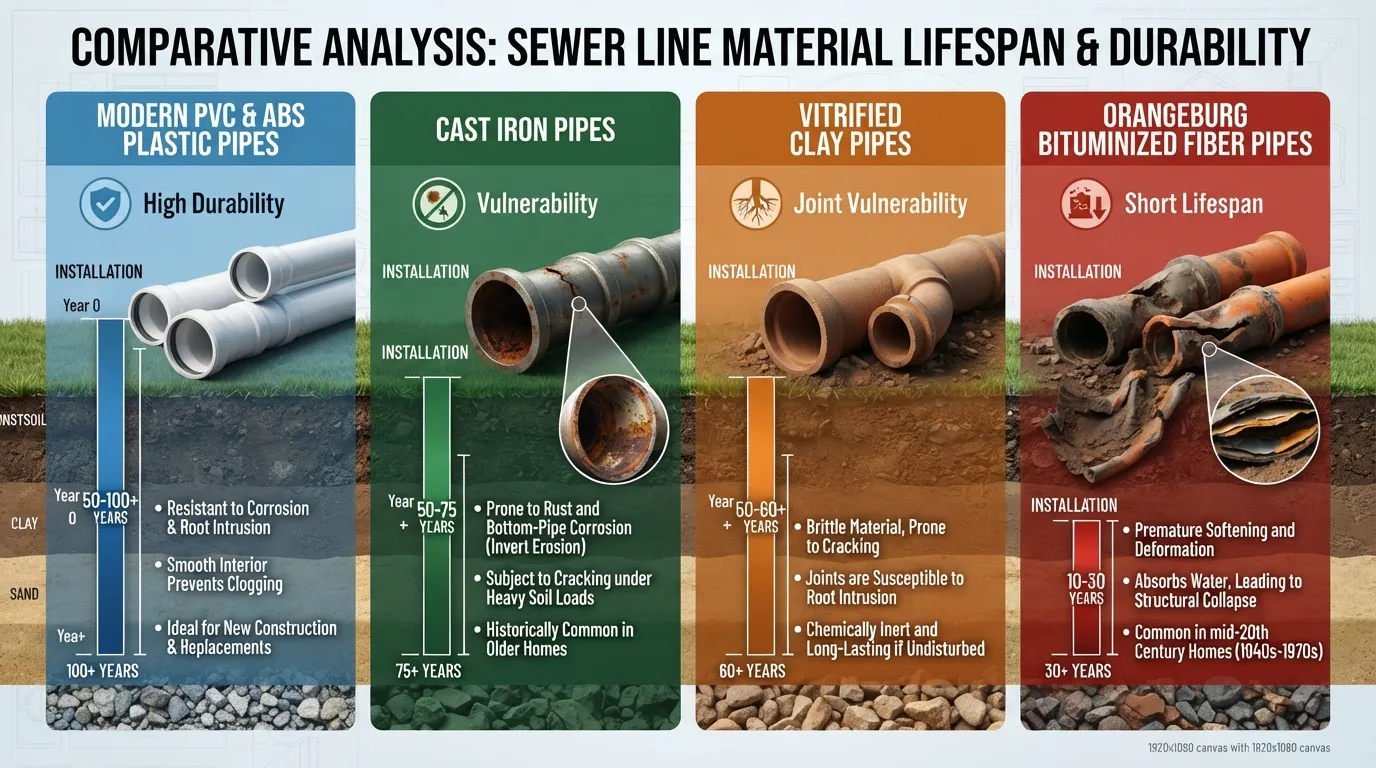
A residential sewer line typically lasts anywhere from 50 to 100 years, depending heavily on the original pipe material, installation quality, local soil chemistry, and household usage patterns. While modern synthetic materials offer exceptional longevity and corrosion resistance, legacy installations often degrade much faster, requiring proactive monitoring and eventual replacement.
Material Dependency: The underlying pipe composition remains the single most critical factor determining how many decades a sewer system will survive.
Environmental Impact: Soil shifting, root pressure, and aggressive ground moisture can accelerate wear and shorten overall system durability.
Lifespan by Pipe Material (Clay, Cast Iron, PVC, Orangeburg)
Different plumbing materials installed across various construction eras exhibit drastically different lifespans. Knowing what material your home uses helps you anticipate when structural failures or replacement needs are likely to occur.
PVC and ABS Plastic Pipes (50 to 100+ Years): Modern plastic conduits are completely immune to rust and root-friendly joint corrosion, providing unmatched long-term reliability and smooth hydraulic performance.
Cast Iron Pipes (50 to 75 Years): While sturdy, cast iron eventually suffers from interior bottom-piping rust, scale buildup, and wastewater corrosion that thins the pipe walls over time.
Vitrified Clay Pipes (50 to 60+ Years): Clay sections resist chemical corrosion well, but their numerous rigid joints are highly susceptible to shifting soil and invasive tree roots.
Orangeburg Bituminized Fiber Pipes (10 to 30 Years): Constructed from compressed wood pulp soaked in coal tar, these mid-century pipes soften, deform, and collapse prematurely, making them the shortest-lived sewer material in residential history.
Is a Broken Sewer Line Covered by Homeowners Insurance?

Standard homeowners insurance policies do not cover damaged sewer lines or underground utility failures. Because subterranean pipes sit outside the physical foundation of the main dwelling structure, standard policies classify them as maintenance responsibility rather than sudden, accidental property damage, leaving homeowners vulnerable to unexpected out-of-pocket repair costs.
Standard Exclusion: General policies exclude wear and tear, rust, tree root infiltration, and ground settling affecting buried lines.
Financial Exposure: Homeowners are financially liable for the entire lateral line running from their exterior wall to the municipal main connection in the street.
What Homeowners Insurance Typically Covers (and Doesn’t)
While standard insurance denies claims for broken outdoor sewer pipes, policies may occasionally cover secondary damage caused by backups inside the home under specific conditions. Understanding the boundary between standard exclusions and policy limitations prevents costly misunderstandings.
Internal Water Backup Endorsements: Many policies offer optional water backup riders that pay to clean up indoor sewage overflow, ruined drywall, or damaged flooring resulting from a blocked line.
The Underlying Pipe Exclusion: Even with an internal backup rider, the actual underground broken pipe, excavation trenches, and lawn repairs remain completely uncovered by standard forms.
Sudden External Accidental Damage: Unless a catastrophic, sudden event (like a vehicle crashing onto your lawn and crushing the line) occurs, normal underground deterioration is never covered.
When a Service Line Warranty or Endorsement Helps
To bridge this coverage gap, major insurance providers offer affordable optional add-ons known as service line endorsements or buried utility line riders. According to the Insurance Information Institute, adding service line protection typically costs just a small annual fee while providing thousands of dollars in vital protection.
Comprehensive Endorsement Protection: Service line riders cover the cost to repair or replace damaged exterior sewer, water, and power lines caused by rust, decay, tree roots, or freezing [1.1.6].
Excavation and Landscaping Coverage: These endorsements frequently pay for the heavy machinery, trenching labor, and subsequent lawn or driveway restoration required after a spot repair or replacement [1.1.6].
Learn more about managing unexpected utility line failures by watching this breakdown on underground utility line coverage.
Can You Repair a Sewer Line Yourself? DIY Risks
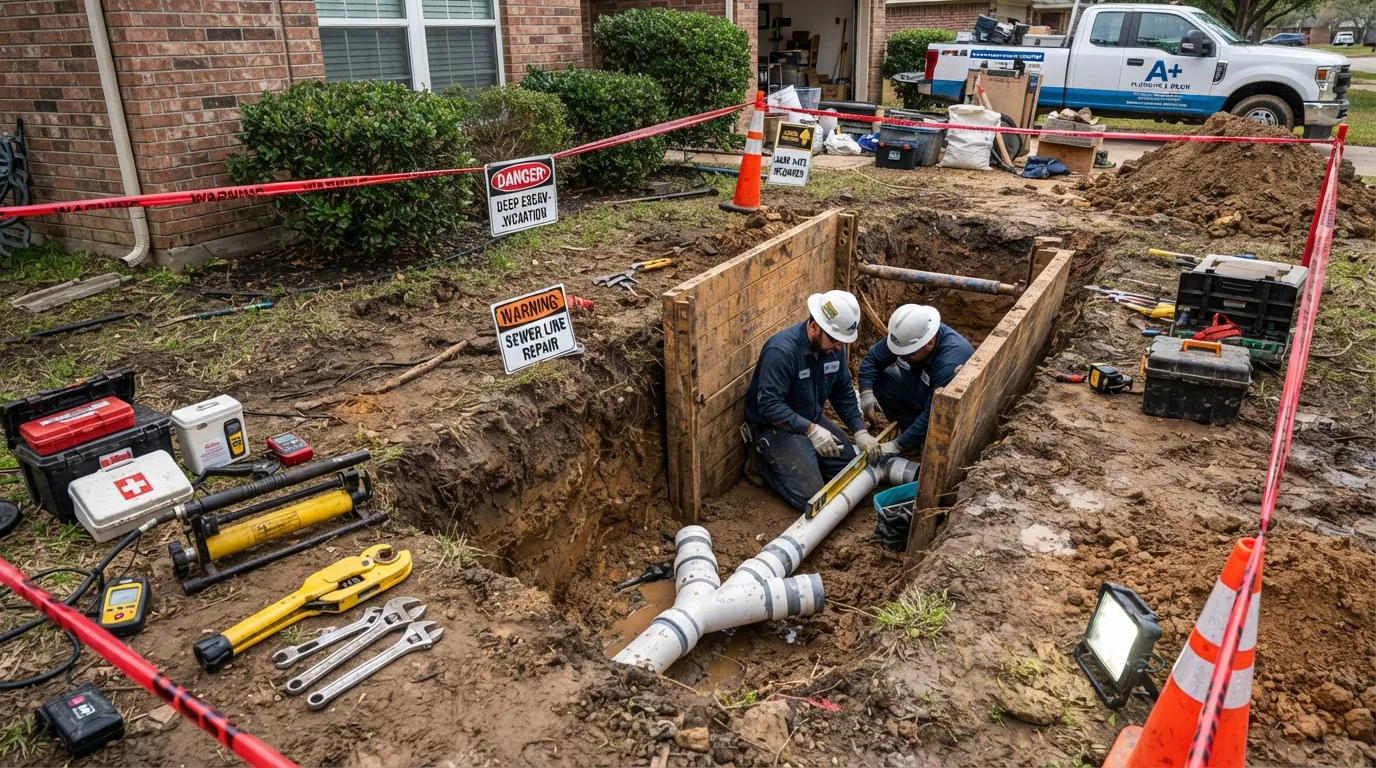
Attempting a DIY sewer line repair is rarely practical or safe for homeowners. Main sewer lines sit deep underground, require precise continuous gravity grade calculations, and demand heavy excavation equipment, making underground plumbing replacement a complex task best left to certified professionals.
High Risk of Failure: A slight error in pipe slope or joint alignment will cause chronic clogs, pooling waste, and rapid structural re-failure.
Regulatory Hurdles: Main sewer repairs require official municipal permits, utility line locates, and strict adherence to local plumbing codes.
Why DIY Sewer Repair Is Risky (Permits, Codes, Health Hazards)
Working on subterranean sewage lines exposes amateurs to significant legal, financial, and biological dangers. Ignoring legal mandates or safety protocols during a self-executed repair can result in hefty fines and catastrophic property damage.
Strict Plumbing Permits and Codes: Municipalities enforce rigorous plumbing codes regarding pipe materials, backflow prevention, and connection angles to the city main. Unpermitted DIY work can cause severe legal liabilities when selling your home.
Biohazard Exposure: Raw sewage carries dangerous pathogens, bacteria, and toxic gases like hydrogen sulfide, creating serious health hazards without proper PPE and containment gear.
Accidental Utility Strikes: Digging without professional line locates risks striking buried gas mains, electrical conduits, or high-pressure water lines, resulting in dangerous injuries or neighborhood-wide outages.
When to Call a Licensed Plumber Instead
While minor fixture clogs or accessible interior trap repairs are suitable for DIY handywork, mainline failures require immediate professional intervention. You should contact a certified emergency plumber the moment you encounter raw sewage backing up into multiple home fixtures, persistent foul odors, or structural line collapses.
Advanced Diagnostic Equipment: Licensed professionals utilize commercial CCTV cameras and electronic sonde locators to map exact pipe depths and pinpoint damage without destructive guesswork.
Heavy Machinery and Trenchless Expertise: Plumbers possess the specialized machinery, CIPP lining equipment, and pipe-bursting rigs necessary to complete repairs safely and up to code.
Guaranteed Workmanship: Hiring a licensed contractor ensures that your repairs are fully warranted, inspected, and compliant with local municipal regulations, protecting your investment for decades.
Sewer Line Spot Repair in Miami, FL – Local Considerations
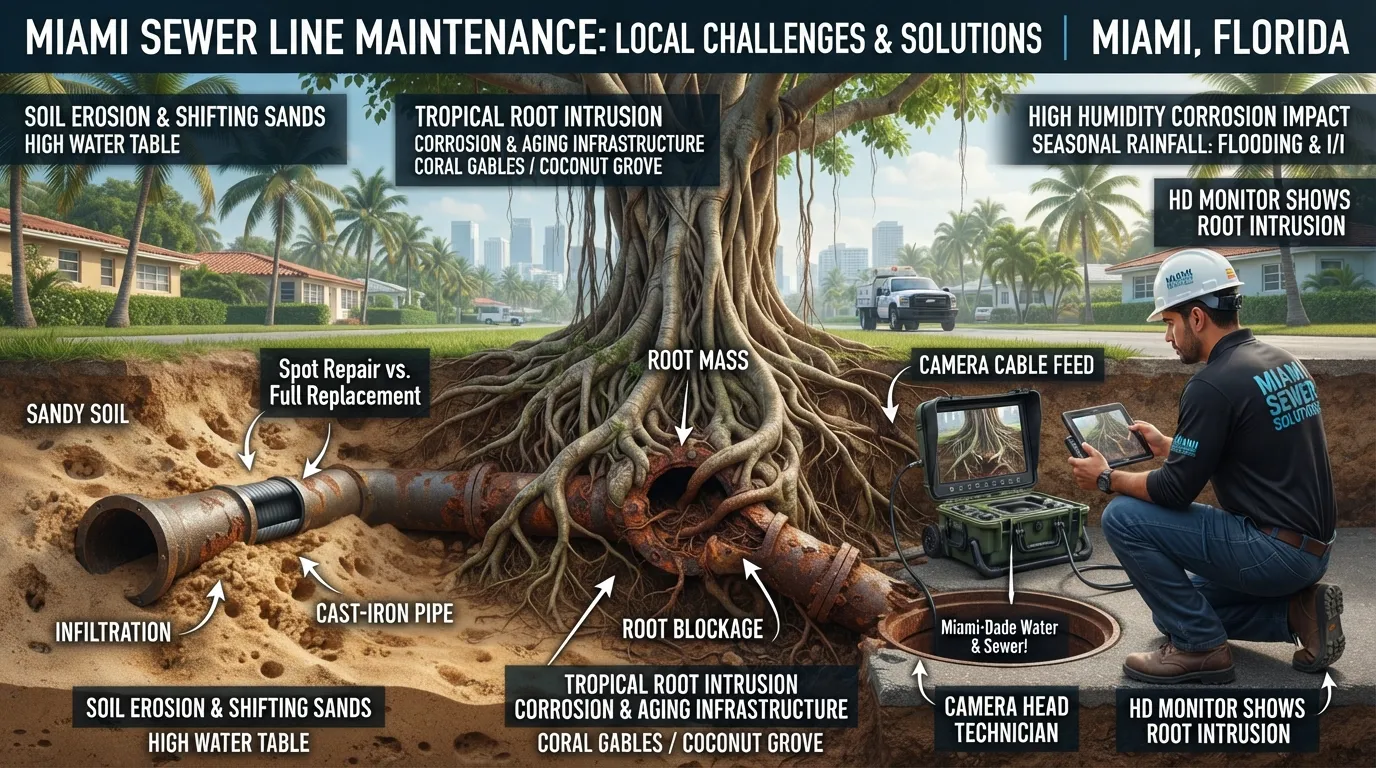
Property owners in South Florida face unique environmental and structural challenges that directly impact underground plumbing infrastructure. High humidity, shifting sandy soils, and a dense urban canopy create aggressive conditions for residential drainage networks, making targeted Miami sewer repair solutions vital for long-term home maintenance.
Environmental Pressures: Local climate factors accelerate pipe wear and encourage aggressive root growth throughout residential neighborhoods.
Proactive Maintenance: Addressing localized pipe defects early prevents extensive property damage caused by recurring tropical downpours and saturated soils.
Florida Soil, Humidity & Older Home Pipe Materials
The regional geology and climate across South Florida introduce severe stressors to underground plumbing systems. Understanding how local conditions interact with legacy pipe materials helps homeowners anticipate when structural repairs will be necessary.
Sandy and Shifting Soils: Miami’s porous, sandy soils frequently shift due to heavy seasonal rainfall and high water tables, causing underground pipes to settle unevenly and offset at the joints.
Aggressive Root Intrusion: Lush tropical landscaping and year-round warmth drive aggressive tree roots to seek out moisture, relentlessly infiltrating minor cracks in older sewer lines.
Legacy Materials in Older Neighborhoods: Historic properties in areas like Coral Gables, Coconut Grove, and Miami Shores often feature aging cast iron or clay lines that struggle to withstand decades of soil movement and corrosive humidity.
Why Miami Homeowners Should Prioritize Camera Inspections
Given the hidden nature of underground utility failures beneath slab foundations and manicured tropical lawns, visual guesswork is never enough. Professional plumbers leverage advanced technology across our comprehensive sewer line services to inspect and evaluate pipe interiors accurately.
Non-Destructive Diagnostics: CCTV cameras threaded through cleanouts identify exact damage locations without tearing up expensive tile flooring, concrete patios, or custom landscaping.
Tailored Repair Strategies: Visual confirmation dictates whether an isolated trenchless spot repair or a full replacement is required to solve the issue permanently.
Storm Readiness: Ensuring your sewer lateral is clear and structurally sound protects your home from severe backups during heavy tropical storms and hurricane-season downpours.
Spot Repair or Full Replacement? Final Decision Checklist
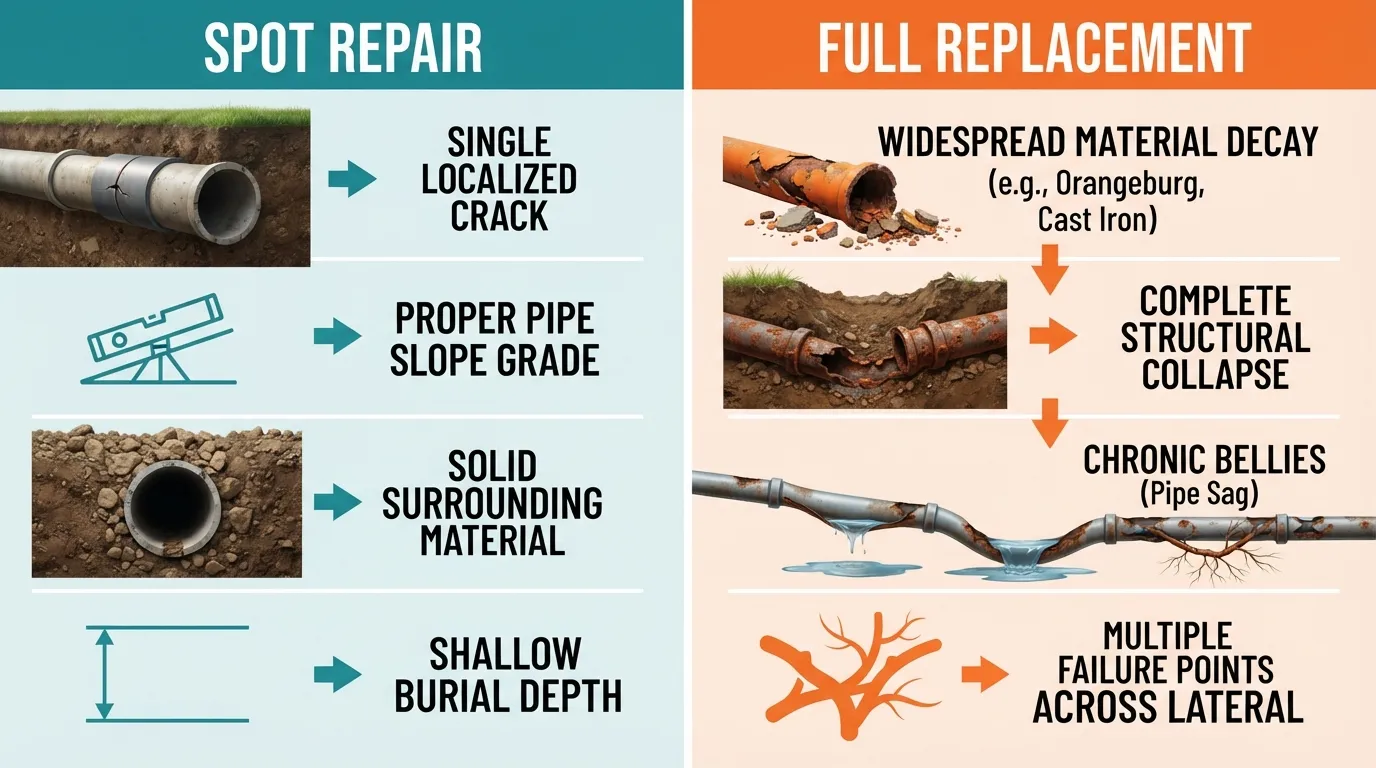
Choosing between a targeted sewer line spot repair and a full system replacement depends entirely on the extent, frequency, and severity of your underground plumbing damage. Reviewing this structured decision framework helps homeowners quickly evaluate their inspection results and select the most cost-effective, long-lasting repair path.
Diagnostic Clarity: Always rely on a professional CCTV camera inspection to confirm whether structural compromise is isolated or systemic.
Cost-Benefit Balance: Weigh immediate patch savings against the long-term reliability of replacing aging legacy pipe networks entirely.
Quick Checklist: Signs You Only Need a Spot Repair
A localized point repair is the ideal solution when damage is confined to a single area and the rest of the plumbing infrastructure remains structurally robust. Look for these key indicators on your inspection footage:
Isolated Damage Zone: The failure is restricted to a single crack, a shifting offset joint, or one root intrusion point spanning only a few feet.
Proper Pipe Grade: Neighboring pipe segments maintain continuous downward slope and proper hydraulic fall.
Sound Surrounding Material: The overall pipe wall thickness is solid without widespread corrosion, scaling, or thinning.
Shallow Burial Depth: The damaged section is easily accessible and located away from major structural foundations or hardscaping.
Quick Checklist: Signs You Need Full Replacement
When a plumbing system suffers from widespread degradation or geometric failure, spot repairs provide only a temporary band-aid. You should plan for a full sewer line replacement if your inspection reveals:
Extensive Material Decay: The line consists of crumbling Orangeburg fiber, severely rusted cast iron, or multiple fractured clay joints across the entire run.
Complete Structural Collapse: Sections of the pipe have caved inward completely, blocking equipment and preventing lining or patching.
Chronic Bellies or Backpitch: Sagging low points trap standing water and solid waste, requiring complete grade reconstruction.
Multiple Failure Points: Frequent, recurring blockages or repeated leaks appear at different locations throughout the lateral line.
Frequently Asked Questions
Can a sewer line spot repair be done under a driveway or patio?
Yes, a sewer line spot repair can often be performed beneath driveways, patios, or concrete walkways using targeted trenchless access pits or miniature excavation techniques. Because spot repairs focus exclusively on the exact point of failure rather than digging up the entire length of the pipe, contractors can minimize destruction to hardscaping, preserving the vast majority of your concrete and paving.
How long does a sewer line spot repair take to complete?
Most residential sewer line spot repairs take between 4 to 8 hours to complete from start to finish. Because the excavation and repair footprint is limited to a small, isolated section of the pipe, professional plumbers can typically finish the job within a single day, allowing your household to resume normal water and plumbing usage by evening.
Will homeowners insurance pay for a sewer line spot repair?
Standard homeowners insurance policies do not cover underground sewer line spot repairs, routine maintenance, or normal wear and tear. Insurance providers classify buried utility lines outside the home foundation as homeowner responsibility, meaning repairs must be paid out-of-pocket unless you carry a specific optional service line endorsement or buried utility rider on your policy.
How do plumbers know if a spot repair is enough instead of a replacement?
Plumbers use specialized closed-circuit television (CCTV) camera inspections to examine the interior of the entire lateral line before recommending a solution. If footage reveals a single isolated crack or root intrusion with surrounding pipe remaining strong and properly sloped, a spot repair is sufficient; however, widespread corrosion, collapsed sections, or multiple failures require a full replacement.
Can tree roots grow back after a sewer line spot repair?
Tree roots can theoretically attempt to re-enter a repaired area if the joint seal or pipe material is compromised, but modern spot repairs permanently block previous entry points. Using seamless CIPP epoxy patches, heavy-duty clamped couplings, or replaced PVC sections eliminates the vulnerable gaps and cracks that roots originally exploited, providing long-term root resistance.
Book a Professional Sewer Inspection
Do not let minor drainage issues escalate into costly structural property emergencies. Whether you are noticing slow indoor drains, unusual yard puddles, or persistent plumbing backups, our expert team is ready to provide precise diagnostics and reliable solutions.
Advanced Diagnostics: Utilizing state-of-the-art CCTV camera technology to pinpoint damage without unnecessary guesswork or property destruction.
Expert Solutions: Delivering honest recommendations for targeted spot repairs, trenchless rehabilitation, or full system replacements tailored to your specific budget.
Take the guesswork out of your plumbing maintenance today. Book your appointment now to schedule a comprehensive sewer inspection with a licensed professional near you and restore total peace of mind to your home.
Main Services
Related Posts
Need a Plumber in Miami?
Schedule service online or speak directly with the EZ Plumbing team.
Owner-Led Local Service
Know who is behind the business before you request service. The owners, contact line and Miami service pages are published clearly.
- Named business owners
- Direct phone and social channels
- Local Miami service information
Clear Help Before You Book
Review the relevant service page, contact the team directly and use the booking page when you are ready—without relying on vague claims.
- Service-specific information
- Direct questions before scheduling
- Clear online booking route