
Bathroom Faucet Trends That Add Style to Your Space in 2026
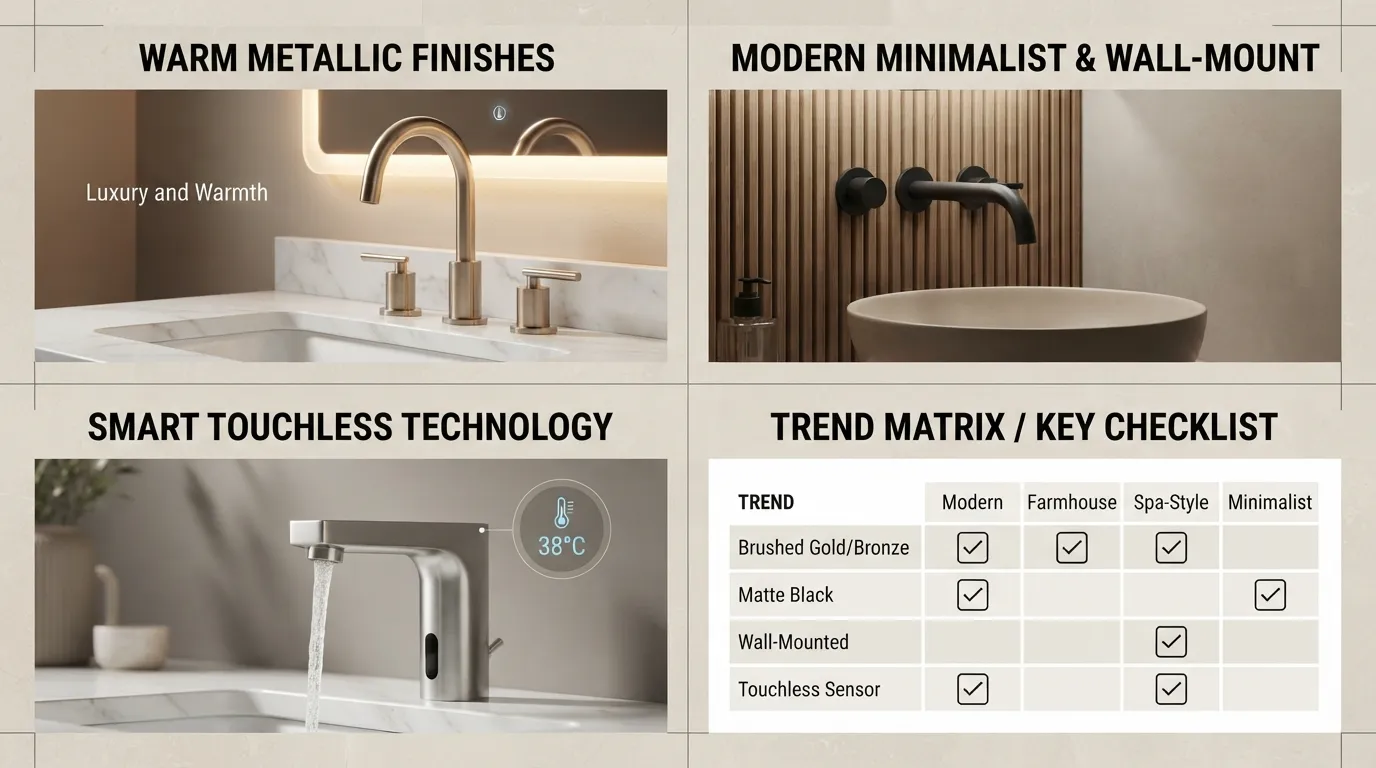
Bathroom Faucet Trends at a Glance
Modern bathroom design centers on soft minimalism, tactile textures, and subtle luxury. Replacing sterile, high-gloss metals, current faucet trends emphasize warm organic tones, sculptural profiles, and integrated smart functionality that elevates daily wellness routines.
What Is Trending in Bathroom Faucets Right Now?
Current bathroom faucet styles balance architectural form with low-maintenance durability. High-gloss, high-maintenance surfaces are yielding to textured and brushed metals that resist water spots while providing rich visual warmth. Meanwhile, sleek wall-mounted installations and touchless sensor technology are transforming residential vanities into streamlined, hygienic, spa-like retreats.
Warm Brushed Finishes: Brushed gold, warm brass, and brushed nickel dominate over cold, reflective metals, creating an inviting, organic atmosphere.
Matte Black Accents: Matte black remains a timeless staple for sharp contrast, especially when paired with natural stone, light wood, or pastel vanity tiles.
Tactile & Sculptural Forms: Faucets featuring knurled handles, fluted details, gently arced spouts, and organic waterfall outlets act as standalone design elements.
Wall-Mounted & Floating Designs: Mounted directly into the wall above floating vanities, these layouts save deck space and streamline sink maintenance.
Integrated Smart Tech: Concealed touchless sensors, digital temperature displays, and eco-friendly flow regulators provide touch-free hygiene and sustainable water management.
2026 Faucet Trends Quick-Reference Table
| Trend | Look & Feel | Best For | Care Level |
|---|---|---|---|
| Brushed Gold & Warm Brass | Soft, luxurious, and vintage-inspired with a subtle golden glow | Warm neutral palettes, natural wood vanities, and spa-style bathrooms | Low (PVD coatings conceal smudges and resist corrosion) |
| Matte Black | Bold, architectural, and modern with a velvety flat surface | Industrial, Scandinavian, and high-contrast contemporary bathrooms | Moderate (Requires mild soap to avoid limestone or calcium build-up) |
| Wall-Mounted & Waterfall | Architectural, open, and fluid with continuous water streams | Small powder rooms, vessel sinks, and minimalist floating vanities | Low to Moderate (Deck cleanup is easier; spouts need gentle wiping) |
| Touchless Smart Faucets | Modern, seamless, and high-tech with hidden infrared sensors | High-traffic family bathrooms, modern master suites, and eco-conscious homes | Very Low (Minimal physical contact reduces water spots and bacterial spread) |
| Knurled & Textured Metals | Industrial, tactile, and detailed with diamond-cut metal handles | Custom luxury spaces, Japandi interiors, and layered-material designs | Low (Textured surfaces hide fingerprints and light daily wear) |
Why These Trends Are Rising
The rapid shift toward these faucet styles stems from a broader evolution in home design, where homeowners treat the bathroom as a personal sanctuary. Warmer metallic tones like brushed gold and warm brass instantly soften hard porcelain surfaces, while sculptural waterfall spouts and wall-mounted setups create an immersive spa-like atmosphere. Furthermore, advancements in physical vapor deposition (PVD) finishes allow dark and brushed metals to resist tarnishing and water spots, meeting the demand for low-maintenance living. Paired with precise, touchless water conservation technology, modern faucets successfully merge understated luxury with responsible, daily utility.
Trending Bathroom Finish Selections and Real-World Honest Assessments
Choosing the right bathroom fixture finishes involves balancing immediate aesthetic impact with long-term maintenance realities. While manufacturer marketing highlights only the benefits, understanding how specific metals wear in daily use ensures a long-lasting, beautiful bathroom installation.
Matte Black
Matte black fixtures provide a striking, modern contrast that anchors contemporary and industrial vanity designs. While flat black finishes excel at hiding everyday fingerprints compared to high-gloss options, they require careful management around high-mineral water sources.
Visual Impact: Delivers high-contrast, architectural elegance, pairing seamlessly with natural stone and light wood.
Fingerprint Resistance: Exceptionally good at concealing standard oils and daily handprints.
Maintenance Reality: Shows hard-water spots, soap residue, and calcium build-up rapidly due to the flat, light-absorbing surface texture.
Care Tip: Wipe fixtures dry with a soft microfiber cloth after each use and clean exclusively with mild dish soap to protect the matte coating.
Brushed Gold and Warm Brass
Brushed gold and warm brass finishes elevate organic, spa-inspired bathrooms by introducing soft, welcoming metallic undertones. Premium versions utilize physical vapor deposition (PVD) technology to bond color molecules at a molecular level, offering far superior durability compared to older lacquered options.
Design Synergy: Complements earthy palettes, warm wood cabinetry, and veined marble countertops.
PVD vs. Lacquered: PVD-coated brass resists tarnishing and corrosion indefinitely, whereas traditional lacquered brass can flake or peel when exposed to humidity.
Living Finish Behavior: True unlacquered brass variations intentionally evolve over time, developing a unique, antique-style oxidation patina.
Brushed Nickel and Polished Chrome
Brushed nickel and polished chrome remain versatile, budget-friendly staples that adapt effortlessly to traditional, transitional, and modern spaces. Chrome delivers brilliant light reflection and easy sanitation, though its high-gloss mirror surface readily highlights smudges.
Polished Chrome: Highly affordable and simple to clean with standard glass cleaner, but demands frequent wiping to eliminate visible water drops and fingerprints.
Brushed Nickel: Features subtle directional polishing lines that naturally disguise minor water marks and daily wear.
Longevity: Timeless choices that maintain visual neutrality when paired with classic handle shapes and gooseneck spouts.
Polished Nickel and Unlacquered Brass
Interior designers frequently return to polished nickel and unlacquered brass for high-end residential projects due to their historic character and depth. Unlike static industrial platings, these metals interact with their environment over years of daily handling.
Polished Nickel: Warmer and richer than standard chrome, featuring a subtle golden cream undertone that looks refined in traditional settings.
Unlacquered Brass: Celebrated for its living finish, meaning it intentionally darkens, spots, and shifts in color based on touch and humidity.
The Patina Factor: Embracing a living finish means accepting surface variation and age marks as part of the material’s authentic charm.
Finish Comparison Table
| Finish Style | Fingerprints & Smudges | Water Spots & Mineral Marks | Durability & Coating | Price Feel | Ideal Design Match |
| Matte Black | Low | High | Moderate (dependent on factory baking/PVD) | Mid-Range | Modern, Industrial, Scandinavian |
| Brushed Gold / Warm Brass | Low to Moderate | Low | High (when PVD finished) | Premium | Transitional, Japandi, Warm Organic |
| Polished Chrome | High | High | High (hard chrome plating) | Budget-Friendly | Traditional, Classic Hotel-Style |
| Brushed Nickel | Low | Low | High | Mid-Range | Universal, Transitional, Farmhouse |
| Unlacquered Brass | High (blends into patina) | High (forms unique spots) | Living Finish (changes organically) | Luxury | Historic, Vintage-Inspired, Custom |
Which Faucet Finish Is Easiest to Maintain?
Brushed nickel stands out as the lowest-maintenance faucet finish for active family bathrooms and high-humidity environments. Its finely textured surface diffuses light and breaks up water droplet refraction, effectively hiding minor hard-water scaling and daily fingerprints between cleanings.
Hard Water Defense: Brushed textures prevent mineral crust from forming stark, highly visible white rings around the base of the spout.
Cleaning Routine: Requires only a quick wipe down with a damp cloth and mild soap to maintain a spotless appearance.
Contrast Caution: Avoid polished finishes in hard-water regions unless willing to maintain a strict daily drying habit to prevent permanent calcium etching.
Faucet Shapes and Styles Shaping Modern Bathrooms
Bathroom fixtures have evolved from purely utilitarian hardware into intentional design anchors that define the room’s character. Modern faucet shapes rely on organic geometries, architectural lines, and ergonomic engineering to transform daily hand-washing into a tactile, luxury experience.
Sculptural and Artistic Silhouettes
Contemporary faucet designs favor soft organic curves, flowing arcs, and tapered spouts over rigid geometric angles. Acting as standalone design objects, these statement faucets set the visual rhythm for the entire vanity area while offering a welcoming, human-centric feel.
Design Evolution: Transitioning away from harsh square boxes, current models embrace fluid curves and disciplined metal detailing.
Visual Rhythm: Sculptural profiles harmonize with organic stone veining and curved mirrors, creating a cohesive sanctuary.
Scale Consideration: Match tall, dramatic spouts with vessel basins, while lower, streamlined profiles complement classic undermount sinks.
Waterfall Spouts
Waterfall faucets replace traditional aerated streams with open channels that cascade water gracefully like a natural spring. While they deliver an immersive spa experience, weighing their visual aesthetic against practical daily performance is essential.
Spa-Style Flow: Creates a soothing, visual cascade that enhances the ambiance of luxury master suites.
Splash and Care Factor: Open channels can cause water to splash outward against shallow basins, requiring frequent wiping of the countertop.
Maintenance Tip: Opt for models with easily accessible internal lips to prevent mineral scale build-up from hard water.
Wall-Mounted Faucets
Mounting the faucet directly onto the wall above the basin frees up valuable counter space and creates a streamlined, minimalist aesthetic. This installation style is a favorite for floating vanities and statement vessel sinks, though it requires meticulous advance planning.
Space Efficiency: Eliminates deck clutter around the sink base, drastically simplifying daily countertop cleaning.
Planned Installation: In-wall valve rough-ins must be mapped out precisely during framing and plumbing stages before tile is laid.
Visual Impact: Delivers an upscale, hotel-inspired look that highlights beautiful backsplash tiles.
Single-Handle vs. Cross/Lever Handles
Choosing how water is controlled impacts both ergonomics and stylistic expression across the vanity setup. The right handle configuration bridges the gap between high-tech convenience and timeless heritage charm.
Single-Handle Models: Deliver effortless, one-handed temperature and flow control with a clean, clutter-free profile.
Cross and Lever Handles: Add classic character and vintage architectural depth, perfectly pairing with traditional and transitional aesthetics.
Ergonomics: Lever handles offer ADA-compliant accessibility, while cross handles lean heavily into timeless, custom craftsmanship.
Minimal and Slim Profiles
For compact powder rooms and narrow guest baths, minimalist slim-profile faucets maximize functionality without overwhelming limited visual space. These compact fixtures prove that small footprints can still make a sophisticated design statement.
Space Optimization: Slim profiles prevent small vanities from feeling overcrowded or cluttered.
Proportional Balance: Pair slender spouts with compact rectangular or round under-mount basins to maintain visual harmony.
Streamlined Care: Fewer crevices and simplified joints make these minimalist units quick and easy to wipe down.
Smart, Touchless, and Water-Saving Faucet Technology
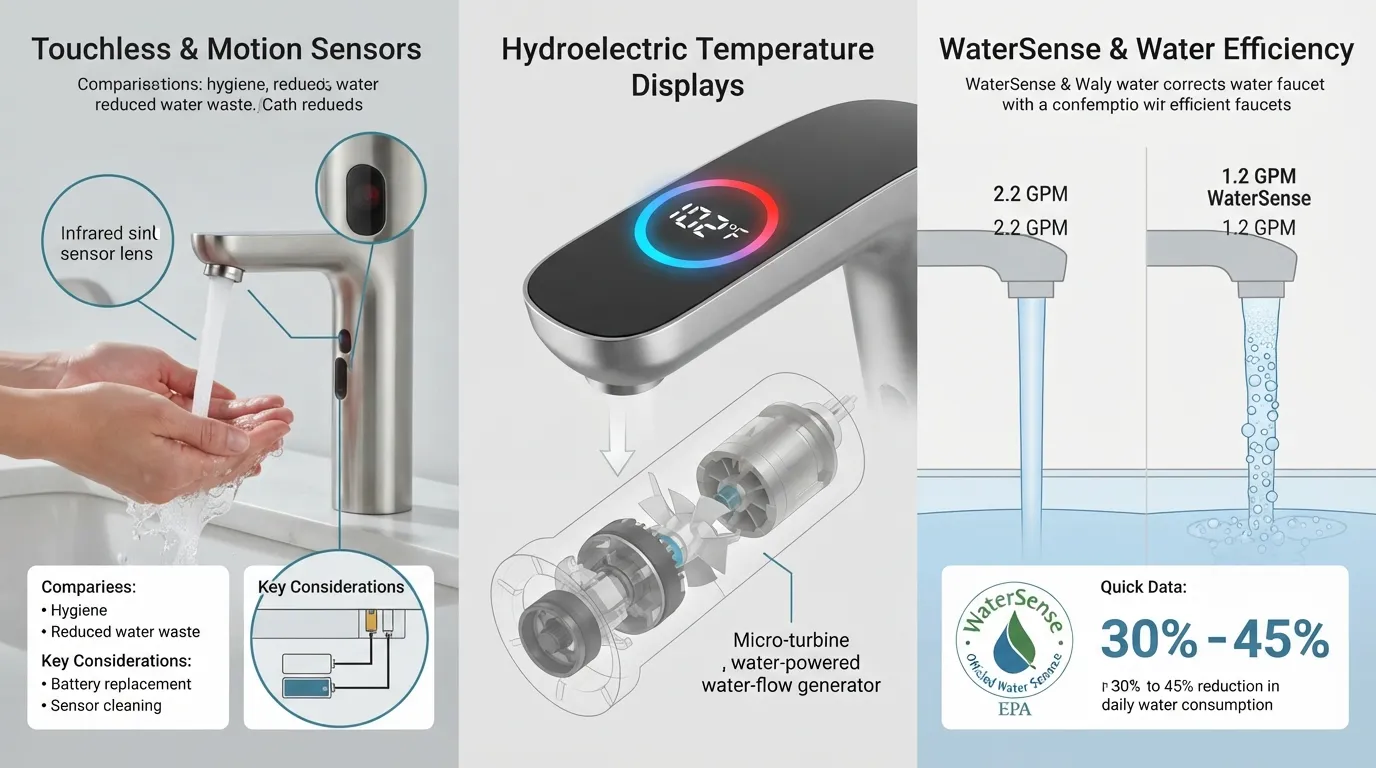
Modern bathroom faucets have evolved far beyond simple mechanical valves, transforming into high-tech fixtures designed to improve hygiene, reduce utility bills, and enhance daily convenience. Integrating smart features into your bathroom sink upgrades both functionality and long-term water efficiency, but selecting the right technology requires balancing innovation against power needs and maintenance demands.
Touchless and Motion-Sensor Faucets
Touchless bathroom faucets utilize infrared motion sensors to activate water flow automatically when hands enter the detection zone. By eliminating physical contact with handles, these fixtures offer distinct functional advantages while introducing unique power requirements.
Hygiene Optimization: Eliminates cross-contamination on faucet handles, keeping bacteria and viruses off shared bathroom surfaces.
Convenience and Cleanliness: Streamlines routine handwashing and prevents soap scum, water spots, and grime buildup on the faucet body.
Water Waste Reduction: Prevents continuous water running during brushing or lathering, saving up to several hundred gallons annually per household.
Key Technical Considerations and Drawbacks:
Power Supply Requirements: Motion sensors require a reliable power source. Options include internal battery packs (typically requiring standard AA or C batteries replaced every 1 to 2 years) or hardwired AC transformers installed beneath the sink.
Sensor Calibration and Maintenance: Low-quality sensors can suffer from delayed activation or phantom triggers. Cleaning infrared lenses regularly is necessary to prevent soap residue or mineral deposits from blocking the signal.
Faucets With Temperature Display
Digital temperature-display faucets display the precise water temperature on an integrated LED screen before hands touch the stream. This feature eliminates guesswork, helping prevent accidental scalding—especially in households with young children or elderly family members.
Turbine-Powered Hydroelectric Generators: High-end models utilize small internal micro-turbines that generate electricity directly from flowing water.
No-Battery Designs: Hydroelectric systems eliminate the hassle of replacing batteries or running electrical wiring underneath the vanity cabinet.
Color-Coded Visual Alerts: Many displays feature color-changing LED halos (e.g., blue for cold, green for warm, red for hot) that provide immediate visual confirmation of water safety.
Water-Efficient Faucets and WaterSense
Upgrading to a water-efficient faucet significantly lowers household utility costs without compromising rinsing performance. Water volume is measured in Gallons Per Minute (GPM), with modern engineering allowing low-flow models to deliver a strong, satisfying spray pattern.
Standard Flow Rates vs. High Efficiency: Standard traditional bathroom faucets flow at 2.2 GPM. Water-efficient models reduce output to 1.5 GPM or 1.2 GPM, achieving a 30% to 45% reduction in water volume.
High-Performance Aerators: Precision aerators mix air into the pressurized stream. This maintains strong linear water pressure while using significantly less physical liquid.
Certification Standards: Choosing fixtures that meet official EPA WaterSense bathroom faucet guidelines ensures the model flows at no more than 1.5 GPM while meeting strict performance criteria for force and coverage.
Measurable Daily Savings: The average household saves over 11,000 gallons of water over the lifetime of a certified faucet, yielding direct savings on energy bills used to heat water.
Are Smart Faucets Worth the Extra Cost?
Determining whether a smart faucet justifies its higher price tag depends on your budget, household size, and tolerance for tech maintenance. Below is a realistic breakdown to help you evaluate if this upgrade fits your bathroom design.
Advantages (Pros)
Superior Sanitation: Prevents the spread of household germs through completely hands-free operation.
Lower Water Bills: Automatic shut-off features and low GPM aerators actively prevent water waste.
Modern Aesthetics & Convenience: LED displays and motion controls bring an elevated, high-end feel to contemporary bathrooms.
Disadvantages (Cons)
Higher Upfront Investment: Smart faucets cost significantly more than standard mechanical single-handle or two-handle faucets.
Complex Installation: Sensor wiring, battery compartments, and control modules beneath the sink increase installation complexity and potential plumbing costs.
Potential Technical Failure Points: Solenoid valves, sensors, and micro-turbines add electronic components that may require troubleshooting or replacement over time.
Final Recommendation: Who Should (and Should Not) Buy
Ideal Candidates: Multi-person households, busy family bathrooms, homes with kids or elderly family members, and homeowners prioritizing modern aesthetics and maximum water conservation.
When to Skip: Secondary guest bathrooms with low usage, historical home restorations where electronic components clash with period hardware, or projects operating on a strict budget.
Best Faucet Trends for Your Bathroom Style
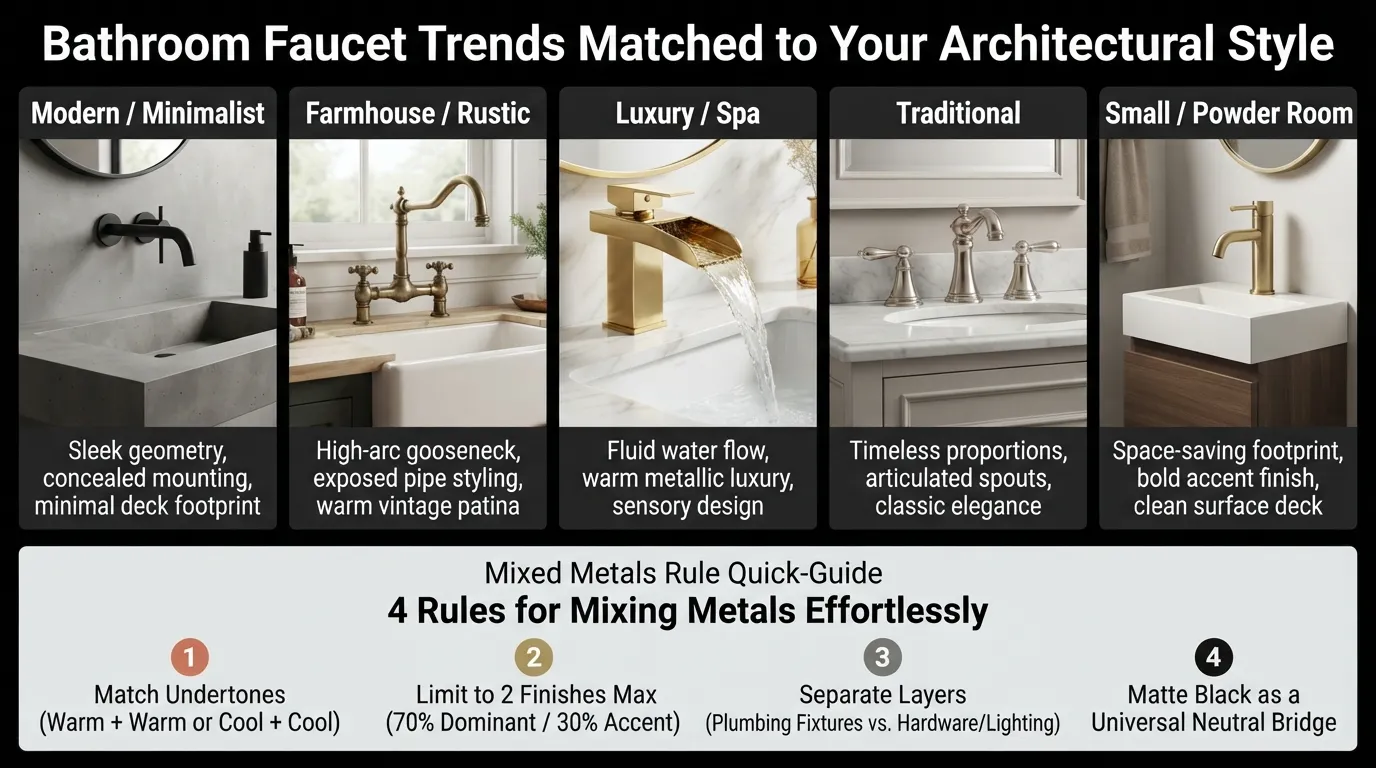
Matching your bathroom faucet to your overall design aesthetic creates a cohesive, high-end look while ensuring optimal daily functionality. Whether you are remodeling a spacious primary suite or updating a compact powder room, aligning fixture design, finish, and mounting style with your vanity style, color scheme, and architectural details guarantees a balanced space.
Modern and Minimalist Bathrooms
Modern bathroom design relies on clean geometry, crisp architecture, and uncluttered countertops. Faucets in minimalist spaces emphasize sleek silhouettes and concealed hardware to keep the focus on subtle materials and spatial flow.
Key Design Features: Single-handle deck-mounted faucets or wall-mounted designs with clean 90-degree spouts and slim lever handles.
Recommended Finishes: Matte black, brushed nickel, or ultra-polished chrome.
Best Paired With: Floating vanity styles, integrated stone sinks, and large-format geometric tiles.
Farmhouse and Rustic Bathrooms
Farmhouse and rustic bathrooms celebrate organic textures, vintage warmth, and artisan craft. Faucets for these spaces draw inspiration from traditional industrial plumbing, offering a tactile, time-tested aesthetic.
Key Design Features: High-arc gooseneck spouts, bridge faucets with exposed plumbing lines, and classic cross or porcelain-lever handles.
Recommended Finishes: Oil-rubbed bronze, antique brass, or matte black for a bold industrial contrast.
Best Paired With: Apron-front vessel sinks, reclaimed wood vanities, board-and-batten accent walls, and open timber shelving.
Luxury and Spa-Style Bathrooms
Spa-style bathrooms prioritize tranquility, opulent materials, and premium finishes. Faucets in luxury retreats feature fluid curves, delicate water delivery systems, and refined metallic tones designed to turn daily routines into sensory experiences.
Key Design Features: Waterfall spouts with open channels, widespread two-handle configurations, and integrated LED accent lighting.
Recommended Finishes: Brushed gold, polished brass, or champagne bronze.
Best Paired With: Freestanding soaking tubs, marble vessel sinks, frameless glass shower enclosures, and back-lit mirrors.
Traditional and Timeless Bathrooms
Traditional bathrooms lean on classic architectural motifs, balanced proportions, and historic details that never go out of style. Fixtures in these spaces evoke understated elegance without feeling overly ornamental or trend-driven.
Key Design Features: Curved widespread faucets, articulated gooseneck spouts, and decorative bell-shaped escutcheon plates.
Recommended Finishes: Polished nickel, brushed chrome, or classic warm brass.
Best Paired With: Undermount ceramic sinks, recessed-panel shaker vanities, crown molding, and classic subway or herringbone tile.
Small Bathrooms and Powder Rooms
Compact bathrooms and powder rooms require fixtures that maximize functional sink space without cluttering the vanity deck. Because powder rooms experience lower daily wear, they also serve as ideal spaces for dramatic design choices.
Space-Saving Strategies: Wall-mounted faucets free up entire vanity surfaces, while narrow-base single-hole faucets keep small decks tidy.
Bold Design Statements: Statement vessel-height faucets in rich metallic finishes elevate small powder room vanities into standout design features.
Best Paired With: Pedestal sinks, narrow floating vanities, and statement wall coverings or dark accent paint.
Can You Mix Metal Finishes?
Mixing metal finishes is a popular approach to adding depth and character to a bathroom, but doing so without a strategy can feel chaotic. Following core design principles ensures your faucet harmonizes with cabinet hardware, lighting, towel bars, and shower fixtures.
Match the Tone: Keep all metals within the same undertone family. Pair warm metals (brushed brass, warm bronze, gold) together, or group cool metals (chrome, polished nickel, matte black) for consistent harmony.
Limit the Palette: Stick to maximum two metal finishes in a single bathroom. Assign one finish as the dominant anchor (around 70% of fixtures) and the second as a intentional accent (around 30%).
Tie Fixtures to Specific Layers: Use one metal finish for plumbing (faucet, shower fixtures, and drain assemblies) and a complementary finish for room accents (lighting, cabinet hardware, mirror frames, and towel bars).
Use Matte Black as a Neutral Bridge: Matte black acts as a versatile bridge that safely pairs with almost any metallic tone, from warm brushed gold to crisp polished chrome.
How to Choose the Right Bathroom Faucet
Selecting the ideal bathroom faucet requires balancing precise sink compatibility, architectural style, and heavy-duty interior build quality. Evaluating these technical criteria beforehand prevents costly installation mismatches and ensures your new fixture delivers flawless daily performance.
Start With Your Sink: Single-Hole, Centerset, Widespread, or Wall-Mount
Your countertop’s pre-drilled hole configuration dictates which faucet styles can be installed without major modification. Matching your fixture to your sink setup ensures a secure, leak-free fit.
Single-Hole Faucets: Features the spout and handle built into a single compact unit designed for one-hole sinks or vanities with optional escutcheon plates.
Centerset Faucets (4-Inch Spread): Designed for 3-hole configurations where the handles and spout are mounted together on a single 6-inch base plate with standard 4-inch spacing between hole centers.
Widespread Faucets (8-Inch Spread): Comprises three independent pieces (hot handle, cold handle, and separate spout) requiring holes spaced 8 to 16 inches apart for a grand, custom look.
Wall-Mount Faucets: Installed directly into the structural wall above the basin, requiring in-wall rough-in valves and specialized plumbing lines.
Match the Faucet to Your Vanity and Color Scheme
Your faucet finish and silhouette should complement surrounding bathroom hardware, lighting fixtures, and vanity materials. Establishing a cohesive design narrative prevents visual clutter in small spaces.
Line Harmony: Pair curved, organic spouts with rounded mirrors and vessel sinks, or match sharp, geometric profiles with clean-lined floating vanities.
Finish Coordination: Select durable metallic tones—such as warm brushed brass, matte black, or timeless polished nickel—that echo lighting fixtures or cabinet pulls.
Proportional Scale: Ensure tall gooseneck spouts pair with deep, wide basins to prevent turbulent splashing during handwashing.
Check Build Quality: Solid Brass vs Zinc, Cartridge Type, Finish Warranty
Internal construction determines whether a faucet lasts for decades or begins leaking within a few years of daily use. Evaluating core materials and valve mechanisms protects your investment.
Solid Brass Construction: High-end faucets feature forged solid brass bodies that resist corrosion, high water pressure, and mineral buildup.
Zinc and Plastic Components: Budget-friendly models often utilize lightweight zinc alloy bodies or internal plastic connectors that wear out faster under heavy family use.
Ceramic Disc Cartridges: Premium faucets utilize diamond-embedded ceramic disc valves that provide drip-free operation and smooth handle resistance.
Manufacturer Finish Warranties: Look for reputable brands offering lifetime limited mechanical and finish warranties to guarantee protection against tarnishing, flaking, or dripping.
Don’t Forget Handle Style, Spout Height, and Reach
Ergonomic functionality ensures your faucet is comfortable and practical for everyone in the household. A functional clearance test prevents awkward handwashing angles and splashing.
Spout Reach: The stream should land directly over the center of the drain bowl rather than splashing against the back slope of the sink.
Clearance Height: Ensure ample vertical distance between the aerator tip and the basin rim to comfortably wash hands or fill small containers.
Handle Ergonomics: Single levers offer quick temperature control with one hand, while classic dual handles provide precise, independent hot and cold mixing.
Should You Install It Yourself or Hire a Plumber?
Swapping a straightforward like-for-like faucet is a manageable DIY project for handy homeowners, but complex configurations require expert intervention. Knowing your limits prevents accidental water damage and structural leaks.
DIY-Friendly Swaps: Replacing an existing single-hole or centerset faucet with an identical setup using clean, modern supply lines takes an afternoon with basic tools.
When to Call a Professional: Wall-mounted installations, drilling new holes in stone countertops, or navigating corroded, aging infrastructure call for professional plumbing services.
Common DIY Pitfalls to Avoid:
Stuck Shut-Off Valves: Old angle stops often fail to close completely; forcing them can snap older supply pipes.
Mismatched Supply Line Threads: Forcing imperial and metric connectors strips threads and creates hidden slow leaks beneath the cabinet.
Overtightened Connections: Cracking ceramic sink basins or plastic compression nuts by cranking down slip-joint pliers with excessive force.
Emergency Situations: If a rusted supply line bursts or a main shut-off valve shears during a DIY swap, shut off the house water supply immediately and contact an emergency plumber to mitigate structural water damage.
Cost, Durability, and Care: What to Expect
Investing in a high-quality bathroom faucet pays off through reliable daily operation and lasting aesthetic appeal. Understanding upfront pricing bands, proper surface care, and environmental impact ensures your new fixture remains functional and pristine over decades of heavy use.
How Much Do Trending Bathroom Faucets Cost?
Bathroom faucet pricing spans three distinct market tiers depending on build quality, finish technology, and integrated smart features. Evaluating these brackets helps line up your expectations with actual project budgets.
Budget Tier ($50 – $150): Standard centerset or basic single-handle faucets made with composite or zinc alloy bodies and chrome finishes. Best suited for basic updates or rental units.
Mid-Range Tier ($150 – $400): Durable solid brass construction, ceramic disc cartridges, and popular finish options like matte black, brushed nickel, or oil-rubbed bronze. Includes entry-level touchless or water-saving WaterSense models.
Premium & Smart Tier ($400 – $1,200+): High-end architectural designs, widespread or wall-mounted configurations, motion sensors, digital temperature displays, and Physical Vapor Deposition (PVD) metallic coatings that resist corrosion.
How to Keep Matte Black, Brass, and Chrome Looking New
Different faucet finishes require tailored cleaning protocols to protect physical vapor deposition layers and prevent protective topcoats from stripping or clouding over time.
Matte Black Finishes: Clean daily with a soft microfiber cloth dampened with warm water and mild dish soap. Avoid chemical bathroom sprays or citrus-based cleaners, which break down the matte sealer and leave chalky white streaks.
Brushed Gold & Brass (PVD): Physical Vapor Deposition binds finishes at an atomic level, making PVD brass ultra-durable. Wipe dry after each use to prevent water spot staining, and never scrub with abrasive pads or steel wool.
Polished Chrome: Highly resilient against daily moisture, but prone to water spots and fingerprints. Buffing with a dry microfiber cloth restores a streak-free shine without harsh polished-metal pastes.
Products to Avoid: Never use bleach, ammonia, acidic tile cleaners, scouring powders, or harsh scrubbing sponges on any decorative faucet finish.
Hard Water, Humidity, and Your Finish
In coastal, warm, and humid climates like South Florida, environmental exposure creates unique challenges for plumbing hardware. Elevated ambient humidity coupled with mineral-dense hard water accelerates surface scaling and internal component wear.
Mineral Scale Buildup: High concentrations of calcium and magnesium in local water supplies cause white, chalky crust to form around aerator nozzles, clogging water flow and distorting spray patterns.
Aerator Maintenance: Unscrew the tip aerator every 3 to 6 months, soak it in warm water with mild dish soap (or diluting mild white vinegar strictly for the removable aerator piece), and brush away dissolved mineral deposits using a soft toothbrush.
First-Hand Plumber Observation: In humid coastal environments, salt-laden air and constant humidity accelerate galvanic corrosion on low-end zinc hardware. Installing solid brass fixtures with PVD protective finishes is essential to keep coastal vanity hardware from pitting or flaking.
When a Dripping Faucet Means More Than a Worn Cartridge
While a dripping spout usually points to a worn ceramic cartridge or failing O-ring, water pooling around the vanity base signals more severe underlying issues. Addressing minor leaks early prevents structural water damage and mold growth beneath the cabinet floor.
Hidden Under-Sink Leaks: Pressurized supply lines, shut-off valve packings, or loose pop-up drain assemblies can leak silently inside dark vanity cabinets, rot timber decks, and ruin flooring.
In-Wall Valve Leaks: Wall-mounted faucets hide internal mixer valves behind tile and drywall. A slow drip within the wall cavity can saturate framing long before moisture surfaces on paint.
When to Call a Specialist: If changing the cartridge fails to stop the leak or moisture continuously pools inside your cabinet, schedule professional leak detection and repair immediately to locate hidden plumbing fractures before extensive restoration becomes necessary.
Bathroom Faucet Trends to Watch in 2027
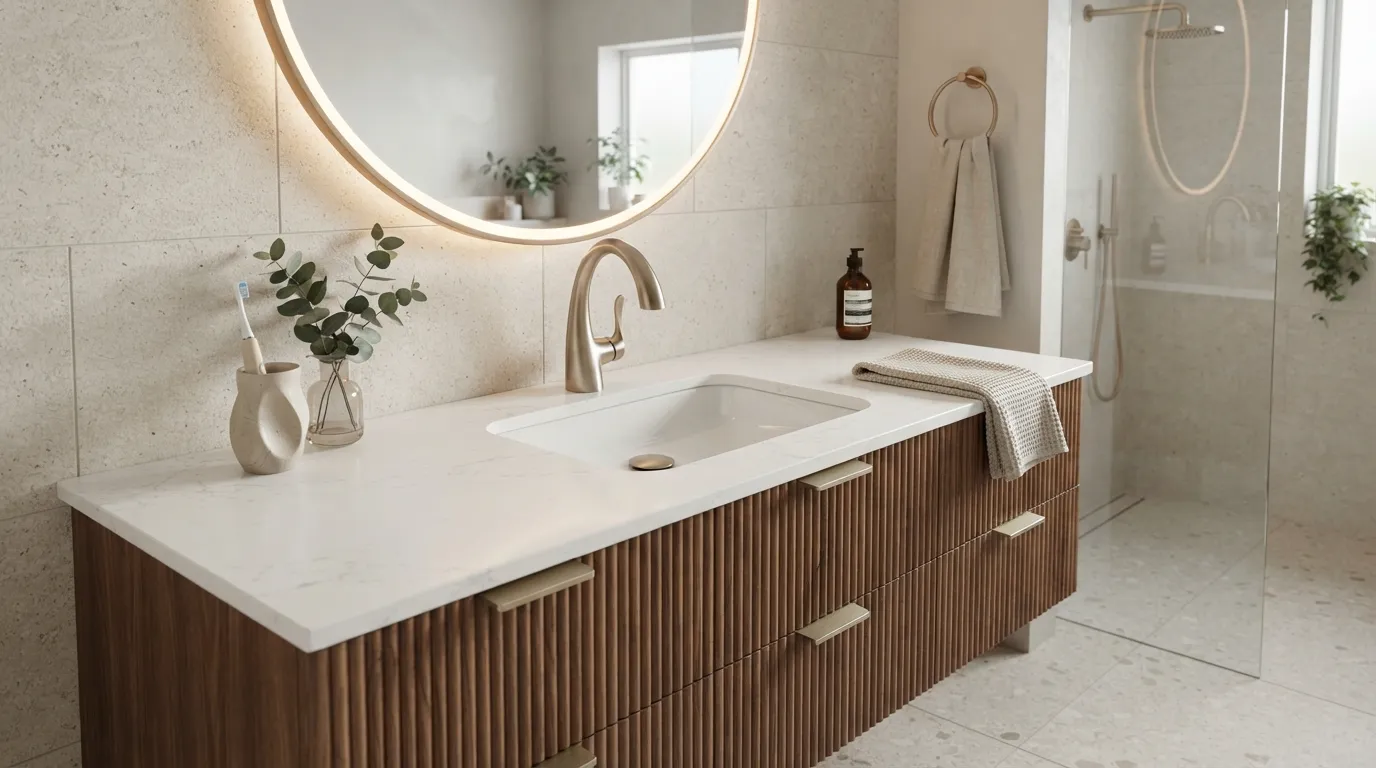
As bathroom design continues to move away from rigid, sterile minimalism toward warm, sensory-rich spaces, faucet technology and finishes are evolving in parallel. Looking ahead toward 2027, the emphasis shifts toward organic sculptural forms, sustainable water conservation, and long-lasting material finishes that blend timeless aesthetics with smart functionality.
Where Faucet Design Is Heading
Upcoming bathroom faucet designs focus on bringing warmth, tactile texture, and intelligent efficiency into daily self-care routines. Rather than purely utilitarian hardware, future fixtures act as architectural focal points within the space.
Rise of Warmer Metals: Cool chrome and stark matte black are giving way to warm metallic tones like brushed champagne bronze, rich brass, and warm copper. These finishes add immediate depth and vintage warmth to modern vanities.
Sculptural and Organic Forms: Faucet silhouettes are becoming softer and more fluid. Expect to see graceful goosenecks, arched spouts with integrated waterfall lips, and textured or knurled handle handles inspired by natural stone and artisan metalwork.
Integrated Tech and Water Efficiency: Smart technology is becoming more subtle and power-independent. Micro-turbine temperature displays and hyper-efficient 1.2 GPM aerators deliver high performance while supporting home water conservation.
Longer-Lasting Finishes: Advanced Physical Vapor Deposition (PVD) coatings are expanding, allowing manufacturers to create scratch-resistant, anti-corrosive finishes that withstand harsh humidity and heavy daily use without tarnishing.
Which 2026 Trends Are Likely to Last?
Evaluating recent design trends against long-term staying power helps homeowners avoid premature hardware obsolescence when remodeling.
High Staying Power (Timeless Trends):
Brushed Gold & Warm Brass: These finishes have transitioned from short-lived design trends to permanent classics that pair effortlessly with neutral stone, tile, and wood tones.
WaterSense Efficiency: Low-flow aerators and high-efficiency water engineering are becoming standard building expectations rather than optional upgrades.
Clean Wall-Mount Configurations: Wall-mounted faucets remain a lasting favorite for minimalist spaces and small powder rooms due to their space-saving and easy-to-clean nature.
Trend-Dependent (Moderate Staying Power):
Ultra-High-Gloss Finishes: High-shine metallic coatings require continuous polishing and are gradually being replaced by satin, brushed, and low-sheen tactile finishes.
Complex App-Connected Faucets: Smart features that rely on smartphone apps or frequent battery replacements are giving way to simple, reliable motion-sensor and hydroelectric setups.
How to Choose a Faucet That Still Looks Good Later
Selecting a bathroom faucet with lasting visual and functional appeal protects your investment and keeps your vanity looking relevant through changing design cycles.
Prioritize Proportion Over Flash: Choose a faucet size, spout height, and reach that perfectly matches the scale of your sink basin and vanity setup rather than buying solely for an eye-catching shape.
Opt for Tactile, Low-Maintenance Finishes: Satin and brushed finishes like brushed nickel, champagne bronze, or matte black hide water spots and fingerprints far better than ultra-reflective polished surfaces.
Invest in Proven Internal Engineering: Focus your budget on solid brass construction and diamond ceramic disc cartridges. High internal build quality ensures smooth handle operation and drip-free performance for decades, regardless of how design trends evolve outside the wall.
Bathroom Faucet Trends FAQs
What is the current trend in bathroom faucets?
The primary current trend in bathroom faucets centers on warm metallic finishes, tactile textures, and touchless motion sensors. Homeowners are favoring brushed champagne bronze, warm brass, and matte black finishes. Streamlined wall-mounted installations and water-efficient low-flow aerators are also leading design choices for modern and eco-friendly vanities.
What are the bathroom faucet trends for 2026?
Bathroom faucet trends for 2026 highlight organic sculptural shapes, hydroelectric LED temperature displays, and durable PVD coatings. Water conservation remains critical, with WaterSense-certified models flowing at 1.2 to 1.5 GPM dominating the market alongside subtle, power-independent smart features and mixed-metal design pairings.
What is in style for bathrooms right now?
Right now, bathroom styles emphasize spa-like serenity, organic textures, and warm metallic accents. Popular elements include floating vanities, fluted wood details, vessel sinks paired with high-arc gooseneck faucets, frameless glass shower enclosures, and layered lighting that creates a relaxed, retreat-like environment.
What color bathroom fixtures are in style in 2026?
In 2026, warm metals dominate fixture color choices. Brushed brass, champagne bronze, and polished nickel lead designer preference over cold chrome. Matte black remains a strong neutral accent, particularly when paired with warm natural wood vanities or organic stone countertops.
What are some outdated bathroom trends to avoid?
Outdated trends to avoid include all-white sterile tile schemes, oversized Jacuzzi tub surrounds, glossy brass hardware with yellow undertones, and short, builder-grade 4-inch centerset faucets. Overly complex app-dependent smart fixtures that require constant battery swaps are also declining in popularity.
What makes a bathroom look tacky according to designers?
Designers consider bathrooms tacky when they feature overly matched hardware sets, cheap plastic-feeling chrome fixtures, exposed plumbing leaks, or misproportioned scale (such as tiny faucets over massive vessel sinks). Excess clutter, peeling artificial finish coatings, and chaotic metal mixing without shared undertones also harm aesthetics.
What are the bathroom design trends for 2027?
Looking ahead to 2027, bathroom design trends lean into warm copper tones, fluid waterfall spouts, knurled metal handles, and ultra-efficient 1.2 GPM aerators. Expect subtle hydroelectric smart sensors, bio-based sustainable materials, and long-lasting PVD finishes built for humid, high-mineral environments.
What are bathroom fixtures called?
Bathroom fixtures refer to permanent plumbing items attached to the home’s water and drainage system. Key bathroom fixtures include the sink faucet, showerhead, bathtub filler, toilet, vanity basin, bidet, and tub spout, alongside permanent hardware like drain assemblies.
Is matte black still in style for bathroom faucets?
Yes, matte black remains in style for bathroom faucets. While no longer an exclusive accent, it has transitioned into a permanent neutral finish. It serves as an ideal anchor for minimalist spaces or as a grounding accent metal when mixing with warm brass lighting and cabinet hardware.
Are wall-mounted faucets a good idea?
Wall-mounted faucets are a great choice for saving vanity counter space, making sink bowl cleaning easier, and creating a sleek modern look. However, they require precise in-wall rough-in plumbing during installation, making them more costly to install and repair compared to deck-mounted options.
Final Thoughts and Next Step
Upgrading your bathroom faucet is one of the most impactful ways to elevate your space, combining modern aesthetic appeal with everyday functionality. By carefully considering your room’s overall style, space requirements, and daily needs, you can select a fixture that looks great and delivers reliable performance for years to come.
Choosing a Faucet That Fits Your Space
Finding the ideal bathroom fixture comes down to a clear four-step process: match the metal finish to your room’s undertones, choose a shape that mirrors your bathroom’s architecture, verify your sink’s hole configuration, and set a budget that prioritizes solid brass construction. Staying aligned with current bathroom faucet trends ensures your vanity looks intentional and modern. Taking time to double-check spout reach and valve compatibility prevents costly installation surprises down the line.
Need Help Installing Your New Faucet?
Whether you are updating a single powder room vanity or complete bathroom overhaul, proper installation ensures long-lasting, leak-free operation. If you are dealing with corroded valves, in-wall plumbing, or mounting delicate stone sink basins, working with a licensed plumber ensures your installation meets local plumbing codes and protects your investment.
If you are located in the greater Miami area and need assistance with your plumbing setup, our experienced team is ready to help. Schedule your faucet installation today to get your new bathroom fixtures mounted quickly and safely.
Main Services
Related Posts
Need a Plumber in Miami?
Schedule service online or speak directly with the EZ Plumbing team.
Owner-Led Local Service
Know who is behind the business before you request service. The owners, contact line and Miami service pages are published clearly.
- Named business owners
- Direct phone and social channels
- Local Miami service information
Clear Help Before You Book
Review the relevant service page, contact the team directly and use the booking page when you are ready—without relying on vague claims.
- Service-specific information
- Direct questions before scheduling
- Clear online booking route