Why You Should Consider Plumbing as a Career: Pay, Pros and Cons
Is Plumbing a Good Career Choice?
Yes, plumbing is a highly stable, well-paying, and rewarding career choice within the skilled trades. It offers strong earning potential without four-year college debt, exceptional job security driven by constant demand, and clear pathways to becoming a licensed plumber or business owner. It is best suited for hands-on problem solvers who enjoy active work and independent daily tasks.
Who Plumbing Is a Great Fit For
A plumbing career is an exceptional match for individuals looking to build a high-earning, future-proof career on a practical timeline. It specifically suits people who:
Prefer active, practical problem-solving: You enjoy diagnosing physical issues, using hand tools, and working with your hands rather than sitting at a desk all day.
Want to earn while learning: You prefer a paid apprenticeship where you gain real-world experience and earn a salary instead of accumulating four-year college tuition debt.
Prioritize long-term job security: You want a essential skill set that cannot be offshored, automated, or replaced by artificial intelligence.
Value independence and career control: You aim to eventually earn a master plumber license or start your own commercial or residential plumbing business.
Who Might Want to Think Twice
While the skilled trades offer high financial rewards and stability, the day-to-day realities mean it is not the right fit for everyone. Consider other options if you:
Dislike physical exertion: The role requires heavy lifting, maneuvering in cramped crawlspaces, climbing ladders, and working in demanding physical environments.
Prefer predictable office hours: Emergency plumbing calls, leak repairs, and major pipe installations often demand evening, weekend, or on-call availability.
Are averse to messy environments: Daily work involves exposure to harsh chemicals, raw sewage, dirty water, and harsh weather conditions.
Seek an immediate desk-bound remote job: Plumbing requires an on-site physical presence and cannot be performed remotely.
What This Guide Covers
To help you evaluate whether a career change into plumbing aligns with your financial and personal goals, this guide breaks down every key aspect of the trade:
Financial Breakdown: Comprehensive salary expectations, hourly rates, and long-term earning potential.
Pathways & Entry: How to secure a paid apprenticeship, complete classroom hours, and obtain a state license.
Pros & Cons Analysis: An honest assessment of trade benefits, physical demands, and job satisfaction metrics.
Career Progression: Moving from an entry-level apprentice to a journey-level worker, master plumber, or contractor.
7 Reasons to Consider Plumbing as a Career
Plumbing offers a powerful mix of financial freedom, professional autonomy, and essential societal value that makes it one of the most reliable career paths in the modern labor market. While absolute labels like “recession-proof” require nuance, the high demand for core infrastructure upkeep gives the trade remarkable economic resilience.
Why Is Plumbing So Important?
Plumbing systems are the backbone of public health, managing clean water distribution, safe sewage disposal, and environmental sanitation. Without functional water and sewage systems, modern communities could not maintain hygiene, control disease, or sustain daily residential and commercial life.
Steady Demand That Does Not Depend on Trends
Essential service nature: People will always need clean running water, working toilets, and leak repairs regardless of broader economic cycles.
Constant maintenance needs: Buildings continuously age, requiring ongoing pipe replacements, fixture updates, and emergency maintenance.
An Aging Workforce and Open Positions
Retiring plumbers: According to data from the U.S. Bureau of Labor Statistics, a massive wave of retirements across the skilled trade shortage is creating hundreds of thousands of job openings.
Low replacement rate: Fewer young workers enter the trades each year than veterans leaving the field, creating immense job security and negotiating power for new entrants.
Resistance to Recessions and Outsourcing
Localized emergency work: Plumbing repairs cannot be outsourced overseas or performed remotely via computer software, protecting local jobs.
Market cycle nuance: While residential and commercial new-construction projects can slow down during economic downturns, emergency repair and maintenance work stays consistently high.
Why Robots and AI Are Unlikely to Replace Hands-On Diagnostics
Complex physical environments: Every building features unique framing layouts, tight crawlspaces, and unexpected structural obstacles that require human dexterity.
Advanced tools as aids: Emerging technologies like diagnostic thermal cameras and robotic pipe crawlers assist plumbers rather than replace them, making skilled professionals more efficient.
Get Paid While You Learn
Earn-while-you-learn model: Instead of paying tuition, you start earning a salary on your very first day as an apprentice.
Direct mentorship: You gain practical, hands-on experience working directly under licensed, experienced master plumbers.
Less Student Debt Than a Four-Year Degree
Zero to minimal debt: Avoid the tens of thousands of dollars in student loans typically associated with a traditional four-year degree.
Financial head start: While college graduates enter the workforce with heavy debt, plumbing apprentices build savings and retirement accounts years earlier.
Variety, Problem Solving, and Visible Results
Dynamic daily challenges: No two service calls or construction sites are identical, keeping daily work engaging and intellectually stimulating.
Immediate tangible impact: You leave every job site with a fully fixed leak or working system, providing deep professional satisfaction and appreciative clients.
How Much Do Plumbers Earn? Real Pay by Career Stage
A plumbing career offers a direct path to a high-earning trade without carrying four-year college debt. While total income depends heavily on your geographic location, licensing level, and business structure, trade professionals consistently earn well above national median figures.
National Pay Snapshot
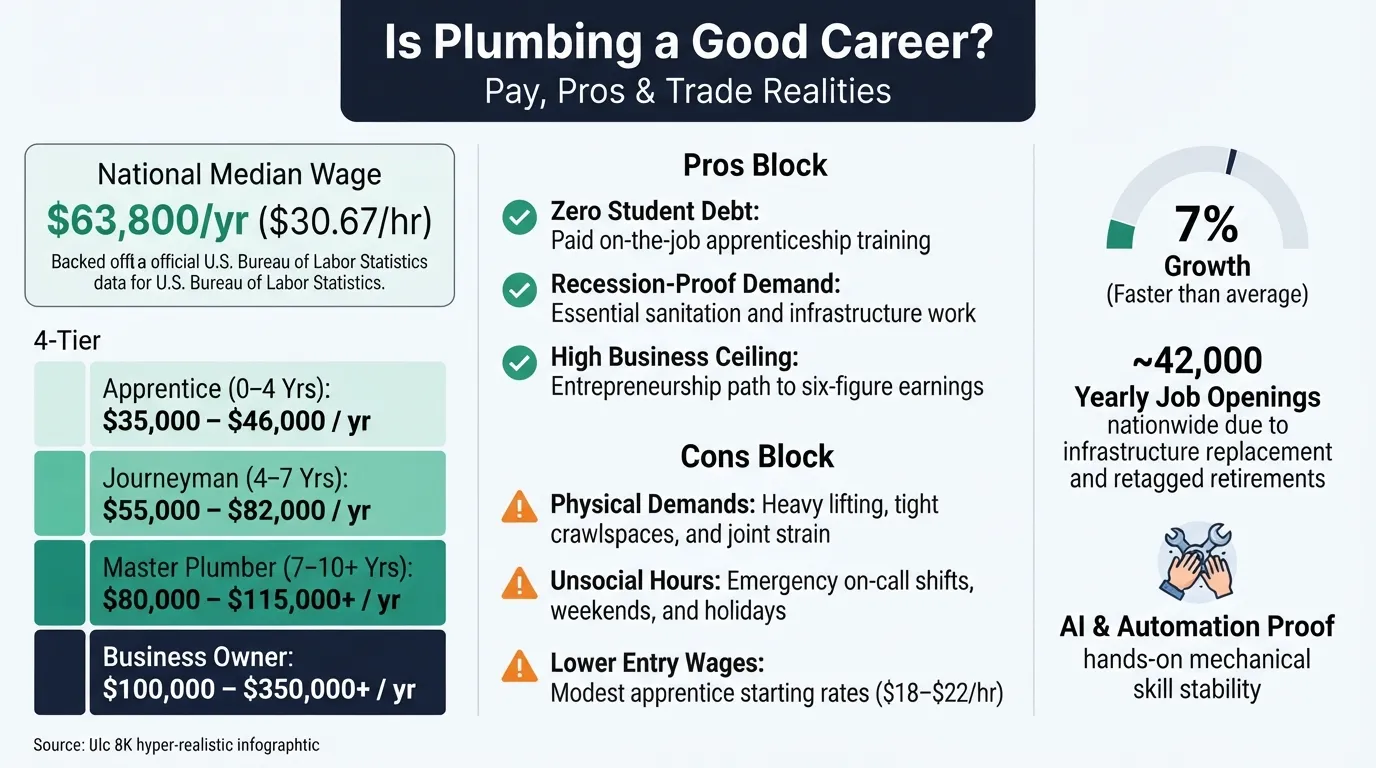
According to official labor data from the U.S. Bureau of Labor Statistics (May 2025 release), the national median wage for plumbers, pipefitters, and steamfitters is $63,800 per year ($30.67 per hour).
Lowest 10 Percent: Earns less than $44,150 annually (typical entry-level apprentices).
Highest 10 Percent: Earns more than $108,420 annually (experienced master plumbers, specialized technicians, and union leads).
Job Growth Outlook: Employment is projected to grow 7 percent through 2035, generating roughly 42,000 open positions each year.
Pay by Career Stage: Apprentice to Business Owner
Earning potential scales upward significantly as you complete required classroom hours and pass state licensing exams. State-level dynamics also impact earnings; for example, Florida plumber salary ranges reflect high regional service demand, with Miami plumber pay frequently trending higher than state averages due to cost-of-living adjustments and dense commercial infrastructure.
| Career Stage | Typical Roles & Responsibilities | Estimated Hourly Rate | Annual Earning Range | Florida & Miami Regional Variance |
| Apprentice | Assisting licensed plumbers, carrying tools, learning basic pipefitting | $18.00 – $25.00 | $37,000 – $52,000 | Starts around $17.50–$22.00/hr in FL |
| Journeyman Plumber | Performing independent residential and commercial service, repairs, and installs | $28.00 – $42.00 | $58,000 – $87,000 | Matches mid-to-upper national averages in Miami |
| Master Plumber | Pulling permits, managing job sites, designing complex commercial layout systems | $40.00 – $60.00+ | $83,000 – $125,000+ | Commands premium rates for complex installations |
| Plumbing Business Owner | Managing fleet operations, hiring tradespeople, scaling commercial contracts | N/A (Net Profit) | $120,000 – $350,000+ | Highly lucrative in competitive urban markets |
What Moves Your Income Up
Emergency & On-Call Work: Servicing late-night pipe bursts or weekend drain backups commands time-and-a-half or double-time billable rates.
Specialization & Certifications: Holding specialized credentials in backflow prevention, medical gas piping, or solar water heating increases your base hourly value.
Commercial vs. Residential Work: Commercial projects often offer higher base wages and union wage protections, while residential service offers sales commission models.
Overtime Hours: Peak seasonal demands allow plumbers to rack up substantial overtime pay, pushing base earnings into a six-figure income.
Are Plumbers the Next Millionaires?
While headlines proclaim tradespeople as the new millionaires, achieving a net worth in seven figures strictly on W-2 hourly plumber salary wages is rare. Most high-earning tradespeople reach millionaire status by leveraging their skills into a full-scale plumbing business owner model, building an operational fleet, or investing early earnings without the drag of student debt.
Plumbing vs. a Four-Year Degree: Time to Earn and Cost to Start
| Comparison Factor | Plumbing Career Path | Traditional Four-Year University Degree |
| Upfront Tuition Cost | $0 to $5,000 (Trade school or sponsored apprenticeship) | $40,000 to $120,000+ in tuition and room/board |
| Debt at Entry | Zero to minimal debt | Significant student loan debt |
| Time to First Earnings | Day 1 (Get paid while learning as an apprentice) | 4+ years (Unpaid or minimum wage part-time work) |
| 4-Year Earnings Potential | $160,000+ net positive earnings accumulated | -$40,000 to -$120,000 net negative balance |
How to Become a Plumber: Training, Licensing, and Timeline
Entering the plumbing trade requires passing foundational prerequisites, completing a balance of classroom instruction and paid field work, and meeting state licensing thresholds. The entire pathway takes four to five years to reach full independent working status, providing structural job security every step of the way.
The Career Ladder: From Apprentice to Contractor
The trajectory from entry-level trainee to business operator follows a strict progression of verified experience, practical skills, and regulatory examinations.
| Career Stage | Typical Timeline | Key Requirements & Milestones | Scope of Authority |
| Apprentice | Years 1 – 4 | 2,000 paid hours/year of on-the-job training + 144 hours/year classroom learning | Works directly under the visual supervision of a licensed plumber |
| Journeyman Plumber | Years 4 – 5 | Complete apprenticeship, log ~8,000 total hours, pass local or state Journeyman exam | Performs independent residential and commercial installs and repairs |
| Master Plumber | Years 5 – 7+ | 1 to 3 years as active Journeyman, pass advanced trade theory and code exams | Pulls permits, designs complex plumbing layouts, supervises crews |
| Plumbing Contractor | Year 7+ | Pass Business & Finance + Trade exams, demonstrate financial stability, carry insurance | Runs an independent commercial or residential plumbing business |
Apprenticeship vs. Trade School: Which Path Fits You?
Union & Non-Union Apprenticeships:
Pros: Direct earn-while-you-learn structure with zero tuition cost, guaranteed wage increases, and immediate union benefits or employer mentorship.
Cons: Highly competitive application processes, fixed multi-year schedules, and mandatory night classes after full workdays.
Trade School / Vocational Programs:
Pros: Faster classroom completion (typically 1 to 2 years), hands-on lab environments, and dedicated job placement assistance.
Cons: Requires upfront tuition costs ($3,000–$15,000) and still requires completing logged field hours under a contractor to qualify for licensing.
The Real Cost of Getting Started
While plumbing avoids massive university tuition debt, entering the trade involves real initial out-of-pocket expenses and short-term financial trade-offs:
Essential Hand Tools & Gear ($500 – $1,500): Apprentices are expected to supply their own basic toolkit, including pipe wrenches, copper cutters, torpedo levels, channel locks, and steel-toe work boots.
Textbooks & Code Books ($300 – $700): Required course materials, safety manuals, and official state plumbing code references.
Examination & License Fees ($300 – $600): Costs associated with background checks, state test administration, and initial registration fees.
Initial Wage Trade-off: First-year apprentices start at entry-level hourly pay (typically 50% of a journeyman rate) while building core competencies.
Plumbing Licensing Requirements in Florida
To operate legally in Florida, tradespeople must navigate state-level regulations overseen by the Florida Department of Business and Professional Regulation (DBPR) alongside local municipal codes.
Statewide DBPR Contractor Licenses:
Certified Plumbing Contractor: Allows you to execute commercial and residential plumbing projects anywhere in the state of Florida. Requires passing the two-part state exam (Trade Knowledge and Business & Finance), demonstrating 4 years of verified trade experience (including at least 1 year as a foreman), showing a FICO credit score of 660+, and carrying general liability and workers’ compensation coverage.
Registered Plumbing Contractor: Restricts your legal working authority to specific local counties or cities where you hold a Certificate of Competency.
Local Municipal & Miami-Dade County Standards:
Local jurisdictions like Miami-Dade County enforce specific local tradesman licensing boards. Journeymen and contractors in Miami-Dade must obtain local competency cards, meet county insurance minimums, and register their local license with the Florida DBPR.
Continuing Education: Active Florida plumbing contractors must complete 14 hours of DBPR-approved continuing education every two-year renewal cycle, covering Florida Building Code updates, workplace safety, and business laws.
Basic Requirements to Enter the Trade
Age & Legal Status: You must be at least 18 years old and eligible to work in the United States.
Education: A high school diploma or GED equivalent is required for apprenticeship entry and state trade exams.
Driver’s License & Clean Record: A valid driver’s license with a clean driving record is essential, as technicians drive company service vans daily.
Physical & Technical Capability: Candidates need physical stamina (ability to lift 50+ lbs, work in tight spaces), basic algebra skills, and spatial comprehension for reading blueprints and isometric drawings.
A Day in the Life of a Plumber
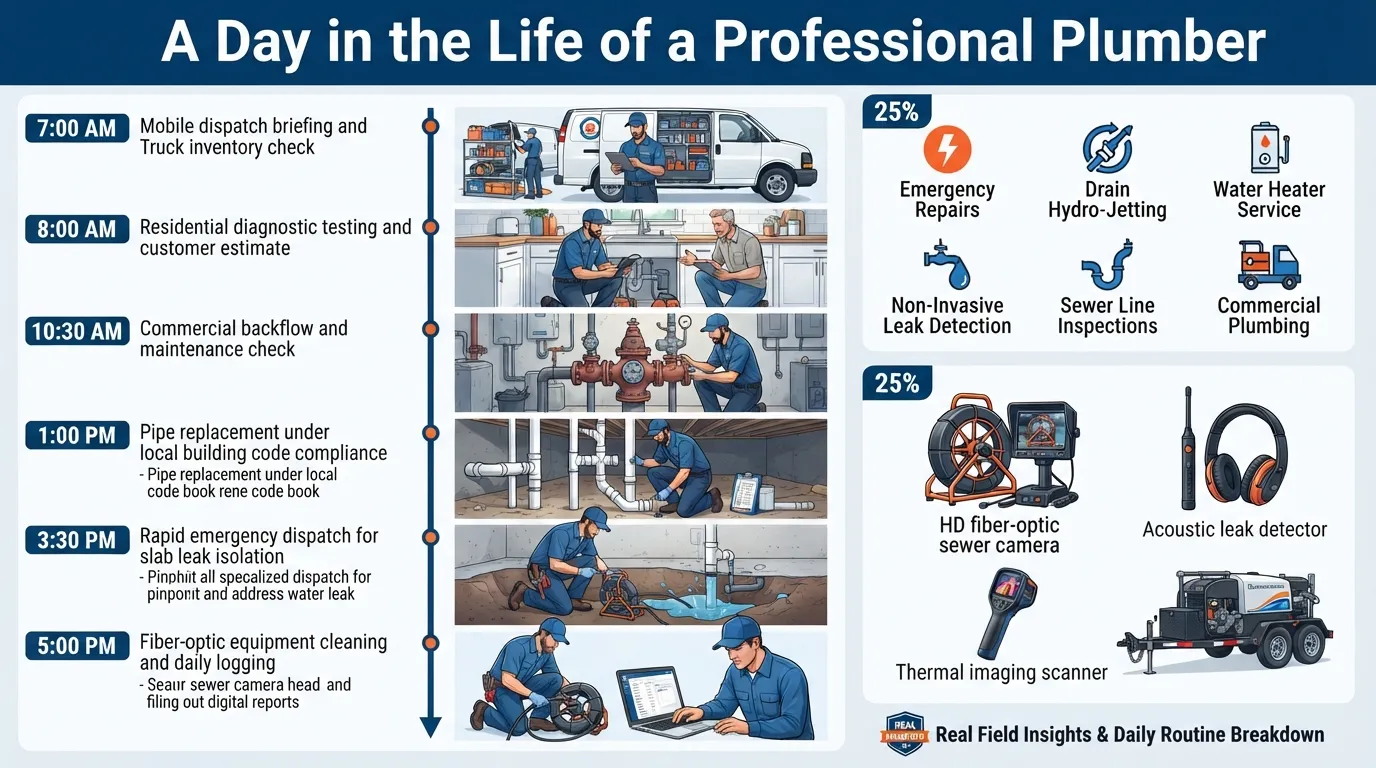
A plumber’s daily routine blends advanced technical diagnostics, mechanical precision, and direct client interactions. Far from being repetitive manual labor, a typical shift demands rapid problem-solving as technicians navigate shifting dispatch schedules, evolving code standards, and varied structural challenges across residential and commercial properties.
A Typical Day, Hour by Hour
A licensed field technician’s day starts early to ensure rapid response times across local service zones:
7:00 AM – Dispatch Briefing & Truck Stocking: Reviewing assigned service calls via mobile dispatch software, inspecting inventory, loading specialized parts, and verifying safety gear.
8:00 AM – First Morning Service Call: Arriving at a residential property for diagnostics, running preliminary pressure tests, and providing an upfront flat-rate estimate.
10:30 AM – Commercial Diagnostics: Transitioning to a local commercial building to perform scheduled backflow testing and mechanical system maintenance.
1:00 PM – Mid-Day Complex Repair: Replacing a failed mainline valve, joining pipe segments under strict local building codes, and completing city compliance documentation.
3:30 PM – Rapid Emergency Dispatch: Responding to an urgent, high-priority emergency call to isolate a major slab leak before catastrophic water damage occurs.
5:00 PM – Equipment Maintenance & Logs: Cleaning diagnostic cameras, logging job tickets, restocking parts, and staging the service vehicle for the next shift.
“People assume we just turn wrenches all day, but 80% of the job is diagnostic logic and communication,” notes Marco Vance, a Lead Master Technician with over 12 years of field experience in Miami plumbing. “You arrive at a home where a family is stressed because water is pouring through their ceiling. Being able to pinpoint the leak behind a wall without destroying their drywall, fixing it cleanly, and restoring their peace of mind—that is what makes this career genuinely rewarding.”
Common Jobs a Plumber Handles
Field technicians deliver comprehensive residential and commercial plumbing services to keep critical water, gas, and sanitation infrastructure operating safely:
Emergency plumbing calls: Rapid response to burst pipes, severe sewage backups, and main water line shut-offs to prevent structural property loss.
Drain cleaning: Clearing heavy grease blockages, root intrusions, and mineral scale build-up using high-pressure hydro-jetting and motorized snakes.
Water heater repair and installation: Servicing heating elements, flushing tank sediment, and installing energy-efficient tankless systems.
Leak detection and repair: Pinpointing hidden pinhole leaks inside walls, under concrete slabs, and within subfloors using non-invasive acoustic technology.
Sewer line repair: Repairing cracked, sagged, or collapsed lateral sewer pipes via traditional trenching or trenchless CIPP lining.
Toilet repairs: Fixing phantom flushes, replacing damaged fill valves, resolving recurring clogs, and installing high-efficiency fixtures.
Sump pump installation and repair: Testing float switches, replacing burn-out motors, and installing battery backup systems to prevent basements and sub-grade areas from flooding.
Commercial plumbing projects: Installing commercial grease traps, multi-story water booster pumps, and complex code-compliant waste networks.
The Tools and Technology Plumbers Use Today
Modern plumbing relies on sophisticated diagnostic equipment to resolve complex issues without unnecessary destruction:
HD Fiber-Optic Pipe Cameras: Flexible micro-cameras with built-in LED lighting and transmitters sent down drain lines to inspect pipe condition and map blockages in real time.
Acoustic & Ultrasonic Leak Detectors: High-frequency listening devices and ground microphones that locate the exact sound of water escaping under concrete slabs or inside walls.
Thermal Imaging Cameras: Infrared cameras that track temperature differentials to trace hidden hot water leaks, radiant floor defects, and moisture intrusion behind finishes.
Hydro-Jetting Systems: Industrial units that scour pipe interior walls clean at pressures up to 4,000 PSI using high-pressure water streams.
What Working Plumbers Say About the Job
Experienced trade professionals consistently highlight key aspects that make plumbing a satisfying long-term career:
High Daily Variety: Every job site presents a unique puzzle, ensuring work remains engaging and non-repetitive.
Job Security & Essential Demand: Automation cannot replace skilled hands-on mechanical troubleshooting, providing reliable long-term career stability regardless of economic fluctuations.
Tangible Problem-Solving: Technicians take pride in seeing direct, immediate results from their work, restoring vital clean water and sanitation to homes and businesses every day.
The Honest Downsides: Pros and Cons of Being a Plumber
Entering the plumbing trade requires balancing high financial rewards against genuine physical and operational challenges. While promotional overviews often gloss over the daily hurdles, experienced trade professionals emphasize that knowing the real downsides is essential to long-term career success.
Pros and Cons at a Glance
| Advantages (Pros) | Disadvantages (Cons) |
| Zero or minimal student loan debt at entry | Physically demanding work in tight, awkward spaces |
| High earning potential and strong job security | Unpredictable on-call shifts, nights, and weekends |
| Clear, structured path from apprentice to owner | Exposure to harsh environments, grime, and sewage |
| High autonomy and independent daily operations | Steep learning curve and low early-career wages |
Physical Demands and Injury Risk
Sustained physical strain: Plumbers frequently work in cramped crawlspaces, beneath low kitchen sinks, or in awkward overhead positions that strain muscles and joints.
Occupational health factors: Bending, lifting heavy cast-iron pipes, and using high-torque tools contribute to musculoskeletal stress, strains, and sprains over time.
On-Call Hours, Nights, and Weekends
Emergency disruptions: Plumbing failures happen without warning, requiring technicians to handle late-night pipe bursts, holiday backups, or weekend system collapses.
Work-life balance trade-offs: Emergency on-call rotations can disrupt personal schedules and family time, particularly for service-side residential plumbers.
Heat, Humidity, and Tight Spaces
Subtropical working environments: In regions like Florida, working in unconditioned attics, outdoor utility trenches, or unventilated commercial mechanical rooms exposes technicians to intense heat and humidity.
Confined maneuverability: Navigating tight structural spaces requires physical endurance, patience, and strict adherence to safety protocols.
Low Early-Career Pay
Apprentice compensation structure: First-year apprentices earn reduced entry-level wages while building foundational skills, requiring careful short-term financial planning.
The multi-year ramp-up: Reaching peak earning potential takes years of logged hours, classroom study, and passing rigorous licensing exams.
Is Plumbing a Low-Stress Job?
Plumbing is generally not considered a low-stress job. Technicians face high-pressure situations when arriving at homes or businesses flooded with water, where diagnosing complex, hidden problems under strict time constraints requires intense mental focus and emotional composure.
How Experienced Plumbers Manage the Downsides
Veteran tradespeople successfully navigate the challenges of the trade by investing in proper ergonomics, protecting their joints with heavy-duty knee pads, leveraging modern diagnostic tools to minimize guesswork, and setting firm scheduling boundaries as they advance in their careers.
As one master plumber with over 20 years in the field shares: “You have to take care of your body like an athlete and your truck like a business. If you respect the physical limits, pace yourself, and use your head before your muscles, you can build a long, highly lucrative career without burning out.”
Plumber vs. Electrician: Which Trade Is Better?
Choosing between a plumbing career and an electrical career comes down to personal preferences regarding physical labor, mental focus, and working environments. Both licensed trades offer exceptional job security, non-college training pathways, and high earning potential exceeding $63,000 to $108,000+ annually at full master or contractor status. However, key differences in day-to-day physical hazards, diagnostic complexity, and regulatory code requirements set them apart.
Side-by-Side Comparison: Plumbing vs. Electrical Trade
| Comparison Factor | Plumbing Career Path | Electrical Career Path |
| Typical Apprenticeship Length | 4 to 5 Years (8,000 hours OJT + classroom) | 4 to 5 Years (8,000 hours OJT + classroom) |
| National Median Annual Pay | $63,800 / year ($30.67 / hour) | $63,190 / year ($30.38 / hour) |
| Top 10% Earning Ceiling | $108,420+ / year | $108,510+ / year |
| Primary Physical Environment | Crawlspaces, damp basements, attics, wet trenches | Ladders, attics, utility panels, commercial conduit |
| Primary Safety Risk | Wastewater contaminants, torch burns, lifting strain | High-voltage electrocution, arc flash, fall risks |
| Licensing Requirements | State Journeyman & Master Plumbing Exams | State Journeyman & Master Electrician Exams |
| 10-Year Growth Rate | 7% (Faster than national average) | 6% (Faster than national average) |
Which Trade Is the Better Fit for You?
Selecting the right trade depends on the daily work conditions and problem-solving styles you prefer:
Plumbing is the better fit if: You enjoy working with heavy mechanical systems, fluid dynamics, and hands-on assembly. Plumbers often encounter greater variety in residential customer emergency calls and face slightly higher physical lifting demands, but benefit from less abstract theoretical code requirements than electrical theory.
An Electrical career is the better fit if: You prefer working in cleaner, dry environments and excel at abstract mathematical calculations, schematic reading, and precise circuit troubleshooting. While electricians face severe high-voltage electrocution risks, their work involves significantly less exposure to wastewater or biological contaminants.
What Is the Hardest Trade to Learn?
Determining the “hardest trade” depends entirely on whether physical strain or cognitive complexity poses a bigger challenge for you:
Cognitive & Theoretical Difficulty (Electrical): Electricians must master intricate electrical theory, national electrical code (NEC) regulations, Ohm’s law calculations, and multi-wire circuit diagrams. A single wiring error carries immediate fire or arc-flash hazards.
Physical & Environmental Difficulty (Plumbing): Plumbers navigate demanding physical conditions—maneuvering heavy cast-iron piping, operating motorized drain snakes in raw sewage, and soldering copper pipe in tight, unventilated crawlspaces or hot attics.
Neither trade is universally “harder”; electrical work demands greater mathematical precision, while plumbing demands higher physical stamina and resilience.
Other Skilled Trades Worth Comparing
Beyond plumbing and electrical work, several other licensed trades offer solid earning tracks with zero college debt:
HVAC Technician: Focuses on heating, ventilation, and air conditioning systems. Integrates electrical wiring, refrigeration chemistry, and sheet metal work. (National Median: $61,010/year)
Industrial Welder: Specializes in structural steel, pressure vessels, and pipeline joining. High demand in heavy manufacturing and infrastructure construction. (National Median: $53,750/year)
Framing & Finish Carpenter: Focuses on structural building frameworks, cabinetry, and interior trim work. Involves high physical activity and spatial design skills. (National Median: $58,150/year range)
Is Plumbing a Good Career for Women?
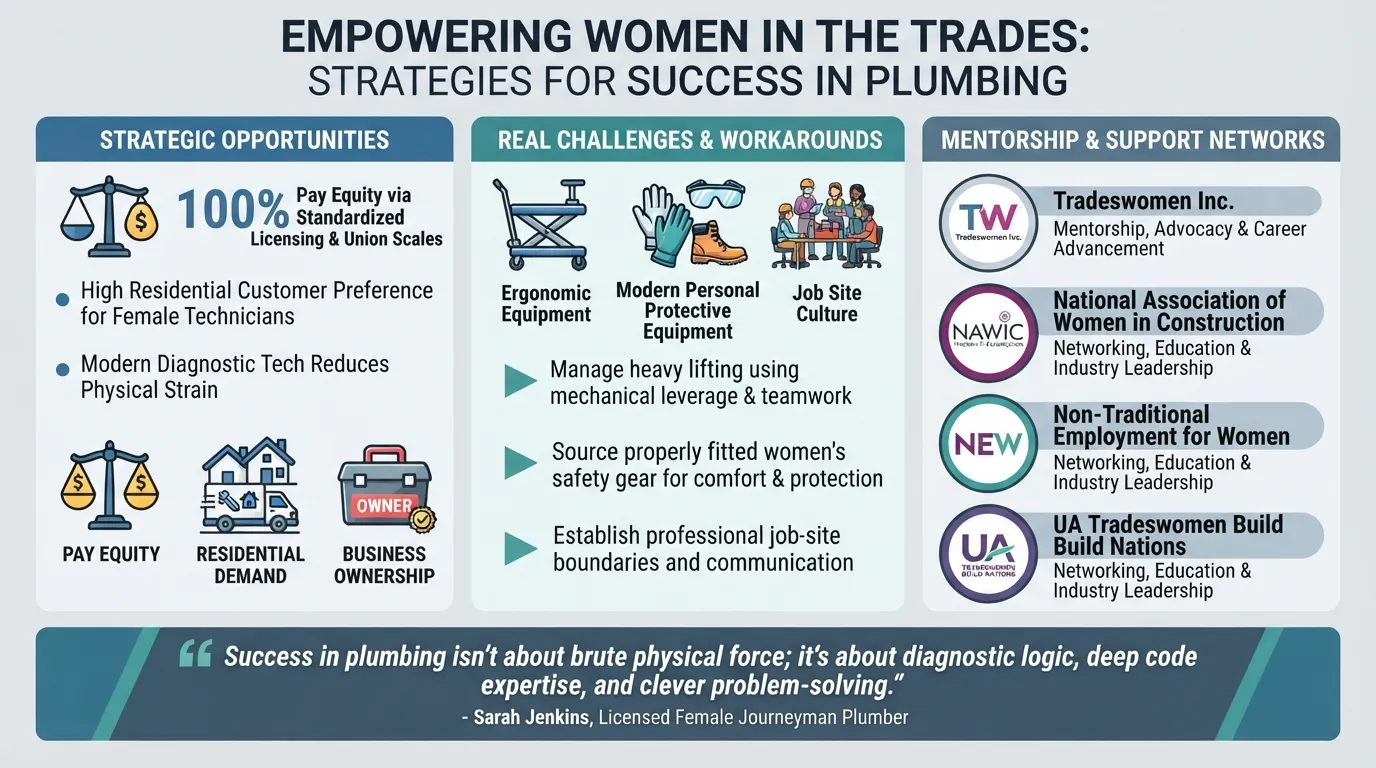
Plumbing represents a high-paying, recession-proof trade pathway for women, offering complete pay equity where compensation is strictly dictated by union wage scales, state licensing, and hourly skill tiers rather than gender. While women currently make up approximately 3.1% to 5.3% of the overall plumbing and pipefitting workforce in the United States, targeted recruitment initiatives, modern ergonomic tool designs, and expanding support networks are opening unprecedented operational opportunities across the trade.
Strategic Opportunities for Women in the Skilled Trades
Female plumbers possess distinct operational and market advantages that drive immediate career advancement and long-term business growth:
High Demand in Residential Contracting: Single homeowning women, elderly residents, and families frequently express a clear preference for female service technicians entering their private homes, giving female plumbing contractors a strong competitive marketing edge.
Equal Earning Potential: Unlike corporate offices where gender pay gaps persist, skilled trade apprenticeships and journey-level positions pay set, non-negotiable hourly wages based directly on license status and experience.
Precision and Problem-Solving: Modern plumbing relies heavily on diagnostic logic, thermal mapping, fiber-optic camera inspection, and detailed code compliance, where analytical precision and spatial awareness matter far more than brute physical force.
Entrepreneurial Ownership: The scarcity of female-led trades businesses creates massive positioning advantages for women launching independent residential service shops, commercial maintenance firms, or inspection agencies.
Real Challenges to Navigate Honestly
Entering a historically male-dominated industry presents distinct physical, cultural, and professional hurdles that require grit and strategic planning:
Physical Strain & Mechanical Workarounds: Operating heavy 100-pound sewer cables, lifting cast-iron fixtures, and breaking seized pipe fittings require technique, mechanical leverage, and specialized lifting equipment rather than reliance on raw muscle.
Workplace Culture & Social Resistance: Outdated stereotypes, casual job site skepticism, and working alongside male-dominated crews require thick skin, firm professional boundaries, and unwavering confidence in code knowledge.
Improperly Sized Protective Gear: Finding specialized personal protective equipment (PPE)—such as properly fitted cut-resistant gloves, safety harnesses, and work boots sized accurately for women—can still require sourcing from specialized trade gear suppliers.
Isolating Early Career Stages: Being the only female technician on a large commercial construction site or within an apprentice cohort can feel isolating without an established local peer network.
Professional Mentorship and Support Networks
Women pursuing a plumbing career can access specialized mentorship programs, trades education funds, and industry advocacy groups designed to accelerate training and job placement:
Tradeswomen Inc.: A dedicated advocacy organization providing career counseling, pre-apprenticeship support, and job placement assistance for women entering building and mechanical trades.
National Association of Women in Construction (NAWIC): A national network offering professional development, leadership training, and local mentorship chapters across the mechanical contracting sector.
Non-Traditional Employment for Women (NEW): A structured workforce development program preparing women for union apprenticeships, safety certifications, and physical readiness in heavy mechanical fields.
UA Tradeswomen Build Nations: An annual international conference gathering thousands of union female plumbers, pipefitters, and sprinkler fitters to share technical insights, union leadership paths, and workplace strategies.
A Voice From the Field
“Plumbing is a huge brain game; people think you just muscle heavy pipes all day, but 90% of it is understanding fluid mechanics, building codes, and diagnostic troubleshooting,” shares Sarah Jenkins, a licensed Journeyman Plumber. “When you step onto a job site, your license and your work output speak for themselves. Once clients and site foremen see that you diagnose problems fast and execute clean, leak-free installations, gender completely fades into the background—you’re simply a skilled professional getting the job done.”
Is Plumbing a Good Career for the Future?
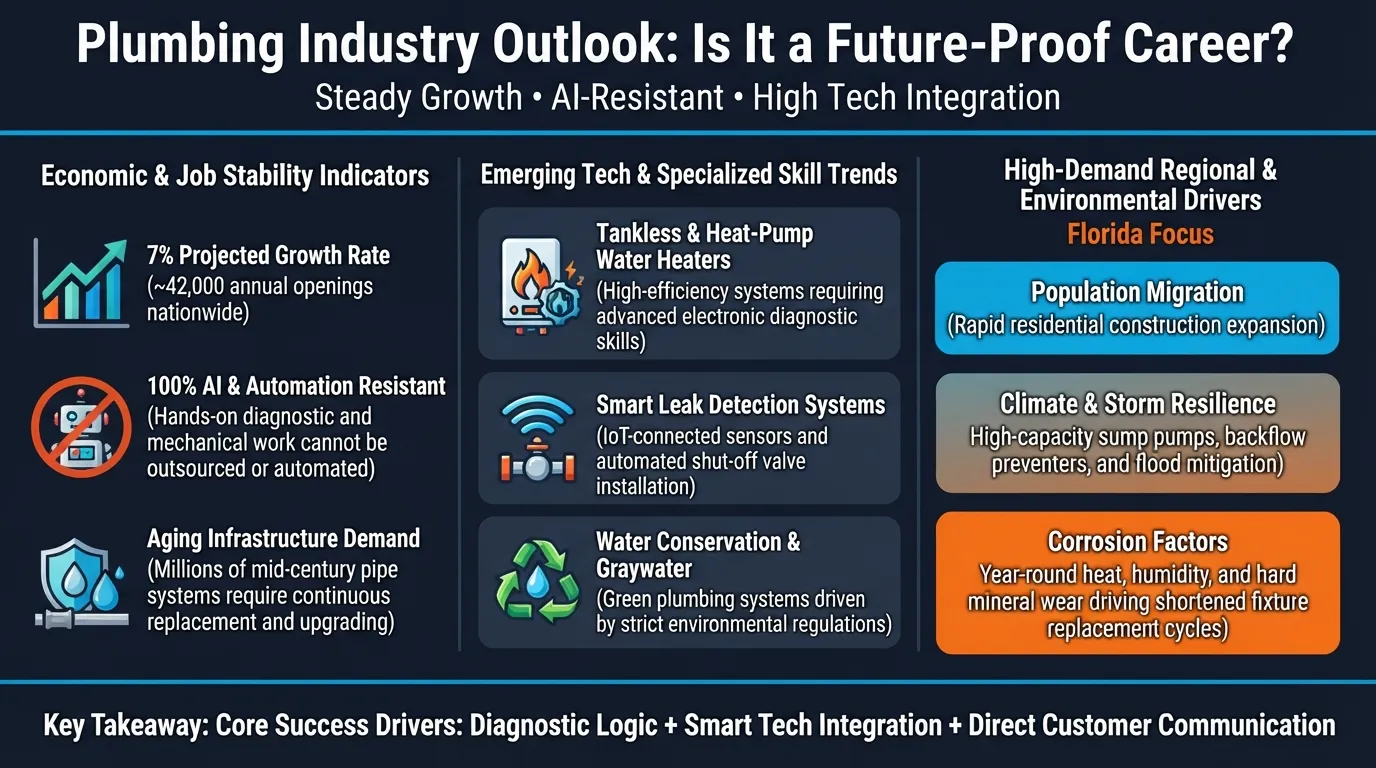
Plumbing offers exceptional long-term stability driven by essential public health necessity, non-automatable hands-on skill requirements, and continuous infrastructure replacement. While industry expansion reflects steady, reliable demand rather than explosive tech-sector growth, the trade remains virtually immune to offshore outsourcing, economic recessions, and artificial intelligence displacement.
Honest Job Outlook: Steady, Reliable Growth
The long-term career outlook for plumbers is defined by consistent demand rather than volatile boom-and-bust cycles. Official employment projections anticipate a steady 7% expansion rate over the coming decade, creating approximately 42,000 job openings per year nationally.
Rather than relying purely on new construction, the vast majority of these annual openings stem from workforce retirements and the ongoing operational need to repair existing sanitation networks.
Aging Infrastructure and Continuous Replacement Demand
A primary driver for the future of plumbing is the critical state of national pipe networks. Millions of commercial buildings and residential structures built during the mid-20th century rely on aging galvanized iron, cast iron, or orangeburg piping systems that are reaching the end of their operational lifespan. Replacing deteriorated main lines, converting lead supply connections, and updating municipal water networks ensure decades of continuous work for licensed piping contractors.
Technological Advancement: Water Conservation and Smart Plumbing
The modern trade is rapidly evolving through green technologies and internet-connected plumbing devices, requiring technicians to expand their technical knowledge:
High-Efficiency Tankless Systems: Widespread adoption of tankless and heat-pump water heaters requires plumbers skilled in advanced electrical controls, gas line sizing, and electronic diagnostic error codes.
Smart Leak Sensors & Automated Shut-Offs: Internet-connected leak detection systems and remote water shut-off valves require technicians to integrate mechanical pipe assembly with smart home networking.
Water Conservation & Graywater Recycling: Stringent environmental regulations drive demand for dual-flush systems, low-flow commercial fixtures, and graywater recycling networks that repurpose non-potable water.
Why Florida and Coastal Markets Present Unique Growth
The future of plumbing in coastal regions like Florida is fueled by aggressive population migration and extreme climate resilience demands:
Continuous Construction Growth: Expanding residential developments and commercial high-rises require miles of newly installed utility and supply piping.
Hurricane and Flood Resilience: Severe tropical weather, rising water tables, and coastal tidal surges create constant demand for high-capacity sump pumps, backflow preventers, and reinforced storm drainage systems.
Subtropical Environmental Wear: Year-round high humidity, salt air exposure, and mineral-rich hard water accelerate pipe corrosion and mechanical fixture failure, shortening replacement cycles compared to northern climates.
Core Skills That Keep You Valuable in the Future
To maximize long-term earning power and stay competitive in an evolving marketplace, modern plumbers must cultivate a versatile skill set:
Advanced Diagnostic Logic: Mastering non-invasive diagnostic equipment—such as thermal imaging cameras, fiber-optic pipe scopes, and ultrasonic acoustic detectors—to solve complex leaks efficiently.
Tech-Savvy Operations: Utilizing digital dispatch applications, mobile estimating software, and automated inventory systems directly from field service vehicles.
Exceptional Customer Communication: Delivering clear, transparent flat-rate pricing, explaining complex technical repairs simply, and providing superior service that generates repeat clients and five-star reviews.
Is Plumbing Right for You? Checklist and How to Get Started
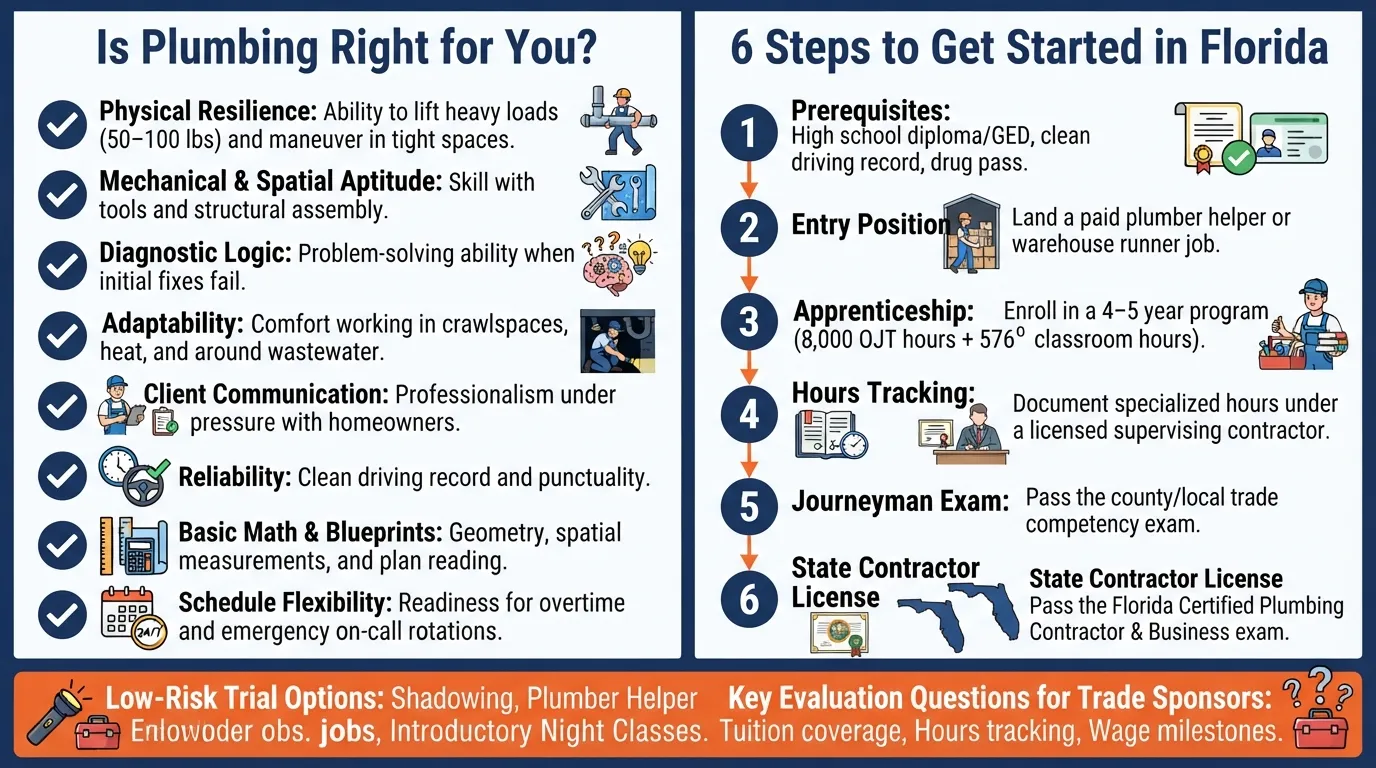
Deciding to enter the plumbing trade requires matching your personal strengths, physical capabilities, and career goals with the everyday realities of mechanical fieldwork. Whether you are entering the workforce fresh out of high school or considering a mid-life career change at 30 or 40, transitioning into the trade offers a direct pathway to financial independence without accumulating college tuition debt.
Quick Self-Assessment Checklist
Review these fundamental operational criteria to determine whether a plumbing career aligns with your work style and expectations:
[ ] Physical Resilience: Are you comfortable lifting heavy equipment (50–100 lbs), crawling under sub-floors, and working on your feet for 8 to 10 hours daily?
Mechanical Aptitude: Do you enjoy working with your hands, using power tools, and figuring out how mechanical systems fit together?
Diagnostic Logic: Can you systematically troubleshoot complex problems when an initial repair attempt does not go as planned?
Adaptability to Working Conditions: Are you comfortable working in extreme weather, cramped spaces, or messy environments containing wastewater and grime?
Strong Customer Communication: Can you remain calm, professional, and empathetic when explaining costly repairs to stressed homeowners?
Dependable Work Ethic: Do you maintain a clean driving record, pass drug screenings, and consistently show up on time for early-morning dispatches?
Math & Blueprint Readiness: Are you comfortable with basic algebra, spatial geometry, and precise tape-measure calculations?
Schedule Flexibility: Are you willing to work overtime, weekend shifts, or emergency on-call rotations when mainline failures occur?
6 Steps to Start a Plumbing Career in Florida
Starting a plumbing career in Florida involves a structured progression from entry-level foundational work to state licensure:
Meet Basic Prerequisites: Earn a high school diploma or GED, obtain a valid Florida driver’s license with a clean driving record, and ensure you can pass standard pre-employment drug screenings.
Secure an Entry-Level Position: Apply for a paid entry-level plumber or helper job with a licensed mechanical contractor to gain initial field exposure and safety experience.
Enroll in a Registered Apprenticeship Program: Join a recognized union (such as UA Local 519 in South Florida) or non-union (ABC/PHCC) trade program to complete 8,000 required hours (4 to 5 years) of paid on-the-job training alongside 576+ hours of classroom instruction.
Maintain Meticulous Hours Tracking: Log every verified work hour under your supervising licensed contractor, ensuring proper documentation across residential, commercial, industrial, and drainage specialties.
Pass the County or Journeyman Competency Exam: Upon completing your apprenticeship hours, register for and pass your local county Journeyman examination (or trade competency equivalent) covering local plumbing codes and isometric plan reading.
Apply for Florida Plumbing Contractor Licensure: After meeting state experience requirements (typically 4 years of total trade experience), pass the comprehensive 9-hour Florida State Certified Plumbing Contractor exam and Business & Finance test to launch your own independent business.
How to Try Before You Commit
If you are uncertain about committing to a multi-year apprenticeship or contemplating a career change at 30 or 40, utilize these low-risk strategies to evaluate the trade firsthand:
Request Job Shadowing: Contact local residential service contractors and request to shadow a senior field technician for 2 to 3 days to observe the real daily routine, dispatch flow, and job site environments.
Apply for a Plumber Helper Job: Take an entry-level helper job or warehouse runner role with a local plumbing company. Helper positions require zero prior trade experience and allow you to stock trucks, deliver parts, and assist technicians while earning an hourly wage.
Enroll in a Trade School Introductory Course: Take a short, 8-week introductory pipefitting or mechanical trades night course at a local vocational community college to test your mechanical aptitude and blueprint reading skills before applying for formal apprenticeships.
Key Questions to Ask an Apprenticeship Program or Employer
Before signing an apprenticeship contract or accepting an entry-level plumber offer, ask prospective sponsors these vital evaluation questions:
Sponsorship & Cost: “Does the company cover 100% of my trade school tuition and textbook fees, or are those expenses deducted from my paycheck?”
Hours Tracking & Licensing Support: “How does your company track and sign off on my official on-the-job training hours to ensure I qualify for my licensing exams without delays?”
Wage Scales & Merit Raises: “What is the exact hourly starting pay, and what specific milestones or license completions trigger guaranteed wage increases?”
Equipment & Tool Allowances: “Does the company provide heavy diagnostic equipment and power tools, or am I expected to purchase my own tool set out of pocket?”
Safety & PPE Policies: “What personal protective equipment is provided, and what safety protocols are enforced on high-risk commercial or excavation job sites?”
Plumbing Career FAQs
What are the benefits of becoming a plumber?
Becoming a plumber provides high earning potential without college debt, immediate income during paid apprenticeships, and exceptional job security. Plumbers enjoy strong trade independence, high daily variety across residential and commercial environments, and the long-term potential to build a lucrative contracting business with zero risk of AI automation.
Why is plumbing so important?
Plumbing is fundamental to public health, sanitation, and modern civilization. Without functional plumbing systems, communities face severe contamination risks, waterborne disease outbreaks, and unmanaged waste. Plumbers protect drinking water safety, manage municipal sewage, and maintain essential heating and backflow infrastructure that keeps homes, hospitals, and businesses safe.
Is a plumber a good career choice?
Yes, plumbing is a highly rewarding career choice for those who enjoy mechanical problem-solving and hands-on work. It offers recession-proof stability, structured license progression, and median earnings exceeding $63,800 per year. Top-tier master plumbers and shop owners routinely earn six-figure incomes while benefiting from lifelong career independence.
Why should I become a plumber?
You should become a plumber if you want to earn while you learn through a paid apprenticeship rather than accumulating heavy student debt. The trade provides immediate cash flow, high demand in growing metro regions, tangible satisfaction from solving critical problems, and clear pathways to launching your own business.
What are the pros and cons of becoming a plumber?
The pros include high pay potential, job security, zero university debt, and diverse daily job sites. The cons involve physical strain, exposure to wastewater and harsh weather, irregular emergency on-call hours, and modest apprentice starting pay. Balancing ergonomic care with long-term business goals helps manage these trade-offs effectively.
What is the hardest trade to learn?
The hardest trade depends on your specific strengths. Electrical work is widely considered the most theoretical due to complex code regulations, electrical math, and high-voltage circuit mechanics. Plumbing is often considered the most physically demanding due to heavy lifting, maneuvering in tight crawlspaces, and handling high-pressure piping assemblies under harsh conditions.
Are plumbers the next millionaires?
Plumbers do not become millionaires solely through standard hourly wages. However, skilled technicians who transition into plumbing business owners—managing multi-truck fleets, scaling service contracts, and employing licensed journeymen—frequently build net worths exceeding seven figures through business equity, high profit margins, and commercial expansion.
Is plumbing a low-stress job?
Plumbing is not a low-stress job. Field technicians face daily pressure diagnosing complex system failures, working against tight customer timelines, managing physical risks, and responding to high-stakes emergency leaks. Managing stress requires strong diagnostic organization, effective boundary setting for on-call shifts, and consistent physical self-care.
What did Albert Einstein say about plumbers?
Albert Einstein is widely attributed as stating in a 1954 letter that if he were a young man again, he would choose to be a plumber or a peddler in search of modest independence. While the quote’s exact context remains historically disputed, it highlighted his admiration for practical trade independence during a politically tense era.
What are five lines about a plumber?
A plumber is a skilled trade professional who installs, repairs, and maintains essential water, gas, and drainage systems. They perform vital diagnostic tasks, clear clogged sewer lines, and service heating equipment to keep communities clean and safe. By earning while they learn through paid apprenticeships, plumbers avoid student debt while acquiring lifelong mechanical expertise. Plumbers work in diverse residential, commercial, and industrial settings to protect public health every day. With high demand and strong earning potential, plumbing remains one of the most reliable and essential careers in the skilled trades.
Final Verdict: Should You Become a Plumber?
Becoming a licensed plumber is an exceptional career choice if you enjoy active, mechanical problem-solving and want to earn a competitive income without taking on heavy college debt. While the physical demands, tight spaces, and emergency on-call shifts require genuine resilience, the long-term payoff is unmatched job security and complete career independence. If you possess a strong work ethic, diagnostic aptitude, and the willingness to learn on the job, a plumbing career provides a direct pathway to financial freedom and business ownership.
Key Takeaways
Debt-Free Earning Pathway: Paid apprenticeship programs allow you to earn a full-time wage while mastering your trade, completely bypassing student loans.
Exceptional Pay Ceiling: National median pay stands at $63,800 annually, with experienced master plumbers and specialized contractors earning over $108,000 to $400,000+ through business equity.
Recession-Proof Stability: Essential water, sanitation, and gas infrastructure repairs cannot be automated by AI or outsourced overseas, ensuring lifetime job security.
Multiple Specialization Tracks: Career growth spans residential service, commercial construction, industrial pipefitting, medical gas certification, and contracting business ownership.
Physical Resilience Required: Long-term success demands managing ergonomic physical stress, using proper personal protective equipment, and pacing your daily workflow to maintain lasting health.
If you are a local property owner currently facing an active leak, drain backup, or fixture issue, you can quickly book a plumber for fast, professional service.
Main Services
Related Posts
Need a Plumber in Miami?
Schedule service online or speak directly with the EZ Plumbing team.
Owner-Led Local Service
Know who is behind the business before you request service. The owners, contact line and Miami service pages are published clearly.
- Named business owners
- Direct phone and social channels
- Local Miami service information
Clear Help Before You Book
Review the relevant service page, contact the team directly and use the booking page when you are ready—without relying on vague claims.
- Service-specific information
- Direct questions before scheduling
- Clear online booking route