Thermostatic vs Pressure Balance Shower Valves: What's the Difference?
Thermostatic vs. Pressure Balance Shower Valves at a Glance
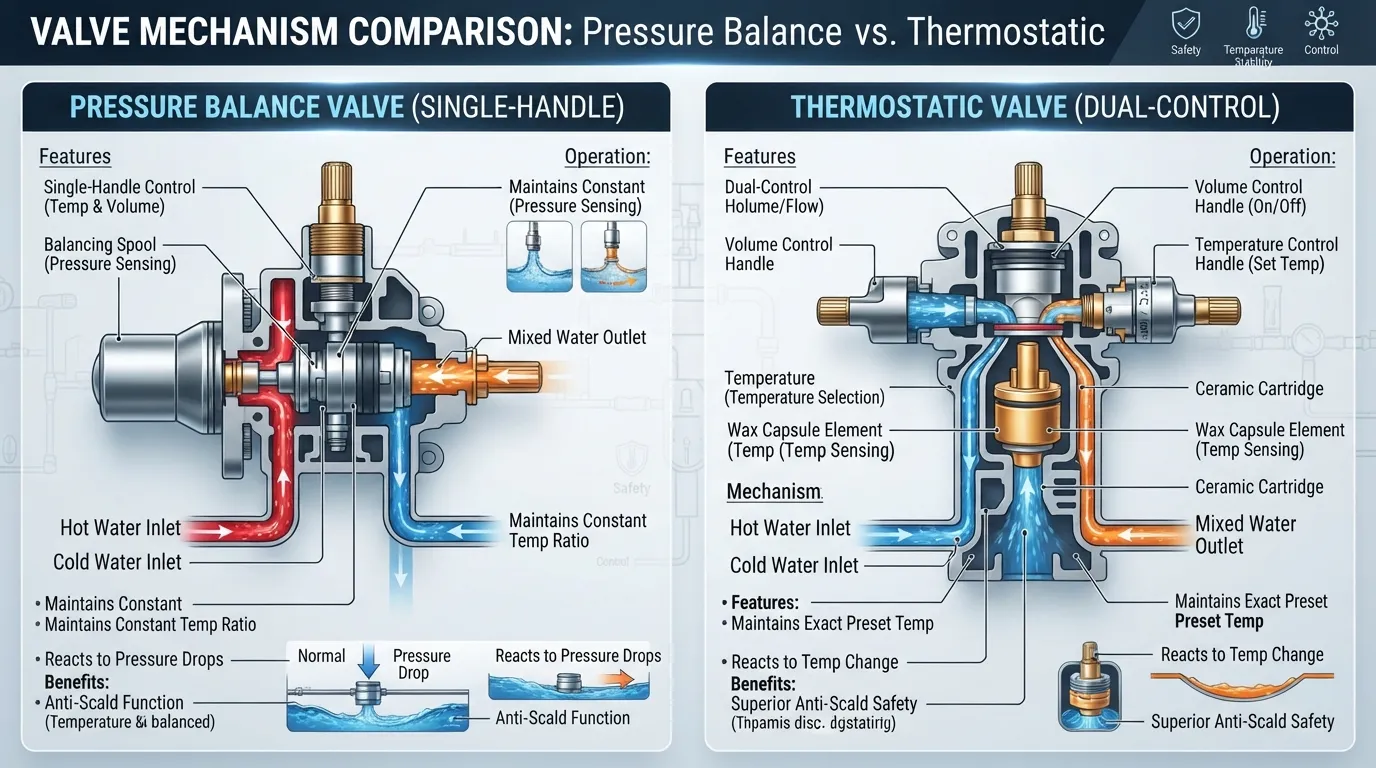
Choosing the right shower valve dictates your daily comfort, safety, and water flow capabilities. The fundamental difference lies in how they regulate your water: pressure balance valves focus entirely on balancing water pressure to prevent sudden temperature spikes, while thermostatic shower valves independently measure and control water temperature regardless of pressure fluctuations in your plumbing lines.
Quick Comparison Table
| Feature | Pressure Balance Valve | Thermostatic Valve |
| How it works | Uses a pressure-balancing piston or spool to equalize hot and cold water pressure. | Uses a wax thermostatic element to blend water to a precise, pre-set temperature. |
| What it senses | Pressure changes only. | Temperature changes only. |
| Controls | Typically single-handle control (rotates for temperature, often pulls/pushes for volume if equipped). | Dual or separate controls (one handle for precise temperature, separate handles for volume/outlets). |
| Temperature accuracy | Moderate (subject to minor fluctuations if someone flushes a toilet elsewhere). | High (maintains temperature within $\pm 1°F$, shutting off if hot water fails). |
| Outlet capacity | Designed for a single shower outlet (showerhead or tub/shower combo). | High capacity, capable of supporting multiple outlets (showerhead, hand shower, body sprays). |
| Flow rate | Standard flow rate, optimized for basic setups. | Often allows higher GPM flow rates, though performance depends on the rough-in valve capacity. |
| Typical cost range | Budget-friendly ($50 to $200 for the valve body). | Premium ($200 to $600+ for the valve body and trim). |
| Installation complexity | Standard plumbing installation; straightforward for single-outlet retrofits. | More complex installation; often requires separate volume control valves and deeper wall space. |
| Best for | Standard guest bathrooms, single-shower setups, and budget-conscious projects. | Master bathrooms, multi-head luxury showers, households with children or elderly residents prioritizing safety. |
Note: Specific features, flow rates, and performance vary by model, so always check the manufacturer’s technical specifications before purchasing.
The One-Sentence Rule of Thumb
Pressure balance systems serve as the reliable, budget-friendly choice for a single showerhead setup. Thermostatic systems deliver precise temperature management and support multiple outlets, making them ideal when safety, comfort, and custom luxury are top priorities.
What Is a Pressure Balance Shower Valve and How Does It Work?
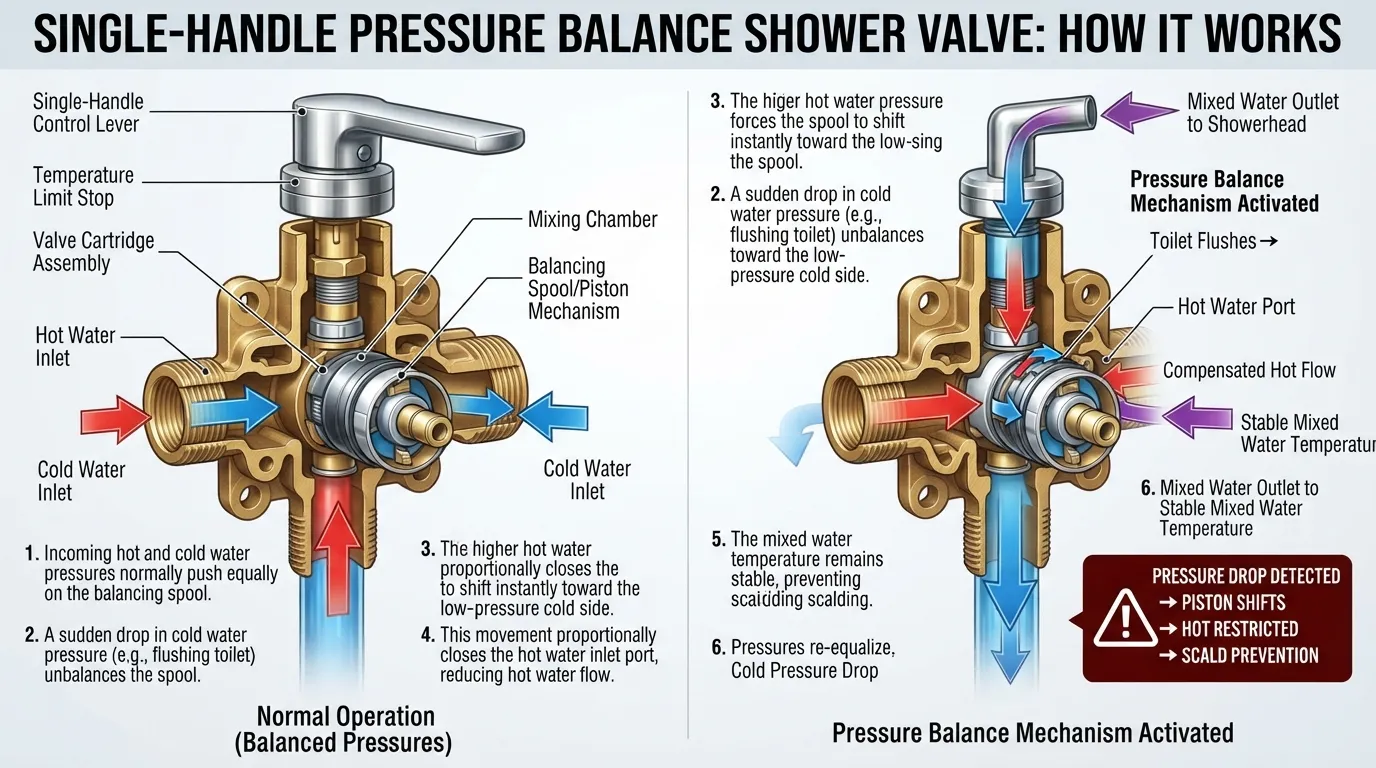
A pressure-balancing valve serves as the mechanical heart of a traditional shower, designed specifically to prevent sudden scalding or freezing when household water usage fluctuates. By automatically equalizing hot and cold water pressures, it ensures your shower temperature remains safe and stable even when appliances draw from the supply lines.
How a Pressure Balance Valve Works
At the core of the rough-in valve sits a precision-engineered cartridge containing a floating piston or spool. This internal mechanism continuously monitors the incoming pressures of both supply lines and instantly shifts toward the side experiencing a drop in pressure to restrict the stronger flow.
Plumber’s Note: In residential service calls, homeowners frequently ask why a hot-water spike hits the shower the exact second someone flushes a toilet or runs the washing machine. When a toilet flushes, it rapidly diverts cold water supply, causing a sudden cold-pressure drop. The piston inside a pressure-balancing valve instantly slides toward the cold port to throttle the hot water, protecting you from thermal shock within a fraction of a second.
Single-Handle Operation: A single handle controls both temperature and volume simultaneously, rotating for temperature mix and pulling outward for flow.
Internal Cartridge: The replaceable cartridge acts as the primary moving assembly, housing the spool or piston mechanism that manages pressure shifts.
Pros of Pressure Balance Valves
Pressure balance valves remain an industry staple for standard bathroom renovations due to their reliability, safety compliance, and cost-effectiveness.
Cost-Effective: Significantly more affordable than luxury multi-port systems, reducing overall project expenses.
Code Compliant: Easily meets modern anti-scald safety requirements mandated in residential plumbing codes.
Simple Design & Maintenance: Features fewer moving parts, making replacement trim kits and internal cartridges widely available at any hardware store.
Limitations of Pressure Balance Valves
While highly dependable for standard applications, pressure balance systems have inherent mechanical limitations governed by their design.
Pressure-Driven Only: They react exclusively to pressure changes, meaning they cannot compensate for temperature drift if the water heater’s overall output temperature shifts.
Linked Controls: Temperature and volume share a single handle, so adjusting the flow rate can inadvertently alter the feel of the water temperature.
Single-Outlet Capacity: Designed primarily for a single-outlet setup, making them unsuitable for complex multi-head shower systems or separate body sprays.
Who Should Choose One
Standard Remodels: Ideal for guest bathrooms, powder rooms, and standard tub-and-shower combinations.
Single Showerhead Layouts: Perfect for homes utilizing one primary showerhead without auxiliary body sprays or hand showers.
Budget-Conscious Projects: Excellent for homeowners seeking reliable safety and performance without the premium cost of thermostatic infrastructure.
What Is a Thermostatic Shower Valve and How Does It Work?
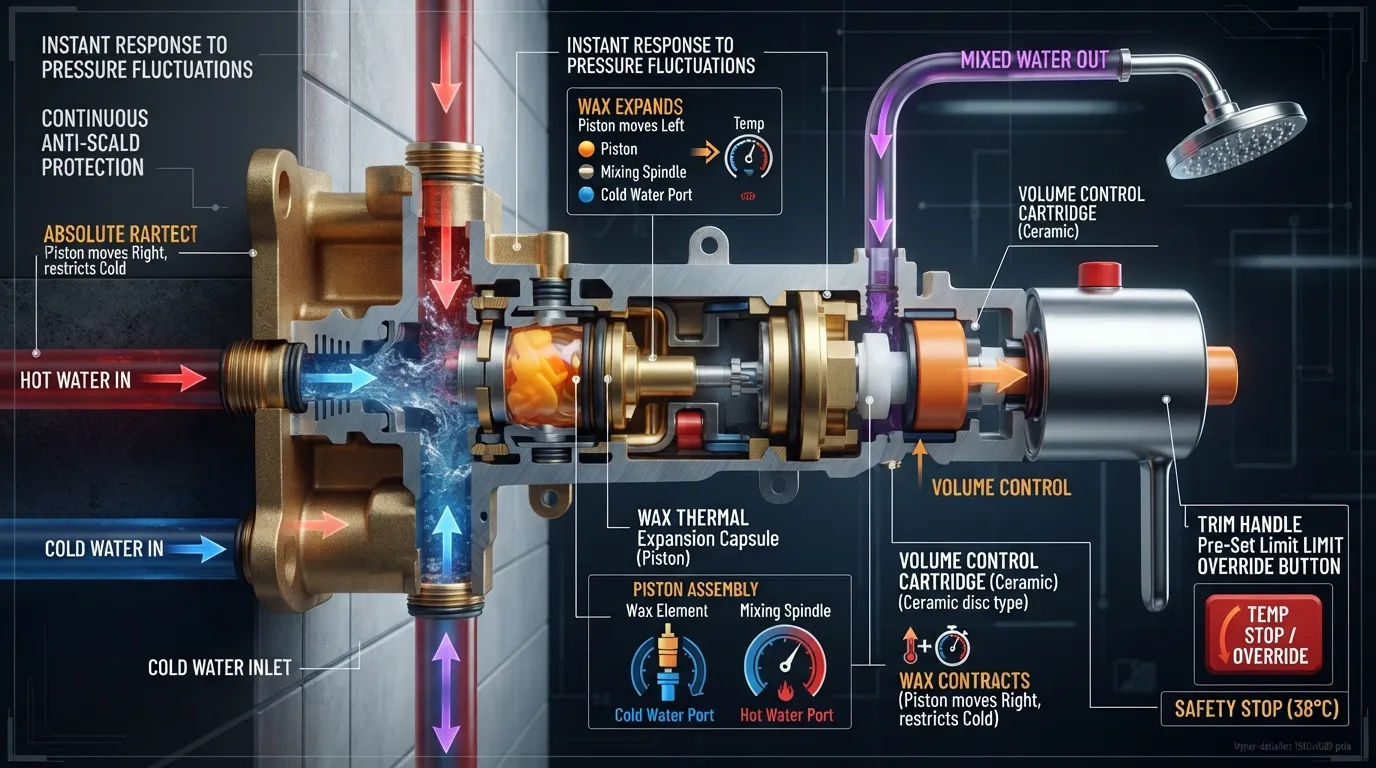
A thermostatic shower valve represents the gold standard in modern bathroom luxury and safety, engineered to deliver absolute temperature precision. Unlike basic valves, it dynamically controls water temperature independently of water pressure, ensuring your shower remains within a fraction of a degree of your desired setting from start to finish.
How a Thermostatic Valve Works
At the heart of a thermostatic valve lies a responsive wax or thermal element that continuously senses the actual mixed water temperature. As the water temperature shifts due to outside fluctuations, the wax expands or contracts to automatically adjust the ratio of hot and cold water flowing into the valve.
Plumber’s Note: On custom multi-outlet jobs featuring a combination rain showerhead, hand shower, and multiple body sprays, a standard pressure-balance valve simply falls short of the performance and safety requirements. Thermostatic valves handle these high-demand layouts effortlessly by keeping the temperature rock-solid, even when multiple heavy-flow outlets are running simultaneously.
Independent Controls: Features separate dials—typically a primary temperature dial for your exact degree setting and a secondary volume or diverter control to manage flow and select specific outlets.
Built-in Safety Stop: Most models include a manual override safety button set around 100°F to 104°F to protect users from accidental scalding.
Pros of Thermostatic Valves
Thermoset technology offers unmatched performance advantages, making it the preferred choice for high-end residential and multi-outlet shower configurations.
Pinpoint Accuracy: Maintains your chosen temperature within $\pm 1°F$, eliminating sudden hot or cold surges.
Dual Compensation: Automatically adjusts for both pressure drops and supply-line temperature changes (such as when a household appliance alters water heater output).
High Flow Capacity: Engineered to support high flow rates, making them ideal for complex, multi-outlet luxury setups.
Limitations of Thermostatic Valves
Despite their advanced capabilities, thermostatic systems come with specific trade-offs that homeowners should consider before purchasing.
Higher Investment: Both the rough-in valve body and the compatible trim kits carry a significantly higher price tag.
Complex Installation: Requires more intricate plumbing installation, often demanding a dedicated separate volume control valve and extra wall cavity depth.
Hot Water Demand: Because they support multiple high-flow outlets like body sprays and rain showerheads, your home’s water heater must be adequately sized to feed the system.
Who Should Choose One
Multi-Outlet Showers: Essential for custom shower stalls combining a rain showerhead, hand shower, and body sprays.
Safety-First Households: Ideal for families with young children or elderly residents who require reliable anti-scald protection.
Comfort-Driven Remodels: Perfect for homeowners prioritizing a spa-like, precise temperature experience.
Key Differences Side by Side
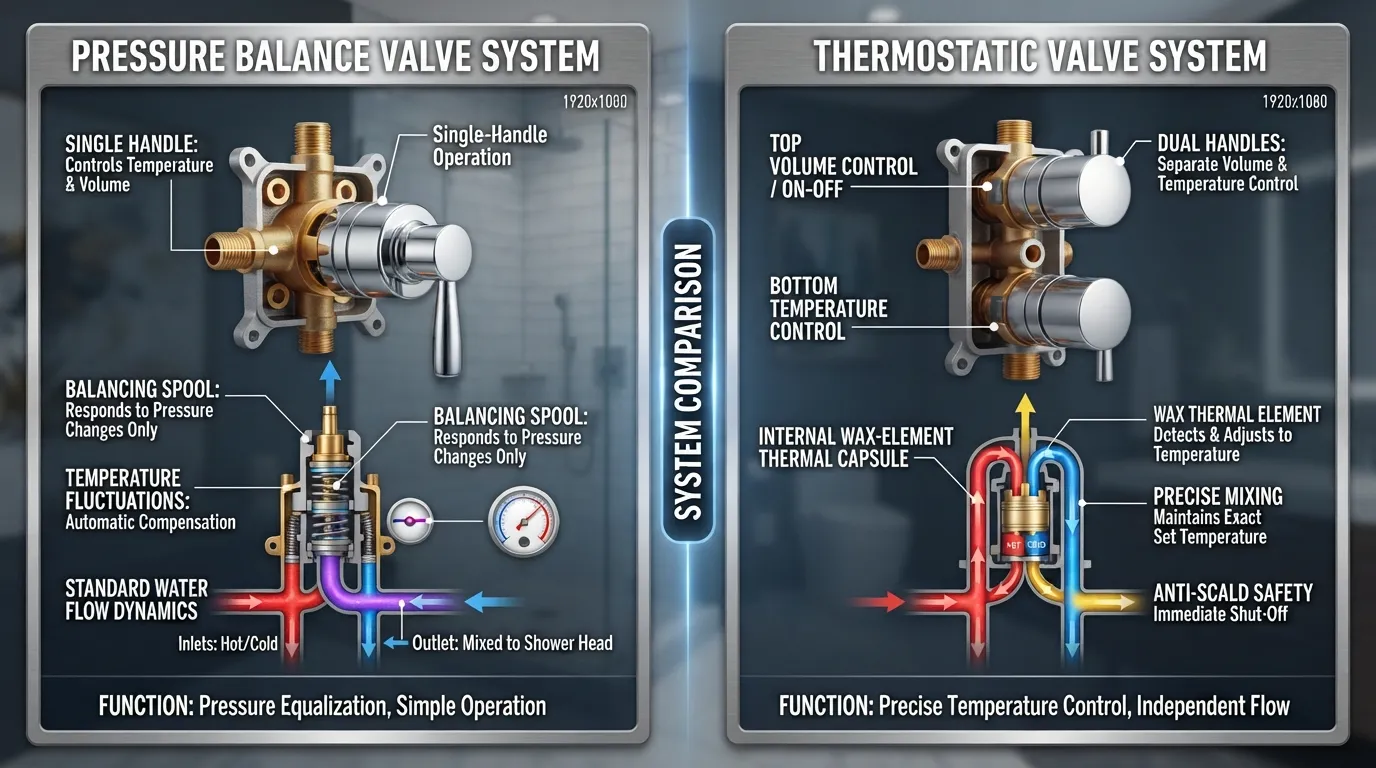
Comparing shower valves requires looking past the surface trim to understand how internal mechanics govern daily performance, safety, and long-term convenience. Evaluating these core differences ensures your selection matches both your household usage patterns and plumbing infrastructure.
Temperature Control and Accuracy
Pressure Balance Valves: These units monitor incoming pressure variations but remain blind to absolute temperature. If a household appliance alters the overall water heater output, a pressure-balance valve will experience temperature drift because the incoming hot water temperature itself has changed.
Thermostatic Valves: Operating via a wax or thermal element, these valves sense the actual mixed water temperature directly. They actively correct for both pressure drops and source-temperature shifts, holding your water temperature steady within a fraction of a degree.
Safety and Scald Protection
Pressure Balance Mechanism: Scald prevention relies entirely on mechanical equilibrium. If cold pressure drops suddenly due to a toilet flush, the valve instantly throttles hot water to prevent thermal shock.
Thermostatic Mechanism: Protection relies on two layers: active thermal blending and a built-in mechanical safety stop (typically capped at 100°F to 104°F). Users must manually press an override button to access higher temperatures, adding an extra safeguard for children and elderly family members.
Flow Rate and Number of Outlets
Standard Limits: Pressure balance valves are generally engineered for a single-outlet configuration, such as a standalone showerhead or a tub-and-shower combination.
Multi-Outlet Flexibility: Thermostatic rough-in valves offer higher flow capacities and pair seamlessly with dedicated diverters. This allows you to run complex multi-head configurations—like a rain showerhead, hand shower, and wall body sprays simultaneously—though exact flow rates and GPM limits always vary by specific manufacturer models and plumbing line sizes.
Controls and Daily Use
Unified Handle Experience: Pressure balance systems use a single handle that rotates to adjust temperature and pulls outward to increase volume, keeping daily operation simple and intuitive.
Independent Dial Layout: Thermostatic systems feature separate, dedicated controls. One dial sets the exact water temperature, while a secondary handle or push-button array manages volume and outlet selection, offering a customized, spa-like experience.
Cost and Installation Complexity
Budget vs. Premium: Pressure balance units feature a straightforward design that requires less wall cavity depth and lower upfront product costs.
Advanced Infrastructure: Thermostatic installations involve higher material costs, more intricate rough-in valve assemblies, and often require running separate volume control valves for each water source.
Maintenance
Service Simplicity: Pressure balance valves feature fewer moving parts, making internal cartridge replacements and routine maintenance quick and affordable.
Scale Management: Thermostatic wax elements can be more sensitive to hard water mineral buildup over time, making periodic cartridge cleaning or replacement necessary to preserve peak temperature accuracy.
Which Is Better: Thermostatic or Pressure Balance Shower Valves?
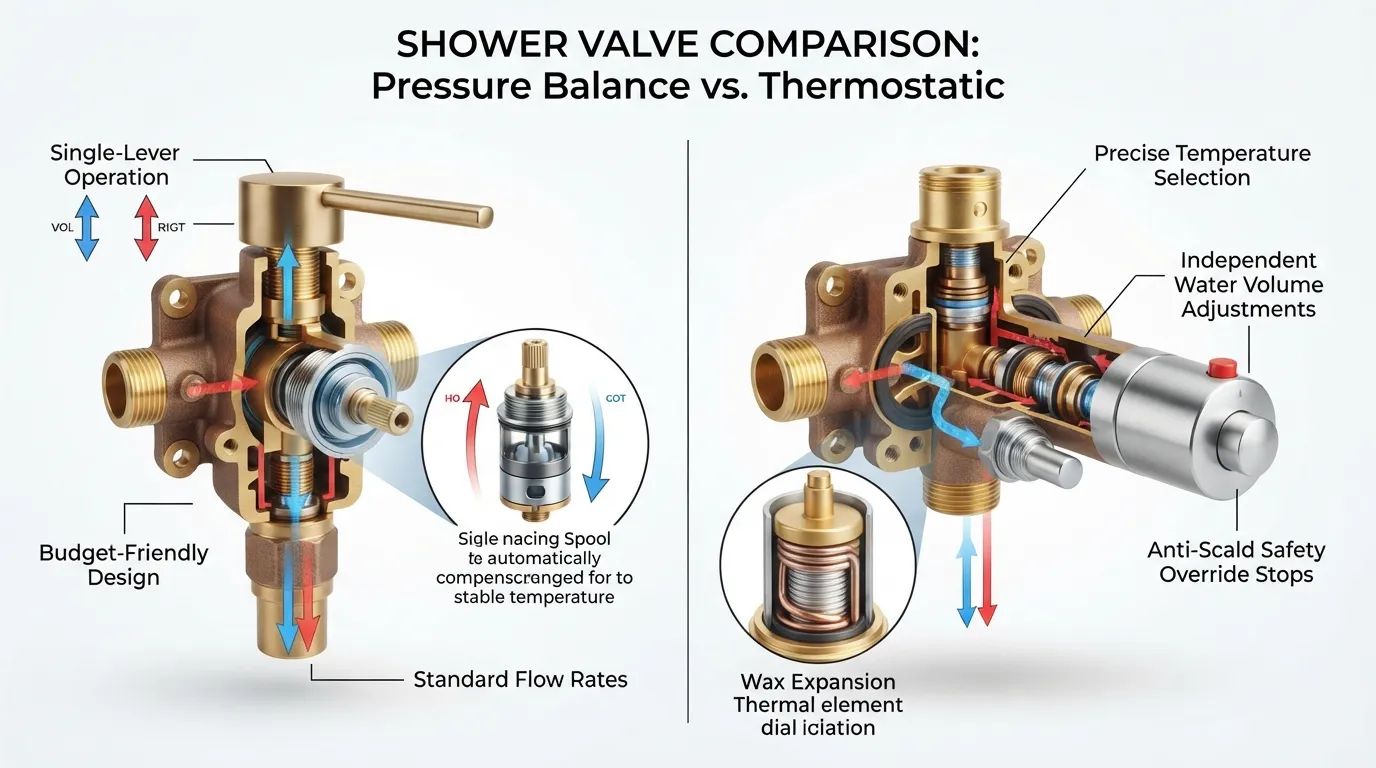
Determining which shower valve is “better” depends entirely on your architectural setup, household safety priorities, and budget. Rather than a one-size-fits-all answer, choosing the right shower valve requires aligning your mechanical needs with how you use your bathroom daily.
Short Answer
Neither valve type is universally superior; each serves distinct plumbing needs. A pressure balance valve is the ideal, cost-effective choice for standard single-showerhead bathrooms, whereas a thermostatic valve is well worth the extra investment when you require precise temperature control, absolute scald safety, or a multi-outlet luxury shower layout.
Choose a Pressure Balance Valve If…
You Have a Single Showerhead: Your bathroom configuration features only one primary showerhead or a standard tub-and-shower combination.
You Are Working Within a Budget: You want a reliable, code-compliant plumbing setup without paying a premium for luxury hardware.
You Prefer Simple Maintenance: You value straightforward mechanics with fewer moving parts and readily available, affordable replacement cartridges.
You Are Doing a Standard Remodel: Your project involves replacing an existing single-handle rough-in valve without expanding wall cavity space.
Choose a Thermostatic Valve If…
You Are Installing Multiple Outlets: Your design includes a rain showerhead paired with a hand shower, ceiling jets, or wall-mounted body sprays.
You Prioritize Family Safety: Your household includes young children or elderly residents who need reliable anti-scald protection and predictable temperature control.
You Want Exact Temperature Memory: You prefer dialing in an exact temperature degree every single time you step into the shower.
You Are Building a Custom Luxury Bath: You are investing in a high-end master bathroom renovation where comfort and custom performance are paramount.
Plumber’s Note: When consulting with homeowners on custom home builds and high-rise condo renovations, the decision almost always comes down to fixture count and user experience. If a client is installing a simple guest bath or standard apartment shower, a pressure-balance valve prevents unnecessary complication and expense. However, for master suites featuring multiple body sprays or rainheads—especially in households with kids—steering clients toward a thermostatic valve is essential to prevent pressure drop starvation and deliver true luxury comfort.
Quick Decision Checklist
Answer these five questions to determine which valve matches your project:
Are you installing more than one shower outlet or body sprays? (If yes $\rightarrow$ Thermostatic)
Is your total budget strictly focused on standard, cost-effective remodeling? (If yes $\rightarrow$ Pressure Balance)
Do you have young children or elderly family members who need precise anti-scald protection? (If yes $\rightarrow$ Thermostatic)
Do you prefer a single handle that controls both temperature and water volume together? (If yes $\rightarrow$ Pressure Balance)
Do you want to set your exact shower temperature by degree every time you turn on the water? (If yes $\rightarrow$ Thermostatic)
Are Thermostatic Shower Valves Worth the Extra Cost?
For the vast majority of master bathrooms and multi-outlet custom showers, thermostatic valves are unquestionably worth the extra cost. They eliminate temperature drift, support high-capacity water flow, and offer unmatched safety.
However, if you are updating a secondary guest bath or a rental property with a single showerhead, paying extra for a thermostatic system provides little practical return. In those straightforward scenarios, a reliable pressure-balance valve delivers all the performance and safety you need at a fraction of the price.
Disadvantages and Problems of Each Valve Type
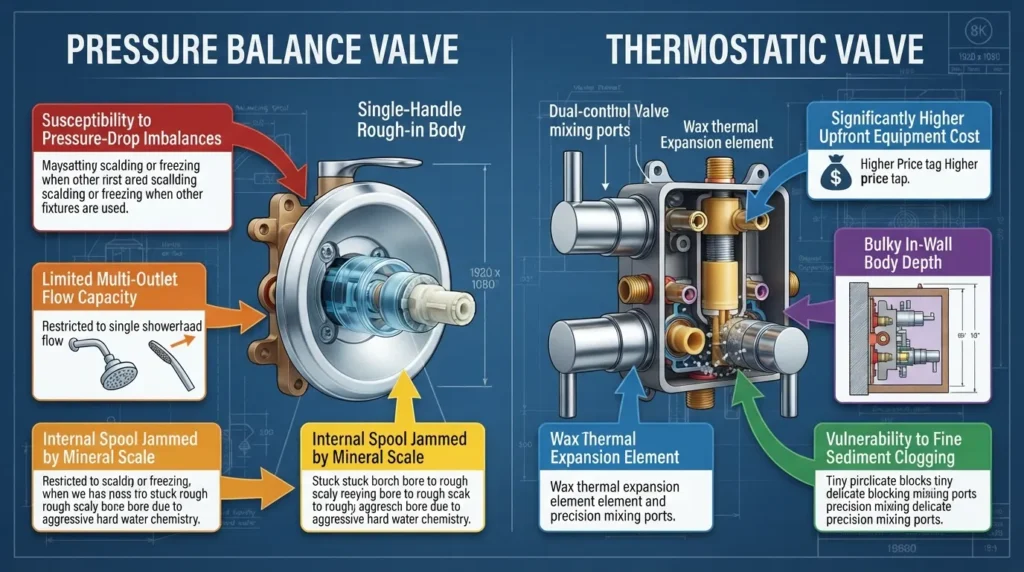
Evaluating the drawbacks of each system ensures you avoid unpleasant surprises after installation. Every shower valve design involves mechanical trade-offs between cost, complexity, and maintenance requirements over its lifespan.
What Is the Disadvantage of a Thermostatic Shower Valve?
The primary disadvantage of a thermostatic shower valve is its significantly higher upfront cost, more complex installation requirements, and sensitivity to hard water mineral buildup. Because they rely on precise internal wax elements and multi-port balancing mechanics, they require professional installation and periodic maintenance.
High Initial Investment: Both the rough-in valve body and the matching multi-outlet trim kits carry a steep price tag compared to standard valves.
Bulkier Infrastructure: The valve body is larger, requiring greater wall cavity depth and often separate volume control valves.
Wax Element Aging: Over years of service, the internal thermal element can degrade or collect mineral scale, leading to slower response times or temperature inaccuracies.
Strict Hot Supply Demands: They require a robust, adequately sized hot water supply; an underpowered water heater will leave multi-outlet setups feeling lukewarm.
Plumber’s Note: When our team receives troubleshooting calls regarding thermostatic valves, the complaints almost always center on two issues: either hard water scale locking up the wax element after years of neglect, or a homeowner installing high-flow body sprays without verifying that their water heater can actually sustain the demand.
What Are the Disadvantages of a Pressure Balance Valve?
The main disadvantage of a pressure balance valve is its inability to compensate for source temperature shifts and its lack of support for multi-outlet luxury shower configurations. Because they regulate pressure rather than actual temperature, they offer less precise overall control.
No Temperature Drift Correction: If your water heater’s output temperature fluctuates, a pressure-balance valve cannot adjust and will pass that temperature change directly to the showerhead.
Linked Controls: Temperature and volume share a single handle, making it impossible to adjust water flow without altering your preferred temperature mix.
Single-Outlet Restriction: Built strictly for one outlet, meaning you cannot run a rain showerhead and hand shower simultaneously without custom, separate diverter plumbing.
Why Is My Thermostatic Valve Not Mixing Properly?
When a thermostatic valve fails to mix water properly, it typically stems from a restricted hot water supply, severe mineral scale, or a worn-out thermal cartridge. Catching these symptoms early can prevent complete valve failure during a routine morning shower.
Insufficient Hot Supply: If your hot water pressure drops or your water heater service reveals an underperforming unit, the valve cannot blend the correct proportion.
Hard Water Scale Accumulation: Mineral deposits inside the valve body restrict the movement of the internal spool or wax element.
Failing Thermostatic Element: Over time, the internal wax capsule can lose calibration, preventing the valve from holding a steady mixed temperature.
Shower Valve Cost: Valve Price, Installation, and Plumber Charges
Understanding the true financial investment of a shower valve replacement involves looking at hardware costs, specialized labor, and potential wall access requirements. Knowing these price breakdowns helps you budget accurately and avoid unexpected remodeling expenses.
Cost of Pressure Balance vs. Thermostatic Valves
Material expenses vary significantly depending on whether you choose a straightforward single-handle pressure balance unit or a multi-port thermostatic system.
| Valve Type | Valve Body & Rough-In | Trim Kit (Handles/Faceplate) | Typical Total Installed Range |
| Pressure Balance Valve | $50 – $200 | $40 – $150 | $150 – $450 |
| Thermostatic Valve | $150 – $450 | $100 – $400+ | $350 – $950+ |
Note: Total installed ranges reflect standard replacements where wall access is already available. Pricing varies by brand, designer finish (such as matte black or brushed brass), and rough-in complexity.
How Much Does a Plumber Charge to Replace a Shower Valve?
Professional plumber charges for a complete shower valve replacement typically range from $225 to $750, depending heavily on whether the technician can access the plumbing from behind the wall or must cut through tiled surfaces.
Labor & Standard Install: Basic swap-outs where an access panel already exists usually take 1.5 to 3 hours of labor.
Valve Type Impact: Upgrading from a basic mixing valve to a complex multi-outlet thermostatic setup increases labor time due to additional rough-in lines.
Plumbing Code & Permits: Local municipal plumbing codes may require a permit for valve replacements, which can add minor administrative fees.
Factors That Increase the Total Cost
Tile Removal and Wall Repair: If your shower has no rear access panel, plumbers must cut through drywall or remove expensive ceramic or porcelain tiles, adding costs for tile restoration or drywall patching.
Relocating or Adding Outlets: Shifting the valve position or running extra lines for body sprays and hand showers requires custom piping modifications.
Corroded or Outdated Supply Lines: Older galvanized or degraded copper pipes often require soldering, adapters, or localized repiping before the new valve can be safely mounted.
When It Makes Sense to Hire a Professional
While handy DIYers can sometimes swap out a shower cartridge, replacing a main rough-in valve requires specialized soldering, precise alignment, and adherence to strict anti-scald codes. In-wall structural work, tile cutting, and municipal permitting make professional intervention essential for protecting your home from hidden leaks.
Ready to upgrade your bathroom? For expert plumbing services in Miami, trust our experienced team to handle your installation right the first time. Schedule a shower valve replacement today to secure precise comfort and reliability.
Reliability, Lifespan, and Maintenance
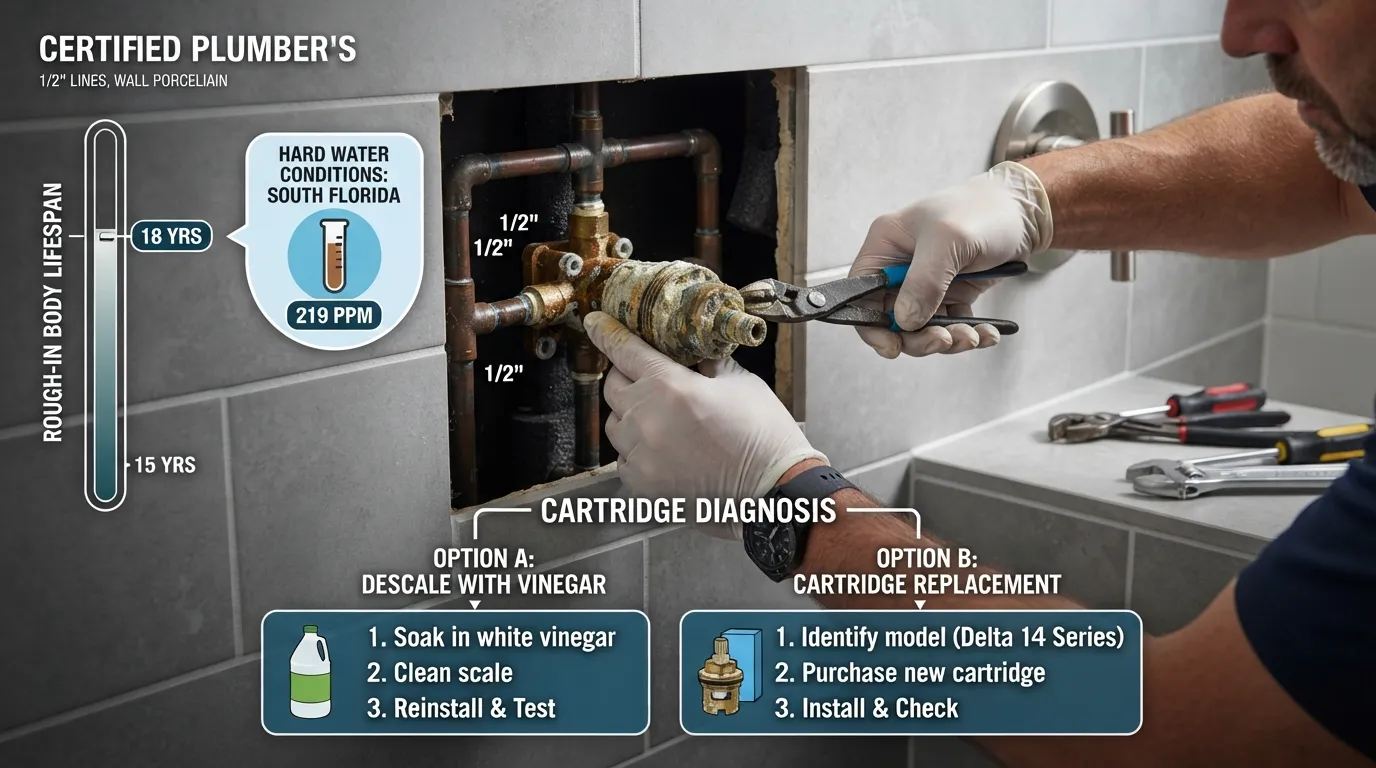
Long-term bathroom performance relies heavily on build quality, household water chemistry, and routine servicing. Understanding how these factors impact both valve types ensures uninterrupted daily comfort.
Which Shower Valve Is the Most Reliable?
Reliability depends primarily on manufacturing quality, water chemistry, and consistent maintenance rather than the valve type alone. High-end brass pressure balance and thermostatic valves offer exceptional longevity when paired with clean water and proper care.
Build Quality Standards: Premium manufacturers use solid forged-brass bodies and ceramic disc components that withstand decades of use.
Environmental Impact: Poor water quality and heavy mineral content will compromise both valve types equally if maintenance is ignored.
How Long Do Shower Valves Last?
Manufacturer data and industry standards indicate that the solid brass rough-in valve body can easily last 15 to 20 years—essentially the lifespan of the home. However, internal wear items like cartridges, O-rings, and thermal elements typically require servicing or replacement every 5 to 10 years due to daily friction and mineral accumulation.
Factors That Shorten Lifespan: Aggressive water chemistry, high water pressure surges, and infrequent use accelerate internal seal degradation.
The “Spark Plug” Analogy: Think of the internal cartridge as a car’s spark plug: it is a wear-and-tear component designed to be replaced periodically without requiring you to tear out the tile or replace the main valve body.
Sigma Faucet Parts
Hard Water, Scale, and Your Shower Valve
Mineral accumulation poses the single greatest threat to shower valve reliability. Hard water contains dissolved calcium and magnesium that precipitate out when exposed to hot water, coating internal moving parts.
South Florida Water Hardness: In the Greater Miami area, municipal water hardness averages around 219 PPM (approx. 12 grains per gallon), which classifies as very hard water.
AquatellImpact on Thermostatic Elements: The wax expansion capsule and micro-ports inside a thermostatic cartridge are highly sensitive to mineral scale, which can cause the internal piston to stick or react sluggishly.
Impact on Pressure Balance Spools: Balancing spools can become locked in place by lime scale, leading to stiff handles or an inability to properly balance mixed water pressures.
Plumber’s Note: In Miami residential service calls, scale-clogged cartridges are one of the most common reasons a shower handle locks up or loses temperature control. Because local water hardness averages 12 grains per gallon, mineral crust quickly cements unprotected moving parts. Installing a whole-home water softener or performing scheduled cartridge descaling saves homeowners from premature valve failures.
Should You Descale or Replace the Cartridge?
Deciding whether to clean your existing cartridge or install a brand-new assembly depends on the severity of the mineral buildup and physical wear.
When Descaling Is Enough: If the valve is relatively new and simply feels stiff or shows minor temperature drift due to light calcium film, soaking the disassembled cartridge in a 50/50 water and white vinegar solution will usually restore full movement.
When Replacement Is the Necessary Call: If O-rings are flattened, ceramic plates are scratched, or the internal wax element is permanently calcified and unresponsive, attempting to clean it is a temporary fix. Replacing the cartridge entirely provides a like-new factory seal and performance.
Simple Maintenance Tips
Flush Annually: Periodically cycle your shower handle through its full hot and cold range once a month to prevent mineral binding in unused valve positions.
Inspect for Leaks: Watch for slow drips from the showerhead or moisture around the handle trim, which indicate failing internal O-rings.
Use Quality Filtration: Consider pairing your home’s plumbing system with a water softener or dedicated scale-reduction filter to protect precision valves from hard water damage.
Signs Your Shower Valve Needs Repair or Replacement
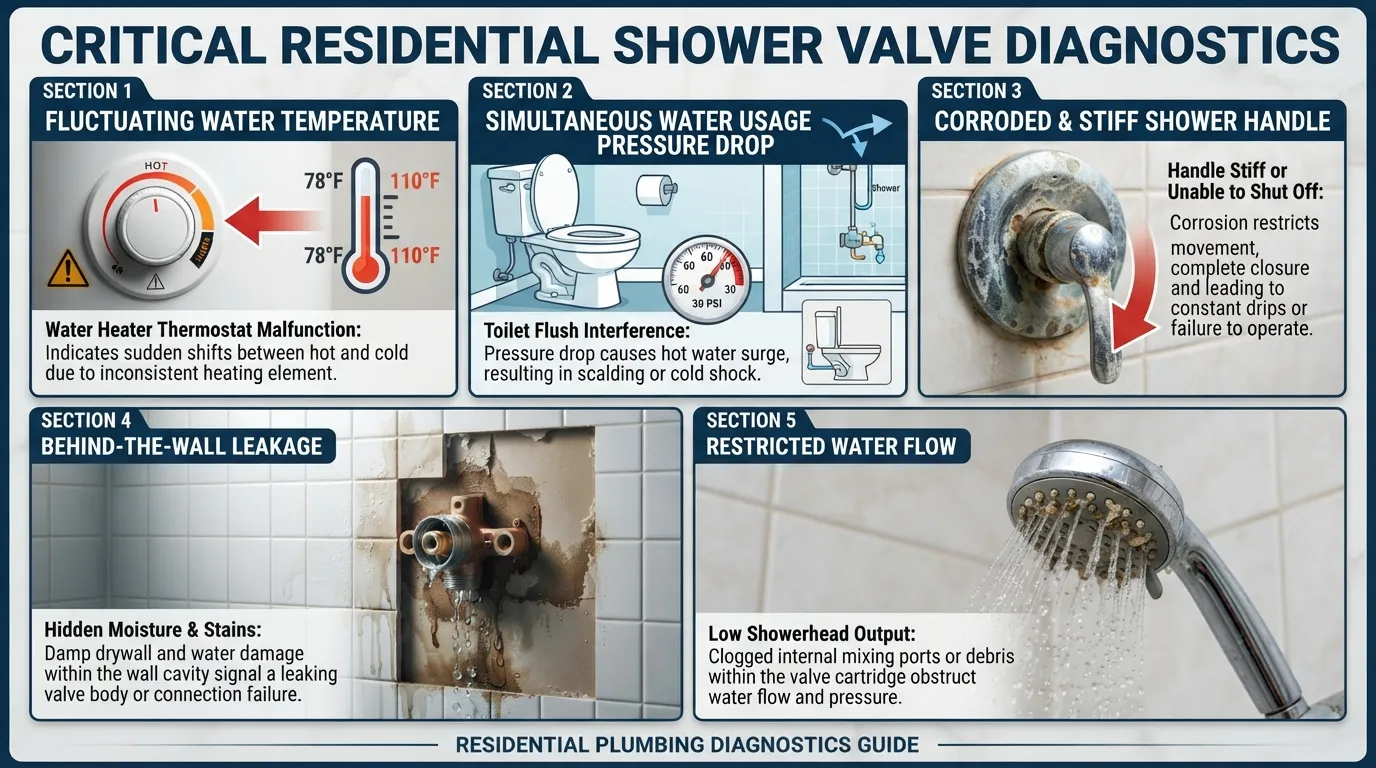
Recognizing the early warning signs of a failing shower valve can save you from costly water damage, frustrating temperature swings, and unexpected plumbing emergencies. When performance begins to slip, knowing how to diagnose the issue helps you decide whether a simple fix will suffice or if it is time for a complete replacement.
Water Is Suddenly Too Hot or Too Cold
When your shower unexpectedly blasts freezing water or scalding heat, it typically points to an internal cartridge failure or a balancing piston that has jammed out of position.
Before assuming the valve is completely broken, check your water heater settings to rule out a source-side thermostat drop or burner failure. If the water heater is operating normally, the internal mixing cartridge has likely lost its calibration and requires replacement.
Temperature Fluctuations When Others Use Water
If your shower temperature spikes or plummets every time a household toilet flushes or a washing machine starts, your pressure balance valve is no longer compensating effectively. Over time, mineral buildup can restrict the internal spool’s freedom of movement, robbing the valve of its ability to maintain pressure equilibrium.
Handle Is Hard to Turn or Will Not Shut Off
A stiff handle, grinding sensation, or complete failure to shut off the water flow usually indicates severe hard water scale accumulation or a worn-out mechanical cartridge.
Plumber’s Note: When a technician arrives on-site for a faulty shower valve, the diagnostic routine follows a strict order: first, we verify main water shut-off functionality; second, we inspect and isolate the cartridge for scale or O-ring failure; third, we test balancing pressures and hot water supply recovery rates.
If the handle completely shears off or your shower will not shut off at all, treat it as an urgent situation and call an emergency plumber immediately to prevent major water damage.
Leaks Behind the Wall or From the Trim
Hidden valve body leaks often manifest long before you notice an active drip on the bathroom floor.
Visible Indicators: Soft or bubbling drywall around the shower surround, persistent musty mold odors, unexplained water stains on ceilings directly below the bathroom, or a sudden, unexplained spike in your monthly water bill.
Action Required: If you suspect a hidden leak, professional leak detection and repair is crucial to locate the source behind the tile and prevent structural wood rot.
Low Flow or Inconsistent Mixing
If your water pressure feels weak only in the shower, or if the water refuses to blend to a comfortable warm temperature, the problem is often localized inside the valve assembly. Fine mineral sediment and calcium scale can clog internal mixing ports and integrated check-valve screens, restricting water delivery even when home water pressure is otherwise normal.
Can You Replace One Valve Type With the Other?
When updating a bathroom, homeowners frequently ask whether they can simply swap an old pressure balance valve for a modern thermostatic system. Understanding valve compatibility before purchasing hardware prevents costly installation mistakes and frustrating remodeling delays.
Can I Swap a Pressure Balance Valve for a Thermostatic Valve?
No, you cannot simply swap a pressure balance valve for a thermostatic valve using your existing in-wall plumbing. Because thermostatic systems require different internal mixing architecture, larger rough-in bodies, and often separate volume control valves, upgrading means replacing the entire rough-in valve body, which requires opening the shower wall.
Brand & Type Restrictions: Trim kits and internal cartridges are rarely universal. You cannot install a thermostatic trim handle onto a pressure balance valve body, even if they are made by the same manufacturer.
The Wall Opening Reality: To transition between valve types, a plumber must access the internal plumbing from behind the wall or cut through the shower surround to remove the old valve body and solder in the new thermostatic rough-in.
Plumber’s Note: We frequently field calls from homeowners who purchased a high-end thermostatic trim kit online, assuming it would twist right onto their existing single-handle pressure balance rough-in. Unfortunately, because the internal mixing mechanics are completely different, the only way forward is opening the wall to replace the brass valve body entirely.
Valve Body, Cartridge, and Trim: What Can Be Swapped?
| Component Level | Compatibility Rules | Can It Be Done Without Opening the Wall? |
| Cartridge Replacement | Must match the exact brand and series model number of the existing valve. | Yes (accessed through the front trim plate). |
| Trim Swap (Handles & Faceplate) | Only compatible within the exact same brand and valve series. | Yes (surface-level cosmetic change). |
| Full Valve Swap (Pressure Balance to Thermostatic) | Requires changing the entire rough-in body and adding volume controls. | No (requires cutting drywall or tile). |
Remodel vs. Simple Replacement
Simple Valve Replacement: Involves unthreading or cutting out an identical valve body during an open-wall renovation, or swapping a worn cartridge. It preserves existing supply lines and layout.
Full System Remodel: Involves converting a single-outlet pressure balance enclosure into a multi-outlet luxury shower. This requires expanding the wall cavity, running new lines up to rainheads or body sprays, and installing a thermostatic rough-in valve.
DIY or Hire a Plumber?
DIY-Friendly Tasks: Confident homeowners can typically handle straightforward cosmetic trim swaps or simple cartridge replacements, provided they shut off the main water supply first.
Professional Required: Replacing a main rough-in valve, soldering copper supply lines, cutting tile, and complying with local anti-scald plumbing codes are complex tasks best left to licensed professionals.
If you are planning a bathroom upgrade and need help navigating valve compatibility or rough-in installation, book a plumber to ensure your new system is installed safely and up to code.
Safety Standards, Code, and Water Heater Temperature
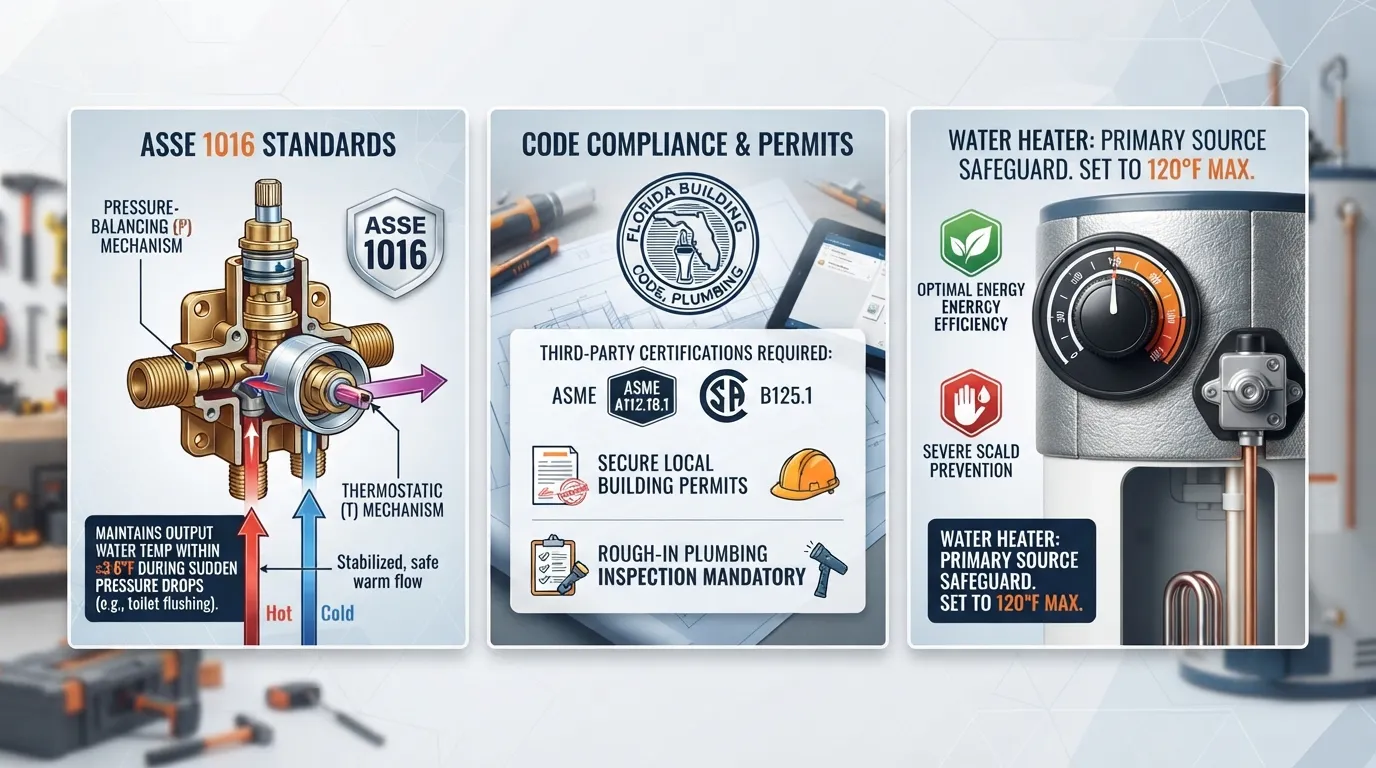
Navigating plumbing regulations, anti-scald compliance, and source temperatures ensures your shower system operates safely within legal building codes. Meeting these safety benchmarks protects your household and guarantees long-term compliance.
What Is ASSE 1016 and Why Does It Matter?
The ASSE 1016 standard serves as the primary benchmark for individual shower and tub-and-shower control valves, specifically governing anti-scald performance. Established by the American Society of Sanitary Engineering, it evaluates how effectively a valve prevents sudden temperature spikes during pressure or supply shifts.
Valve Classifications: The standard covers three primary types: pressure balancing (P), thermostatic (T), and combination balanced-thermostatic (T/P) valves.
Performance Parameters: Certified ASSE 1016 valves are engineered to hold outlet temperature within a tight tolerance of $3.6^\circ F$ during sudden cold- or hot-water pressure changes.
Industry Overview: For a deeper dive into technical mechanics, you can review this ASSE 1016 standard overview covering multi-port valve engineering.
Always check the valve body specifications or packaging for ASSE 1016, ASME A112.18.1, or CSA B125.1 certifications before purchasing.
Do Both Valve Types Meet Code?
Yes, both pressure balance and thermostatic valves can fully comply with plumbing codes—provided they carry the proper third-party certifications and are installed correctly.
Local Regulatory Compliance: Building requirements vary by municipality. Homeowners should verify current guidelines under the Florida Building Code, Plumbing.
Permit Requirements: Major rough-in plumbing changes and valve replacements typically require a local building permit. Consulting a licensed plumber or your local building department ensures your installation meets all safety and legal mandates.
Set Your Water Heater Temperature Safely
According to guidance from the U.S. Department of Energy and consumer safety agencies, setting your residential water heater thermostat to $120^\circ F$ provides an optimal balance between energy efficiency and scald prevention. At $120^\circ F$, water is hot enough for household needs while significantly reducing the risk of severe burns.
Plumber’s Note: While your shower valve acts as an essential anti-scald safeguard at the point of use, it is not a replacement for a properly set source temperature. Keeping your main water heater correctly calibrated protects children and guests throughout the entire house.
Popular Shower Valve Brands: Delta, Moen, Kohler, Grohe, and Symmons
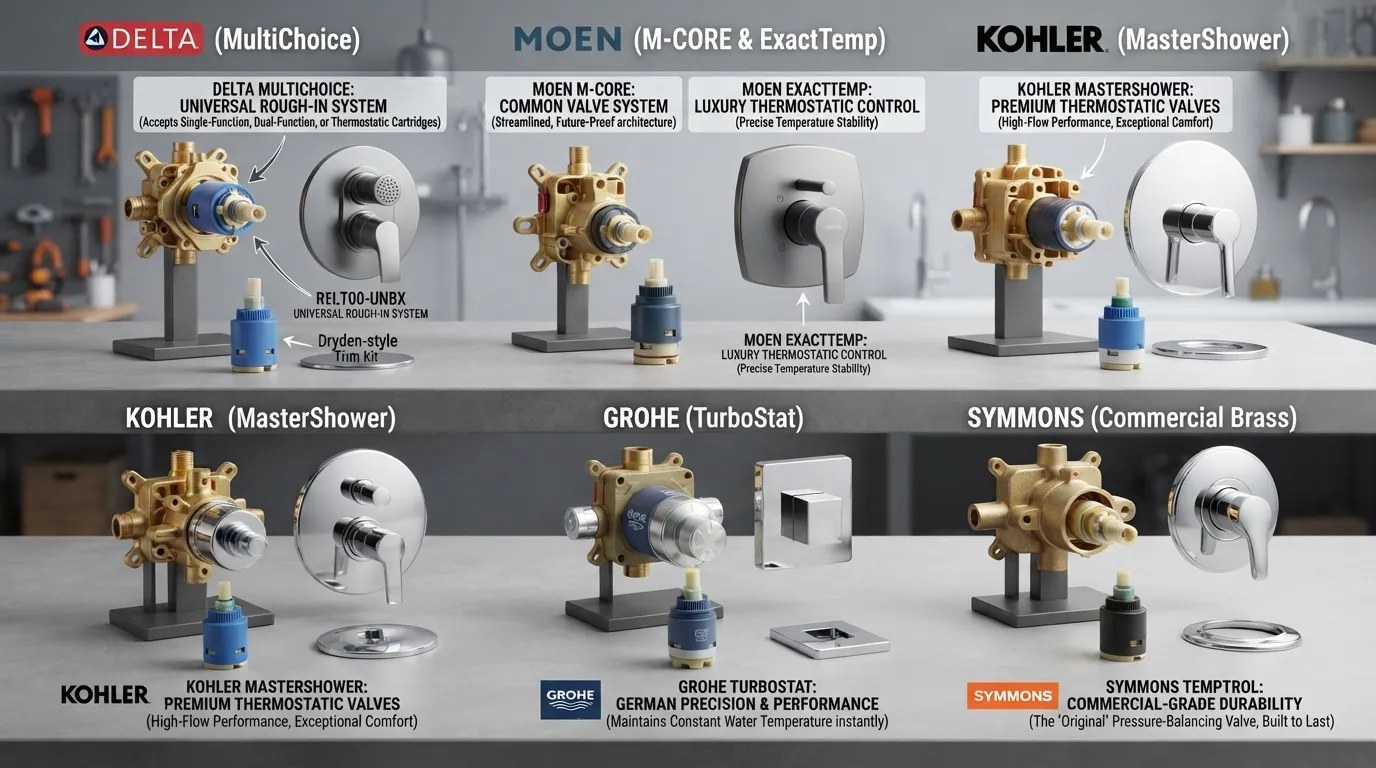
Navigating shower valve options means evaluating major manufacturing ecosystems. Each leading brand offers distinct rough-in architectures, styling collections, and replacement parts availability that impact long-term serviceability.
Delta vs. Moen: Which Is Better?
Delta and Moen represent the two most widely installed plumbing brands in North American residential construction, each offering robust lifetime warranties and widespread parts availability.
Valve Design & Maintenance: Delta relies heavily on its MultiChoice universal rough-in valve platform, which allows you to change trim styles or upgrade functionality down the road without replacing the in-wall body. Moen features its classic Posi-Temp and modernized M-CORE systems, renowned for straightforward cartridge access and durable balancing spools.
Parts and Service: Both brands excel in local plumbing supply support. Replacement cartridges are stocked by nearly every hardware store, making both brands exceptionally contractor-friendly.
Verdict: Neither is objectively superior; personal preference often comes down to specific trim aesthetics and plumber familiarity.
Does Moen Make a Thermostatic Shower Valve?
Yes, Moen manufactures advanced thermostatic and multi-outlet valves designed for custom luxury showers.
ExactTemp and M-CORE 4-Series: Moen’s ExactTemp 3/4-inch thermostatic valves and newer M-CORE 4-Series systems use genuine thermal wax elements to maintain exact temperature settings independent of pressure shifts.
Digital Integration: Moen also offers the U by Moen digital thermostatic shower system, allowing users to control precise temperatures via wall controllers or smartphone applications.
Kohler, Grohe, and Symmons: What to Know
Kohler: Known for high-end designer aesthetics and robust MasterShower thermostatic rough-in valves. Kohler bridges the gap between luxury architectural styling and heavy-duty brass construction, though trim collections sit at a higher price point.
Grohe: A global leader in European engineering, Grohe features precision thermostatic cartridges (such as their TurboStat technology) that react rapidly to temperature and pressure changes. They are a staple in contemporary, high-flow custom bathroom designs.
Symmons: A trusted commercial and residential heritage brand famous for the original Safetrac and Temptrol pressure-balance valves. Symmons systems are engineered primarily from heavy-gauge brass, prioritizing rugged, institutional-grade durability over decorative variety.
How to Choose a Brand
Match Your Rough-In Ecosystem: Sticking with a unified brand for both rough-in valves and trim kits prevents compatibility issues.
Check Local Parts Availability: Choose brands that local plumbing supply houses stock extensively in your area so replacement cartridges or service seals are readily accessible.
Verify Warranty Protection: Look for manufacturer-backed lifetime limited warranties covering leaks, drips, and functional defects.
Consult Your Plumber: Choose a brand your installation contractor works with regularly, ensuring fast, code-compliant rough-in and trouble-free maintenance for years to come.
Frequently Asked Questions
Find quick, direct answers to the most common questions regarding thermostatic and pressure balance shower valves, installation costs, and brand comparisons.
What Is the Disadvantage of a Thermostatic Shower Valve?
The primary disadvantages of a thermostatic shower valve are its higher upfront price, complex installation requirements, and sensitivity to hard water scale over time. Additionally, they require a robust hot water supply to feed multi-outlet configurations effectively.
Which Is Better, Thermostatic or Pressure Balanced Shower Valves?
Neither valve is universally superior. Pressure balance valves are ideal for standard, single-outlet bathrooms on a budget. Thermostatic valves are better when you require precise temperature control, absolute anti-scald protection, or a multi-outlet luxury shower layout.
Which Shower Valve Is the Most Reliable?
Reliability depends more on manufacturing quality, water chemistry, and routine maintenance than the valve type. Premium brass rough-in valves from reputable brands offer exceptional longevity when protected from heavy mineral scale buildup.
Are Thermostatic Shower Valves Worth It?
Yes, thermostatic valves are well worth the investment for master bathrooms and custom multi-outlet showers. They eliminate temperature drift, support high-flow rainheads or body sprays, and provide unmatched safety, though they are unnecessary for simple guest baths.
Does Moen Make a Thermostatic Shower Valve?
Yes, Moen manufactures advanced thermostatic systems, including their ExactTemp 3/4-inch valves, M-CORE 4-Series configurations, and digital U by Moen smart shower technology, all designed to maintain exact water temperatures independent of pressure changes.
Which Is Better, Delta or Moen?
Neither Delta nor Moen is objectively superior. Both brands offer robust lifetime warranties, widespread replacement parts availability, and contractor-friendly designs. Choosing between them usually comes down to personal design preferences and plumber familiarity.
How Much Should a Plumber Charge to Replace a Shower Valve?
A professional plumber typically charges between $225 and $750 to replace a shower valve. Total costs vary depending on whether an existing wall access panel is available or if technicians must cut through tile and drywall.
Can I Replace a Shower Valve Yourself?
Confident DIYers can handle simple cosmetic trim swaps or exact-match cartridge replacements. However, replacing the main in-wall rough-in valve requires specialized copper soldering, precise alignment, and adherence to local plumbing codes, which are best left to professionals.
Do Thermostatic and Pressure Balance Valves Prevent Scalding?
Yes, both valve types are specifically engineered to provide anti-scald protection. Pressure balance valves automatically restrict hot water if cold pressure drops, while thermostatic valves rely on an internal thermal element and a preset mechanical safety stop.
Choosing the Right Shower Valve
Selecting the correct shower valve shapes the comfort, safety, and longevity of your bathroom for years to come. By weighing your household layout, water heater capacity, and performance priorities, you can invest with total confidence.
Final Recommendation
Pressure balance valves remain the ideal, budget-friendly choice for standard single-showerhead bathrooms where dependable anti-scald protection is the primary goal. Thermostatic valves provide superior temperature precision, independent volume control, and the high-flow flexibility needed for luxury multi-outlet shower systems. Always verify that your chosen model carries an ASSE 1016 listing and complies fully with local building codes before installation.
Need Help Choosing or Installing a Shower Valve?
Navigating rough-in compatibility, hard water maintenance, or code-compliant installation can be challenging. Whether you need expert valve selection guidance, emergency repair, or professional our plumbing services, our licensed Miami plumbers are here to help.
Main Services
Related Posts
Need a Plumber in Miami?
Schedule service online or speak directly with the EZ Plumbing team.
Owner-Led Local Service
Know who is behind the business before you request service. The owners, contact line and Miami service pages are published clearly.
- Named business owners
- Direct phone and social channels
- Local Miami service information
Clear Help Before You Book
Review the relevant service page, contact the team directly and use the booking page when you are ready—without relying on vague claims.
- Service-specific information
- Direct questions before scheduling
- Clear online booking route