Trenchless Sewer Line Repair: Pros, Cons & Real Costs (2026 Guide)
What Is Trenchless Sewer Line Repair?
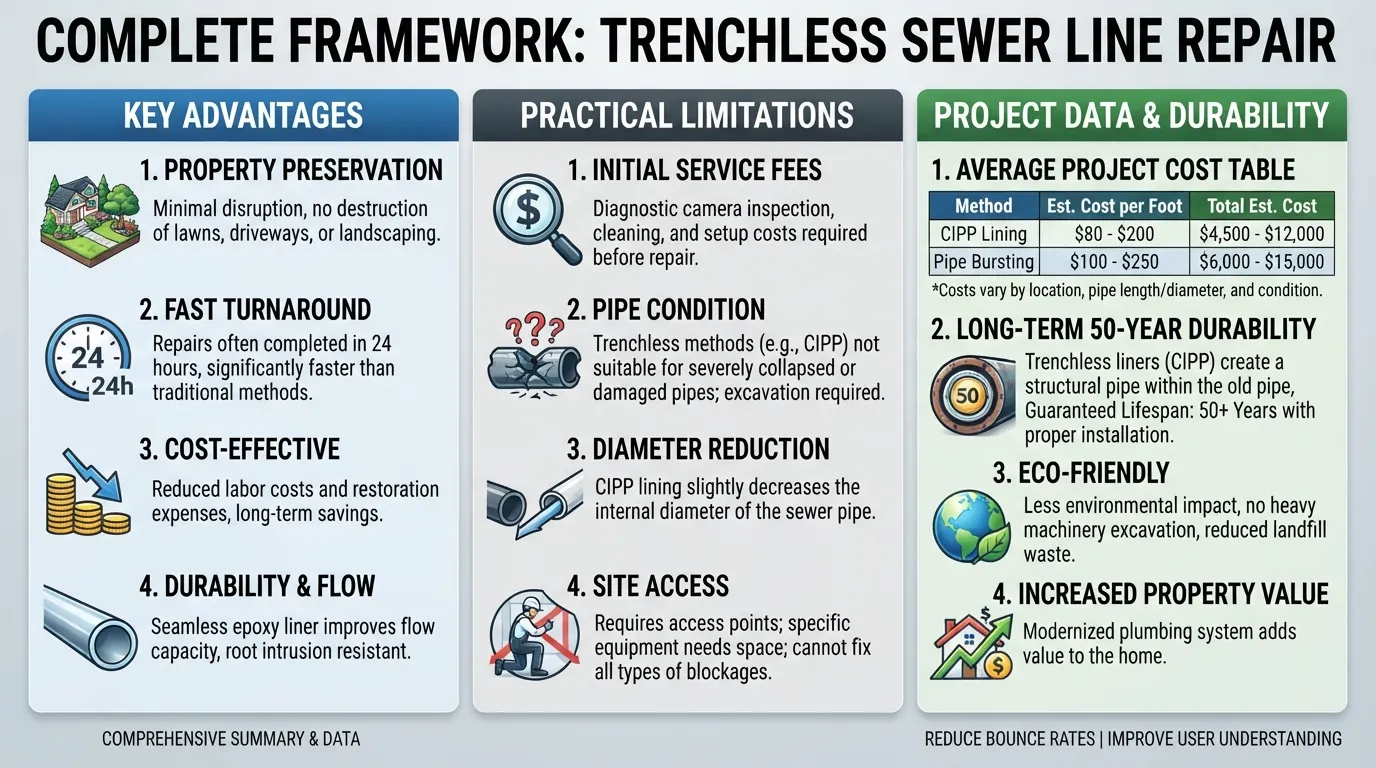
Trenchless sewer line repair is an advanced plumbing method used to fix or replace damaged underground pipes without digging up your entire yard, driveway, or landscaping. Instead of utilizing heavy machinery to excavate trenches, technicians access the existing sewer system through small, strategic entry points, saving property owners thousands in restoration costs.
What Trenchless Sewer Repair Means (CIPP Lining vs. Pipe Bursting)
Trenchless technology relies on specialized engineering techniques to rehabilitate compromised underground pipes from the inside. Rather than removing the old pipe entirely, modern methods either coat the interior or fracture the old line while simultaneously pulling a seamless new pipe into place.
The two primary methods used by professionals include:
Cured-In-Place Pipe (CIPP) Lining: Often referred to as “pipe lining,” this technique involves inserting a flexible, resin-saturated tube into the damaged pipe. The liner is then inflated and cured using steam or hot water, creating a smooth, durable, jointless new pipe within the old structure.
Pipe Bursting: This method is ideal for collapsed or severely deformed lines. A heavy-duty steel bursting head is pulled through the old underground pipe, breaking it outward into the surrounding soil while simultaneously dragging a seamless high-density polyethylene (HDPE) replacement pipe behind it.
How It Differs From Traditional Excavation
Traditional excavation—often called open-trench repair—requires heavy digging equipment to unearth the entire length of a damaged sewer line. This older approach demands extensive manual labor to physically dig down to the pipe, replace it section by section, and backfill the trench.
The key operational and structural differences include:
Property Impact: Traditional digging destroys lawns, hardscaping, patios, and driveways, whereas trenchless methods typically require only two small access holes (pits).
Project Timeline: Open-trench jobs can take several days or even weeks due to excavation and property restoration, while most trenchless repairs are completed in a single day.
Cost Efficiency: While equipment and material costs can vary, trenchless solutions drastically reduce labor hours and eliminate expensive landscaping restoration bills.
The Pros of Trenchless Sewer Line Repair
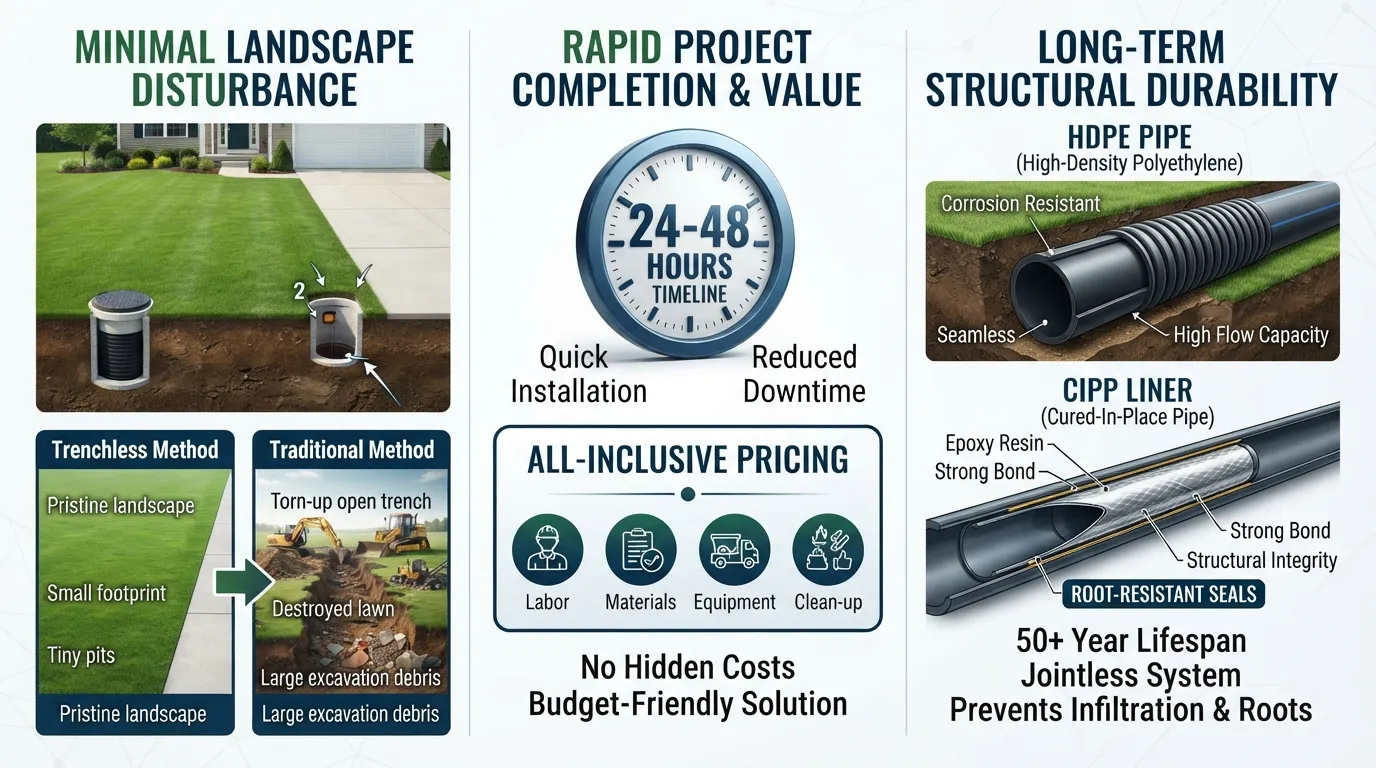
Trenchless sewer line repair offers a modern alternative to traditional excavation by preserving property landscapes, minimizing project timelines, and lowering overall costs. By utilizing advanced engineering materials like high-density polyethylene and structural epoxy resin, this technology delivers long-term durability that often outperforms older cast iron or clay pipes.
Preserves Landscaping, Driveways, and Hardscapes
Traditional sewer repairs frequently require tearing up mature lawns, concrete driveways, custom patios, and expensive hardscaping. Trenchless methods eliminate this heavy destruction by operating entirely through minimal access points.
Strategic Access: Technicians only need one or two small entry pits—often just a few feet square—to rehabilitate the entire line.
Zero Hardscape Demolition: Driveways, walkways, and foundational landscaping remain completely untouched during the process.
Eliminated Restoration Bills: Property owners save thousands of dollars by avoiding post-repair sod replacement, paving, and landscape redesign.
Faster Turnaround (24–48 Hour Completion)
Excavating an entire sewer line is a labor-intensive, multi-day ordeal that disrupts daily routines. Trenchless technology streamlines the entire workflow into a rapid operation.
Rapid Deployment: Most residential trenchless repairs are fully completed within 24 to 48 hours from initial inspection to final testing.
Minimal Household Disruption: Because heavy trenching is avoided, families can usually remain in their homes with water service restored quickly.
Streamlined Workflow: Advanced cleaning, camera scoping, and lining or bursting are executed sequentially in a single visit.
Lower Total Project Cost (Upfront Fee vs. Restoration Savings)
While the equipment and material costs for trenchless repair can appear comparable to or slightly higher than baseline digging quotes on paper, the true economic value lies in what comes after. Traditional plumbing quotes rarely include the hidden costs of property remediation.
All-Inclusive Pricing: Trenchless bids cover the actual pipeline fix without unexpected secondary bills for heavy landscaping or concrete work.
Reduced Labor Hours: Needing fewer technicians and less heavy machinery for shorter durations keeps labor expenses manageable.
Long-Term Value: Preventing collateral property damage translates to maximum return on investment for homeowners.
Long-Term Durability of HDPE Pipes and Epoxy Resin (50-Year Warranty Context)
Modern trenchless materials are engineered to withstand extreme environmental stress and subterranean shifting. The structural components used provide exceptional structural integrity.
Epoxy Resin Strength: CIPP lining forms a seamless, jointless pipe-within-a-pipe that eliminates traditional weak points where leaks commonly start.
HDPE Resilience: Pipe bursting pulls a flexible high-density polyethylene pipe through the earth that can absorb ground movement without cracking.
Extended Lifespan: Both materials offer root intrusion resistance and corrosion resistance, frequently backed by manufacturer or contractor warranties extending up to 50 years.
Eco-Friendly Impact (Less Machinery, Less Landfill Waste)
Trenchless sewer repair significantly reduces the environmental burden associated with major plumbing overhauls. Sustainable construction practices are inherently built into the process.
Lower Carbon Footprint: Operating heavy excavators and backhoes for days consumes substantial fuel and generates heavy emissions, which trenchless methods bypass.
Waste Minimization: Leaving the old pipe in the ground prevents tons of broken concrete, clay, and iron from being hauled off to local landfills.
Soil Preservation: Avoiding deep trenching protects the surrounding soil microbiome and natural root systems of established trees.
The Cons of Trenchless Sewer Line Repair
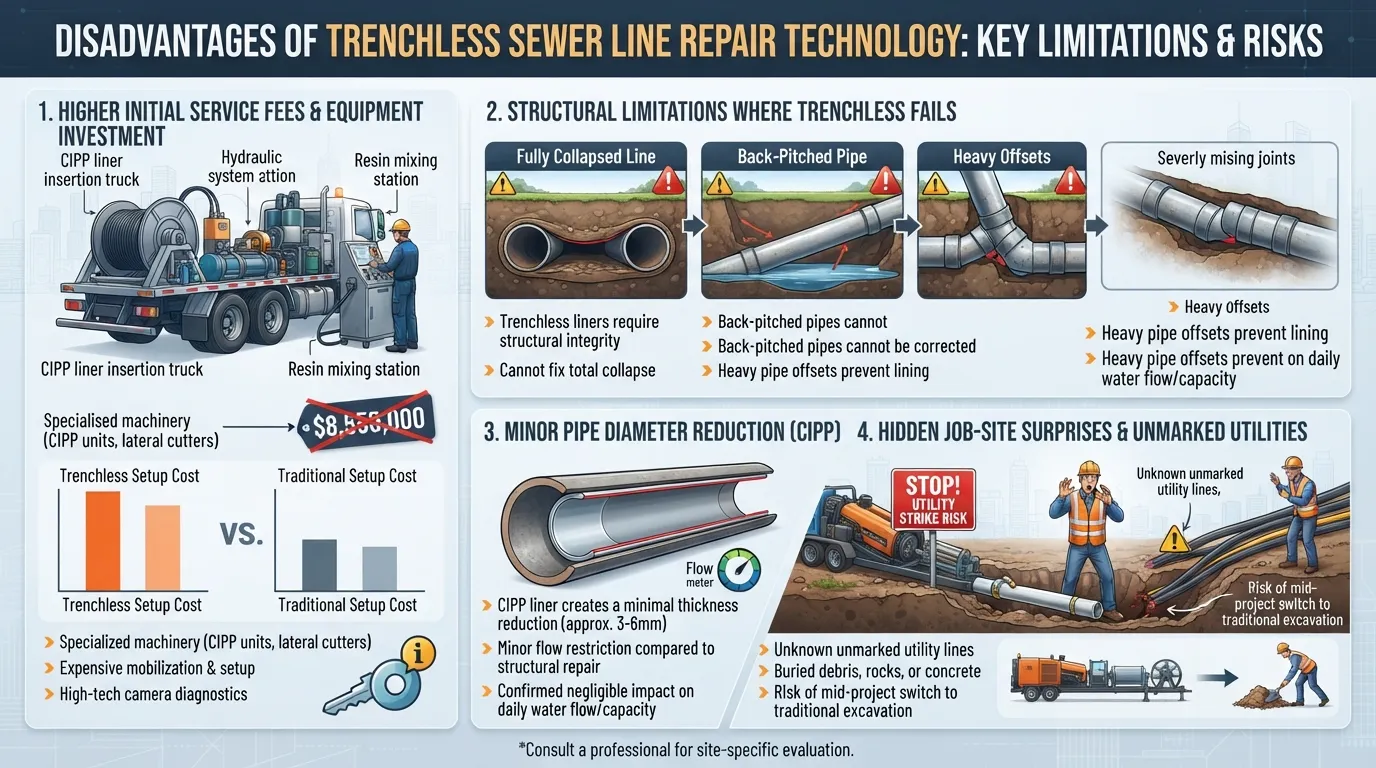
While trenchless technology offers undeniable advantages, it is not a universal solution for every underground plumbing failure. Understanding the potential drawbacks, limitations, and operational risks ensures property owners can make an informed decision before committing to a specific repair methodology.
Higher Initial Service Fees Explained
Trenchless sewer line repair typically carries a higher initial contractor quote compared to traditional open-trench digging. This pricing structure often causes sticker shock for homeowners reviewing competing bids.
Specialized Equipment Cost: Contractors invest heavily in industrial-grade CIPP drum units, steam curing systems, HDPE pulling heads, and high-resolution diagnostic cameras.
Advanced Technical Training: Operating trenchless systems requires certified expertise, meaning labor rates reflect skilled engineering rather than basic manual excavation.
The Cost-Value Tradeoff: Although the upfront service fee is higher, it almost always offsets the hidden secondary costs of repairing ruined driveways, patios, and landscaping.
Why Trenchless Doesn’t Work for Every Type of Damage (Collapsed, Back-Pitched, or Misaligned Pipes)
A common misconception is that trenchless methods can solve any sewer line failure. In reality, the existing host pipe must retain a basic structural framework to support lining or bursting.
Structural Collapse: If a pipe has completely collapsed or disintegrated, a CIPP liner has no stable mold to expand against, rendering the technique impossible.
Back-Pitched Pipes: Trenchless repairs follow the path of the existing pipe. If a section is back-pitched (sagging downward), lining or bursting it will only preserve the negative slope, causing future wastewater pooling and recurring clogs.
Severe Misalignment: Disconnected joints or heavily offset pipes can block the passage of pulling cables or lining equipment, requiring targeted excavation to fix the geometric alignment.
Slight Pipe Diameter Reduction — Does It Actually Affect Water Flow?
Installing a CIPP liner inside an existing host pipe inherently reduces the internal diameter by a fraction of an inch to accommodate the resin-saturated tube. Homeowners frequently worry this reduction will choke household wastewater capacity.
Hydraulic Efficiency Offset: While the physical diameter shrinks slightly, epoxy resin creates an ultra-smooth, friction-free interior surface.
Improved Flow Velocity: Wastewater actually travels faster through a smooth, seamless epoxy lining than through an old, rough, root-choked cast iron pipe.
Negligible Impact: For standard residential systems, the minor cross-sectional loss does not restrict daily drainage capacity in any noticeable way.
Risk of Hidden Complications (Unmarked Utilities, Mid-Project Switch to Digging)
Subterranean work always carries inherent unknowns once equipment begins operating below ground level. Trenchless projects can occasionally encounter unforeseen job-site obstacles.
Unmarked Utility Lines: Older properties often feature private or incorrectly mapped utility lines (gas, water, electric, or telecommunications) that create safety hazards during ground entry.
Mid-Project Scoping Surprises: High-resolution camera inspections can occasionally miss structural anomalies hidden behind heavy calcification or blockages until cleaning occurs.
Fallback Excavation Requirement: If a severe structural failure or severe pipe collapse is discovered mid-project, the technician may have to abort the trenchless plan and switch to targeted open-trench digging for that specific section.
Trenchless vs. Traditional Excavation: Side-by-Side Comparison
When facing a failing sewer line, choosing between trenchless technology and traditional open-trench excavation comes down to weighing project speed, upfront costs, and property disruption. A direct side-by-side comparison helps clarify which approach aligns best with your specific plumbing emergency and property constraints.
Comparison Table: Digging Required, Timeline, Base Cost, Restoration Cost, Lifespan
| Feature | Trenchless Repair (CIPP / Pipe Bursting) | Traditional Open-Trench Excavation |
| Digging Required | Minimal (1 to 2 small access pits) | Extensive trenching across the entire pipe run |
| Project Timeline | 24 to 48 hours | 3 to 7+ days |
| Base Service Cost | Moderate to High upfront equipment/labor fees | Moderate base digging costs |
| Restoration Cost | Near zero (landscaping and hardscapes remain intact) | High (requires driveway paving, sod, and patio repair) |
| Expected Lifespan | 50+ years (seamless HDPE or epoxy resin) | 30 to 50 years (standard PVC, clay, or cast iron) |
Which Option Wins for Time-Sensitive Repairs?
The Winner: Trenchless Repair
Why It Matters: Time is critical when a primary sewer line backs up and renders a home uninhabitable. Trenchless methods streamline camera scoping, hydro-jetting, and structural lining or bursting into a rapid 1-to-2-day workflow.
Operational Edge: Traditional excavation forces families to endure prolonged yard disruption, open trenches, and slower municipal inspection turnarounds that stretch across an entire week.
Which Option Wins for Budget-Conscious Homeowners?
The Winner: It Depends on the Damage Scope and Hardscaping
Upfront vs. Total Cost Reality: While traditional digging may feature a lower initial labor quote for straightforward lines, secondary property restoration expenses frequently flip the financial equation.
When Trenchless Saves Money: If your damaged sewer line runs beneath a concrete driveway, custom stone patio, or mature landscaping, trenchless repair prevents thousands of dollars in hidden remediation bills.
When Excavation Wins: If a pipe is completely collapsed, severely back-pitched, or misaligned, trenchless solutions are unviable, making traditional excavation the only economically sound path forward.
Which Method Is Right for Your Situation? (Decision Framework)
Determining whether to choose trenchless repair or traditional excavation depends entirely on the structural condition of your underground line, the layout of your property, and the nature of the blockage. Applying a systematic decision framework helps homeowners identify the safest and most cost-effective path forward before hiring a professional.
If Your Pipe Is Fully Collapsed or Severely Damaged
When a sewer pipe has suffered catastrophic structural failure, trenchless methods are rarely viable. Cured-in-place pipe (CIPP) lining and pipe bursting require a stable host pipe or continuous alignment to guide the equipment and support new materials.
When Excavation Is Mandatory: If your pipe is completely crushed, heavily offset, or missing substantial sections, traditional open-trench digging is required to reconstruct the line.
The Safety Risk: Attempting a trenchless application on a collapsed pipe risks getting equipment stuck underground, creating a secondary emergency that drives up labor costs.
If You Have a Driveway, Patio, or Mature Landscaping Above the Line
Property preservation is the single biggest factor pushing homeowners toward trenchless plumbing solutions. The physical location of your damaged sewer line dictates how disruptive the repair process will be.
The Trenchless Advantage: If your sewer line runs directly beneath a concrete driveway, stamped patio, sprinkler system, or expensive custom landscaping, trenchless repair prevents thousands of dollars in property destruction.
When Digging Is Acceptable: If the damaged section sits underneath an accessible patch of lawn or unpaved backyard where restoration is inexpensive, traditional excavation remains a practical option.
If Your Home Is Older or Has Unknown Pipe Material
Older residential properties often feature legacy pipe materials—such as Orangeburg, brittle clay, or heavily corroded cast iron—that require careful diagnostic evaluation.
The Diagnostic First Step: Never authorize a repair without a professional camera inspection to examine the interior walls and joint integrity.
Material Compatibility: While CIPP lining successfully reinforces older cast iron and clay, severely deteriorated or root-choked lines may require heavy hydro-jetting or mechanical descaling before any trenchless technique can be safely applied.
Quick Self-Check Checklist Before Calling a Plumber
Reviewing a few key details about your property before speaking with a contractor ensures you ask the right questions and understand your repair options:
$\square$ Locate Access Points: Do you know if your home has an exterior sewer cleanout for easy camera and equipment entry?
$\square$ Map Surface Obstacles: Are there driveways, patios, or large trees directly above the failing sewer path?
$\square$ Review Failure History: Is this a first-time clog caused by root intrusion, or a recurring collapse due to aging infrastructure?
$\square$ Schedule Diagnostic Scoping: Have you requested a high-resolution video camera inspection from a certified technician to verify pipe pitch and structural damage?
How Much Does Trenchless Sewer Repair Cost?
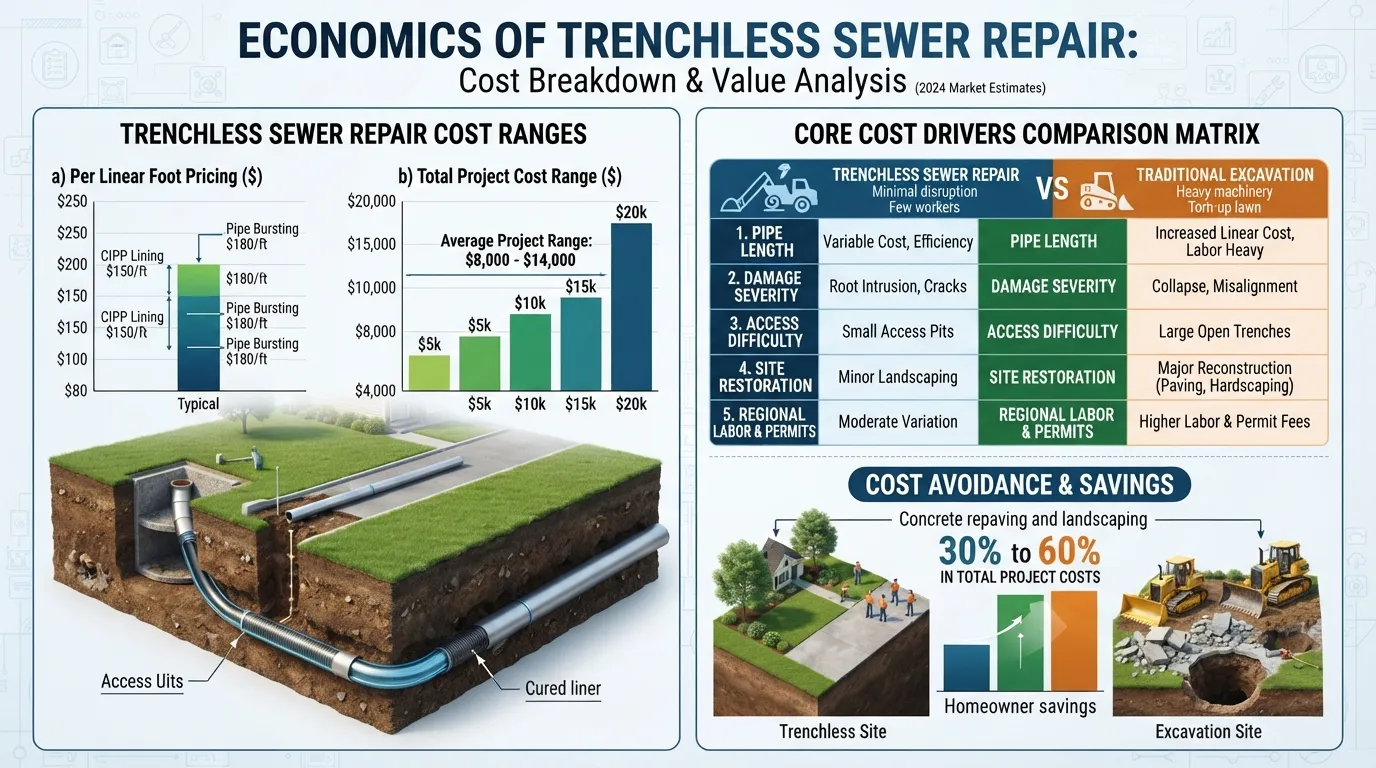
Understanding the financial investment required for underground plumbing overhauls helps eliminate budget surprises. While trenchless sewer line repair typically commands a higher initial service fee than basic digging, examining total project costs reveals why modern homeowners increasingly choose non-invasive solutions.
Average Cost Range (Per Linear Foot and Total Project)
Trenchless sewer repairs generally range from $80 to $250 per linear foot depending on the chosen method (CIPP lining versus pipe bursting) and local labor rates.
Total Project Scale: Most residential trenchless projects total between $4,000 and $20,000 for a standard 50-to-100-foot sewer lateral running from the house to the municipal main connection.
Method Variations: Cured-in-place pipe (CIPP) lining typically runs toward the middle-to-higher end of material costs due to specialized epoxy resin, while pipe bursting can vary based on the necessity of pulling new high-density polyethylene (HDPE) lines through difficult terrain.
Cost Factors: Pipe Length, Damage Severity, Access Difficulty, Region
No two sewer repair jobs are identical. Contractors evaluate several distinct variables when generating a formal pricing quote:
Pipe Length and Depth: Longer runs increase material requirements, while deeply buried lines require specialized safety shoring and more intensive excavation for access pits.
Damage Severity and Preparation: Heavily blocked or scaled lines require extensive hydro-jetting and mechanical root-cutting before a liner can be safely deployed.
Access Difficulty: Properties with restricted entry gates, tight side yards, or indoor basement cleanouts complicate equipment staging and drive up labor hours.
Regional Pricing Variations: Urban markets with higher costs of living (such as Seattle, San Francisco, or New York) feature elevated labor and municipal permitting fees compared to rural areas.
Trenchless Upfront Cost vs. Traditional Excavation + Restoration Total
Evaluating price tags requires looking beyond the initial plumbing invoice to calculate total project expenditure. Traditional open-trench digging often appears cheaper on paper ($50 to $250 per foot), but it excludes surface property remediation.
The Hidden Restoration Trap: Traditional excavation destroys everything sitting above the pipe line, triggering steep secondary bills for concrete driveway repaving ($8 to $18 per square foot), new sod installation, and professional landscaping or hardscape rebuilding.
The Trenchless Value Equation: Because trenchless repairs require only one or two small access pits, surface restoration costs drop to near zero. Homeowners routinely save 30% to 60% in total project costs by avoiding landscape and driveway reconstruction.
Does Homeowners Insurance Cover Trenchless Sewer Repair?
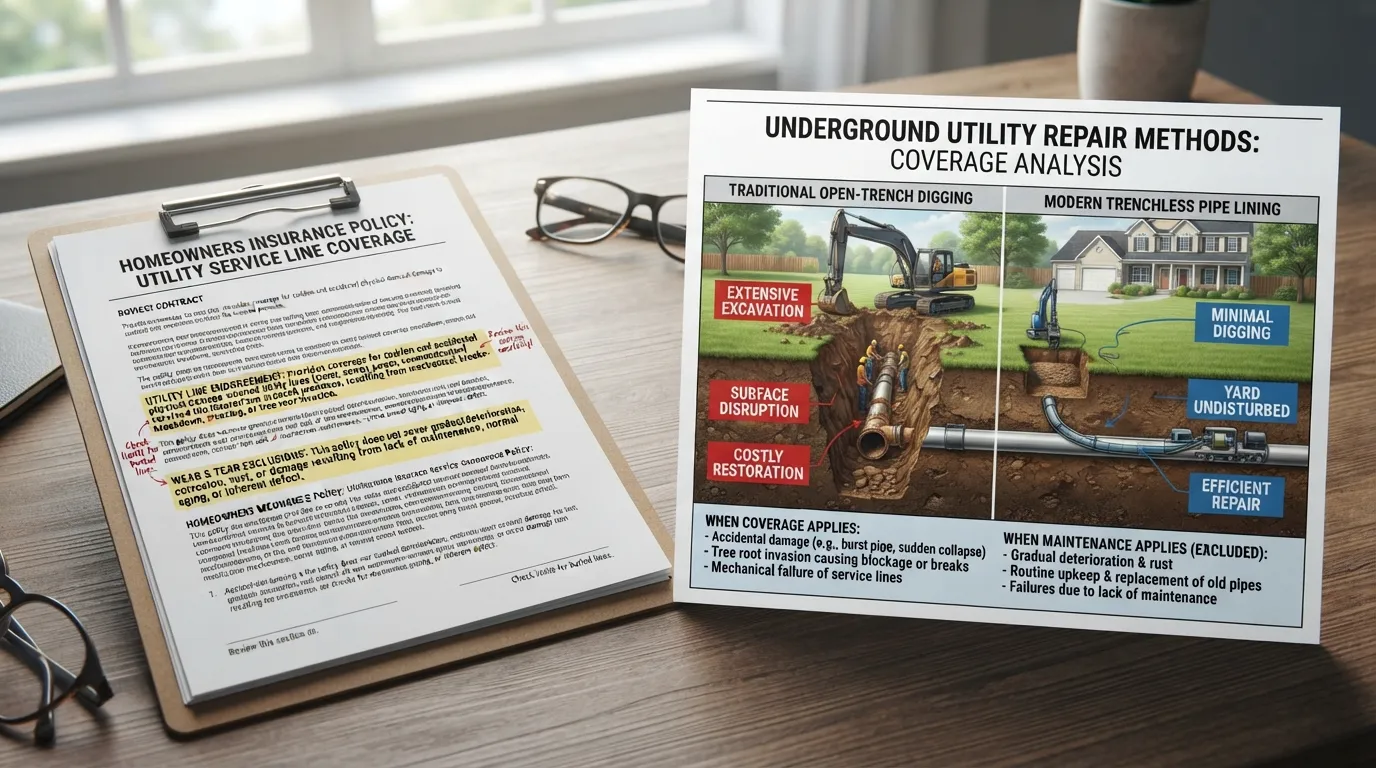
Navigating insurance claims for underground plumbing failures can be confusing. For most homeowners, discovering a broken sewer lateral brings an immediate question: will my policy cover the repair work, including modern trenchless methods like CIPP lining or pipe bursting?
When Sewer Line Damage Is Typically Covered
Standard homeowners insurance policies generally draw a strict line between sudden accidental damage and gradual deterioration. Insurance providers rarely cover the physical pipe itself unless a specific, acute event triggers the failure.
Sudden External Incidents: If a heavy vehicle drives across your yard and crushes the lateral, or an accredited utility contractor accidentally drills through your sewer line, standard coverage or third-party liability often applies.
Optional Endorsements & Riders: Many carriers offer specialized sewer and drain backup riders or service line endorsements for a nominal annual fee. These optional add-ons frequently cover the excavation or trenchless repair costs required to fix damaged exterior utility pipes.
When It’s Usually Excluded (Wear and Tear, Root Damage)
The vast majority of sewer line failures stem from long-term environmental factors. Consequently, standard policies exclude these scenarios from coverage.
Wear and Tear Exclusion: Aging cast iron, clay, or Orangeburg pipes that degrade, corrode, or crack simply due to old age are classified as routine home maintenance, making repair costs the homeowner’s responsibility.
Tree Root Intrusion: Because root infiltration happens gradually over years as roots seek out moisture, insurance companies view root damage as preventable wear and tear rather than a sudden disaster.
Ground Settling and Shifting: Natural soil compaction or gradual settling that cracks underground pipes is almost universally excluded unless paired with a specific endorsement. You can review detailed breakdowns on structural water exclusions through consumer guidance provided by the Insurance Information Institute
What to Ask Your Insurance Provider Before Filing a Claim
Before you authorize a plumber or submit formal paperwork to your insurance carrier, clarifying your policy language prevents unexpected claim denials.
Do I carry a service line endorsement? Ask your agent specifically if your policy includes underground utility or service line coverage extensions.
Is interior water damage covered? Even if the outdoor pipe repair is denied, check if your policy covers the cleanup and restoration of interior drywall or flooring damaged by a resulting sewage backup.
What constitutes a “sudden” failure? Ask how your specific carrier defines acute damage versus long-term maintenance issues to determine if your incident qualifies for review.
How Long Does Trenchless Sewer Repair Last? (Lifespan & Maintenance)
Investing in trenchless sewer rehabilitation is designed to be a permanent, long-term fix for aging infrastructure. Understanding the expected lifespan of modern materials and implementing basic preventive maintenance ensures your rehabilitated sewer line operates reliably for decades.
Expected Lifespan of CIPP and HDPE Pipe Lining (50+ Years)
Trenchless repairs utilize industrial-grade materials engineered to outlast traditional plumbing components. Both cured-in-place pipe (CIPP) liners and high-density polyethylene (HDPE) pipes provide exceptional structural longevity.
Design Longevity: Professionally installed epoxy resin liners and HDPE pipes routinely feature an expected operational lifespan of 50 years or more, frequently matching or exceeding the durability of brand-new PVC installations.
Corrosion and Root Resistance: Because epoxy and HDPE feature smooth, non-porous inner walls, they offer total corrosion resistance and eliminate root intrusion at former joint weak points.
Manufacturer Warranties: Certified trenchless contractors and material manufacturers frequently back these installations with multi-decade warranties, providing long-term peace of mind for property owners.
Signs Your Sewer Line May Need Attention Again
Even with a robust 50-year lifespan, monitoring your plumbing system for early warning signs prevents unexpected backups and costly emergency repairs.
Slow-Draining Fixtures: If multiple drains throughout your home (tubs, sinks, and toilets) begin emptying sluggishly at the same time, it indicates a developing blockage downstream.
Gurgling Toilet Bowls: A gurgling sound when flushing or running washing machine water points to trapped air venting backward through the system due to a restriction.
Unpleasant Odors or Wet Spots: Lingering sewage smells near cleanouts or unexplained soggy patches in your yard require immediate diagnostic camera scoping.
Simple Maintenance Tips to Extend Pipe Life
Protecting your trenchless investment requires mindful everyday usage and routine preventative care. Implementing these simple guidelines keeps your drainage system flowing freely:
Watch What You Flush: Never flush “flushable” wipes, paper towels, hygiene products, or cooking grease down drains, as these items create stubborn clogs over time.
Schedule Routine Hydro-Jetting: If your property sits near aggressive mature trees, periodic professional hydro-jetting every few years clears minor debris before it impacts flow.
Avoid Chemical Drain Cleaners: Harsh chemical drain openers can degrade plumbing fixtures and rubber seals over extended periods; rely on mechanical snaking or professional jetting instead.
Real-World Experience: What Homeowners Are Saying
Navigating sewer line failures often brings a mix of anxiety and uncertainty for property owners. Examining community discussions and insights from experienced licensed plumbing professionals reveals key themes regarding expectations, contractor selection, and the practical realities of executing a trenchless repair project.
Common Homeowner Concerns Before Choosing Trenchless Repair
Community feedback and homeowner forums consistently highlight three major anxieties when facing sewer line replacements:
Initial Cost Sticker Shock: Many property owners experience initial hesitation when reviewing upfront quotes for trenchless technology, wondering if the specialized service fees genuinely outweigh traditional digging estimates.
Contractor Trust and Validation: Homeowners frequently express concern about verifying whether a contractor is genuinely certified to install proprietary CIPP liners or if they are paying for subpar work that lacks manufacturer warranty backing.
Disruption and Access Worries: Even though trenchless methods avoid massive yard trenches, clients often worry about unexpected property impacts, such as where access pits will be dug or whether indoor fixtures will remain usable during the procedure.
What Licensed Plumbers Say to Expect During the Process
Experienced plumbing contractors emphasize that transparent communication during the initial diagnostic phase prevents misunderstandings.
The Camera Scoping Mandate: Reliable technicians insist on a thorough video camera inspection before quoting any trenchless work to confirm the pipe is free of severe bellies, structural collapses, or severe offsets.
Setting Realistic Expectations: Professionals stress that while trenchless repairs eliminate open trenches across your lawn, creating access pits or cleaning out heavy scale with industrial chain knockers remains a necessary part of the workflow.
A Practical Example: What a Typical Trenchless Job Looks Like Start to Finish
Understanding the chronological progression of a standard residential trenchless project helps set clear expectations from day one:
Day 1 (Inspection & Preparation): Technicians run a high-resolution camera down the line, followed by mechanical descaling or hydro-jetting to scrub the host pipe interior clean of roots and debris.
Day 2 (Lining or Bursting Execution): The epoxy resin liner or HDPE pipe is pulled or inverted into place, inflated, and cured using steam or specialized UV light systems.
Final Quality Check: A post-installation camera scoping is performed to verify structural integrity, ensure branch connections are clear, and officially sign off on the multi-decade warranty.
Frequently Asked Questions About Trenchless Sewer Repair
Navigating underground plumbing decisions often raises specific questions regarding cost, durability, and practical alternatives. Reviewing direct answers to common queries helps property owners make confident, informed choices about their sewer systems.
Is Trenchless Sewer Repair Worth It?
The Direct Answer: Yes, trenchless sewer repair is generally well worth the investment for homeowners looking to protect expensive landscaping, driveways, and custom hardscapes.
The Value Proposition: While upfront service quotes can appear higher than traditional digging estimates, saving thousands of dollars in property restoration fees makes trenchless solutions highly cost-effective overall.
Is Relining a Sewer Pipe Worth It?
The Direct Answer: Pipe relining (CIPP) is exceptionally worthwhile when the existing host pipe retains a solid structural framework and is free of severe bellies or complete collapses.
The Long-Term Benefit: Relining creates a seamless, jointless pipe-within-a-pipe that eliminates root intrusion and corrosion, backed by manufacturer lifespans stretching up to 50 years.
Can You Repair a Sewer Line Without Digging It Up?
The Direct Answer: In many residential scenarios, yes; trenchless methods like CIPP lining and pipe bursting rehabilitate or replace compromised pipes using only one or two small access pits.
The Operational Caveat: While these methods avoid open-trench digging across your entire yard, they are not entirely “digless”—technicians still require localized access points or cleanouts to insert diagnostic and repair equipment.
How Often Do Residential Sewer Lines Need to Be Replaced?
The Direct Answer: Traditional sewer lines typically last 30 to 50 years depending on material quality, while modern trenchless installations (such as epoxy resin liners and HDPE pipes) are engineered for a 50+ year lifespan.
Preventive Care Cross-Reference: As explored in Section 8, routine maintenance—including avoiding harmful flushes and scheduling periodic professional inspections—plays a major role in maximizing your system’s longevity.
Conclusion & Next Steps
Choosing between trenchless technology and traditional open-trench excavation ultimately hinges on weighing upfront costs, property preservation, and your sewer line’s structural condition. While trenchless methods like CIPP lining and pipe bursting protect mature landscaping and deliver 50-year durability, severely collapsed or back-pitched pipes still require traditional digging. Evaluating your specific damage scope ensures you select the most cost-effective and permanent solution for your home.
Final Verdict: Is Trenchless Repair Right for You?
Trenchless repair is the clear winner for homeowners looking to avoid the massive restoration bills associated with torn-up driveways, patios, and lawns. However, a successful project requires matching the technology to the pipe’s actual health. If your line suffers from minor cracks, root intrusion, or corrosion rather than total structural failure, non-invasive rehabilitation offers unmatched speed and longevity.
Get a Professional Sewer Line Evaluation
Because every underground plumbing system features unique challenges, guessing the right fix can lead to costly mistakes. The safest and most effective way to start is by consulting an expert. You can schedule your evaluation today with a certified technician to get a high-resolution camera inspection and an accurate quote for your property.
Main Services
Related Posts
Need a Plumber in Miami?
Schedule service online or speak directly with the EZ Plumbing team.
Owner-Led Local Service
Know who is behind the business before you request service. The owners, contact line and Miami service pages are published clearly.
- Named business owners
- Direct phone and social channels
- Local Miami service information
Clear Help Before You Book
Review the relevant service page, contact the team directly and use the booking page when you are ready—without relying on vague claims.
- Service-specific information
- Direct questions before scheduling
- Clear online booking route