If you’re staring at a wall of couplings, elbows, and adapters trying to figure out which 3/4 inch pipe fitting you actually need, you’re not alone. Between different materials, connection styles, and thread standards, it’s easy to grab the wrong part and end up with a leak instead of a fix. In this guide, I’ll walk you through everything you need to know about 3/4 inch pipe fittings — what they are, which material fits your project, how to avoid the most common mistakes, and when it’s worth calling in a licensed plumber instead of DIY-ing it.
A 3/4 inch pipe fitting is a connector used to join, redirect, branch off, or seal 3/4-inch diameter pipes. They come in materials like PVC, copper, CPVC, brass/steel, and PEX, and connect using slip/glue, threaded (NPT), push-to-connect, or barbed methods. The right choice depends on what’s running through the pipe (water, gas, irrigation) and whether the line is hot, cold, or pressurized.
What Is a 3/4 Inch Pipe Fitting?
A 3/4 inch pipe fitting is any connector designed to join two or more sections of 3/4-inch pipe, change the direction of a pipe run, branch a single line into multiple lines, or cap off an unused pipe end. The “3/4 inch” refers to the nominal pipe size, not necessarily the exact outer diameter — this is one of the most common points of confusion, and we’ll clear it up below.
Common Types of 3/4 Inch Pipe Fittings
Most residential plumbing and irrigation projects only need a handful of fitting types. Here’s what each one does:
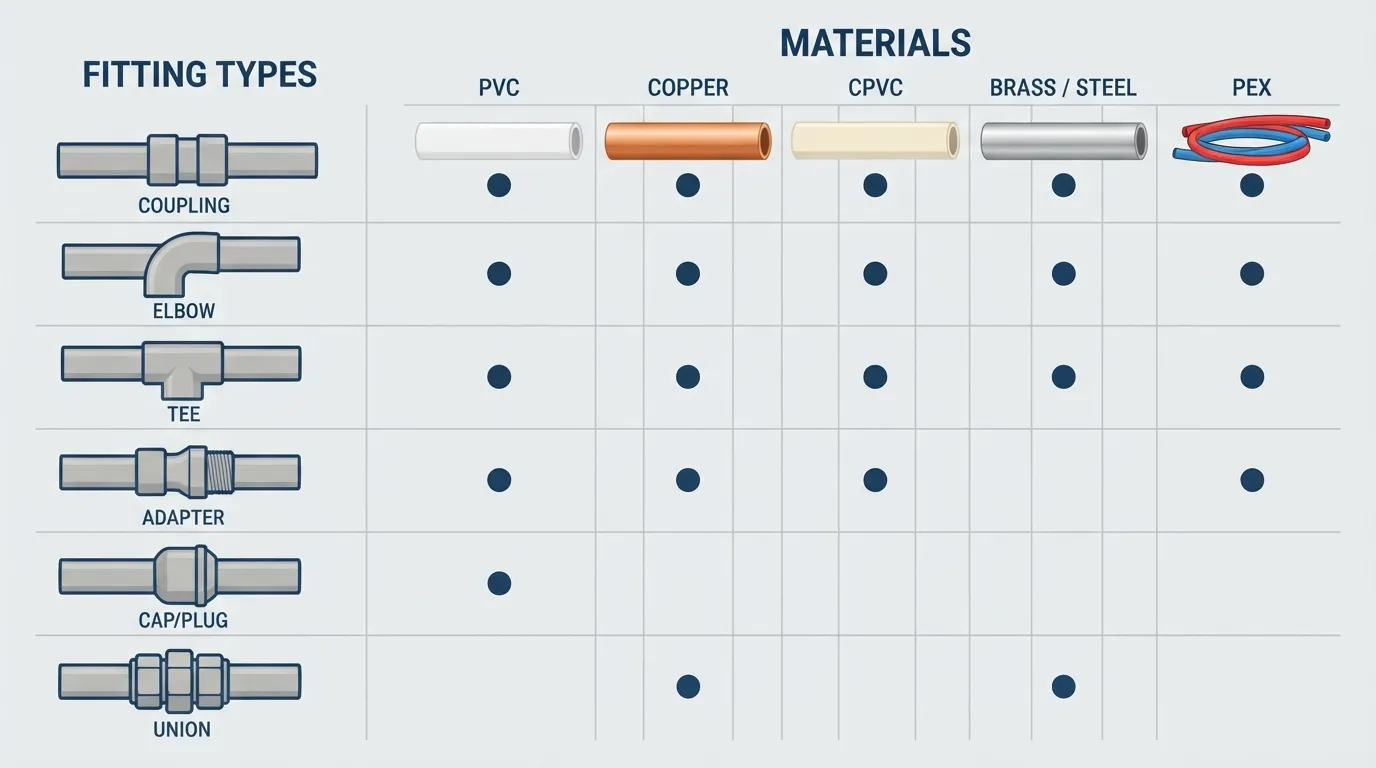
- Coupling — Joins two straight pipe sections into one continuous run.
- Elbow — Changes the direction of the pipe, typically at a 90° or 45° angle.
- Tee — Splits one line into two, forming a “T” shape (or combines two lines into one).
- Adapter — Connects two different pipe materials or joins the pipe to a fixture, valve, or appliance.
- Cap / Plug — Seals off the open end of a pipe, temporarily or permanently.
- Union — Allows a section of pipe to be disconnected and reconnected without cutting, useful near shut-off valves or appliances that need servicing.
Which Material Should You Choose?
The material of your fitting should almost always match the material of your existing pipe, and it needs to be rated for what’s flowing through it. Here’s a side-by-side comparison to help you decide:
| Material | Best For | Connection Method | Notes |
|---|---|---|---|
| PVC | Cold water, sprinklers, pools | Slip/glue | Not rated for hot water; solvent cement bond is permanent |
| Copper | Hot and cold water lines | Soldered or press-fit | Traditional, durable, but requires more skill/tools to install |
| CPVC | Hot water distribution | Slip/glue | Handles higher temperatures than standard PVC |
| Brass / Steel | Gas lines, high-pressure, heavy-duty | Threaded (NPT) | Required for gas — never substitute plastic fittings on a gas line |
| PEX | Modern residential water lines | Push-to-connect, crimp, or barbed | Flexible, freeze-resistant, no glue or soldering needed |
⚠ Safety Note
Gas lines require brass or steel fittings rated specifically for gas — plastic fittings, even ones rated for high water pressure, are not a safe substitute. If you’re working on or near a gas line, this is one job where it’s worth having a licensed plumber verify the connection before you turn the gas back on.
Connection Methods Explained
Beyond material, fittings also differ in how they physically join to the pipe:
- Slip/Socket: Plain ends that slide over the pipe and require solvent cement (glue) to bond permanently. Common with PVC and CPVC.
- Threaded (NPT): Grooved ends that screw together, following National Pipe Thread standards. Common on brass, steel, and adapter fittings.
- Push-to-Connect: Quick “push” fittings (like SharkBite) that grip the pipe with no glue, solder, or tools required — great for repairs in tight spaces.
- Barbed: Ridged fittings pushed into soft plastic or PEX tubing and secured with a metal clamp.
What Size Is a 3/4 Inch Pipe, Really?
This trips up a lot of people. “3/4 inch” is the nominal size, not the exact measured diameter. For threaded (NPT) fittings, the actual outside diameter of a 3/4″ pipe is closer to 1.05 inches — the nominal number is a naming convention, not a literal measurement. This is why it’s always safer to bring the actual fitting or a section of your existing pipe with you when buying a replacement, rather than relying on the number alone.
What Is a 3/4 Inch NPT?
NPT stands for National Pipe Thread — the standard thread pattern used on most threaded plumbing and gas fittings in the U.S. A 3/4 inch NPT fitting has threads sized and tapered to match other 3/4″ NPT components, so the connection tightens and seals as it’s screwed in. Mixing NPT with a non-NPT thread standard (like BSP, common outside the U.S.) is one of the most common causes of a fitting that “almost” fits but won’t seal properly.
Is There a Pipe Size Between 1/2 and 3/4?
Yes — there isn’t a common “5/8 inch” nominal fitting size in standard plumbing, but there are transition fittings (reducers/adapters) specifically made to step down from 3/4″ to 1/2″, or up from 1/2″ to 3/4″. If your existing line and your new fixture don’t match, the fix is almost always a reducing adapter, not a mid-size pipe.
Decision Box: Can You Go From 1/2 to 3/4 Water Line?
Yes, with the right reducing coupling or adapter — but there’s a catch. Going from a 1/2″ line up to a 3/4″ fixture can increase flow and reduce pressure loss, which is often the goal. Going the other way (3/4″ down to 1/2″) will restrict flow. Before making this change, it’s worth checking:
- Whether your main supply line can support the increased flow
- Local plumbing code requirements for the fixture you’re connecting
- Whether the transition needs to happen at a specific point (like before a manifold)
Can I Run 3/4 Inch PEX to My Shower Valve?
Most residential shower valves are designed for 1/2″ PEX connections, since that’s what typically feeds individual fixtures. Running 3/4″ PEX directly to the shower valve usually means you’ll need a reducing fitting at the valve body itself, since most valve inlets are sized for 1/2″. For a single shower, 1/2″ PEX is generally sufficient for flow — 3/4″ is more commonly used for trunk lines (the main lines feeding multiple fixtures) rather than the final connection to a fixture.
Should I Use 1/2 or 3/4 PEX for Shower?
For the branch line running directly to a single shower, 1/2″ PEX is the standard choice and matches most valve and showerhead fittings. 3/4″ PEX makes more sense as your main distribution line if you’re running a manifold system feeding several fixtures, or if you’re specifically trying to maximize flow to a high-demand shower system with multiple heads.
PEX vs PVC: Which Is Better for Your Project?
Neither material is universally “better” — it depends on the job:
- Choose PVC for cold-water applications, irrigation systems, pools, or drain lines where rigidity and cost matter more than flexibility.
- Choose PEX for interior water supply lines, especially in tight spaces, retrofits, or areas where freeze resistance is a concern — PEX flexes rather than cracking under pressure from expanding ice.
If you’re mixing the two — for example, transitioning an old PVC line to new PEX distribution — you’ll need a threaded or push-to-connect transition fitting, since PVC solvent cement will not bond to PEX.
What Should PEX Not Be Used For?
PEX is versatile, but it’s not the right choice everywhere. It’s generally not recommended for:
- Direct outdoor exposure to sunlight over long periods — UV exposure degrades PEX over time unless it’s specifically UV-rated
- Gas lines — PEX is a water-distribution product, not rated for fuel gas
- Applications requiring extremely high temperatures beyond its rated tolerance
How Long Will PEX Last Buried Underground?
PEX is commonly used in buried and underground applications because it resists corrosion and handles ground movement better than rigid pipe. That said, longevity depends heavily on proper installation — correct bedding material, protection from sharp rocks or debris, and using fittings rated for underground/direct-burial use. Poor installation is a far more common cause of early failure than the material itself.
Common Mistakes That Cause Leaks
Most fitting failures we see aren’t caused by a bad product — they’re caused by how the fitting was installed. A few things worth double-checking before you call a project “done”:
- Over-tightening threaded fittings — This can crack the fitting or strip the threads, especially on plastic components.
- Skipping thread seal tape or pipe dope — Threaded connections almost always need a sealant; dry threads rarely seal reliably on their own.
- Not deburring cut pipe ends — Rough edges from cutting can prevent a clean seal, particularly with push-to-connect and slip fittings.
- Mixing incompatible materials without a proper transition fitting — Gluing PVC directly to PEX, for example, won’t create a lasting seal.
- Not letting solvent cement cure fully — Pressurizing a PVC joint too soon after gluing is one of the most common causes of early leaks.
Miami Climate Considerations
South Florida’s heat and humidity add a few extra considerations beyond what a general national guide will tell you. Prolonged sun exposure on exterior PVC lines can make the material more brittle over time, so shading or UV-rated pipe is worth considering for outdoor irrigation runs. Humidity can also slow solvent cement curing slightly compared to drier climates, so it’s worth giving glued joints a little extra time to set before pressurizing the line — especially on larger repair jobs.
DIY vs. Calling a Professional Plumber
DIY is usually fine for: replacing a single visible fitting, swapping a cap or plug, straightforward PVC repairs on irrigation lines.
Call a professional for: any gas line work, fittings behind walls or under slabs, transitions between materials you’re unfamiliar with, or repeated leaks at the same joint.
If you’d rather have it done right the first time, our team at Miami Florida Plumbing handles everything from small fitting repairs to full water heater replacements, and we’re happy to take a look before a small leak becomes a bigger repair.
Watch: How Basic Pipe Fittings Work
If you’re more of a visual learner, this short video walks through the most common pipe fitting types used in residential plumbing:
Key Takeaways
- Match the fitting material to your existing pipe and what’s flowing through it
- Gas lines always require brass/steel fittings — never plastic
- “3/4 inch” is a nominal size, not the exact measured diameter
- PEX is the more flexible, freeze-resistant option for interior supply lines; PVC suits cold water, irrigation, and pools
- Most leaks come from installation mistakes, not bad fittings
Frequently Asked Questions
What is the price of a 3/4 inch pipe connector?
Pricing varies significantly by material and connection type — plastic slip fittings tend to be the most affordable, while brass, press-fit copper, and specialty push-to-connect fittings cost more. Retailers like Home Depot, Grainger, and McMaster carry current pricing by material and style.
Is it better to use PVC or PEX?
It depends on the application — PVC is well-suited to cold water, irrigation, and drain lines, while PEX is generally preferred for interior water supply lines because of its flexibility and freeze resistance. See the comparison above for more detail.
What size is 3/4 inch pipe?
3/4 inch is the nominal size, which does not always match the exact outer diameter of the pipe. Bringing the existing pipe or fitting to the store when shopping for a replacement is the most reliable way to get an exact match.
Need Help With a Fitting Repair or Replacement?
Whether it’s a single leaking fitting or a larger repiping job, our licensed plumbers can take a look and get it fixed right the first time. Browse our full range of plumbing services or give us a call directly.
Have a Plumbing Issue You’d Rather Not DIY?
Related Resources for Sourcing Fittings
If you’re shopping for the physical parts, these retailers carry a wide selection of 3/4 inch pipe fittings across materials and connection types: