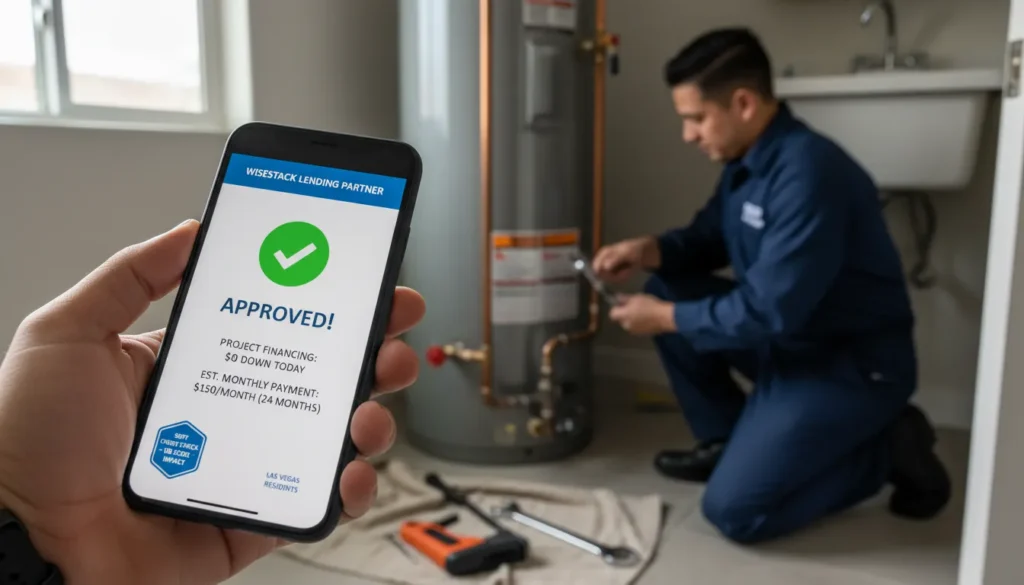
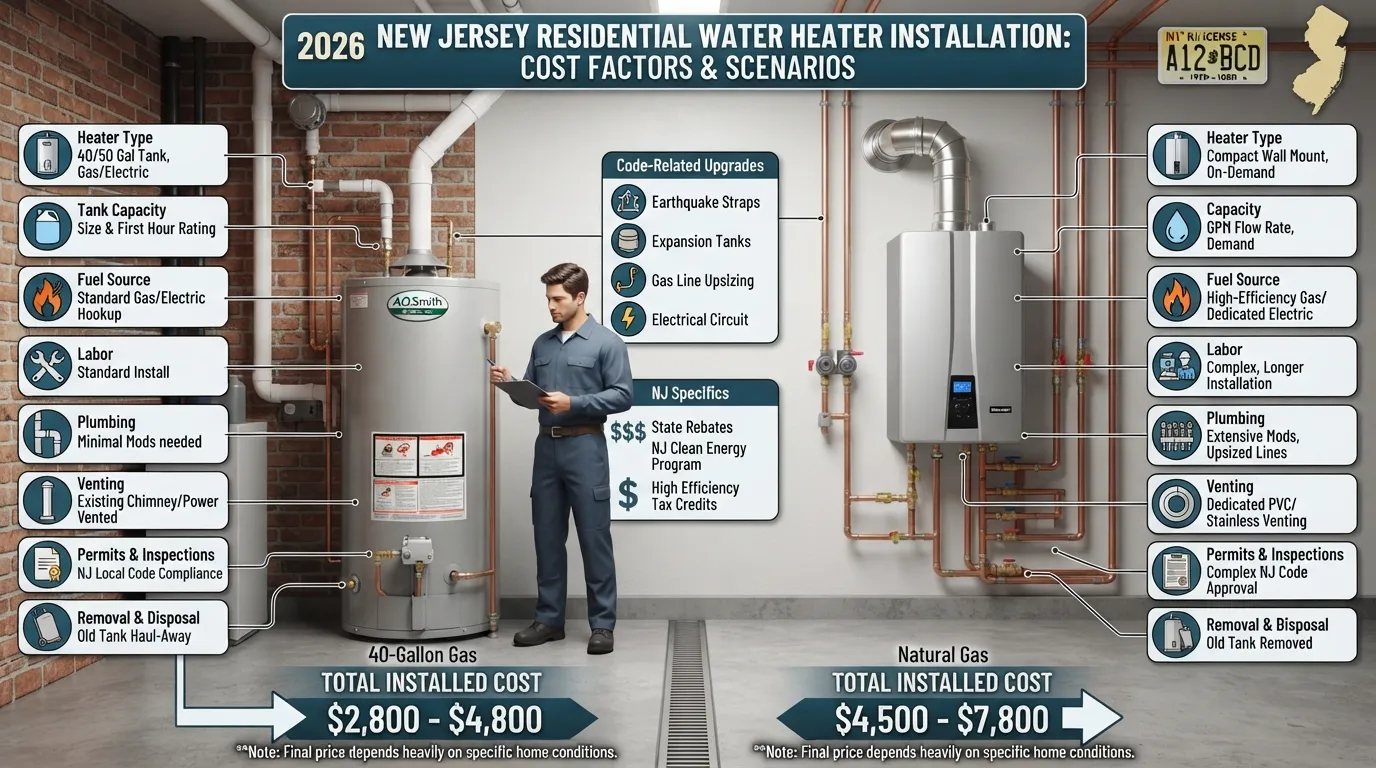
Water heater installation cost in New Jersey can vary substantially depending on the heater type, fuel source, capacity, venting, existing plumbing, electrical or gas work, permits, and whether you are replacing an existing unit or changing systems.
As a useful national reference point, Home Depot currently lists average installation costs of about $1,950 for a tank water heater and $4,300 for a tankless water heater, while HomeAdvisor reports a 2025–2026 replacement range of $881–$1,825. These figures are not a guaranteed New Jersey quote; your actual NJ price depends heavily on the installation conditions at your home.
If you are searching for water heater installation cost in NJ, you probably do not just want another generic national average. You want to know what you may actually pay, why two plumbers can give you very different quotes, whether a tankless upgrade is worth the extra money, what can increase the final bill, and what you should ask before approving an installation.
That is what this guide is designed to help you understand.
Water Heater Installation Cost in NJ at a Glance
The important point is that there is no single “New Jersey water heater price.” A replacement using the same type of heater in the same location can be much simpler than converting from a conventional tank to a tankless system.
What Determines Your Water Heater Replacement Cost in NJ?
When you compare quotes, look beyond the number at the bottom. The scope of work is often what explains the difference.
1. Water heater type
A conventional storage-tank water heater is usually a different project from installing a tankless system. Tankless equipment can require changes to gas capacity, venting, electrical connections, condensate drainage or other components depending on the installation.
Home Depot’s current cost guide illustrates the difference: it lists a general average of about $1,950 for tank installation and about $4,300 for tankless installation. Those are reference figures rather than a New Jersey-specific quote. :contentReference[oaicite:0]{index=0}
2. Tank size and household demand
A 40-gallon or 50-gallon tank may make sense for many homes, but the correct size depends on how much hot water you use and when you use it. Choosing a larger tank simply because it sounds better can increase equipment and operating costs without solving the real problem.
Before replacing your heater, consider the number of people in the home, simultaneous showers, appliances that use hot water, and whether your current system regularly runs out of hot water.
3. Gas, electric, propane, or another fuel source
Fuel source matters because the installation requirements are not identical. Replacing an existing gas tank with another compatible gas tank can be a very different job from converting to an electric or tankless system.
4. Venting and gas-line requirements
This is one of the areas homeowners sometimes overlook when comparing quotes. A new system may require changes to venting or gas piping rather than simply disconnecting the old heater and connecting the new one.
Important:
Do not compare a basic replacement quote with a conversion quote as if they were the same job. If a contractor is changing the fuel source, heater type, venting or installation location, additional work may be required.
5. Plumbing modifications and code-related work
Older installations may not match the requirements or configuration of a new water heater. Depending on the property and installation, the plumber may need to address piping, shutoff components, temperature and pressure protection, expansion control, drainage, venting or other installation details.
New Jersey currently operates under its Uniform Construction Code, with the National Standard Plumbing Code/2021, New Jersey edition adopted as the plumbing subcode. :contentReference[oaicite:1]{index=1}
6. Permit and inspection requirements
Permit requirements can depend on the work being performed and the local enforcing agency. Because requirements can change and municipalities administer construction-code processes, you should confirm the applicable permit and inspection requirements for your property before work begins.
The New Jersey Department of Community Affairs maintains the state’s Uniform Construction Code and publishes current code information and updates. :contentReference[oaicite:2]{index=2}
7. Removing and disposing of the old heater
Ask whether removal and disposal of your existing water heater are included in the quoted price. If they are listed separately, you can compare estimates more accurately.
Water Heater Installation Cost: Tank vs. Tankless
Which one should you choose?
Choose a conventional tank when:
- You want a familiar system.
- Your existing setup already supports a compatible tank.
- You want to minimize installation complexity.
- Your household’s hot-water demand is already being met adequately.
Consider tankless when:
- You want an on-demand hot-water system.
- Your home and installation conditions are suitable for the conversion.
- You are comfortable with a potentially higher upfront installation cost.
- You have considered the required gas, venting, electrical and condensate changes.
The cheapest installation is not automatically the best value. If a lower-priced quote leaves out required work, the initial savings may disappear later.
How Much Is Labor to Install a Water Heater?
There is no reliable single labor price that applies to every New Jersey installation. Labor depends on access, removal, the existing connections, installation complexity, code-related work, equipment type and whether additional plumbing, gas or electrical work is required.
This is why you may see very different labor figures online or receive substantially different quotes from contractors. A labor-only number also does not necessarily represent the full installation cost.
When comparing labor, ask what is included.
- Old-unit removal
- New-unit installation
- Connections and required fittings
- Venting or gas-line work, if applicable
- Electrical modifications, if applicable
- Permit and inspection handling
- Startup and testing
- Cleanup and disposal
Why One NJ Water Heater Quote Can Be Much Higher Than Another
Imagine two plumbers inspect the same house. One quotes a straightforward replacement. The other identifies additional work involving venting, piping, an expansion tank, electrical service or code compliance. The second quote may be higher because it includes more work, not necessarily because the plumber is charging more for the same job.
Before choosing the cheapest bid, compare the scope of work.
A better way to compare three quotes
- Confirm the exact water heater model and capacity.
- Confirm whether the quoted amount includes the equipment.
- Ask whether removal and disposal are included.
- Ask whether required permits and inspections are included.
- Ask whether code-related upgrades are included or billed separately.
- For gas systems, ask whether venting and gas-line work are included.
- For electric systems, ask whether any electrical upgrades are included.
- Ask what circumstances could cause the quoted price to change.
Do You Need a Permit to Install a Hot Water Heater in NJ?
This is one of the most important questions to ask before starting a replacement. New Jersey construction work is governed by the Uniform Construction Code, but the applicable requirements depend on the project and enforcing agency. The state’s Department of Community Affairs provides the current code framework and updates. :contentReference[oaicite:3]{index=3}
Rather than assuming that every water-heater replacement has exactly the same permit process, ask your plumber or local construction official what applies to your specific installation.
Do not skip this step: If a permit or inspection is required for your project, make sure the responsibility for obtaining it is clearly stated in your estimate.
What About a 40-Gallon or 50-Gallon Gas Water Heater?
A 40- or 50-gallon gas water heater is a common configuration, but the installation price still depends on the condition of the existing setup. The equipment itself is only one part of the project.
For example, if the replacement can remain in the same location with compatible gas, water and vent connections, the project may be simpler than an installation that requires modifications. Home Depot currently lists residential gas tank models in 40- and 50-gallon configurations, illustrating that equipment pricing also varies by model and features. :contentReference[oaicite:4]{index=4}
Water Heater Replacement Cost vs. Installation Cost
People often use “installation” and “replacement” interchangeably, but there can be an important difference.
- Replacement generally means removing an existing heater and installing a new one.
- Installation can also describe a new system or a more extensive conversion where additional work is required.
That distinction matters when researching water heater replacement cost NJ. A simple same-type replacement should not automatically be compared with a tankless conversion or a new installation requiring major modifications.
Hidden Costs That Can Increase Your Final Water Heater Price
The following items may affect your final project cost depending on your installation:
- Permit and inspection requirements
- Old water heater removal and disposal
- New or modified water connections
- Expansion-control components where required
- Temperature and pressure protection components
- Gas-line modifications
- New or modified venting
- Electrical upgrades
- Condensate drainage for applicable equipment
- Relocating the water heater
- Bringing an older installation into compliance with applicable requirements
The most useful question to ask your plumber
“Is this a complete installed price, and what work could cause the final cost to increase?”
Should You Repair or Replace Your Water Heater?
If your water heater has stopped working, replacement is not always the first answer. The right decision depends on the age and condition of the unit, the type of problem, repair cost, reliability and whether the existing system still meets your needs.
Replacement may make more sense when:
- The tank is leaking.
- The unit has repeated failures.
- Repair costs are becoming difficult to justify.
- Your household’s hot-water needs have changed.
- You want to change from a conventional tank to another technology.
If you are unsure, have the system inspected before committing to replacement.
How to Get a More Accurate NJ Water Heater Installation Estimate
Online averages are useful for planning, but they cannot see your basement, utility room, piping, venting or electrical service. A more useful estimate comes from evaluating the actual installation.
- Take a photo of your current water heater and its connections.
- Record the manufacturer, model, capacity and fuel type.
- Note whether the current unit is tank or tankless.
- Ask for an itemized estimate.
- Get the exact replacement model in writing.
- Ask about permits and inspections.
- Ask about potential code-related upgrades.
- Compare the total installed price rather than only labor.
A Simple Water Heater Quote Checklist
Before you approve the job, make sure your quote answers these questions:
- What exact water heater is being installed?
- What is its capacity?
- Is it gas, electric, propane, tankless or hybrid?
- Is the old unit included for removal?
- Is disposal included?
- Are permits included?
- Are inspections included?
- Are required plumbing modifications included?
- Are gas-line or venting changes included if needed?
- Are electrical modifications included if needed?
- What warranty applies to the equipment?
- What warranty applies to the installation?
- What circumstances could change the quoted price?
Key Takeaways
- There is no single price that applies to every New Jersey water heater installation.
- Tank, tankless and hybrid systems can have very different installation requirements.
- The existing gas, plumbing, electrical and venting setup can have a major effect on cost.
- Permits and code requirements should be confirmed for your specific project.
- A low quote is not necessarily the best quote if important work has been excluded.
- The most useful comparison is an itemized, installed price with the scope of work clearly defined.
Frequently Asked Questions
How much does it cost to replace a water heater in NJ?
The answer depends on the heater type and installation conditions. National cost guides currently show substantial variation: Home Depot lists average installation figures around $1,950 for tank systems and $4,300 for tankless systems, while HomeAdvisor reports a different national replacement range. These should be treated as planning references rather than a guaranteed New Jersey price. :contentReference[oaicite:5]{index=5}
What is the average labor cost to install a 40-gallon gas water heater?
There is no dependable single NJ labor price because the scope of work varies. Ask whether the labor quote includes removal, disposal, connections, required modifications, permits, testing and cleanup.
How much do plumbers charge per hour in NJ?
Hourly rates can vary by contractor, location, service type and job complexity. For a water heater replacement, an hourly rate alone is often less useful than the total installed price because equipment, fittings, permits and additional work can represent a substantial part of the project.
Is a tankless water heater more expensive to install?
It can be. Tankless installation may involve additional requirements that are not present in a straightforward tank replacement. Home Depot’s current guide shows a higher average installation figure for tankless systems than conventional tanks. :contentReference[oaicite:6]{index=6}
Why did my plumber’s quote increase after looking at the existing water heater?
An on-site inspection can reveal work that is impossible to price accurately from the heater alone. Examples can include incompatible connections, venting issues, gas-line requirements, electrical work, plumbing modifications or code-related corrections.
Can I use the same location for my replacement water heater?
Often the existing location can be reused, but the new system must be appropriate for that location and its connections. A change in heater type or fuel source can alter the installation requirements.
Related Plumbing Help
If you are comparing replacement options, you can learn more about water heater replacement services and review the broader plumbing services available.
Need Help Choosing the Right Water Heater?
The right choice depends on your current system, household demand and installation conditions. Getting the existing setup evaluated can help you avoid comparing the wrong type of quote.
Useful Resources
- New Jersey Department of Community Affairs — Current Construction Codes
- New Jersey Uniform Construction Code
- Home Depot Water Heater Replacement Cost Guide
- HomeAdvisor Water Heater Replacement Cost Guide
Pricing note: Water heater prices and installation costs change over time and vary by property. Online figures are useful for budgeting, but an on-site assessment and itemized estimate are the best way to determine your actual project cost.