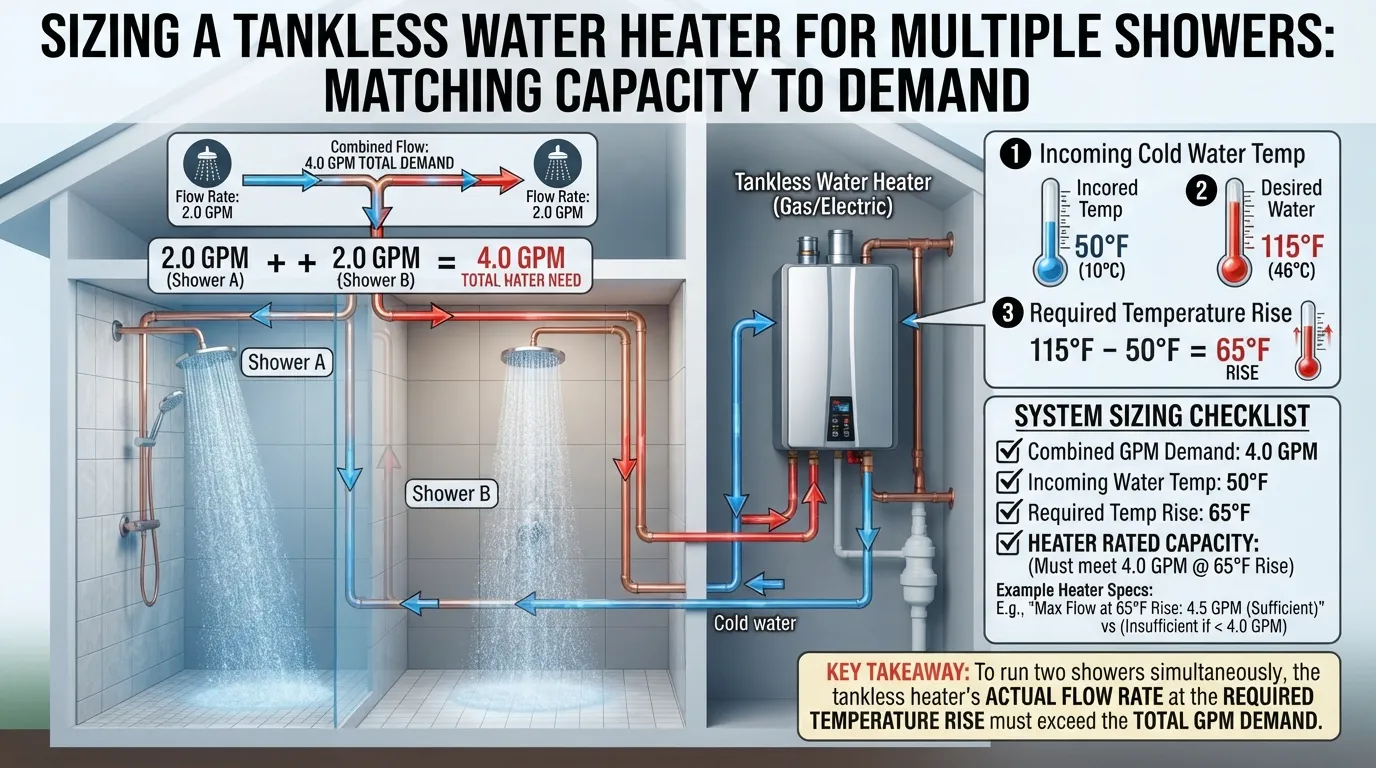
If you want to run two showers at the same time, the most important question is not simply how many bathrooms you have or whether a tankless water heater is advertised as “whole-house.” The real question is how much hot water those showers require at the temperature your home needs.
Can a Tankless Water Heater Run Two Showers?
Yes. A properly sized tankless water heater can supply two showers at the same time. But “two showers” does not automatically tell you what size heater you need.
Sizing depends mainly on:
- The combined flow rate of both showers in gallons per minute (GPM)
- The temperature of the incoming cold water
- Your desired hot-water temperature
- The heater’s actual flow capacity at the required temperature rise
- Whether another fixture is using hot water at the same time
Bottom line: an 18kW tankless water heater may be suitable for two showers under certain conditions, but the 18kW label alone is not enough to prove that it will provide the flow you want.
This guide will show you how to think about the problem, how to estimate your two-shower demand, why temperature rise matters, and how to decide whether an 18kW tankless water heater is actually appropriate for your home.
What Size Tankless Water Heater Do You Need for Two Showers?
The best way to size a tankless water heater is to start with simultaneous hot-water demand, not the number of bathrooms.
For example, having two bathrooms does not necessarily mean you need enough capacity for two showers. If only one shower normally runs at a time, your peak demand may be much lower. On the other hand, two people taking showers simultaneously can create a much larger demand.
As a starting point, consider the flow rate of each shower:
These figures are simply examples of how flow adds up. Your actual shower flow should be checked from the fixture specifications or measured at the fixture.
Why “Two Showers” Is Not a Complete Sizing Specification
Imagine two homes with exactly two showers.
Home A has two 2.0 GPM showerheads. Its simultaneous shower demand is approximately 4 GPM.
Home B has two 2.5 GPM showerheads. Its simultaneous shower demand is approximately 5 GPM.
Those homes have the same number of showers, but the tankless water heater has to supply different amounts of water.
The situation changes again if someone is using a bathroom sink, kitchen faucet, bathtub, or another hot-water appliance while both showers are running.
Important: Two Showers ≠ Two Bathrooms
Tankless sizing is based much more directly on simultaneous hot-water flow than on bathroom count. Always think about what fixtures could realistically operate at the same time during your busiest period.
How Temperature Rise Changes Tankless Water Heater Sizing
Flow rate is only half of the sizing equation.
You also need to consider temperature rise.
Temperature rise is the difference between the incoming water temperature and the temperature you want the heater to deliver.
The basic calculation is:
Required Temperature Rise = Desired Outlet Temperature − Incoming Water Temperature
For example, if incoming water is 60°F and you want 120°F water, the required temperature rise is 60°F.
If incoming water is 50°F and the desired outlet temperature is 120°F, the required temperature rise is 70°F.
The second situation requires the heater to do more heating work for the same water flow.
This is why you should never choose a tankless heater simply because a product page says it can handle “two showers.” You need to look at the manufacturer’s published performance at the temperature rise your home actually requires.
Is an 18kW Tankless Water Heater Enough for Two Showers?
Sometimes, but not automatically.
This is one of the most important points when comparing an 18kW tankless water heater.
An 18kW rating tells you about the heater’s electrical input capacity. It does not mean every 18kW unit will deliver the same GPM at every temperature rise.
For example, Bosch’s published specifications for its Tronic 6100 C 18kW model list approximately 3.51 GPM at a 35°F temperature rise, 2.73 GPM at a 45°F rise, and 1.59 GPM at a 77°F rise. The same documentation identifies the model as an 18kW, 208/240V electric tankless water heater. Exact performance varies by model and operating conditions. See the manufacturer’s published specifications.
The 18kW Takeaway
If two showers require 4–5 GPM of hot water, you should not compare that demand with the “18kW” number alone.
Compare the required GPM with the heater’s published GPM at your required temperature rise. That is the comparison that tells you whether the unit can realistically meet your demand.
How to Calculate Your Two-Shower Demand
You can make the sizing question much clearer by working through these steps.
Step 1: Find the Flow Rate of Each Shower
Check the showerhead or fixture specifications for GPM.
If you have two 2.0 GPM showers:
2.0 + 2.0 = 4.0 GPM
If you have two 2.5 GPM showers:
2.5 + 2.5 = 5.0 GPM
Step 2: Add Other Fixtures That Could Run at the Same Time
Now think about your real morning routine.
Could both showers run while someone is using a bathroom sink? Could someone be using the kitchen faucet? Could a dishwasher or another hot-water appliance be operating?
For example:
- Shower 1: 2.0 GPM
- Shower 2: 2.0 GPM
- Bathroom sink: 1.0 GPM
That creates a potential simultaneous demand of approximately 5.0 GPM.
The actual flow rates in your home may be different, so use your fixture specifications when possible.
Step 3: Determine the Incoming Water Temperature
Incoming water temperature varies by location and season. It can have a major effect on tankless performance because colder incoming water requires a larger temperature rise.
For sizing, use a realistic low-end incoming temperature rather than assuming the warmest water your home receives during summer.
Step 4: Decide on the Desired Hot-Water Temperature
Your required outlet temperature depends on your home’s setup, fixtures, mixing, and safety requirements.
Do not automatically copy a temperature setting from another home. Follow the water-heater manufacturer’s instructions and applicable plumbing requirements.
Step 5: Calculate the Required Temperature Rise
Subtract the incoming water temperature from your desired outlet temperature.
Example: 120°F desired outlet temperature − 55°F incoming water = 65°F temperature rise.
Step 6: Match GPM and Temperature Rise to the Manufacturer’s Performance Data
This is the step that determines whether a particular heater is actually suitable.
Do not compare your 5 GPM demand with a product’s maximum flow number if that maximum was measured at a much lower temperature rise. Look for the manufacturer’s performance data at the temperature rise you actually need.
A Simple Two-Shower Sizing Decision Guide
This table is a planning guide, not a substitute for the performance specifications of the exact water heater you intend to install.
What Happens If a Tankless Water Heater Is Undersized?
One common misunderstanding is that an undersized tankless heater will simply “run out” of hot water like a small storage tank.
Tankless systems operate differently. If the unit cannot provide enough heating capacity for the requested flow and temperature rise, the system may have to reduce the flow to maintain the desired outlet temperature.
In practical terms, you may notice that the shower flow becomes weaker when two people are showering simultaneously.
That is why correct sizing matters. A system that technically produces hot water is not necessarily a system that provides the shower pressure and flow you expect.
What If an 18kW Tankless Water Heater Is Not Large Enough?
You have several possible options, depending on your home’s electrical service, fuel availability, plumbing configuration, and actual hot-water demand.
Option 1: Choose a Larger Electric Unit
A larger electric tankless heater can provide more heating capacity, but the electrical requirements also increase. The home’s electrical service and installation requirements must be evaluated before selecting the equipment.
Option 2: Consider a Gas Tankless Water Heater
For higher simultaneous hot-water demand, gas tankless systems can provide a different capacity profile than electric units. However, gas availability, venting, combustion air, gas-line requirements, installation location, and local code all matter.
Option 3: Use Multiple Tankless Units
In higher-demand applications, manufacturers may support multiple tankless units operating together as a system. This can be useful when one unit cannot meet the home’s peak demand.
The correct configuration should be selected according to the manufacturer’s approved installation method and the home’s actual requirements.
Option 4: Reduce Simultaneous Demand
Sometimes the simplest solution is changing the demand rather than dramatically increasing equipment capacity.
For example, lower-flow shower fixtures can reduce the total GPM requirement. Staggering major hot-water uses can also reduce peak demand if that fits your household routine.
Electric vs. Gas Tankless Water Heater for Two Showers
There is no universal winner for every home. The right choice depends on the home’s existing infrastructure and the amount of hot water you actually need at the same time.
Electrical Requirements Matter With an 18kW Electric Heater
If you’re considering an 18kW electric tankless water heater, don’t stop at the plumbing side of the installation.
For example, the published Bosch Tronic 6100 C 18kW specifications identify a 208/240V electrical supply and multiple 30A double-pole breakers for that particular model. Those requirements are model-specific and should not be treated as universal requirements for every 18kW heater.
Before purchasing an electric tankless heater, have the electrical system evaluated to determine whether the existing service, panel, breakers, conductors, and installation location can support the exact model.
Don’t Choose an 18kW Heater From the Number Alone
An 18kW label does not tell you whether your home can support the unit electrically or whether it can deliver your desired GPM at your required temperature rise. Check the exact manufacturer’s specifications and have the installation requirements evaluated before buying.
Can Two Showers and a Sink Run at the Same Time?
Potentially, yes—but the water heater must be sized for the combined demand.
For example, if two showers use 2.0 GPM each and a bathroom sink adds another 1.0 GPM, the potential simultaneous demand is approximately:
2.0 + 2.0 + 1.0 = 5.0 GPM
The heater then needs to be capable of delivering that flow at the required temperature rise.
This is why a household’s actual routine matters more than simply counting bathrooms or residents.
What About Two Showers Plus a Kitchen Sink or Dishwasher?
This is where sizing based only on the keyword “two showers” can become misleading.
If your busiest period includes two showers plus another hot-water fixture, that additional demand should be considered when selecting the system.
A useful question to ask yourself is:
“What is the worst realistic combination of hot-water fixtures that I expect to operate at the same time?”
That peak scenario is much more useful for tankless sizing than your home’s total number of bathrooms.
How to Choose the Right Tankless Water Heater for Your Home
- List the fixtures that may run simultaneously.
- Find the GPM of each fixture.
- Add the simultaneous flow rates together.
- Determine the realistic incoming water temperature.
- Determine the desired outlet temperature.
- Calculate the required temperature rise.
- Compare your required GPM with the manufacturer’s performance at that temperature rise.
- Check electrical or gas requirements for the exact model.
- Confirm the installation meets applicable plumbing, electrical, gas, venting, and manufacturer requirements.
If you do these steps, you are no longer guessing whether a particular tankless water heater can handle two showers. You’re matching the equipment to the actual demand.
Frequently Asked Questions
Can a tankless water heater run two showers at once?
Yes. A properly sized tankless water heater can supply two simultaneous showers. The required capacity depends on the combined shower GPM, incoming water temperature, desired outlet temperature, and any other fixtures operating at the same time.
What size tankless water heater do I need for two showers?
There is no single size that works for every two-shower home. Start by adding the GPM of both showers, then determine the required temperature rise and compare that demand with the manufacturer’s published performance data.
Is an 18kW tankless water heater enough for two showers?
It can be under the right conditions, but the 18kW rating by itself is not enough to determine suitability. Check the exact model’s GPM performance at the temperature rise your home requires. An 18kW electric model may have substantially different flow capability at a low temperature rise versus a high temperature rise.
How many GPM do two showers need?
It depends on the showerheads. Two 1.5 GPM showers require about 3 GPM combined, two 2.0 GPM showers require about 4 GPM, and two 2.5 GPM showers require about 5 GPM. Your actual fixture specifications should be used for final sizing.
Does incoming water temperature affect tankless water heater performance?
Yes. Colder incoming water requires a greater temperature rise to reach the desired outlet temperature. As the required temperature rise increases, the available flow from a given tankless heater can decrease.
What happens if my tankless water heater is too small?
The system may struggle to maintain the desired hot-water flow when demand is high. You may experience reduced flow while the heater works to maintain the target temperature.
Can two tankless water heaters work together?
Some manufacturers support multiple-unit configurations for higher-demand applications. The units must be compatible and installed according to the manufacturer’s approved configuration and applicable requirements.
Is an electric or gas tankless water heater better for two showers?
Either can work when properly sized. The better choice depends on your home’s electrical service, gas availability, installation requirements, desired capacity, and total hot-water demand.
When Should You Get Professional Tankless Water Heater Sizing?
If you’re replacing a water heater and want reliable performance for two simultaneous showers, professional sizing can save you from choosing a unit that looks adequate on paper but cannot deliver the flow you expect in real use.
This is especially important when:
- You want two or more showers operating simultaneously.
- You are considering an 18kW or larger electric tankless heater.
- Your home has limited electrical service capacity.
- You want to add another hot-water fixture to the peak demand.
- You are switching between electric and gas equipment.
- You are replacing an existing water heater and changing the system type.
- You are considering multiple tankless units.
If you’re planning a replacement, you can learn more about water heater replacement and the factors that go into choosing the right system.
Need Help With Tankless Water Heater Sizing or Installation?
Let’s Match the System to Your Actual Hot-Water Demand
If you’re unsure whether an 18kW unit can handle two showers in your home, don’t guess from the wattage number. The right answer comes from your simultaneous GPM demand, incoming water temperature, desired outlet temperature, and the exact heater’s performance data.
For broader plumbing needs, you can also explore our plumbing services.
Helpful Tankless Water Heater Resources
If you’re comparing equipment before making a purchase, use manufacturer performance data rather than relying only on a product’s advertised “number of showers.” These resources can help you understand sizing, flow rate, and temperature rise:
- Stiebel Eltron tankless water heater sizing guidance — explains GPM, simultaneous fixtures, and temperature rise.
- Rheem water-heater education resources — discusses peak demand, incoming water temperature, and tankless sizing.
- Bosch Tronic 6100 C technical specifications — provides model-specific 18kW flow performance at different temperature rises.
Final Takeaway
A tankless water heater can absolutely supply two showers, but “two showers” is not a tankless sizing specification.
Start with the combined GPM of the showers. Then account for incoming water temperature, desired outlet temperature, and any other fixtures that may run at the same time.
If you’re considering an 18kW tankless water heater, compare its actual flow rate at your required temperature rise instead of assuming the 18kW label guarantees two-shower performance.
The best system is the one that matches your home’s real peak demand—not simply the one with the biggest number on the box.