If you are trying to decide between a gas or electric tankless water heater, the best choice is not simply the one with the higher efficiency rating or lower purchase price. The right system depends on how much hot water you need, how cold your incoming water gets, whether your home already has a gas line or adequate electrical service, and what installation will actually cost.
For a home with high simultaneous hot-water demand, especially where gas service is already available, a properly sized gas tankless water heater is often the stronger whole-home option. For a smaller household, point-of-use application, remote bathroom, or home without gas service, an electric tankless water heater can be attractive because it does not need combustion venting and can fit in compact spaces. But you should make the final decision based on flow rate, temperature rise, infrastructure, utility rates, and total installed cost rather than house size alone.
That last point matters. A tankless water heater is sized according to the maximum hot-water flow you expect to use at one time and the temperature rise required to heat your incoming water to your desired temperature. The U.S. Department of Energy identifies both factors as central to tankless sizing.
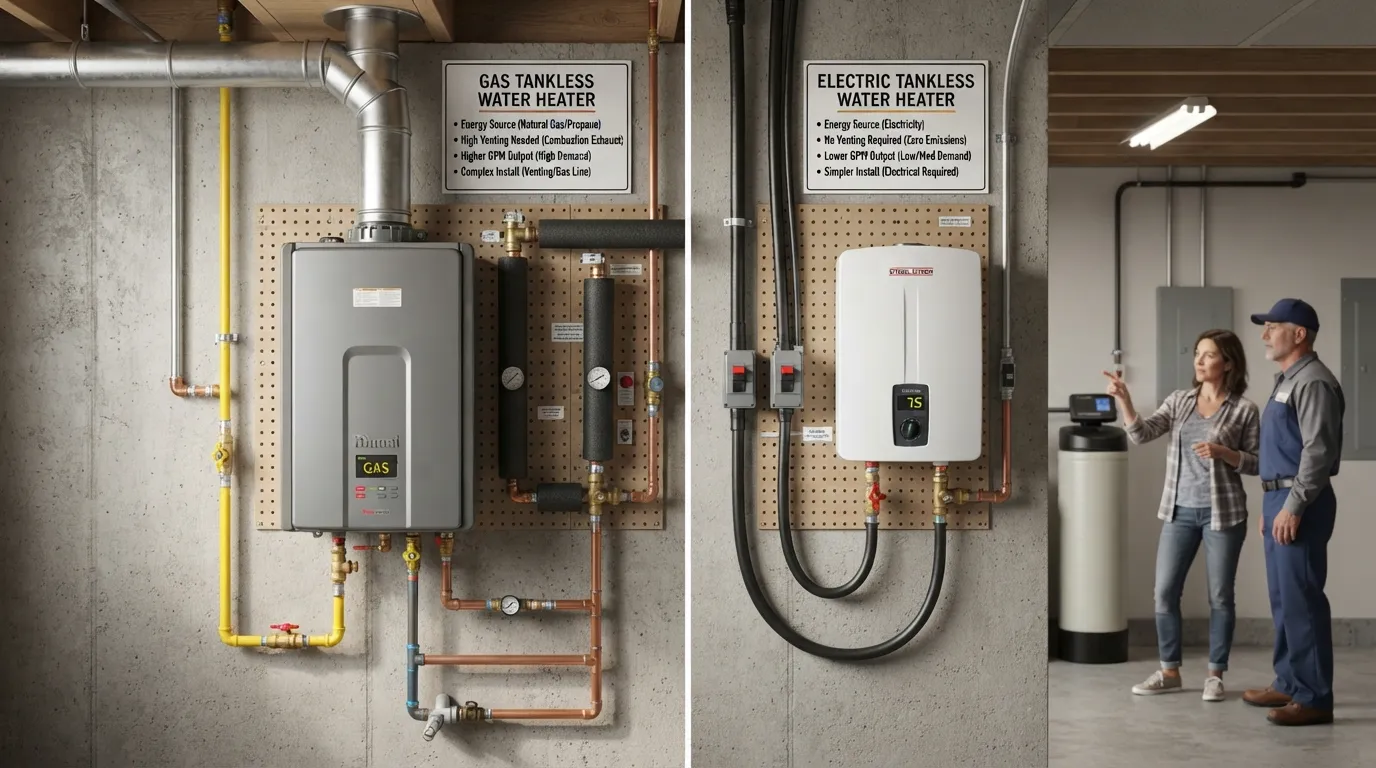
Gas vs Electric Tankless Water Heater at a Glance
Gas Tankless
- Generally better suited to higher whole-home hot-water demand.
- Can support higher flow rates on appropriately sized models.
- Requires a gas supply and combustion exhaust venting.
- Installation can be more involved if gas piping or venting must be added.
- Available in natural gas and propane configurations.
Electric Tankless
- Compact and does not require combustion exhaust venting.
- Can work particularly well for point-of-use or lower-demand applications.
- Whole-home models can require substantial electrical capacity.
- Installation may require dedicated circuits or electrical-service changes.
- Operating cost depends heavily on your electricity rate and hot-water usage.
So the better question is not simply “Which is more efficient?” It is “Which system can meet my hot-water demand with the infrastructure and energy costs I have?”
How Does a Tankless Water Heater Work?
Unlike a traditional storage water heater, a tankless unit does not keep a large volume of hot water sitting in a tank. When you open a hot-water fixture, the system detects water flow and heats the water as it passes through a heat exchanger.
A gas model uses a burner to transfer heat to the water. An electric tankless model uses electrical heating elements. Because the system heats water when there is demand instead of continually maintaining a tank of stored hot water, tankless technology can reduce standby losses compared with conventional storage systems.
Important:
“Tankless” does not mean unlimited water flow. It means you are not limited by the amount of hot water stored in a tank. The heater still has a maximum heating capacity, so your available hot-water flow depends on the unit’s capacity and the required temperature rise.
The Most Important Factor: Hot-Water Demand
Before comparing gas and electric, figure out what your home actually demands.
Ask yourself:
- How many people live in the home?
- How many bathrooms do you have?
- How many showers might run at the same time?
- Could someone be using the kitchen sink while another person is showering?
- Could a dishwasher or laundry appliance be drawing hot water at the same time?
- Do you need a whole-home system or only hot water at one remote fixture?
The goal is to estimate your maximum simultaneous hot-water flow, not your total daily water consumption.
Why GPM Matters
Tankless heaters are commonly rated by flow in gallons per minute (GPM). The higher the required flow and temperature rise, the more heating capacity the system needs.
The DOE’s tankless sizing guidance recommends identifying the flow rates of the fixtures and appliances that could operate simultaneously and then selecting a unit capable of handling that demand at the required temperature rise.
A Simple Way to Think About It
One shower: usually a relatively modest demand.
Two showers at the same time: substantially higher demand.
Two showers + kitchen faucet: higher again.
Your actual fixture flow rates vary, so use the manufacturer’s sizing information and your home’s real fixtures rather than relying on a generic GPM assumption.
Temperature Rise: The Factor Many Buyers Miss
This is one of the most important differences between simply reading a heater’s GPM rating and understanding what the heater can actually do in your home.
Temperature rise = desired hot-water temperature − incoming water temperature.
Temperature Rise = Desired Outlet Temperature − Incoming Water Temperature
For example, if incoming water is 50°F and your target is 120°F, the heater needs to provide a 70°F temperature rise.
If incoming water is warmer, the required temperature rise is smaller. If incoming water is colder, the required temperature rise is larger. That means a heater that appears capable of a certain flow under one set of conditions may deliver less flow when the incoming water is much colder.
This is why simply saying “gas is better in cold climates” is incomplete. The better explanation is that colder incoming water increases the temperature rise the heater must achieve, which can reduce the flow a given system can deliver at the desired outlet temperature.
Gas Tankless Water Heater: Pros and Cons
Advantages of Gas Tankless Water Heaters
- Strong whole-home performance: Gas systems can be well suited to homes with high simultaneous hot-water demand when correctly sized.
- High heating input: Gas-fired tankless systems can provide substantial heating capacity for demanding applications.
- Good fit when gas infrastructure already exists: If your home already has suitable gas service and the installation location works for the required venting, gas may become more attractive.
- Natural gas and propane options: Depending on the model, homeowners may have a choice of fuel source.
DOE guidance notes that gas tankless sizing should consider both maximum flow and the temperature rise required by the home’s incoming water conditions.
Disadvantages of Gas Tankless Water Heaters
- More installation requirements: A gas unit needs an appropriate gas supply and a combustion exhaust system.
- Potentially higher installation complexity: Retrofitting a home may involve new gas piping, venting, electrical connections, condensate management on some models, and other code-required work.
- Combustion-related requirements: Indoor gas units need the correct venting and installation arrangement for safe operation.
- Maintenance matters: Scale and mineral buildup can affect tankless heat exchangers, particularly in hard-water conditions.
ENERGY STAR explains that whole-home gas tankless systems use dedicated sealed venting for combustion gases, while condensing models use a secondary heat exchanger to recover additional heat from exhaust gases.
Electric Tankless Water Heater: Pros and Cons
Advantages of Electric Tankless Water Heaters
- No combustion venting: Electric tankless systems do not burn fuel, so they do not require gas combustion exhaust venting.
- Compact installation: Their lack of combustion equipment can make electric units practical where space is limited.
- Strong point-of-use potential: Electric tankless heaters are commonly used close to the fixture, including remote bathrooms and other lower-demand applications.
- No gas connection required: If your property has no gas service, electric may be the more practical technology to investigate.
ENERGY STAR notes that point-of-use water heaters can be useful for remote fixtures and situations where low hot-water demand makes decentralized heating practical.
Disadvantages of Electric Tankless Water Heaters
- Electrical capacity can become the limiting factor: A whole-home electric tankless heater can require significant electrical power.
- Possible electrical upgrades: Depending on the model and existing service, additional circuits or electrical-service work may be necessary.
- Flow can become challenging at high temperature rise: High demand combined with cold incoming water can require substantial heating capacity.
- Operating cost depends on electricity rates: A high conversion efficiency does not automatically mean the lowest monthly bill.
Don’t Assume “Electric” Means Easy
Electric tankless avoids gas piping and combustion venting, but a whole-home model can place a significant load on your electrical system. Before buying, have the required voltage, amperage, breakers, wiring, and available service capacity checked against the exact model you are considering.
Gas vs Electric Tankless: Which Is More Efficient?
This question needs a more careful answer than simply declaring one winner.
Efficiency describes how effectively the heater converts its energy input into useful hot water under a defined test condition. Your actual operating cost also depends on the price of that energy where you live and how much hot water your household uses.
For that reason, an electric unit can have a very high conversion efficiency while still not necessarily producing the lowest monthly water-heating bill if electricity is expensive in your area. Likewise, a gas system’s economics depend on the local price of natural gas or propane and the model’s efficiency.
When comparing products, look at the standardized efficiency information provided for the specific model, such as its Uniform Energy Factor (UEF), rather than relying on broad claims about an entire technology category. ENERGY STAR uses UEF as a key measure for qualifying water heaters.
Efficiency ≠ Lowest Bill
To estimate operating cost realistically, consider energy price + hot-water usage + heater efficiency + incoming water temperature + your household demand.
Which Is Cheaper to Install: Gas or Electric Tankless?
There is no universal winner because the installation can change dramatically from one home to another.
Gas Installation May Include
- The water heater itself
- Gas-line work if existing piping is insufficient
- Required combustion venting
- Electrical connections and controls
- Plumbing modifications
- Condensate drainage where required by the equipment
- Professional installation and code-related work
Electric Installation May Include
- The water heater itself
- Dedicated circuits
- Breakers and wiring
- Electrical panel or service upgrades if required
- Plumbing modifications
- Professional installation
DOE guidance has long identified added gas-line and venting requirements as potential contributors to higher first costs in retrofit tankless installations.
So don’t compare only the two heater price tags. Compare the complete installed project cost.
Which Is Better for a Cold Climate?
If your incoming water becomes very cold during winter, temperature rise becomes especially important.
A tankless heater must raise the temperature of incoming water to the desired outlet temperature. As the incoming water gets colder, the required temperature rise increases. At a given heating capacity, that can reduce the flow the system can maintain.
Gas tankless systems are often attractive for high-demand cold-climate applications because appropriately sized gas equipment can provide high heating input. But the correct answer still depends on the exact model, required GPM, inlet-water temperature, and installation conditions.
Question
Don’t ask only, “Is gas better in cold weather?” Ask, “What GPM can this exact model deliver at my winter incoming-water temperature and required outlet temperature?”
Whole-Home vs Point-of-Use Tankless Water Heating
Another decision that can completely change the answer is whether you need a whole-home system or a point-of-use system.
Whole-Home Tankless
A whole-home system is designed to serve multiple fixtures from a central water heater. This makes sizing especially important because several fixtures may operate at the same time.
For a large household with several bathrooms and frequent simultaneous hot-water use, a properly sized high-output system may be the better approach.
Point-of-Use Tankless
A point-of-use heater is installed close to the fixture it serves. This can make sense for a remote bathroom, addition, sink, or another location where running a long hot-water line from a central heater would be inefficient or inconvenient.
ENERGY STAR specifically identifies remote fixtures, additions, and lower daily hot-water demand as situations where point-of-use water heating may be worth considering.
What About Condensing vs Non-Condensing Gas Tankless Heaters?
If you decide on gas, you may encounter another choice: condensing vs non-condensing.
Non-Condensing Gas Tankless
A non-condensing unit generally sends hotter combustion exhaust through its venting system after the primary heat exchanger transfers heat to the water. The higher exhaust temperature affects venting requirements.
Condensing Gas Tankless
A condensing system uses additional heat-exchange capability to recover more heat from combustion gases before they leave the unit. This can increase efficiency, but the installation has its own venting and condensate requirements.
ENERGY STAR explains that certified condensing gas tankless systems use a secondary heat exchanger to recover additional heat from combustion gases, while manufacturers note that condensing and non-condensing systems can have different venting and installation requirements.
Buying tip: Don’t compare a condensing gas model with a non-condensing model only by sticker price. Compare efficiency, venting, condensate requirements, installation cost, maintenance requirements, and expected usage.
Hard Water and Tankless Water Heater Maintenance
Water quality is easy to overlook when shopping for a tankless system, but mineral scale can affect the heat exchanger and water flow.
DOE guidance notes that scale can restrict flow through a tankless heat exchanger, reduce performance, and contribute to reduced service life. It also recommends following the manufacturer’s flushing and maintenance instructions because maintenance frequency varies by model and water conditions.
If you live in an area with hard water, ask the installer and manufacturer what maintenance the specific model requires before you buy it.
What Happens During a Power Outage?
Don’t assume that choosing gas means your tankless heater will automatically operate normally during a blackout.
Modern gas tankless systems can include electronic controls, ignition systems, sensors, fans, and other electrical components. Whether a particular model can operate without utility power depends on its design and the available backup system.
If backup hot water is important to you, check the exact manufacturer’s documentation rather than assuming gas automatically provides hot water during an outage.
Gas vs Electric Tankless: Which One Should You Choose?
Gas May Be the Better Fit If…
- You have high simultaneous hot-water demand.
- You have several bathrooms or frequent concurrent showers.
- Your home already has suitable gas service.
- Your electrical service is not well suited to a high-output electric tankless unit.
- You are planning a whole-home system and need substantial flow at high temperature rise.
Electric May Be the Better Fit If…
- You have lower or moderate hot-water demand.
- You need a point-of-use heater.
- You have a remote bathroom, addition, or fixture that needs local hot water.
- You do not have gas service.
- You have sufficient electrical capacity for the exact model.
- You want to avoid combustion venting.
A Better Way to Decide: 8 Questions Before You Buy
- How many people live in the home? More occupants can increase simultaneous demand.
- How many bathrooms are there? Count the fixtures that could realistically run together.
- How many showers could operate simultaneously? This can have a major effect on required GPM.
- What is your coldest incoming-water temperature? Use a realistic winter value for sizing.
- What outlet temperature do you need? The difference between inlet and outlet temperatures determines temperature rise.
- Do you already have gas service? Existing infrastructure can materially change installation economics.
- Can your electrical system support the exact electric model? Check voltage, amperage, circuits, breaker requirements, and service capacity.
- What will the complete installed cost be? Include equipment, labor, required infrastructure changes, venting or electrical work, and future maintenance.
My Practical Recommendation
If I were choosing a tankless water heater for my own home, I would not start with the brand or even the fuel type.
I would first calculate the maximum simultaneous GPM, determine the worst-case temperature rise, and then check whether my home already has the required gas or electrical infrastructure.
Only after those three things would I compare efficiency, installation cost, operating cost, warranty, maintenance, and specific models.
Gas vs Electric Tankless Water Heater: Final Verdict
There is no universal winner between gas and electric tankless water heaters.
Gas is often the stronger choice for high-demand whole-home applications when the property has suitable gas infrastructure and the installation can accommodate the required venting. Electric can be the smarter choice for smaller-demand homes, point-of-use applications, remote fixtures, and properties without gas service—provided the electrical system can support the selected model.
The most important thing is sizing. A heater that is highly efficient but too small for your home’s simultaneous demand will not give you the experience you expect. Likewise, a powerful system that requires expensive infrastructure upgrades may not make financial sense.
So don’t ask only “Gas or electric?” Ask:
“Which system can meet my home’s hot-water demand at the required temperature rise, using the infrastructure I already have, at a total cost that makes sense?”
That is the question that will lead you to the right tankless water heater—not a generic gas-versus-electric rule.
Frequently Asked Questions
Related Resources for Choosing a Tankless Water Heater
- U.S. Department of Energy: Tankless water heater sizing guidance, including flow rate and temperature-rise considerations.
- ENERGY STAR: Whole-home gas tankless water heater guidance and buying considerations.
- ENERGY STAR: Point-of-use water heater guidance for remote and lower-demand applications.
- ENERGY STAR: Water heater efficiency and UEF criteria.
- DOE Building Science Education: Gas tankless water heater sizing and cold-climate considerations.
Before You Buy
Have the exact model checked against your home’s maximum simultaneous GPM, required temperature rise, gas or electrical service, installation requirements, and local code requirements.
If you are replacing an existing water heater, compare the complete installed project—not just the equipment price.