If you open a hot-water faucet and wonder how a tankless water heater can heat water without storing a large tank of it, the basic idea is surprisingly simple: it heats water only when you need it.
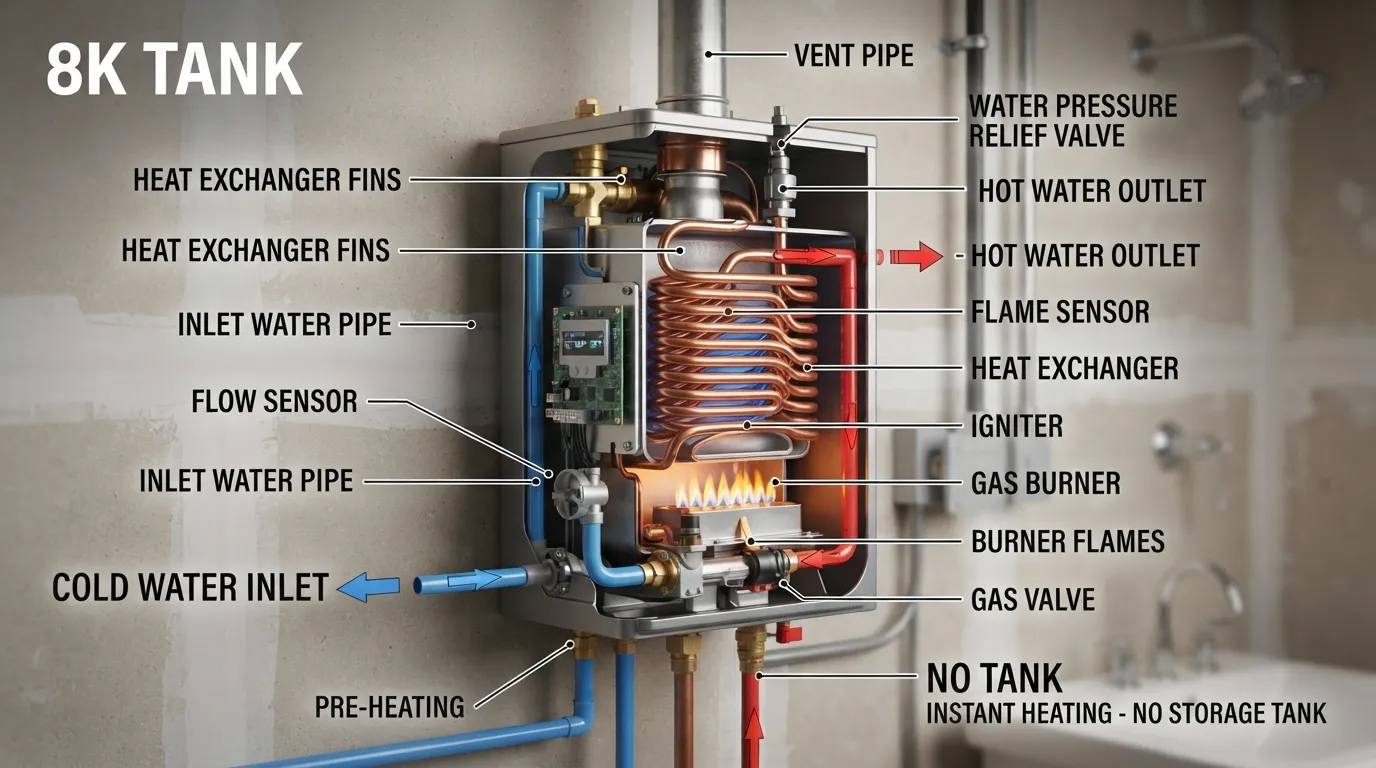
When you turn on a hot-water tap, water flows into the unit, a sensor detects the demand, and the heating system activates. The incoming water then passes through a heat exchanger, where it is heated to the desired temperature before traveling to your faucet. When you close the tap, the unit stops heating.
The Short Answer
A tankless water heater does not keep a large supply of hot water sitting in a storage tank. Instead, it detects water flow, activates a gas burner or electric heating elements, transfers heat to the moving water through a heat exchanger, monitors the outlet temperature, and keeps adjusting its heating output while water is being used.
That sounds simple, but understanding what happens inside the unit explains why tankless systems can provide continuous hot-water delivery, why they still have flow limitations, why hot water may take time to reach a distant shower, and why proper sizing and maintenance matter.
How Does a Tankless Water Heater Work Step by Step?
Think of a tankless water heater as an on-demand heating system. Instead of heating and storing a tank of water, it responds to your demand in real time.
- You open a hot-water faucet. Cold water begins moving from your home’s water supply toward the heater.
- The unit detects water flow. A flow sensor or related control system recognizes that hot water is being requested.
- The heating system activates. Depending on the model, a gas burner or electric heating elements begin producing heat.
- Water passes through the heat exchanger. The moving water absorbs heat as it travels through the heater.
- Temperature sensors monitor the water. The controls adjust heating output to help maintain the selected temperature.
- Hot water leaves the unit. The heated water travels through your hot-water piping to the shower, sink, or appliance.
- You close the faucet. Water flow stops, the system detects the change, and the heating process shuts down or returns to standby.
This basic sequence is consistent with explanations from ENERGY STAR, the U.S. Department of Energy’s Building Science Education resources, and major water-heater manufacturers.
What Happens Inside a Tankless Water Heater?
The easiest way to understand the system is to follow the water and the heat from beginning to end.
1. Cold Water Enters the Heater
When you request hot water, cold water enters the tankless unit through the cold-water inlet. Unlike a traditional storage water heater, there is no large tank that needs to be kept full of heated water.
2. The System Detects the Demand
The heater needs to know when you are asking for hot water. A flow-sensing system detects water movement and signals the controls to begin the heating process.
This is an important difference between a tankless heater and a storage tank: the tankless system responds to demand rather than continuously maintaining a large volume of stored hot water.
3. The Heating Source Turns On
The exact heating method depends on the type of tankless water heater.
- Gas tankless water heaters: A gas burner produces heat that is transferred to the water through the heat exchanger.
- Electric tankless water heaters: Electrical heating elements generate the heat used to warm the flowing water.
Gas systems also have combustion and venting requirements that do not apply in the same way to electric resistance models. ENERGY STAR explains that gas tankless systems use a burner and heat exchanger, while condensing models can use a secondary heat exchanger to recover additional heat from combustion gases.
4. The Heat Exchanger Transfers Heat to the Water
This is the part that makes the tankless concept work.
Instead of heating a large tank and waiting for the stored water to warm, the system transfers heat directly to water moving through the heater. The water passes through the heat exchanger while the burner or heating elements provide the required heat.
The faster the water flows and the greater the required temperature increase, the more heating capacity the system needs.
5. Sensors and Controls Keep Adjusting the Temperature
A modern tankless water heater is not simply an on/off device. Its controls monitor operating conditions and adjust the heating output to help maintain the selected temperature.
That matters because the incoming water temperature and the amount of water flowing through the system can change. A. O. Smith describes the use of temperature monitoring and control adjustments to maintain the desired output temperature.
6. Hot Water Leaves the Heater
Once heated, the water exits the unit and enters your home’s hot-water piping. From there, it travels to the fixture where you opened the faucet.
This leads to an important point: tankless heating is fast, but that does not mean hot water instantly appears at every faucet.
Why Does a Tankless Water Heater Heat Water So Fast?
The answer is not that the heater somehow creates unlimited heat instantly. It is designed to transfer a significant amount of heat to a relatively small, continuously moving stream of water.
Several factors work together:
- The heating source can produce substantial heat output.
- The heat exchanger provides a surface through which heat can transfer to the water.
- The control system responds to water flow and temperature conditions.
- The unit does not first need to heat an entire storage tank.
How fast the system can raise the water temperature depends on the heater’s capacity, the incoming water temperature, the desired outlet temperature, and the water flow rate. Tankless sizing therefore considers both temperature rise and GPM (gallons per minute).
A Simple Way to Think About Temperature Rise
Temperature rise = desired hot-water temperature − incoming water temperature.
For example, if incoming water is 65°F and you want water at 105°F, the system needs to create a 40°F temperature rise. If the incoming water is colder, the required temperature rise becomes greater.
What Do GPM and Temperature Rise Have to Do With Performance?
GPM tells you how much water the heater needs to deliver per minute. Temperature rise tells you how much that water needs to be heated.
These two factors are closely connected when sizing a tankless water heater.
Imagine you are taking one shower. The heater may only need to handle that shower’s flow rate. Now imagine two showers, a dishwasher, and another hot-water fixture operating at the same time. The total demand is much higher.
The heater must have enough capacity to raise the temperature of the combined flow. ENERGY STAR notes that tankless systems are rated by hot-water production in GPM and that simultaneous use of showers and appliances affects the capacity required.
Important: “Endless” Does Not Mean Unlimited
A tankless water heater can continue heating water as long as there is demand, but every unit has a maximum heating and flow capacity. If your household demands more hot water than the heater can heat at the required temperature rise, performance can suffer.
Why Does Hot Water Sometimes Take Time to Reach the Faucet?
This is one of the most misunderstood parts of tankless water heaters.
A tankless heater can heat water quickly, but your home’s plumbing still contains water between the heater and the faucet.
If the heater is far from your shower, that water has to move through the hot-water pipe before newly heated water reaches the fixture. The wait time can therefore depend on the distance between the heater and fixture, pipe insulation, and the design of the plumbing system.
Tankless heating speed ≠ faucet delivery time. The heater may heat the water rapidly, but the hot water still has to travel through the home’s plumbing.
How Does an Electric Tankless Water Heater Work?
An electric tankless water heater uses electrical heating elements instead of a gas burner.
When water flow is detected, the controls activate the required heating elements. Water passes through the heating chamber and absorbs heat before leaving the unit.
The exact electrical requirements vary by model and capacity. Because higher hot-water demand can require more heating power, the home’s available electrical capacity is an important part of planning an electric tankless installation.
How Does a Gas Tankless Water Heater Work?
A gas tankless water heater uses a burner to produce heat. When hot-water demand is detected, the burner activates and heats the heat exchanger while water flows through the unit.
Gas models also have combustion and venting considerations. Condensing gas tankless models can use a secondary heat exchanger to extract additional heat from combustion gases before those gases leave through the venting system.
The important point is that both gas and electric systems follow the same basic concept: detect demand, produce heat, transfer heat to moving water, monitor temperature, and stop heating when demand ends.
Tankless Water Heater vs. Traditional Tank Water Heater
What Happens When Multiple Fixtures Use Hot Water?
This is where proper sizing becomes especially important.
Suppose one person is taking a shower while another person starts a second shower and a dishwasher begins using hot water. The tankless system now has to heat a larger combined flow.
If the demand remains within the heater’s rated capacity, it can continue supplying hot water. If demand exceeds the unit’s capacity, the system cannot magically create additional heating capacity. Water temperature or flow may be affected depending on the system and conditions.
That is why tankless sizing should consider the home’s likely maximum simultaneous hot-water demand rather than simply choosing a unit based on the number of people in the house.
Why Does a Tankless Water Heater Sometimes Produce Temperature Fluctuations?
Temperature fluctuations can have several possible causes, so they should not automatically be blamed on the heater itself.
Possible factors include:
- Changes in water flow.
- Insufficient or incorrect system sizing.
- Scale or debris affecting water flow.
- Installation or configuration problems.
- Sensor or control issues.
- Multiple fixtures changing the hot-water demand.
Manufacturer troubleshooting documentation identifies restricted flow, sensor issues, and installation-related problems among possible causes of fluctuating temperatures.
What Is the “Cold Water Sandwich”?
If you use hot water, turn the faucet off, and then turn it back on shortly afterward, you may occasionally experience a brief burst of cooler water before hot water returns.
This is commonly called the cold-water sandwich. It can occur because of the way intermittent hot-water use and water remaining in the plumbing interact with the tankless system.
If you repeatedly experience significant temperature swings, however, do not assume it is normal. Flow, sizing, installation, maintenance, and equipment condition should be considered.
Does a Tankless Water Heater Need Maintenance?
Yes. Tankless does not mean maintenance-free.
One of the main maintenance concerns is mineral scale, particularly where hard water is present. Mineral buildup can accumulate inside the heat exchanger and interfere with heat transfer and water flow. Regular descaling may therefore be recommended depending on the model, water quality, and manufacturer’s requirements.
Do Not Treat Descaling as a Universal Schedule
Maintenance intervals vary by equipment, water conditions, and manufacturer instructions. Check the owner’s manual or have a qualified professional determine what your particular system requires.
How Does Hard Water Affect a Tankless Water Heater?
Hard water contains dissolved minerals that can form scale. Inside a tankless heat exchanger, that buildup can reduce heat transfer and restrict water flow.
In simple terms, scale can make it harder for the system to transfer heat efficiently from the heating source into the water. This is one reason water quality should be considered when installing and maintaining a tankless system.
Are Tankless Water Heaters Really “Instant”?
The term instant water heater is often used for tankless or instantaneous systems, but “instant” can create the wrong expectation.
The heater can begin heating water when demand is detected, but hot water still has to travel through your home’s plumbing. So you may still wait a short time at a distant faucet even though the heater itself is operating on demand.
That distinction is important: tankless means the water is heated on demand, not that every faucet receives hot water with zero delivery time.
How Are Tankless Water Heaters Sized?
Tankless systems are generally sized around the hot-water flow you expect to need and the temperature rise required to reach your desired outlet temperature.
A practical sizing process considers:
- The minimum expected incoming water temperature.
- The desired hot-water temperature.
- The temperature rise required.
- The flow rate of each hot-water fixture or appliance.
- Which fixtures may operate at the same time.
- The heating capacity of the selected unit.
- Gas, electrical, venting, and installation requirements appropriate to the model.
The U.S. Department of Energy’s tankless-water-heater guidance specifically describes sizing around maximum temperature rise and maximum demanded flow rate.
What Should You Consider Before Replacing a Tank Water Heater With Tankless?
Tankless can be an excellent option, but it is not automatically the best choice for every home.
Tankless May Make Sense If You:
- Want on-demand hot-water production.
- Have limited space for a large storage tank.
- Want to reduce standby heating associated with storing hot water.
- Can support the required gas or electrical capacity.
- Are prepared to maintain the system according to the manufacturer’s requirements.
You Should Also Check:
- Your household’s peak hot-water demand.
- The available electrical capacity for an electric model.
- Gas supply and venting requirements for a gas model.
- Incoming water temperature.
- Water hardness and scale risk.
- The physical location of the heater and distance to major fixtures.
Does a Warmer Climate Change How a Tankless Water Heater Works?
The basic operating principle does not change, but incoming water temperature can affect how much heating is required.
If the water entering your home is warmer, the heater generally needs to create a smaller temperature rise to reach the same outlet temperature. If incoming water is colder, the required temperature rise is greater.
That is particularly relevant when considering tankless sizing in a warm climate such as South Florida. The correct sizing decision should use verified local conditions and the actual requirements of the selected equipment rather than relying on a generic rule.
What Are the Main Benefits of a Tankless Water Heater?
- On-demand heating: Water is heated when there is demand rather than continuously maintaining a large stored volume.
- Continuous hot-water capability: The system can keep heating while demand continues, within its rated capacity.
- Space savings: Tankless units are generally compact and wall-mounted.
- Reduced standby heating: Because there is no large tank of stored hot water to keep hot, the system avoids the same type of standby losses associated with storage-tank operation.
What Are the Limitations?
- Capacity still matters: A tankless heater cannot supply unlimited flow at any desired temperature.
- Installation can be more involved: Gas, electrical, venting, water connections, and sizing all need to be appropriate for the selected unit.
- Maintenance still matters: Mineral scale can affect performance, particularly in hard-water conditions.
- Hot-water delivery can still take time: The distance and configuration of the home’s plumbing affect how quickly hot water reaches a fixture.
Frequently Asked Questions
How does a tankless water heater work?
A tankless water heater heats water on demand. When you open a hot-water faucet, the system detects flow, activates its gas burner or electric heating elements, transfers heat to water moving through a heat exchanger, and sends the heated water to the fixture. When the water flow stops, the heating process stops.
How do tankless water heaters work without a storage tank?
They do not need to store a large volume of hot water. Instead, they heat water as it passes through the unit. This is why they are also called instantaneous or on-demand water heaters.
How does an electric tankless water heater work?
An electric model uses electrical heating elements to heat water as it flows through the unit. Its controls monitor the operating conditions and regulate the heating process to help maintain the desired outlet temperature.
How does a gas tankless water heater work?
A gas model uses a burner to heat a heat exchanger while water flows through the unit. The system also requires appropriate combustion and venting arrangements for the specific model.
How does a tankless water heater heat water so fast?
It does not first heat a large storage tank. Instead, it transfers heat directly to the moving water through a heat exchanger. The actual heating performance depends on the unit’s capacity, water flow, incoming temperature, and required temperature rise.
How long does a tankless water heater work?
During a hot-water draw, a tankless heater can continue heating as long as there is demand and the flow remains within the system’s rated capacity. The equipment’s overall service life depends on its model, installation, water quality, maintenance, and operating conditions.
Why does my tankless water heater take time to deliver hot water?
The heater may heat water quickly, but the heated water still needs to travel through your home’s pipes. The distance from the heater to the faucet, pipe insulation, and plumbing configuration can affect delivery time.
Can a tankless water heater run two showers at once?
It depends on the unit’s capacity and the combined flow and temperature-rise requirements. Two showers may be within the capacity of one system but exceed another, so the heater should be sized according to the home’s expected peak demand.
Does a tankless water heater need maintenance?
Yes. Depending on the equipment and water conditions, tankless systems may require inspection, cleaning, or descaling. Follow the manufacturer’s maintenance instructions, particularly if your water has a high mineral content.
Is a tankless water heater better than a tank water heater?
Neither is automatically better for every home. Tankless systems offer on-demand heating and compact installation, but they also have specific sizing, installation, and maintenance requirements. The right choice depends on your household demand, available utilities, space, water conditions, and installation circumstances.
A tankless water heater works by heating water as you use it rather than storing a large supply of hot water. A flow-sensing system detects demand, the heating source activates, water passes through a heat exchanger, temperature is monitored, and heated water travels to your fixture.
The most important thing to remember is that on-demand does not mean unlimited. Flow rate, temperature rise, incoming water temperature, household demand, installation, and maintenance all affect real-world performance.
Need Help With a Tankless Water Heater?
If you’re deciding whether to replace an existing water heater, install a tankless system, or troubleshoot an existing unit, the right solution starts with your home’s actual hot-water demand and the requirements of the equipment.
For broader plumbing needs, you can explore our plumbing services. If you’re specifically considering replacing your existing water heater, our water heater replacement service can help you evaluate the next step.
You can also return to our Miami plumbing team for more information about residential plumbing services.
Not Sure What Your Home Needs?
A professional evaluation can help determine whether your current water heater should be repaired, replaced, or upgraded to a tankless system.