Choosing a water heater can look simple until you start comparing storage tanks, tankless systems, heat pumps, solar water heaters, condensing units, and point-of-use heaters. The confusion gets worse because different sources use the word “type” in different ways.
So, how many types of water heaters are there? The honest answer is that there is no single universal number. Water heaters can be classified by how they store water, how they heat it, what energy source they use, or how the system is installed.
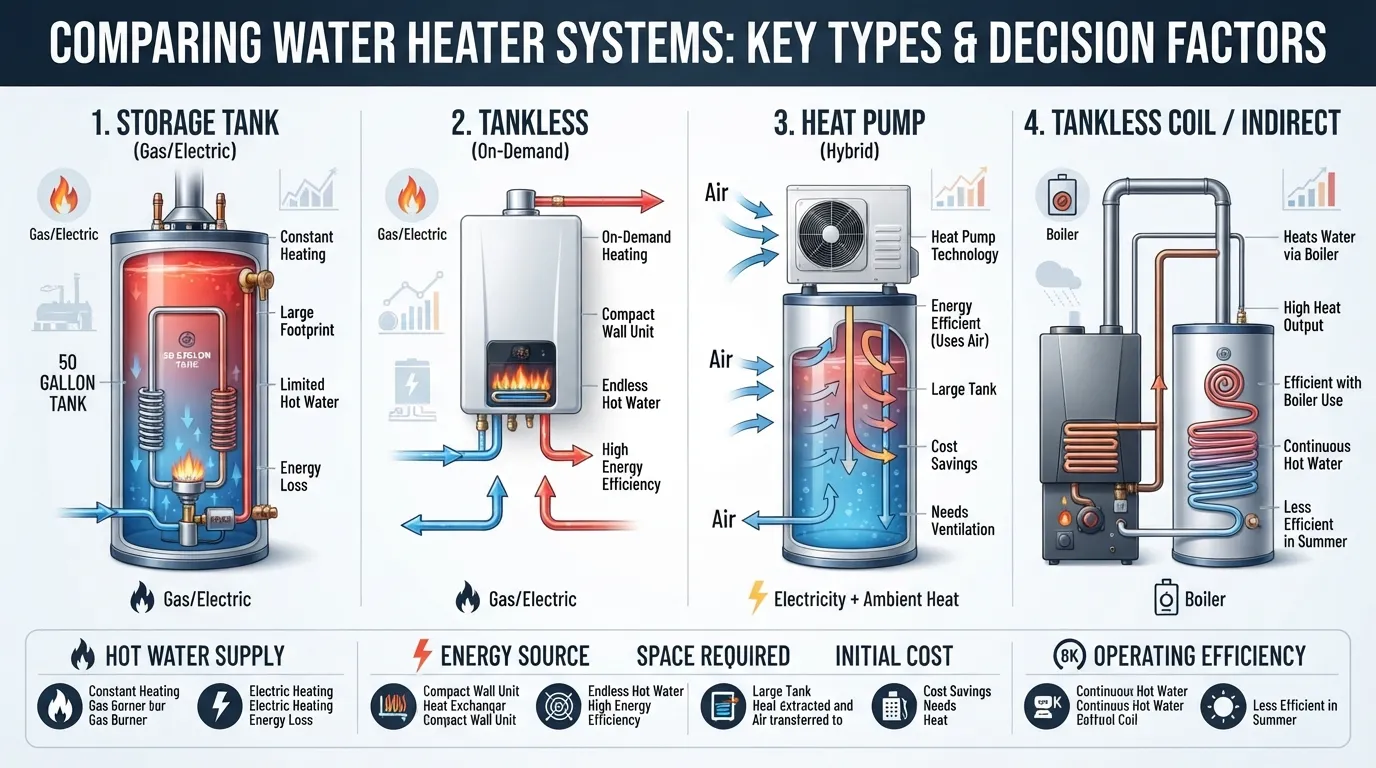
The main hot water system categories are storage-tank, tankless/continuous-flow, heat pump, solar, and condensing water heaters. You can also encounter point-of-use and central systems. The important difference is that these categories are not all based on the same classification method. For example, “tankless” describes how water is stored and heated, while “solar” describes the energy source.
In this guide, I’ll break down the major types, explain how each one works, compare their strengths and limitations, and show you how to choose a system based on your household, bathroom, available energy sources, space, and hot-water demand.
What Are the Main Types of Water Heaters?
If you only need the basic list, these are the major types you should know:
- Storage tank water heaters
- Tankless or continuous-flow water heaters
- Heat pump water heaters
- Solar water heaters
- Condensing water heaters
- Point-of-use water heaters
- Central hot water systems
However, this list needs one important clarification. Storage and tankless systems describe the way water is stored or delivered, while electricity, gas, solar energy, and heat-pump technology describe how heat is supplied. That means one system can fit into more than one category.
A useful way to think about it
Instead of asking only “How many types of water heaters are there?”, ask four questions: How is the water stored? How is it heated? What energy source is used? And where is the system serving hot water? This gives you a much clearer picture of your options.
1. Storage Tank Water Heaters
A storage tank water heater heats water and keeps it in an insulated tank until you need it. This is the traditional water-heating arrangement found in many homes and buildings.
The tank contains a heating system controlled by a thermostat. When the water temperature falls below the set point, the heater operates to bring the water back up to temperature.
Storage water heaters can use different energy sources, including electricity and gas, depending on the model and installation. The U.S. Department of Energy recognizes storage-type units as a major category of consumer water heaters. :contentReference[oaicite:0]{index=0}
How does a storage water heater work?
- Cold water enters the tank.
- A heating element or burner heats the water.
- The insulated tank stores the heated water.
- When you open a hot-water tap, hot water leaves the tank.
- Cold water enters to replace the water that was used.
- The heater reheats the incoming water when necessary.
Advantages of storage water heaters
- Familiar and relatively straightforward technology.
- Can provide a ready supply of hot water from the storage tank.
- Available with different energy sources and capacities.
- Can work well where there is regular household demand for hot water.
Limitations
- The tank requires physical space.
- Stored water can lose heat over time.
- Once the stored hot water is used, the heater needs time to recover.
- The tank size has to be appropriate for household demand.
Storage systems are particularly useful when you want a familiar, established approach and have enough space for the tank.
2. Tankless or Continuous-Flow Water Heaters
A tankless water heater does not rely on a large storage tank. Instead, it heats water as it flows through the unit when there is a demand for hot water.
This is why tankless systems are also called instantaneous, on-demand, or continuous-flow water heaters.
Rather than keeping a large volume of water hot all the time, the system activates when hot water is needed. The U.S. Department of Energy also recognizes instantaneous water heaters as a distinct category. :contentReference[oaicite:1]{index=1}
How does a tankless water heater work?
When you open a hot-water fixture, water begins flowing through the heater. A control system detects the demand and activates the heating mechanism. The water is heated as it passes through the unit and then travels to the fixture.
The important point is that “tankless” does not mean unlimited hot water under every condition. The heater still has a maximum heating capacity and flow rate. If several fixtures operate at the same time, the system has to be capable of handling their combined demand.
Advantages of tankless water heaters
- Do not require a large hot-water storage tank.
- Can save installation space.
- Heat water when there is demand instead of maintaining a large stored volume.
- Can be useful for homes or applications where space is limited.
Limitations
- The unit must have enough heating capacity for the required flow rate.
- Multiple simultaneous showers or fixtures can increase demand significantly.
- Installation requirements depend on the fuel type and local building requirements.
- The initial installation can be more involved than simply replacing a basic storage heater.
Do not choose tankless only because it is “more efficient”
For a tankless system, look at the required flow rate, incoming-water temperature, simultaneous demand, available energy supply, and installation requirements. A system that cannot comfortably meet your peak demand is not a good choice simply because it takes less space.
3. Heat Pump Water Heaters
A heat pump water heater works differently from a conventional electric resistance heater. Instead of creating all the heat directly with an electrical heating element, it uses a heat-pump cycle to move heat from the surrounding air into the water.
This makes heat pump technology fundamentally different from a conventional electric storage heater even though both use electricity.
The U.S. Department of Energy identifies heat pump water heaters as a separate consumer water-heater category. :contentReference[oaicite:2]{index=2}
How does a heat pump water heater work?
- The system draws heat from the surrounding air.
- A refrigerant-based heat pump cycle raises the temperature of that heat.
- The heat is transferred into the stored water.
- The heated water remains available for household use.
Because the system transfers heat rather than relying entirely on direct electrical resistance, its energy-use characteristics can be different from a conventional electric heater.
When does a heat pump water heater make sense?
It can be attractive when reducing energy consumption is an important priority and the installation environment is suitable for the equipment. However, you should consider the purchase cost, available space, climate, installation requirements, noise considerations, and local electricity costs rather than assuming that every household will benefit in exactly the same way.
4. Solar Water Heaters
Solar water heaters use solar energy to heat water. A typical system uses solar collectors to capture heat from sunlight and transfers that heat to water or to another heat-transfer fluid, depending on the system design.
Solar hot-water systems can be configured in different ways. For example, systems may use storage tanks and can be designed as passive or active systems. Passive systems can rely on natural circulation, while active systems use pumps to move fluid through the system. :contentReference[oaicite:3]{index=3}
How does a solar water heater work?
In a basic arrangement, solar collectors absorb heat from sunlight. That heat is transferred to the water or heat-transfer fluid, and the heated water is then stored or distributed for use.
The exact configuration varies. Some systems use direct circulation, while others use a separate heat-transfer loop and heat exchanger. System design therefore matters when comparing solar water heaters.
Passive vs active solar hot-water systems
Passive systems
Use natural circulation rather than a mechanical pump. In thermosiphon arrangements, heated water rises while cooler water moves downward toward the collector.
Active systems
Use pumps and controls to circulate water or heat-transfer fluid between the collectors and the storage system.
Solar water heating can be especially interesting where solar availability is good, but the system still needs to be designed around local climate, hot-water demand, available roof or installation space, and backup-heating requirements.
5. Condensing Water Heaters
A condensing water heater is designed to recover additional heat from combustion gases instead of allowing as much of that heat to leave through the exhaust.
In a gas-fired condensing system, the recovered heat can be used to help heat incoming water. This can improve how effectively the system uses the energy contained in the fuel.
How does a condensing water heater work?
- Gas is burned to produce heat.
- The primary heating process transfers heat to the water.
- Hot combustion gases still contain usable heat.
- The system captures additional heat from those gases.
- The recovered heat helps preheat incoming water.
Condensing technology is most relevant when a gas-fired system and the required installation conditions make it appropriate. It is not simply another synonym for a tankless heater: condensing describes a heat-recovery approach, while tankless describes the absence of a conventional storage tank.
6. Point-of-Use Water Heaters
A point-of-use water heater is designed to heat water close to where it will be used rather than relying on a central heater to supply every fixture.
This can be useful for a single sink, bathroom, kitchen fixture, or another location where a small local supply of hot water is needed.
Technical plumbing education materials used in Pakistan also distinguish point-of-use water heaters from central, storage, and tankless systems. :contentReference[oaicite:4]{index=4}
When is point-of-use heating useful?
- When a fixture is far from the main hot-water source.
- When only a small amount of hot water is needed at a particular location.
- When a separate local heater is more practical than extending a hot-water distribution line.
- When space or installation conditions make a small local system attractive.
The right choice depends on the fixture, expected demand, available energy supply, and local installation requirements.
7. Central Hot Water Systems
A central hot-water system uses a main heating and/or storage arrangement to supply multiple fixtures or areas of a building.
Instead of each bathroom or sink having its own independent heater, hot water can be distributed through a dedicated hot-water piping network.
This approach is common in buildings where several outlets need to be supplied from one coordinated system. Technical plumbing materials distinguish central water heaters from point-of-use systems. :contentReference[oaicite:5]{index=5}
Central vs point-of-use water heating
Why “3 Types of Water Heaters” and “5 Types of Water Heaters” Can Both Be Correct
If you search for “What are the 3 types of water heaters?” and then search for “What are the 5 types of water heaters?”, you may see different answers.
That does not necessarily mean one source is wrong. The problem is that water heaters can be classified using different criteria.
Classification by storage method
- Storage: Water is heated and kept in a tank.
- Tankless: Water is heated as it flows through the system.
Government guidance on hot-water systems also describes storage and continuous-flow systems as two basic system arrangements. :contentReference[oaicite:6]{index=6}
Classification by heating technology
- Conventional electric or gas heating
- Heat pump
- Condensing technology
- Solar thermal
Classification by application
- Central systems
- Point-of-use systems
- Residential systems
- Commercial systems
The key takeaway
There is no need to force every water heater into exactly three or five boxes. A better approach is to identify how the system stores water, how it produces or transfers heat, what energy source it uses, and how it serves the building.
Storage vs Tankless Water Heaters
For many homeowners, the first practical decision is whether they want a storage tank or a continuous-flow system.
What Type of Water Heater Is Best for a Bathroom?
There is no single best bathroom water heater for every home. The right option depends on whether the bathroom is being served by a central hot-water system or needs its own heater, how many people use it, how many fixtures may operate at once, and what energy sources are available.
For one small bathroom or a single fixture
A point-of-use heater can make sense when the hot-water demand is localized and a full central distribution system would be unnecessary or impractical.
For a bathroom serving a larger household
Look beyond the heater’s advertised capacity. Consider simultaneous demand. A household might use a shower while another person uses a sink or another bathroom. The system must be capable of supplying the combined demand without creating unacceptable temperature or flow problems.
For limited installation space
Tankless or appropriately sized point-of-use systems may offer space advantages because they do not require the same large storage volume as a conventional tank.
For homes with suitable solar resources
A solar water-heating system may be worth evaluating, especially when the building has suitable solar exposure and there is a practical way to integrate storage and backup heating.
Bathroom buying checklist
- How many people will use the bathroom?
- Can more than one hot-water fixture run at the same time?
- Is the system serving one bathroom or the entire home?
- What energy sources are reliably available?
- How much installation space is available?
- What water pressure and flow conditions does the plumbing system have?
- What are the local electrical, gas, ventilation, and plumbing requirements?
How Does a Hot Water System Work in Plumbing?
A basic hot-water system can be understood as a chain of components rather than a single appliance.
Cold-Water Supply → Heating System → Storage or Heat Transfer → Hot-Water Distribution → Fixture
In a storage system, the heater warms water and stores it in a tank. In a tankless system, the heating process occurs as water moves through the unit. In a solar system, solar collectors contribute heat before the water is delivered or stored.
The plumbing layout also matters. A system supplying multiple bathrooms has different distribution requirements from a heater installed directly beside a single sink.
What About Gas Water Heater Venting?
Gas water heaters require particular attention to combustion air and exhaust gases. The exact venting arrangement depends on the appliance design, fuel type, installation, and applicable local codes.
Common venting concepts can include atmospheric venting, power-assisted arrangements, and sealed/direct-vent designs, but these terms should not be treated as interchangeable. The manufacturer’s installation instructions and local building and fuel-gas requirements should determine the correct installation.
Important safety note
Do not choose or modify gas-water-heater venting based only on a general online article. Combustion appliances require correct installation, combustion-air provisions, exhaust routing, clearances, and compliance with applicable local requirements. Always follow the manufacturer’s instructions and use a qualified professional where required.
How to Choose the Right Water Heater for Your Home
Instead of starting with a brand or a single “best water heater” list, I recommend working through the following decision process.
Step 1: Determine your hot-water demand
Think about the number of people in the household and the times when hot-water use is likely to overlap. Peak demand is often more important than average daily use when sizing the system.
Step 2: Identify your available energy sources
Determine whether your property has practical access to electricity, natural gas, LPG, solar energy, or another suitable source. Availability can eliminate some options before you even compare them.
Step 3: Check your installation space
A large storage tank needs a suitable location. A tankless system may reduce the space required for storage, while a heat pump or solar system can have its own installation requirements.
Step 4: Consider the complete installation
Do not compare heaters only by the appliance itself. Consider the plumbing, electrical work, gas connections, ventilation, controls, storage, circulation, and other installation requirements that may be necessary.
Step 5: Compare operating requirements
Look at how the system will behave over its expected use rather than focusing only on the purchase price. Energy source, usage patterns, maintenance, climate, and system efficiency can all affect long-term costs.
Step 6: Match the technology to your situation
You have plenty of space
A storage-based system may be worth considering if its capacity matches your household demand.
You have limited space
Consider compact or tankless options, while still checking flow rate and installation requirements.
Energy efficiency is a priority
Compare heat-pump, solar, condensing, and conventional systems based on the conditions at your property rather than assuming one technology always wins.
You need one local hot-water outlet
A point-of-use system may be more appropriate than installing a large central system for a very small demand.
Water Heater Comparison: Which Type Fits Which Situation?
Common Mistakes to Avoid When Choosing a Water Heater
Choosing only by purchase price
The cheapest heater to buy is not automatically the cheapest system to own. Installation requirements and ongoing energy use can change the overall picture.
Ignoring peak demand
A system that works perfectly for one shower may struggle when multiple fixtures operate simultaneously. Always think about the maximum realistic demand.
Assuming tankless means unlimited hot water
Tankless systems can provide hot water continuously while demand remains within their design limits. Their heating capacity and flow rate still matter.
Treating every “solar” system as the same
Solar hot-water systems can have different collector, circulation, storage, and backup arrangements. The design matters as much as the word “solar.”
Ignoring installation and safety requirements
Gas, electrical, solar, and plumbing systems can have specific installation requirements. The manufacturer’s instructions and applicable local codes should always take priority over a generic online recommendation.
Frequently Asked Questions About Water Heater Types
A Simple Water Heater Decision Guide
Start with your situation, not the marketing label
If you are choosing a water heater, work through these questions:
- How much hot water does my household need at peak times?
- Do I need to serve one fixture, one bathroom, or the entire building?
- What energy sources are reliably available?
- How much installation space do I have?
- Do I prefer stored hot water or on-demand heating?
- Is energy efficiency a major priority?
- What installation, plumbing, electrical, gas, or ventilation requirements apply?
Once you answer those questions, the list of realistic options becomes much smaller. That is a better way to choose a water heater than simply searching for the “best” type and copying a generic recommendation.
The most important thing to understand about water heater types is that there is more than one way to classify them.
Storage tank and tankless systems describe how water is stored and delivered. Heat pump and condensing systems describe heating technologies. Solar describes an energy source and collection approach. Central and point-of-use systems describe how hot water is distributed or where it is produced.
Once you understand those differences, choosing a system becomes much easier.
The best choice is the one that matches your real requirements.
Start with your hot-water demand, available energy source, space, plumbing layout, installation conditions, and long-term priorities. Then compare the technologies that actually fit those requirements.
Related Resources
If you want to go deeper before choosing or installing a system, these technical resources are useful:
- U.S. Department of Energy: Consumer Water Heaters — :contentReference[oaicite:7]{index=7}
- ENERGY STAR / U.S. Department of Energy: Solar water-heating information and system fundamentals — :contentReference[oaicite:8]{index=8}
- YourHome: Hot-water systems, storage, continuous flow, and solar configurations — :contentReference[oaicite:9]{index=9}
- Pakistan NAVTTC: Plumbing and Solar Water Heating System textbook covering storage, central, point-of-use, and tankless water heaters — :contentReference[oaicite:10]{index=10}
Further Reading
If you are planning a complete hot-water installation, the next useful step is to compare water-heater sizing, hot-water demand, plumbing distribution, energy sources, installation requirements, and operating costs rather than comparing heater names alone.