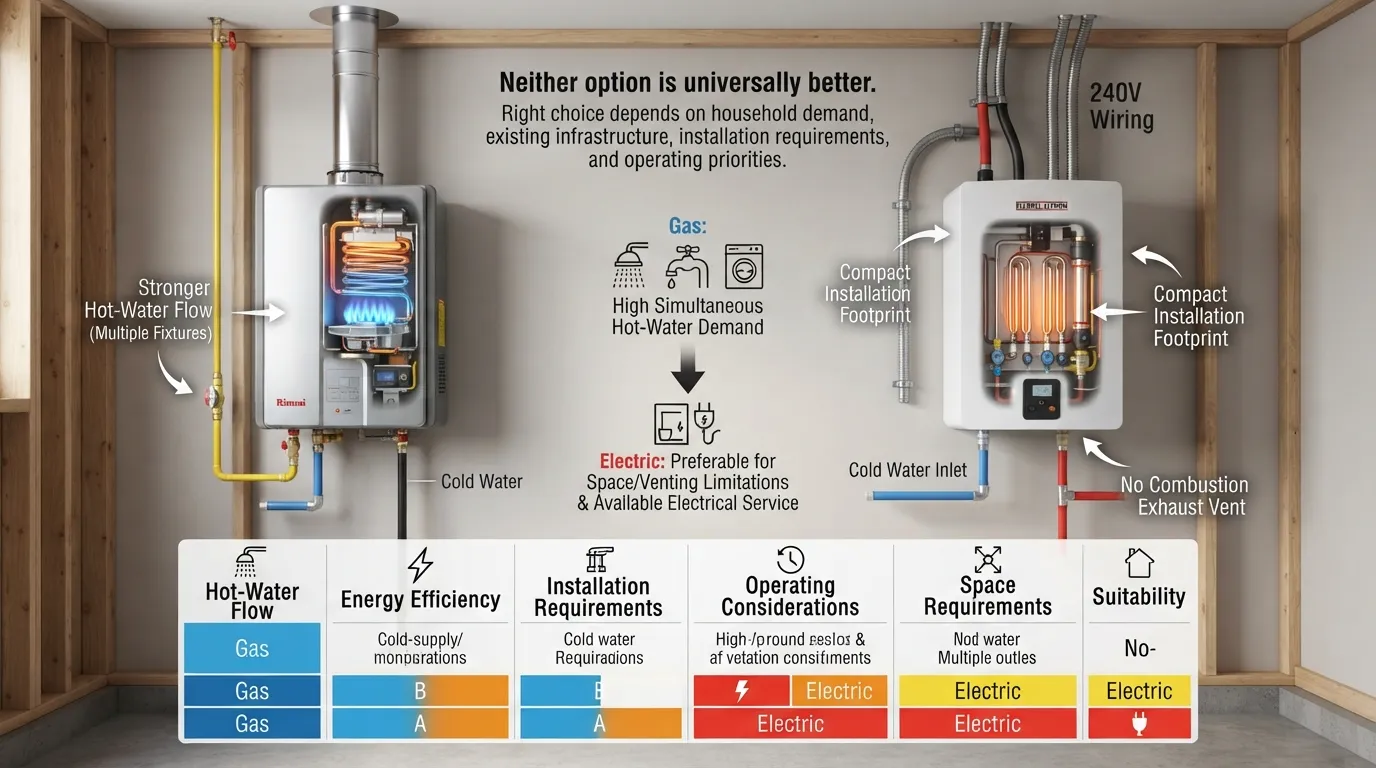
If you are comparing a gas tankless water heater vs. electric tankless water heater, the short answer is: neither is automatically better for every home. The right choice depends on your hot-water demand, required flow rate, incoming water temperature, available gas or electrical capacity, installation requirements, utility rates, and long-term maintenance.
The Short Answer
Gas tankless is usually the stronger choice when your home has high simultaneous hot-water demand, multiple bathrooms, or you need substantial flow and temperature rise.
Electric tankless can be an excellent fit for smaller homes and lower hot-water demand, particularly when you do not have a practical gas or venting setup and your electrical service can support the required load.
The important part is not simply asking, “Which one is more efficient?” A better question is:
Which system can deliver the hot water my household needs at a reasonable installation and operating cost without exceeding my home’s infrastructure?
This guide walks you through that decision step by step, including flow rate, temperature rise, electrical capacity, gas requirements, efficiency, operating cost, maintenance, tank vs. tankless considerations, and the questions you should ask before buying.
Gas vs. Electric Tankless Water Heater at a Glance
How Does a Tankless Water Heater Work?
A tankless water heater, also called an on-demand or instantaneous water heater, heats water as you need it instead of storing a large tank of hot water.
When you open a hot-water tap, the unit detects water flow and activates its heating system. The water passes through a heat exchanger or heating chamber, where its temperature is raised before it reaches the fixture. When hot-water demand stops, the heating system shuts down.
That design eliminates the standby losses associated with continuously storing hot water in a conventional tank. The U.S. Department of Energy notes that demand-type water heaters can avoid standby energy losses and may be more energy efficient than conventional storage tanks in appropriate usage patterns. :contentReference[oaicite:0]{index=0}
But “tankless” does not mean unlimited water at any flow rate. The unit still has a maximum heating capacity. Proper sizing depends on both the flow rate you need and the temperature rise required. :contentReference[oaicite:1]{index=1}
Which Is Better: Gas or Electric Tankless?
Choose Gas When High Output Is Your Priority
Gas tankless is generally the better starting point for homes with several bathrooms, high simultaneous demand, or situations where a large temperature rise and high flow rate are important.
Choose Electric When Simplicity and Available Electrical Capacity Fit Your Home
Electric tankless can make sense when hot-water demand is moderate, you have adequate electrical service, and avoiding combustion venting is valuable. The key is confirming that the home’s electrical system can support the selected unit.
Neither statement should be treated as a universal rule. A properly sized electric unit can work well in the right home, while a gas unit can be a poor choice if the required gas supply and venting upgrades make the installation impractical.
Gas Tankless Water Heater: How It Compares
Advantages of Gas Tankless Water Heaters
- High heating output: Gas-fired systems can provide substantial heating capacity for demanding whole-home applications.
- Strong flow potential: They can be well suited to multiple simultaneous hot-water fixtures when correctly sized.
- Good fit for high-demand homes: Larger households and multi-bath homes often need the additional output.
- Less dependence on large electrical heating loads: The main heat source is gas rather than large electric resistance elements.
- Condensing options: High-efficiency gas models are available, with ENERGY STAR using Uniform Energy Factor (UEF) as its current efficiency metric for qualifying products. :contentReference[oaicite:2]{index=2}
Disadvantages of Gas Tankless Water Heaters
- Venting is required: Combustion gases need to be safely exhausted according to the equipment and applicable code.
- Gas supply must be adequate: A high-output tankless unit may require gas-piping or supply-capacity changes.
- Installation can be more involved: Venting, gas piping, condensate management on some models, and clearances all need to be considered.
- Combustion requires additional safety considerations: Proper installation and maintenance are essential.
- It still may need electricity: Many modern gas tankless units use electrical controls, sensors, fans, and ignition systems.
The U.S. Department of Energy’s Building Science Education materials describe gas tankless systems as using a burner, fan, heat exchanger, and flow sensing to heat water on demand, and emphasize sizing around maximum practical flow and required temperature rise. :contentReference[oaicite:3]{index=3}
Electric Tankless Water Heater: How It Compares
Advantages of Electric Tankless Water Heaters
- No combustion venting: There is no gas burner producing exhaust that needs to be vented.
- Compact installation: Many electric units have a small wall-mounted footprint.
- Quiet operation: Without a gas burner and combustion exhaust system, operation can be quieter.
- High conversion efficiency: Electric resistance heating converts electricity directly to heat at the point of use, although high conversion efficiency does not automatically mean the lowest utility bill.
- Useful where gas service is unavailable: An electric system may be practical when the electrical service is adequate.
Disadvantages of Electric Tankless Water Heaters
- High electrical demand: Whole-home electric tankless units can require substantial electrical capacity.
- Possible electrical upgrades: The project may require new circuits, breakers, wiring, or a service/panel upgrade depending on the unit and existing system.
- Output can become the limiting factor: Higher flow and higher temperature rise require more heating power.
- Electrical operating cost depends on your utility rate: High efficiency alone does not tell you what the water will cost to heat.
Important: Don’t Confuse Efficiency With Operating Cost
A heater can have a very high efficiency percentage and still cost more to operate if the energy source is more expensive for the amount of heat your household uses. Compare the delivered cost of hot water, not just the efficiency number printed on a product page.
Gas vs Electric Tankless: Efficiency Explained Correctly
Efficiency is one of the most confusing parts of this comparison because different manufacturers and articles may use different efficiency measurements.
For modern qualifying gas water heaters, ENERGY STAR uses Uniform Energy Factor (UEF). Its current residential criteria list a UEF requirement of at least 0.95 for qualifying gas-fired instantaneous water heaters. :contentReference[oaicite:4]{index=4}
That does not mean you can simply compare “95% gas” with “99% electric” and declare electric the cheaper option.
Your actual operating cost also depends on:
- How much hot water your household uses
- Your electricity rate
- Your natural gas or propane rate
- The efficiency of the specific model
- Incoming water temperature
- Desired hot-water temperature
- How often the heater operates
In other words:
Efficiency tells you how effectively the unit uses its energy source. Utility rates and your usage determine what that energy actually costs you.
Flow Rate: The Number That Matters More Than Most Buyers Realize
When people compare tankless water heaters, they often look at the maximum gallons per minute (GPM) and stop there. That is a mistake.
A tankless water heater has to raise incoming water to your target temperature. The greater the required temperature rise, the harder the unit has to work at a given flow rate.
ENERGY STAR’s electric tankless assessment explains the relationship clearly: as demanded flow increases, the heater’s ability to raise water temperature decreases. A meaningful capacity comparison therefore needs to consider both GPM and the corresponding temperature rise. :contentReference[oaicite:5]{index=5}
What Is Temperature Rise?
The basic concept is:
Required Temperature Rise = Desired Hot-Water Temperature − Incoming Water Temperature
For example, if incoming water is 60°F and your target is 120°F, the required temperature rise is 60°F.
If incoming water is colder, the same heater has to work harder to reach the same outlet temperature at the same flow.
Why Temperature Rise Matters for Miami Homes
For a Miami-area homeowner, incoming water temperature is an especially useful part of the sizing conversation because the required temperature rise can be different from what a homeowner in a much colder climate experiences.
That does not mean every Miami home should choose electric tankless. Your household demand, fixture flow, electrical service, utility costs, and selected model still determine the correct system.
But it does mean you should not copy a cold-climate recommendation without considering your actual incoming water temperature.
A properly sized professional assessment should look at the home’s real conditions rather than relying on a generic “gas for large homes, electric for small homes” rule.
How Many GPM Do You Actually Need?
The answer depends on which fixtures you may use simultaneously.
Think about your household’s peak hot-water demand, not simply the number of people who live in the house.
- How many showers could run at the same time?
- Could someone be filling a tub while another person showers?
- Could the dishwasher operate during a shower?
- Could a washing machine use hot water during peak demand?
- Do you have multiple bathrooms that are frequently used at the same time?
Once you estimate your peak simultaneous flow, compare it with the manufacturer’s flow rating at the temperature rise you actually need.
Sizing Rule to Remember
Do not choose a tankless water heater by maximum GPM alone. Always check the GPM at the required temperature rise and compare it with the fixtures that could realistically operate at the same time.
Gas vs Electric: Installation Requirements
What Does a Gas Tankless Installation Need?
Depending on the specific model and existing home infrastructure, a gas tankless installation may involve:
- A properly sized natural gas or propane supply
- Approved venting for combustion exhaust
- Appropriate combustion-air provisions where required
- Condensate management for applicable condensing units
- Water and gas connections
- Electrical power for controls and ignition on many models
- Required clearances and code-compliant installation
Gas installation requirements are model-specific, so the manufacturer’s installation manual and applicable local code should control the final design.
What Does an Electric Tankless Installation Need?
Electric tankless avoids combustion venting, but that does not automatically make it an easy retrofit.
A whole-home electric tankless unit can require significant electrical power. Before purchasing one, an electrician should evaluate:
- Electrical service size
- Available breaker spaces
- Required voltage
- Unit amperage
- Dedicated circuit requirements
- Wire sizing and routing
- Panel capacity
- Whether a service or panel upgrade is necessary
A Simple Electrical Example
A hypothetical 24 kW heater operating at 240 volts would require approximately:
24,000 ÷ 240 = 100 amps
That is an illustration of why electrical capacity must be checked before selecting a whole-home electric tankless system. The actual requirements depend on the specific model and installation.
In Miami-Dade County, electrical work is subject to permitting requirements, and the county states that electrical permits are required for electrical work. :contentReference[oaicite:6]{index=6}
Which Costs Less to Run: Gas or Electric?
There is no honest universal answer without knowing your local energy rates and household usage.
Instead of asking, “Is gas cheaper than electricity?” ask:
- How much hot water does my household use?
- What is my electricity cost per kWh?
- What is my natural gas or propane cost?
- What efficiency does the exact heater achieve?
- What temperature rise does my home require?
- Will either option require expensive infrastructure upgrades?
For example, a lower-cost heater that requires a major electrical panel upgrade may not be the lower-cost installation overall. Likewise, a gas unit may have a higher installation complexity if your home needs substantial gas-piping and venting changes.
Florida utility rates also change over time. FPL’s approved 2026–2029 rate agreement, for example, includes updated residential rates beginning in 2026, while Peoples Gas publishes its own residential natural-gas rate information. :contentReference[oaicite:7]{index=7}
That is why a current utility bill is more useful for your personal calculation than a generic national cost estimate.
Upfront Cost: Don’t Compare the Heater Box Alone
The purchase price of the water heater is only one part of the project.
Your total installed cost can include:
- The water heater itself
- Labor
- Gas-piping modifications
- Electrical circuits and wiring
- Panel or service upgrades
- Venting
- Condensate drainage where applicable
- Valves and plumbing modifications
- Required permits and inspections
- Water treatment or filtration where appropriate
Cost Comparison
Total cost of ownership = equipment + installation + infrastructure upgrades + energy + maintenance.
That is a much more useful comparison than looking at two product prices on a store shelf.
Are Tankless Water Heaters Worth It?
They can be, but tankless is not automatically the best choice for every household.
Tankless can be attractive if you value:
- On-demand hot water
- Reduced standby losses
- A smaller wall-mounted footprint
- Potentially strong long-term efficiency
- Not having a large storage tank occupying floor space
But there can also be trade-offs:
- Higher installation complexity
- Gas or electrical infrastructure upgrades
- Correct sizing requirements
- Maintenance and scale management
- Higher upfront project cost in some homes
The U.S. Department of Energy notes that demand water heaters avoid the standby losses associated with storage tanks and can be more efficient in certain usage patterns. :contentReference[oaicite:8]{index=8}
Tank vs Tankless: Which Should You Choose?
If you started your research with “tankless gas vs electric,” there is one more question worth asking:
Do I actually need a tankless system?
A conventional storage tank may still be appropriate if the existing infrastructure, household demand, budget, or installation limitations make a tankless retrofit unattractive.
On the other hand, if you want to eliminate storage standby losses, save floor space, or produce hot water on demand, tankless may be worth evaluating.
Do not force yourself into a gas-vs-electric decision before confirming that tankless itself is the right technology for your home.
Gas vs Electric Tankless for Different Homes
These are starting points, not automatic recommendations. Proper sizing and an evaluation of the existing gas and electrical systems should determine the final choice.
How to Choose the Right Tankless Water Heater for Your Home
Before you buy anything, work through these questions.
1. How Much Hot Water Do You Need at One Time?
List the fixtures that could realistically operate together during your busiest period.
2. What Is Your Incoming Water Temperature?
The lower the incoming temperature, the greater the temperature rise required to reach your desired hot-water temperature.
3. What Temperature Do You Need?
Your installer can help determine the appropriate setpoint and safety considerations for your home’s application.
4. Can Your Gas Supply Handle the Heater?
For gas systems, the existing line and supply capacity need to be evaluated against the manufacturer’s requirements and the other gas appliances in the home.
5. Can Your Electrical Service Handle the Heater?
For electric systems, check service capacity, panel space, breakers, voltage, wire requirements, and the exact manufacturer’s specifications before committing to the unit.
6. What Will Installation Require?
Ask for a complete installation assessment rather than a quote based only on the appliance.
7. What Will It Cost to Operate?
Use your actual utility rates and estimated hot-water consumption whenever possible.
8. What Maintenance Will the Manufacturer Require?
Follow the manufacturer’s maintenance instructions. Water quality and mineral buildup can affect maintenance needs and heat-exchanger performance.
9. Does the Location Make Sense?
Think about access, venting, electrical routing, gas routing, water lines, drainage, clearances, and future service access.
10. Is Tankless Actually the Best Option?
Compare the tankless project with a properly sized conventional or other water-heating solution before making the final decision.
Gas Tankless vs Electric Tankless: Pros and Cons
Maintenance: Gas vs Electric Tankless
Tankless does not mean maintenance-free.
Gas Tankless Maintenance
Depending on the model and water conditions, maintenance can include descaling or flushing, burner and heat-exchanger inspection, venting inspection, and other manufacturer-specified service.
Combustion equipment deserves particular attention because venting and combustion components must remain safe and functional.
Electric Tankless Maintenance
Electric units do not have combustion components, but mineral buildup can still affect water-heating components. Follow the manufacturer’s instructions for flushing, descaling, filters, and other maintenance.
If your home has significant mineral or scale issues, discuss water treatment with a qualified professional rather than assuming every tankless unit will tolerate the same water conditions.
What Happens During a Power Outage?
This is an often-overlooked question.
Electric tankless heaters obviously require electrical power to operate.
Many gas tankless heaters also depend on electricity for electronic controls, sensors, ignition, and other components. Therefore, switching from electric tankless to gas does not automatically mean you will have hot water during a power outage.
If backup hot water during outages is important to you, ask the manufacturer and installer exactly what the selected system requires and what backup options are compatible with it.
Which Is Better for a Large Family?
For a large household with several bathrooms and frequent simultaneous hot-water use, gas tankless is often the stronger starting point because gas-fired equipment can provide the high heating output needed for demanding applications.
But the final decision still depends on the required GPM, temperature rise, gas supply, venting, installation cost, and specific equipment.
Which Is Better for a Small Home?
A smaller home with modest simultaneous demand may have more flexibility.
Electric can be attractive when the electrical system has enough capacity and avoiding gas venting is valuable. Gas can also make sense when the home already has suitable gas infrastructure and the installation does not require major modifications.
For a small home, the key is not simply choosing the smaller heater. It is choosing a unit whose performance at your required temperature rise meets your actual peak demand.
Can an Electric Tankless Water Heater Run Multiple Showers?
It can be possible with a properly sized system, but you should never assume that any electric tankless unit can handle multiple showers simultaneously.
Every additional fixture increases the required flow rate. The heater also has to raise that water to the desired temperature.
That is why you should compare the manufacturer’s published performance at the required temperature rise rather than relying on a maximum GPM number alone.
Which Type of Tankless Water Heater Is More Efficient?
The answer depends on what you mean by “efficient.”
Electric resistance heating can have very high point-of-use conversion efficiency, while modern gas tankless equipment can also achieve high rated efficiency. ENERGY STAR uses UEF to evaluate qualifying residential water heaters rather than relying on an informal “percent efficient” comparison. :contentReference[oaicite:9]{index=9}
More importantly, higher efficiency does not automatically mean lower operating cost. The price of electricity or gas and the amount of energy your home consumes both matter.
Are Tankless Water Heaters More Efficient Than Traditional Water Heaters?
They can be, particularly because tankless systems do not continuously maintain a stored volume of hot water.
The U.S. Department of Energy identifies the reduction of standby energy losses as one of the key benefits of demand-type water heating. :contentReference[oaicite:10]{index=10}
However, the energy savings depend on the system, usage pattern, installation, sizing, and household demand. A tankless heater should be evaluated as part of the whole water-heating system rather than as a guaranteed bill-reduction device.
7 Questions to Ask Before You Buy
- What is my home’s peak simultaneous hot-water demand?
- What GPM can this model provide at my required temperature rise?
- Can my existing gas line and meter support a gas model?
- Can my electrical service support the exact electric model?
- Will I need a panel, service, gas-line, or venting upgrade?
- What will the complete installed project cost?
- What maintenance does the manufacturer require?
A Practical Decision Guide
Gas Is Worth a Closer Look If…
- You have high simultaneous hot-water demand.
- You have several bathrooms.
- You already have suitable gas service.
- You need substantial flow and temperature rise.
- Your electrical service would make a large electric unit difficult.
Electric Is Worth a Closer Look If…
- Your hot-water demand is moderate.
- You have adequate electrical capacity.
- You do not have practical gas service.
- You want to avoid combustion venting.
- A compact and quiet installation is important.
Don’t Forget the Installation Side of the Decision
One of the biggest mistakes homeowners make is choosing the heater first and asking about installation second.
The better process is the opposite:
- Determine peak hot-water demand.
- Determine required temperature rise.
- Check the home’s existing gas and electrical infrastructure.
- Identify potential upgrades.
- Compare complete installed costs.
- Compare expected operating costs.
- Choose a properly sized model.
If you are replacing an existing system, professional evaluation can also help identify whether the existing plumbing, gas, electrical, venting, and installation location are suitable for the new technology.
If your project involves replacing an aging system, you can also review our water heater replacement options before deciding which configuration makes the most sense.
Miami Homeowners: Why Local Installation Conditions Matter
A national comparison can tell you how gas and electric tankless heaters work, but it cannot tell you whether a particular unit is appropriate for your exact Miami-area home.
Your decision should account for:
- Your home’s existing gas service
- Electrical service capacity
- Incoming water temperature
- Number of bathrooms
- Peak simultaneous fixture demand
- Available installation space
- Venting options for gas equipment
- Local permitting and inspection requirements
- Current utility rates
- Water quality and maintenance requirements
For example, Miami-Dade County states that permitted electrical projects must comply with the Florida Building Code and provides permitting and inspection procedures for electrical work. :contentReference[oaicite:11]{index=11}
That is one reason a local assessment is more valuable than choosing a tankless heater from a generic online chart.
When a Professional Assessment Is Worth It
You should consider a professional evaluation before purchasing when:
- You are converting from a storage tank to tankless.
- You are switching from electric to gas or gas to electric.
- You need multiple showers at the same time.
- You are considering a whole-home electric tankless system.
- Your home has an older electrical panel.
- You are unsure whether your gas line is large enough.
- The installation location has limited venting options.
- You want an accurate comparison of upgrade and installation requirements.
A proper assessment should focus on the whole system, not just the water heater model.
Watch: Gas vs Electric Tankless Water Heaters
This video provides an additional practical comparison. Product specifications, installation requirements, and local code requirements should always be verified for your specific project.
Frequently Asked Questions
Which is better, tankless gas or electric?
Gas is often the better fit for high-demand whole-home applications because gas-fired units can provide substantial heating output. Electric can be the better fit for moderate demand when adequate electrical capacity is available and avoiding combustion venting is important. The correct choice depends on your home’s demand and infrastructure.
Which type of geyser is better, gas or electric?
If by “geyser” you mean a tankless water heater, the same basic trade-off applies: gas generally offers strong output, while electric offers a compact, vent-free configuration. Your hot-water demand, energy rates, and available infrastructure should determine the choice.
What are the two types of tankless water heaters?
The two common fuel configurations discussed in this comparison are gas-fired tankless water heaters and electric tankless water heaters. Gas models may use natural gas or propane, while electric models use electrical resistance heating.
Which is better, tank or tankless?
Tankless can be attractive because it heats water on demand and avoids the standby losses associated with storing hot water. A conventional tank can still make sense when installation simplicity, existing infrastructure, budget, or household demand favors storage. The right answer depends on the home.
Do tankless water heaters save money?
They can reduce energy use in appropriate applications by avoiding much of the standby loss associated with storing hot water, but savings are not guaranteed. Installation cost, energy prices, water usage, sizing, maintenance, and the existing system all affect the financial result. :contentReference[oaicite:12]{index=12}
Are tankless water heaters more efficient?
They can be more energy efficient than conventional storage water heaters in appropriate applications because they do not continuously maintain a stored tank of hot water. The actual efficiency and savings depend on the equipment and usage pattern.
Do electric tankless water heaters use a lot of electricity?
A whole-home electric tankless heater can require substantial electrical power because it must heat water instantly while it is flowing. The exact electrical requirement depends on the model, flow rate, and required temperature rise. Always check the manufacturer’s electrical specifications before installation.
Does a gas tankless water heater need electricity?
Many modern gas tankless systems use electricity for controls, sensors, ignition, and other components. Therefore, you should not assume that a gas tankless heater will operate during a power outage.
Can an electric tankless water heater replace a traditional tank?
It can in some homes, but the electric system must be properly sized for peak demand and the home’s electrical service must support the required load. A professional evaluation is especially important for whole-home applications.
Is gas tankless cheaper than electric tankless?
Not necessarily. Gas may have a lower operating cost in some markets, while electric can have lower installation complexity in homes where adequate electrical capacity already exists. Compare complete installation costs and current utility rates rather than assuming one fuel is always cheaper.
Is a tankless water heater worth it in Miami?
It can be, particularly when the system is correctly sized for your home’s demand and the installation makes financial sense. Miami’s warmer climate can affect required temperature rise, but household demand and infrastructure still determine whether gas, electric, or a conventional tank is the better choice.
Final Verdict: Gas or Electric Tankless?
The best tankless water heater is the one that matches your home’s actual demand and infrastructure—not simply the one with the highest efficiency number.
Choose gas when high output, multiple simultaneous fixtures, and existing gas infrastructure make it the practical choice. Consider electric when demand is moderate, electrical capacity is adequate, and a compact, vent-free installation is valuable.
Before you make the final decision, compare flow rate, temperature rise, electrical capacity, gas capacity, installation requirements, utility rates, maintenance, and total cost of ownership.
That approach is much more reliable than simply asking whether gas or electric is “better.”
If you need help evaluating your home’s water-heating setup, start by reviewing our plumbing services and consider a professional assessment before choosing the equipment.
Need Help Choosing the Right Water Heater?
If you’re unsure whether gas or electric tankless is right for your home, a professional evaluation can help you compare demand, installation requirements, and replacement options before you buy.
Related Resources
- ENERGY STAR Water Heater Criteria: Review current efficiency and certification criteria for residential water heaters. :contentReference[oaicite:13]{index=13}
- ENERGY STAR Product Finder: Compare certified water-heating equipment and model-specific performance information. :contentReference[oaicite:14]{index=14}
- U.S. Department of Energy: Learn how tankless water heaters work and why demand-type systems can reduce standby energy losses. :contentReference[oaicite:15]{index=15}
- Miami-Dade County Electrical Permitting: Check local electrical permitting and inspection information before electrical work. :contentReference[oaicite:16]{index=16}
- Florida Power & Light: Review current residential rate information when estimating electric operating costs. :contentReference[oaicite:17]{index=17}
- Peoples Gas: Review current residential natural-gas rate information when comparing operating costs. :contentReference[oaicite:18]{index=18}
Important: Water-heater performance, installation requirements, utility rates, permitting requirements, and product specifications can change. Always verify the current manufacturer’s installation requirements and applicable local codes before purchasing or installing equipment.