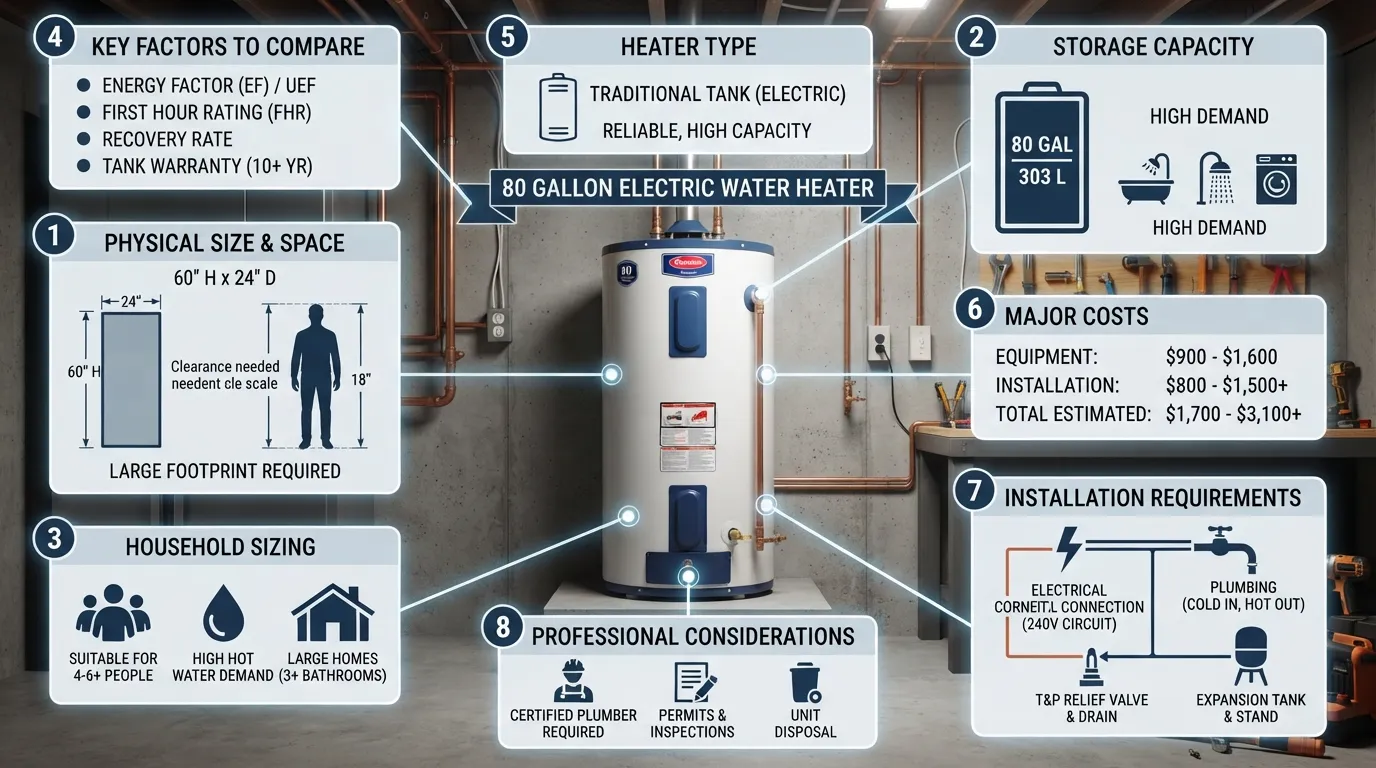
If you are searching for an 80 gallon water heater, you probably do not just want to know how many gallons the tank holds. You want to know whether 80 gallons is actually right for your home, what type you should choose, how much it may cost, how much space it needs, whether you need 240 volts, and how much hot water it can really deliver.
That is why I would not choose an 80-gallon water heater by tank size alone. The better approach is to compare household demand, first-hour performance, recovery, technology, physical space, electrical requirements, efficiency, and total installation cost.
An 80-gallon water heater is a large storage water heater intended for homes or applications with substantial hot-water demand. But 80 gallons does not automatically mean “best for a large family.” You should compare your peak hot-water demand and the heater’s first-hour rating and recovery performance before choosing one. Current residential options include standard electric and hybrid/heat-pump models, while commercial 80-gallon equipment can have very different specifications and installation requirements. :contentReference[oaicite:0]{index=0}
What Is an 80 Gallon Water Heater?
An 80-gallon water heater is a storage-type water heater with a nominal capacity of about 80 gallons. It heats and stores hot water so that it is available when you shower, wash dishes, do laundry, or use other fixtures.
One important distinction is that 80 gallons describes water capacity, not the physical size of the appliance. Two 80-gallon models can have different heights, widths, depths, weights, efficiency ratings, heating systems, and first-hour ratings.
For example, a current 80-gallon conventional electric model listed by Lowe’s has a 24-inch diameter, 59.25-inch height, 240-volt electrical rating, and 20.7 gallons-per-hour recovery at a 90°F rise. A current Rheem 80-gallon hybrid model is listed at 74 inches high, 24.25 inches wide and deep, 262 pounds, 240 volts, and a UEF of 3.7. :contentReference[oaicite:1]{index=1}
The key lesson
Do not ask only, “How many gallons do I need?” Ask, “How much hot water does my household need during its busiest period, and which 80-gallon model can meet that demand efficiently?”
Is an 80 Gallon Water Heater Right for Your Home?
An 80-gallon tank can make sense when your household regularly uses a large amount of hot water, especially when several fixtures or appliances are used close together. But household size by itself is not enough to make the decision.
Look at peak-hour demand
Imagine that several people shower in the morning while the dishwasher is running and someone is using hot water in the kitchen. That busy period matters more than simply counting the people in the house.
A good sizing decision considers:
- Number of people in the home
- Number and duration of showers
- Bathtub use
- Dishwasher use
- Washing-machine hot-water use
- Kitchen and utility-sink demand
- Whether multiple fixtures are used at the same time
- How quickly the selected heater can recover
- The heater’s first-hour rating
That last group is important because two tanks with similar nominal storage can deliver different amounts of usable hot water over an hour.
When an 80-gallon tank may be more than you need
If your household rarely runs out of hot water and your current smaller tank already meets your needs, moving to an 80-gallon tank simply because “bigger is better” may not be a smart upgrade.
A larger tank can cost more, take up more space, and may require different electrical or plumbing considerations. The goal is not to buy the biggest tank available. The goal is to buy the right system for your actual demand.
80 Gallon Water Heater Types
When you search for an 80 gallon water heater, you will encounter several technologies. They should not be treated as interchangeable products.
Standard Electric vs. Hybrid 80 Gallon Water Heater
Standard electric water heater
A conventional electric storage water heater uses electric resistance heating elements to heat the stored water. Current 80-gallon residential examples can use 240-volt service and may have multiple heating elements. :contentReference[oaicite:2]{index=2}
This can be attractive when you want a familiar storage-water-heating design and the existing installation is already compatible. The exact electrical requirements, wattage, dimensions, recovery and warranty still need to be checked for the specific model.
Hybrid or heat-pump water heater
A heat-pump water heater uses electricity to move heat from surrounding air into the water instead of relying only on electric resistance heating. Many hybrid units combine the heat pump with resistance elements so the system can respond to higher hot-water demand. The U.S. Department of Energy notes that heat-pump water heaters can be two to three times more efficient than conventional electric-resistance water heaters, depending on the equipment and operating conditions. :contentReference[oaicite:3]{index=3}
Current ENERGY STAR listings also show that 80-gallon-class heat-pump systems can have substantially different storage volumes, first-hour ratings, voltages and UEF ratings. For example, current certified models include 80-gallon-class systems with first-hour ratings ranging above their nominal storage volume. :contentReference[oaicite:4]{index=4}
Why hybrid performance matters
A larger tank is not automatically a higher-performing tank. When comparing models, look at first-hour rating, recovery performance and efficiency in addition to nominal gallons. Those numbers tell you more about how the heater can respond to real household demand.
How Big Is an 80 Gallon Hot Water Heater?
There is no single physical dimension for every 80-gallon water heater. The dimensions depend on the manufacturer, technology and model.
For example, one current conventional 80-gallon electric model is listed at approximately 59.25 inches high and 24 inches in diameter. A current Rheem 80-gallon hybrid model is listed at approximately 74 inches high, 24.25 inches wide and 24.25 inches deep. :contentReference[oaicite:5]{index=5}
That difference is exactly why you should measure the installation location before ordering a replacement.
Check these dimensions before buying
- Overall height
- Tank diameter or width
- Depth
- Water connection locations
- Electrical connection location
- Required service clearance
- Doorway and access dimensions
- Drain and condensate requirements for applicable heat-pump models
This becomes especially important when replacing a smaller water heater with a taller 80-gallon model or when switching from a conventional tank to a heat-pump system.
How Heavy Is an 80 Gallon Water Heater?
The answer depends on the model, but there is one number you can calculate easily: the weight of the water itself.
80 gallons of water ≈ 667 pounds
That is before adding the weight of the tank, insulation, heating components and other hardware.
For perspective, a current Rheem 80-gallon hybrid model is listed at 262 pounds before being filled with water. :contentReference[oaicite:6]{index=6}
So a full 80-gallon tank can represent a very substantial load. The actual filled weight varies with the specific tank and the water temperature, but the important point is simple: an 80-gallon water heater is not a lightweight appliance.
Important installation warning
Do not plan an 80-gallon installation based only on whether the empty tank can physically fit. The installation location, floor/load considerations, access, drainage, plumbing connections and manufacturer requirements should all be evaluated before installation.
Does an 80 Gallon Electric Water Heater Need 240 Volts?
Many 80-gallon electric water heaters use 240-volt electrical service, but you should never assume that every model has identical electrical requirements.
For example, a current 80-gallon conventional electric model is listed at 240 volts, while a current 80-gallon Rheem hybrid model is also listed at 240 volts. ENERGY STAR’s current guidance says electrical requirements vary by heat-pump model and that manufacturer requirements and applicable electrical codes should be followed. :contentReference[oaicite:7]{index=7}
Before replacing an electric water heater, check:
- The heater’s required voltage
- Rated wattage or electrical input
- Required circuit and overcurrent protection
- Existing wiring and electrical capacity
- Manufacturer installation instructions
- Applicable electrical and local codes
A new heater should not simply be connected to an existing circuit because the old heater happened to work on it. The electrical requirements of the new model must be verified.
80 Gallon Water Heater Cost: What Should You Budget?
There is no single “average price” that accurately represents every 80-gallon water heater. The price changes significantly depending on whether you choose a conventional electric tank, a hybrid heat-pump system, a commercial unit, or another specialized configuration.
Current 2026 cost guides place 80-gallon installed projects in broad ranges, with one source estimating approximately $1,200–$3,600 installed for an 80-gallon tank and another estimating approximately $1,500–$3,500 installed for a typical 80-gallon electric replacement. These are national reference ranges, not a quote for your home. :contentReference[oaicite:8]{index=8}
For that reason, a very low advertised equipment price may not represent the final project cost. If you are replacing an existing unit, ask for a quote that clearly separates the equipment, labor, electrical work, plumbing materials, permits and disposal where applicable.
Is a Hybrid 80 Gallon Water Heater Worth the Higher Upfront Cost?
If energy efficiency is a priority, a hybrid heat-pump water heater deserves serious consideration. Unlike a conventional electric-resistance heater, it moves heat from surrounding air into the water. The Department of Energy describes heat-pump water heaters as an energy-efficient alternative to conventional electric resistance systems. :contentReference[oaicite:9]{index=9}
The tradeoff is that the equipment can cost more upfront and may require a suitable installation environment. ENERGY STAR notes that heat-pump water heaters need adequate surrounding air and that some models can produce condensate that needs to be drained. :contentReference[oaicite:10]{index=10}
A hybrid may make sense when:
- You want to reduce water-heating energy consumption.
- You have enough suitable space around the unit.
- The electrical installation can support the selected model.
- You are comfortable with a higher equipment price in exchange for efficiency.
- You expect to keep the system long enough for operating savings to matter.
A standard electric model may make more sense when:
- You want a simpler conventional storage system.
- The existing installation already matches the selected model.
- Initial purchase cost is your primary concern.
- A heat-pump installation environment is not suitable.
What Is the First-Hour Rating, and Why Does It Matter?
This is one of the most useful specifications to understand when comparing large water heaters.
The first-hour rating (FHR) represents how much hot water a storage water heater can supply during a busy one-hour period under the standardized test conditions used for the rating. It takes both stored hot water and the heater’s ability to recover into account.
That means an 80-gallon tank with a strong first-hour rating may serve your peak demand differently from another model with the same nominal tank capacity.
Current ENERGY STAR listings demonstrate this clearly. Some 80-gallon-class heat-pump models have first-hour ratings above 90 gallons, showing why storage volume and first-hour performance should be evaluated separately. :contentReference[oaicite:11]{index=11}
Buying tip
When comparing two 80-gallon water heaters, do not stop at the gallon number. Put FHR, recovery, UEF, dimensions, electrical requirements and warranty side by side.
80 Gallon Electric Water Heater 240V: What Should You Know?
The phrase “80 gallon electric water heater 240V” is common because many large residential electric models use 240-volt service. But the voltage alone does not tell you whether a particular model is suitable for your existing electrical system.
Some current 80-gallon hybrid products have different electrical characteristics from conventional resistance tanks, and ENERGY STAR lists both 120-volt and 240-volt heat-pump products in its certified database. :contentReference[oaicite:12]{index=12}
Do not select a breaker, wire size or circuit based only on the phrase “80 gallons.” Use the exact manufacturer’s specifications and have the electrical installation evaluated when needed.
Can You Get an 80 Gallon Gas Water Heater?
Gas and high-capacity water-heating equipment exists, but an 80-gallon gas unit should not automatically be treated as the equivalent of an 80-gallon residential electric tank.
Gas equipment can have different venting, input, recovery, fuel-supply and installation requirements. Some 80-gallon products appearing in search results are commercial rather than typical residential equipment.
If you are replacing a gas system, identify the exact application and manufacturer requirements before assuming an 80-gallon electric, gas or commercial model can simply substitute for one another.
Residential vs. Commercial 80 Gallon Water Heaters
This distinction is easy to miss when searching online because shopping results can place residential and commercial products near each other.
A commercial 80-gallon water heater can have a very different input, electrical configuration, recovery capability and intended application from a residential unit. A product being labeled “80 gallons” does not make it a drop-in residential replacement.
Before buying a commercial-looking 80-gallon unit
Confirm that the equipment is actually approved and specified for your intended residential application. Check the model’s fuel type, voltage, input, recovery, installation instructions and applicable requirements rather than relying on the tank capacity alone.
How to Choose the Best 80 Gallon Electric Water Heater
There is no single model that is “best” for every home. The right choice depends on what you value most.
Compare conventional electric models that match your existing installation and hot-water requirements.
Compare ENERGY STAR-certified heat-pump models by UEF, FHR, operating modes, installation space and electrical requirements.
Compare first-hour rating and recovery instead of choosing purely by tank volume.
Start with the existing heater’s capacity, dimensions, fuel source and performance, then determine whether your household actually needs more.
80 Gallon Water Heater Buying Checklist
- Calculate your peak hot-water demand. Focus on the busiest period of the day.
- Compare first-hour ratings. Do not rely only on nominal gallons.
- Choose the technology. Compare standard electric and hybrid/heat-pump options.
- Measure the installation space. Check height, width, depth and access.
- Verify electrical requirements. Confirm voltage, circuit and model-specific requirements.
- Check efficiency. Compare UEF where applicable.
- Review warranty coverage. Look at tank, parts and other manufacturer coverage.
- Estimate the complete installed cost. Include labor, materials, electrical/plumbing work and other applicable costs.
- Check installation requirements. Follow the manufacturer’s instructions and applicable local codes.
- Have the final selection verified before purchase. Especially when changing tank size or technology.
What Should You Check During an 80 Gallon Water Heater Replacement?
If you are replacing an existing water heater, the easiest mistake is to assume that the new unit only needs to connect to the same pipes and power source.
A proper replacement assessment should consider:
- Existing tank size and condition
- Current fuel type
- Hot-water demand
- New tank dimensions
- Water connection locations
- Electrical requirements
- Drainage and safety components
- Expansion-control requirements where applicable
- Access for removal and installation
- Manufacturer installation requirements
- Applicable local plumbing and electrical requirements
If you are unsure which configuration fits your home, it is usually better to determine that before purchasing the heater rather than discovering an incompatibility during installation.
If your project is a replacement rather than a simple product comparison, you can learn more through our water heater replacement service.
80 Gallon Water Heater: Pros and Cons
Pros
- Large stored hot-water capacity
- Can suit homes with substantial hot-water demand
- Available in conventional electric and heat-pump configurations
- Modern hybrid models can provide high efficiency
- Large tanks can reduce the risk of running out of stored hot water when properly sized
Cons
- Larger physical footprint
- Heavier than smaller storage tanks
- Higher purchase and installation cost can be involved
- May require electrical or installation changes
- An oversized tank may be unnecessary for a lower-demand household
- Heat-pump models need appropriate space, airflow and condensate planning
Should You Buy an 80 Gallon Water Heater or a Smaller Tank?
Use this simple decision process instead of choosing by household size alone.
Your decision path
- Do you regularly run out of hot water?
- Does the problem happen during a predictable peak period?
- Are multiple showers or appliances using hot water at the same time?
- Does your current heater’s first-hour performance meet your demand?
- Will an 80-gallon model physically fit with the required clearances?
- Can your electrical/plumbing system support the selected model?
- Would a hybrid heat-pump model lower operating costs enough to justify its higher upfront price?
If your answers point toward high peak demand, an 80-gallon system may be appropriate. If your existing smaller tank already satisfies your demand, simply moving to a larger tank may not provide enough benefit to justify the extra cost and space.
How to Get More Value From an 80 Gallon Water Heater
The best purchase is not necessarily the tank with the highest capacity or the longest list of features. It is the system that matches your demand and operating priorities.
- Choose the capacity based on real hot-water demand.
- Compare first-hour rating and recovery performance.
- Compare efficiency ratings when evaluating electric models.
- Consider a heat-pump model when lower operating energy use is a priority.
- Measure before purchasing.
- Verify electrical requirements before installation.
- Follow the manufacturer’s installation and maintenance instructions.
- Do not ignore water drainage and safety requirements.
For broader plumbing needs, you can also explore our plumbing services.
Frequently Asked Questions About 80 Gallon Water Heaters
Related Resources for Comparing 80 Gallon Water Heaters
Because this is a product-research query, it can be useful to compare current manufacturer specifications and retailer listings after you understand the sizing and installation requirements.
- :contentReference[oaicite:19]{index=19} — useful for comparing current certified models, UEF, storage volume and first-hour ratings.
- :contentReference[oaicite:20]{index=20} — useful for understanding efficiency and heat-pump water-heater performance.
- :contentReference[oaicite:21]{index=21} — useful for checking real-world dimensions, voltage and recovery specifications.
- :contentReference[oaicite:22]{index=22} — useful for comparing a current hybrid model’s dimensions, weight, UEF and electrical requirements.
Need Help Choosing or Replacing an 80 Gallon Water Heater?
Choosing the right 80-gallon system is about more than finding a tank that fits the search query. Your hot-water demand, installation space, electrical requirements, efficiency goals and existing plumbing all matter.
If you need help with the replacement side of the project, explore our water heater replacement service or learn more about our plumbing services.
One final buying rule
Don’t buy an 80 gallon water heater simply because you have a large household. Choose the system that can meet your peak demand, physically fit your space, work with your home’s infrastructure, and make financial sense over its useful life.