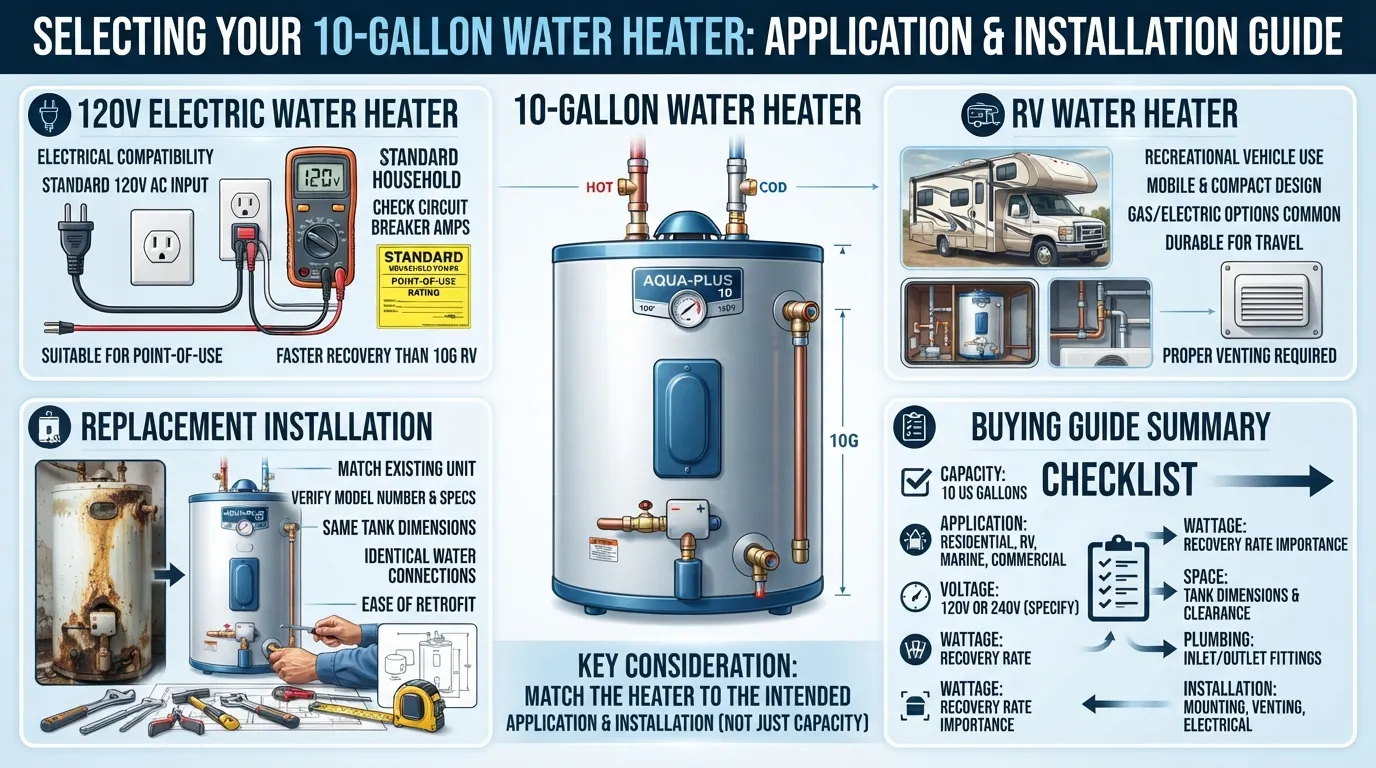
A 10 gallon water heater is usually a small storage-tank or point-of-use water heater designed for a limited hot-water demand. It can be a practical choice for a remote sink, small point-of-use application, or certain RV installations, but it is not automatically the right size for an entire home. Before buying one, check the application, voltage, wattage, dimensions, connections, recovery performance, and installation requirements rather than choosing by tank size alone.
If you are searching for a 10 gallon water boiler, 10 gallon water heater, 10 gallon hot water heater, or 10 gallon water heater 120 volt, you are probably trying to answer a practical question: Which 10-gallon unit will actually work for my situation?
That question matters because a 10-gallon residential point-of-use heater and a 10-gallon RV water heater may look similar in a search result but can be designed for very different applications. The same is true of 120V, 208V, and 240V models.
This guide helps you sort through those differences, understand when 10 gallons is enough, compare electric and RV options, prepare for a replacement, and avoid buying a heater that does not match your existing plumbing or electrical setup.
First: What Kind of 10 Gallon Water Heater Do You Need?
Before comparing brands or prices, identify the application. This is the step many product-focused search results do not explain clearly enough.
Use this simple decision guide
- Residential point-of-use: Look for a compact electric storage-tank water heater designed for the intended plumbing application.
- RV or camper: Look for an RV-rated water heater. RV models can use different fuel systems, controls, dimensions, and installation requirements.
- Replacement: Match the existing unit’s voltage, wattage, dimensions, connections, fuel type, and application before ordering.
- Multiple showers or whole-home demand: Do not assume a 10-gallon tank is large enough simply because the existing heater is 10 gallons. Your actual hot-water demand may require a different solution.
What Is a 10 Gallon Water Heater?
A 10-gallon water heater is a storage-tank heater that holds approximately 10 U.S. gallons of water. In residential applications, small tank heaters are commonly used as point-of-use systems, meaning the heater is installed relatively close to the fixture or area that needs hot water.
The term 10 gallon water boiler is also commonly used in searches, but it is important to distinguish a small domestic water heater from a boiler used for hydronic space heating. When you are shopping for hot water at a sink, bathroom, utility area, or similar fixture, you are generally looking for a water heater rather than a hydronic boiler.
The tank capacity tells you how much water the tank stores. It does not by itself tell you exactly how long the hot water will last. That depends on factors such as incoming water temperature, thermostat setting, fixture flow rate, mixing, and the heater’s recovery capability.
Is a 10 Gallon Water Heater Enough?
Sometimes yes, and sometimes no.
A 10-gallon heater can make sense when the hot-water demand is relatively limited. For example, it may be suitable for a point-of-use application where a small fixture needs its own hot-water supply.
It becomes less attractive when you expect several people or fixtures to demand hot water at the same time. A small storage tank can be depleted more quickly when flow rates are high or multiple fixtures are running together.
Important: Tank size is only one part of the equation
Do not estimate performance from the 10-gallon label alone. A heater’s practical performance depends on the temperature of the incoming water, desired outlet temperature, fixture flow rate, recovery rate, and whether other fixtures are using hot water at the same time.
A 10-gallon heater may be a good fit for:
- A limited point-of-use application
- A remote sink or fixture where waiting for hot water from a central heater is undesirable
- Low-demand spaces
- Certain small commercial applications when the selected model is rated for that use
- Specific RV or camper applications when using an RV-rated model
It may not be the right fit for:
- A high-demand whole-house application
- Multiple simultaneous showers
- Several high-flow fixtures running together
- An installation where the available electrical supply does not match the heater
10 Gallon Water Heater 120 Volt: What You Need to Know
If you specifically searched for a 10 gallon water heater 120 volt or 10 gallon water heater 110 volt, electrical compatibility should be one of the first things you verify.
For example, a current Rheem Commercial 10-gallon point-of-use electric model listed by Home Depot Canada uses a 1500W element and 120V electricity. The same 10-gallon product family also includes models rated at 2000W and 208V or 240V.
Never choose a heater based only on the voltage written in a search query. Check the model’s nameplate and manufacturer documentation, then make sure the electrical circuit and installation are appropriate for that specific unit.
Electric 10 Gallon Water Heater Options
Electric storage-tank models are one of the main product categories appearing for 10-gallon water heater searches. Current Canadian listings show 10-gallon point-of-use models with different voltage and wattage configurations rather than one universal specification.
For example, Home Depot Canada currently lists a Rheem 10-gallon, 1.5kW, 120V point-of-use model with a 3-year limited tank and parts warranty. Its listed features include overheat protection, a temperature-and-pressure relief valve, a compact profile, and wall-mount capability.
That does not mean that model is automatically the best choice for every installation. It simply demonstrates why you should compare the complete specification rather than the gallon capacity alone.
What to compare on an electric 10-gallon heater
- Rated voltage
- Element wattage
- Tank dimensions
- Water connection locations and sizes
- Installation orientation and mounting requirements
- Thermostat and temperature controls
- Temperature and pressure relief protection
- Overheat protection
- Warranty
- Manufacturer installation requirements
10 Gallon RV Water Heater vs. Residential Water Heater
This is one of the most important distinctions in the current search results.
Search results for “10 gallon water heater” can mix residential point-of-use products with RV-specific products. Those are not automatically interchangeable.
For example, Suburban’s 10-gallon RV water heater is specifically designed for RVs and campers. The manufacturer’s specifications for its SW10D/5242A model include a porcelain-lined steel tank, replaceable anode rod, direct spark ignition, a 12,000 BTU/h gas input, an optional 1,440W electric element, and model-specific recovery rates.
Do not assume these are interchangeable
Residential point-of-use heater: Designed around residential or commercial plumbing and electrical requirements.
RV water heater: Designed for the specific space, fuel system, controls, connections, and installation environment of an RV or camper.
If you are replacing an RV heater, identify the existing model and follow the RV heater manufacturer’s replacement requirements. If you are replacing a residential point-of-use heater, match the residential unit’s specifications instead.
How Much Hot Water Does a 10 Gallon Heater Provide?
This is where a simple tank-size comparison can become misleading.
Suppose you have a 10-gallon storage tank. The amount of usable hot water at a fixture is affected by how much hot water the fixture consumes, how cold the incoming water is, the temperature stored in the tank, and how quickly the heater can recover after hot water is used.
For example, a low-flow faucet and a high-flow shower do not consume hot water at the same rate. Two fixtures running together can also deplete stored hot water faster than one fixture.
That is why a good sizing decision starts with your actual use case, not simply the number “10 gallons.”
Ask yourself these questions
- How many fixtures will use hot water?
- Will more than one fixture operate at the same time?
- What is the approximate flow rate of the fixture?
- What is the incoming cold-water temperature?
- What temperature do you need at the fixture?
- How quickly does the selected heater recover?
Once you answer those questions, you can determine whether a 10-gallon storage tank makes sense or whether a larger tank or another type of water-heating system would be more appropriate.
10 Gallon Water Heater Replacement: Check These Things First
If you are replacing an existing heater, do not buy the replacement by gallon size alone.
10-gallon replacement checklist
- Identify the existing model number. Photograph the data plate before removing the old heater if possible.
- Verify voltage. Do not assume the replacement should use the same voltage without checking the existing installation and new manufacturer’s requirements.
- Verify wattage. A different wattage can affect electrical requirements and recovery performance.
- Measure the available space. Check height, width, depth, and required service clearance.
- Check water connections. Connection size, location, and orientation can affect whether a replacement fits without modifications.
- Confirm the application. Residential, commercial, point-of-use, and RV units can have different requirements.
- Review the manufacturer’s installation instructions. The installation must comply with the requirements applicable to the selected model and location.
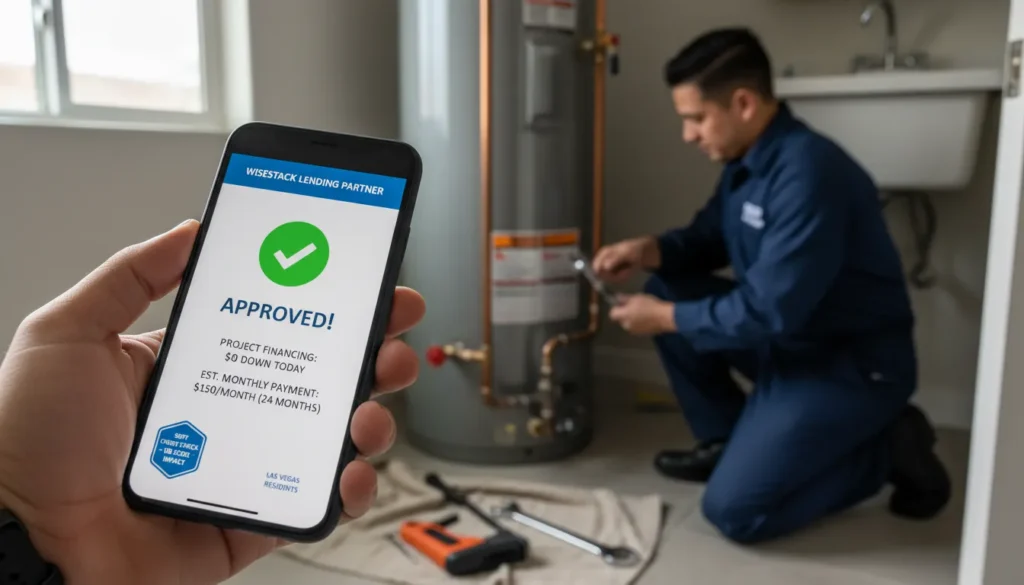
If your existing heater is failing, replacing it with the first 10-gallon product you find online can create unnecessary plumbing or electrical work. A professional assessment can help confirm what will actually fit and work in your installation.
What Does a 10 Gallon Water Heater Cost?
Product prices vary by brand, voltage, wattage, availability, and market. As one current Canadian example, Home Depot Canada lists a Rheem 10-gallon 1.5kW/120V point-of-use model at approximately CAD $603 at the time checked, while its 10-gallon 2kW/208V and 2kW/240V versions are listed at approximately CAD $660. Prices and availability can change.
Do not treat a retail product price as the total replacement cost.
Your total project cost may include:
- The water heater itself
- Professional installation
- Plumbing modifications, if required
- Electrical modifications, if required
- Valves, fittings, connectors, or other installation materials
- Removal or disposal of the old unit
- Any applicable permit or code-related requirements
For a local installation, the best way to get an accurate total is to have the existing setup evaluated rather than relying on a generic online installation estimate.
10 Gallon Water Heater vs. Smaller or Larger Options
A 10-gallon tank is not automatically the ideal size just because it is compact.
Current point-of-use product ranges include smaller mini-tanks and larger storage tanks as well as tankless options. Home Depot Canada, for example, currently lists 1.5-gallon and 4-gallon point-of-use mini-tanks alongside 6-, 10-, 15-, 20-, and larger-gallon products.
Common Mistakes When Buying a 10 Gallon Hot Water Heater
1. Choosing by gallon capacity only
Two 10-gallon heaters can have very different electrical ratings, dimensions, recovery characteristics, and intended applications.
2. Assuming 110V and 120V are interchangeable
Search terminology can be loose, but appliance specifications are not. Verify the manufacturer’s rated voltage for the exact model.
3. Buying an RV heater for a residential installation
The gallon capacity does not make two products equivalent. Check the intended application and installation requirements.
4. Ignoring dimensions and connection locations
A heater can have the correct capacity and still be a poor replacement if it does not physically fit or the connections do not align with the existing installation.
5. Looking only at the purchase price
A lower-priced tank may require additional plumbing or electrical work. Compare the complete installed solution, not just the product listing.
How to Choose the Right 10 Gallon Water Heater
My 7-step buying process
- Define the application. Residential, point-of-use, commercial, RV, or another specific use.
- Confirm the required capacity. Make sure 10 gallons actually matches your hot-water demand.
- Check the electrical supply. Verify voltage and available circuit requirements.
- Compare wattage and recovery. Capacity alone does not tell the whole performance story.
- Measure the installation space. Check dimensions and service access.
- Confirm plumbing compatibility. Review connections and orientation.
- Verify the exact model documentation. Use the manufacturer’s installation instructions before purchase or installation.
When You Should Consider Professional Installation
A water heater replacement can involve both plumbing and electrical considerations. If you are changing voltage, wattage, connections, installation location, or heater type, it is especially important to verify compatibility before work begins.
If you are replacing a failed unit and are not sure whether the existing installation is compatible with the replacement you found, getting the setup evaluated first can prevent buying the wrong equipment.
For broader water-heating needs, you may also want to review our water heater replacement service to understand the replacement process and when professional help makes sense.
For other plumbing needs, you can also explore our plumbing services.
10 Gallon Water Heater FAQs
Is a 10 gallon water heater enough for a shower?
It depends on the shower flow rate, incoming water temperature, desired temperature, recovery capability, and whether other fixtures are using hot water. A 10-gallon tank should not be assumed to provide a fixed number of shower minutes.
Is a 10 gallon water heater good for a whole house?
Usually, a 10-gallon storage tank is better suited to limited or point-of-use demand than a high-demand whole-house application. If multiple fixtures or showers can operate at the same time, compare larger or alternative water-heating systems.
Can I use a 120V 10 gallon water heater instead of a 240V model?
Not automatically. The electrical supply, heater rating, wattage, circuit requirements, and manufacturer’s installation instructions all need to match. A 120V model and 240V model should not be treated as interchangeable simply because both hold 10 gallons.
Is a 110V water heater the same as a 120V water heater?
“110V” is commonly used as a search term for household electrical equipment, but you should select the heater according to the exact voltage rating provided by the manufacturer and the electrical characteristics of your installation.
What is the difference between a 10 gallon RV water heater and a residential 10 gallon water heater?
They are designed for different applications. RV models can incorporate RV-specific dimensions, controls, fuel systems, and installation requirements. Residential point-of-use heaters are designed around residential or commercial plumbing and electrical installations. Always match the heater to the intended application.
What should I check before replacing a 10 gallon water heater?
Check the existing model, voltage, wattage, dimensions, connection locations, fuel type, application, and installation requirements. Also verify the new manufacturer’s documentation before ordering.
Can I install a 10 gallon water heater myself?
The answer depends on the specific equipment, installation, plumbing, electrical work, and applicable requirements. If the replacement involves electrical changes, plumbing modifications, or uncertainty about compatibility, professional installation is the safer approach.
What is the best 10 gallon water heater?
There is no single best model for every situation. The right heater is the one that matches your application, voltage, wattage, space, plumbing connections, hot-water demand, and manufacturer’s requirements. A residential point-of-use heater and an RV heater should be evaluated separately.
Watch: 10 Gallon Water Heater Information & Installation Resources
Visual demonstrations can be useful when you are trying to understand heater components, installation layouts, or replacement considerations. Use the videos below as supplementary information and always follow the manufacturer’s documentation for the exact model being installed.
Related Resources for Comparing 10 Gallon Water Heaters
If you are researching products before making a decision, manufacturer and major retailer listings can help you verify current specifications, model numbers, availability, and installation documentation.
- Home Depot Canada 10-gallon water heater listings — useful for comparing current 10-gallon product configurations.
- Suburban 10-gallon RV water heater specifications — useful when researching RV-specific 10-gallon models.
- Rheem 10-gallon 120V point-of-use example — check the manufacturer’s/model documentation and current retailer specifications before purchase.
Need Help Choosing or Replacing a 10 Gallon Water Heater?
Choose the heater based on your actual installation—not just the gallon label.
If you are unsure whether a 10-gallon heater is appropriate, need to replace an existing unit, or want to confirm compatibility before purchasing equipment, professional plumbing help can save you from an expensive mismatch.
For additional plumbing solutions, visit our full range of plumbing services.
If you prefer to speak with a plumbing professional, you can also contact our plumbing team to discuss your water-heating needs.
Final Takeaway
The best 10 gallon water heater is not simply the product with the lowest price or the highest number of features. It is the heater that matches your hot-water demand, application, voltage, wattage, physical space, plumbing connections, and installation requirements.
If you are shopping for a 10 gallon water heater 120 volt, start with the electrical requirements. If you are replacing an existing unit, start with the model number and complete specifications. If you are buying for an RV, choose an RV-rated model. And if you are considering a 10-gallon tank for a larger household or multiple simultaneous fixtures, make sure the capacity and recovery performance actually match your demand.
In short: don’t choose a 10-gallon water heater because it says “10 gallons.” Choose it because the complete system fits your application.