Why You Need an Insured Plumber and How to Verify One in Miami
Quick Answer — Why Hiring an Insured Plumber Protects Your Home and Wallet
Essential Coverage Overview
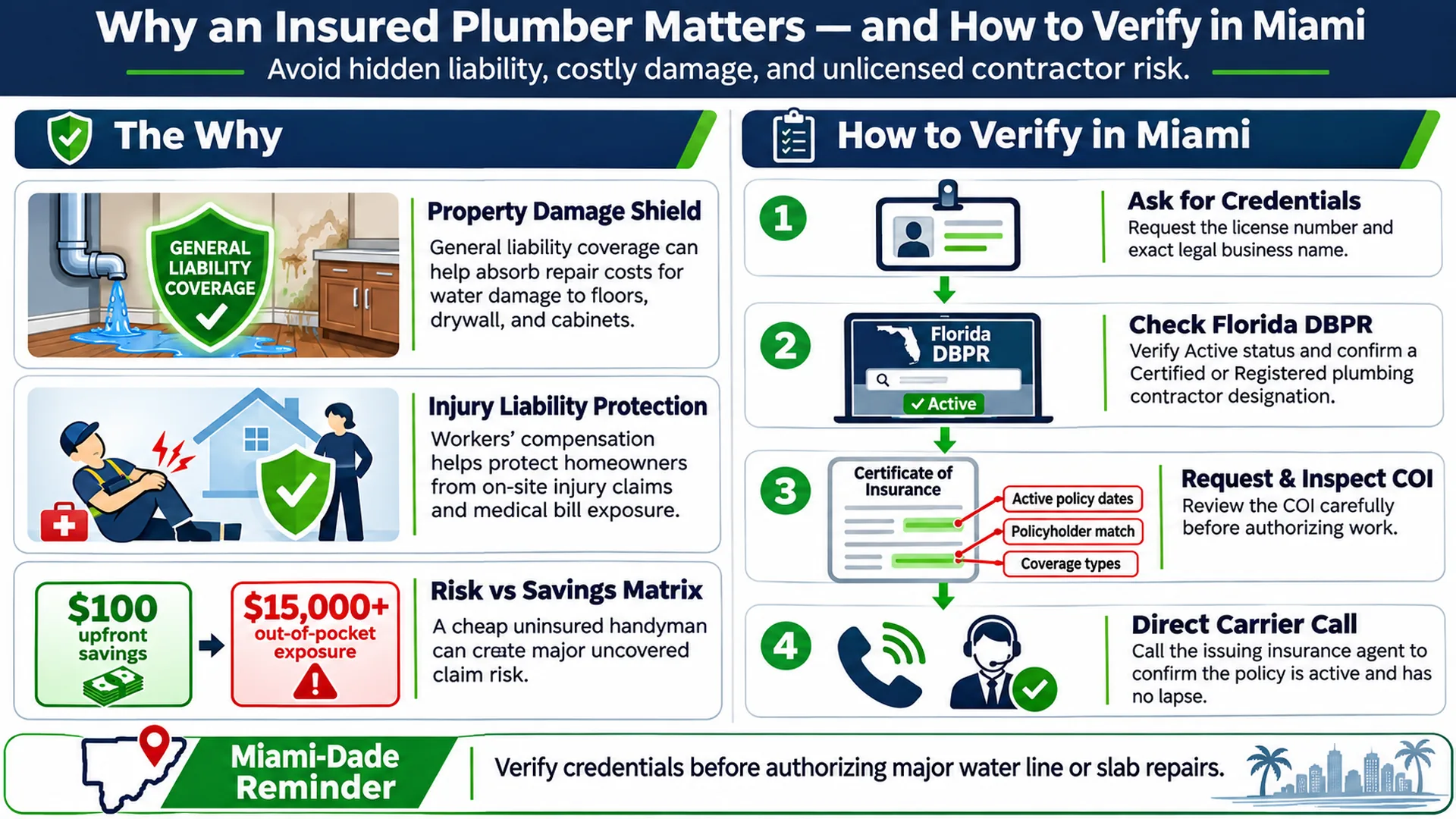
Hiring an insured plumber guarantees that your home and finances are fully protected against catastrophic accidents during a repair or installation. If an unexpected pipe burst damages your property, the plumber’s general liability insurance covers the repair costs. Furthermore, if a technician suffers an injury on your premises, their workers’ compensation policy pays for their medical expenses and lost wages, ensuring you are never held personally or financially liable.
3 Risks You Avoid by Hiring an Insured Plumber
Out-of-Pocket Property Damage Costs: Major plumbing failures can lead to thousands of dollars in structural water damage, ruined flooring, or destroyed personal items. An insured professional carries general liability insurance to absorb these remediation expenses directly.
Personal Worker Injury Claims: If an uninsured tradesperson slips, falls, or gets hurt inside your home, their medical bills and lost income could become your responsibility under standard homeowner liability rules. Hiring insured contractors eliminates this severe legal risk.
Devastating Lawsuit Exposure: Uninsured claims often escalate into complex litigation, potentially resulting in personal property liens or severe financial loss. Valid insurance policies shield your personal assets by providing dedicated legal defense and coverage funds.
Quick Takeaways
Dual Protection: An insured plumber brings both general liability insurance (for your property) and workers’ compensation (for their employees).
Zero Personal Liability: Valid coverage prevents injured contractors from filing claims against your home insurance policy or suing you directly.
Verified Reliability: Reputable plumbing businesses proactively maintain proof of insurance to protect their customers and preserve their professional reputation.
Local Compliance: Always verify credentials with a licensed and insured Miami plumber before granting access to your home’s primary water systems.
What Does “Insured Plumber” Actually Mean?
Understanding what an insured plumber brings to your home requires looking closely at their specific coverage types. When a plumbing company carries valid insurance, it means they maintain distinct financial safety nets designed to handle third-party damage and bodily injury that may occur during a project.
General Liability Insurance: What It Covers
General liability insurance is a plumber’s primary shield against unexpected accidents that harm your property. If a technician accidentally punctures a high-pressure line or ruptures a supply pipe, this coverage pays for the resulting physical damage.
Structural Damage: Repairs to soaked drywall, warped hardwood floors, subflooring, and ceiling structures caused by sudden leaks.
Cabinetry and Millwork: Restoration or replacement of ruined kitchen and bathroom cabinets, countertops, and custom carpentry.
Personal Property: Cleaning, repairing, or replacing furniture, electronics, carpets, and personal belongings damaged by water intrusion.
Secondary Water Remediation: Professional mold testing, dehumidification, and water extraction services needed to restore safe living conditions.
Workers’ Compensation: What It Covers
Workers’ compensation insurance protects both the technician working in your home and you as the property owner. If a plumber experiences a physical injury on your job site, this coverage acts as the primary payer.
Medical Expense Coverage: Emergency room visits, surgeries, prescription medications, and ongoing physical therapy for the injured trade worker.
Disability and Wage Replacement: Financial support covering lost income while the worker recovers from job-site injuries.
Homeowner Immunity: Legal protections that prevent the injured worker from filing claims against your personal homeowner liability policy.
What Insurance Usually Does Not Cover
While plumbing insurance offers robust financial protection, it is not an all-encompassing warranty for poor services. Policy limits vary across different providers, and specific exclusions always apply.
Defective Workmanship: Insurance covers secondary water damage caused by a mistake, but it typically does not pay to fix or redo poor-quality work itself.
Pre-Existing Wear and Tear: Gradual corrosion, aging pipes, or long-standing hidden leaks present before the service call are excluded.
Policy Exclusions: Specific high-risk procedures or specialized equipment may be explicitly excluded under cheaper, base-level trade policies.
Lapsed or Expired Policies: If a plumbing company fails to pay premiums, their insurer will deny all active third-party damage and bodily injury claims.
Licensed vs Bonded vs Insured: What’s the Difference?
Homeowners frequently confuse licensing, bonding, and insurance. While all three credentials are vital for complete protection, each serves a distinct legal and financial purpose.
| Credential | What It Is | Who It Protects | What It Does Not Do |
|---|---|---|---|
| Licensed | Government certification confirming state exam completion, trade competency, and background checks. | The Public | Does not provide direct money or funds to repair physical property damage. |
| Bonded | A surety bond held with a third party to guarantee ethical business practices and contract completion. | The Homeowner | Does not pay for accidental property damage or job-site bodily injuries. |
| Insured | Active general liability and workers’ compensation policies backed by an insurance carrier. | Homeowner & Workers | Does not guarantee project completion if the plumber abandons the job without cause. |
What Is a Certificate of Insurance (COI)?
A Certificate of Insurance (COI) is an official document issued directly by an insurance broker verifying that a contractor holds active, valid policies. It acts as official proof by outlining exact policy numbers, effective coverage dates, policy limits, and specific liability types.
Reviewing a current COI ensures that you are relying on verified protection rather than an unbacked verbal promise or an outdated promotional badge.
What Can Happen When You Hire an Uninsured Plumber
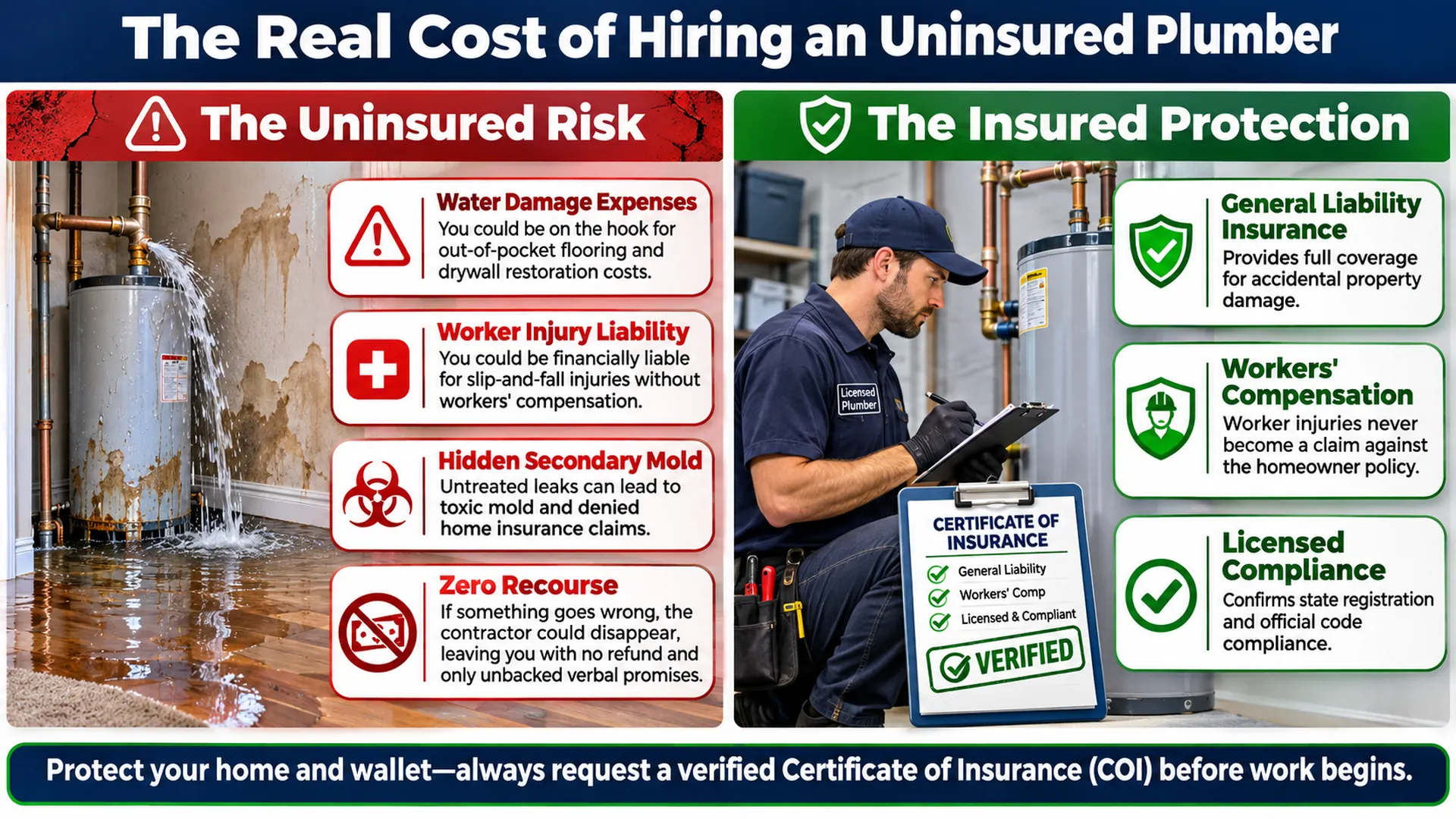
Hiring an uninsured plumber or an unlicensed handyman might seem like a practical way to save money on immediate labor costs. However, skipping verified coverage transfers immense financial and legal risks directly onto you as the property owner. When an unbonded or uninsured operator causes an accident, you are left paying for the repairs out-of-pocket.
Scenario 1: A Burst Supply Line During a Water Heater Swap
Consider a routine upgrade involving water heater repair and installation. If an uninsured worker accidentally snaps a main copper supply valve or cross-threads a flex line while pressurized, hundreds of gallons of water can flood your living space within minutes.
Insured Plumber Outcome: The contractor’s general liability insurance pays for immediate emergency water extraction, drying equipment, drywall removal, and hardwood floor restoration.
Uninsured Handyman Outcome: The handyman leaves the site, leaving you solely responsible for thousands of dollars in emergency water damage cleanup and restoration.
Field Note from Lead Technicians Oscar and Lennin: “On job sites across Miami, we frequently get emergency calls to fix work started by uninsured handymen. We’ve seen situations where an improper hose fitting on a tankless or traditional heater burst overnight, saturating adjacent cabinets, baseboards, and subflooring. When those homeowners called the original installer back, the phone was disconnected, leaving them with massive structural restoration bills. Always demand proof of liability before letting anyone turn a wrench on your main lines.”
Scenario 2: Hidden Leak Damage Discovered After the “Repair”
Plumbing mistakes are not always immediately visible. An unlicensed installer might improperly glue a drain line or pinch an O-ring inside a wall cavity during a fixture swap.
Over several weeks, slow seepage behind drywall leads to rotting wall studs, ruined cabinetry, and widespread toxic mold growth. When you file a claim with your homeowner insurance provider, they may deny coverage because the damage stemmed from work completed by an uncertified, uninsured individual.
Scenario 3: A Worker Injured on Your Property
Plumbing requires heavy equipment, soldering torches, and maneuvering in tight, slick spaces. If an uninsured worker slips on a wet tile floor, falls from a ladder, or suffers a severe burn while working inside your home, they lack workers’ compensation protection.
Because they cannot collect wage replacement or medical coverage from an employer, their personal injury attorney can file a claim against your homeowner insurance policy or sue you directly for medical bills, rehabilitation costs, and lost wages under premises liability laws.
Is a Plumber Liable for Water Damage?
Yes, a plumber is legally liable for water damage if the destruction stems from their negligence, faulty installation, or poor workmanship. However, establishing liability and collecting actual payment are two very different matters:
Establishing Fault: You must prove that the worker caused the defect through improper techniques or direct negligence.
Contract Terms: Written agreements often define scope and liability limits, so always review project documentation carefully.
Actual Recovery: If a plumber is uninsured, winning a legal judgment against them does not guarantee they have the liquid assets or capital to pay for your property repairs.
The Hidden Cost of Cheap: Why “Cash-Only, No Paperwork” Quotes Cost More Later
Off-the-books, cash-only quotes from unlicensed operators look attractive on paper because they exclude overhead expenses like business licensing, trade bonds, and active insurance premiums.
However, that initial savings disappears the moment a fitting fails or an injury occurs. Paying slightly less upfront leaves your home exposed to catastrophic water damage, mold remediation expenses, and personal lawsuit exposure that vastly outpaces any initial discount.
Who Pays If Something Goes Wrong? How a Claim Works
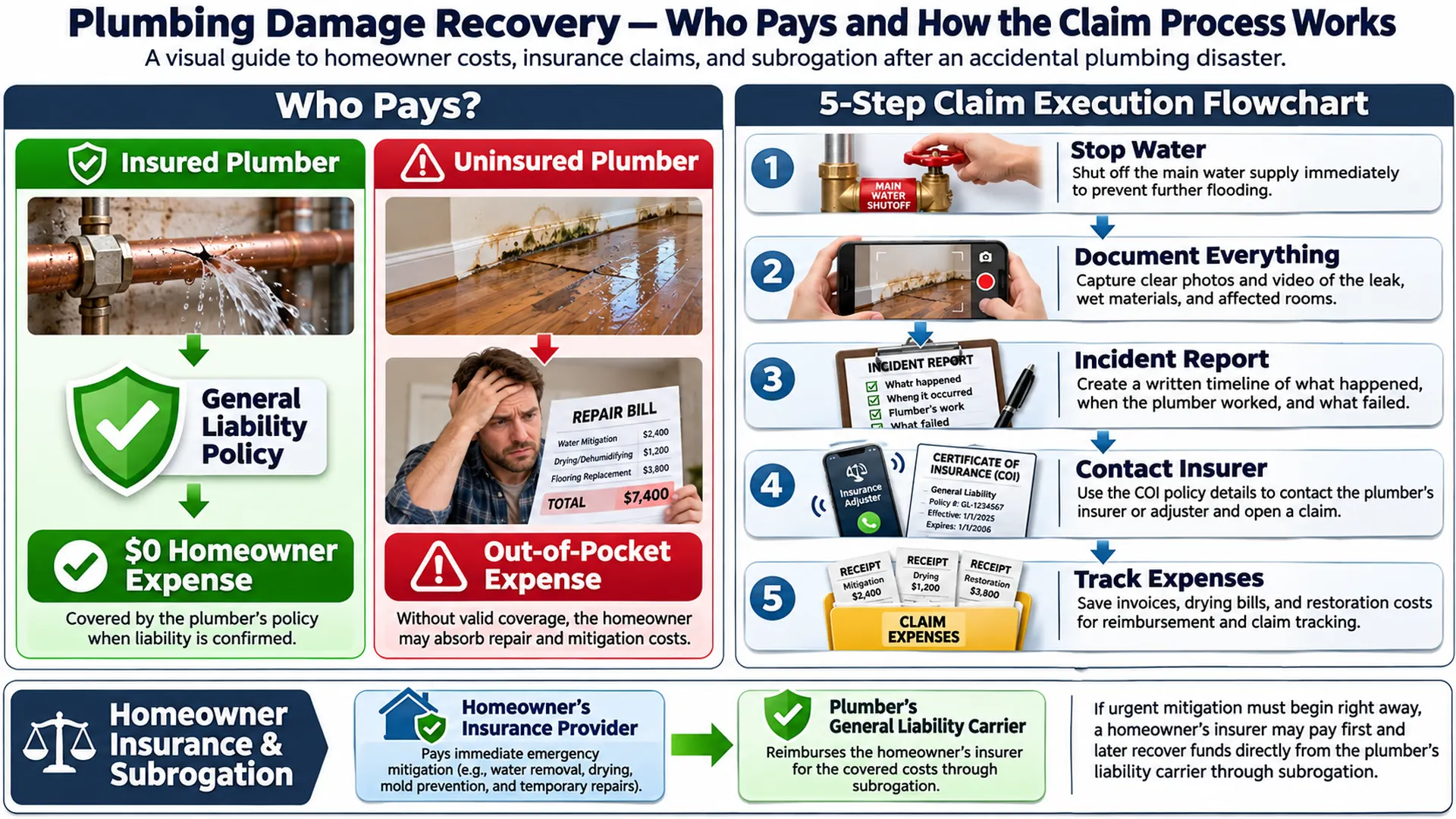
When an accident occurs during a plumbing project, knowing how the recovery process works helps minimize stress and prevents mounting financial loss. Navigating an insurance claim requires quick action, meticulous record-keeping, and direct communication with the appropriate carrier.
Step-by-Step: What to Do After Damage Happens
Shut Off the Water: Immediately shut down your home’s main water supply valve to stop active flooding, or call a local emergency plumber to isolate the leak safely.
Document the Scene Thoroughly: Capture clear high-resolution photos and video of all damaged structural elements, standing water, affected appliances, and personal belongings before starting any cleanup.
Request an Official Incident Report: Ask the plumber or job site supervisor for a written incident report detailing what went wrong, what broken components failed, and their immediate account of the event.
File a Claim with the Plumber’s Insurer: Contact the insurance broker listed on the plumber’s Certificate of Insurance (COI) to open a formal liability claim against their active policy.
Track Every Single Expense: Keep detailed itemized receipts for professional water mitigation services, hotel stays, emergency repairs, and secondary restoration work needed to restore your home.
Will My Homeowner’s Insurance Help?
Whether your personal homeowner’s insurance policy covers plumbing damage depends heavily on the specific language in your policy contract, your chosen deductible, and how the loss occurred.
In many cases, your home insurance carrier will step in to cover immediate water damage under standard accidental discharge clauses. However, if your policy pays for initial repairs, your insurer will likely seek reimbursement from the plumber’s general liability provider through a legal process known as subrogation. Always consult your insurance broker directly to understand your specific coverage limits and avoid unexpected out-of-pocket costs.
Why an Uninsured Contractor Makes Claims Harder
Attempting to recover compensation after an uninsured contractor damages your home creates severe administrative and legal hurdles.
Without a commercial policy to pay out claims, you must collect directly from the individual worker or business owner. An independent insurance adjuster hired by your personal home insurer will require a formal proof of loss, but if the responsible party lacks assets, your home insurance company may raise your monthly premiums or deny secondary claims. This leaves you paying your personal deductible and covering thousands of dollars in remediation costs on your own.
Why Insurance Matters Even More in Miami-Dade
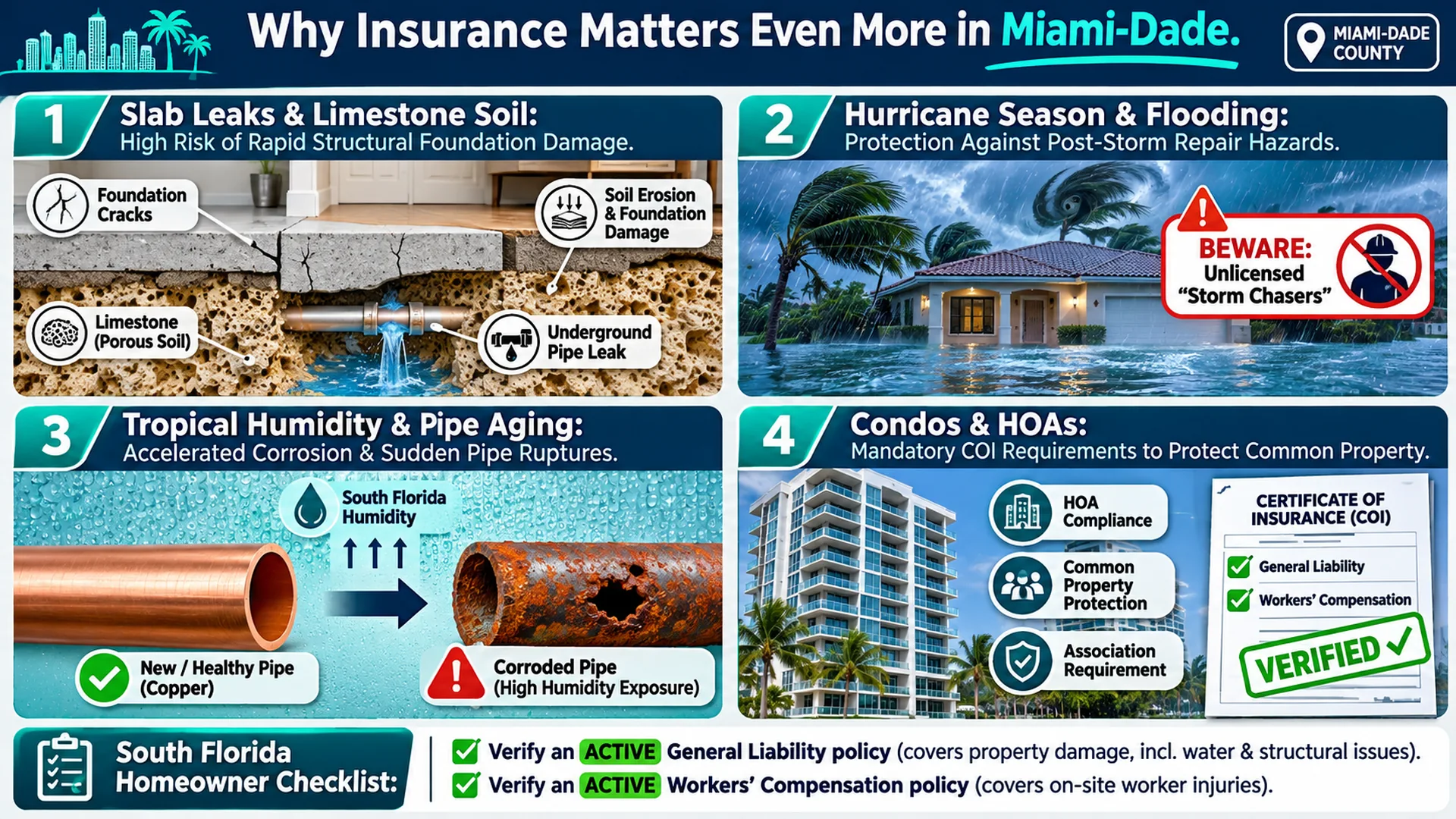
Plumbing risks are not uniform across the country. Operating a home in South Florida introduces unique structural and environmental challenges that make hiring a fully insured professional mandatory. Local environmental factors accelerate system failures, meaning property damage can escalate from a minor leak to a major emergency in a matter of hours.
Slab Leaks and Limestone Soil: Expensive Damage Happens Fast
South Florida’s unique terrain consists heavily of porous limestone bedrock, shifting water tables, and high moisture levels. Over time, these conditions stress copper and cast-iron supply lines running underneath concrete foundations. When these lines rupture, you face a major structural emergency requiring specialized slab leak repair.
Foundation Compromise: High-pressure leaks beneath a concrete slab can erode sub-base soils, causing floors to sink and structural cracks to form.
Massive Financial Exposure: Excavating through concrete foundations to access broken plumbing lines is labor-intensive and costly.
The Insurance Safeguard: An insured contractor ensures that if heavy equipment or exploratory drilling damages adjacent structural elements, their commercial policy absorbs the cost.
Hurricane Season, Flooding, and Emergency Repairs
Severe weather events during hurricane season bring torrential downpours, localized storm surge, and widespread power disruptions that strain municipal and residential plumbing infrastructure.
Following severe storms, neighborhoods often see an influx of opportunistic, unlicensed “storm chasers” offering quick, cash-only repairs. These temporary operators rarely carry valid general liability protection. Always verify licensing and credentials before letting anyone service your drainage or water systems during an emergency.
Humidity and Old Pipes: Higher Failure Risk in South Florida
The year-round tropical humidity in Miami-Dade County accelerates exterior pipe corrosion, fitting degradation, and seal breakdown. Homes built decades ago often feature aging distribution networks that require professional pipe repair or whole-home repiping.
Corrosion Vulnerability: Moist air and damp crawlspaces speed up rust on exposed valves and threaded connections.
Sudden Joint Failures: Aging infrastructure is prone to abrupt ruptures when subjected to sudden pressure spikes.
Comprehensive Protection: Working with qualified teams across the areas we serve across Miami-Dade ensures that any accidental collateral damage during complex pipe overhauls is fully covered.
Condos, HOAs, and Property Managers: Why They Often Ask for a COI
If you live in a multi-family condominium or a managed community governed by a Homeowners Association (HOA), property managers typically enforce strict vendor requirements before allowing contractors on-site.
Common Element Protection: Plumbing failures in a multi-story building can easily flood neighboring units or damage shared structural elements like elevators and electrical risers.
Mandatory Vendor Compliance: Community bylaws and association rules routinely require plumbers to submit a verified Certificate of Insurance (COI)—naming the association as an additional insured—before issuing service elevator keys or granting access to building stacks.
How to Verify a Plumber Is Licensed and Insured Step by Step
Protecting your home from costly liabilities requires more than taking a contractor’s word at face value. Verifying credentials takes only a few minutes and ensures you are working with an accountable, legally compliant professional.
Step 1: Ask for the License Number and Company Name
Always begin by requesting the official license number, exact business legal name, and primary contact details before scheduling any service work. Reputable plumbing companies readily display license numbers on their service vehicles, official estimates, invoices, and websites. If a contractor hesitates or provides vague answers, treat it as an immediate warning sign.
Step 2: Check the License Status on the Florida DBPR Website
Go to the official Florida DBPR license search portal to validate the credentials against state records.
Active Status: Ensure the license status clearly reads “Active” rather than delinquent, inactive, or revoked.
License Type: Verify whether the contractor holds a Certified Plumbing Contractor license (permitting work statewide) or a Registered Plumbing Contractor license (permitting work restricted to specific local municipalities).
Florida Risk PartnersName Matching: Confirm that the qualifying individual’s name and business entity match what the contractor provided on their paperwork. To see an example of transparent credentialing, see how our Miami team documents its licensing.
Step 3: Ask for a Certificate of Insurance (COI)
Request a current Certificate of Insurance (COI) directly from the plumbing company or have their insurance agent email it to you. A legitimate professional will share this document without hesitation to prove they maintain active financial backing.
Step 4: What to Check on the COI
Examine the certificate layout carefully to ensure the protections match your project scope and protect your property interests.
| COI Element | What to Look For | Details Most People Miss |
|---|---|---|
| Policyholder Name | Exact match with the plumbing business name. | Ensure you are not looking at a certificate issued to an entirely different corporate entity or DBA. |
| Insurance Carrier | Licensed, reputable carrier authorized in Florida. | Check that the underwriting company holds a solid financial strength rating. |
| Policy Number | Active alphanumeric tracking numbers. | Blank spaces or placeholder text indicate fake or fraudulent paperwork. |
| Effective & Expiry Dates | Valid coverage spanning your project dates. | Verify that policies have not expired or scheduled to lapse mid-project. |
| Coverage Types | General liability and workers’ compensation. | Check that the limits cover property damage and bodily injury adequately. |
Step 5: Confirm Directly with the Insurance Company
Certificates can occasionally be altered or canceled after issuance due to missed premium payments. Call the insurance agency or carrier listed on the COI directly to verify that the policy remains fully active and that your property address or project can be added if required.
The process is similar in Florida, but use the DBPR site linked above.
Step 6: Check Workers’ Comp Coverage or Exemption
Under Florida law, the construction industry—which includes plumbing contractors—mandates that employers with even one employee must carry active workers’ compensation insurance. Alternatively, corporate officers or business owners may hold a state-approved exemption certificate.
Verify Employee Coverage: Ensure the COI explicitly lists active workers’ compensation coverage if the company sends technicians to your home.
Check Exempt Status: If a sole proprietor claims an exemption, remember that they lack on-the-job injury coverage, which can introduce premises liability risks if an accident occurs on your property.
Red Flags Checklist
Watch out for these common warning signs that indicate an unqualified or high-risk operator:
Refusal to Provide Documentation: Evasiveness when asked for license numbers, insurance certificates, or written estimates.
Missing Company Identity: Unmarked vehicles, lack of physical business addresses, or using generic phone numbers without a registered business name.
Cash-Only Demands: Insisting on cash or peer-to-peer mobile payments with zero paperwork, invoices, or receipts.
Large Upfront Cash Deposits: Demanding massive cash payments before any material is delivered or work begins.
Expired or Invalid Credentials: License statuses that show up as null, revoked, or expired on state databases.
High-Pressure Sales Tactics: Urging you to sign immediately using scare tactics while refusing to provide transparent written terms.
8 Questions to Ask Before You Hire a Plumber
Asking the right questions before hiring a plumber protects your home from shoddy work and financial liability. Evaluating a contractor’s credentials, subcontractor policies, warranties, and permits upfront ensures total transparency, prevents unexpected out-of-pocket costs, and guarantees you are working with a true certified professional.
The Questions
Are you fully licensed in my local jurisdiction? Confirm that the contractor holds a valid state license authorizing them to perform plumbing work in your area.
May I see a current Certificate of Insurance (COI)? Request direct verification of active general liability and workers’ compensation coverage before work begins.
Who specifically will be performing the work in my home? Determine whether certified professionals or unsupervised trainees will manage your plumbing repairs.
Do you use subcontractors, and are they covered? Ensure third-party workers carry independent insurance policies so your property remains protected.
Can you provide a detailed, itemized written estimate? Insist on transparent, upfront pricing that outlines labor, parts, and potential contingencies.
What does your workmanship and parts warranty cover? Clarify the exact duration and scope of guarantees offered if a repaired component fails.
Do you handle all required local building permits? Verify that the company pulls official municipal permits for major installations and system replacements.
What exact process do you follow if accidental property damage occurs? Understand the protocol for filing claims against the plumber’s commercial insurance policy.
What a Good Answer Sounds Like vs a Warning Sign
| Good Answer | Warning Sign |
|---|---|
| Readily provides an active state license number and matches it to official business registries. | Hesitates, gives vague answers, or claims a formal trade license is unnecessary. |
| Instantly emails a verified Certificate of Insurance directly from their insurance agency. | Claims “we are fully insured” but refuses or is unable to provide written proof. |
| Confirms all technicians are trained employees or fully covered, vetted subcontractors. | Admits to using random unverified day-laborers with zero liability protection. |
| Explains local permit requirements and manages all official municipal filing paperwork. | Asks the property owner to pull owner-builder permits to bypass inspection codes. |
Quick Phone Script
“Hi, I’m looking to get some plumbing work done at my home. Before we schedule an estimate, could you please share your state license number and email me a current Certificate of Insurance? I also wanted to check if you pull local permits for this type of installation and what kind of warranty you offer on your labor.“
For additional peace of mind regarding our reliability, feel free to check what our customers say about our transparent communication and service quality.
Does an Insured Plumber Cost More?
It is common to notice a slight difference in upfront pricing when comparing a fully insured plumbing company to an unlicensed handyman or an off-the-books operator. However, evaluating quotes solely based on the lowest initial price tag overlooks the long-term total cost of ownership and financial protection that active insurance provides.
Why Insured Plumbers May Charge More
Reputable plumbing contractors operate legitimate commercial businesses, which incurs necessary operational overhead. These fixed costs are reflected in their service rates to ensure high-quality workmanship and legal compliance:
Insurance Premiums: Maintaining active general liability and mandatory state workers’ compensation coverage requires continuous premium investments.
State Licensing and Compliance: Obtaining state certifications through the Florida Construction Industry Licensing Board requires ongoing education, fees, and rigorous background checks.
Technician Training and Equipment: Insured contractors invest in specialized tools, diagnostic technology, and ongoing trade safety training for their staff.
Workmanship Warranty Backing: Legitimate companies set aside financial reserves to stand behind their service warranties if an issue arises post-installation.
Cost vs Risk: A Simple Comparison
In the Miami metropolitan area, a standard plumbing repair typically ranges from $150 to $450, or $70 to $150 per hour for standard daytime service. While an uninsured operator might offer a lower hourly rate of $50 to $75, saving $100 upfront exposes you to extreme financial risk if an unexpected failure occurs.
| Cost Factor | Fully Insured Plumber | Uninsured / Unlicensed Operator |
|---|---|---|
| Upfront Labor Quote | Standard transparent pricing (e.g., $150 – $450 for typical repairs). | Appears $50 – $150 cheaper upfront. |
| Out-of-Pocket Damage Risk | $0 (Covered by general liability insurance). | $3,000 – $15,000+ for water extraction, drywall, and mold remediation. |
| Worker Injury Liability Risk | $0 (Covered by workers’ compensation policy). | $10,000 – $50,000+ in potential personal injury or medical claims. |
| Workmanship Guarantees | Backed by a formal company warranty and active license. | None. No legal recourse or protection if the worker disappears. |
How to Compare Quotes Fairly
When reviewing proposals from multiple plumbing contractors, make sure you are comparing identical service standards to avoid hidden fees or unverified coverage:
Demand Upfront Flat-Rate Pricing: Ensure each quote provides an itemized breakdown of labor, equipment, and materials rather than open-ended estimates.
www.miamifloridaplumbing.comVerify Identical Project Scope: Confirm that all competing contractors are quoting the exact same scope of repair or installation methods.
Require Written Warranties: Ensure that parts and labor warranties are clearly documented in writing on the formal estimate.
EZ Plumbing Repair ServicesConfirm Attached Insurance Proof: Only evaluate bids that include a verifiable Certificate of Insurance (COI) and active state license details.
EZ Plumbing Repair Services
Can’t I Just Hire a Handyman or Do It Myself?
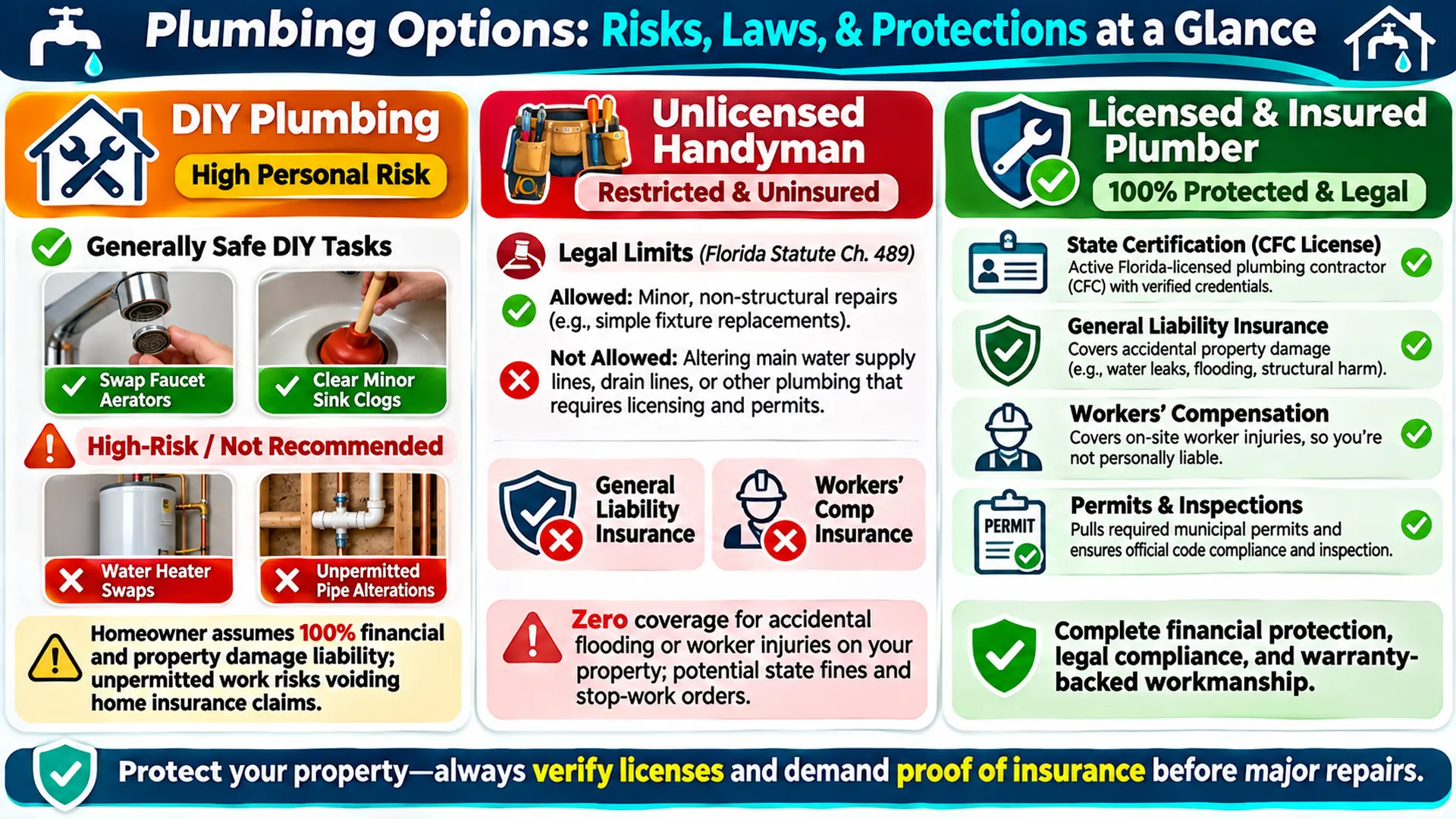
It is tempting to attempt a DIY project or hire an unlicensed handyman to handle minor home repairs. However, plumbing systems are governed by strict building codes and municipal regulations. Understanding where legal handyman boundaries end and where homeowner liability begins will save you from major financial, legal, and structural issues down the road.
When a Handyman Is Not Enough
Under Florida state law (Florida Statute Chapter 489), handymen without a state plumbing license are restricted to basic surface repairs and non-plumbing tasks. They cannot legally alter, install, extend, or repair supply pipes, drainage lines, water heaters, or sewer connections.
Legal Restrictions: Handymen are legally prohibited from advertising or performing core plumbing work that alters supply or waste lines.
All Pro Home Solutions LLCFines and Violations: Contracting unlicensed individuals for specialized trade work can result in state fines, project stop-work orders, and mandatory removal of non-compliant work.
YouTubeInsurance Risks: Unlicensed handymen rarely carry valid trade insurance, leaving you responsible for any accidental water damage or worker injuries.
DIY Plumbing: Where the Risk Starts
While Florida allows single-family homeowners to perform work on their own primary residence under specific owner-builder exemptions, going the DIY route introduces significant risks:
Permit Requirements: Major modifications—such as re-piping, replacing a water heater, or moving drain lines—legally require local building permits and official code inspections regardless of who performs the work.
FL Plumbing ToolsCode Compliance: Substandard joints, incorrect pipe sizing, or improper venting violate the Florida Building Code and can lead to recurring sewer gas leaks or water damage.
Resale Disclosure Issues: Unpermitted DIY work must be formally disclosed to buyers when selling your home, which can delay closing, lower appraisal values, or require costly teardowns.
Voided Home Insurance Claims: Personal home insurance policies often deny claims for water damage caused by unpermitted or non-code-compliant DIY alterations.
Safe vs Not-Safe Jobs for Homeowners
To keep your property safe and compliant, distinguish between simple cosmetic maintenance and complex plumbing repair services:
Safe DIY Tasks
Replacing faucet aerators or showerheads.
Replacing sink stoppers or toilet flappers.
Clearing minor sink clogs with a hand plunger.
Installing surface-mounted towel bars or vanity mirrors.
High-Risk Jobs (Require a Licensed & Insured Plumber)
Replacing or converting tankless water heaters.
Whole-home copper or PEX pipe replacements.
Main drain line clearing, hydro-jetting, or sewer line repairs.
Relocating supply lines or installing gas line connections.
How EZ Plumbing Repair Handles Licensing and Insurance
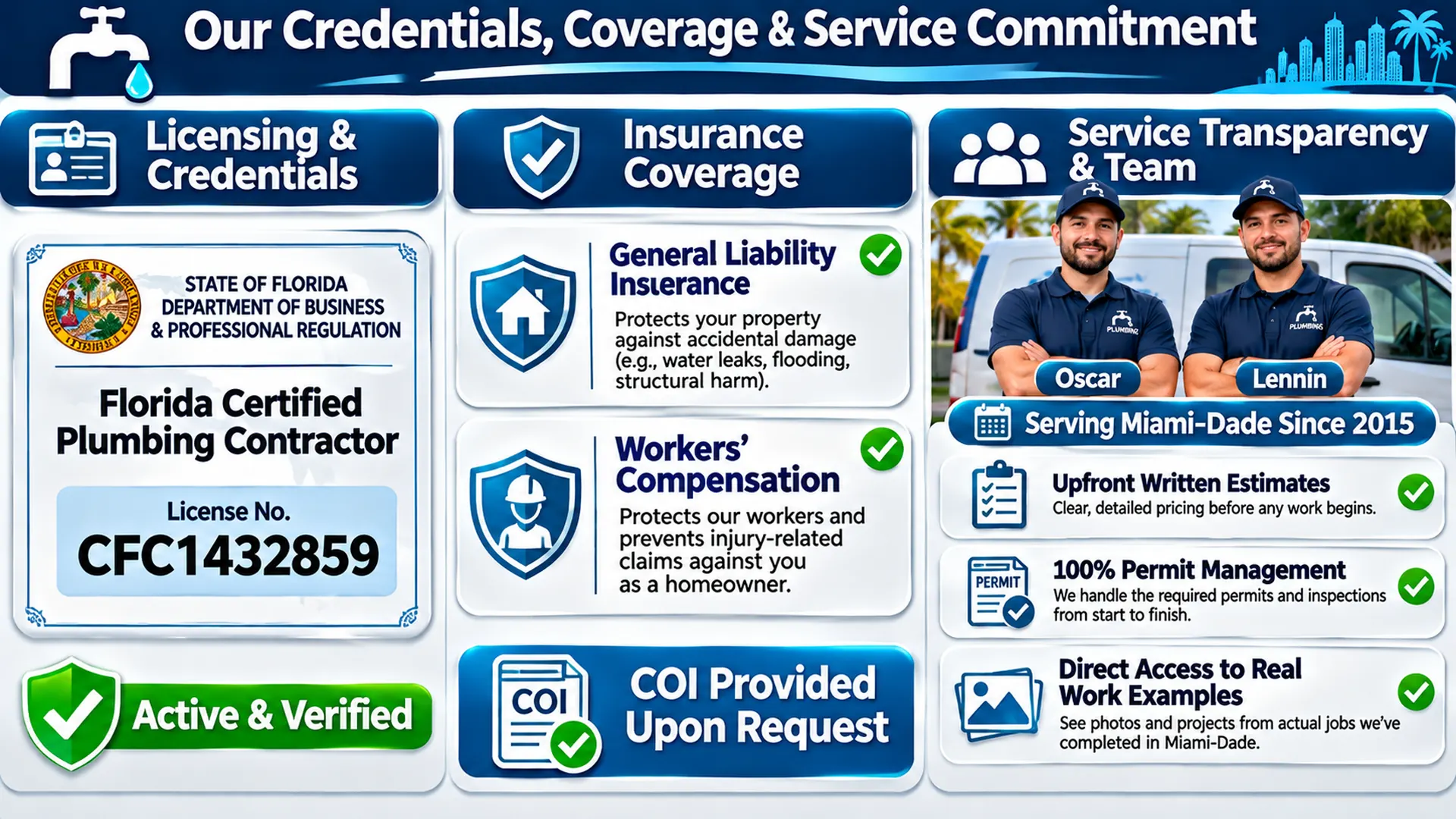
Transparency and total client protection are foundational principles at EZ Plumbing Repair. Practicing exactly what we preach, our business operates with full legal compliance, rigorous trade standards, and robust insurance backing on every residential and commercial project.
Our Licensing and Insurance, in Plain Terms
EZ Plumbing Repair is a verified Florida Certified Plumbing Contractor operating under State License Number CFC1432859. We remain fully insured and bonded to shield our clients from property damage risks and job-site liabilities.
Active Liability Policies: We carry comprehensive commercial general liability insurance designed to protect your home’s structure, finishes, and personal belongings.
Complete Worker Protection: Our team is backed by full workers’ compensation coverage, eliminating any personal homeowner liability if an unexpected injury occurs on-site.
State Compliance: Our active status as a certified plumbing contractor means we meet strict continuing education, trade examination, and financial stability standards set by the state of Florida.
www.miamifloridaplumbing.com
What We Provide Before the Job Starts
We believe in complete clarity before a single tool is taken out of the van. Prior to beginning any service or installation, we ensure our customers receive clear documentation:
Upfront Written Estimates: Detailed, transparent pricing that breaks down labor, materials, and project scope without hidden fees.
Proof of Insurance on Request: Direct access to a verified Certificate of Insurance (COI) confirming active general liability and workers’ compensation policies.
Permit Management: Complete handling of required local building permits for major plumbing installations and system overhauls.
Who You’ll Meet: Our Team
Led by master-licensed plumbers Oscar and Lennin, our dedicated service group has been proudly serving residential and commercial properties across Miami-Dade County since 2015.
Our experienced technicians bring deep local knowledge to every job, from complex slab leaks and emergency repairs to full-home pipe restorations. When our crew arrives at your front door, you can rest assured that you are working with vetted, background-checked, and fully insured trade professionals who treat your property with the utmost care and respect.
See Our Real Work
We take pride in our workmanship and complete transparency on every project. Feel free to see our completed projects to inspect our standards, or reach our team directly to request proof of credentials or book your next service appointment.
Frequently Asked Questions About Insured Plumbers
What does plumber’s insurance cover?
Plumber’s insurance primarily includes general liability and workers’ compensation. General liability covers third-party property damage and bodily injury caused by the plumber’s work—such as a burst pipe ruining your flooring. Workers’ compensation pays for the technician’s medical bills and lost wages if they are injured on your property.
What is the difference between a licensed and an insured plumber?
A licensed plumber has passed state examinations and met government competency requirements to perform plumbing work legally. An insured plumber carries commercial insurance policies to pay for unexpected property damage or job-site injuries. A reputable plumber must be both licensed and insured for full consumer protection.
How do I verify a plumber’s insurance?
Request a Certificate of Insurance (COI) directly from the plumber or their insurance provider. The document should list active policy numbers, coverage limits, effective dates, and insurance carrier details. Call the issuing insurance agency to confirm the policy remains active and has not lapsed due to non-payment.
Can I be sued if a plumber gets hurt on my property?
Yes. If an uninsured plumber or handyman gets injured in your home, they can file a personal injury lawsuit against your homeowner insurance policy. Hiring a contractor with active workers’ compensation insurance protects you from personal legal and financial liability for job-site injuries.
Is a plumber liable for water damage?
A plumber is legally liable for water damage caused by their negligence, improper installation, or faulty workmanship. However, if they lack insurance or personal assets, collecting money for repairs can be difficult. Hiring a fully insured professional ensures an insurance carrier pays for structural water damage.
Should a contractor be licensed, bonded, and insured?
Yes, contractors should hold all three credentials. Licensing proves technical qualification under state regulations, bonding offers a financial guarantee for ethical business practices and contract completion, and insurance covers physical property damage and bodily injuries during the job.
How do I check if a plumber is licensed in Florida?
Visit the official Florida Department of Business and Professional Regulation (DBPR) website and search the contractor’s name or license number. Verify that the license status reads “Active,” check whether it is Certified or Registered, and ensure the business name matches the contractor’s documentation.
Is it worth paying more for an insured plumber?
Yes. Paying a slightly higher rate for an insured plumber protects you from thousands of dollars in potential out-of-pocket costs from accidental water damage, mold remediation, or injury claims. The financial safety net far outweighs the minor initial savings of hiring an uninsured operator.
Hire a Plumber Who Protects Your Home
Selecting the right professional to service your home’s primary water systems should never be a gamble. While an unverified handyman or off-the-books operator may offer attractive upfront savings, skipping verified liability insurance and proper state licensing leaves your property vulnerable to devastating water damage, mold remediation costs, and personal injury claims.
Partnering with a fully certified and insured plumber ensures that every repair, installation, or emergency intervention is backed by complete legal compliance, professional accountability, and comprehensive financial protection.
Your 3-Point Checklist Before You Hire
Verify State License Status: Confirm that the contractor holds an active Certified or Registered Plumbing Contractor license on the official state registry before authorizing any work.
Request a Verified COI: Review a current Certificate of Insurance (COI) detailing active general liability and workers’ compensation policies, and confirm status directly with the issuing broker.
Insist on Upfront Written Estimates: Obtain an itemized, transparent estimate outlining the exact project scope, pricing breakdown, permit handling, and workmanship warranty coverage.
Need a Licensed and Insured Plumber in Miami?
If you require emergency repairs, routine maintenance, or complex system upgrades, trust master-licensed technicians who put your safety and property protection first. EZ Plumbing Repair delivers 24/7 emergency response, transparent upfront pricing, and total peace of mind for residential and commercial clients across Miami-Dade County.
Ready to protect your property with proven expertise? Book a plumber online to schedule your service appointment, or Call 786-239-6529 to speak directly with our licensed and insured team today.
Main Services
Related Posts
Need a Plumber in Miami?
Schedule service online or speak directly with the EZ Plumbing team.
Owner-Led Local Service
Know who is behind the business before you request service. The owners, contact line and Miami service pages are published clearly.
- Named business owners
- Direct phone and social channels
- Local Miami service information
Clear Help Before You Book
Review the relevant service page, contact the team directly and use the booking page when you are ready—without relying on vague claims.
- Service-specific information
- Direct questions before scheduling
- Clear online booking route