How to Turn Off the Main Water Shut Off Valve: Step by Step Guide
How Do You Turn Off the Main Water Shut-Off Valve?
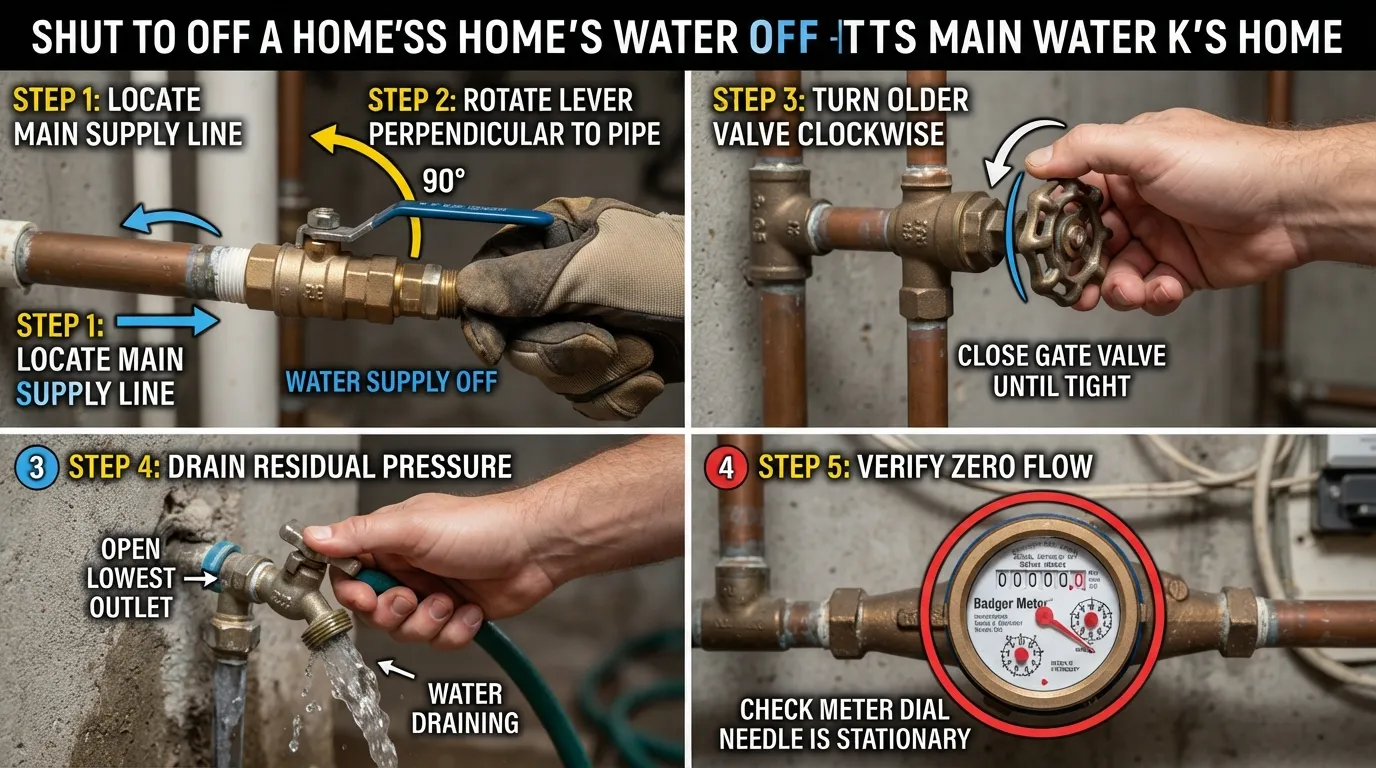
Locate your main water shut-off valve and turn a ball valve lever a quarter turn (90 degrees) until the handle is perpendicular to the pipe. If you have a gate valve with a round wheel, turn it clockwise until it stops completely. Finally, open a low-lying faucet to confirm the water flow has stopped.
What You’ll Need
Flashlight or headlamp for dark basements, crawlspaces, or utility boxes
Pliers or an adjustable wrench (required only if the valve is stiff or stuck)
Towel and a bucket to catch any residual water trapped in the lines
Meter key (required only for street-side or utility-side water meter valves)
Before You Start: When to Call a Plumber Right Away
A burst or violently ruptured pipe causing active indoor flooding
Main water is flowing uncontrollably and you cannot locate or safely move the valve
A rusted or aging valve that leaks, cracks, or begins dripping when touched
Emergency Assistance
If an active plumbing emergency threatens your property and you cannot isolate the water supply, contact a licensed emergency plumber immediately to prevent catastrophic water damage.
Where Is the Main Water Shut-Off Valve in Your Home?
Locating your main water shut-off valve quickly during a plumbing emergency prevents severe property damage. The valve stops the flow of incoming municipal or well water before it reaches your home’s interior plumbing system. Knowing its exact location saves precious minutes when a pipe bursts or a major leak occurs.
Inside the House
Indoor shut-off valves are typically found on the ground floor or in utility areas along the perimeter wall closest to the street. Water service lines usually enter the house in a straight line from the municipal water meter at the curb.
Utility Closets and Laundry Rooms: Inspect the walls near water heaters, washing machine hookups, and HVAC closets on ground levels.
Garages and Basements: Look along the front-facing exterior wall where the main supply pipe penetrates the foundation. Homes with basements or crawl spaces often have the valve positioned right where the main pipe enters through the foundation wall.
Outside the House
Exterior water shut-off valves are common in warmer climates where freezing temperatures do not threaten outdoor plumbing. These valves are installed directly against exterior walls or underground near property lines.
Exterior Walls and Hose Bibs: Scan the perimeter wall facing the street or municipal water meter. Look near outdoor hose bibs or spigots where the main supply line feeds into the home.
In-Ground Meter Boxes: Locate the utility meter box embedded in the ground near the front curb or property line. Inside this box, you will find the municipal curb valve, which requires a specialized meter key to operate.
Where to Look in Miami and South Florida Homes
South Florida residential construction features unique architectural designs, such as slab-on-grade foundations, which completely eliminate basements and crawl spaces. This construction style changes where plumbing supply lines run and terminate.
Garage and Utility Walls: Inspect the garage walls, particularly near the water heater or adjacent to the laundry connection area.
Exterior Perimeter Walls: Check the exterior wall facing the street or the side of the house where the utility lines cross the property line.
Meter Boxes and Backflow Preventers: Look inside the ground-level utility meter box near the front property line or examine the backflow preventer assembly commonly installed on exterior walls.
Interior Valve vs. Street (Meter) Valve
| Feature | Interior Main Shut-Off Valve | Street / Meter Valve |
| Location | Inside the home (garage, utility closet, basement wall) | Inside the in-ground meter box near the curb or street |
| Who Controls It | The homeowner | The municipal water utility provider |
| Who Is Allowed to Use It | Homeowners and licensed plumbers | Utility technicians and authorized personnel only |
| Typical Use Case | Everyday home plumbing repairs, leaks, and indoor emergencies | Main service line breaks, meter replacements, or stuck interior valves |
What if You Can’t Find It?
Searching for a hidden or heavily concealed water shut-off valve requires systematic tracing of your home’s main plumbing lines. Water pipes follow a predictable path from the street into the structure.
Trace the Line from the Meter: Walk an imaginary straight line from your front street meter box toward your house, and inspect that specific interior or exterior wall zone.
Inspect the Water Heater Supply: Follow the cold water supply line backward from your water heater to find the main shut-off point.
Check Near Pressure Regulators: Look for the valve positioned immediately before or after the pressure reducing valve (PRV) where water enters the home. Take a clear photograph and attach a permanent label once you locate it.
Pro Tip: Find It Before You Need It
Locating your shut-off valve during a high-pressure plumbing emergency is stressful and counterproductive. Identify and test your valve today to ensure complete preparedness.
Test the Handle Movement: Turn the valve handle gently to verify it moves freely without sticking or leaking.
Attach a Bright Label: Tie a high-visibility tag or neon marker to the valve handle so family members can spot it instantly in low-light conditions.
How to Turn Off the Main Water Supply: Step by Step
Shutting off your home’s main water supply safely requires following a precise sequence to protect your plumbing infrastructure. This step-by-step process prevents accidental pipe bursts, controls active leaks, and ensures complete water isolation. Mastering these steps keeps your home safe during major plumbing emergencies.
Step 1: Locate the Main Valve
Finding your shut-off mechanism is the critical first step before attempting any emergency plumbing repair.
Scan the Primary Zones: Refer to the location guidelines detailed in the previous section to find your indoor or outdoor main shut-off valve.
Clear the Area: Move any storage boxes, tools, or hanging items away from the valve area to ensure unobstructed access and leverage.
Step 2: Identify the Valve Type
Different valve styles require distinct mechanical motions to close properly. Identifying your specific valve design prevents mishandling and internal component damage.
Ball Valve vs. Gate Valve: Modern systems typically use ball valves featuring a straight lever handle, while older homes often feature gate valves with a round wheel handle.
| Valve Type | Handle Description | Visual Characteristics |
| Ball Valve | Straight Lever Handle | Features a solid metal lever that runs parallel to the pipe when open and rotates 90 degrees to shut. |
| Gate Valve | Round Wheel Handle | Features a circular multi-turn spoked wheel that raises or lowers an internal metal gate. |
Step 3: Shut Off the Water
Executing the physical shutdown requires exact alignment or careful turning depending on your valve mechanism. Take your time to ensure a complete, airtight seal.
Operating a Ball Valve: Grasp the lever handle and rotate it a full quarter turn (90 degrees) so that it sits completely perpendicular (crosswise) to the pipe.
Operating a Gate Valve: Turn the round wheel clockwise continuously until it feels completely snug. Never use wrenches or excessive force to crank a stuck wheel, as older brass stems can snap easily.
Watch this YouTube video to see a complete visual guide on shutting off your main water supply.
Step 4: Relieve Pressure and Drain the Pipes
Closing the main valve stops incoming supply, but hundreds of gallons of pressurized water remain trapped inside your home’s vertical and horizontal pipe networks.
Open Low-Level Faucets: Turn on the lowest interior faucet in your home, such as a basement sink or first-floor bathtub spigot, to let trapped water escape.
Drain Exterior Lines: Open an outdoor hose bib to allow gravity to pull remaining fluid out of the system, and flush a toilet once to empty the tank.
Step 5: Verify the Water Has Stopped
Confirming a successful shutdown guarantees that no residual pressure or bypass flow remains in your active plumbing lines before you begin repairs.
Check Indoor Fixtures: Return to your open faucets and verify that the water flow has completely trickled down to zero.
Inspect the Meter Dial: Walk out to your street water meter box and watch the low-flow indicator triangle or sweep hand to ensure it remains completely stationary.
Quick Reference: Which Way Do I Turn It?
Review this concise reference table to quickly determine the correct closing motion for your specific handle configuration.
| Handle Style | Closing Action | Position When Off |
| Straight Lever (Ball Valve) | Rotate 90 degrees | Perpendicular to the pipe |
| Round Wheel (Gate Valve) | Turn clockwise (Right) | Fully tightened until snug |
Common Mistakes to Avoid
Avoiding common operational errors protects your plumbing fixtures from permanent damage and ensures total water containment.
Forcing a Stuck Valve: Applying excessive leverage or wrench pressure to a seized gate valve can snap the internal stem, turning a minor maintenance check into a major emergency.
Turning the Wrong Direction: Forcing a gate valve counterclockwise when trying to close it opens the line wider and increases flow pressure.
Closing Secondary Valves: Mistakenly turning off individual supply lines, such as the water heater supply valve, rather than the primary main shut-off valve.
Skipping Fixture Draining: Failing to open low faucets leaves trapped pipe pressure that causes unexpected spraying when cutting into pipes.
How to Turn Off Your Water Without a Tool or Water Key
Shutting off your home’s water supply during an emergency does not always require specialized equipment. Most residential interior shut-off valves are engineered for quick, tool-free manual operation by homeowners. Knowing how to manipulate these valves by hand saves crucial seconds when every moment counts.
Turn Off the Interior Valve by Hand
Modern interior shut-off points utilize ergonomic components designed specifically for hand operation.
Lever-Style Ball Valves: These valves require only a firm grip with bare hands to rotate the handle 90 degrees.
Handwheel Gate Valves: Round spoked wheels are textured with ridges to provide sufficient friction for manual grip, letting you tighten the gate shut without tools.
Using Pliers or an Adjustable Wrench Safely
Older valves or those stiffened by mineral accumulation may resist bare-hand operation. Applying mechanical leverage requires caution to avoid shearing fragile brass valve stems.
Support the Valve Body: Always grip the main valve body firmly with one pair of pliers or a wrench to counter the rotational force before turning the handle.
Protect the Stem: Apply gentle, steady pressure with an adjustable wrench on the handle nut, stopping immediately if the metal begins to twist or bend.
Can You Use a Water Key or Meter Key?
Accessing a street-side curb stop valve requires a specialized tool known as a meter key or water key. This long metal rod features a T-handle on one end and a socket on the other to engage underground valves.
Utility Ownership: The meter box, curb stop, and street valve are strictly public infrastructure owned by the utility company.
Restricted Access: Homeowners should generally avoid opening or altering street-side valves unless an absolute emergency occurs and the private interior valve has failed entirely.
Is It Illegal to Turn Off Your Own Water?
Homeowners frequently ask if shutting off their own water supply violates regulations. You maintain full legal right to operate the main shut-off valve located inside your property boundaries. However, tampering with municipal equipment outside your home is strictly regulated.
Private vs. Public Control: Operating your interior home valve is fully authorized, while unauthorized manipulation of municipal curb valves or meter locks can lead to heavy municipal fines.
Consult Local Regulations: Review guidelines provided by your local water utility to understand specific regional ordinances governing water infrastructure access.
Which Way to Turn the Street Valve
If you are authorized to operate an outdoor meter or curb valve in an emergency, directional mechanics matter.
Clockwise Closure: Rotate the T-handle or wheel clockwise (to the right) until the internal gate seats fully and flow ceases.
Call for Assistance: If the valve refuses to turn or municipal equipment appears damaged, stop immediately and contact a licensed plumber or your municipal utility provider.
How to Turn the Water Back On Safely
Restoring your home’s water supply after completing plumbing repairs requires a controlled, gradual process. Rushing this step can create violent pressure surges, cause water hammer, and blow out fragile seals or newly installed pipe joints.
Before You Reopen the Valve
Preparation ensures your home’s infrastructure is completely secure before municipal pressure floods back into the lines.
Check All Fixtures: Ensure every indoor faucet, shower control, and outdoor hose bib is tightly closed to prevent accidental indoor flooding.
Inspect the Repair Area: Confirm that all newly glued PVC joints, soldered copper pipes, or replaced fittings have fully cured and dried.
Verify System Status: Check that your water heater is filled and ready for operation before introducing pressure.
Open the Main Valve Slowly
Reintroducing water into a dry plumbing system must be done with extreme care to manage trapped air and pressure waves.
Operating a Gate Valve: Turn the round wheel handle counterclockwise slowly, pausing frequently to let water trickle into the empty lines.
Operating a Ball Valve: Rotate the lever handle back toward the pipe in a slow, controlled motion rather than snapping it open instantly.
Bleed Air From the Lines
Empty pipes are filled with trapped air pockets that must be purged safely to prevent sputtering and violent pipe rattling.
Start Low and Move Up: Open the lowest faucet in the house first, letting air and sputtering water escape until a steady stream flows.
Purge All Taps: Move progressively through every hot and cold tap in the home, including bathroom sinks, showers, and kitchen faucets, until air pockets are completely gone.
Check for Leaks
Monitoring your plumbing network immediately after pressurization catches slow leaks before they cause hidden structural damage.
Inspect the Valve and Fixtures: Walk around every repaired joint, valve body, and active fixture to check for moisture or active dripping.
Monitor the Water Meter: Leave all faucets closed for ten minutes and check your street meter dial to verify the low-flow indicator remains completely still.
Why Is My Water Cloudy, Sputtering or Low Pressure After?
Turning the water back on routinely disturbs internal pipe conditions, resulting in temporary aesthetic and mechanical changes.
Trapped Air and Sediment: Sputtering and cloudy water are caused by compressed air bubbles and loose mineral sediment flushed loose from the pipe walls.
Aerator Blockages: Mineral flakes often accumulate inside faucet aerator screens; unscrew the tip of the faucet and rinse out any trapped debris if pressure remains low.
Should the Shut-Off Valve Be Open All the Up?
Homeowners often wonder if the main valve should remain partially closed to regulate high municipal pressure.
Fully Open Position: Your main shut-off valve should always remain completely open during normal operation to ensure maximum water flow and proper pressure to all appliances.
Professional Guidance: Avoid leaving gate valves backed off from their fully open position unless specifically instructed by a licensed plumber to prevent stem binding.
How Long Does It Take for Water to Stop After Turning Off the Main?
Understanding drainage timing helps you gauge whether your main valve is fully sealing off incoming pressure.
Immediate Pressure Drop: Residual water drains completely from open low-level faucets within a few moments after closing the valve.
Continuous Flow Warning: If water continues running steadily from an open faucet after closing the main valve, the valve gate is failing to seat completely and requires service.
Safety Checklist Before You Shut Off the Water
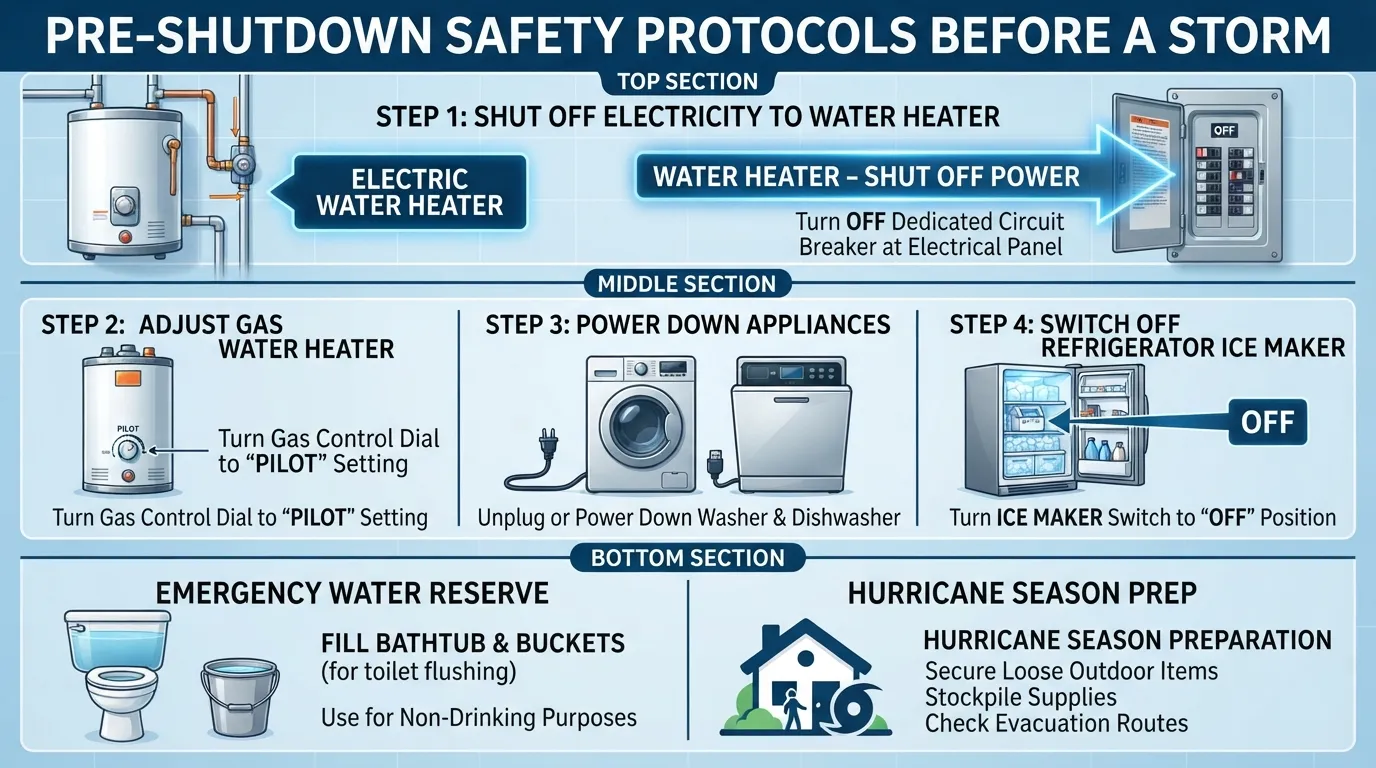
Executing a main water shutdown involves more than simply turning a valve handle. Overlooking system interlocks, such as energized water heaters or active motorized appliances, can cause severe equipment damage and costly repairs. Reviewing this comprehensive safety checklist protects your home before you cut off the supply.
Turn Off Your Water Heater First
Running an active heating element inside an unpressurized, draining tank can permanently burn out internal components.
Electric Water Heaters: Switch off the dedicated circuit breaker in your electrical panel before shutting down the water supply to prevent the upper heating element from dry-firing and failing.
Gas Water Heaters: Turn the gas control valve from the “On” position down to the “Pilot” setting so the burner does not attempt to heat an empty vessel.
What to Do With Appliances
Appliances connected directly to your municipal water supply require proper isolation to prevent electrical faults, solenoid valve damage, or cycle interruptions.
Dishwashers and Washing Machines: Cancel any active wash cycles immediately and leave power switches off to prevent inlet valves from burning out while starved of water.
Ice Makers and Humidifiers: Flip the toggle switch on your automatic refrigerator ice maker to the “Off” position to prevent internal mold growth or valve overheating from dry cycling.
Can I Still Use the Toilet When the Water Is Shut Off?
Homeowners frequently worry about sanitary conditions during emergency plumbing repairs.
The Reserve Flush: You can perform one standard flush using the residual water currently stored inside the toilet tank.
Manual Tank Refilling: For subsequent flushes, pour a bucket of water directly into the toilet bowl to force a manual gravity flush, or use toilet repair services if internal fill mechanisms fail once water is restored.
How Long Can You Leave the Main Water Off?
Leaving your main water supply closed for short durations during active repairs is standard practice, but extended shutdowns require precautions.
Short-Term Maintenance: Keeping the water off for several hours or a full weekend while addressing a leak is entirely safe for residential plumbing lines.
Extended Vacations: If you shut off water before leaving for a long trip, verify whether your home relies on integrated fire sprinkler networks or automated drip-irrigation lines that still require active pressure.
Hurricane Season and Vacation Prep (Miami Angle)
Living in South Florida presents unique environmental challenges, making proactive water shutdowns a vital part of seasonal disaster preparedness.
Pre-Storm Protection: Shutting off your main water valve before a severe tropical storm or hurricane makes landfall prevents internal flooding if high winds compromise roof lines or break exterior windows and snap nearby pipes.
Seasonal Checklist: Test your valve handle operation annually before hurricane season begins, ensure your water heater breakers are clearly labeled, and practice draining outdoor taps.
Winter and Outdoor Spigots
While rare in subtropical climates like South Florida, sudden hard freezes require immediate preventative actions for exposed plumbing fixtures.
Insulate Outdoor Spigots: Disconnect garden hoses and slip insulated foam covers over exterior hose bibs to prevent ice expansion from cracking supply lines inside the wall.
Traveler Precautions: If you travel north during winter months, shut off your indoor main supply and drain the low points of your plumbing system to eliminate freeze-burst risks.
What If Your Main Water Valve Is Stuck, Leaking or Won't Turn?
Discovering a seized, leaking, or broken main water shut-off valve during an active plumbing emergency creates immediate panic. Seized valves are common, especially in properties with hard water or in older homes where the mechanism has sat untouched for years. Knowing how to troubleshoot a stubborn valve safely prevents minor maintenance issues from escalating into major structural floods.
Why Shut-Off Valves Get Stuck
Understanding why valves lock up helps you approach the problem with caution rather than brute force.
Mineral Buildup and Hard Water: High mineral content leaves stubborn calcium and lime deposits around moving metal parts, effectively gluing the internal gate or ball in place.
Corrosion and Age: Years of chemical exposure and oxidation fuse brass or iron components together, while rarely used gate valves rust solid in the open position.
Safe Things to Try
If your valve refuses to budge, you can attempt a few safe, non-destructive troubleshooting techniques. Never force a stuck valve, as snapping the handle stem will instantly flood your home.
Gentle Alternating Movement: Try rocking the handle back and forth by millimeters to crack mineral bonds rather than forcing it in one continuous direction.
Penetrating Lubricant: Apply a few drops of penetrating oil exclusively around the valve stem and packing nut, allowing it to soak in before trying again. Avoid getting oil inside potable water lines.
Signs of a Failing Valve
Recognizing the early warning signs of mechanical failure lets you schedule a proactive replacement before an emergency strikes.
Visible Leaks and Corrosion: Look for slow drips forming around the handle packing nut, or green and white crusty mineral deposits coating the valve body.
Spinning Free Handles or Unstopped Flow: If a valve handle spins endlessly without resistance or fails to halt water flow entirely, the internal gate mechanism has detached or worn out completely.
When to Replace the Valve
Aging gate valves are prime candidates for permanent replacement with modern quarter-turn ball valves.
Quarter-Turn Upgrades: Upgrading to a smooth-operating ball valve eliminates the risk of future sticking and ensures a positive, watertight seal.
Professional Replacement: Because replacing a main valve requires shutting off the municipal water supply at the street meter, this work must be handled by a licensed plumber.
Water Still Running After Closing the Valve?
If you managed to turn the valve off completely but water continues to flow through your home, several factors could be at play.
Faulty Internal Sealing: The valve gate may be worn out, failing to block the passage despite the handle being turned.
Residual Pressure and Multi-Line Feeds: Trapped pipe pressure can keep faucets dripping temporarily, or your home may feature a secondary supply line. Watch your street water meter dial to confirm whether water is actively flowing.
Why Is Water Still Running Even Though I Turned Off the Faucet?
Homeowners often confuse a main supply issue with a localized fixture failure when a single tap will not stop running.
Worn Fixture Washers: A continuously dripping faucet points directly to a degraded rubber washer or a damaged ceramic cartridge inside that specific handle assembly rather than a main valve failure.
Need Help Now?
If your main water valve is completely seized, leaking uncontrollably, or broken off, do not risk major property damage. Contact our expert team for fast emergency plumbing service across South Florida, or explore our full range of plumbing services to keep your home protected.
Watch this YouTube Shorts video for a quick visual demonstration on handling a stuck or leaking water valve.
Ready to fix your plumbing issue? Book an appointment with our licensed Miami plumbing professionals today for fast, reliable repair and replacement.
When You Need to Shut Off the Water Immediately Burst Pipe or Major Leak
A major plumbing failure or burst pipe requires immediate, decisive action to minimize catastrophic water damage. Knowing exactly what to do in the first sixty seconds prevents structural flooding, protects electrical systems, and preserves your insurance claim.
What to Do in the First 60 Seconds
Swift execution during an emergency keeps a bad situation from turning into a total disaster.
Shut Off the Main Valve: Immediately run to your indoor or outdoor main shut-off valve and close it completely to stop incoming water flow.
Kill the Power if Necessary: Switch off your electrical panel breakers if water is actively spraying near wall outlets, ceiling light fixtures, or appliance panels.
Open Low Faucets: Open a ground-floor bathtub faucet or an outdoor spigot to drain residual pressure quickly.
Call for Backup: Contact professional leak detection and repair specialists or a 24/7 emergency plumber to dispatch help right away.
Burst Pipe or Flooding Checklist
Protect your family, belongings, and property value by following this critical emergency action plan.
Secure the Water Supply: Fully close the main shut-off valve to isolate the active break.
Cut Electrical Hazards: Turn off power breakers for any flooded rooms to prevent electrical shock or short circuits.
Document the Damage: Take clear, high-resolution photographs and videos of all flooded areas, damaged drywall, and ruined personal property before cleanup begins.
Move Valuables: Lift rugs, electronics, and sentimental items away from standing water to higher, dry ground.
Begin Water Removal: Use mops, wet/dry vacuums, or towels to extract standing water and slow structural absorption.
Hidden Leaks: Is the Meter Still Moving?
Not all major leaks announce themselves with a burst pipe; hidden slab leaks and underground line breaks can cause silent damage.
The Meter Test: Turn off every single indoor and outdoor faucet, shower, and appliance in the home.
Check the Dial: Walk out to your municipal meter box and check the low-flow indicator triangle or sweep hand. If the dial is still spinning, water is actively escaping somewhere in your system.
When to Call an Emergency Plumber
Some plumbing problems are simply too severe or complex for DIY fixes and require professional intervention.
Uncontrollable Flow: If your main shut-off valve is broken, seized, or fails to completely stop the water entering your home.
Slab Leaks and Main Line Breaks: When water is bubbling up through your foundation slab or pooling in your yard from a broken service line.
Electrical Compromise: Whenever major leaks threaten your home’s electrical panel or wiring network.
Other Water Shut-Off Valves in Your Home And When to Use Them
Isolating water flow to a single plumbing fixture or appliance prevents the need to shut off your home’s main water supply during minor repairs. Understanding the network of local isolation valves around your property allows you to perform targeted maintenance efficiently and safely.
Fixture Shut-Off Valves (Under Sinks and Behind Toilets)
Localized isolation valves, often called angle stops, are installed directly beneath plumbing fixtures to control water delivery to specific components.
Under-Sink and Toilet Valves: Locate the small metal handle attached to the supply line directly beneath your bathroom or kitchen sink, or on the wall immediately behind the toilet tank.
Closing Direction: Turn the handle clockwise (to the right) until it stops completely to cut off water flow exclusively to that fixture while leaving the rest of the house fully pressurized. If your toilet continuously runs or fails to fill properly after adjusting these valves, professional toilet repair services may be required.
Water Heater Shut-Off Valve
Your water heater features a dedicated cold water inlet shut-off valve located directly on top of the tank.
Purpose: This valve isolates the water heater from the rest of the domestic plumbing network during tank flushing, component replacement, or emergency leaks without cutting off cold water to your sinks and showers.
Outdoor Spigot and Irrigation Valves
Exterior water lines often include dedicated isolation valves to prevent freezing risks or yard flooding.
Hose Bib and Sprinkler Shut-Offs: Look for inline gate or ball valves positioned along the interior basement wall or crawl space ceiling where pipes extend outdoors, or inside dedicated backflow preventer assemblies for irrigation systems.
How Do You Replace a Shut-Off Valve Without Turning Off the Water?
Homeowners often ask if a faulty under-sink or main valve can be replaced live without shutting off the water supply.
The Reality: You generally cannot safely replace a main or fixture shut-off valve while water pressure is active. Doing so will result in an uncontrolled indoor flood.
Professional Methods: Professional plumbers use specialized pipe-freezing kits to create a temporary ice plug inside copper lines for quick repairs, or they shut off the main water supply at the street meter to perform replacements safely.
Fixture Valve vs. Main Valve: Quick Comparison Table
| Valve Type | Location | What It Controls | When to Use It |
| Fixture Valve (Angle Stop) | Under sinks, behind toilets | A single sink, faucet, or toilet | Fixing a dripping faucet, unclogging a supply line, or replacing a toilet |
| Main Shut-Off Valve | Garage, utility wall, exterior, or meter box | The entire home’s water supply | Major leaks, burst pipes, whole-house plumbing renovations, or emergencies |
Frequently Asked Questions About the Main Water Shut-Off Valve
Which way do I turn my main water shut-off valve?
Rotate a straight-lever ball valve 90 degrees so the handle sits completely perpendicular to the pipe to close it. For a round-wheel gate valve, turn the handle clockwise (to the right) continuously until it feels snug. Verify success by checking that indoor faucets stop running entirely.
How do I shut off the main water valve to my house?
Locate your primary indoor or outdoor valve, clear away any nearby obstructions, and firmly turn a lever handle a quarter-turn crosswise or twist a round wheel clockwise until tight. Confirm the shutdown is complete by opening a low-level faucet and watching the water flow drop to zero.
How long does it take for water to stop after turning off the main valve?
Residual water inside your pressurized supply lines drains out within a few moments once you open a low-level faucet. Confirm the process is complete when open taps stop dripping completely and the municipal meter dial stops moving.
Do I need to open faucets when I turn water off and on?
Opening faucets is not strictly required when shutting off the water, but doing so relieves trapped pipe pressure and drains remaining fluid. Opening taps before turning the water back on is essential to safely bleed out compressed air pockets.
Can I still use my toilet if the water is shut off?
You can perform one final flush using the reserve water currently stored inside the toilet tank. For subsequent flushes during an emergency, manually pour a bucket of water directly into the bowl to force a gravity flush.
Why is the water still running even though I turned off the faucet?
Water continuing to flow from a single tap usually points to a worn-out rubber washer or a damaged ceramic cartridge inside that specific handle assembly. If the entire house continues running after closing the main valve, the primary valve gate is failing to seal.
How long can you leave the main water shut off?
Leaving your main water supply closed for several hours or a full weekend during plumbing repairs is completely safe. For extended absences or vacations, a permanent shut-off is recommended, provided your home does not rely on active fire sprinkler systems.
Is it illegal to turn off your own water supply?
You maintain full legal right to operate the main shut-off valve located inside your property boundaries. However, unauthorized manipulation or tampering with public utility meter boxes and street-side curb valves outside your property is strictly prohibited.
Should I shut off water to the outside spigot in winter?
Homeowners in freezing climates should always shut off, disconnect, and drain exterior hose bibs to prevent ice expansion from cracking pipes. Subtropical regions like South Florida rarely require winter spigot isolation except during sudden hard freezes.
Should the water shut-off valve be open all the way?
Your main shut-off valve should always remain completely open during normal residential operation to guarantee maximum water pressure and volume. Avoid leaving gate valves partially closed unless specifically directed by a licensed plumber.
How do I turn off the main water without a tool?
Most modern residential interior ball and gate valves are designed for tool-free manual operation by hand. Firmly grip the lever or wheel and turn it manually into the closed position without applying excessive wrench leverage.
Can I turn the water off and leave the heating on?
You can safely leave your central heating system running when shutting off water, provided you also switch off your electric water heater’s circuit breaker. Leaving an unpressurized electric water heating element energized without water will cause permanent dry-fire damage.
Final Tips: Know Your Valve Before an Emergency Happens
Mastering the location and operation of your home’s main water shut-off valve is one of the most valuable preventative steps you can take as a homeowner. Being prepared ensures you can act swiftly during a burst pipe or unexpected leak, preventing thousands of dollars in property damage. Keep your plumbing infrastructure secure by following these final expert guidelines.
Review this fast, step-by-step summary to keep essential shutdown and restoration procedures fresh in your mind.
Locate: Find your primary indoor or outdoor main shut-off valve before an emergency strikes.
Identify: Distinguish between a modern quarter-turn ball valve and a multi-turn gate valve.
Turn: Close the valve completely by rotating a lever 90 degrees or twisting a wheel clockwise.
Verify: Check that indoor fixtures stop flowing and watch the street meter dial to confirm zero movement.
Restore: Open valves slowly and bleed trapped air through your lowest taps when turning water back on.
Test Your Valve Twice a Year
Establishing a simple routine maintenance habit prevents valves from seizing up from mineral accumulation or disuse.
Semi-Annual Checkups: Test your valve handle twice a year by turning it slightly back and forth to ensure it operates smoothly without sticking.
Tag and Clear: Keep the area around your shut-off valve completely clear of storage boxes, and attach a high-visibility tag so family members can find it instantly.
Need a Hand? Our Licensed Plumbers Can Help
If your main water valve is completely seized, leaking persistently, or due for an upgrade to a reliable quarter-turn ball valve, you do not have to tackle it alone. Our expert team of licensed professionals provides fast service across Miami and South Florida. Explore all of our plumbing services to learn more, or book your plumbing service with us today to keep your home fully protected.
Main Services
Related Posts
Need a Plumber in Miami?
Schedule service online or speak directly with the EZ Plumbing team.
Owner-Led Local Service
Know who is behind the business before you request service. The owners, contact line and Miami service pages are published clearly.
- Named business owners
- Direct phone and social channels
- Local Miami service information
Clear Help Before You Book
Review the relevant service page, contact the team directly and use the booking page when you are ready—without relying on vague claims.
- Service-specific information
- Direct questions before scheduling
- Clear online booking route