
How to Get Something Out of a Sink Drain: Rings, Jewelry and Small Items
What to Do in the First 60 Seconds
Dropping a valuable ring or piece of jewelry down the sink drain creates instant panic, but taking immediate, precise steps prevents the item from washing away. The first minute is critical: the object typically rests in the upper drain assembly or the water seal of the P-trap directly beneath the sink. By stopping the flow of water and securing the opening, you retain full control over the recovery process.
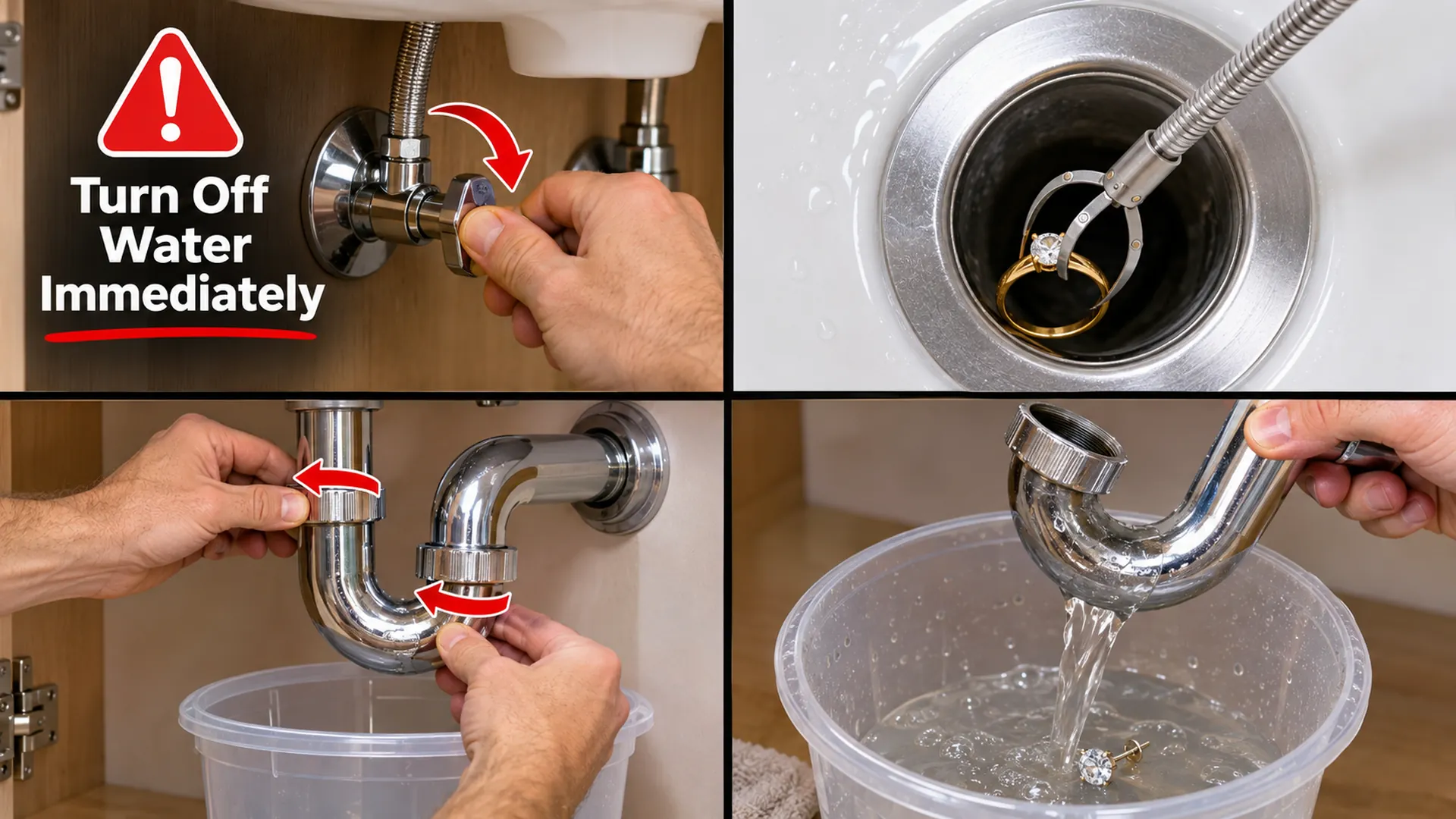
Stop and Turn Off the Water Right Away
Shut off all running water at the faucet immediately. Running water creates kinetic force and a continuous siphon effect that pushes a heavy item past the sink strainer, through the vertical tailpiece, and down into the lower main sewer lines where recovery becomes significantly harder.
Cut the main faucet: Turn the sink handles to the off position instantly.
Inform household members: Alert anyone nearby not to run water in adjacent fixtures, as shared drainage pipes can create suction.
Shut off supply valves (if needed): If the faucet is leaking or won’t shut off completely, turn the shutoff valves under the sink clockwise until tight.
Unplug the Garbage Disposal or Switch Off the Breaker
CRITICAL SAFETY WARNING: Never insert your fingers, hands, or metal tools into a sink drain connected to a garbage disposal while it has electrical power. An accidental engagement can cause severe physical injury or permanently destroy valuable jewelry.
If the item dropped into a drain equipped with a disposal unit, cut all electrical power before taking any physical action:
Unplug the unit: Locate the electrical cord for the garbage disposal under the cabinet and pull it directly from the wall outlet.
Switch off the circuit breaker: If the disposal unit is hardwired directly into your home’s electrical grid, head to your main breaker panel and flip the switch controlling the kitchen disposal to the “OFF” position.
Verify power termination: Press the wall switch for the disposal to confirm the unit does not turn on.
Shine a Flashlight Down the Drain
Peer into the drain opening using a high-lumen flashlight or your smartphone light to pinpoint the exact location of the dropped item. Position your view directly above the sink opening, ensuring you do not block the light source.
Check the strainer or grate: Look closely at the top mesh or crossbars; lightweight rings or small jewelry often catch on the upper flange.
Inspect the garbage disposal splash guard: If your sink has a rubber splash guard, gently push back the black flaps with a non-abrasive wooden tool to look inside the upper grinding chamber.
Examine the vertical tailpiece: Direct the light straight down the pipe. If you see a metallic glint resting in standing water, the item has settled at the top of the P-trap water seal.
Block the Drain Opening
Once you have visually assessed the area, immediately seal the sink opening. Blocking the drain prevents secondary accidents—such as dropping tools, screws, or additional items down the pipe—while you assemble your retrieval gear.
Stuff with a rag: Push a clean microfiber cloth or small towel tightly into the drain opening to create a secure seal.
Insert a sink stopper: Place a rubber sink plug or flat drain cover directly over the drain opening.
Keep the workspace clear: Remove soap bottles, sponges, and small objects from the rim of the sink so nothing else accidentally falls inside.
What NOT to Do and What Happens If Something Goes Down the Drain
Panicking after dropping an object down the drain often leads to quick, impulsive actions that turn a simple recovery task into a costly plumbing repair. Knowing what not to do is just as critical as taking the right first steps. Avoiding common mistakes keeps the item trapped in an accessible location and prevents severe pipe damage or permanent loss.
Don’t Run Water or Flush the Item Down
Resist the urge to turn on the faucet to “wash away” debris or test if the drain is clear. Water flow introduces continuous volume and hydrodynamic pressure that washes heavy objects out of the immediate trap and into the main drain line.
Avoid flushing adjacent fixtures: Running water in an adjoining sink basin or flushing a nearby toilet can create suction and flow in shared branch lines.
Do not use chemical drain cleaners: Pouring harsh chemicals down the drain won’t dissolve solid objects like jewelry or metal, but it will create a hazardous environment for your hands when you attempt manual retrieval.
Don’t Push the Item Further with a Stick or Fingers
Never insert unguided tools, rigid sticks, or your fingers blindly into the pipe. Prodding around inside the narrow tailpiece usually dislodges an item caught on the upper flange or internal lip, causing it to fall deeper into the drainage network.
Fingers block your vision: Blindly reaching inside obscures your line of sight and risks pushing the object past the upper bend.
Rigid objects create blockages: Stiff tools can wedge small items sideways inside the pipe, creating a permanent obstruction that restricts future water flow.
Don’t Turn On the Garbage Disposal
Flipping the switch on a garbage disposal while an item rests inside will shatter fragile materials, mangle precious metals, and damage the disposal’s internal components.
Impact damage: The impellers and grinding ring spin at high speeds, which instantly crushes soft metals like gold or silver and breaks gemstones.
Mechanical jam: Hard objects can jam between the spinning flywheel and the shredder ring, burning out the disposal motor or tripping its internal overload switch.
What Happens If Something Goes Down the Sink Drain?
When an object falls past the sink strainer, gravity pulls it directly into the drainage assembly. Where it stops depends entirely on the item’s weight, size, shape, and whether water was flowing at the time of the drop.
Where Items Usually Settle: The P-Trap
In almost all residential plumbing systems, objects settle at the bottom of the P-trap—the curved, U-shaped section of pipe directly beneath the sink cabinet. Because the P-trap holds standing water to block sewer gases, dense objects like a metal ring, earring, or heavy screw naturally drop to the lowest point of the curve and remain trapped until retrieved.
When Items Travel Farther Down the Main Line
If water continues running, the velocity creates enough turbulence to carry lighter materials up and over the P-trap exit weir. Once an item exits the P-trap, it enters the horizontal branch line and heads toward the main sewer stack, where retrieval requires specialized plumbing equipment.
Real-World Scenarios: How Common Items Behave
A metal nail or screw: Due to high density, a iron or stainless steel nail drops straight to the bottom of the P-trap immediately. However, its sharp points can scratch PVC lines or snag hair and lint, accelerating a stubborn clog.
A plastic ring-shaped item or cap: Lightweight plastics often float or remain suspended in the P-trap water seal. Continuous water usage will easily push light plastic past the trap into the main line, where it can catch on pipe joints and cause a severe blockage.
Cigarette ash or fine organic powder: Fine particulate matter mixes with standing water and soap scum inside the trap. While ash won’t cause structural pipe damage, heavy accumulation contributes to organic sludge buildup along the inner walls of the pipe.
Can You Just Leave a Small Item in the Drain?
Whether you can safely leave a dropped item down the drain depends strictly on the material composition, size, and shape of the object. While some organic materials break down over time, inorganic objects almost always present long-term plumbing risks.
| Item Type | Safe to Leave? | Plumbing Risk Level | Outcome & Recommendation |
|---|---|---|---|
| Precious Metal & Jewelry | No | High Risk | Metal will not dissolve. It acts as an anchor point that collects hair, grease, and debris, eventually leading to a complete pipe clog. Retrieve immediately. |
| Hard Plastics & Caps | No | High Risk | Non-biodegradable plastics catch on pipe seams or corrode internal walls over time, creating chronic drainage obstructions. Retrieve immediately. |
| Small Ferrous Metal (Nails/Screws) | No | Medium-High Risk | Can rust, expand, and snag hair inside the line, or pierce thin PVC and flexible drain tubes. Retrieve immediately. |
| Organic Debris & Fine Ash | Yes | Low Risk | Small amounts of ash or soft organic material dissolve or flush through the drainage system naturally without damaging pipes. Flush with hot water later. |
How to Get Something Out of a Sink Drain Without Taking It Apart
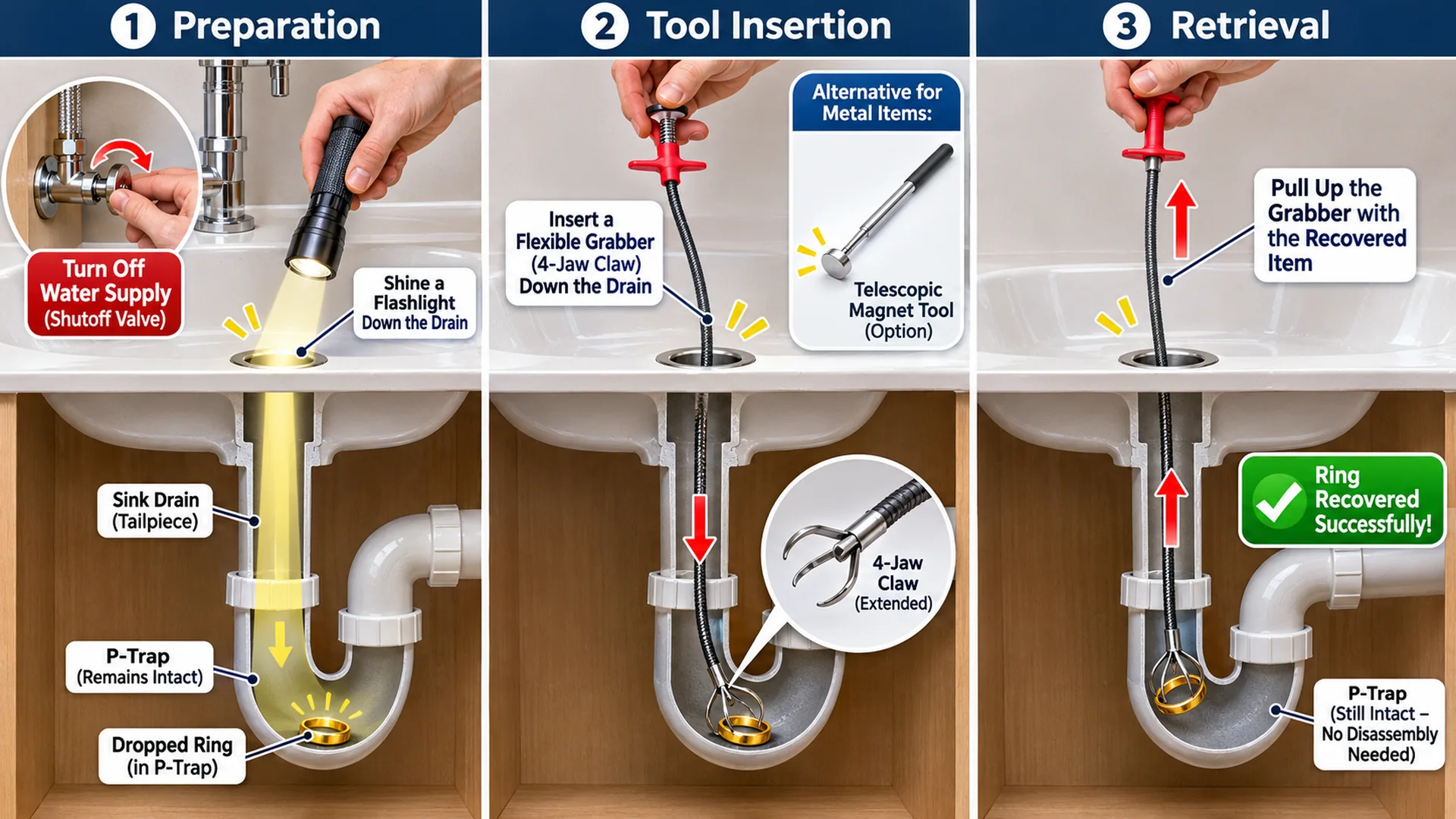
Retrieving a dropped item without dismantling the plumbing under your sink is entirely possible if you act quickly and use the right non-invasive retrieval tools. Most lost jewelry, screws, or small hardware sit right beneath the drain stopper or just inside the upper tailpiece, making them fully accessible from above without tools or wrenches.
Method 1: Remove the Stopper or Strainer and Look Directly
Removing the sink stopper gives you immediate, unobstructed access to the drain throat where most dropped items get stuck. Different sink stoppers require specific detachment techniques under the sink or at the flange, allowing you to quickly lift out the obstruction without touching the P-trap.
Pop-up stoppers with a pivot rod: Disconnect the horizontal pivot rod beneath the sink basin by loosening the plastic retaining nut, pull the rod out from the clevis strap, and lift the stopper straight up from the drain flange.
Lift-and-turn stoppers: Unscrew the small cap or knob on top of the stopper by holding the body steady and turning it counterclockwise.
Push-pull stoppers: Rotate the top knob counterclockwise while pulling upward to unscrew it entirely from the inner threaded post.
Method 2: Use Tweezers, Needle-Nose Pliers, or a Bent Wire Hanger
Fine-tipped tools like long tweezers or needle-nose pliers allow you to precisely grab small metallic items sitting just below the bathroom sink drain strainer. If the item is slightly out of reach, a custom-bent wire coat hanger acts as an instant extended grabber.
Targeted illumination: Shine a high-lumen flashlight down the drain while extracting to guide your tool precisely and prevent blind fumbling.
Precision grip: Use locking needle-nose pliers to firmly clamp onto a ring band without accidentally nudging it deeper into the pipe.
Custom wire extension: Unwind a metal coat hanger, keep a small hook at the end, and carefully sweep it to catch loop-shaped items or jewelry chains.
Method 3: Use a Magnet on a String or a Telescoping Magnet
A strong magnetic tool provides an effortless, non-contact method to retrieve iron- or steel-based items like screws, bobby pins, or white-gold and stainless steel rings. Lowering a telescoping magnet down the drain lets you snap onto the metal object instantly.
Telescoping design: Extend a pocket magnet tool down the pipe until it makes direct contact with the metallic surface.
Magnet on a string: Tie a heavy-duty rare-earth magnet to a sturdy string if you lack a telescoping wand, lowering it slowly into the standing water.
Extraction caution: Pull straight up slowly and steadily to prevent the magnetic bond from breaking halfway up the narrow pipe.
Method 4: Use a Flexible Four-Prong Grabber
A flexible four-prong claw tool navigates tight pipe bends and securely clamps onto non-magnetic or bulky objects that a magnet cannot catch. Pushing the plunger button at the top extends steel wire fingers that grasp the item tightly upon release.
Flexible routing: Feed the coiled metal cable smoothly past the upper drain grate and down into the tailpiece curve.
Claw engagement: Position the open prongs around the item and release the top plunger button to lock onto it securely.
Safe withdrawal: Gently pull the tool back up, keeping steady tension on the claw mechanism so the item doesn’t slip free before reaching the sink opening.
Method 5: Try a Wet/Dry Vacuum (Small Items, With Caution)
A wet/dry shop vacuum can quickly suction lightweight items out of a drain without disassembly, provided you maintain an airtight seal. Use low suction power to avoid pulling hazardous debris or damaging delicate items inside the vacuum tank.
Airtight seal preparation: Wrap a damp cloth around the vacuum hose nozzle and press it firmly over the sink drain opening to block air gaps.
Low power setting: Turn the vacuum on at minimal suction so you can listen carefully and hear if the item hits the hose or filter.
Canister inspection: Turn off the unit immediately and empty the dry vacuum tank or filter bag onto a clean white towel to locate the recovered item.
Method 6: Gentle Plunging (When It Works and When It Doesn’t)
Gentle plunging uses hydrodynamic pressure changes to dislodge items wedged near the top of the P-trap, but it requires a careful technique to avoid pushing the object further down. Use this method only as a last resort before pulling apart pipes.
Plug the overflow hole: Seal the overflow opening near the top of the sink basin with a wet rag to ensure optimal air and water pressure transfer.
Controlled motion: Place a small cup plunger over the drain, submerge it completely in standing water, and execute light, shallow up-and-down strokes.
Safety warning: Stop immediately if the item does not dislodge within three to four strokes, as aggressive plunging forces small items past the trap and into the main sewer line.
How to Remove the P-Trap and Get the Item Out Step-by-Step
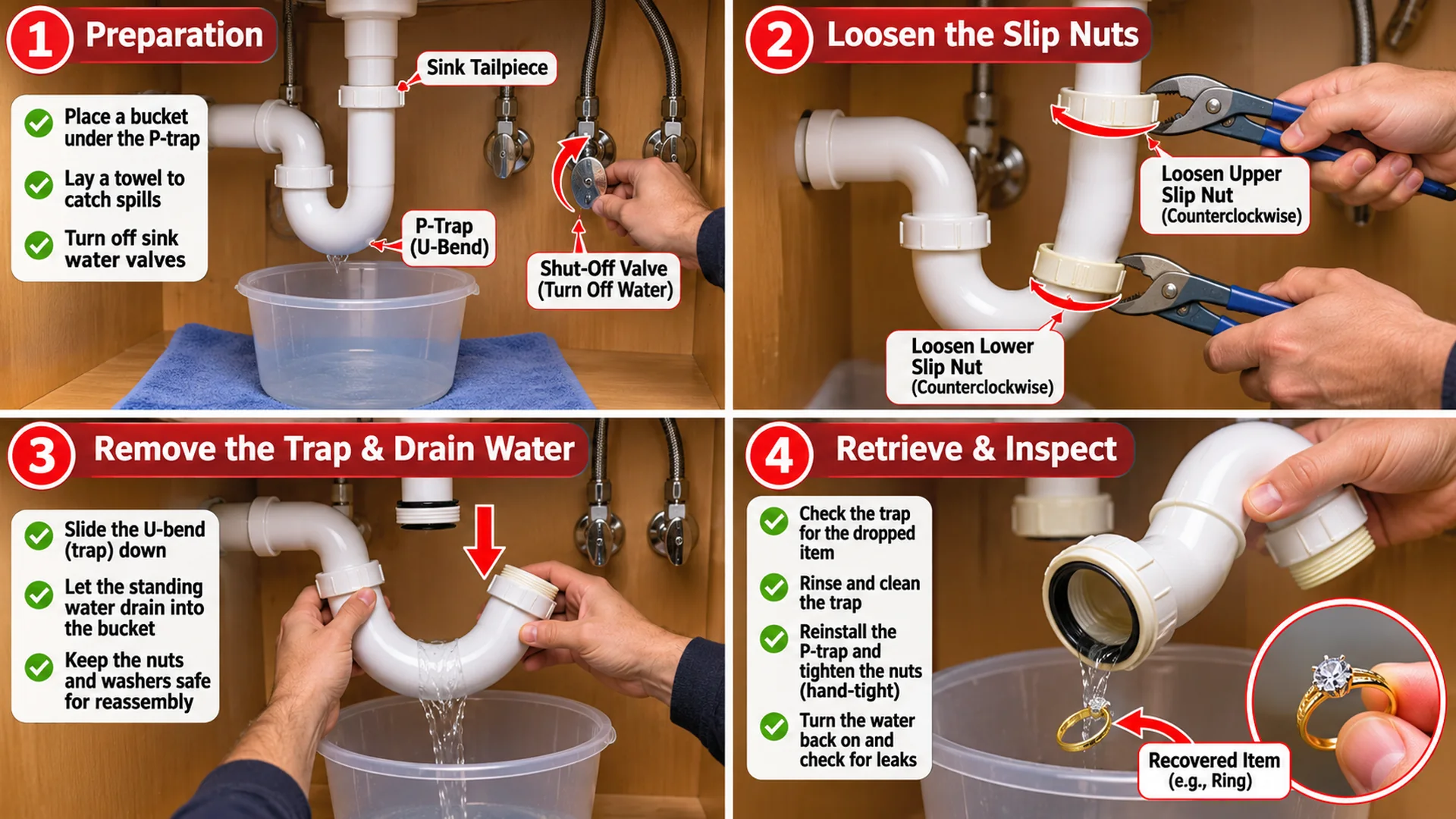
Removing the P-trap is the most reliable, foolproof method to recover any item lost down a sink drain. When surface grabbers and magnets fail, dismantling this U-shaped water seal guarantees you will locate your ring, earring, or fastener trapped safely inside.
What Is a P-Trap and Why Do Dropped Items End Up There?
The P-trap is a curved, U-shaped section of pipe located directly beneath your sink that holds standing water to block hazardous sewer gases from entering your home. Because gravity pulls heavy objects downward, items falling past the vertical tailpiece naturally sink to the lowest point of this water bend and stay securely lodged there.
Tools and Materials You’ll Need
Gathering your equipment beforehand prevents messy spills and streamlines the entire extraction process. Make sure you have the following items ready beneath your sink cabinet:
Bucket: A small 2-to-3-gallon bucket to catch standing water and debris.
Old Towel: Placed on the floor under the cabinet to absorb splashes and protect flooring.
Channel Locks or Pliers: Adjustable jaw pliers to loosen stubborn or tight slip nuts.
Rubber Gloves: Heavy-duty gloves to protect your hands from accumulated hair, soap scum, and sludge.
Flashlight or Headlamp: To illuminate the dark interior of the pipe assembly.
Old Toothbrush or Rag: For cleaning out gunk and inspecting the internal washers.
Step 1: Set Up the Bucket and Towel
Clear out all storage items, cleaning bottles, and boxes from beneath the sink cabinet to create a wide, unobstructed workspace.
Lay the towel: Place an absorbent old towel flat on the cabinet floor directly underneath the entire P-trap assembly.
Position the bucket: Set your empty bucket right beneath the lowest curve of the U-shaped pipe to catch residual water.
Step 2: Loosen the Slip Nuts (Hand vs. Pliers; Plastic vs. Metal Pipes)
The P-trap is secured at both ends by threaded plastic or metal collars known as slip nuts. Locate the slip nut connecting the trap to the vertical tailpiece and the nut connecting the trap to the horizontal wall arm.
Plastic PVC pipes: Try loosening these nuts by hand first using a counterclockwise twist, as factory-tightened plastic fittings rarely require heavy tools.
Metal brass or chrome pipes: These often corrode or tighten over time, requiring you to gently grip the slip nut with channel locks and turn counterclockwise.
Protect the finish: If your pipes are polished chrome, wrap a piece of electrical tape around the jaws of your pliers to prevent scratching the metal surface.
Step 3: Lower the Trap and Empty It Into the Bucket
Once both slip nuts are loosened and threaded off the male pipe threads, gently push the vertical tailpiece and wall arm slightly apart.
Tilt the pipe: Tilt the U-shaped trap downward toward your bucket to let the trapped water drain out completely.
Slide down the nuts: Slide the freed slip nuts and slip washers down and off the ends of the pipe sections so they do not fall into the bucket water.
Step 4: Sift Through the Debris and Retrieve the Item
Pour the contents of the P-trap into your bucket or through an old wire mesh strainer to find your missing item amidst the hair and soap sludge.
Inspect the sludge: Check the inner walls of the pipe, as flat rings or small screws often cling to sticky buildup near the bottom curve.
Rinse thoroughly: Take the removed pipe section to a secondary utility sink or bucket of clean water to rinse away residue and verify your item is secure.
Step 5: Reassemble Correctly
Reassembling the P-trap correctly ensures a watertight seal and prevents future under-sink leaks. Follow proper orientation rules for every internal component.
Check washer orientation: Slide the slip nuts onto the pipes with the tapered, sloped side (beveled edge) facing toward the fitting opening.
Seat the washers: Push the rubber slip washers snugly into the flared pipe ends to ensure an airtight and watertight compression seal.
Hand-tighten first: Screw the slip nuts clockwise by hand until snug; avoid over-tightening plastic nuts, which can warp or crack the threads.
Step 6: Run Water Slowly and Check for Leaks
Test your plumbing assembly before closing up the cabinet to verify that all connections are secure and leak-free.
Turn on the faucet: Run cold water slowly down the drain for 30 to 45 seconds while watching all pipe connection points.
Check with a dry paper towel: Wipe your hand or a dry tissue along the bottom of the slip nuts to detect any hidden moisture or slow drips.
Common Mistakes (Cross-Threading, Missing Washers, Over-Tightening)
Avoiding rookie mistakes during reassembly saves you from costly water damage and future sink repair calls. Professional plumbers note that rushing the re-installation phase accounts for the vast majority of emergency cabinet leaks.
Cross-threading slip nuts: Forcing a plastic nut onto metal or PVC threads at an angle destroys the threading; always turn counterclockwise first until you feel the threads click into alignment, then tighten clockwise.
Forgetting or reversing washers: Leaving out a rubber slip washer or installing it backward prevents a proper compression seal, leading to persistent drips.
Over-tightening with pliers: Cranking down hard on PVC slip nuts with channel locks cracks the plastic flange and deforms the rubber gasket, permanently ruining the seal.
What If the Item Isn’t in the P-Trap?
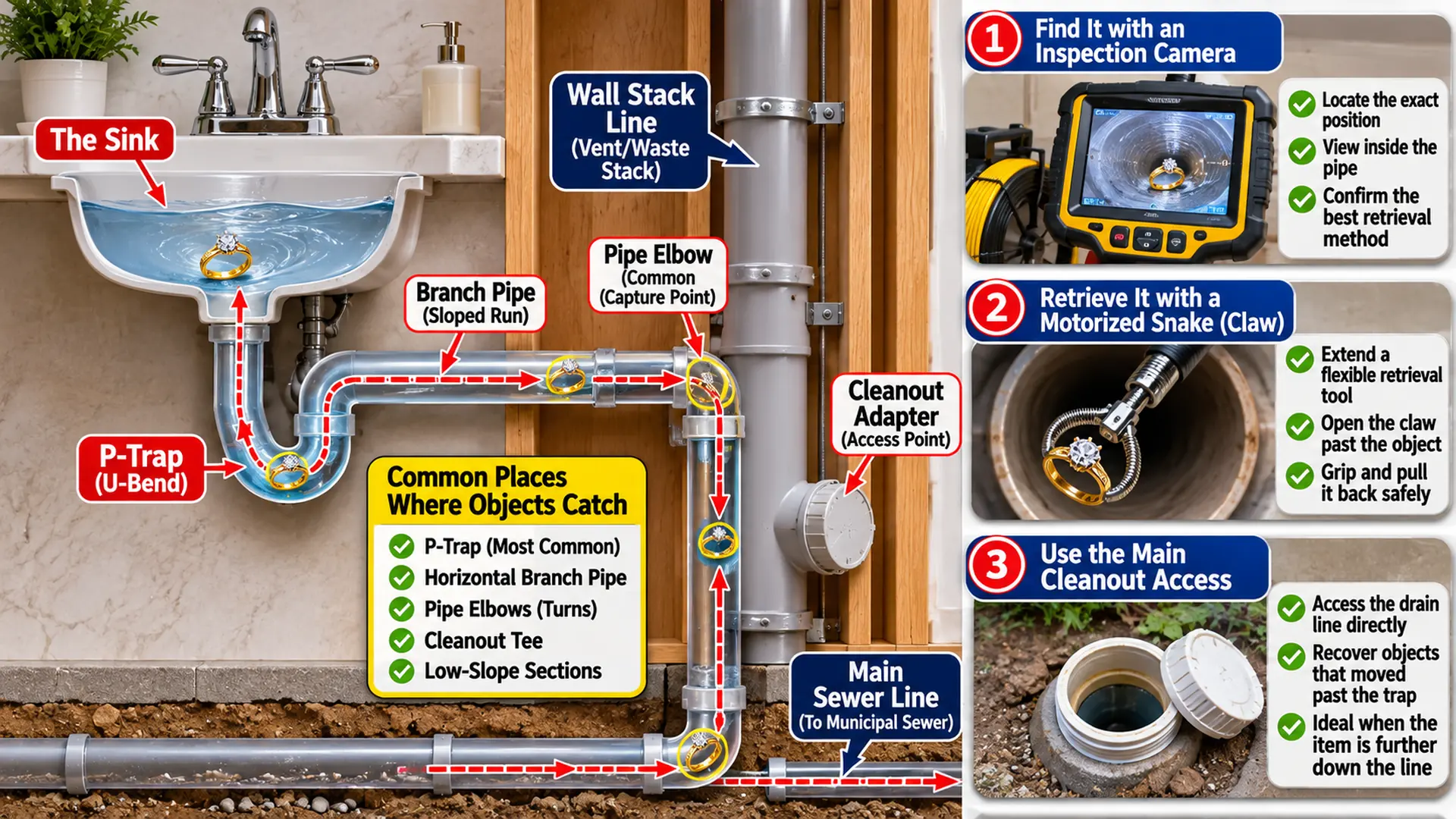
Finding an empty P-trap after a frantic disassembly can cause immediate worry, but the dropped item has likely only migrated a short distance into the horizontal pipe assembly. Systematic inspection of the adjacent lines and the use of specialized retrieval tools will quickly locate and secure the missing object before it enters deep sewer infrastructure.
Check the Trap Arm and the Wall Pipe
The trap arm is the horizontal section of pipe connecting the P-trap to the sanitary tee embedded in the wall. Because water flows downward at a slight grade, lightweight or flat objects often slide past the U-bend and lodge horizontally inside this straight tube.
Inspect the horizontal slope: Look directly inside the open wall arm with a flashlight before flushing or moving other fixtures.
Feel for obstructions: Insert a gloved finger or a bent wire gently into the trap arm to check for hard edges or metallic resistance.
Remove the trap arm: If visual inspection is blocked, unscrew the slip nut at the wall adapter to slide the entire arm out for a direct flush.
Use a Drain Snake or Zip Tool for Items Past the Trap
When an object pushes past the accessible plumbing trap and into the hidden branch lines, a manual drain snake or a plastic hair-zipper tool provides the required reach. These flexible tools navigate bends to catch, snag, or push the object back toward an accessible cleanout point.
Feed a mini drum auger: Slowly feed a 1/4-inch cable snake into the wall opening, rotating the handle clockwise to catch loops or rings.
Use a barbed plastic zip tool: Push a flexible plastic strip with side barbs into the line to snag hair and small objects trapped just beyond the reach of your fingers.
Proceed with caution: Avoid aggressive twisting or high-torque drilling with power snakes, which can permanently dent or puncture thin-walled PVC pipes.
Is There a Cleanout Access Point?
Many modern plumbing installations feature a sanitary cleanout plug located directly beneath the sink or on the exterior wall stack. Removing this threaded plug opens a direct path to the main vertical drain line, bypassing tight pipe corners.
Locate the cleanout plug: Look for a square-headed threaded plug positioned on the drainage stack or right below the sink branch tee.
Open with a wrench: Turn the plug counterclockwise using an adjustable wrench while holding a bucket underneath to catch any trapped wastewater.
Inspect the junction: Shine a bright light into the opening to check if your item settled right at the sweep of the tee fitting.
Signs the Item Has Moved Into the Main Line
If your retrieval tools fail to catch the item and drainage behavior changes abruptly, the object has likely traveled deeper into the main drain line or vertical stack. Recognizing specific warning signs prevents you from worsening a developing obstruction.
Sudden slow draining: Water pools significantly longer in the basin during normal use without any prior history of grease buildup.
Audible gurgling noises: Air bubbles escaping through the sink or adjacent vents indicate a partial blockage is trapping air in the drainage network.
Repeated localized clogs: Debris collects rapidly around the item, causing frequent backups whenever you run the faucet.
Why a Camera Inspection Helps Locate It
When valuable jewelry or expensive components vanish past accessible pipe fittings, a professional sewer camera inspection provides exact, visual coordinates of the item’s location. Plumbers thread a fiber-optic camera down the line to pinpoint the exact depth and pipe segment holding your lost property.
Eliminate guesswork: High-definition live video feeds show whether the item is resting in a branch line or has dropped safely into a larger vertical stack.
Prevent destructive digging: Pinpointing the exact obstruction depth means you only open or dismantle the specific section of pipe required.
Professional assistance: Contact licensed plumbing experts to perform a sewer camera inspection before authorizing any major pipe cutting.
How to Get Something Out of Different Types of Drains
Different plumbing fixtures require completely unique retrieval techniques, as treating a shower drain the same as a kitchen sink or bathroom vanity will only push dropped items further down the pipe. Understanding the structural mechanics of each specific fixture ensures you recover lost valuables safely without damaging your plumbing system or causing accidental blockages.
How to Get Something Out of a Bathroom Sink Drain
Retrieving a small item like a ring, earring, or back-stub from a bathroom sink starts by examining the pop-up stopper and pivot rod under the basin [00:00]. Most modern bathroom sinks feature a removable stopper connected to a horizontal pivot rod at the back of the tailpiece.
Step 1: Disconnect the spring clip and unscrew the pivot nut behind the drain pipe to slide the pivot rod out of the stopper.
Step 2: Pull the pop-up stopper straight up and out from inside the sink basin to check if the item is caught directly on it.
Step 3: If the item passed the stopper, place a bucket underneath the P-trap, loosen the slip nuts by hand or with channel-type pliers, and inspect the U-shaped bend where heavy objects naturally settle [00:09], [00:49].
For a visual demonstration on retrieving dropped items from a trap, you can watch the video below:
Video Source: What to do if you dropped something down the drain
How to Get Something Out of a Kitchen Sink Drain
Kitchen sink setups are complicated by strainer baskets, double sink configurations, and shared branch lines connected to a dishwasher. Dropped cutlery or small kitchen tools usually lodge right beneath the sink basket or at the sanitary tee junction.
Inspect the Strainer Basket: Remove any food debris or rubber stoppers to check if the item is wedged inside the basket crosshairs.
Evaluate Double Sink Dynamics: In double sinks, water or dropped items can travel across the cross-pipe baffle before entering the central P-trap.
Check Dishwasher Connections: If a small utensil vanishes while running a cycle, disconnect the dishwasher drain hose inlet at the tailpiece, as lightweight plastics frequently get trapped right at this junction.
How to Get Something Out of a Sink With a Garbage Disposal
Dropping a utensil into a garbage disposal requires extreme caution to protect your hands and electrical safety. Never place your bare hands inside the chamber while the unit is wired, even if the wall switch is turned off.
Cut Power Completely: Unplug the disposal under the sink or switch off the dedicated circuit breaker to eliminate any risk of accidental activation.
Use Extender Tools: Shine a flashlight down the chamber and use long-handled tongs or needle-nose pliers to grab the item without touching the blades.
Manual Flywheel Rotation: If the item is jammed tightly beneath the impeller blades, insert the provided hex wrench (allen key) into the socket at the bottom center of the disposal housing underneath the sink and crank it back and forth to clear the flywheel.
Reset and Test: Press the red overload reset button on the bottom or side of the unit before restoring power. For persistent mechanical failures or jammed internal components, professional garbage disposal repair is recommended.
How to Get Something Out of a Shower Drain
Shower drains deal primarily with dense hair clumps, soap scum, and small dropped bottle caps or jewelry. Because shower traps are hidden beneath the subfloor, retrieval relies entirely on surface access tools.
Remove the Drain Cover: Pry up snap-in drain covers or unscrew flathead retaining screws on grid-style covers to expose the drain pipe opening.
Clear Hair Catchers: Pull away built-up hair and gunk using a flexible plastic barbed hair snake or wire drain claw.
Use Grabber Tools: Insert a flexible magnetic pickup tool or a multi-claw retrieval tool down the trap bend to snag metallic items like bobby pins, rings, or razors. If stubborn pipe damage or deep clogs prevent retrieval, professional shower repair can safely resolve the issue.
Utility Sink and Washing Machine Drain Situations
Utility sinks and washing machine standpipes handle heavy discharge volumes and frequently catch lint, coins, or small garment items washed out of pockets. Because washing machine standpipes connect directly to vertical stack lines, dropped items can fall deep past accessible P-traps.
Utility Sink Traps: Utility sinks feature deep basins with standard exposed P-traps that can be unscrewed easily by hand to retrieve heavy objects like coins or keys.
Washing Machine Standpipes: If a small clothing item or lint clog drops into a laundry standpipe, avoid using rigid snakes that can puncture PVC elbows; instead, use a specialized long-reach retrieval auger designed for narrow vertical drain pipes.
Will Drain Cleaners Like Drano Dissolve What You Dropped?
Chemical drain cleaners are engineered to react with organic matter, but they are ineffective against solid non-organic objects trapped in plumbing pipes. Pouring harsh chemicals down a clogged sink in an attempt to dissolve solid valuables or debris creates severe safety hazards and makes manual retrieval far more difficult.
Can Drano or Chemical Drain Cleaners Dissolve Plastic, Metal, or Jewelry?
No, chemical drain cleaners such as Drano will not dissolve plastic, metal, glass, or jewelry. Chemical drain cleaners rely on caustic alkaline substances—primarily lye (sodium hydroxide)—or concentrated acids designed exclusively to hydrolyze organic proteins like hair, grease, and food waste.
Plastic Toys and Objects: Standard plumbing fixtures and most modern toy compositions are made from synthetic polymers such as PVC, polypropylene, or polyethylene, which are completely immune to caustic lye formulations.
Metallic Valuables and Jewelry: Precious metals (gold, platinum, silver) and hard plastics will remain entirely intact within the pipe while trapped in caustic liquid.
Organic Clog Scoping: Chemical agents only break down soft organic blockages; solid physical obstructions require mechanical extraction methods.
Why Chemical Cleaners Can Make Retrieval Harder and Riskier
Pouring caustic drain cleaners into a blocked pipe turns a simple mechanical retrieval task into a dangerous physical hazard. When the chemical fails to clear the solid object, the corrosive liquid remains trapped inside the P-trap assembly directly beneath your sink basin.
Caustic Standing Water: The P-trap becomes filled with a highly toxic, burning liquid mixture. Reaching into the drain or dismantling the pipes beneath the sink risks severe chemical burns to your hands, arms, and eyes.
Corrosion and Heat Damage: Chemical reactions generate intense heat that can warp thin PVC pipes, melt plastic traps, or weaken joints and corroded metal plumbing.
Hazardous Splashing and Plumber Risk: Using tools like plungers or flexible grabbers on a drain filled with chemical cleaner can cause toxic liquid to splash back onto counter surfaces and skin. Furthermore, according to safety protocols established by Poison Controlenzymatic drain cleaners contain corrosive chemicals that cause severe skin burns and permanent tissue damage, making it extremely hazardous for homeowners or professional plumbers to dismantle the assembly later.
Safer Alternatives
If an object is dropped down the drain alongside soft organic buildup, avoid harsh chemical products entirely in favor of safe mechanical and non-corrosive clearing methods.
Hot Water Flush (Organic Debris Only): Running hot (not boiling) tap water can help soften residual grease or soap scum holding a lightweight item in place without damaging plastic PVC joints.
Mechanical Removal Tools: Use a flexible four-jaw grabber tool, a long needle-nose pliers, or a magnetic pickup tool down the drain neck to latch onto the dropped item.
Manual Trap Disassembly: Place a catch bucket under the sink and physically unscrew the P-trap slip nuts by hand to remove the trapped object safely without chemical exposure.
What Breaks Down Food in the Sink Drain?
Food debris wedged in kitchen drains breaks down best through natural enzymatic action or mechanical garbage disposal grinding rather than harsh chemicals. Enzymatic drain cleaners use natural bacteria and enzymes to digest fats, proteins, and starches overnight without generating heat or damaging pipes. For immediate food clogs, flushing the line with warm water while running the garbage disposal or using a manual sink plunger creates the necessary physical force to move organic waste through the branch line safely.
When to Stop DIY and Call a Plumber
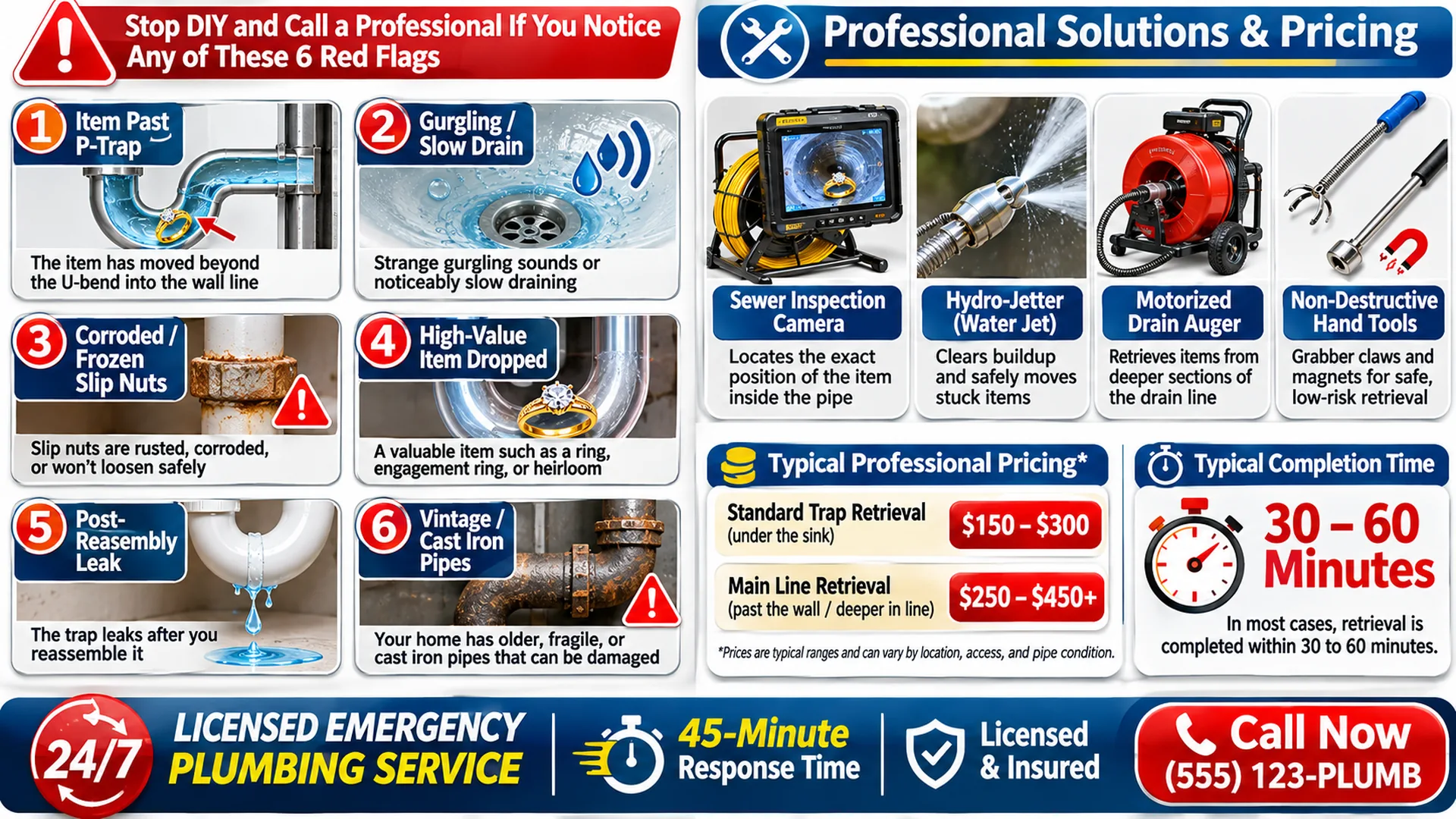
While many retrieved items can be successfully extracted at home with basic hand tools, certain situations exceed safe DIY limits. Knowing when to stop prevents minor drain mishaps from turning into high-cost pipe replacements or extensive home water damage.
6 Signs You Should Call a Plumber Instead
Continuing to poke, rod, or flush a line when system indicators signal a deeper issue can force a dropped item directly into your home’s main soil stack. Contact a licensed plumber immediately if you observe any of the following warning signs:
Item Has Passed the P-Trap: If the object fell beyond the U-shaped trap bend and down into the vertical wall stack, standard household grabber tools will no longer reach it.
Persistent Slow Drainage or Gurgling: Gurgling noises or delayed drainage after an item drops indicate a partial line blockage, displaced pipe seal, or trapped debris altering system venting.
Corroded or Frozen Slip Nuts: Forcing rusted metal lock nuts or sun-baked plastic fittings under the sink risks snapping the tailpiece assembly off at the wall connection.
High-Value Valuables Dropped: Precious metal wedding bands, loose gemstones, or delicate heirloom jewelry can easily be scratched, lost, or flushed away during amateur extraction attempts.
Persistent Water Leaks After Reassembly: If reinstalling the P-trap leads to continuous dripping from the joint seals despite tightening, the rubber washers are likely degraded, misaligned, or dry-rotted.
Shared Branch Lines or Vintage Plumbing: Older galvanized steel, cast iron, or hub-and-spigot lead piping systems require specialized handling to prevent catastrophic joint cracking.
What a Professional Does That You Can’t Easily Do at Home
Professional plumbers utilize specialized industrial diagnostic and extraction equipment designed to clear drain lines rapidly without damaging your fixtures or home interior.
High-Definition Sewer Camera Inspection: A specialized drain technician feeds a flexible optic camera line into the pipe to visually verify the exact depth, position, and orientation of the dropped item before attempting extraction.
Flexible Motorized Drain Snake: Unlike rigid handheld snakes that risk jamming, professional augers feature specialized retrieval heads (such as expanding retriever hooks or bulb cutters) designed to wrap around and pull items upward intact.
Hydro Jetting Systems: For solid obstructions backed up by heavy grease or scale buildup, high-pressure water streams scour the inner walls of the pipe to clear surrounding debris without damaging PVC or cast iron.
Non-Destructive Mechanical Disassembly: Trained specialists disassemble complex pedestal sinks, integrated vanity traps, and commercial waste lines using precision tools, preserving original plumbing components and surrounding cabinetry.
How Much Does It Cost to Retrieve an Item From a Drain?
Professional retrieval costs depend on the accessibility of the line, the location of the object, and whether disassembly or line snaking is required. Under an upfront flat-rate pricing model, you receive a complete, written quote following an initial inspection so you know the exact scope and cost before any work begins.
Upfront Flat-Rate Estimates: Rather than open-ended hourly billing, diagnostic inspections result in a single, predictable flat-rate quote tailored to the repair type.
Standard Retrieval Range: Simple P-trap disassemblies or straightforward mechanical extractions generally fall within standard flat-rate service rates (typically ranging from $150 to $300 during regular service hours).
Deep Stack or Main Line Retrieval: If the object has traveled into the main line requiring advanced snake tools or camera tracking, equipment setup and specialized labor adjust the flat-rate scope accordingly (typically ranging from $250 to $450+).
How Long Does It Usually Take?
A standard drain retrieval above or within the P-trap takes a professional technician roughly 30 to 60 minutes from setup to final testing.
If the dropped item has migrated deep into wall piping, beneath a concrete slab, or through a multi-story branch line requiring high-definition camera tracking and power-snaking, service times typically extend to 1 to 2 hours.
Need Help in Miami-Dade?
If you dropped a valuable item down the drain or are facing a persistent backup, our team of licensed specialists delivers fast, 45-minute response times across all service areas. We provide transparent, upfront flat-rate quotes with zero hidden fees and no after-hours surcharges. Contact an emergency plumber now to schedule professional drain cleaning and retrieval.
Call 786-239-6529
Frequently Asked Questions
How to get something out of a sink drain without removing it?
You can get an item out of a sink drain without removing the pipe by using a flexible four-jaw grabber tool, a long needle-nose pliers, or a strong telescopic magnet. Insert the tool down through the drain opening, grasp the object under direct flashlight beam, and pull it straight up.
What happens if something goes down the sink drain?
When an item falls into a sink drain, it usually settles at the bottom of the curved P-trap due to gravity and water displacement. If water is run continuously, the object can wash past the trap bend, leading to deep main line blockages or permanent loss.
What dissolves stuff in drains?
Caustic chemical cleaners containing sodium hydroxide or lye dissolve organic materials like hair, grease, and soap scum through hydrolytic chemical reactions. However, these chemicals cannot break down solid non-organic objects like plastic, glass, toys, or metallic jewelry trapped inside the pipe.
How do you grab something out of a drain?
Grab an item out of a drain by sliding a mechanical pickup tool or flexible grabber claw past the drain crosshairs. Press the plunger handle to extend the spring claws, latch firmly around the dropped object, and carefully lift it out without dropping it back into the trap.
I dropped something in the sink drain. What should I do?
Turn off the water faucet immediately to prevent flushing the item past the P-trap. Avoid running the garbage disposal or using plungers, shine a light down the drain to locate the object, and retrieve it using grabber tools or by unscrewing the trap underneath.
Can Drano dissolve plastic toys?
No, Drano cannot dissolve plastic toys or synthetic polymers. Caustic drain cleaners are formulated specifically for soft organic material and will leave hard plastic objects completely intact while creating a dangerous pool of caustic water inside your sink trap.
How to get a ring out of the sink without taking it apart?
To retrieve a ring without pipe disassembly, use a small flexible mechanical retrieval claw or a strong neodymium magnet attached to a bendable wire. Thread the tool carefully down through the pop-up stopper opening to hook or attract the ring resting at the trap bottom.
Is it okay to just turn on the water after dropping a nail?
No, you should never turn on the water after dropping a metal nail or hardware into the drain. Water flow pushes the heavy nail out of the P-trap into the main sewer line, where it can snag debris, puncture plastic lines, or cause deep plumbing clogs.
My sink drain is stuck. What can I do to fix it?
If a sink drain stopper or slip nut is stuck, clear surrounding corrosion with penetrating oil or vinegar before gently turning with channel-lock pliers. Avoid forcing rusted metal fittings; if the pipe remains jammed, contact a professional for specialized sink repair.
How to get something out of the bathroom sink drain?
Extract an item from a bathroom sink drain by removing the pop-up stopper via its pivot rod behind the tailpiece. Once the stopper is removed, use a thin grabber tool to lift the object out or loosen the P-trap slip nuts below with a catch bucket in place.
How to Prevent Items From Falling Down the Drain
Preventing items from dropping into your plumbing fixtures is far easier than retrieving them after an accident. Simple habit shifts and low-cost protective accessories keep small valuables secure and eliminate the risk of sudden drain blockages.
Use a Drain Strainer or Mesh Cover
Installing a dedicated drain strainer or stainless steel mesh cover creates a physical barrier that catches rings, earrings, screws, and debris before they enter the pipe.
Bathroom Sinks & Showers: Place a fine mesh screen or rubber hair catcher over the opening to trap small jewelry, soap chips, and loose strands.
Kitchen Basins: Keep a removable basket strainer in place at all times, even when rinsing dishes, to block silverware and small kitchen prep tools.
Put a Plug or Towel Over the Drain When Removing Jewelry or Working Near the Sink
Accidental drops frequently happen during daily routines like washing hands, applying makeup, or cleaning jewelry over an open basin.
Block the Drain Opening: Insert the sink plug or lay a clean hand towel directly over the drain opening before taking off rings, changing earrings, or adjusting small hardware near the sink.
Use a Jewelry Dish: Place a small decorative dish or tray next to the vanity so dropped items land safely on the countertop rather than bouncing into the basin.
Keep Small Items Away From the Sink Edge (Especially With Kids)
Items sitting on narrow sink ledges or vanity rims easily vibrate or fall directly into the open drain.
Clear the Sink Perimeter: Store razors, hair clips, cosmetic caps, and small bottles in medicine cabinets or drawers rather than along the edge of the bowl.
Child Safety Measures: Keep small plastic toys, bath caps, and loose knick-knacks off the tub ledge during bath time, and teach children not to place objects near open drains.
Keep a Basic Drain Rescue Kit Under the Sink
Having essential retrieval tools readily accessible beneath your vanity or kitchen sink allows you to act immediately before a dropped item travels deep into the wall stack.
Flexible Grabber Claw: A four-jaw spring-loaded pickup tool to reach inside P-traps.
Telescopic Magnet: A extendable magnetic rod for retrieving iron, steel, or nickel hardware.
Dedicated Flashlight: A compact LED light to illuminate dark drain necks clearly.
Rubber Gloves & Microfiber Towel: Durable gloves for grip and a clean towel to block the drain or wipe down wet fittings.
Final Tips and Next Steps
Dropping a ring, utensil, or hardware down a sink drain is stressful, but acting quickly and using the right retrieval technique prevents minor accidents from becoming major plumbing headaches.
Before taking apart your plumbing or attempting manual extraction, keep these three essential rules in mind:
Stop the Water Immediately: Never run the faucet or switch on the garbage disposal after dropping an item. Water pressure pushes heavy objects past the P-trap and deep into your home’s main vertical stack.
Start With the Simplest Retrieval Method First: Try extracting the object using a flashlight and a flexible grabber tool through the drain neck before unhooking fittings beneath the vanity.
Know When to Call a Professional: If an item passes beyond the U-shaped trap bend, or if you encounter corroded slip nuts and persistent leaks, stop DIY attempts immediately to protect your pipes.
If your dropped item is out of reach or you need immediate professional assistance, the expert team at Miami Florida Plumbing is ready to help. Our licensed plumbers provide fast, transparent, flat-rate drain retrieval across Miami-Dade County.
Call 786-239-6529
Main Services
Related Posts
Need a Plumber in Miami?
Schedule service online or speak directly with the EZ Plumbing team.
Owner-Led Local Service
Know who is behind the business before you request service. The owners, contact line and Miami service pages are published clearly.
- Named business owners
- Direct phone and social channels
- Local Miami service information
Clear Help Before You Book
Review the relevant service page, contact the team directly and use the booking page when you are ready—without relying on vague claims.
- Service-specific information
- Direct questions before scheduling
- Clear online booking route