
Do Magnetic Water Softeners Work? What Science and Plumbers Say
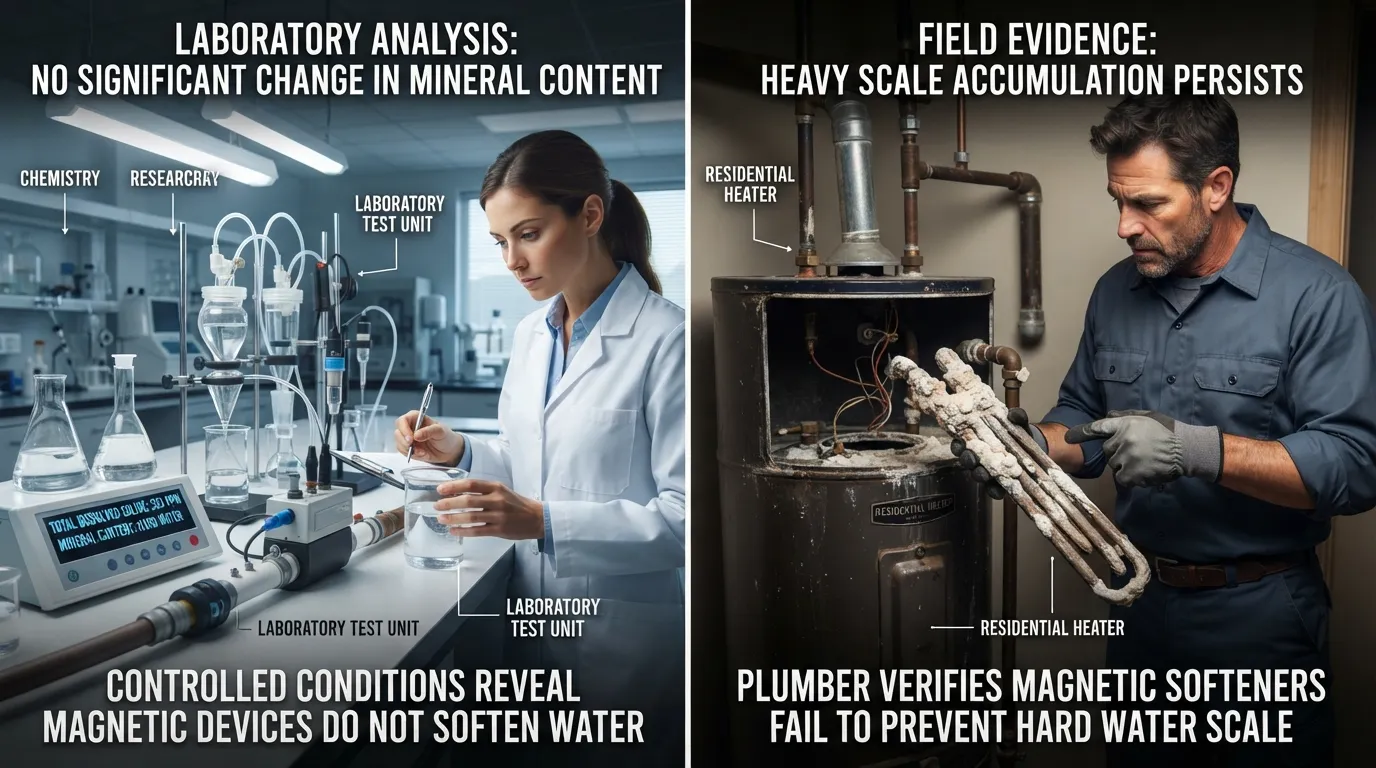
Do Magnetic Water Softeners Actually Work?
The Quick Verdict
Magnetic water conditioners do not remove calcium or magnesium ions from water, meaning they fail to truly soften hard water. Independent testing shows that their effects on limescale prevention are inconsistent and largely unreliable. While they may alter how minerals crystalize under certain conditions, they are not a legitimate substitute for salt-based ion-exchange softeners.
At a Glance
What they do: Pass water through a magnetic or electromagnetic field to temporarily alter mineral behavior.
What they don’t do: Remove calcium, magnesium, or minerals, or reduce overall water hardness.
What works instead: Traditional salt-based ion-exchange softeners or verified reverse osmosis filtration systems.
Who This Article Is For
This evaluation is designed for homeowners dealing with crusty limescale buildup on plumbing fixtures, water heaters, and dishware who are trying to decide whether magnetic devices offer a genuine fix.
Our Position (Transparency)
We are plumbers; we do not sell magnetic devices or traditional water softeners.
How Magnetic Water Softeners Claim to Work
What Is a Magnetic Water Softener?
Magnetic water conditioners are non-chemical physical water treatment systems designed to tackle hard water challenges without traditional ion-exchange salt or complex plumbing modifications. These devices aim to alter how dissolved minerals behave as they flow through your household supply pipes, preventing hard scale accumulation on fixtures and appliances.
What a Magnetic Water Conditioner Is
Magnetic scale reducers are external clamp-on devices fitted securely around incoming household water pipes. They require zero cutting into existing plumbing lines and need no electrical power source to operate.
Non-Invasive Design: The unit consists of permanent magnets or electromagnetic coils housed in a split-casing shell that fastens directly onto copper, PEX, or PVC pipes.
No Power Required: Most consumer-grade models run entirely on permanent neodymium magnets, eliminating electricity costs and wiring hazards.
Compact Footprint: Because they clamp directly onto the exterior wall of the pipe, they take up virtually zero floor space compared to bulky brine tanks.
The Claim: Magnetic Fields and Mineral Behavior
Manufacturers of magnetic descalers claim that passing hard water through a strong magnetic field alters the physical properties of dissolved calcium carbonate. Instead of forming hard, adherent limescale crusts, the minerals are said to change crystal structures.
Altered Crystallization: The magnetic field purportedly encourages dissolved minerals to precipitate into loose, suspended microscopic crystals rather than sticking to pipe walls.
Calcite vs. Aragonite Conversion: The core claim suggests that hard calcite crystals transform into needle-like aragonite crystals that flow harmlessly down the drain instead of bonding to heating elements and faucet aerators.
Water Conditioner vs. Softener Distinction: Marketers often label these units as a physical water conditioner or scale reducer rather than a traditional water softener, noting that they alter mineral behavior rather than removing calcium and magnesium ions entirely.
What Installation Looks Like in a Real Home
Installing a magnetic pipe clamp is a straightforward DIY task that takes less than fifteen minutes with no special tools required. Homeowners typically position the device on the main water supply line just where it enters the house or immediately upstream of the water heater.
Strategic Placement: Clamping the unit near the main water meter or right before the water heater protects both hot and cold water distribution lines from mineral buildup.
Secure Fastening: The two halves of the magnetic casing bolt or snap tightly around the cleaned exterior of the pipe to maximize magnetic flux penetration through the flowing water.
Here is a helpful overview of how these systems are structured and discussed in practical applications:
About Magnetic Water Softeners
Why They’re Appealing
Magnetic water conditioners attract homeowners seeking a hassle-free, low-cost alternative to traditional salt-based ion-exchange water softeners. Their primary appeal lies in sheer convenience and low operational upkeep.
Zero Maintenance: With no salt bags to lift, resin beds to clean, or filters to replace, these systems operate completely hands-off once clamped into place.
Budget-Friendly: Initial purchasing costs are a fraction of traditional water softening systems, and ongoing utility or maintenance expenses are non-existent.
Eco-Friendly Operation: Because they do not flush salty brine wastewater into municipal drainage or septic systems, they represent a more environmentally sustainable approach to water conditioning.
Why Do Some Users Report Results?
Navigating consumer feedback on magnetic water conditioners reveals a fascinating divide. While laboratory tests often question their efficacy, community discussions across Reddit, Quora, and home improvement forums frequently feature users swearing by their devices. Examining these mixed experiences provides a balanced, objective view of what homeowners actually observe in daily practice.
What Users Typically Report
Homeowners who praise magnetic scale reducers rarely claim their hard water completely disappears. Instead, their observations center around subtle changes in how mineral residue behaves on household fixtures and glass surfaces.
Easier-to-Wipe Scale: Users frequently note that limescale crusts on showerheads and faucets feel softer, powdery, or less cemented to surfaces, requiring less scrubbing during routine cleaning.
Reduced Visual Buildup: Some reports highlight noticeably cleaner glass shower doors or fewer stubborn white rings around kitchen sinks after months of continuous use.
Softer Soap Lather: A subset of reviews mentions a marginal improvement in how soap foams or rinses off, though this remains entirely subjective compared to traditional ion-exchange systems.
Possible Explanations
The gap between glowing consumer testimonials and strict scientific skepticism can be attributed to several behavioral, environmental, and physical factors rather than direct softening.
The Placebo Effect: Investing money and time into installing a device naturally primes homeowners to look closer for improvements, often interpreting standard cleaning results as a direct success of the magnet.
Altered Cleaning Habits: Installing a new gadget often coincides with a temporary surge in deep cleaning or descaling of existing fixtures, skewing the perceived performance of the water conditioner.
Seasonal Water Variations: Municipal water supplies fluctuate in mineral concentration and pH throughout the year, meaning a drop in scale might simply reflect a change in the incoming water source.
Inconsistent Crystal Modification: Some niche fluid dynamics research suggests magnetic fields can momentarily alter calcium precipitation under very specific laboratory conditions, though replicating these results reliably in home plumbing remains difficult.
Why Results Vary So Much From Home to Home
No two households experience identical water conditions, which explains why one neighbor swears by a magnetic descaler while another notices zero difference. Multiple variables influence whether a device appears to work.
Water Hardness and Chemistry: Total dissolved solids, pH levels, and the precise ratio of calcium to magnesium dictate how aggressively scale forms and how it responds to external physical triggers.
Flow Rate and Pipe Material: The speed at which water moves through the magnetic field—alongside whether your plumbing uses copper, PEX, or galvanized iron—drastically alters magnetic flux exposure.
Water Temperature and Residence Time: How long water sits stagnant in pipes and how intensely a water heater boils the supply heavily dictates mineral precipitation rates across different homes.
What Does Independent Testing and Research Say?
Evaluating magnetic and electronic scale reducers requires separating clever marketing claims from rigorous scientific evidence. When independent laboratories, academic researchers, and engineering bodies put these devices to the test under controlled conditions, a very different picture emerges compared to manufacturer brochures.
Magnets Don’t Remove Calcium or Magnesium Ions
Water hardness is determined by the total concentration of dissolved calcium and magnesium ions flowing through your supply. A permanent magnet clamped to the outside of a pipe has no physical mechanism to extract, filter, or bind these minerals out of the water stream.
Unchanged Mineral Content: Comprehensive water chemistry tests confirm that water flowing through a magnetic field retains the exact same mineral parts-per-million (ppm) before and after passing the device.
Lack of Ion Exchange: Unlike true ion-exchange softeners that swap hardness ions for sodium or potassium, external magnets leave total dissolved solids completely intact.
Thermodynamic Limits: Chemistry principles dictate that altering mineral solubility or crystal precipitation permanently requires chemical additives, thermal energy, or ion removal—none of which a passive pipe clamp provides.
What Scientific Reviews Generally Conclude
Independent evaluations by university researchers and government engineering bodies consistently find no reliable, repeatable, or lasting benefit from magnetic water treatment devices.
Rigorous Testing Consensus: Institutional evaluations—such as historic studies by the U.S. Army Corps of Engineers—have subjected physical water conditioners to rigorous long-term bench testing and found negligible differences in scale reduction or corrosion protection compared to untreated water.
Lack of Repeatable Data: While an isolated laboratory trial might occasionally record a minute shift in crystal behavior under highly specialized, artificial flow conditions, those results vanish in standard, fluctuating residential plumbing environments.
Absence of Standardized Certification: Unlike water softeners backed by NSF/ANSI performance standards for mineral reduction, magnetic descalers lack recognized certification protocols proving measurable scale prevention in homes.
Why “Mixed Results” Does Not Mean “It Works”
A common defense from manufacturers is that scientific testing yields mixed results, proving that the technology works under certain undisclosed conditions. In empirical science, however, inconsistent and non-reproducible outcomes indicate the exact opposite.
Random Variance vs. Proven Causation: If a test succeeds once out of twenty trials under unknown variables, it points to experimental noise or coincidence rather than a functional physical law.
The Placebo Trap: Consumer forums full of satisfied users do not constitute scientific proof, as subjective human observations are easily influenced by confirmation bias and concurrent cleaning routines.
Controlled Benchmarks: True engineering validation requires consistent performance across varying water temperatures, flow rates, and hardness levels—standards that magnetic units consistently fail to meet.
Quick Reality Check: Claims vs Evidence
| Marketing Claim | What It Implies | What Evidence Shows |
| Softens hard water | Removes calcium and magnesium like a salt system | Mineral levels remain 100% unchanged in lab assays |
| Prevents all limescale | Stops scale from ever forming on heating elements | Scale still accumulates on water heater elements and fixtures |
| Magnetic crystal alteration | Changes calcite into harmless aragonite crystals | No verifiable, lasting shift in crystal structure inside home pipes |
Here is a detailed breakdown exploring how these electronic and magnetic scale devices are constructed and why their theoretical claims fall short in practice:
The truth about electromagnetic water treatment! (PWJ193)
What We See in the Field as Plumbers
Field inspections across hundreds of residential service calls tell a definitive story that matches laboratory research. When plumbers pull apart water heaters or clean clogged faucet aerators in homes equipped with magnetic or electronic scale reducers, the physical evidence of heavy limescale accumulation remains unmistakably present.
Water Heater Autopsies: Tankless and storage water heaters in homes boasting magnetic descalers regularly exhibit thick, baked-on calcium carbonate crusts on heating elements and heat exchangers just like unprotected systems.
Fixture Buildup: Showerheads and kitchen faucet aerators in these homes still clog with mineral deposits over time, requiring standard chemical descaling or manual scraping.
The Bottom Line: Real-world plumbing inspections confirm that passive magnets cannot substitute for actual mineral removal when dealing with genuinely hard municipal or well water.
Magnetic vs Electronic vs Salt-Free vs Salt-Based: What’s the Difference?
Choosing the right water treatment system requires understanding the fundamental differences between passive magnets, active electronic units, template-assisted crystallization, and traditional ion-exchange softeners. Each technology approaches hard water differently, offering unique trade-offs in effectiveness, upkeep, and cost.
Quick Comparison Table
| Type | How It Works | Removes Hardness Minerals? | Maintenance | Typical Cost Range | Best For |
| Magnetic Conditioner | Uses permanent magnets clamped to the pipe exterior | No | Zero maintenance | $30 – $200 | Minor scale reduction on a tight budget |
| Electronic/Electrolytic Descaler | Wraps coils around pipes or uses electrodes with pulsed currents | No | Zero maintenance | $150 – $600 | Preventing light crusting without plumbing modifications |
| TAC Salt-Free Conditioner | Uses catalytic media to convert minerals into microscopic crystals | No (neutralizes scale formation) | Media replacement every 3–5 years | $800 – $2,500 | Preventing scale without adding sodium or slippery water feel |
| Salt-Based Ion Exchange Softener | Swaps calcium and magnesium ions for sodium or potassium using resin beads | Yes (removes them completely) | Regular salt refills and periodic sanitization | $500 – $3,000+ | True soft water, luxurious lather, and complete scale elimination |
How a Salt-Based Softener Works (Ion Exchange)
Salt-based ion-exchange softeners remain the gold standard of water treatment because they physically remove calcium and magnesium from your water supply entirely. Inside the system, hard water passes through a tank filled with plastic resin beads charged with sodium or potassium ions.
The Ion Swap: As hard water flows across the resin bed, the beads attract and hold onto calcium and magnesium ions, releasing sodium ions into the water in their place.
Complete Mineral Removal: This chemical exchange ensures that true soft water reaches your appliances, eliminating scale formation and providing exceptional soap lather.
Regeneration Cycle: Over time, the resin beads become saturated with hardness minerals and must be flushed with a brine solution from the salt tank to recharge their sodium ions.
Here is a helpful visual breakdown explaining how traditional softening systems manage hard water minerals:
How different water softening and conditioning systems work
Electronic and Electrolytic Descalers
Electronic and electrolytic descalers step up from passive magnets by wrapping wires around incoming pipes or inserting electrodes directly into the water stream to deliver low-voltage electrical impulses. Manufacturers claim these signals disrupt mineral bonding more effectively than permanent magnets.
Active Signal Generation: Powered by household electricity, these devices generate fluctuating magnetic or electric fields designed to encourage microscopic mineral precipitation before scale can bake onto hot surfaces.
Evidence and Performance: While slightly more sophisticated than static magnets, independent studies show they still fail to remove minerals or prevent scale accumulation under high-temperature or heavy hardness conditions.
Upkeep and Reliability: They require an electrical outlet near the plumbing line and rely on electronic components that can fail over time, offering minimal verifiable advantages over cheaper passive clamps.
Salt-Free TAC Systems
Template-Assisted Crystallization (TAC) represents the most scientifically credible alternative to traditional salt-based softeners among salt-free systems. Instead of removing minerals or relying on unverified magnets, TAC uses specialized catalytic media to permanently alter mineral behavior.
Catalytic Nucleation: TAC media acts as a catalyst, transforming dissolved calcium and magnesium bicarbonate ions into microscopic, inert crystal micro-template particles within seconds.
Inert Micro-Crystals: Because these crystals are already fully formed, they flow freely through pipes, water heaters, and fixtures without bonding to surfaces to create hard limescale crusts.
Limitations: While TAC systems effectively prevent scale buildup, they do not remove hardness ions or provide the slippery, sudsy water feel that many homeowners expect from a true softener.
The Big Distinction: Softening vs Scale Conditioning
Confusing water softening with scale conditioning is the most common mistake homeowners make when shopping for plumbing protection. Recognizing the boundary between these two terms prevents costly mismatched expectations.
True Softening (Removal): Softening implies the literal extraction of calcium and magnesium ions from the water, resulting in true soft water that lathers effortlessly and leaves zero mineral residue.
Scale Conditioning (Modification): Conditioning or descaling implies that minerals remain dissolved in the water stream, but their physical structure or adhesion properties are altered to minimize crust buildup.
Making the Right Choice: If you want spot-free dishes, luxurious skin, and protected appliances, an ion-exchange softener is mandatory; if you simply want to mitigate heavy scale accumulation without buying salt or altering water feel, a TAC system is the only viable alternative backed by solid third-party testing.
What Are the Downsides of Magnetic Water Treatment?
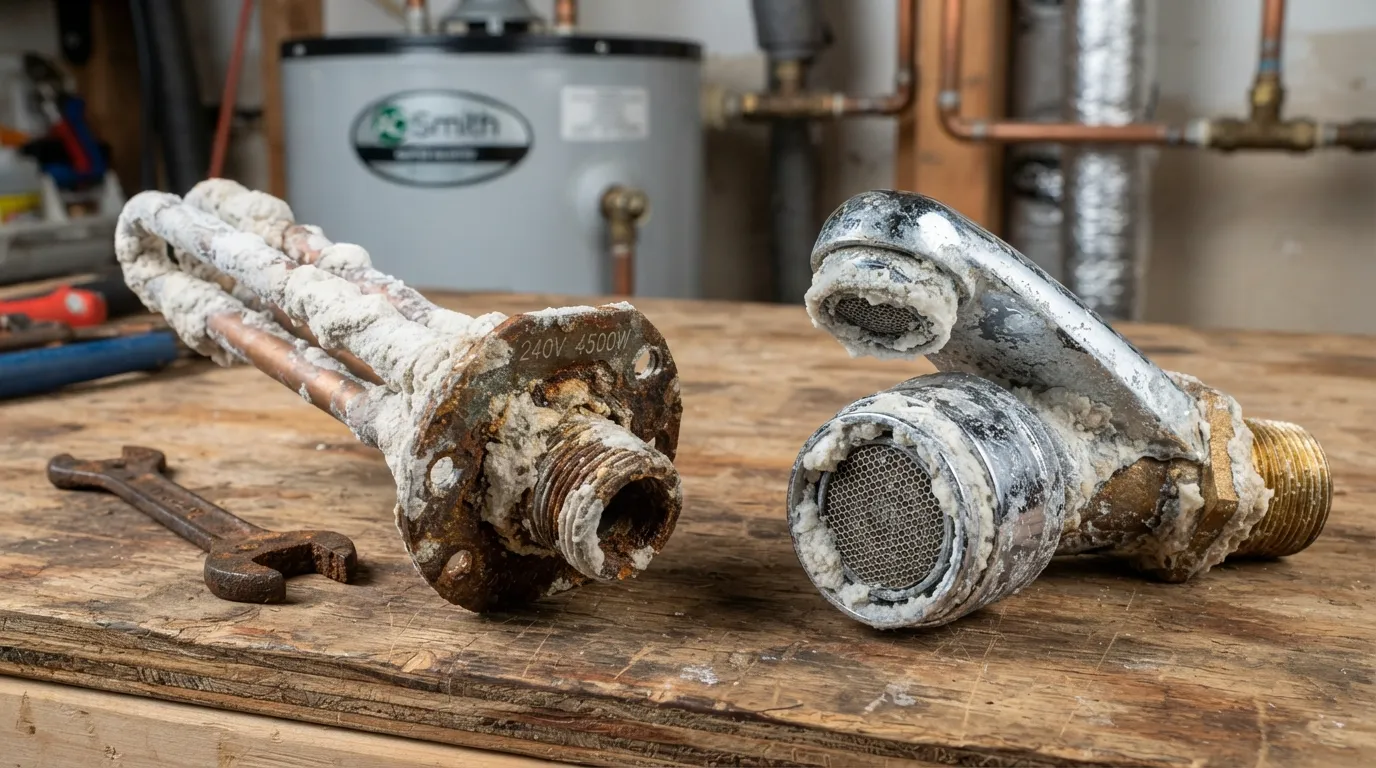
Navigating the market for hard water solutions requires a sharp eye for unrealistic promises and unverified gadgets. While magnetic scale reducers look appealing on paper, relying on them can carry hidden financial risks and lead to costly appliance damage down the road.
The Main Downsides
Installing a magnetic pipe clamp on your incoming water supply comes with several significant drawbacks that homeowners often discover only after experiencing scale-related plumbing issues.
Zero Mineral Reduction: Because magnets do not extract calcium or magnesium, your water remains chemically hard, leaving you to deal with spotty glassware and dry skin.
Inconsistent Real-World Results: The complete lack of standardized performance means your home may see zero noticeable change in scale accumulation on fixtures or appliances.
False Sense of Appliance Protection: Believing a magnetic device protects your tankless water heater or washing machine can lead to skipped maintenance, resulting in premature equipment failure.
Marketing Red Flags to Watch For
Marketers of magnetic and electronic descalers frequently rely on exaggerated language and pseudoscientific jargon to mask the lack of hard data behind their products. Spotting these red flags protects your budget from deceptive sales tactics.
Exaggerated Catchphrases: Be wary of claims promising “instant softening,” “permanent scale removal,” or “100% limescale elimination” from a simple non-invasive pipe clamp.
Vague Technological Authority: Vague references to “space-age technology” or “NASA-tested magnetic fields” without citing peer-reviewed, independently verifiable white papers are major warning signs.
Missing Certifications: Reputable water treatment equipment carries NSF/ANSI standards certifications; magnetic units almost universally lack recognized third-party validation.
What a Trustworthy Product Claim Looks Like
Evaluating water treatment alternatives responsibly means looking for manufacturers that rely on transparent engineering rather than clever marketing tricks. Honest companies clearly define what their products can and cannot do.
Specific and Realistic Scope: Trustworthy brands market their devices as scale conditioners or physical reducers rather than water softeners, explicitly acknowledging that minerals remain in the water.
Transparent Testing Data: Legitimate manufacturers provide accessible, peer-reviewed independent lab test results detailing performance across varying water hardness levels.
Risk-Free Return Guarantees: A reputable company backs its product with a reasonable money-back guarantee, allowing you to test the system on your own water supply without losing your investment.
How Much Money You Could Waste
Purchasing an ineffective magnetic device might seem like a low-risk experiment given their modest upfront price tag, but the true financial danger lies in indirect expenses.
Initial Outlay vs. Value: While spending fifty dollars on a plastic-cased magnet feels harmless, it delivers virtually no return on investment compared to a proven treatment system.
Appliance Degradation Risk: Relying on a false sense of security can lead to heavy mineral scaling inside your plumbing system, resulting in expensive emergency water heater repair and replacement or premature appliance replacement costs that far exceed the price of a proper softener.
Hard Water in Miami and South Florida: What You’re Actually Dealing With
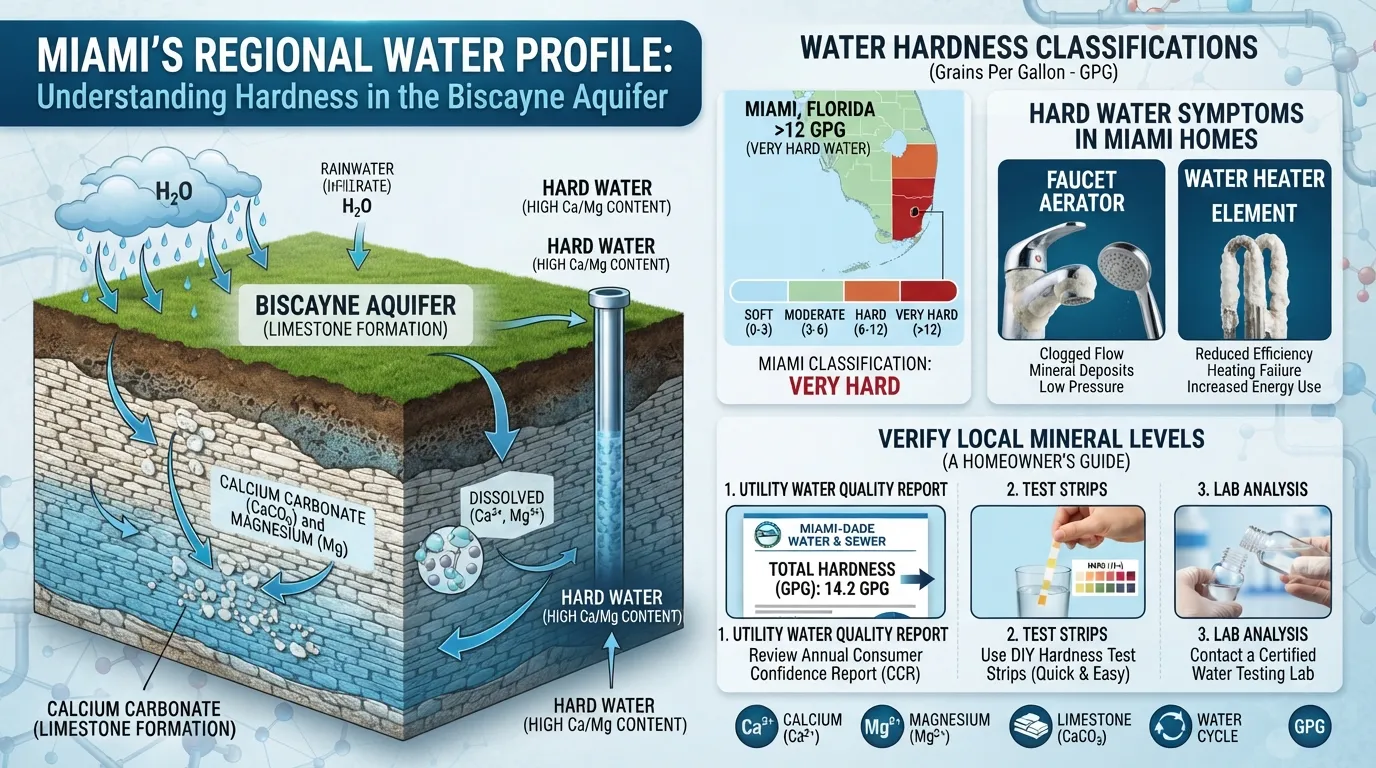
Tackling hard water issues effectively requires understanding your municipal supply’s unique chemistry before investing in any equipment. South Florida homes face distinct mineral challenges that make proper treatment essential for appliance longevity and household comfort.
What Hard Water Is (and Isn’t)
Water hardness is determined strictly by the concentration of dissolved calcium and magnesium minerals picked up as water travels through underground limestone and rock formations. Learning how water hardness is defined clarifies why it behaves the way it does in residential plumbing.
Mineral-Rich Composition: Hardness is measured in parts per million (ppm), milligrams per liter (mg/L), or grains per gallon (GPG), representing the physical weight of dissolved minerals in the supply.
A Nuisance, Not a Danger: While mineral buildup ruins fixtures and stiffens laundry, hard water is entirely safe to drink and does not pose any adverse human health risks.
Why South Florida Water Tends to Leave Scale
South Florida sits atop vast limestone aquifers, meaning local groundwater is naturally saturated with dissolved calcium and magnesium. Regional water utility data confirms that the greater Miami area and surrounding South Florida municipalities consistently fall into the “hard” to “very hard” classification range.
Limestone Aquifer Seepage: As water is pumped from the Biscayne Aquifer and regional wellfields, it dissolves ancient calcium carbonate rock layers, driving up total hardness levels.
Aggressive Scale Potential: With hardness readings frequently exceeding 12 grains per gallon (over 200 mg/L), local water readily deposits stubborn white crusts on heating elements and plumbing fixtures within weeks of installation.
Signs Hard Water Is Affecting Your Home
Recognizing the early warning signs of mineral overload helps you catch plumbing issues before they turn into costly emergencies. South Florida homeowners deal with several distinct symptoms of hard water daily.
Crusted Fixtures and Glass: White, chalky limescale buildup rapidly accumulates around showerheads, faucet aerators, and glass shower doors.
Reduced Appliance Lifespan: Heating elements in water heaters, dishwashers, and washing machines coat over quickly, driving up energy bills and risking premature failure.
Plumbing System Stress: Over time, heavy mineral accumulation restricts interior pipe diameters, frequently leading to low water pressure or hidden leaks that require professional leak detection and repair services.
Stiff Laundry and Dry Skin: Soap struggles to lather properly in hard water, leaving a film on skin and making fabrics feel rigid after washing.
How to Test Your Water Hardness at Home
Pinpointing your exact water hardness ensures you choose a treatment system capable of handling your specific local conditions. Homeowners have several straightforward testing options available.
At-Home Test Strips: Inexpensive dip strips react to mineral concentrations, changing color to give you an immediate reading in ppm or grains per gallon.
TDS Meters vs. Hardness: A Total Dissolved Solids (TDS) meter measures all dissolved matter in water, but it cannot differentiate between harmless minerals and harmful contaminants, making dedicated hardness test kits necessary.
Consumer Confidence Reports: Reviewing your local municipal water quality report or sending a sample to an independent certified laboratory provides the most precise baseline data.
Before-and-After Testing Tip
Evaluating whether a water treatment device actually works requires a controlled, empirical approach rather than relying on guesswork. Proper testing prevents you from keeping an ineffective system.
Baseline Testing: Test your water’s hardness using a reliable drop-titration kit or test strip immediately before installing any conditioner or softener to record your starting numbers.
Post-Installation Audit: Run the system for at least four to six weeks under normal household water usage, then test the water again at the exact same tap.
The Reality Check: If your post-installation test shows identical mineral levels and hardness measurements, your system has altered nothing chemically, proving that passive devices deliver no physical softening effect.
I Already Installed a Magnetic Softener. What Now?
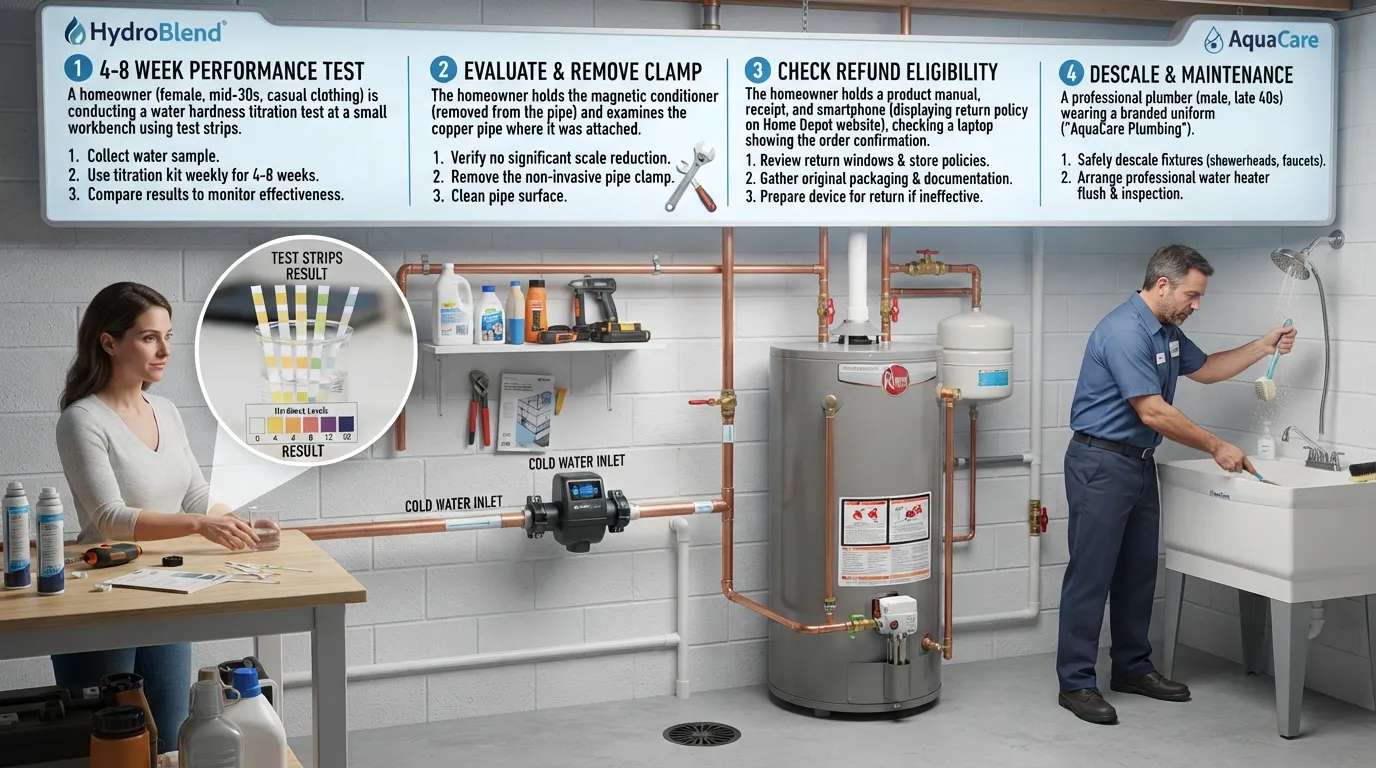
Realizing you may have installed an ineffective magnetic water treatment device can be frustrating, but you have several practical options to verify its performance and protect your home. Rather than guessing whether your purchase is working, you can take systematic steps to evaluate the system, explore your refund options, and safely clean up existing mineral deposits.
Is It Doing Anything? How to Check
Evaluating a magnetic scale reducer requires a structured, empirical approach rather than relying on visual impressions after a quick wipe down. Testing your water before and after a multi-week trial provides an objective verdict.
Establish a Water Hardness Baseline: Use a reliable drop-titration test kit or test strip to record your water’s exact hardness in grains per gallon (gpg) or parts per million (ppm) on day one.
Run a 4 to 8-Week Trial: Allow the device to operate uninterrupted under normal household water consumption patterns for at least one to two months.
Perform a Post-Installation Test: Retest the water using the exact same method and test kit at the same tap, comparing the mineral numbers to your initial baseline to check for any reduction.
Should You Remove It?
If your tests confirm that the device is doing nothing to alter your water chemistry, you face a choice regarding whether to take it off your plumbing line.
Harmless to Leave Attached: Because magnetic clamps are non-invasive and sit entirely on the outside of the pipe without restricting water flow, leaving the device in place causes no physical harm to your plumbing.
Avoid False Security: Never rely on a passive magnet to protect major appliances like tankless water heaters or dishwashers from heavy mineral scaling.
Check Your Return Window: Look up your purchase date immediately to see if you are still within the manufacturer’s money-back guarantee or retail return window.
How to Get a Refund or Return
If you decide to remove an ineffective magnetic descaler, securing your money back depends on following the manufacturer or retailer guidelines carefully.
Review the Return Policy: Check the seller’s terms to identify any specific time limits, restocking fees, or trial-period requirements attached to the purchase.
Gather Proof of Purchase: Locate your original receipt, online order confirmation, and any warranty registration documents.
Document Your Findings: Keep a record of your before-and-after test strip results or notes from your trial period, as some customer support teams request troubleshooting notes for returns.
Cleaning Up Existing Scale Safely
If hard water scale has already accumulated on your plumbing fixtures, removing it safely restores water flow and appearance without damaging finishes.
Soak Removable Fixtures: Detach aerators and showerheads, then soak them in warm distilled white vinegar for 30 to 60 minutes to dissolve mineral crusts before gently scrubbing with a soft brush.
Wipe Down Surfaces: Use a mild acid-based cleaner or vinegar solution to wipe down faucets and glass doors regularly, preventing thick layers of limescale from cementing onto surfaces.
Call for Professional Maintenance: If stubborn scale has heavily impacted your appliances or internal plumbing lines, reach out to a licensed professional plumber to inspect your system and flush out your water heater tank safely.
What Actually Works for Hard Water?
Navigating the crowded marketplace of hard water solutions can feel overwhelming, but science and plumbing experience clearly separate gimmicks from genuine performance. Choosing the right system depends entirely on your specific household needs, water hardness levels, and personal preferences regarding maintenance and water feel.
Best Option by Problem
Matching your specific hard water nuisance to the correct technology ensures you invest your money wisely the first time around.
| Your Problem | Best Option | Why |
| Whole-home scale | Salt-Based Ion Exchange Softener or TAC Salt-Free System | They either remove minerals entirely or neutralize their bonding capability across every pipe. |
| Water heater protection | Salt-Based Softener or Annual Flushing | Eliminates mineral precipitation or manually clears accumulated sediment before it ruins the tank. |
| Spotted dishes | Reverse Osmosis (RO) System or Salt-Based Softener | Removes total dissolved solids or calcium ions that cause spotty glassware during drying. |
| Shower and skin concerns | Salt-Based Ion Exchange Softener | True mineral removal stops soap scum buildup, leaving hair and skin feeling clean and soft. |
| Drinking water taste | Point-of-Use Reverse Osmosis Filter | Dedicated under-sink filtration purifies water for drinking and cooking by stripping out minerals and impurities. |
Salt-Based Softeners: The Proven Choice
When it comes to completely eliminating hard water throughout an entire home, salt-based ion-exchange systems remain the gold standard backed by decades of proven plumbing reliability.
Complete Mineral Removal: They actively extract calcium and magnesium from your supply, preventing scale and providing luxurious suds.
Maintenance Requirements: Systems require regular salt bag refills every few months and occasional brine tank cleaning to operate efficiently.
The Sodium Consideration: Softened water contains a tiny amount of sodium added during ion exchange, though it is generally negligible for healthy diets (amounting to less than a slice of white bread per glass).
Other Options
If a traditional salt-based system does not fit your lifestyle or home layout, several alternative approaches offer varying degrees of scale control and water improvement.
Salt-Free TAC Conditioners: Template-Assisted Crystallization systems convert minerals into inert micro-crystals without adding salt or electricity, protecting pipes without making water feel slippery.
Point-of-Use Filters: Under-sink carbon filters or reverse osmosis units target specific drinking and cooking taps, ensuring high purity where it matters most.
Regular Preventive Maintenance: Routine water heater flushing and fixture descaling help manage mineral buildup if you choose not to install a whole-house treatment system.
Protecting Your Water Heater From Scale
Hard water takes its heaviest toll on your water heater, where high temperatures accelerate mineral precipitation and layer heating elements with insulating scale crusts.
Annual Flushing Schedule: Draining your tank once a year clears out loose sediment before it hardens against the bottom burner or lower electric element.
Anode Rod Inspection: Checking and replacing your sacrificial anode rod every few years prevents galvanic corrosion and extends the overall lifespan of the tank.
Warning Signs: Rumbling noises, popping sounds during heating cycles, or a noticeable drop in hot water capacity indicate heavy sediment buildup requiring professional water heater services.
When to Call a Plumber
While basic fixture cleaning and routine filter swaps are manageable DIY tasks, complex hard water damage and plumbing system wear demand professional expertise.
Persistent Performance Issues: If you notice sudden drops in hot water pressure, recurring faucet clogs, or unexplained pipe leaks, it is time to book a plumbing visit for a comprehensive diagnostic check.
Tank Failure Risks: Leaking water heater bases, persistent pilot light failures, or rusted tank seams require immediate licensed plumbing intervention to prevent catastrophic property damage.
What About Drinking Magnetized Water?

Beyond residential plumbing and scale prevention, the market for magnetic water devices frequently crosses into personal wellness territory. Promoters often market “magnetized water” as a health tonic, leading many consumers to wonder whether drinking water exposed to magnets offers real benefits.
What Is Magnetized Water?
Magnetized water is regular tap or bottled water that has been passed through or stored near a magnetic field.
The Core Concept: Proponents claim that the magnetic exposure realigns water molecules and alters their cluster size or physical properties.
Intended Use: Marketers suggest drinking this water to improve digestion, boost metabolism, enhance cellular hydration, and balance bodily pH levels.
Claimed Benefits vs Evidence
While wellness blogs and alternative health sites heavily promote magnetized water, rigorous scientific validation for these health claims remains virtually nonexistent.
Limited Scientific Evidence: Clinical studies supporting the health benefits of drinking water exposed to magnetic fields are extremely sparse, poorly controlled, and lack replication in mainstream medical research.
No Proven Therapeutic Effect: There is no credible biochemical mechanism showing that temporary exposure to a static magnet alters water’s interaction with human biology or digestion.
Consult a Healthcare Professional: Anyone considering alternative wellness trends or managing specific health conditions should consult a qualified medical doctor before altering their health or hydration routines.
Does It Matter for Household Plumbing?
It is important to keep health claims entirely separate from the mechanical reality of your home plumbing system.
Different Spheres of Performance: Whether a magnetic field theoretically changes drinking water properties has no bearing on its ability to stop calcium carbonate from crusting up your water heater.
Magnetic devices fail to soften household water or reliably prevent limescale, regardless of any unproven wellness claims associated with drinking the water they treat.
Frequently Asked Questions About Magnetic Water Softeners
Got questions about how magnetic water treatment systems stack up against reality? Here are direct, evidence-based answers to the most common questions homeowners ask about magnetic softeners, scale reducers, and water conditioning alternatives.
Do magnetic water softeners actually work?
Magnetic water softeners do not actually soften water. Independent scientific tests and plumbing inspections show that permanent magnets clamped to pipes fail to remove calcium and magnesium minerals, leaving water chemistry completely unchanged and allowing limescale to continue forming on heating elements and fixtures.
Do magnets on water pipes work?
Magnets placed on water pipes do not soften water or reliably prevent limescale accumulation. While manufacturers claim magnetic fields alter crystal structures, rigorous laboratory evaluations and field studies confirm they provide no consistent, measurable, or lasting protection against hard water scale.
Do magnetic limescale removers work?
Magnetic limescale removers do not reliably remove or prevent limescale in real-world residential plumbing. Although some users report slightly softer scale texture due to placebo effects or cleaning habits, independent engineering studies prove they cannot substitute for true mineral removal systems.
How do magnetic scale reducers work?
Magnetic scale reducers work by using permanent neodymium magnets or magnetic strips clamped to the exterior of incoming water pipes. Manufacturers claim the magnetic field alters dissolved calcium carbonate, changing hard calcite crystals into loose aragonite micro-crystals that flow down the drain rather than sticking to pipes.
How do magnets affect water?
Magnets do not chemically alter or physically remove dissolved minerals in flowing water. Water chemistry assays confirm that passing water through a static magnetic field leaves mineral parts-per-million, ion concentration, and total dissolved solids entirely unaffected.
What are the downsides of using magnetic water treatment?
The main downsides of using magnetic water treatment include zero mineral reduction, inconsistent real-world scale prevention, and a false sense of appliance security. Relying on an ineffective magnet can lead to heavy limescale buildup, damaged water heaters, and wasted money on unverified technology.
What is the difference between electrolytic and magnetic scale inhibitors?
The difference between electrolytic and magnetic scale inhibitors lies in their power source and mechanism. Magnetic inhibitors use static permanent magnets clamped to pipes, whereas electrolytic or electronic descalers use household electricity to deliver low-voltage electrical or electromagnetic pulses through coils or electrodes.
What is the best limescale reducer?
The best limescale reducer depends on your household needs and budget. Salt-based ion-exchange softeners offer complete mineral removal, Template-Assisted Crystallization (TAC) systems neutralize scale without adding salt, and annual water heater flushing provides reliable mechanical protection.
What are the benefits of drinking magnetized water?
The benefits of drinking magnetized water lack rigorous scientific support. While alternative wellness claims suggest magnetized water improves digestion or hydration, there is no clinical evidence or proven biochemical mechanism showing that temporary magnetic exposure alters water’s impact on human health.
Does water demagnetize magnets?
Water flowing past a permanent magnet does not demagnetize it. High-quality neodymium magnets maintain their magnetic strength indefinitely under normal residential plumbing temperatures, though physical degradation, extreme heat, or physical impact can reduce their strength over time.
Do electronic water softeners work?
Electronic water softeners do not genuinely soften water or remove hardness minerals. Like static magnetic clamps, electronic or electromagnetic descalers lack independent scientific backing proving they reliably prevent scale formation or protect water heaters in standard residential conditions.
Are magnetic water softeners worth it?
Magnetic water softeners are rarely worth the investment when dealing with genuine hard water. Community reviews on Reddit and consumer forums show mixed opinions, but because scientific tests confirm they fail to remove minerals or stop scale, homeowners seeking real protection are better off choosing proven salt-based or TAC systems.
The Bottom Line on Magnetic Water Softeners
Navigating hard water solutions requires clear facts, reliable testing, and a realistic understanding of what different systems can achieve. While magnetic pipe clamps promise an effortless fix, independent research and practical plumbing experience confirm they cannot replace true water softening.
Final Verdict in Three Lines
Do not rely on external magnets to soften your water or stop heavy limescale accumulation. Test your home water supply accurately to understand your specific mineral levels before purchasing any equipment. Choose a proven treatment system or maintenance routine tailored to your actual plumbing needs.
Need Help With Scale or Water Heater Problems?
Dealing with stubborn scale damage to your water heater, fixtures, and internal plumbing pipes requires professional expertise and reliable solutions. If hard water has already taken a toll on your home systems, our licensed team is here to help diagnose and resolve the issue.
Expert Diagnostics: We inspect your plumbing, water heater efficiency, and mineral buildup to recommend the right course of action.
Transparent Service: Get straightforward advice on maintenance, repairs, or proven whole-home treatment options.
Take Action: Ready to protect your home from mineral damage? You can schedule a plumbing appointment with our team today.
About the Author / Reviewed By
This guide was authored and reviewed by experienced licensed plumbing professionals with over fifteen years of hands-on service in the South Florida residential market. Our team specializes in diagnosing hard water damage, maintaining water heaters, and helping homeowners select reliable plumbing solutions. As an independent service provider, we do not sell water softeners or magnetic gadgets, ensuring our recommendations remain completely objective and focused on protecting your home.
Main Services
Related Posts
Need a Plumber in Miami?
Schedule service online or speak directly with the EZ Plumbing team.
Owner-Led Local Service
Know who is behind the business before you request service. The owners, contact line and Miami service pages are published clearly.
- Named business owners
- Direct phone and social channels
- Local Miami service information
Clear Help Before You Book
Review the relevant service page, contact the team directly and use the booking page when you are ready—without relying on vague claims.
- Service-specific information
- Direct questions before scheduling
- Clear online booking route