Trenchless Sewer Repair: How It Works and What It Costs in 2026
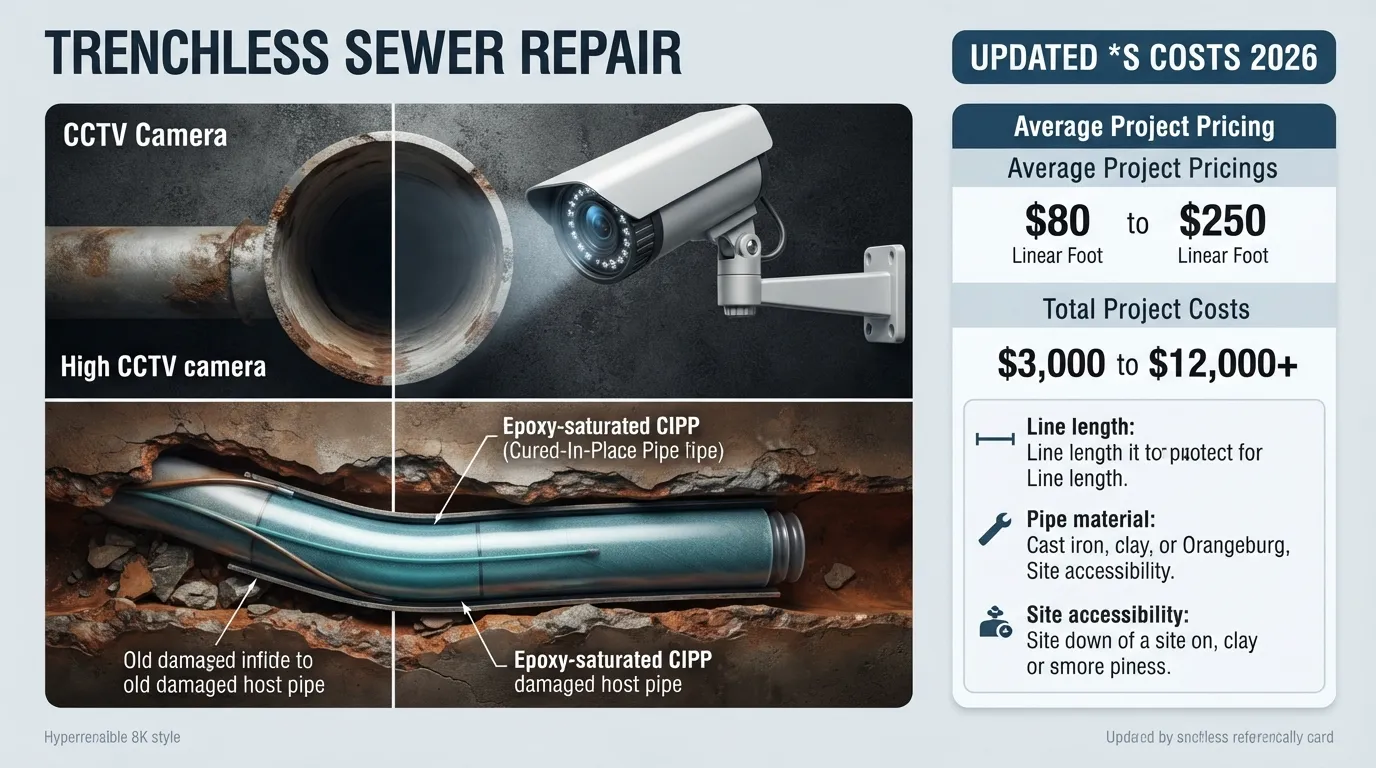
Trenchless Sewer Repair at a Glance
Trenchless sewer repair is an advanced, non-invasive plumbing method that repairs or replaces underground sewer lines through small entry access points instead of utilizing traditional excavation. By avoiding heavy trenching, property owners save significant time and prevent extensive landscape damage.
What Is Trenchless Sewer Repair?
Trenchless sewer repair utilizes specialized technologies—such as CIPP lining and pipe bursting—to fix damaged pipes from the inside out. Instead of digging up entire yards, driveways, or patios, technicians only need one or two small access pits to rehabilitate the line. This modern approach restores structural integrity quickly while keeping your surface infrastructure completely intact.
Quick Cost Snapshot
| Repair Method | Cost Per Linear Foot | Typical Total Project Range |
|---|---|---|
| CIPP Lining | $80 – $250 | $3,000 – $10,000 |
| Pipe Bursting | $150 – $300 | $4,000 – $15,000 |
| Spot Repair | $900 – $2,500 per section | $900 – $2,500 |
Is Trenchless Right for You? (30-Second Answer)
Best Fit: Ideal for properties with minor structural cracks, root intrusion, or pipes running beneath expensive landscaping, concrete driveways, or municipal structures where avoiding excavation preserves major replacement costs.
Anta PlumbingNot Suitable: Generally unviable if the pipe has experienced a complete structural collapse with severe offset fragments, or if the pipe layout has multiple complex 90-degree bends that prevent pulling new lining or equipment through.
Decision Framework: If your line maintains basic alignment and you want to protect your yard from destructive digging, trenchless options like no-dig sewer repair or sewer line replacement provide a faster, cleaner solution.
Warning Signs You May Need Sewer Line Repair
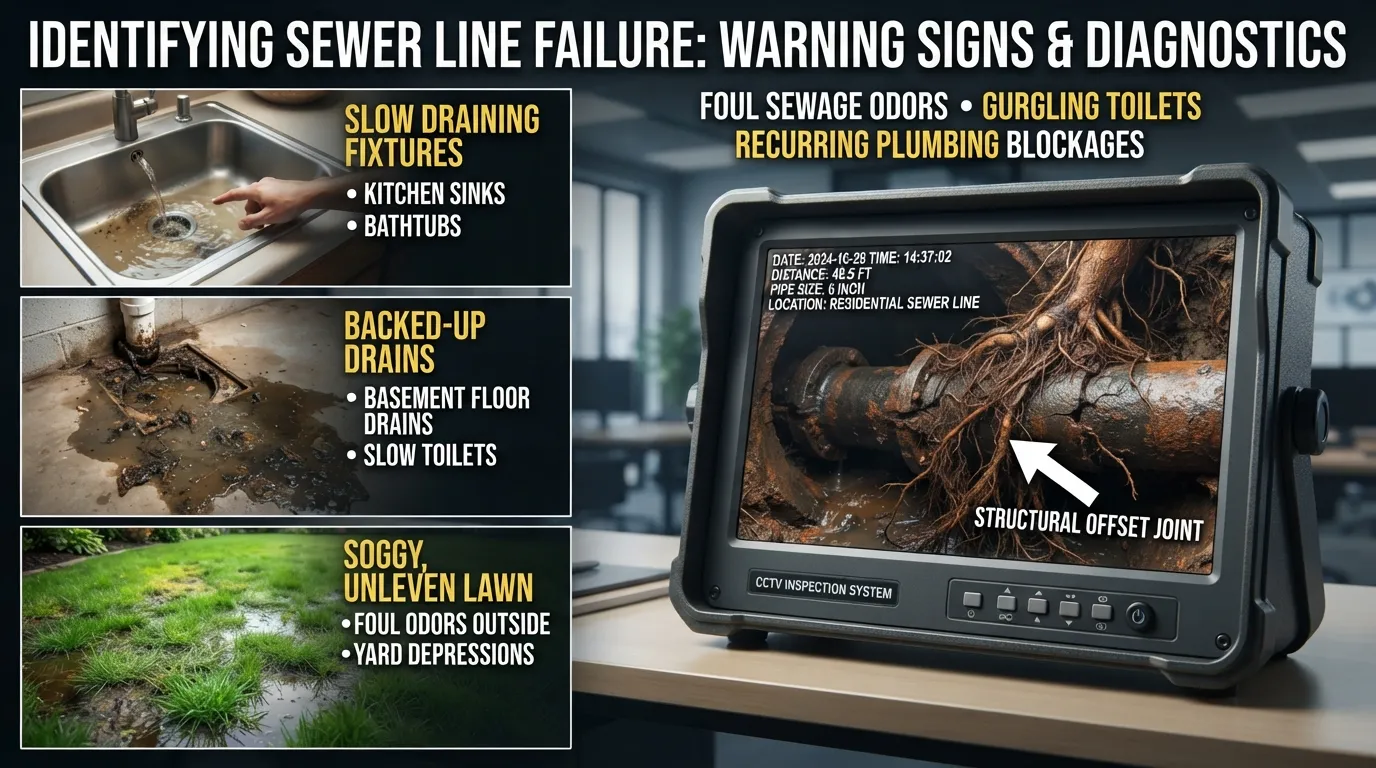
Recognizing early indicators of sewer line failure prevents catastrophic property damage and costly structural disasters. Property owners experiencing a recurring clog should consider that it might actually be a symptom, not the root cause, requiring professional drain cleaning combined with an evaluation.
Common Symptoms of a Damaged Sewer Line
Slow Drains and Multiple Fixtures: When multiple sinks, tubs, and toilets drain sluggishly at the same time, the blockage is typically deep within the main lateral line rather than a single fixture trap.
Repeated Sewer Backups: Frequent overflows in lower-level toilets or floor drains indicate severe flow restrictions or a cracked pipe holding back wastewater.
Gurgling Toilets and Drains: Air bubbles trapped in the plumbing system create gurgling sounds when appliances like washing machines or toilets discharge water.
Unpleasant Sewage Odors: Foul smells lingering in your basement, yard, or crawlspace signal that sewer gases are escaping through a fissure or break.
Soggy or Unusually Green Yard Patches: Unexplained wet spots, foul-smelling puddles, or exceptionally lush, vibrant grass patches often point to an underground leak acting as natural fertilizer.
Foundation Cracks and Settlement: Escaping wastewater can erode soil stability beneath your home, causing structural shifts and foundation cracks.
What Causes Sewer Line Damage?
Aggressive Tree Root Intrusion: Fast-growing roots seek out moisture and nutrients inside pipe joints, expanding hairline cracks into complete breaks.
Aging and Deteriorating Materials: Older properties feature fragile legacy infrastructure such as clay pipes, cast iron, or deteriorated Orangeburg fiber conduits that degrade over time.
Ground Shifting and Soil Movement: Earth settlement, seismic activity, or heavy vehicle traffic above ground can stress the pipe network, causing a belly/sag or a fully collapsed pipe.
Grease and Debris Buildup: Accumulated fats, oils, grease, and non-flushable items constrict internal diameters, increasing hydraulic pressure until lines fracture.
Technician Insight: The most common cause we see in older Miami homes is heavy root intrusion chewing through aging clay and cast-iron lateral lines, exacerbated by shifting, moisture-rich soils.
Why a Camera Inspection Comes First
Before any digging or rehabilitative procedure begins, technicians insert a high-definition fiber-optic camera into the lateral line to diagnose the exact problem. This non-guesswork step identifies structural faults, exact depths, and optimal repair paths, leading directly into our detailed sewer scoping methodology discussed in the next section.
When a Backup Is an Emergency
Active Sewage Overflow: Standing wastewater backing up into bathtubs, showers, or living spaces creates an immediate biohazard and health risk.
Immediate Action Steps: Stop using all indoor water sources immediately to prevent further contamination of your living areas.
Professional Intervention: Contact a trusted emergency plumber right away to extract wastewater, sanitize the affected zone, and clear or repair the compromised line safely.
How Trenchless Sewer Repair Works, Step by Step
Trenchless sewer repair rehabilitates damaged underground infrastructure efficiently through a streamlined multi-stage methodology. By leveraging advanced diagnostics and specialized equipment, professional sewer line services restore pipe functionality without destroying your property.
Step 1: Video Sewer Inspection
A high-resolution sewer camera is pushed through the line to accurately map out structural defects. This diagnostic phase records exact measurements, locating root intrusions, cracks, offsets, and overall pipe condition before any work begins.
Camera Inspection Insight: Below are real technician captures from our diagnostic assessments.
Figure 1: Heavy root intrusion choking a residential lateral line, identified via fiber-optic camera.
Figure 2: Severe pipe wall fracture and joint displacement requiring structural rehabilitation.
Step 2: Cleaning the Line
Before any lining or bursting can occur, the interior pipe walls must be scoured clean. Technicians use high-pressure hydro-jetting and drain cleaning techniques or mechanical snakes to strip away grease, mineral scale, and intrusive roots.
High-pressure water jets scour away stubborn debris down to the bare pipe wall.
Mechanical cutting heads slice through thick root masses blocking the flow path.
Thorough cleaning guarantees maximum bonding adhesion for subsequent lining materials.
Step 3: Choosing the Repair Method
Following the pipeline assessment, technicians evaluate structural data, material type, bury depth, and run length. This critical step dictates whether CIPP lining or pipe bursting represents the optimal engineering fit for your specific layout.
Step 4: Installing the New Pipe or Liner
The chosen rehabilitation technique is deployed through existing access points to construct a seamless structural conduit. Whether pulling a resin-saturated textile tube or bursting the old pipe outward while simultaneously pulling a high-density polyethylene replacement, this phase renews the pipeline’s longevity.
Step 5: Final Inspection and Testing
A mandatory post-repair inspection camera run is executed to verify flawless liner expansion or pipe placement.
Technicians perform comprehensive water flow tests to ensure wastewater discharges smoothly without obstructions.
Final sign-off guarantees the newly installed structural barrier meets all local plumbing code requirements.
What Homeowners Can Expect on Repair Day
Access Points: Technicians utilize existing cleanouts or small, strategic entry pits rather than excavating long trenches.
Noise and Timelines: Expect standard equipment operation sounds, with most residential projects successfully completed within a single day.
Water Shut-Off Window: Temporary indoor water restrictions apply for a few hours while technicians cure or install the new structural liner.
Minimal Yard Disruption: Your landscaping, hardscaping, and driveway remain completely intact, eliminating costly post-repair property restoration.
Types of Trenchless Sewer Repair: CIPP Lining vs. Pipe Bursting vs. Spot Repair
Selecting the appropriate trenchless rehabilitation method depends heavily on structural assessments, material composition, and pipeline damage severity. Understanding how each technique operates ensures property owners make an informed investment that secures long-term hydraulic performance.
CIPP Lining (Cured-in-Place Pipe)
CIPP lining creates a seamless structural “pipe within a pipe” by pulling a flexible, resin-coated liner through the damaged conduit. Once inflated against the host pipe walls, the resin is hardened using UV curing or steam curing to form a corrosion-resistant barrier. This method preserves optimal pipe diameter while sealing cracks, root entry points, and minor misalignments completely.
Pipe Bursting
Pipe bursting replaces heavily deteriorated or fractured lines by pulling a heavy-duty steel bursting head through the old conduit. As the bursting head advances, it forcefully fractures the legacy pipe outward into the surrounding soil while simultaneously pulling a seamless, durable HDPE pipe into its place. This approach accommodates full structural replacements without digging up the yard.
Spot (Sectional) Repair
Spot repair targets isolated structural defects, localized cracks, or single broken joints without rehabilitating the entire lateral run. Technicians deploy a shortened resin liner directly over the damaged area via a pneumatic packer, creating a durable localized patch that saves on overall project costs.
Epoxy Pipe Relining vs. CIPP: What’s the Difference?
Epoxy Relining: Typically applied to smaller diameter interior plumbing (such as potable water or vent lines) using atomized epoxy coatings blown through dried pipes.
CIPP Lining: Designed specifically for larger-diameter underground lateral and main sewer lines, utilizing structural felt tubes saturated with advanced thermosetting resins.
Cost Considerations: Evaluating epoxy pipe relining cost versus full structural CIPP depends entirely on whether you are treating pressurized interior water pipes or gravity-fed exterior drainage networks.
Side-by-Side Comparison Table
| Feature | CIPP Lining | Pipe Bursting | Spot Repair |
| Best For | Cracks, root intrusion, corrosion | Collapsed, severely offset, or decayed lines | Single localized breaks or faulty joints |
| Pipe Condition Required | Structurally sound host pipe | Any condition (replaces old pipe entirely) | Intact pipe except for one specific damaged area |
| Cost Per Foot | $80 – $250 | $150 – $300 | $900 – $2,500 total per section |
| Disruption | Minimal (existing access points used) | Minimal (small entry/exit pits required) | Extremely minimal (single targeted access) |
| Lifespan | 50+ years | 50+ years | 30 – 50 years |
| Limitations | Unviable on fully collapsed pipes | Requires adequate clearance for pulling gear | Only fixes isolated, short-distance damage |
Which Method Fits Your Situation?
Minor Cracks or Root Damage: Choose CIPP lining to reinforce aging walls and seal out root intrusions while maintaining smooth internal flow.
Collapsed or Heavily Deteriorated Pipe: Choose pipe bursting when structural integrity is completely lost and a brand-new HDPE pipe is required.
Single Damaged Section: Choose spot repair if your overall sewer line services inspection shows pristine conditions everywhere except for one isolated fracture.
Is Trenchless Cheaper Than Traditional Digging?
Evaluating whether trenchless sewer repair is more affordable requires looking beyond simple per-foot estimates to examine the total economic impact. While upfront material costs for trenchless methods can sometimes mirror or slightly exceed open-trench techniques, factoring in property restoration makes trenchless technology significantly more cost-effective for most homeowners.
Per-Foot Cost: Trenchless vs. Excavation
Direct Installation Fees: On a strict per-linear-foot basis, trenchless lining and pipe bursting generally range from $80 to $300 per foot, while open-trench excavation often ranges from $50 to $200 per foot.
Why Upfront Rates Vary: Trenchless methods require specialized resin materials, advanced machinery, and certified technician training, whereas traditional digging relies primarily on heavy excavation equipment and manual labor.
The Initial Misconception: Homeowners examining only the raw installation quote may mistakenly assume traditional digging is cheaper, missing the hidden expenses tied to property destruction.
The Real Difference: Restoration Costs
Landscape Destruction: Traditional excavation requires digging a deep trench directly above your sewer line, which often destroys lawns, mature flower beds, and custom landscaping.
Hardscape Demolition: If your sewer line runs beneath a concrete driveway, paver patio, or municipal sidewalk, open trenching requires destroying and subsequently repaving those surfaces.
Restoration Overheads: Rebuilding a stamped concrete driveway or replacing professional landscaping can easily add $3,000 to $10,000+ in secondary restoration costs, shifting the true financial burden heavily toward traditional digging.
Total Cost Comparison Table
| Expense Category | Trenchless Sewer Repair | Traditional Open-Trench Excavation |
| Pipe Repair / Replacement | $3,000 – $15,000 | $2,500 – $12,000 |
| Excavation & Labor | Included (Access pit method) | Heavy digging and trench backfilling |
| Surface & Landscaping Restoration | $0 – $500 (Minimal turf patch) | $2,000 – $10,000+ (Driveway/paver/lawn rebuild) |
| Typical Project Timeline | 1 to 2 Days | 3 to 7+ Days |
| Property Disruption Level | Extremely Low | High (Yard rendered unusable) |
Worked Cost Example (Estimated): Consider a project where a damaged 50-foot sewer line runs beneath an established front lawn and concrete walkway. A trenchless CIPP quote might total $6,000 with negligible cleanup. Conversely, an open-trench quote might start at $4,500 for digging, but add $4,000 in concrete and landscape restoration—bringing the true comparative total to $8,500. In scenarios like this, trenchless methods can deliver estimated net savings of 30% to 40% on the overall project investment.
When Traditional Excavation Still Makes Sense
Complete Structural Collapse: If a pipe is totally crushed or fragmented to the point where new liners or bursting heads cannot physically pass through, digging is unavoidable.
Severe Grade Bends: Extreme, unauthorized 90-degree offsets or incorrect original plumbing layouts may prevent pulling equipment through underground runs.
Full System Redesign: If you need to completely reroute your main sewer line path away from its current location, traditional excavation provides the flexibility required to redesign the layout.
Downsides and Limitations of Trenchless Sewer Repair
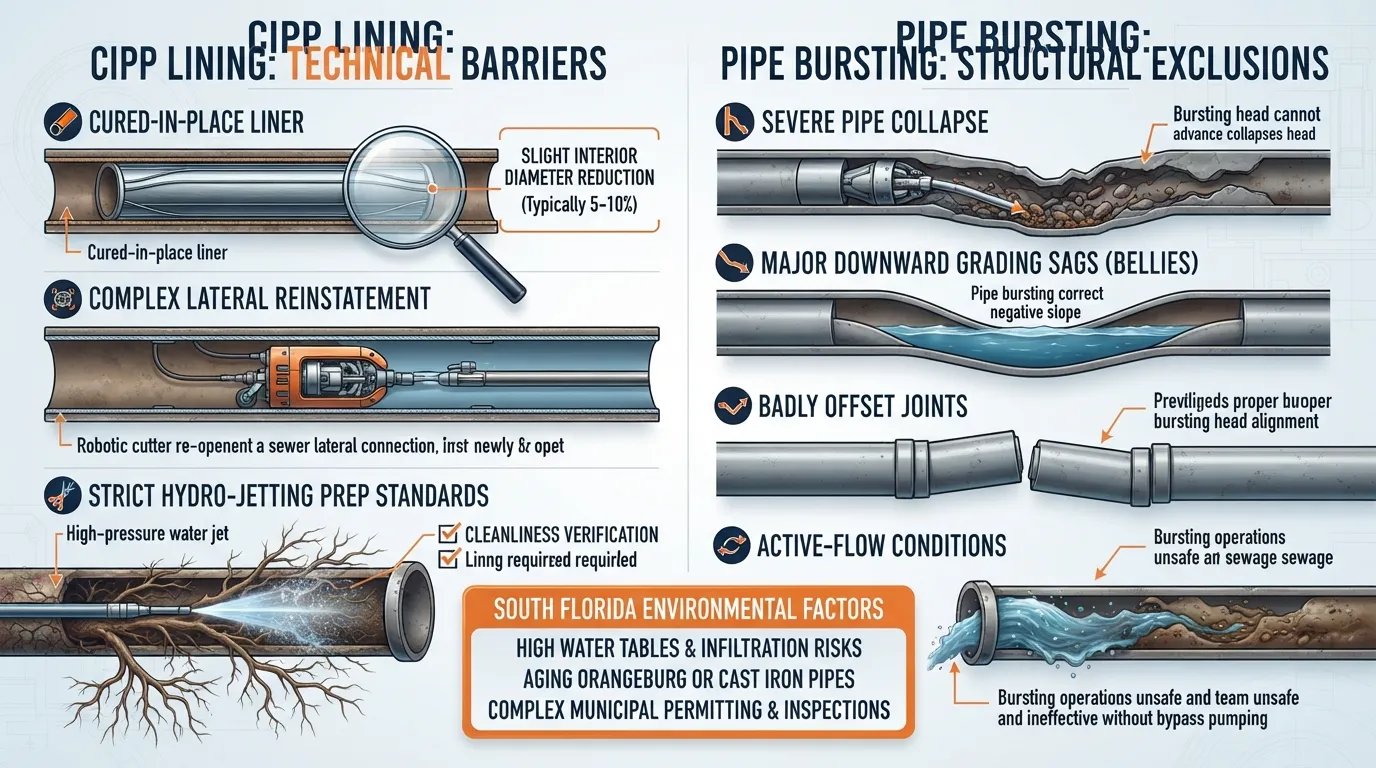
Trenchless sewer repair is not a universal fix, despite its minimal lawn disruption and speed. Understanding its mechanical and site-specific limitations prevents costly installation failures, failed inspections, and premature system backups.
When Trenchless Won’t Work
Trenchless methods require a structurally viable host pipe to line or burst through. Severe structural damage completely compromises the pathway, making trenchless rehabilitation impossible.
Severe Structural Collapse: If a pipe has completely caved in, no cleaning cable or inversion bladder can pass through to execute Cured-In-Place Pipe (CIPP).
Major Bellies and Sags: Severe downward grading shifts create low points where water and sludge pool. Lining or bursting follows the existing path, leaving the drainage sag uncorrected.
Badly Offset Joints: Displaced joints exceeding pipe tolerance block the entry of lining equipment or disrupt bursting heads mid-run.
Active-Flow Conditions: Heavy continuous water infiltration prevents proper resin curing for CIPP or floods excavation pits during pipe bursting.
Field Note: On a historic residential project in Coral Gables, our team had to pivot from CIPP to traditional open-cut excavation because a 15-foot section of cast iron had completely disintegrated into the surrounding soil. Forcing a trenchless liner through zero structural substrate would have resulted in immediate collapse under soil load.
Disadvantages of CIPP Lining
CIPP lining saves landscaping, but it introduces minor mechanical trade-offs within the rehabilitated pipe run.
Slight Diameter Reduction: The epoxy-saturated felt or fiberglass tube adds a nominal thickness to the interior wall, slightly reducing interior pipe diameter and flow capacity.
Lateral Reinstatement Precision: After lining the main sewer line, robotic cutters must reopen connections to branch lines from the inside. Quality depends entirely on operator skill to prevent jagged edges that catch debris.
Rigorous Prep Requirements: The host pipe must undergo high-pressure hydro-jetting and root-cutting. Any missed grease or scale prevents the epoxy resin from bonding to the pipe wall.
Disadvantages of Pipe Bursting
Pipe bursting replaces the old line by pulling a new HDPE pipe through while fracturing the legacy pipe outward. It remains a trench-reliant process at key access points.
Pit Excavations Required: Installers must dig entry and exit pits—often 4×6 feet or larger—to insert the bursting head and receive the new pipe, impacting driveways or porches.
Utility Strike Risks: Because the old pipe shatters outward into the surrounding soil, unmarked nearby gas lines, water mains, or fiber optics face high disruption risks.
Soil Displacement Pressure: The outward force required to crack rigid clay or cast iron can shift surrounding soil and potentially stress adjacent underground infrastructure.
Installer Quality Matters
Trenchless rehabilitation relies heavily on specialized chemistry, precise pull rates, and strict adherence to engineering protocols. Poor workmanship results in uncured resin, delamination, or structural voids.
Industry oversight relies heavily on guidelines established by the NASSCO target=”_blank”}, which sets the baseline for pipeline assessment and rehabilitation certification. Professional installations must strictly follow ASTM standards for resin properties, wall thickness calculations, and pull-in tensions to ensure a 50-year design life.
Miami-Area Considerations
South Florida presents unique geotechnical and municipal challenges that dictate whether trenchless methods succeed or fail.
Aggressive Pipe Materials: Older properties across Miami-Dade frequently feature decaying Orangeburg, fragile clay, or heavily corroded cast iron weakened by decades of high soil acidity.
High Water Table: Shallow groundwater tables require continuous dewatering pumps during pit excavation for pipe bursting to keep work areas stable.
Local Permit Enforcement: Municipalities require specific engineering sign-offs, right-of-way bonds, and plumbing permits before executing major sewer overhauls.
How Long Does Trenchless Sewer Repair Take and How Long Does It Last?
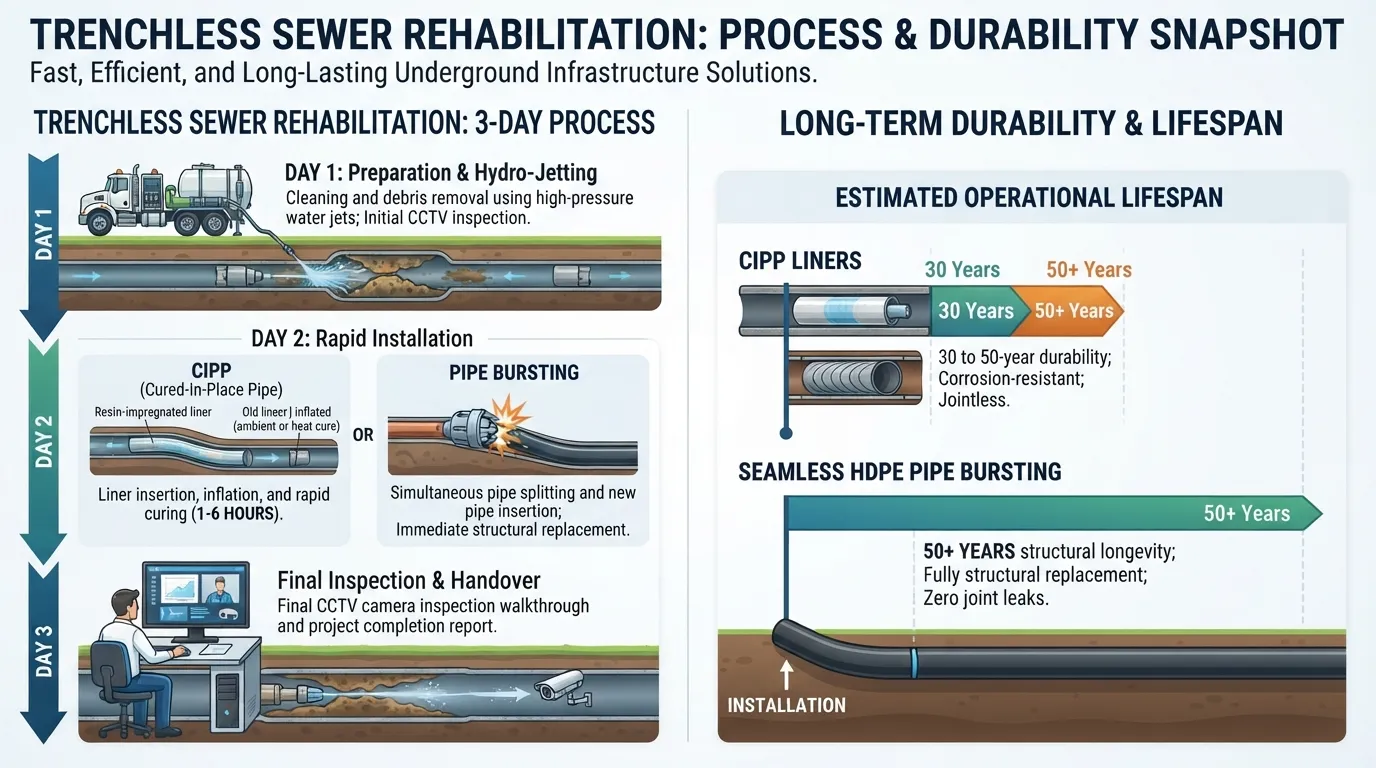
Trenchless sewer repairs dramatically reduce project timelines and offer decades of structural reliability compared to traditional open-cut methods. Understanding realistic schedules and long-term durability expectations helps property owners plan effectively.
Typical Project Timeline
Most residential trenchless projects wrap up in just one to three days, bypassing weeks of yard excavation and property disruption.
Day One – Preparation & Cleaning: Technicians perform a high-definition CCTV camera inspection to map out blockages, followed by hydro-jetting to strip away roots and scale.
Day Two – Installation: The actual lining or pipe bursting process takes place, usually requiring only a few hours of active installation.
Final Walkthrough: A post-repair video inspection verifies that liners are fully seated and branch connections are cleared.
How Long Does CIPP Lining Take to Cure?
Cured-in-Place Pipe (CIPP) hardening happens rapidly once the resin-saturated tube is positioned inside the host pipe.
Ambient vs. Accelerated Curing: Ambient air curing can take anywhere from 3 to 6 hours depending on ambient ground temperatures.
Heat-Assisted Curing: Technicians frequently use hot water or steam circulation to accelerate the chemical reaction, cutting cure times down to 1 to 2 hours.
Return to Service: Once the resin cures into a rigid, structural pipe, the system can resume normal wastewater flow almost immediately.
Expected Lifespan of CIPP and Pipe Bursting
Trenchless installations provide long-term structural integrity that matches or exceeds traditional PVC piping.
CIPP Lining Lifespan: Industry estimates place the expected operational lifespan of a properly installed structural CIPP liner between 30 to 50 years.
Pipe Bursting HDPE Lifespan: Seamless High-Density Polyethylene (HDPE) pipe pulled during pipe bursting carries an estimated industry lifespan of 50 years or more.
Structural Rating: Both methods create a jointless, root-resistant conduit classified as a completely new structural pipe rather than a temporary patch.
What Affects Longevity
Achieving the maximum design life of a trenchless repair depends heavily on environmental factors and execution standards.
Installation Precision: Correct resin saturation, exact chemical mix ratios, and proper pull-in tensions are vital to prevent premature delamination.
Host Pipe Environment: Aggressive soil chemistry or continuous exposure to harsh chemical drain cleaners can slowly impact exposed transition points.
Proactive Maintenance: Avoiding grease build-up and preventing structural intrusions protect the new interior lining over decades of use.
Warranty and Maintenance
Reputable trenchless providers stand behind their craftsmanship with comprehensive protection and clear maintenance guidance.
Asking About Warranties: Request details on both manufacturer material warranties and contractor workmanship guarantees, which typically range from 10 to 50 years.
Post-Repair Camera Verification: Insist on receiving a digital copy of the final inspection video showing the completed liner from end to end.
Routine Care: Schedule routine sewer camera inspections every few years to monitor system performance and catch root intrusions early.
Does Homeowners Insurance Cover Sewer Line Repair? Who Is Responsible?
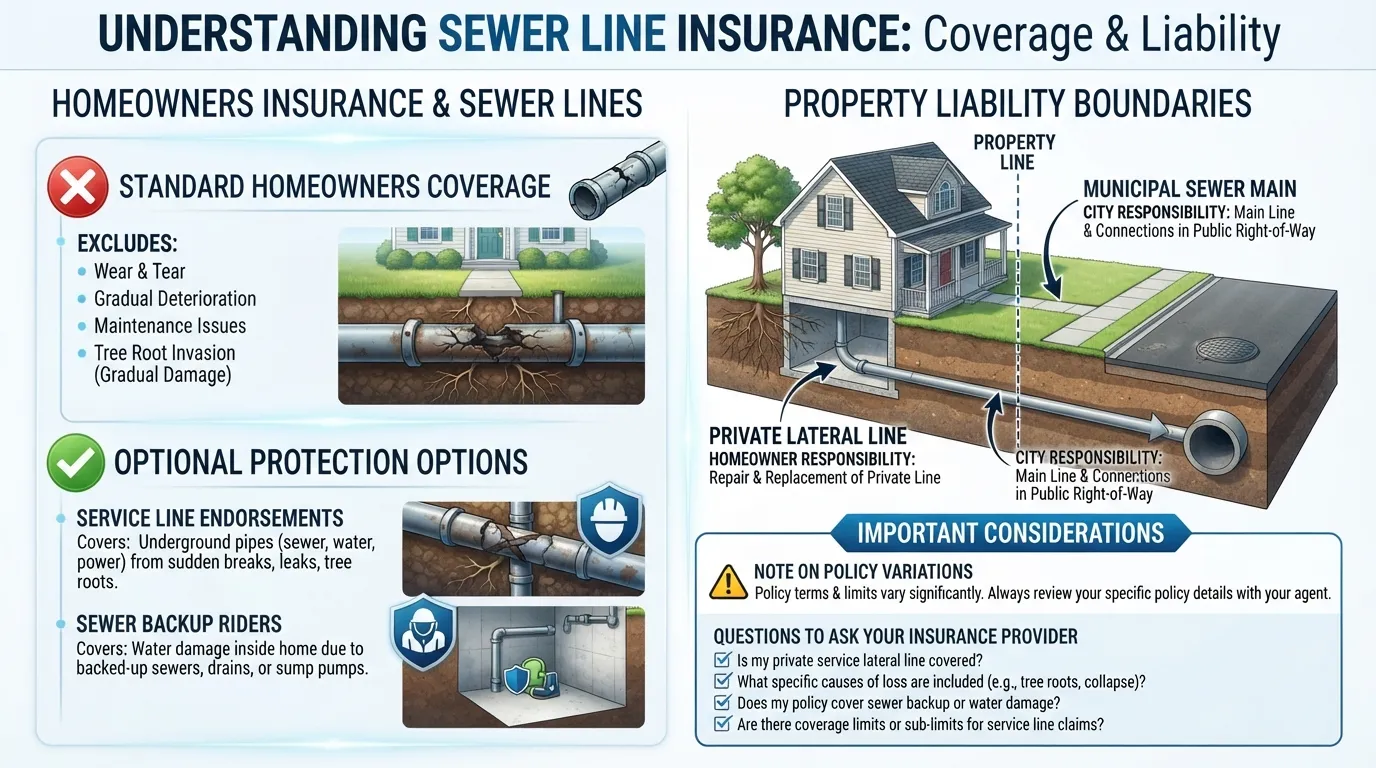
Standard homeowners insurance policies rarely cover standard sewer line wear and tear, but coverage depends heavily on the root cause of the damage and specific policy endorsements. Knowing how insurance handles underground pipes and where municipal responsibility begins prevents unexpected out-of-pocket repair costs.
Does Homeowners Insurance Cover Sewer Line Replacement?
Most standard policies cover sudden and accidental damage—such as a vehicle crashing over your yard and crushing the line—while excluding gradual deterioration.
Wear and Tear Exclusions: Normal aging, corrosion, shifting soil, and slow tree root intrusion are typically classified as maintenance issues and left uncovered.
Service Line Endorsements: Many carriers now offer optional service line coverage riders for a small annual fee, which protect against underground pipe leaks, breaks, and root damage.
Water and Sewer Backup Riders: While these riders generally cover property damage inside the home when a line backs up, they do not automatically cover the cost of digging up and repairing the broken pipe outside.
Who Is Responsible: Homeowner or City?
Property ownership boundaries dictate who pays for broken or blocked underground sewer infrastructure.
Private Lateral Responsibility: Homeowners are entirely responsible for the private lateral line running from the house foundation all the way out to the connection at the street.
Municipal Main Responsibility: The city or local utility district manages the main sewer line running down the public right-of-way or easement.
Tree Root Liability: Even if aggressive tree roots from a neighbor’s yard or a city tree infiltrate your lateral line, the property owner remains responsible for clearing and repairing the private pipe.
Questions to Ask Your Insurer
Reviewing your policy details proactively ensures you understand your exact financial exposure before an emergency strikes.
Does my policy include a service line coverage endorsement for underground water and sewer pipes?
Are repairs covered if tree roots crack or crush my private lateral line?
What is my specific deductible for sewer backup or exterior utility claims?
Disclaimer: The information provided above is for educational purposes only and does not constitute legal or insurance advice. Policy terms, exclusions, and endorsements vary significantly by carrier and state.
Is Trenchless Sewer Repair Worth It? A Simple Decision Framework
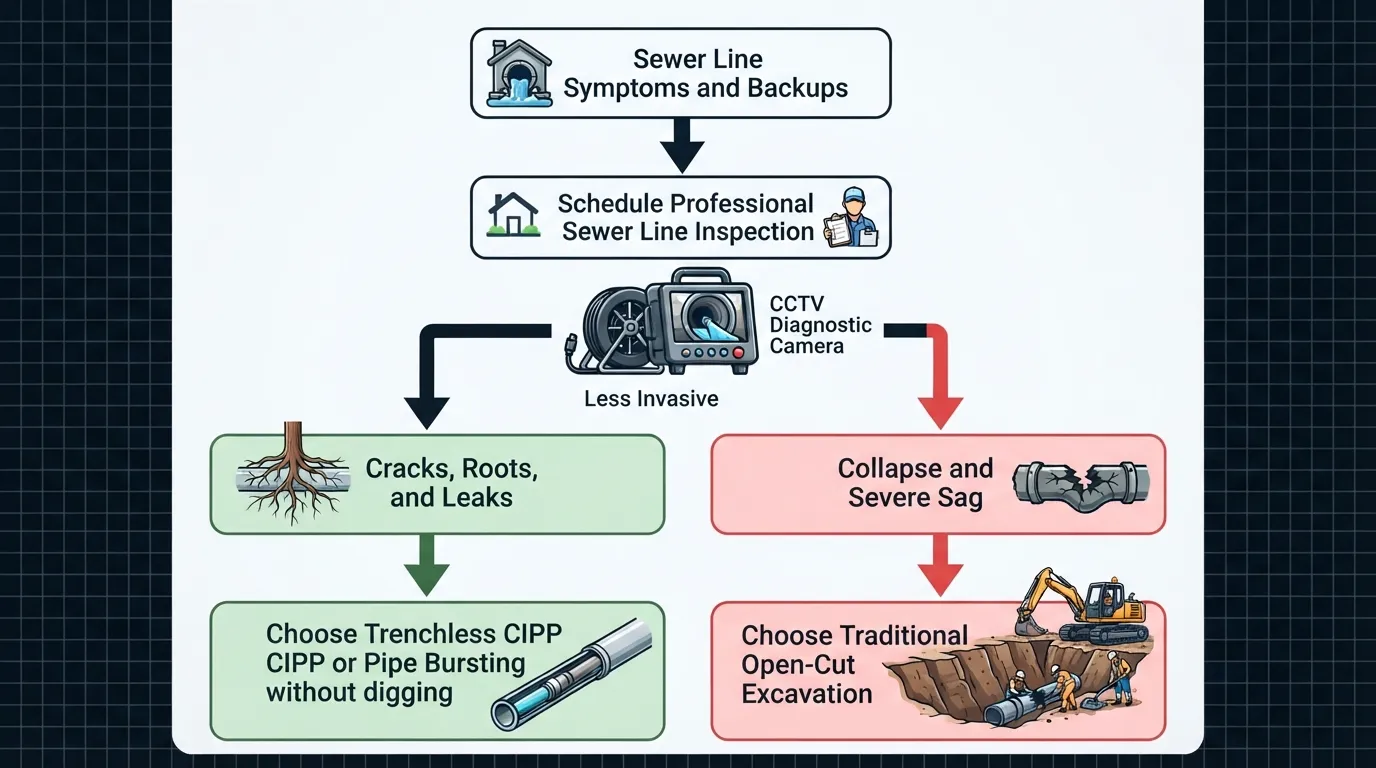
Deciding between trenchless rehabilitation and traditional open-cut excavation comes down to balancing immediate repair costs against long-term property preservation. Trenchless methods deliver exceptional value for most residential properties, but specific structural and site conditions dictate the right choice.
Trenchless Is Usually Worth It When…
Trenchless technology provides unmatched advantages when site conditions and pipe integrity allow for inversion or bursting techniques.
Landscaping Preservation Matters: Your sewer line runs beneath mature trees, custom driveways, concrete patios, or expensive paver installations that you cannot afford to rip up.
Minimizing Downtime is Critical: You need the sewer system restored in days rather than waiting weeks for heavy excavation permits and yard restoration.
The Pipe Is Structurally Intact: The host pipe suffers from root intrusion, minor cracks, or joint leaks, but still maintains its overall structural alignment without major collapses.
Long-Term Value is a Priority: You want a jointless, root-resistant conduit with a 50-year design life that prevents future soil infiltration.
You May Want to Consider Other Options When…
Traditional open-cut excavation remains the necessary fallback when severe structural failures compromise the underground pathway.
Severe Structural Collapse: The pipe has completely caved in, preventing resin bladders or bursting heads from passing through.
Major Bellies or Sags: Large low spots exist where gravity drainage fails, requiring physical regrading of the trench bed to correct the slope.
Extensive Redirection Needed: You need to alter the slope, depth, or routing of the sewer line to accommodate new home additions or plumbing layouts.
Severe Offset Joints: Displaced pipe sections block mechanical equipment from navigating the run.
Quick Checklist: What to Know Before Requesting a Quote
Gathering key property details before calling a contractor speeds up the diagnostic process and ensures an accurate project estimate.
Current Symptoms: Document whether you are experiencing slow drains, multiple plumbing backups, foul odors, or soggy patches in the yard.
Line Length and Depth: Note the approximate distance from your house foundation out to the street connection and how deep the line is buried.
Pipe Age and Material: Identify whether your home features legacy materials like clay, cast iron, or Orangeburg.
Surface Obstructions: Map out any hardscaping, decks, fences, or utility lines sitting directly above the sewer path.
Decision Flowchart: Choosing Your Repair Path
Sewer Repair Decision Flowchart
Expert Recommendation: Always start with a high-definition video inspection before committing to any repair method. A certified professional sewer line inspection eliminates guesswork and confirms whether your pipe qualifies for trenchless restoration.
How to Choose a Trenchless Sewer Repair Contractor
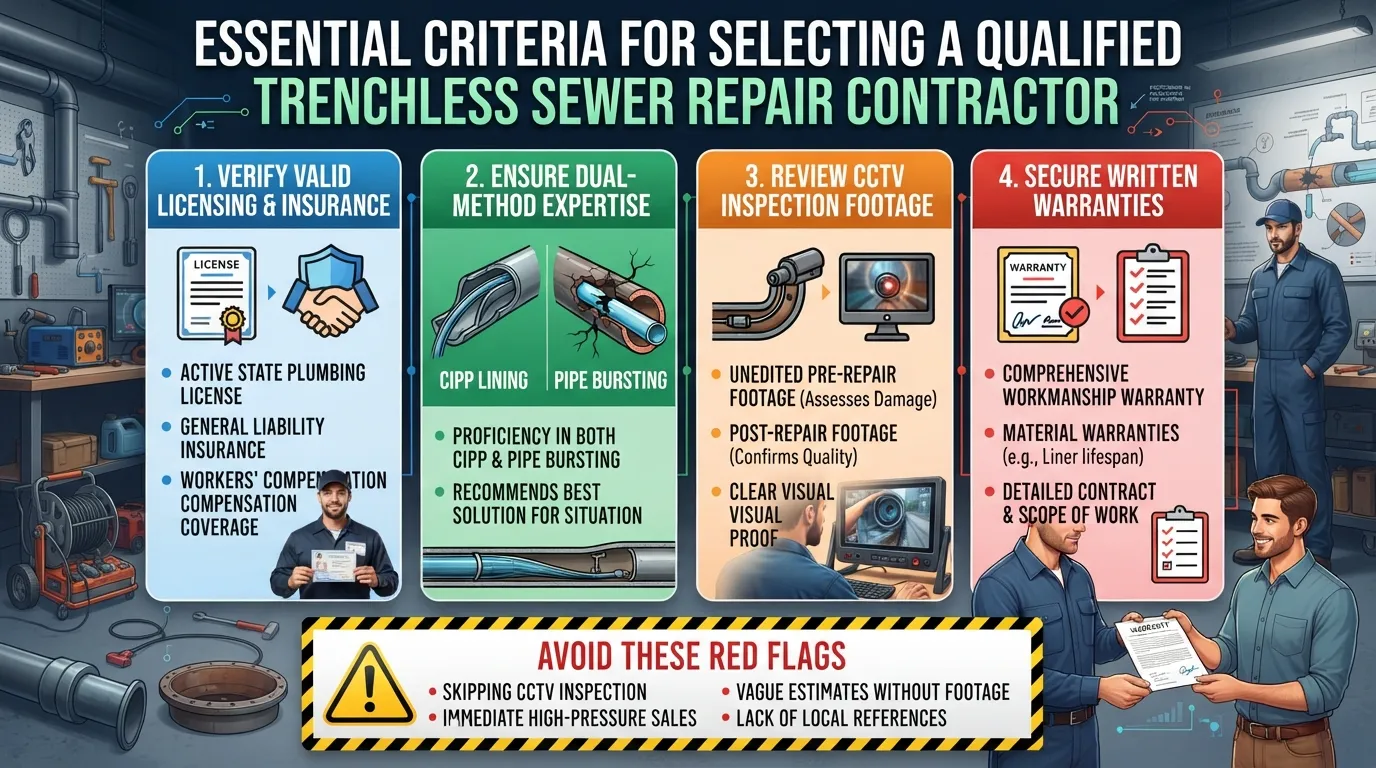
Selecting the right plumbing professional ensures your trenchless rehabilitation is executed to strict engineering standards. Because underground infrastructure repairs require specialized equipment and precise resin chemistry, partnering with an experienced contractor protects your property investment.
What to Look For
Top-tier contractors possess the credentials, technical capabilities, and transparency needed to handle complex underground pipe rehabilitations safely.
Valid Licensing and Insurance: Verify that the company holds a valid state plumbing license and carries comprehensive general liability and workers’ compensation insurance.
Dual Method Expertise: Look for technicians certified and experienced in both Cured-In-Place Pipe (CIPP) lining and pipe bursting to ensure you get the right solution for your specific pipe condition.
Verifiable Camera Evidence: Reputable providers always supply unedited digital video footage of the interior pipe before and after the repair.
Robust Warranties: Choose a company that backs its workmanship and materials with clear, long-term warranty documentation.
Questions to Ask Before You Hire
Asking targeted technical and operational questions helps separate qualified specialists from inexperienced operators.
Are your technicians certified specifically in trenchless pipe lining and bursting methods?
Can you provide proof of active general liability insurance and worker compensation coverage?
Do you include a digital copy of the pre- and post-repair video inspection with the project package?
What specific manufacturer and workmanship warranty do you offer on this rehabilitation?
Red Flags to Watch Out For
Protect your home and budget by avoiding contractors who cut corners or utilize high-pressure sales tactics.
Skipping the Camera Inspection: Any contractor willing to quote a trenchless repair without viewing the interior pipe via CCTV first is guessing.
Vague Estimates: A quote that lacks specific details on liner thickness, material type, or exact scope of work can lead to costly surprise fees mid-project.
High-Pressure Sales Tactics: Avoid companies that push you to sign a contract immediately or demand full payment upfront before permits are pulled.
Lack of Written Warranty: If a contractor refuses to put their guarantee in writing, look elsewhere for your sewer line repair and replacement services.
What a Good Estimate Includes
A transparent, professional estimate outlines every phase of the project so you know exactly what to expect from start to finish.
Detailed Scope of Work: Clear breakdown of whether CIPP or pipe bursting will be used, along with access pit locations.
Itemized Pricing: Transparent breakdown of labor, permitting fees, material costs, and any required prep work like hydro-jetting.
Timeline Estimates: Expected project duration, cure times, and when your water and plumbing fixtures can return to active service.
Clear Guarantee Terms: Explicit written details regarding workmanship warranties and manufacturer product guarantees.
Next Step: Ready to secure your plumbing system with expert underground diagnostics? You can book an appointment online today to schedule a comprehensive evaluation. For business owners managing multi-unit or industrial facilities, explore our specialized commercial plumbing division for heavy-duty infrastructure support.
Trenchless Sewer Repair FAQs
Find direct answers to the most common questions regarding trenchless sewer replacement, installation timelines, durability, and cost expectations below.
What is trenchless pipe repair and how does it work?
Trenchless pipe repair rehabilitates broken underground sewer lines without digging up your entire yard or driveway. It works by inserting a structural epoxy-saturated liner (CIPP) or pulling a seamless high-density polyethylene pipe through the existing route, creating a jointless, root-resistant pipe within the old one.
Does trenchless sewer repair work?
Yes, trenchless sewer repair is highly effective and widely utilized by municipal and residential contractors. When installed correctly within a structurally viable host pipe, methods like CIPP lining and pipe bursting create a brand-new conduit that structurally outperforms legacy clay or cast iron pipes.
Is trenchless sewer repair cheaper?
Trenchless repair often matches or slightly beats traditional excavation costs upfront, but it delivers massive long-term savings. By eliminating the need to tear up concrete patios, custom hardscaping, or mature landscaping, property owners save thousands of dollars in post-repair surface restoration.
What are the potential downsides of trenchless sewer repair?
Trenchless methods cannot fix severely collapsed pipes, major structural sags, or heavily offset joints that block equipment. Additionally, processes like pipe bursting require small entry and exit pits, which still impact localized areas of your yard.
What are the disadvantages of CIPP lining?
CIPP lining introduces a very minor reduction in internal pipe diameter and flow capacity because of the added structural wall thickness. It also requires meticulous high-pressure hydro-jetting prep, and precise robotic cutting to reopen branch connections from the inside.
What is the average lifespan of a CIPP liner in sewers?
The expected operational lifespan of a properly installed CIPP liner ranges between 30 to 50 years. Both CIPP and pipe bursting create permanent, root-resistant conduits that carry multi-decade design lives comparable to brand-new PVC piping.
How long does CIPP lining take to cure?
CIPP resin hardening takes anywhere from 1 to 6 hours depending on ambient ground temperatures and whether technicians utilize heat-accelerated steam or hot water curing. Most residential trenchless projects wrap up completely within one to three days.
Is sewer pipe relining worth it?
Sewer pipe relining is well worth the investment for properties where protecting mature landscaping, driveways, or hardscaping is a priority. It restores full structural integrity and stops root intrusions with minimal downtime compared to traditional digging.
How much does epoxy pipe relining cost?
Epoxy pipe relining typically ranges between $80 and $250 per linear foot, with total residential project costs varying based on line length, depth, site accessibility, and local plumbing labor rates.
Will homeowners insurance cover sewer line replacement?
Standard homeowners insurance policies exclude gradual wear, tear, and root damage, meaning they rarely cover standard sewer line replacement. However, many insurers now offer optional service line coverage endorsements that protect against underground pipe breaks.
Are homeowners responsible for repairs after tree roots damage their pipes?
Yes, property owners are fully responsible for maintaining and repairing the private lateral line running from their home foundation out to the municipal connection at the street, even if tree roots from a city tree or neighbor’s yard caused the damage.
How much does it cost to repair or replace a home’s outside sewer line?
Traditional and trenchless main sewer line replacements typically range from $3,000 to $12,000+ total. Exact pricing depends heavily on the total footage, depth of the burial, existing pipe material, and the chosen repair method.
How do we choose the best trenchless sewer repair professionals?
Choose top-tier professionals by verifying valid state licensing, general liability insurance, and specialized certifications in both CIPP and pipe bursting. Always request unedited pre- and post-repair CCTV camera footage and written long-term warranties.
Final Thoughts and Next Steps
Trenchless sewer repair has revolutionized underground plumbing rehabilitation, offering property owners a fast, non-invasive way to restore failing infrastructure. Understanding the technology, limitations, and upfront requirements ensures you make an informed investment in your home’s long-term health.
Key Takeaways
How It Works: Methods like CIPP lining and pipe bursting create a brand-new, jointless, and root-resistant structural pipe from the inside out without excavation.
Cost Range & Value: While projects typically range from $3,000 to $12,000+, trenchless techniques save thousands by preserving expensive driveways, patios, and landscaping.
Best-Fit Method: Trenchless restoration excels against root intrusion and minor cracks, though traditional open-cut digging remains necessary for completely collapsed lines or severe sags.
The Main Limitation: Severely compromised host pipes or major offsets cannot support trenchless lining or bursting equipment.
Inspection First: Always mandate a professional CCTV camera inspection before signing a contract to eliminate guesswork and confirm exact pipe conditions.
Need a Sewer Line Inspection or Estimate?
Unsure whether your plumbing system qualifies for trenchless restoration or need a transparent evaluation of your underground pipes? Partner with experienced professionals who utilize cutting-edge diagnostics to deliver lasting solutions. Explore our comprehensive sewer line services to learn more about our repair capabilities.
Book Your Sewer Inspection online today to schedule your service. For any other household maintenance needs, feel free to explore all our plumbing services.
Main Services
Related Posts
Need a Plumber in Miami?
Schedule service online or speak directly with the EZ Plumbing team.
Owner-Led Local Service
Know who is behind the business before you request service. The owners, contact line and Miami service pages are published clearly.
- Named business owners
- Direct phone and social channels
- Local Miami service information
Clear Help Before You Book
Review the relevant service page, contact the team directly and use the booking page when you are ready—without relying on vague claims.
- Service-specific information
- Direct questions before scheduling
- Clear online booking route