
How to Get Something Out of a Sink Drain: Safe Methods for Any Item
How to Get Something Out of a Sink Drain
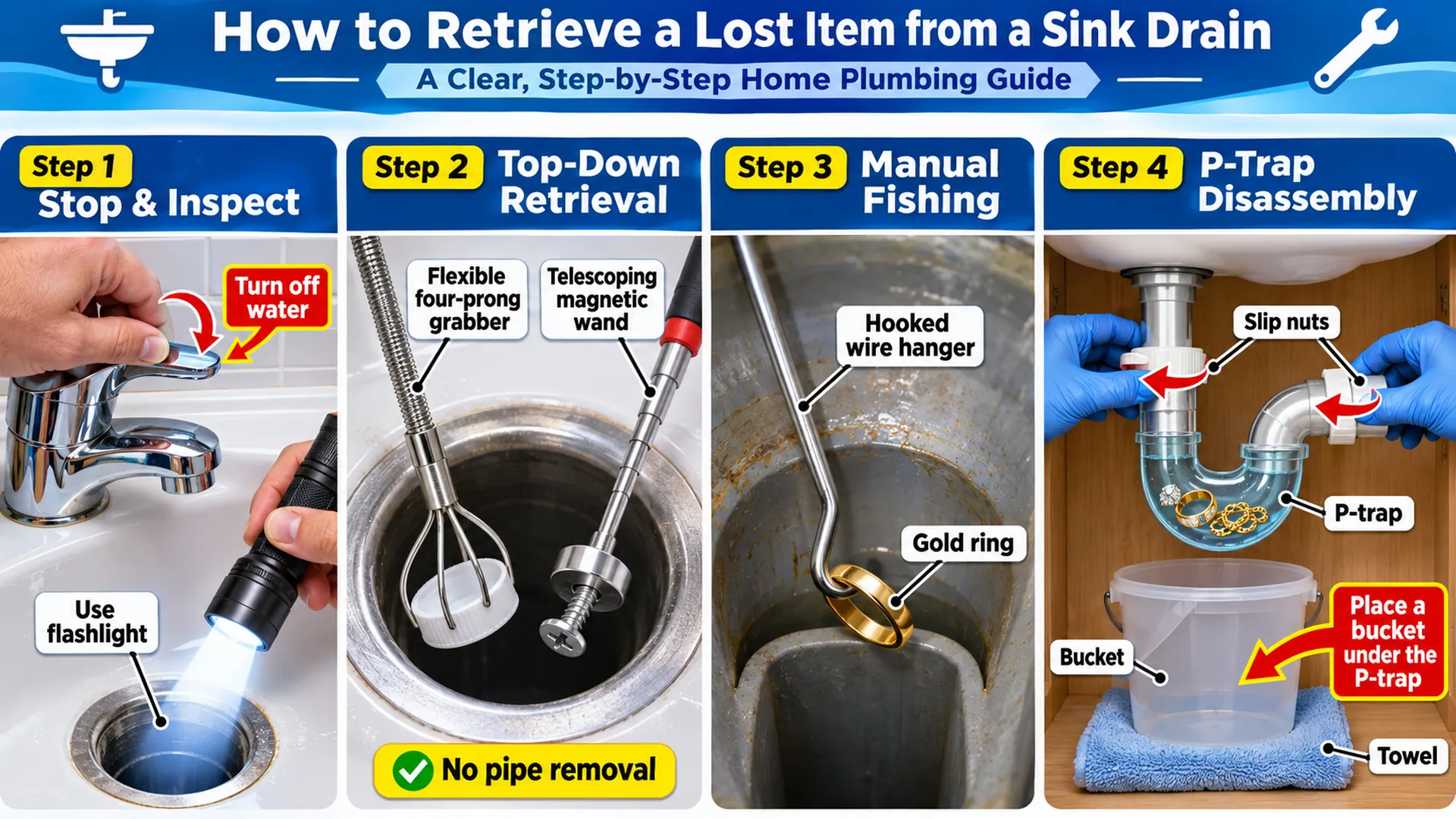
Dropping a valuable item down a sink drain requires immediate action before it washes deeper into your plumbing system. By stopping water usage, inspecting the upper drain, utilizing retrieval tools, and dismantling the P-trap if necessary, you can safely recover rings, earrings, or small metal parts within minutes.
The 4-Step Short Answer
Stop the water: Turn off the faucet immediately to prevent running water from pushing the lost item further down the drain pipe.
Check the top with a flashlight: Shine a bright light down the sink drain opening to see if the item is resting just beneath the stopper or crossbars.
Try a magnet or grabber: Use a flexible magnetic pickup tool or a mini claw grabber to snag the object if it remains visible near the surface.
Open the P-trap: Place a bucket underneath the curved pipe beneath your sink, loosen the slip nuts by hand or with pliers, and inspect the trap where heavy items naturally settle.
How Long Does It Take and What Do You Need?
Time: 10 to 20 minutes | Difficulty: Beginner | Tools: Flashlight, bucket, adjustable pliers, flexible magnet or grabber tool
What to Do in the First 60 Seconds
The seconds immediately after dropping an object down the drain determine whether you recover it easily or face a complex plumbing job. Taking prompt, protective measures prevents the item from traveling into main sewer lines and eliminates safety hazards before you begin retrieval.
Stop the Water Immediately
Turn off the faucet right away and inform anyone else nearby not to use the sink. Running water creates a siphon effect and washes small items past the curved trap beneath the basin, driving them deep into the main branch line where recovery becomes significantly harder.
Do not run nearby fixtures: Avoid running water in adjacent sinks, showers, or dishwashers on the same drainage line until the item is retrieved.
Avoid pushing down: Resist the urge to push hair or debris down the drain in an attempt to feel for the item, as this packs debris over the object.
Turn Off the Garbage Disposal at the Switch and the Breaker
If the item falls into a kitchen sink equipped with a waste disposer, turn off the wall switch instantly and disconnect power at the main electrical breaker box. Never place your hands or metal tools inside a disposal unit while it remains connected to a live power source.
If the disposal jams or hums after you reach in, that is a job for garbage disposal repair, not DIY.
Put a Plug Over the Drain Opening
Cover the drain opening immediately using a rubber sink stopper, a damp washcloth, or a piece of heavy tape over the grate.
Prevent secondary drops: Securing the opening stops additional objects, screws, or dropped retrieval tools from falling inside while you work.
Block accidental water flow: A physical barrier prevents accidental drips from soap bottles, wet hands, or leaky faucets from entering the pipe.
Gather Your Tools
Assemble your equipment before attempting any physical retrieval so you can work efficiently without leaving the sink unattended.
Flashlight or headlamp: Provides bright, direct illumination into the dark drain opening.
Rubber gloves: Protects your hands from bacteria, sharp metal edges, and grime inside the pipework.
Needle-nose pliers: Assists in gripping small rings or chain links visible near the drain crossbars.
Flexible magnetic pickup tool: Retains ferrous metal objects resting just out of hand reach.
Small bucket and towel: Catches residual water and protects your cabinet floor during P-trap disassembly.
Identify What Fell In and Choose the Right Method
The physical characteristics of your lost object dictate the safest and most effective extraction technique. Assessing the item type, depth, and specific sink configuration before attempting extraction prevents pushing the object further down the pipe line.
Quick Decision Guide: Item Type vs. Best Method
| Lost Item Type | Examples | Primary Retrieval Method | Alternative Method |
|---|---|---|---|
| Precious Jewelry | Gold ring, silver earring, bracelet | Flexible claw grabber | P-trap disassembly |
| Ferrous Metal | Bobby pin, steel screw, iron nail | Magnetic pickup tool | Mechanical grabber |
| Lightweight Plastic | Bottle cap, plastic earbuds, tube cap | Vacuum attachment with pantyhose | Hooked wire coat hanger |
| Glass / Fragile / Sharp | Broken vial, razor blade, glass bead | P-trap disassembly (do not use bare hands) | Shop vacuum suction |
| Organic Matter | Heavy hair clump, food particles | Sink snake or wire hook | Flush after clearing trap |
Use a Flashlight to Check How Deep It Went
Position a concentrated light beam directly down the center of the drain opening to locate the object’s precise depth and orientation.
Check the crossbars: Look for items caught on the sink drain grate or pop-up stopper mechanism just 1 to 2 inches below the rim.
Inspect the upper tailpiece: Search the straight vertical pipe section beneath the basin before the plumbing turns.
Confirm P-trap entry: If the object is not visible in the upper tailpiece, it has likely settled into the standing water of the curved P-trap.
Kitchen Sink vs. Bathroom Sink: What Is Different?
Garbage Disposal Integration: Kitchen drains often route directly through a disposal unit, requiring extra safety precautions and physical clearance through rubber splash guards compared to open bathroom drains.
Stopper Assemblies: Bathroom sinks typically feature mechanical pop-up stoppers held by a pivot rod, which can block tools or catch rings, whereas kitchen sinks utilize removable drop-in strainers.
Drain Diameter and Depth: Kitchen sink tailpieces are wider (1.51.51.5 inches) and sit lower in cabinet bases, while bathroom tailpieces are narrower (1.251.251.25 inches) with a higher, more accessible P-trap.
How to Get Something Out of a Sink Drain Without Taking It Apart
Retrieving a dropped item without dismantling plumbing pipes saves time and avoids tools. When an object remains lodged near the sink opening or within easy reach of an extension tool, targeted grabbers can extract it in seconds.
Tweezers, Needle-Nose Pliers, or a Bent Wire Hanger
For items resting just beneath the drain crossbars or stuck in the pop-up stopper assembly, precision tools offer immediate retrieval.
Tweezers or needle-nose pliers: Ideal for narrow items like screws or bobby pins. Grip the object carefully to avoid pushing it deeper.
Bent wire coat hanger: Unwind a wire hanger, leaving a small hook at the end to fish out hanging jewelry or rings with loops.
Using a Magnet (and Why It Won’t Work on Gold, Silver, or Plastic)
A telescoping magnetic pickup tool or a strong magnet tied to a piece of string easily catches steel and iron items.
Ferromagnetic targets: Highly effective for steel screws, iron nails, bobby pins, and paperclips.
Precious metals and synthetics: Pure gold and silver are non-magnetic, meaning a magnet will slide right off a gold wedding band or silver earring. Plastic earbuds, caps, and glass also require mechanical grabbers instead.
A Flexible Four-Prong Grabber for Small Non-Metal Items
A mechanical claw tool features a spring-loaded plunger on one end and four retractable steel prongs on the other.
How it works: Push the plunger button to extend the tiny steel claws into the pipe, position them around the object, and release to clamp down.
Versatility: Excellent for non-magnetic items like plastic caps, glass beads, or gemstones that slipped past the upper strainer.
Can You Plunge a Sink to Dislodge an Item?
Plunging a sink to retrieve a dropped item is rarely recommended and carries significant risks.
The risk of downward pressure: A plunger creates powerful hydraulic force that can push a loose ring or screw past the safety net of the P-trap and deep into the home’s main branch drain lines.
When to use caution: Only use a cup plunger if the sink is clogged with debris and you are trying to clear a blockage, not specifically to retrieve a valuable object.
What to Do If None of These Work
If surface extraction tools fail to reach the object, the item has settled past the vertical tailpiece and into the P-trap below.
As demonstrated above, moving underneath the sink to inspect the curved P-trap is the most reliable next step when top-down tools come up empty [00:06].
How to Remove a Sink Stopper or Strainer
Removing the sink stopper or strainer assembly provides immediate top-down access to the upper drain pipe and clears room for retrieval tools. Because different sinks utilize distinct stopper mechanisms, choosing the correct removal steps prevents damage to the underlying linkage.
Pop-Up Stopper: Unscrewing the Pivot Rod Under the Sink
Most bathroom sinks use a lever-operated pop-up stopper controlled by a metal linkage mechanism located beneath the sink basin.
Locate the pivot rod: Look behind the vertical tailpiece under your sink to find the horizontal metal rod held by a spring clip and a circular retaining nut.
Remove the spring clip: Squeeze the flat metal spring clip to slide it off the vertical clevis strap and free the horizontal pivot rod.
Unscrew the retaining nut: Turn the plastic or metal retaining nut counterclockwise by hand or using pliers until it unscrews completely from the pipe.
Extract the stopper: Pull the pivot rod straight back out of the tailpiece, then lift the pop-up stopper directly out from inside the sink basin.
Lift-and-Turn and Push-and-Seal Stoppers
Modern vanity sinks often feature stopper caps that function without under-sink linkages.
Lift-and-turn stoppers: Set the stopper to the open position, grip the top knob firmly, turn counterclockwise until you feel the internal thread release, and pull straight up.
Push-and-seal (toe-touch) stoppers: Press down to unlock the cap, unscrew the top cylinder counterclockwise from the central shaft, and unseat the remaining brass post with pliers if necessary.
Kitchen Basket Strainer
Kitchen sinks rely on removable drop-in basket strainers designed for high-volume drainage and food catching.
Standard drop-in strainers: Lift the center post straight out of the drain cup, or turn the post slightly counterclockwise to disengage the locking groove before pulling up.
Fixed mesh grates: Unfasten the single central screw securing the metal grate to the tailpiece flange using a Phillips-head screwdriver to open the pipe.
How to Open a Sink Drain Plug
Opening a stuck or jammed sink drain plug requires clearing the mechanical blockages holding the stopper in place.
If a pop-up drain plug refuses to lift out, the pivot rod under the sink is likely still engaged in the stopper hook, or debris has corroded the assembly [00:09]. Unscrewing the retaining nut underneath allows you to free the drain plug safely without snapping the internal mechanism.
How to Open the P-Trap Step by Step
When top-down retrieval tools fail to catch a lost item, opening the P-trap beneath the sink provides a 100 percent foolproof recovery method. Because gravity naturally pulls heavy items downward into the lowest curve of the pipe, rings, coins, and screws almost always settle right inside this section [00:25].
What Is a P-Trap and Why Do Dropped Items End Up There?
The P-trap is the U-shaped or P-shaped curved pipe section located directly underneath your sink basin.
Sewer gas barrier: It maintains a standing pool of water that blocks foul sewer gases from entering your living space [00:28].
The natural collection zone: Because of its low bend, the trap acts as an accidental holding tank for heavy objects that fall past the drain opening.
Step 1: Place a Bucket and Towel Under the Trap
Position a small bucket directly beneath the curved P-trap to catch the standing water and debris trapped inside the pipe. Lay a thick towel around the base of the bucket to absorb any accidental splashes or residual drips.
Step 2: Loosen the Slip Nuts by Hand or With Channel Locks
Locate the threaded slip nuts holding the curved trap segment to the vertical tailpiece and the horizontal trap arm.
Hand-loosening: Try turning the plastic slip nuts counterclockwise by hand, as modern fittings are often intentionally hand-tightened [00:19].
Using channel locks: If the nuts are stuck or corroded, grip them gently with adjustable pliers or channel locks and turn counterclockwise just enough to break the seal.
Step 3: Lower the Trap and Empty It Into the Bucket
Unscrew both slip nuts completely and slide them down the pipe sections. Carefully lower the curved P-trap downward, allowing the standing water to empty into your bucket [00:31].
Inspect the sediment: Pour the contents of the trap through a fine mesh strainer or directly into the bucket to locate your lost item resting among hair and sludge.
Step 4: Clean the Trap and Check the Washers
Wipe the interior of the P-trap clean with a rag or bottle brush to remove accumulated gunk, soap scum, and hair. Inspect the small wedge-shaped rubber washers (slip-joint washers) seated inside each nut to ensure they are not cracked, flattened, or torn.
Step 5: Reassemble and Test for Leaks
Fit the rubber washers back onto the pipe ends with the tapered edge facing toward the connection point. Reattach the P-trap, tighten the slip nuts securely by hand, and turn on the faucet slowly to run a thorough leak test.
As outlined in the tutorial above, working methodically through each P-trap connection ensures a quick, mess-free recovery without harming your plumbing system [00:31].
Common Mistakes That Cause Leaks
Cross-threading: Forcing a slip nut onto threads at an angle ruins the plastic threading and causes persistent leaks. Always turn the nut counterclockwise a quarter-turn first until it clicks into the thread groove before tightening clockwise.
Flipped washers: Installing the tapered washer backward prevents a proper water seal against the pipe flange. The narrow edge must always point toward the receiving fitting.
Over-tightening: Cranking down plastic nuts with heavy wrenches warps the plastic and cracks the washers. Hand-tightened plus a quarter-turn with pliers is all that is required.
If the Trap Is Corroded or Keeps Leaks
If you notice water damage under the cabinet, it may be a hidden leak. A trap that leaks after reassembly, or pipes that are cracked or corroded, need proper sink repair. If underlying pipe assemblies are worn out or damaged beyond DIY fixes, professional water leak repair protects your cabinetry from structural water damage.
How to Get a Ring or Jewelry Out of a Sink Drain
Dropping a wedding band, diamond ring, or cherished piece of jewelry down the drain sparks immediate panic, but the vast majority of dropped valuables remain completely safe inside your home’s plumbing system. By avoiding running water and deploying precise retrieval methods, you can recover your jewelry quickly.
Don’t Panic: Why Rings Usually Stay in the P-Trap
Because precious jewelry is heavy and dense (composed of solid gold, platinum, or silver with gemstones), gravity immediately halts its downward trajectory [00:41].
The physics of recovery: As long as you turned off the faucet instantly and did not run large volumes of water afterward, the ring will settle harmlessly at the bottom curve of the P-trap beneath the basin [00:47].
Avoid plunging: Never use a plunger or pour chemical drain openers down the sink, as these actions push or dissolve the blockage rather than saving your jewelry.
Why a Magnet Won’t Work on Gold or Silver
Many homeowners attempt to fish rings out using a magnetic pickup tool, only to find it completely ineffective.
Non-ferrous properties: Fine jewelry crafted from 14k or 18k gold, sterling silver, or platinum possesses zero magnetic attraction.
When magnets help: Only costume jewelry containing steel pins or cheap alloy clasps will respond to a magnetic wand. For real precious metals, you must rely on mechanical grabbers or pipe dismantling.
Retrieving a Ring Without Taking the Pipe Apart
If you acted instantly and suspect the ring is lodged right beneath the drain crossbars or in the upper tailpiece, try surface extraction.
Flexible four-prong claw: Feed a telescoping mechanical grabber down the open drain, depress the plunger to open the tiny prongs, and close them around the ring band.
Modified wire loop: Straighten a coat hanger and shape a tight hook at the tip to snag stone settings or open chain links.
Retrieving a Ring From the P-Trap
If surface tools cannot reach the item, the ring has dropped into the curved trap segment.
As demonstrated above, placing a bowl beneath the sink, loosening the slip nuts by hand, and lowering the P-trap allows you to safely empty out the standing water and find your ring resting at the bottom [01:51]. (For detailed, step-by-step instructions on loosening fittings and inspecting seals, refer back to Section 6).
When to Stop and Call a Pro to Protect an Expensive or Sentimental Item
While P-trap recovery is straightforward for most DIYers, certain situations call for professional intervention.
Severely corroded brass pipes: Old metal slip nuts can crumble or twist off when forced, turning a simple retrieval into a major pipe replacement job.
Complex or fragile configurations: Wall-mounted architectural sinks, delicate antique brass fixtures, or integrated stone vanities require expert handling.
High-value peace of mind: If a multi-thousand-dollar diamond ring is lost and you are uncomfortable opening the plumbing lines, calling a licensed plumber ensures zero risk of dropping the item further into main sewer lines.
What If the Item Isn’t in the P-Trap?
If you opened the P-trap and found only standing water and sludge, the object has managed to pass through the U-bend and into the wall piping. When an item travels beyond the trap into the branch drain, DIY retrieval tools lose effectiveness, and continued attempts can push the object beyond recovery.
Signs the Item Went Further Down the Line
When a hard object lodges past the P-trap, it disrupts normal wastewater flow and catches passing hair, soap scum, and debris.
Persistent slow drainage: Water drains sluggishly out of the basin even after you have thoroughly cleaned and reattached the P-trap.
Gurgling sounds: Air bubbles escaping around a newly formed obstruction cause distinct gurgling noises from the sink or nearby fixtures.
Repeated clogs: Organic waste rapidly builds up around the foreign object, creating recurring main-line blockages short distances inside the wall.
Why You Should Stop Trying Random Tools
Inserting improvisational tools into the wall line once an item has cleared the P-trap often backfires.
Risk of pushing the item into the stack: Standard wire hangers or stiff cables push objects out of the local branch drain into vertical soil stacks or main sewer lines, making recovery impossible.
Pipelining damage: Pushing metal snakes around uninspected elbows can puncture aging galvanized steel or crack rigid PVC joints behind your dry wall.
How a Camera Inspection Finds Items Inside the Pipe
To locate an object trapped inside hidden wall pipes without opening up drywall, plumbers utilize specialized fiber-optic equipment.
A video sewer camera inspection shows exactly where the item stopped, pinpointing its distance from the fixture and determining if mechanical extraction is feasible.
Professional Drain Cleaning vs. Retrieval
Standard drain clearing focuses on destroying blockages, whereas object retrieval requires delicate extraction techniques to save the item intact.
Drain clearing risks: Aggressive motorized augers or high-pressure hydro-jetting units can pulverize plastic items, break glass, or flush lightweight valuables directly to the municipal sewer.
Specialized retrieval: Once located, snaking or professional drain cleaning can clear it safely using specialized retrieval heads designed to hook or vacuum the object backward without damaging your pipes.
What Not to Do When Something Falls Down the Drain
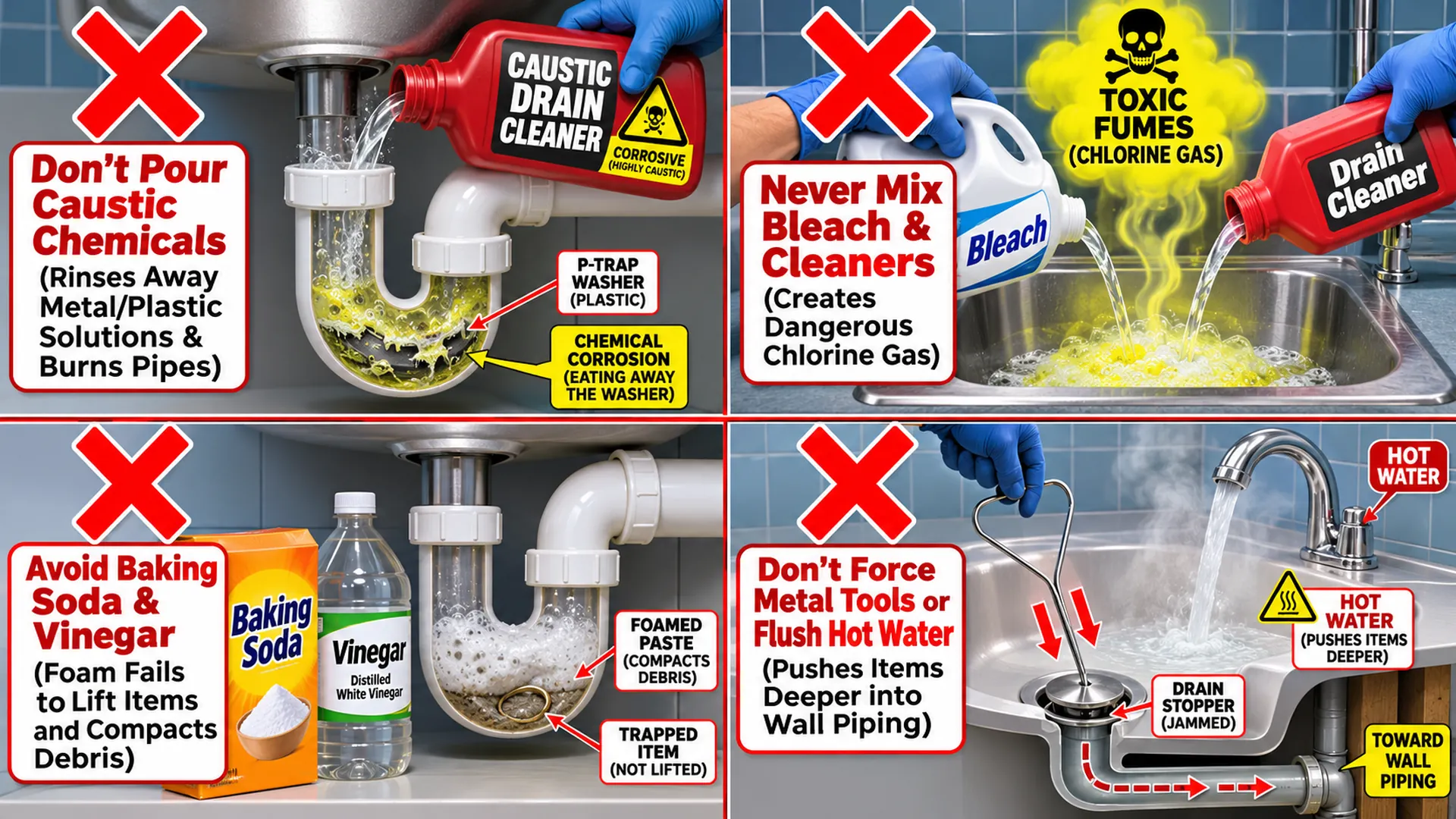
When an object drops into the plumbing system, quick reaction is essential, but taking the wrong corrective steps can ruin valuable items, cause chemical burns, or permanently damage pipe assemblies. Avoiding common home remedy mistakes ensures a safe, efficient retrieval process.
Don’t Pour Chemical Drain Cleaner on a Dropped Object
Pouring caustic chemical drain cleaners (such as Drano or liquid lye) down the sink when a valuable or solid object is lost is completely ineffective and dangerous.
Inability to dissolve hard materials: Caustic chemicals are formulated to break down organic hair and grease. They will never dissolve gold, sterling silver, plastic caps, or steel screws.
Corrosive hazards: Chemical cleaners sit inside the P-trap standing water, creating a toxic bath. When you eventually disassemble the pipe or reach inside with tools, skin contact with these trapped chemicals can cause severe chemical burns.
PVC pipe damage: Chemical reactions generate high heat, which can warp thin PVC pipes or melt delicate rubber seals within the slip joints.
Never Mix Drain Cleaners With Bleach or Other Cleaners
Combining different chemical clearing agents or mixing residual drain openers with household cleaning supplies creates deadly chemical reactions inside closed plumbing fixtures.
Always remember that mixing drain cleaners with bleach or other cleaning products can release toxic gas, such as dangerous chlorine or chloramine gas, which can severely burn your eyes, skin, and respiratory system.
Why Baking Soda and Vinegar Usually Won’t Help Here
While the classic mixture of baking soda (sodium bicarbonate) and vinegar (acetic acid) is a popular DIY solution for mild organic clogs, it serves no practical purpose for item retrieval.
No mechanical lift: The mild foaming action generated by the acid-base reaction is far too weak to lift dense metal jewelry or plastic parts upward out of the trap.
Increased debris compaction: Pouring dry powders down a dry pipe can actually form a thick paste over the fallen item, cementing it in place alongside trapped hair and grease.
Don’t Force It With Metal Tools or Run the Disposal
Using excessive physical force or turning on mechanical appliances in a hurry often worsens the problem.
Tool jamming: Jamming stiff metal hangers or bulky screwdrivers into small drain openings can scrape pipe interiors, bend drain crossbars, or jam mechanical pop-up stoppers beyond repair.
Disposal damage: Activating a garbage disposal while a metal ring or hard plastic cap rests inside will cause the blades to shatter the item, ruin the disposal motor, and create hazardous flying shrapnel.
Why Hot Water Won’t Fix It
Flushing the sink with boiling or scalding hot water will not clear solid foreign objects out of your pipework.
Deepens the loss: Pouring hot water into the basin simply pushes the standing water in the P-trap forward, flushing your lost item out of the reachable trap bend and deep into the main branch lines.
Thermal shock: Pouring boiling water directly into cold porcelain or thin plastic traps can crack porcelain basins or weaken plastic glue joints.
Can You Just Leave It in the Drain? What Happens Next
Ignoring an object dropped down a sink drain might seem tempting if the item holds little monetary value, but leaving foreign materials inside plumbing fixtures almost always triggers structural or operational issues over time. Knowing how different materials behave inside pipework helps you decide whether immediate retrieval is necessary.
Small Metal Items: Will They Hurt the Pipes?
Leaving small metallic objects—such as iron nails, steel screws, or bobby pins—inside your drainage lines creates long-term hazards for your plumbing system.
Corrosion and rust expansion: Non-stainless metals oxidize rapidly when submerged in the P-trap’s standing water, expanding as they rust and flaking off sharp debris that can score or puncture thin pipe walls.
Debris catchers: Metallic items wedge sideways inside the curved trap or against pipe joints, acting as permanent hooks that snag hair, soap scum, and food particles until a severe clog forms.
Small Plastic Items: Will They Cause a Clog Later?
While plastic rings, bottle caps, or earbud covers do not rust or degrade in water, leaving them in the drain guarantees future plumbing disruptions.
Flow restriction: Synthetic caps and solid plastic objects float or rest at the base of the P-trap, significantly reducing the cross-sectional area available for wastewater passage.
Grease accumulation: Fats, oils, and body washes bind readily to smooth plastic surfaces, building thick layers of sludge around the item that eventually seal the pipe completely.
Food, Hair, and Ash: How to Clear Them
Organic matter and fine particulates require different clearing methods than solid metallic or plastic items.
Food debris: If raw vegetables or heavy food scraps slip down a bathroom or non-disposal kitchen drain, do not try to flush them with cold water. Use a manual zip-it plastic drain snake or open the P-trap to clean out the decaying buildup (satisfying the common query on how to remove food stuck in sink drain).
Hair clumps: Use a barbed hair-removal tool to hook and pull tangled hair masses directly up through the drain grate before they form a dense mat around internal stopper assemblies.
Cigarette ash and fine powders: Ash and powdery residues combine with standing P-trap water to create a paste similar to wet concrete. Flush the line thoroughly with warm water and dish soap for several minutes to dissolve and carry away fine particulates.
How Long Can It Sit Before It Becomes a Problem?
The timeline between dropping an item and experiencing a total drain failure depends heavily on your daily water usage and the item’s physical profile.
| Item Profile | Timeframe Until Problem Occurs | Expected Plumbing Impact |
|---|---|---|
| Large plastic cap or earbud | 24 to 48 hours | Immediate slow drain; rapid hair binding |
| Sharp screw or nail | 1 to 2 weeks | Snags hair/fibers; begins rusting and staining PVC/metal |
| Small flat plastic washer | 2 to 4 weeks | Gradual sludge accumulation leading to recurring clogs |
| Dense ring or metal ball | Months (if unused) | Remains submerged; clogs when heavy debris enters |
When to Call a Plumber
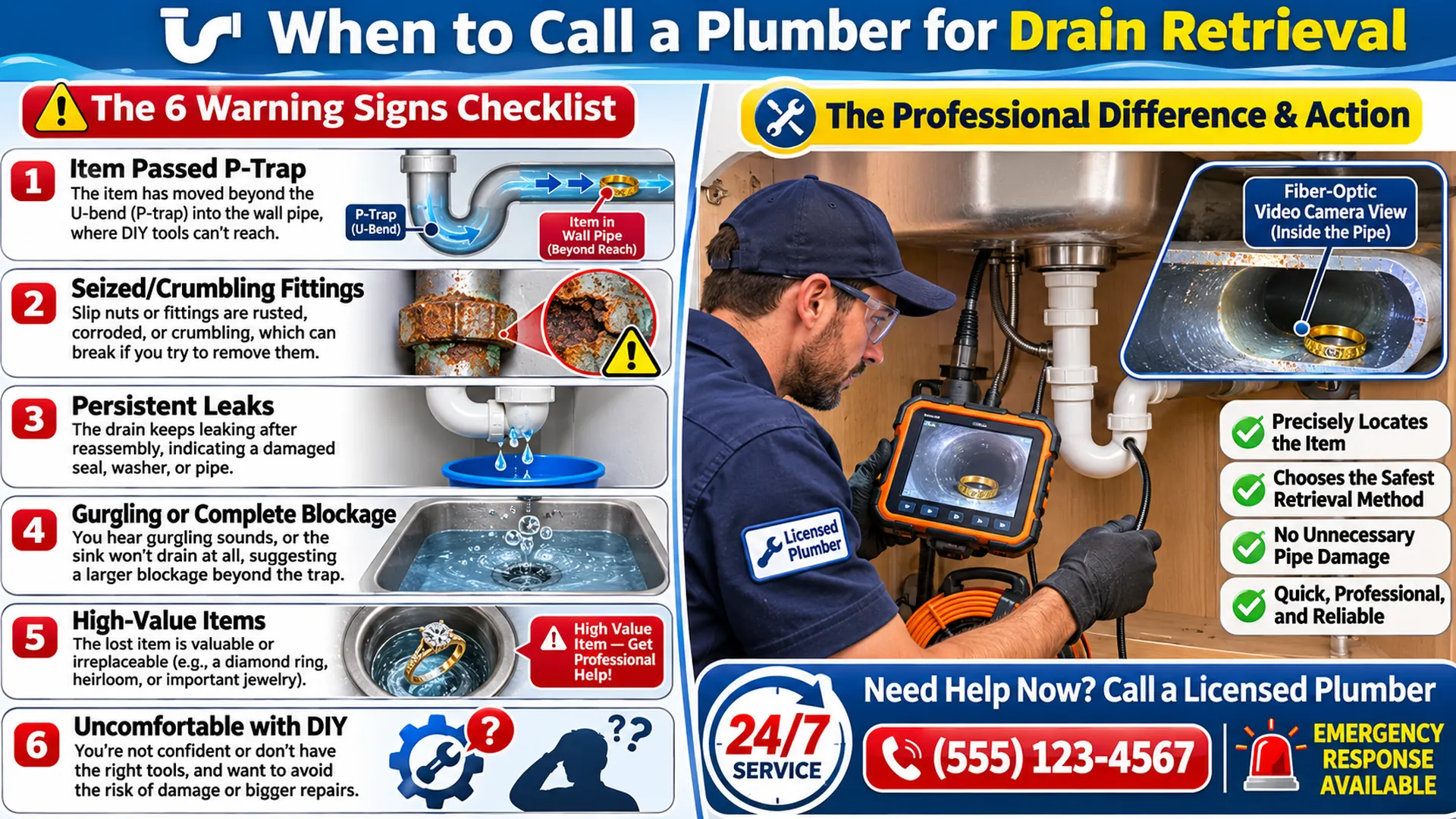
While many drain retrieval situations can be resolved with quick action and basic hand tools, certain plumbing configurations and stubborn blockages demand expert intervention. Knowing when to transition from DIY attempts to professional service prevents costly pipe damage and protects your valuables.
6 Signs It’s Time to Stop DIY
Recognizing the limits of DIY methods saves time and prevents minor issues from escalating into major plumbing repairs.
The item passed the P-trap: If you dismantled the trap and found nothing, the object has migrated into the branch drain line inside the wall where manual hand tools cannot reach.
The trap fittings are seized or crumbling: Old brass nuts or sun-baked plastic fittings that refuse to turn by hand can break under heavy wrench pressure.
The pipe continues to leak after reassembly: Persistent dripping around slip joints despite replacing washers indicates warped threads or alignment issues.
The drain is gurgling or fully blocked: Standing water that refuses to recede points to a dense obstruction formed deeper in the drainage stack.
The lost item has high financial or sentimental value: High-value heirloom jewelry or irreplaceable rings warrant professional handling to avoid flushing them further.
You feel uncomfortable opening plumbing lines: If you lack the tools, time, or confidence to disassemble waste pipes safely, letting a professional manage the job ensures complete peace of mind.
What a Plumber Does Differently
Professional technicians rely on specialized equipment and refined diagnostic procedures to locate and extract foreign objects without causing structural harm to your home.
Fiber-optic video camera inspection: High-definition miniature cameras are snake-fed directly into the branch lines to pinpoint the exact location and orientation of the trapped item.
Specialized retrieval snakes and hooks: Licensed plumbers deploy precision retrieval heads, magnetic augers, and expandable retrieval claws specifically engineered to grab items intact without pushing them down the stack.
Non-destructive extraction: Technicians preserve your existing vanity structures, antique brass assemblies, and delicate PVC fittings while guaranteeing water-tight seals upon reassembly.
Need Help in Miami? Here’s How to Reach Us
If you dropped a valuable item down the drain or hit a wall during your DIY retrieval attempt, prompt assistance is available across the region.
Our team provides comprehensive plumbing services throughout our designated service areas across Miami-Dade County. For urgent situations where a main line is backup-threatened or an irreplaceable item is at risk, our emergency plumber team offers rapid response times and flat-rate pricing.
Call directly at 786-239-6529 or book online to schedule a technician to safely recover your item today.
How to Prevent Things From Going Down Your Sink Drain
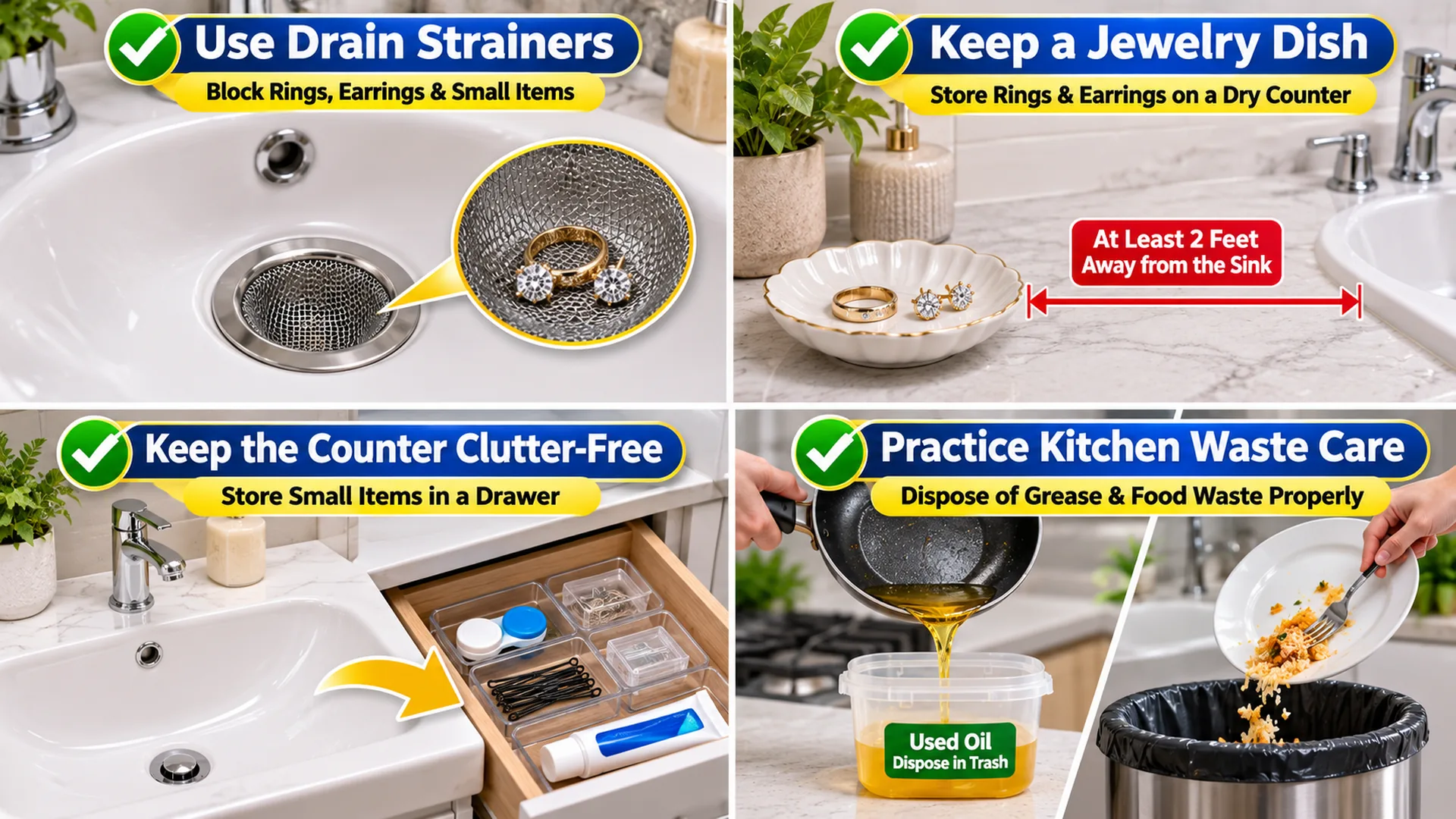
Taking simple, proactive steps around your bathroom vanities and kitchen sinks prevents future retrieval headaches and keeps your plumbing lines flowing smoothly. Establishing safe daily habits around open drain openings eliminates the risk of accidentally dropping valuable items or causing severe blockages.
Install a Drain Strainer or Catcher
Placing a physical barrier over the drain opening is the single most effective way to block foreign objects from entering your pipework.
Mesh basin strainers: Stainless steel mesh baskets sit flush inside bathroom and kitchen drains, catching small earrings, screws, and debris while allowing water to pass freely.
Silicone hair catchers: Flexible silicone guards fit snugly over pop-up stoppers to trap long hair strands and small jewelry pieces before they reach the tailpiece.
Take Rings Off Before Washing Hands (Use a Ring Dish)
Slippery soap lathers cause rings to slide off fingers effortlessly while washing hands or applying lotions near the basin.
Place a ring dish away from the basin: Keep a dedicated ceramic ring dish or small tray on a counter surface at least two feet away from the sink rim.
Remove jewelry first: Always place your rings, watch, or earrings securely in the dish before turning on the faucet or lathering your hands.
Keep Small Items Away From the Sink Edge
Avoid setting small personal items directly on the narrow ledges or rim surfaces of your sink.
Clear the vanity rim: Toothpaste caps, razor blades, contact lens cases, and bobby pins easily slip or roll off slick porcelain surfaces directly down an open drain.
Use vanity drawers or wall trays: Store small grooming accessories inside medicine cabinets or drawer dividers rather than leaving them loose around the basin edge.
Keep Grease and Food Out of the Kitchen Drain
Preventing sticky sludge accumulation inside your pipes ensures that if an item ever drops down the kitchen sink in the future, it rests loosely in clean water rather than becoming cemented in debris.
Dispose of fats properly: Pour cooking oils, grease, and bacon fat into a sealable container to cool, then discard it in the trash instead of rinsing it down the kitchen drain.
Scrape plates into the trash: Wipe heavy food solids into the garbage before washing dishes to prevent organic waste from building up inside the P-trap.
Frequently Asked Questions
How to get something out of a sink drain without removing it?
You can retrieve items from a sink drain without removing the pipework by using a flexible four-pronged grabber tool, a telescoping magnet for ferrous metal objects, or a pair of needle-nose pliers. Straightening a wire coat hanger into a small hook also works well for grabbing items caught near the drain grate.
What happens if something goes down the sink drain?
When an item drops down a sink drain, it usually falls into the standing water of the curved P-trap. If water continues to run, the item may get pushed further into the branch drain line, where it can snag hair and debris, causing severe clogs, pipe corrosion, or water blockages over time.
What dissolves stuff in drains?
Caustic drain cleaners containing sodium hydroxide (lye) or sulfuric acid dissolve organic matter like hair, grease, and soap scum. However, chemicals will not dissolve hard objects such as metal, plastic, gold, or silver. Use chemical drain cleaners with caution, as they can damage PVC pipes and rubber washers.
What breaks down food in the sink drain?
Enzyme-based drain cleaners break down organic food waste safely over several hours without damaging your plumbing lines. For quick clearing of minor food blockages, pouring boiling water followed by dish soap helps melt fats and flush soft food particles past the P-trap into the main sewer line.
How to remove food stuck in a sink drain?
To remove food stuck in a sink drain, insert a plastic barbed drain snake into the opening to hook and pull out the debris. If the food remains lodged, place a bucket beneath the P-trap, unscrew the slip nuts, remove the curved pipe segment, and manually clear out the trapped food waste.
Will Drano break up food?
Drano can break up soft organic food waste like vegetables or starches caught in standing water, but it works inefficiently on dense meat scraps, bones, or heavy grease buildup. Additionally, Drano will not dissolve solid plastic or metal objects that may be holding the food blockage in place.
How to retrieve items from a sink drain?
To retrieve items from a sink drain, stop the running water immediately. Check the drain opening with a flashlight and attempt extraction using a mechanical grabber tool or needle-nose pliers. If the item is out of reach, place a bucket underneath the sink, loosen the P-trap slip nuts, and empty the trap.
Can I pour vinegar down the drain to unclog it?
Yes, you can pour vinegar down the drain to dissolve mild mineral deposits or freshen smelly pipes. However, vinegar alone lacks the chemical strength to break up heavy grease blockages, dense hair clogs, or solid objects dropped down the line. It serves primarily as a mild cleaning and deodorizing agent.
Why shouldn’t you use baking soda and vinegar to unclog a drain?
Combining baking soda and vinegar produces an acid-base reaction that yields salt water and carbon dioxide gas. The fizzing action creates no real pressure in an open pipe system, making it ineffective against tough clogs. Furthermore, undissolved baking soda powder can settle over dropped items, creating a hardened paste that compacts the blockage.
How do I get a ring out of the sink without taking it apart?
To get a ring out of the sink without taking it apart, shine a flashlight down the basin to locate it. If it rests near the surface, use a flexible four-prong grabber tool or a wire coat hanger bent into a hook to latch onto the ring band. Avoid using magnets, as gold and silver are non-magnetic.
Is it OK to just turn on the water after dropping a nail down the sink?
No, turning on the water after dropping a nail down the sink pushes the nail from the safety of the P-trap deeper into the branch drain. Iron or steel nails will rust in standing water, snag passing hair and debris, and eventually cause severe pipe blockages or punctures inside your wall piping.
Main Services
Related Posts
Need a Plumber in Miami?
Schedule service online or speak directly with the EZ Plumbing team.
Owner-Led Local Service
Know who is behind the business before you request service. The owners, contact line and Miami service pages are published clearly.
- Named business owners
- Direct phone and social channels
- Local Miami service information
Clear Help Before You Book
Review the relevant service page, contact the team directly and use the booking page when you are ready—without relying on vague claims.
- Service-specific information
- Direct questions before scheduling
- Clear online booking route