
What Is the Statue of Liberty Worth in Scrap Metal? The Real Math
What Is the Statue of Liberty Worth in Scrap Metal?
Estimated Scrap Value Range
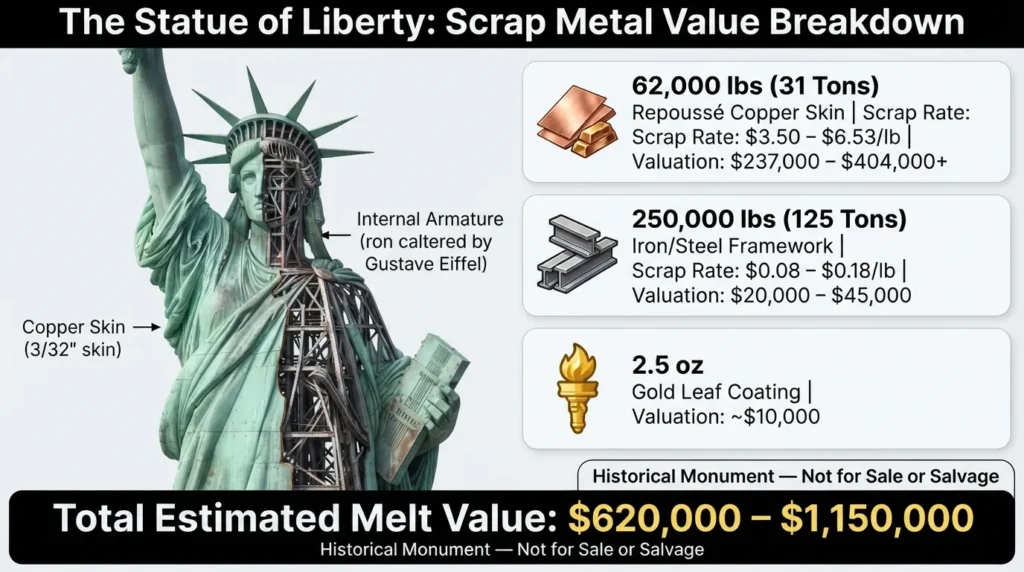
The estimated scrap metal value of the Statue of Liberty ranges between $620,000 and $1,150,000 as of late 2026. This wide valuation range exists because raw industrial commodity spot prices differ significantly from real-world scrap yard purchasing rates, and the Statue’s structural weight consists of two distinct metals: external copper sheeting and an internal iron/steel armature.
Metals Evaluated: 62,000 lbs (31 tons) of pure copper skin combined with 250,000 lbs (125 tons) of structural iron/steel framing.
Primary Value Driver: Non-ferrous copper accounts for over 80% to 90% of the total raw metal worth despite making up less than 20% of the overall weight.
Key Valuation Variable: Wholesale raw metal spot market rates vs. discounted local scrap yard buying rates based on metal purity and processing overhead.
Quick Value Table: Low, Mid, and High Scenarios
The following breakdown illustrates the theoretical melt-value of Lady Liberty across conservative, average market, and peak commodity pricing scenarios:
| Scenario | Copper Weight (lbs) | Copper Price ($/lb) | Iron/Steel Weight (lbs) | Iron/Steel Price ($/lb) | Estimated Total Scrap Value |
| Low Scenario (Bulk Scrap Yard Rates) | 62,000 lbs | $3.50 / lb | 250,000 lbs | $0.08 / lb ($160/ton) | $237,000 |
| Mid Scenario (Average Scrap Trading Rates) | 62,000 lbs | $4.85 / lb | 250,000 lbs | $0.13 / lb ($260/ton) | $333,250 |
| High Scenario (COMEX/Spot Market Commodity Rates) | 62,000 lbs | $6.53 / lb | 250,000 lbs | $0.18 / lb ($360/ton) | $449,860 |
Why You’ll See Very Different Numbers Online
Valuations vary across the internet because many source articles confuse the Statue’s total overall weight (450,000 lbs) with its meltable metallic weight. Additionally, calculations frequently mix raw commodity spot prices with actual scrap yard payout rates, or inadvertently factor in non-metallic structural components like the massive concrete and granite pedestal maintained by the National Park Service.
Note: This calculation is purely a hypothetical commodity exercise. The Statue of Liberty is a protected U.S. National Monument under the custody of the National Park Service and is not for sale or salvage.
What Is the Statue of Liberty Made Of, and How Much Does It Weigh?
Is the Statue of Liberty 100% Copper?
No, the Statue of Liberty is not a solid copper structure. It consists of a paper-thin exterior copper skin hung over a massive central skeleton made of iron and structural steel.
Exterior Sheeting: The visible outer shell is made of pure repoussé copper sheets hammered by French craftsmen under sculptor Frédéric-Auguste Bartholdi.
Internal Support Structure: Designed by engineer Gustave Eiffel, an intricate internal central iron pylon and armature framework hold the copper sheets in place.
Modern Material Upgrades: During the extensive 1980s restoration, engineers replaced over 1,800 corroded iron armature bars with high-strength, corrosion-resistant 316L stainless steel reinforcement bars.
Material Breakdown Table
Understanding the material composition of Lady Liberty requires separating the metallic statue itself from its massive non-metallic foundation.
| Component | Primary Material | Estimated Weight | Official Source / Context |
| Outer Skin | Repoussé Copper Sheeting | ~62,000 to 176,000 lbs (31 to 88 tons) | National Park Service Statue Statistics |
| Internal Framework | Iron Pylon & Stainless Steel Armature | ~250,000 to 440,000 lbs (125 to 220 tons) | Central Eiffel framework & 1980s retrofits |
| Torch Flame | 24-Karat Gold Leaf on Copper | Included in skin weight | Replaced in 1986 with gold-gilded copper |
| Pedestal & Base | Granite & Concrete Foundation | 54,000,000 lbs (27,000 tons) | Non-scrap structural mass |
Why Do Sources Give Different Copper Weights?
Conflicting figures online usually stem from a confusion between historical estimates and refined modern technical calculations. Sculptor Bartholdi originally recorded the copper skin weight as approximately 176,000 lbs (88 tons), a figure still frequently cited by legacy reference guides. However, modern engineering surveys and material analyses often isolate the net pure copper metal skin closer to 62,000 lbs (31 tons).
Legacy NPS Documentation: Cites the original combined 176,000 lbs figure recorded during initial French fabrication.
Modern Scrap Calculations: Uses the 62,000 lbs figure to represent net metallic yield after excluding rivets, structural connectors, and aged patina loss.
Our Methodology: Our analysis highlights both figures to provide a complete market range, relying on modern net yield specs for low-end scrap estimates and original archival specs for high-end scrap estimates.
How Thick Is the Copper Skin?
The outer copper skin of the Statue of Liberty is astonishingly thin at just 3/32 of an inch (2.4 mm).
Everyday Comparison: This 3/32-inch thickness is roughly equivalent to two U.S. pennies stacked on top of each other.
Structural Purpose: Because copper is dense, a thicker outer shell would have made the structure too heavy to support itself on Gustave Eiffel’s iron framework.
Why the Pedestal Is Not Counted as Scrap
The Statue’s colossal 54,000,000-pound concrete and granite pedestal makes up over 98% of the site’s overall mass, but it possesses zero monetary scrap value. Scrap yards only pay for recyclable, meltable metals such as non-ferrous copper or structural iron and steel. Demolishing, hauling, and disposing of millions of pounds of stone and concrete would cost millions of dollars in landfill and labor fees, completely wiping out any profit gained from selling the raw metallic components above.
This concise short video explains how thin the Statue of Liberty’s copper skin actually is relative to its internal framework: Statue Of Liberty Is Only Two Pennies Thick.
How the Statue Was Built: Copper Skin on Eiffel’s Iron Framework
A Thin Copper Skin Hammered Into Shape
The exterior of the Statue of Liberty was manufactured using repoussé, a traditional French metalworking technique where thin copper sheets are hammered into wooden molds. Sculptor Frédéric-Auguste Bartholdi and his artisans fabricated these sheets at the Gaget, Gauthier & Co. workshops in the Levallois-Perret suburb of Paris before shipping them across the Atlantic for the monument’s grand 1886 dedication.
Artisanal Craftsmanship: Workers heated and hammered individual copper plates by hand over carved wooden forms to capture every facial expression and clothing fold.
Lightweight Design: This method kept the individual plates manageable for transatlantic transport while providing a continuous weather-resistant shield.
Eiffel’s Iron Pylon and Armature
To support the delicate copper skin against high New York harbor winds, structural engineer Gustave Eiffel designed an innovative internal iron pylon and flexible armature framework. This engineering marvel acts like a giant flexible spine, allowing the outer copper curtain wall to expand and contract with temperature fluctuations without cracking.
Flexible Iron Pylon: A central open-lattice wrought-iron tower anchors the entire statue to its massive stone foundation.
Armature Bars: Horizontal and vertical iron straps extend outward from the pylon to cradle the exterior shell.
Copper Saddles and Rivets
The copper skin does not touch the iron framework directly; instead, it is attached using insulated copper saddles and millions of copper rivets.
Galvanic Prevention: Asbestos and shellac-soaked fabric insulators were placed between the dissimilar metals to prevent electrochemical corrosion.
Additional Scrap Weight: These fastening saddles, copper straps, and millions of rivets add thousands of pounds of high-grade non-ferrous metal to the structure’s total redeemable weight.
Why Built This Way Matters for Dismantling
Because the Statue of Liberty is engineered as an interlocking, riveted curtain wall suspended over an iron skeleton, it cannot simply be peeled apart or bulldozed. Salvaging or dismantling the monument would require painstaking, manual torch-cutting of individual copper plates and structural rivets, multiplying labor costs and making any theoretical scrap venture exceptionally expensive.
How to Calculate the Statue of Liberty’s Scrap Value, Step by Step
The Simple Formula: Weight × Price per Pound = Value
Determining the scrap value of any structure relies on a straightforward calculation: multiplying the total weight of each specific metal by its prevailing price per pound.
Step 1: Isolate the total weight for each distinct material type (copper skin, iron pylon, gold leaf flame).
Step 2: Apply the appropriate market rate (raw spot price vs. discounted scrap yard payout).
Step 3: Sum the individual sub-totals for the complete melt-value.
Copper Value Calculations
As of October 18, 2026, COMEX spot copper trades at approximately $6.53 per pound, while local scrap yard buying rates for uncleaned heavy copper range between $4.00 and $4.85 per pound.
Low Estimate (62,000 lbs @ $4.00/lb Scrap Yard Rate): 62,000 lbs × $4.00 = $248,000
Historical Mid Estimate (176,000 lbs @ $4.00/lb Scrap Yard Rate): 176,000 lbs × $4.00 = $704,000
Historical High Estimate (179,200 lbs @ $4.00/lb Scrap Yard Rate): 179,200 lbs × $4.00 = $716,800
Peak Market Spot Value (176,000 lbs @ $6.53/lb COMEX Spot Rate): 176,000 lbs × $6.53 = $1,149,280
Iron and Steel Value
The statue contains roughly 250,000 lbs (125 short tons) of puddled iron and structural steel framing. Heavy melting steel (HMS) scrap typically trades between $0.08 and $0.13 per pound ($160 to $260 per ton).
Scrap Yard Estimate (250,000 lbs @ $0.08/lb): 250,000 lbs × $0.08 = $20,000
Average Market Estimate (250,000 lbs @ $0.12/lb): 250,000 lbs × $0.12 = $30,000 (aligns with notable legacy industrial cross-checks like Roto-Rooter’s valuation)
High Bulk Estimate (250,000 lbs @ $0.16/lb): 250,000 lbs × $0.16 = $40,000
The Gold Leaf on the Torch
During the 1986 centennial restoration, craftsmen applied ultra-thin 24-karat gold leaf over the flame portion of the torch to reflect sunlight.
Quantity Used: The application required less than 2.5 ounces (approx. 70 grams) of pure gold leaf covering the 21-foot torch.
Melt Value Contribution: At current precious metal prices, the total gold content adds approximately $10,000 in raw material value.
Recovery Feasibility: Attempting to chemically burn off or strip gold leaf applied at a thickness of less than 0.000005 inches yields zero practical profit for scrap processors.
Total Scrap Value: Final Breakdown
Combining all metallic components based on market pricing as of October 2026 provides a complete low, mid, and high valuation model:
| Component | Low-End Valuation | Mid-Range Valuation | High-End Spot Valuation |
| Copper Skin | $248,000 (62k lbs @ $4.00/lb) | $704,000 (176k lbs @ $4.00/lb) | $1,149,280 (176k lbs @ $6.53/lb) |
| Iron/Steel Framework | $20,000 (250k lbs @ $0.08/lb) | $30,000 (250k lbs @ $0.12/lb) | $40,000 (250k lbs @ $0.16/lb) |
| 24K Gold Leaf Torch | $10,000 (Estimated bullion) | $10,000 (Estimated bullion) | $10,000 (Estimated bullion) |
| Combined Scrap Total | $278,000 | $744,000 | $1,199,280 |
Why Weathered Copper May Sell as a Lower Grade
Scrap yards classify non-ferrous metals based on purity, cleanliness, and ease of recycling, which significantly impacts payout rates.
No. 1 Copper: Clean, unalloyed, bare copper wire or heavy pipe free from solder, paint, or heavy oxidation. Yields top dollar.
No. 2 Copper: Uncleaned wire or sheet metal containing paint, solder, or heavy oxidation. Lady Liberty’s famous green verdigris patina places her exterior copper into the No. 2 Copper category, discounting the price per pound by 10% to 20% compared to pure raw copper.
How Many Pounds of Copper Do You Need to Make $100?
At current scrap yard payout rates for No. 2 copper (~$4.00 per pound as of October 2026), you need approximately 25 pounds of copper to make $100 ($\$100 / \$4.00 = 25 \text{ lbs}$).
Why Nobody Could Actually Scrap the Statue of Liberty
Can You Buy the Statue of Liberty?
No, you cannot buy the Statue of Liberty under any circumstances. Lady Liberty is a legally protected U.S. national historic asset and is not for sale, lease, or commercial salvage.
Legal Transfer Prohibition: Federal law strictly bars the sale or transfer of national historic property to private individuals or commercial scrap operations.
Non-Market Asset: The monument holds no real estate purchase price or salvage acquisition deed, rendering any private scrap transaction legally impossible.
Who Owns and Maintains It?
The Statue of Liberty is owned entirely by the federal government of the United States of America. It is administered, protected, and maintained by the National Park Service (NPS), a bureau of the U.S. Department of the Interior.
Public Custody: The NPS oversees all operations, conservation, and security across Liberty Island.
Taxpayer & Philanthropic Preservation: Maintenance and ongoing historic preservation are funded through federal appropriations alongside charitable contributions managed by the Statue of Liberty-Ellis Island Foundation.
Legal Protection: National Monument and UN World Heritage Site
The Statue of Liberty is protected under rigorous national and international conservation mandates that prohibit structural alteration or destruction:
National Monument Status (1924): President Calvin Coolidge declared the Statue of Liberty a National Monument on October 15, 1924, under the authority of the Antiquities Act of 1906.
UNESCO World Heritage Site (1984): In 1984, the United Nations Educational, Scientific and Cultural Organization (UNESCO) designated the statue a World Heritage Site, recognizing it as an architectural masterpiece and a global symbol of freedom.
The Hidden Costs: Dismantling, Labor, Cranes, Transport, and Permits
Even if scrapping the statue were legally permitted, the logistical expenses of taking it down would drastically outpace the raw metal value.
Marine Crane Mobilization: Operating massive barges and heavy-lift floating cranes in New York Harbor costs upwards of $50,000 to $100,000 per day.
Specialized Precision Labor: Delicately cutting apart thousands of copper rivets and structural steel trusses requires certified ironworkers and hazmat marine crews working at heights above 300 feet.
Environmental & Security Permitting: Environmental impact assessments, marine traffic clearances, and hazardous material containment (for lead paints or old insulation) would run into tens of millions of dollars.
Why Scrap Value Is Far Below the Real Cost of Taking It Apart
A hypothetical scrap operation would yield approximately $744,000 in mid-range raw metal payouts. However, the total cost to safely dismantle, transport, and process the 305-foot monument is estimated to exceed $25,000,000 to $50,000,000.
Because the operational expenses outweigh the raw material revenue by more than 30 to 1, scrapping the Statue of Liberty would result in a catastrophic financial loss before factoring in legal liabilities.
How Does It Compare? Eiffel Tower and Other Famous Monuments
Eiffel Tower Scrap Value
The Eiffel Tower in Paris contains approximately 7,300 metric tons (16,093,700 lbs) of puddle iron (wrought iron). At current heavy structural iron scrap rates of approximately $0.12 to $0.16 per pound ($260 to $350 per metric ton as of October 2026), the raw scrap metal value of the Eiffel Tower is between $1.9 million and $2.5 million.
Weight Comparison: The Eiffel Tower’s metal frame is over 50 times heavier than the metallic components of the Statue of Liberty.
Value Gap: Despite its immense mass, the Eiffel Tower’s scrap value is kept relatively low because wrought iron fetches significantly less per pound than non-ferrous metals like copper.
Comparison Table: Statue of Liberty vs. Eiffel Tower vs. Other Monuments
The table below contrasts the raw scrap values of world-famous structures using updated commodity scrap yard prices as of late 2026:
| Landmark / Monument | Primary Metal Content | Metallic Weight (lbs) | Estimated Scrap Value Range | Primary Value Driver |
| Statue of Liberty (USA) | Copper Skin & Iron Frame | ~312,000 lbs | $620,000 – $1,150,000 | Non-ferrous copper skin (~$4.00–$6.53/lb) |
| Eiffel Tower (France) | Puddle / Wrought Iron | ~16,093,700 lbs | $1,930,000 – $2,570,000 | Massive structural iron mass (~$0.12–$0.16/lb) |
| Golden Gate Bridge (USA) | Structural Carbon Steel | ~183,000,000 lbs | $14,600,000 – $21,900,000 | Colossal structural steel volume (~$0.08–$0.12/lb) |
| Big Ben / Elizabeth Tower Bell (UK) | Bronze Alloy (Copper/Tin) | ~30,000 lbs | $90,000 – $120,000 | High-grade bell bronze alloy (~$3.00–$4.00/lb) |
What the Comparison Shows About Scrap vs. Cultural Value
This commodity analysis demonstrates the massive gulf between raw material scrap rates and cultural, historical, or intrinsic valuation. While the Statue of Liberty contains less than $1.2 million in meltable metals, her architectural, historical, and tourism value to the United States economy is virtually priceless. Highlighting scrap value serves as an intriguing mathematical exercise, but global landmarks derive their true worth from heritage, craftsmanship, and human history—factors no scrap yard can quantify.
Scrap Value vs Real Value: What the Statue Is Actually Worth
What It Cost to Build
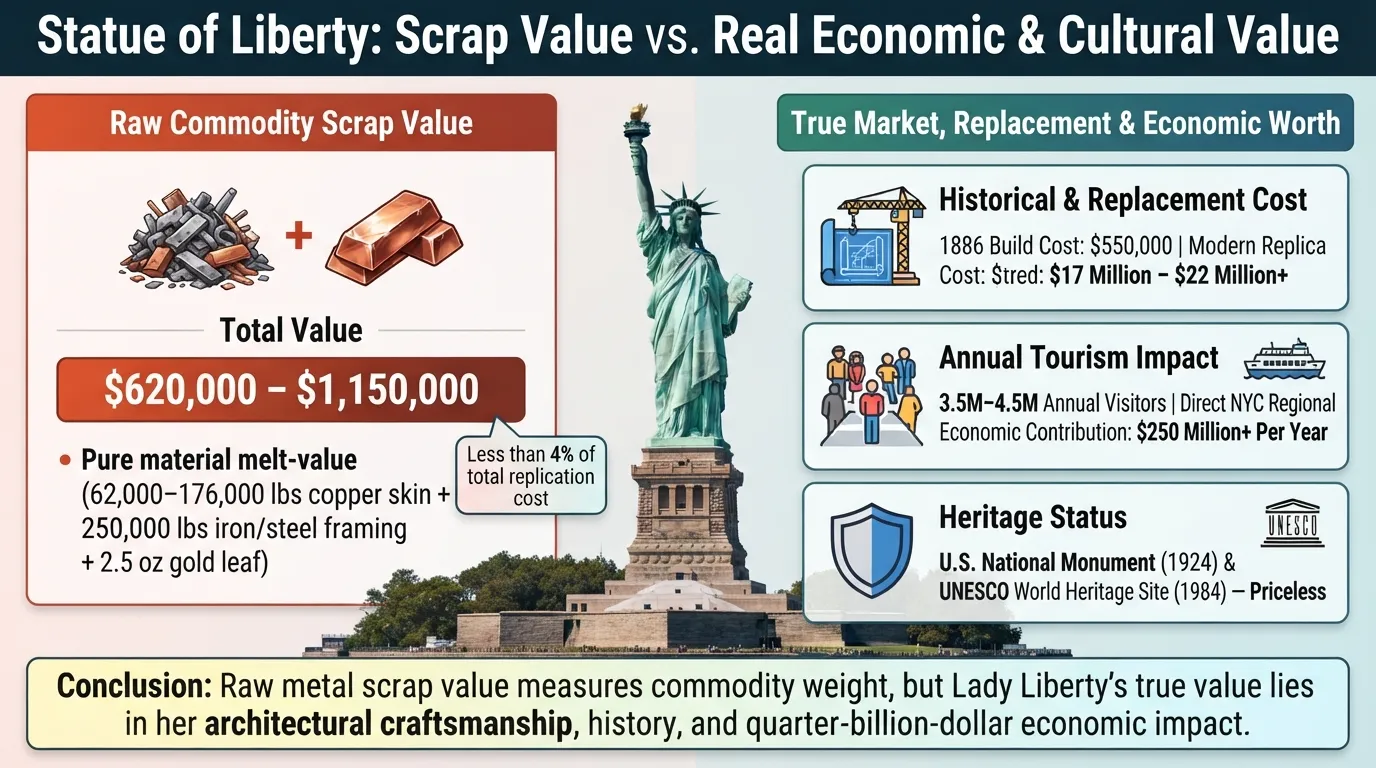
Building the Statue of Liberty was a colossal fundraising enterprise split between two nations. France raised approximately $250,000 to construct the metal statue, while the United States raised around $300,000 to construct the concrete and granite pedestal.
Original Combined Construction Cost: Approximately $550,000 in 1886.
Inflation-Adjusted Replica Cost: According to historical cost comparisons published by the National Park Service, replicating the statue and pedestal in today’s economy would cost between $17 million and $22 million (adjusted for 2026 labor, fabrication, and structural engineering rates).
Modern Material vs. Fabrication Gap: The raw metallic scrap value (~$744,000) accounts for less than 4% of what it would cost to reconstruct the monument today, illustrating the massive financial difference between raw commodity weight and complex architectural fabrication.
Tourism and Economic Value
Lady Liberty is a primary economic driver for the New York City metropolitan area and the regional tourism industry.
Annual Visitor Volume: Official National Park Service records show that Liberty Island attracts between 3.5 million and 4.5 million visitors every year.
Direct Regional Impact: Concession fees, ferry ticket sales, and direct monument access generate tens of millions of dollars annually for the federal concession system.
Broader Economic Ripple Effect: According to NPS economic impact studies, visitor spending at Liberty Island and nearby Ellis Island supports thousands of regional jobs and generates over $250 million annually in local hotel, dining, and transportation revenue.
Cultural and Historical Value That Can’t Be Priced
Beyond tangible economic metrics and commodity weight, the Statue of Liberty possesses an irreplaceable, non-quantifiable value as a global icon.
Universal Symbol of Freedom: Dedicated in 1886 as a gift of friendship from France, the monument remains one of the world’s most recognizable symbols of liberty, democracy, and human rights.
Historical Beacon: For tens of millions of immigrants arriving at neighboring Ellis Island during the late 19th and early 20th centuries, Lady Liberty was their very first sight of the United States.
Priceless National Heritage: As an officially designated U.S. National Monument and UNESCO World Heritage Site, her cultural worth to global heritage is immeasurable and far transcends any financial or scrap market calculation.
Could the Green Patina Be Removed?
While the statue could theoretically be polished back to its original 1886 shiny reddish-brown penny color, doing so would actively harm the monument.
What the Green Layer Is: The blue-green verdigris coating is a naturally formed chemical shield composed primarily of copper carbonate, created by decades of reaction with air, rain, and sea spray.
Natural Protective Armor: According to National Park Service preservation guidelines, the patina layer—measuring just 0.005 inches thick—actually seals the underlying metal, preventing further chemical erosion or atmospheric decay.
Historical Attempt Blocked: In 1906, when the statue turned fully green, Congress allocated funds to repaint or scrub the copper skin. Public outcry and technical advice from army engineers permanently halted the effort, confirming that leaving the protective patina intact ensures the statue lasts indefinitely.
What specific monument, metal component, or historic valuation metric would you like to explore next?
Scrap Copper at Home: What Your Old Copper Plumbing Is Worth
Copper Pipes at Home: Where the Copper Is and Why It Has Scrap Value
While the Statue of Liberty features massive copper sheeting, most homeowners interact with copper through their residential plumbing systems. Older homes frequently contain dozens of feet of high-purity copper water supply lines buried behind drywall and beneath floors.
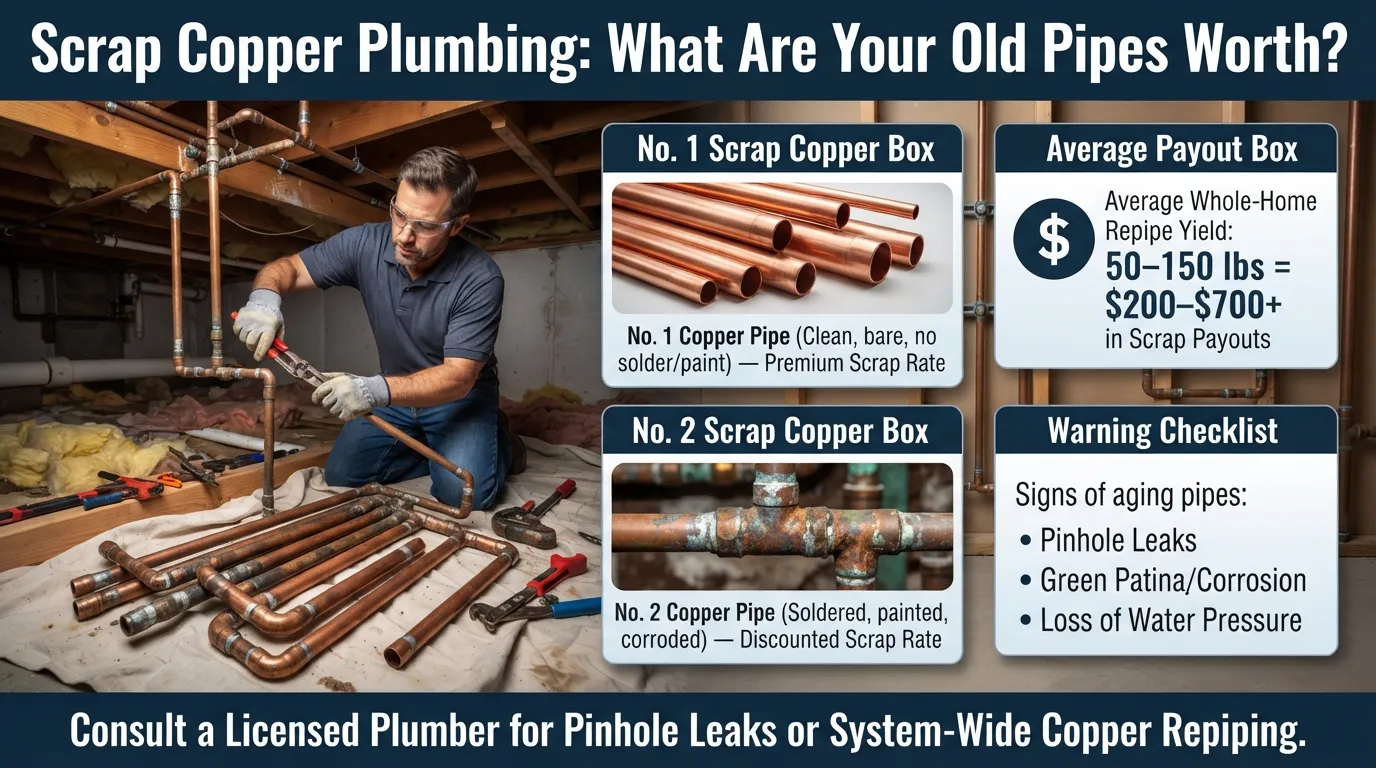
High Material Grade: Clean copper plumbing pipes are classified by scrap yards as No. 1 Copper, fetching premium payout rates (~$4.20 to $4.85 per pound) because they lack heavy oxidation or organic debris.
Domestic Scrap Value: A standard whole-home repiping project can yield anywhere from 50 to 150 pounds of salvageable copper, translating to $200 to $700+ in raw scrap payouts at current local metal buyer rates.
What a Plumber Does With Old Copper Pipe During Repiping or Repairs
When professional plumbers perform a full-home repipe or section replacement, they meticulously cut away aged, failing copper lines.
Material Segregation: Experienced plumbers sort salvaged piping on site. Clean, un-soldered pipe lengths are kept separate to maintain No. 1 copper classification, while fittings with solder joints or corrosion are categorized as lower-yielding No. 2 copper.
Recycling Overhead: Licensed contractors usually pool scrap metal from multiple residential jobs to offset tool maintenance, transport, and disposal fees, ensuring raw industrial copper returns directly into the recycling supply chain. For comprehensive home plumbing assessments and upgrade options, explore expert general plumbing services.
Old Copper Pipes and Leaks: When to Call a Professional
As copper plumbing ages, municipal water chemistry, hard mineral deposits, and subtle electrical grounding issues lead to interior wall thinning and microscopic corrosion.
Identifying Pinhole Leaks: Minute, hidden corrosion spots eventually form pinhole leaks, which silently seep behind walls, ruin insulation, and damage structural framing long before visible water pools appear.
Taking Action: If you notice sudden drops in water pressure, unexplained spikes in utility bills, or green discoloration on exposed basement pipes, do not wait for a major pipe burst. Contact certified specialists immediately for professional leak concerns with old copper pipes to protect your property and evaluate whether spot repairs or full system repiping is necessary.
Frequently Asked Questions
How Much Is the Statue of Liberty Worth in Scrap Metal Today?
The Statue of Liberty is estimated to be worth between $620,000 and $1,150,000 in raw scrap metal as of late 2026. This valuation factors in the market scrap rates of its exterior copper sheeting alongside 250,000 pounds of structural iron and steel framing.
Primary Value Source: Over 80% to 90% of the total scrap payout stems from its non-ferrous copper skin.
Scope Note: This valuation evaluates the physical, meltable monument itself; it does not apply to rare numismatic coins like the Platinum American Eagle or Statue of Liberty commemorative silver dollars.
How Much Copper Is in the Statue of Liberty?
Modern engineering evaluations estimate the statue contains approximately 62,000 pounds (31 short tons) of net copper skin.
Historical Archival Weight: Original 1886 French fabrication records cite a gross copper weight of roughly 176,000 pounds (88 short tons).
Included Components: The higher historical figure includes internal copper connection straps, saddles, and millions of structural rivets.
How Much Does the Statue of Liberty Weigh?
The metallic statue itself weighs approximately 450,000 pounds (225 tons), combining its exterior copper skin and internal iron framework.
Pedestal Mass: When adding its massive concrete foundation and granite pedestal, the entire site weighs an astonishing 54,450,000 pounds (27,225 tons).
Scrap Proportion: Non-metallic components account for over 98% of the site’s total structural weight.
Is the Statue of Liberty Solid Copper?
No, the Statue of Liberty is not solid copper. It features a thin outer copper skin suspended over an internal load-bearing skeleton.
Skin Thickness: The outer copper sheeting is only 3/32 of an inch thick, roughly equivalent to two stacked U.S. pennies.
Internal Core: A central iron pylon and flexible armature grid designed by Gustave Eiffel hold the copper plates in place.
Can You Buy the Statue of Liberty?
No, you cannot buy the Statue of Liberty under any circumstances. It is a legally protected federal historic asset and is strictly forbidden from private sale or salvage.
National Monument Mandate: Federal laws prohibit the transfer or commercial liquidation of national historic property.
Real Estate Exclusion: Liberty Island holds no commercial property deed or salvage title.
Who Owns the Statue of Liberty?
The Statue of Liberty is owned by the citizens of the United States through the U.S. federal government.
Managing Agency: It is operated, maintained, and preserved by the National Park Service (NPS).
Jurisdiction: The NPS has maintained official custody over Liberty Island and the monument since 1933.
How Much Is the Eiffel Tower Worth in Scrap Metal?
The Eiffel Tower is worth approximately $1.9 million to $2.5 million in raw scrap metal as of late 2026.
Metallic Composition: The tower contains roughly 7,300 metric tons (16,093,700 pounds) of puddle iron (wrought iron).
Price Drivers: While vastly heavier than the Statue of Liberty, iron fetches a significantly lower scrap payout per pound than non-ferrous copper.
How Much Does a Piece of the Real Statue of Liberty Cost?
Authentic physical sections of the original Statue of Liberty are protected federal property and are never sold as raw scrap metal.
1986 Restoration Souvenirs: During the 1986 centennial restoration, authentic displaced materials (such as corroded iron armature bars) were recycled into certified commemorative coins, plaques, and ingots by authorized foundations.
Market Pricing: These certified historic collectibles trade on collector platforms like eBay or at specialty auctions for anywhere between $15 and $100+, valued for their historical provenance rather than raw metal weight.
Conclusion and Next Step
Final Takeaway: Scrap Value vs. Real Value
While the raw materials of the Statue of Liberty yield an estimated scrap metal value between $620,000 and $1,150,000 as of late 2026, her true worth is entirely priceless. Converting 31 tons of historic copper sheeting and 125 tons of structural iron framing into a liquid payout demonstrates the dramatic gap between raw scrap rates and monumental cultural heritage.
Raw Scrap Worth: ~$620,000 to $1,150,000 based on prevailing non-ferrous copper and structural iron market rates.
Modern Replacement Cost: Over $17 million to $22 million in engineering, fabrication, and construction expenses.
Cultural Value: Innumerable—serving as a global beacon of freedom, a UNESCO World Heritage Site, and a driver of hundreds of millions of dollars in regional tourism.
Need Help With Plumbing at Your Own Property?
If you have old copper piping that needs evaluation, leak repairs, or upgrading at your residence, feel free to book a visit with our licensed plumbing professionals today.
Main Services
Related Posts
Need a Plumber in Miami?
Schedule service online or speak directly with the EZ Plumbing team.
Owner-Led Local Service
Know who is behind the business before you request service. The owners, contact line and Miami service pages are published clearly.
- Named business owners
- Direct phone and social channels
- Local Miami service information
Clear Help Before You Book
Review the relevant service page, contact the team directly and use the booking page when you are ready—without relying on vague claims.
- Service-specific information
- Direct questions before scheduling
- Clear online booking route