Where Does Sewer Water Go? The Full Journey From Your Drain to Treatment
Where Does Sewer Water Go?
When you flush a toilet, run the washing machine, or drain a sink, wastewater leaves your home through a hidden network of pipes designed for rapid disposal. The moment water vanishes down the drain, it enters a multi-step purification journey managed by your local municipality or an on-site treatment system.
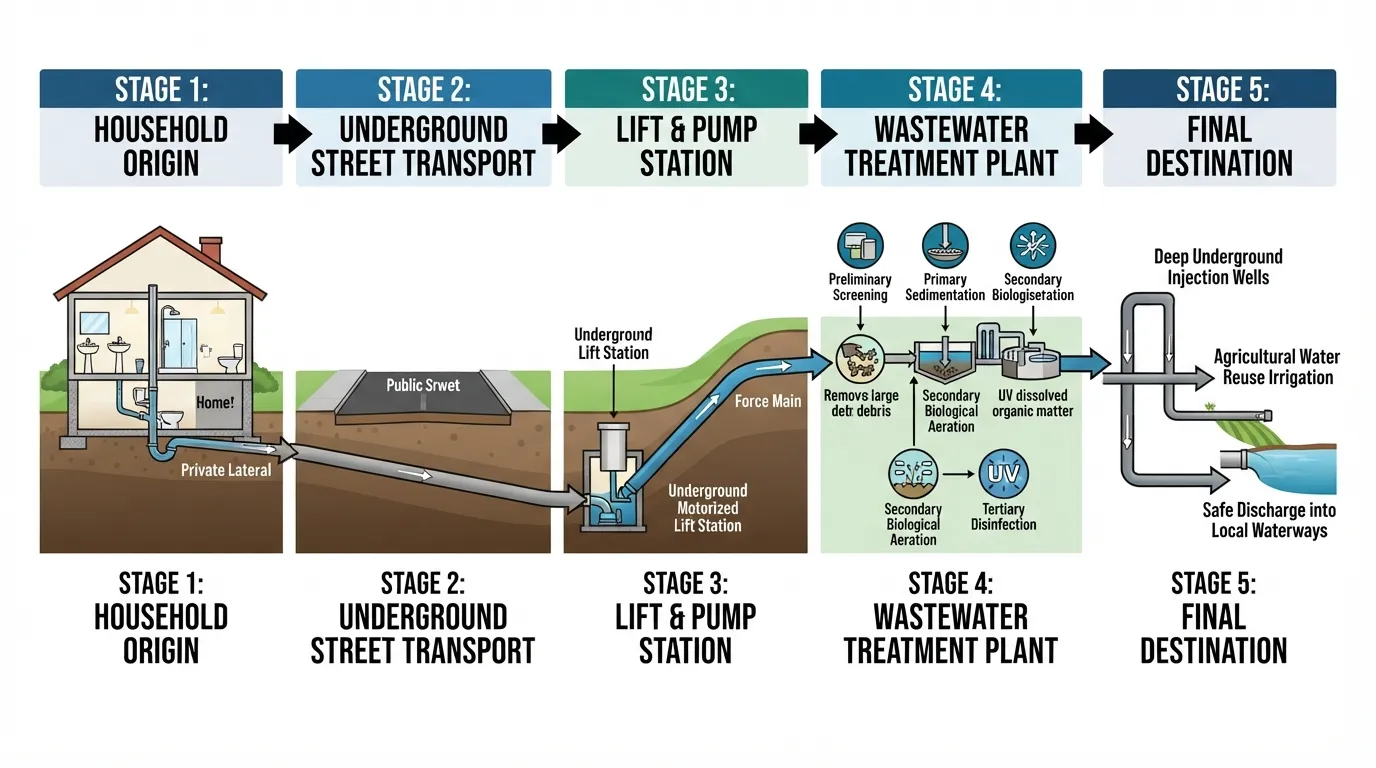
Sewer water leaves your home through private drain pipes, flows into the main municipal sewer line, and travels via gravity and lift stations to a wastewater treatment plant. There, advanced physical, biological, and chemical processes filter out contaminants so the treated water (effluent) can be safely released into local waterways, injected deep underground, or recycled for irrigation. Homes relying on a septic system process this water directly in their yard instead.
Sewer vs. Septic: Which One Does Your Home Use?
Understanding where your wastewater goes depends entirely on whether your property connects to a municipal sewer system or relies on an on-site septic tank. The key differences impact maintenance responsibility, cost, and potential property risks:
| Feature / Aspect | Municipal Sewer System | On-Site Septic System |
| Where Wastewater Goes | Flows into city pipes to a centralized treatment plant. | Collects in a private underground tank and drain field. |
| Who Maintains It | The local utility (property owner manages only the lateral pipe). | The homeowner is 100% responsible for maintenance and pumping. |
| Common Areas | Urban neighborhoods, dense suburbs, and commercial zones. | Rural locations, older suburbs, and low-density residential areas. |
| Typical Risk | Main line backups, citywide surcharge fees, pipe aging. | Tank overflow, drain field failure, ground/well water contamination. |
Quick Tip: Miami-Dade homeowners can verify their system type by checking their monthly utility bill for a sewer service fee, reviewing property records on the county appraiser website, or inspecting the yard for a visible septic tank riser lid.
The Journey at a Glance
The transition from raw household sewage to environmentally safe water happens through five continuous structural stages:
The Household Drain: Water exits your fixtures and flows through internal plumbing stacks toward the base of your home.
The Private Lateral Line: Gravity carries wastewater across your property through a single underground sewer lateral pipe.
The Municipal Sewer Main: Your lateral connects to larger city collection pipes buried beneath public streets.
Pumping and Lift Stations: Large motorized pumps lift the wastewater uphill whenever natural gravity flow is insufficient across flat terrain.
The Wastewater Treatment Plant: Sewage arrives at a centralized facility where physical screens, beneficial bacteria, and disinfectants purify the water before environmental release.
The Step-by-Step Journey of Sewer Water From Your Home
Step 1: Your Home’s Drains and the P-Trap
Sinks, showers, toilets, and household appliances all feed into a unified internal drainage network powered by gravity and plumbing vent stacks. Every fixture features a curved pipe section known as the P-trap, which holds a small pool of standing water to block dangerous sewer gases from entering living spaces.
Step 2: The Lateral Line (Your Responsibility)
Once wastewater exits your home’s foundation, it enters the private lateral pipe that connects your household plumbing to the main public sewer in the street. Property owners are generally legally responsible for maintaining, repairing, or replacing this entire lateral line up to the public connection point. Common structural threats include root intrusion, structural cracking, and pipe collapse—issues particularly prevalent in older Miami neighborhoods featuring aging clay or deteriorating cast iron lines. For expert diagnostics on these hidden issues, scheduling a professional sewer line repair and inspection can prevent catastrophic backyard failures.
Step 3: Gravity Mains Under the Street
After passing through your lateral, wastewater enters large municipal gravity mains buried beneath public roadways. These large-diameter pipes slope downward at a calculated gradient, allowing raw sewage and greywater to travel continuously toward regional processing centers using natural momentum.
Step 4: Why Miami Needs Lift Stations
South Florida’s flat topography and high water table prevent continuous gravity flow across long urban distances. Municipalities rely on strategically placed pump stations and force mains—collectively known as lift stations—to elevate wastewater uphill or propel it across level terrain. When a lift station experiences mechanical failure or power loss during heavy storms, untreated sewage can surcharge into streets or back up into residential properties.
Step 5: Arrival at the Treatment Plant
Wastewater eventually arrives at regional processing facilities, such as those managed by the Miami-Dade Water and Sewer Department (WASD), including the Central District, North District, and South District wastewater treatment plants. These facilities subject incoming sewage to rigorous physical screening, biological aeration, and advanced disinfection before releasing treated effluent.
What a Plumber Sees in the Field
Field camera inspections frequently reveal that many residential blockages stem entirely from aggressive tree roots infiltrating cracked joints in older lateral pipes. In one recent Miami service call, our team discovered a dense root ball completely sealing off a cast iron lateral, which had trapped months of kitchen grease and paper waste. This real-world example highlights why routine preventive maintenance is vital for protecting your home’s plumbing infrastructure.
What Happens Inside a Wastewater Treatment Plant?
Why Wastewater Must Be Treated
Treating raw municipal influent is critical for safeguarding public health, protecting natural freshwater reserves, and preserving fragile regional ecosystems. In South Florida, improper wastewater management poses an immediate threat to vulnerable environmental habitats like Biscayne Bay, the Everglades, and the shallow Biscayne Aquifer, which serves as the region’s primary source of drinking water. Comprehensive sewage treatment eliminates harmful pathogens and excess chemical pollutants before water re-enters the natural water cycle.
Stage 1: Preliminary Treatment (Screening and Grit Removal)
As raw wastewater arrives at the processing facility, heavy mechanical screens capture and extract large debris such as flushable wipes, rags, plastics, and debris. Following screening, water flows into a grit chamber where sand, gravel, and heavy inorganic particles settle out to protect downstream pumps from premature abrasion.
Stage 2: Primary Treatment (Settling)
The screened wastewater enters large sedimentation basins where gravity causes suspended organic solids to settle slowly to the bottom as raw sludge. Simultaneously, lighter fats, oils, and greases float to the surface where mechanical skimmers sweep them away for separate disposal.
Stage 3: Secondary Treatment (Biological Breakdown)
Dissolved and microscopic organic matter is eliminated during secondary treatment through biological aeration basins. Specialized colonies of microorganisms and activated sludge consume remaining organic pollutants, converting dissolved waste into harmless biological mass.
Stage 4: Tertiary Treatment and Disinfection
Tertiary treatment utilizes advanced filtration membranes, nutrient removal protocols, and chemical or physical disinfection to polish the effluent. High-output ultraviolet (UV) radiation or controlled chlorine dosing destroys remaining pathogens, ensuring the resulting water meets stringent environmental standards.
What Happens to the Leftover Sludge (Biosolids)?
The solid sludge harvested during primary and secondary sedimentation undergoes extensive mechanical dewatering and anaerobic digestion. Microorganisms break down volatile organic solids inside heated tanks, reducing pathogen counts and volume before the stabilized material is repurposed as nutrient-rich agricultural biosolids or safely landfilled.
How Much Gets Removed?
Advanced municipal facilities utilize multi-stage processing to remove over 90% of suspended solids, biochemical oxygen demand (BOD), and harmful pathogens from incoming sewage.
| Treatment Stage | Primary Target / Pollutants Removed | Core Mechanism Used |
| Preliminary | Rags, wipes, grit, sand, and large floating debris | Mechanical bar screens and vortex grit chambers |
| Primary | Settlable organic solids, greases, and floating oils | Gravity sedimentation tanks and surface skimmers |
| Secondary | Dissolved organic compounds and colloidal matter | Aerated biological tanks and activated sludge bacteria |
| Tertiary | Fine suspended particles, nitrogen, and phosphorus | Sand filters, chemical precipitation, and biological nutrient removal |
| Disinfection | Harmful bacteria, viruses, and microbial pathogens | Ultraviolet (UV) radiation or chlorine injection |
Where Does Treated Sewer Water Go? Rivers, Ocean, Underground or Reuse
Does Sewer Water Go Into the Ocean?
Treated sewer water historically discharged into the Atlantic Ocean, but Florida law strictly limits this practice today. Under the state’s Ocean Outfall Legislation, South Florida municipalities were mandated to eliminate routine wastewater ocean outfall discharges, transitioning instead toward deep injection wells and high-capacity reclaimed water systems to protect sensitive marine ecosystems and coral reefs.
Deep Injection Wells in South Florida
Deep injection wells pump highly treated effluent thousands of feet below the surface into sealed geological formations, far beneath local drinking water supplies.
The Boulder Zone: Water is injected roughly 2,000 to 3,000 feet underground into porous limestone layers known as the Boulder Zone.
Aquifer Protection: Dense, impermeable rock formations isolate the injected effluent, preventing it from migrating upward into the shallow Biscayne Aquifer, South Florida’s primary drinking water supply.
Environmental Safety: Deep well injection provides a permanent disposal route that prevents excess nutrients like nitrogen and phosphorus from contaminating surface waters such as Biscayne Bay.
Water Reuse: Irrigation, Industry, and Cooling
Reclaimed water undergoes advanced filtration to meet strict environmental standards so it can be safely reused for non-potable applications. Municipal facilities distribute recycled effluent through dedicated purple pipes for several critical uses:
Commercial & Residential Irrigation: Watering public parklands, highway medians, residential lawns, and golf courses without depleting fresh drinking supplies.
Industrial Cooling Towers: Supplying massive volumes of cooling water for power generation stations and large industrial HVAC facilities.
Environmental Restoration: Recharging local wetlands and maintaining hydrological barriers to prevent saltwater intrusion into coastal freshwater zones.
Rivers and Lakes in Other Regions
In inland regions across the United States, treated wastewater effluent is discharged directly into local rivers, lakes, and streams under federal National Pollutant Discharge Elimination System (NPDES) permits. These permits enforce rigorous water quality standards to ensure discharged effluent does not compromise aquatic life or downstream public water intakes.
Where Does Sewer Water Go in the United States?
Across the United States, the destination of treated wastewater varies significantly based on regional geography, environmental regulations, and local water supply needs:
| Region / System | Primary Destination | Common Utilization |
| Inland Municipalities | Rivers, lakes, and freshwater streams | Surface water recharge, downstream drinking water supply. |
| Coastal Florida (Miami-Dade) | Deep injection wells (Boulder Zone) & reclaimed systems | Groundwater isolation, saltwater intrusion barriers, landscape irrigation. |
| Arid Southwest (AZ, CA, NV) | Advanced water purification facilities | Direct/indirect potable reuse, aquifer injection, agricultural irrigation. |
| Rural Residential Areas | Subsurface drain fields (via septic tanks) | On-site soil percolation and natural groundwater filtering. |
Do We Eventually Drink Sewage Water?
In most parts of the country, you do not drink treated sewage directly from your tap. Most municipal wastewater is discharged into rivers, oceans, or deep underground injection wells, or purified for non-potable uses like landscaping and industrial cooling. However, because natural water systems continuously recirculate moisture across watersheds, purified wastewater can indirectly re-enter drinking water supplies over time.
Indirect vs. Direct Potable Reuse
Distinguishing between water recycling frameworks comes down to whether an natural buffer separates treatment facilities from municipal drinking networks:
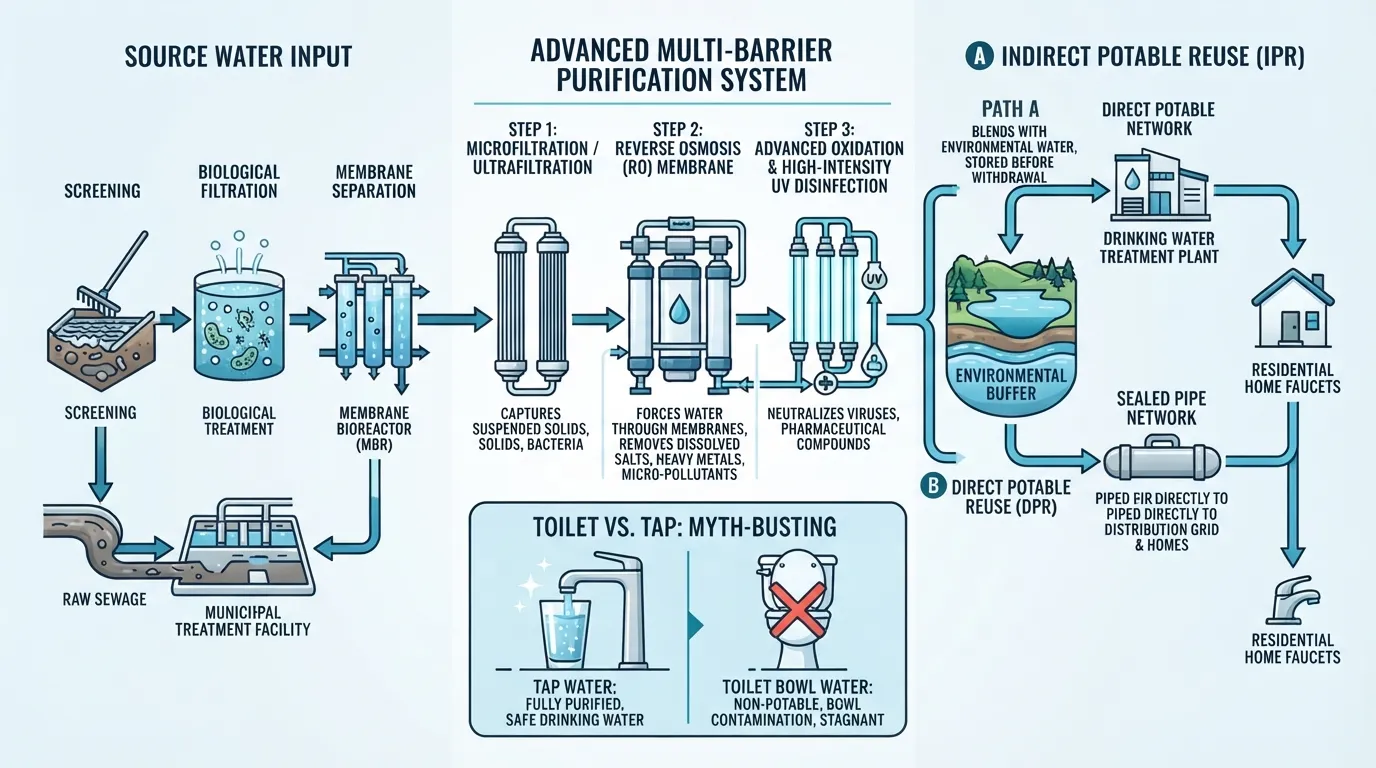
Indirect Potable Reuse (IPR): Purified wastewater is discharged into an environmental buffer—such as a natural river, reservoir, or underground aquifer—where it blends with ambient water. Downstream drinking facilities later withdraw and re-treat this water before pumping it to homes.
Direct Potable Reuse (DPR): Recycled wastewater undergoes multi-stage purification and flows directly into a drinking water distribution plant or pipe network without passing through an intermediate natural buffer.
How “Toilet to Tap” Systems Are Purified
Advanced purification facilities rely on a multi-barrier engineering approach that removes contaminants down to the molecular level:
Microfiltration & Ultrafiltration: Physical membrane barriers strain out suspended solids, microscopic parasites, and fine particulate matter.
Reverse Osmosis (RO): Water molecules are forced through semi-permeable membranes under intense pressure, stripping away dissolved salts, pharmaceuticals, industrial chemicals, and heavy metals.
Advanced Oxidation & UV Disinfection: High-intensity ultraviolet light combined with hydrogen peroxide breaks down remaining trace organic compounds and neutralizes pathogen DNA.
Is It Safe? What Regulators Check
Potable reuse systems undergo extensive oversight to guarantee biological and chemical safety before public distribution. Federal framework guidelines established under the Safe Drinking Water Act (SDWA) alongside state regulatory mandates enforce continuous real-time monitoring. For technical guidance on national water recycling frameworks, explore EPA’s water reuse resources to see how federal agencies track water purification standards.
Is Toilet Water the Cleanest Water in Your House?
The short answer is no; toilet water is not a clean source of household drinking water. While the water entering your toilet tank comes from the same potable municipal supply as your kitchen faucet, conditions inside the plumbing change rapidly:
Toilet Tank vs. Bowl: The water sitting inside the porcelain tank remains clean municipal water, but the toilet bowl contains residual bacteria, cleaning chemicals, and standing waste contaminants.
Stagnation Concerns: Tank water sits idle for long periods, allowing mineral build-up and bacterial growth along internal rubber flappers and fill valves.
The Verdict: Household tap water filtered at the faucet or refrigerator remains the safest, cleanest source for daily consumption.
Where Does Wastewater Go If You Have a Septic Tank?
How a Septic System Works
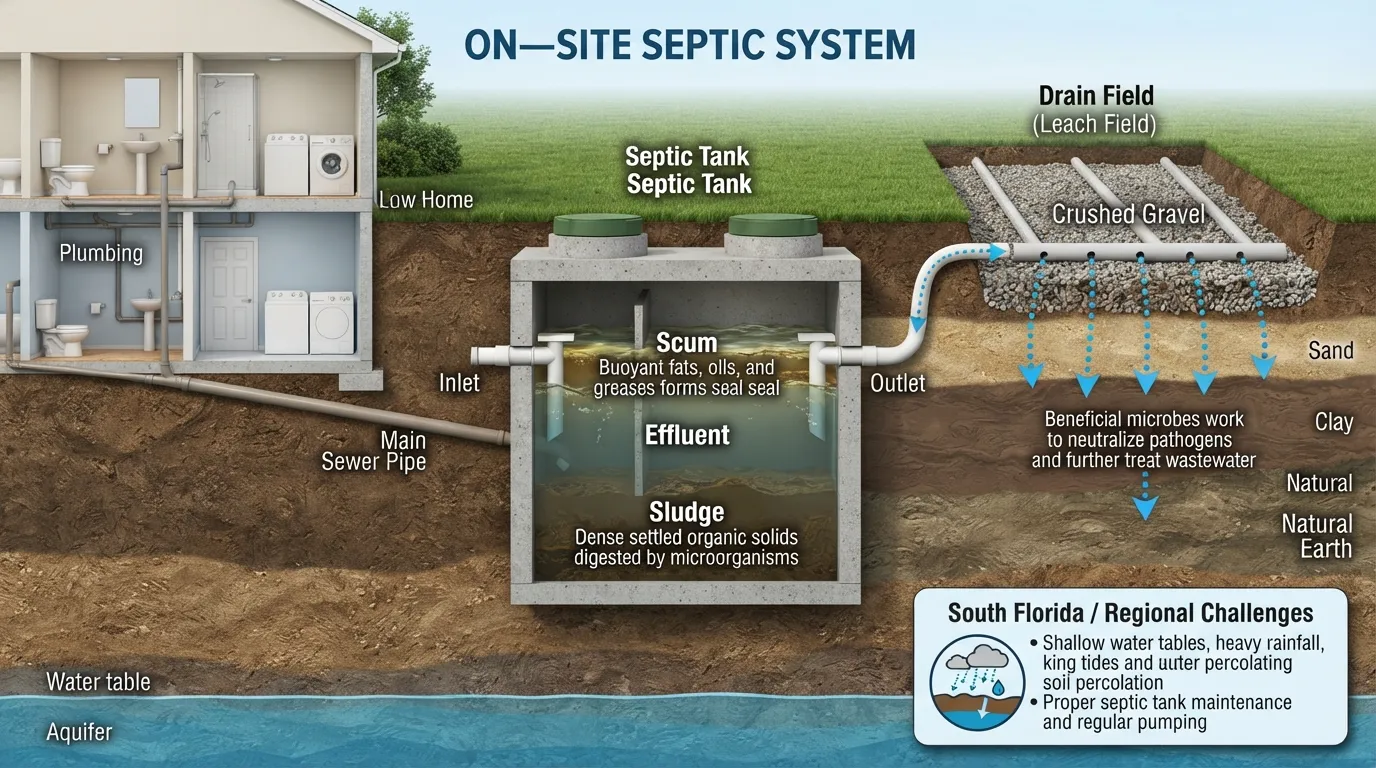
Homes disconnected from municipal sewer grids process wastewater on-site using an underground septic tank and dedicated soil treatment area. Household sewage flows into a watertight septic tank where natural gravity separates incoming solids into three distinct operational layers:
The Sludge Layer: Dense heavy organic solids sink to the bottom of the tank, where anaerobic bacteria slowly break down waste.
The Effluent Layer: Clarified liquid wastewater accumulates in the middle portion between settled solids and floating scum.
The Scum Layer: Lighter fats, oils, and greases float to the surface, forming a buoyant seal.
Internal T-shaped inlet and outlet baffles prevent floating scum and bottom sludge from exiting the tank, ensuring only liquid effluent flows into the drain field.
What Happens in the Drain Field
Clarified effluent leaves the septic tank through an outlet pipe and flows into the drain field (also called a leach field), which consists of perforated pipes buried in gravel-filled trenches. Liquid slowly trickles through the gravel and percolates downward into unsaturated soil layers. Naturally occurring soil microbes and physical soil filtration absorb excess nutrients, strip out residual pathogens, and filter biological pollutants before the purified water recharges the underlying groundwater table.
Septic Challenges in South Florida
Maintaining an on-site septic system in South Florida presents unique engineering obstacles due to regional geography and climate dynamics:
High Water Table: Shallow groundwater limits the unsaturated soil depth required beneath drain fields for effective biological treatment.
Heavy Rainfall & Storm Surges: Tropical rainstorms saturate soil layers, restricting natural percolation and causing effluent to pool above ground.
King Tides & Sea Level Rise: High seasonal tides elevate coastal groundwater tables, flooding drain field trenches and causing wastewater to back up into home drains.
Warning Signs of a Failing Septic System
Promptly identifying structural or hydraulic septic failure prevents costly property damage and groundwater contamination. Homeowners should watch for these early indicators:
Slow Drainage & Gurgling: Sinks, showers, and toilets drain sluggishly while plumbing vents emit distinct gurgling sounds.
Persistent Sewer Odors: Foul sewage smells escape from indoor drains or accumulate near the outdoor drain field area.
Soggy Yard Hotspots: Unusually lush, bright green patches of grass or pooling surface water appear directly above the drain field.
Direct Sewage Backups: Raw sewage or greywater backs up into low-lying home fixtures like bathtubs and floor drains.
Septic-to-Sewer Conversion
To safeguard regional water quality and eliminate vulnerable septic infrastructure, local governments are expanding municipal sewer networks. Initiatives like Miami-Dade County’s Connect2Protect (C2P) program actively assist property owners in transitioning from aging septic tanks to centralized county sewer services. Eligible homeowners can access municipal financial assistance, grants, or low-interest loans to cover the costs of extending private lateral lines, connecting to public mains, and properly decommissioning old septic tanks.
Sanitary Sewer vs. Storm Drain: Where Does Street Drain Water Go?
Sanitary Sewer vs. Storm Drain: The Key Difference
Street drains and indoor plumbing belong to two distinct municipal piping networks. While indoor wastewater undergoes multi-stage filtration at a water reclamation plant, street drains collect rainwater runoff and discharge it directly into local bodies of water without treatment.
| Operational Feature | Sanitary Sewer System | Storm Drain System |
|---|---|---|
| Primary Source | Toilets, sinks, showers, and household appliances. | Rainwater runoff from streets, driveways, and roofs. |
| Final Destination | Regional wastewater treatment plants. | Local canals, rivers, lakes, bays, and oceans. |
| Treatment Level | Multi-stage physical, biological, and chemical purification. | Untreated (discharged directly into natural waterways). |
| Key Environmental Risk | Pipe blockages, root intrusion, and indoor backups. | Chemical runoff, litter pollution, and toxic spills. |
Where Does Storm Drain Water Go in Miami?
In Miami-Dade County, street drains collect storm runoff and channel it rapidly through underground culverts into regional drainage canals, Biscayne Bay, and the Atlantic Ocean. Because storm sewer water bypasses treatment facilities entirely, dumping motor oil, paint, lawn fertilizers, or trash into street drains directly pollutes coastal waters and harms marine life.
What Is a Combined Sewer System?
A combined sewer system uses a single pipe network to transport both domestic sewage and urban stormwater runoff to a treatment facility. During extreme rainfall events, incoming water volumes can exceed plant processing capacity, triggering a combined sewer overflow (CSO) that releases untreated sewage and stormwater into local rivers. Unlike older industrial hubs in the Northeast and Midwest, most Florida municipalities utilize modern separated sewer systems to prevent CSO events.
How Heavy Rain Can Cause Sewer Backups
Heavy tropical rainstorms can overload sanitary sewers through a process known as inflow and infiltration (I&I):
Inflow: Rainwater enters sanitary sewer lines through illegally connected roof downspouts, yard drains, or submerged manhole covers.
Infiltration: Rising groundwater seeps into underground lateral pipes through cracks, loose joints, and deteriorating pipe walls.
System Surcharge: Excessive water volume overpowers local lift stations, causing sewage to surge back up through low-lying residential drains.
Sump Pumps and Groundwater
Properties located in low-lying coastal areas often experience groundwater intrusion around foundations and crawl spaces during heavy rainstorms. Installing a dedicated system like a sump pump installation and repair service ensures that excess groundwater is collected in a basin and safely pumped away from your foundation before it can cause structural flooding or sewer backup complications.
Which Household Drains Go to the Sewer? Toilet, Shower, Sink, and Laundry
Do Toilet and Sink Water Go Through the Same Sewer Drain?
Every indoor plumbing fixture in your home—including toilets, kitchen sinks, bathroom vanities, and shower stalls—eventually empties into the exact same primary sewer drain. While individual fixtures start on isolated branch drain lines, these branches merge into a central main drain stack beneath your floor or in your foundation slab, which directs all combined wastewater out toward the street main or septic tank.
Does Shower Water Go to the Sewer?
Shower water flows directly into the main sanitary sewer system, exiting your bathroom through a dedicated drain pipe and P-trap assembly. Although shower runoff consists primarily of rinse water and soap lather (classified as greywater), building codes require residential plumbing to discharge this water directly into the main sewer line alongside toilet waste (blackwater) unless a specialized, code-compliant greywater diversion system is installed.
Does Laundry Water Go to the Sewer?
Washing machine discharge connects directly to your home’s sanitary drainage system via a dedicated standpipe and P-trap. Laundry discharge delivers high volumes of water containing detergents, microplastics, and fabric lint; consequently, local plumbing standards mandate that this drain pipe maintain a minimum 2-inch diameter to prevent suds pressure from backing up into neighboring fixtures.
Can a Toilet, Shower, and Sink Share the Same Drain?
Multiple fixtures can share a common horizontal branch drain line under modern plumbing codes through a technique known as wet venting. In a code-compliant bathroom group, a larger 3-inch drain pipe accommodates toilet waste while simultaneously serving as a wet vent for adjacent low-flow fixtures like sinks and showers.
Modern Plumbing vs. System Blockages
Code-Compliant Design: Proper wet-venting ensures smooth airflow, protecting every fixture trap from siphonage.
Failure Point: When a shared branch line or main line becomes clogged with roots, grease, or flushed debris, wastewater takes the path of least resistance.
Field Reality: During main line blockages, flushing an upstairs toilet often forces raw sewage and greywater to back up into the lowest available fixture in the house—typically a ground-floor shower drain or bathtub basin.
Greywater vs. Blackwater: What’s the Difference?
Plumbing codes categorize indoor wastewater based on its source and biological contaminant level:
| Water Classification | Originating Fixtures | Primary Characteristics | Disposal / Recycling Requirements |
| Greywater | Bathroom sinks, showers, tubs, and washing machines. | Contains traces of soap, hair, flakes, and light organic debris. | Directly discharged to sewers; can be diverted for subsurface irrigation per local codes. |
| Blackwater | Toilets, bidets, kitchen sinks, and garbage disposals. | Contains human waste, heavy food solids, fats, grease, and dangerous pathogens. | Must be routed to the sanitary sewer or septic tank; strictly prohibited from landscape reuse. |
What You Should Never Flush or Pour Down the Drain
Items That Damage Pipes and Treatment Plants
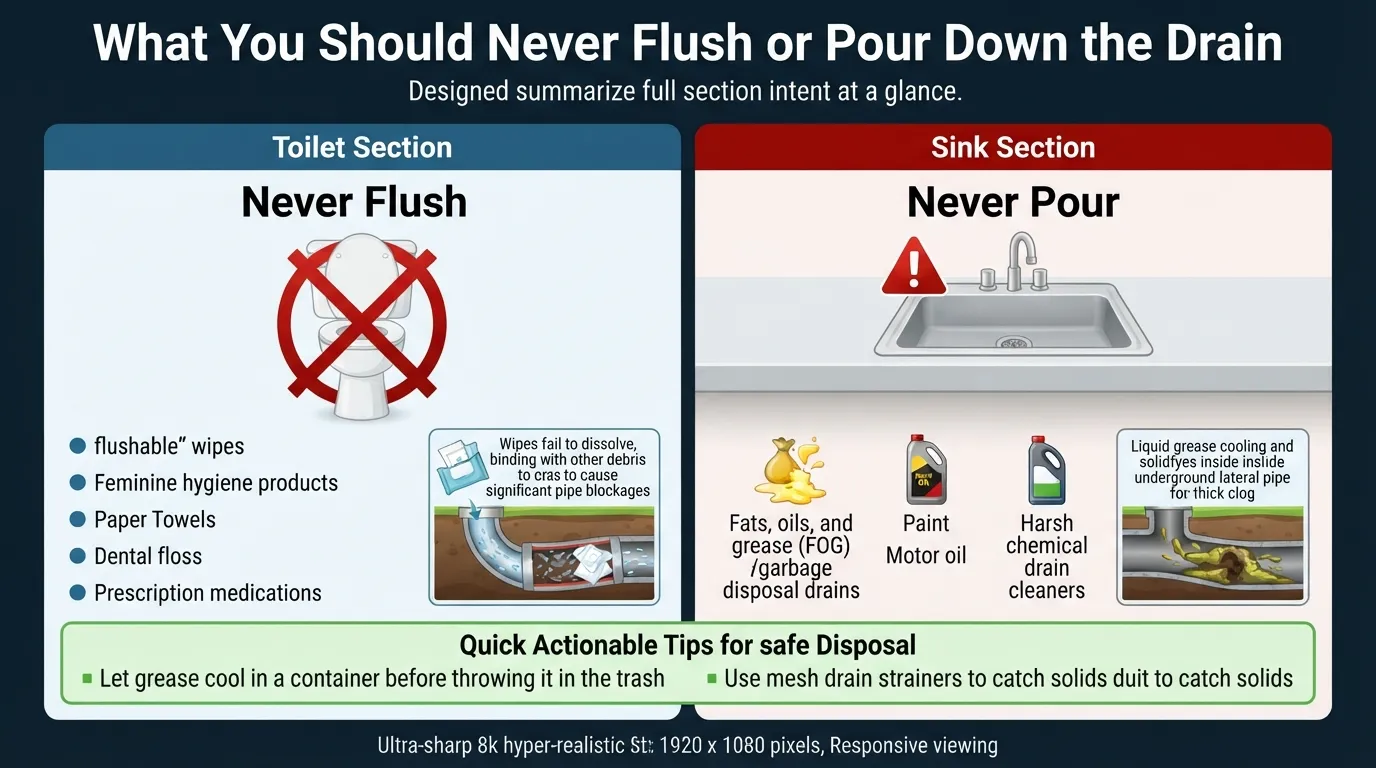
Plumbing infrastructure and municipal treatment systems are engineered to handle only human waste and toilet paper. Disposing of improper materials down toilets or sinks triggers severe pipe blockages, damages pump impellers at lift stations, and disrupts biological treatment processes. The most destructive culprits include:
“Flushable” Wipes: Despite marketing claims, synthetic wipes do not break down in water. They bind with grease to form massive blockages inside private laterals and municipal pumps.
Fats, Oils, and Grease (FOG): Liquid cooking fats solidify as they cool inside underground pipes, restricting water flow until the line freezes completely.
Feminine Hygiene Products & Paper Towels: These dense cotton and paper items expand upon absorbing water, snagging on rough pipe walls or root intrusions.
Dental Floss & Stringy Materials: Non-biodegradable floss acts as a net inside drain lines, entangling hair and debris into solid structural plugs.
Medications & Harsh Chemicals: Household chemicals and pharmaceuticals pass through biological treatment stages untreated, contaminating regional waterways and marine life.
Field Note: In local Miami homes, our service technicians find that the combination of “flushable” wipes and hardened cooking grease accounts for over 80% of residential sewer line emergencies.
Grease: The Silent Pipe Killer
When hot cooking oil or grease is poured down a kitchen sink, it travels smoothly through warm trap pipes but rapidly cools and thickens once it reaches unheated underground lateral lines. Over time, layers of grease accumulate along pipe walls, capturing food particles and paper debris until the internal pipe diameter narrows to a pinhole. Instead of pouring grease down the drain, let cooking oils cool in a glass jar or tin can, then discard the solid waste directly into the household garbage.
How to Tell If a Toilet Drain Is Clogged
Catching a sewer blockage early prevents raw wastewater from backing up into your living spaces. Common warning signs of an developing toilet clog include:
Slow Flushes: The water level inside the bowl rises unusually high before draining sluggishly.
Gurgling Sounds: Trapped air bubbles burst through neighboring shower or sink traps when the toilet is flushed.
Water Level Fluctuation: Water levels inside the bowl rise or fall spontaneously when appliances like washing machines run.
Cross-Fixture Backups: Running water in the bathroom vanity sink causes water to pool or gurgle inside the toilet bowl.
If water backs up continuously or your toilet refuses to clear after basic plunging, scheduling a timely toilet repair can resolve the obstruction before structural line damage occurs.
Simple Maintenance Habits
Protecting your indoor drainage system requires simple daily precautions rather than harsh chemical interventions. Installing fine mesh strainers over sink and shower drains catches hair and food scraps before they enter branch pipes. Additionally, avoiding corrosive store-bought chemical drain cleaners protects older clay, PVC, and cast iron lines from thermal and chemical degradation. For stubborn line buildup, investing in periodic professional drain cleaning—such as hydro jetting—clears scale, tree roots, and grease buildup safely without compromising pipe integrity.
Signs of a Sewer Problem and When to Call a Plumber
Warning Signs of a Sewer Line Problem
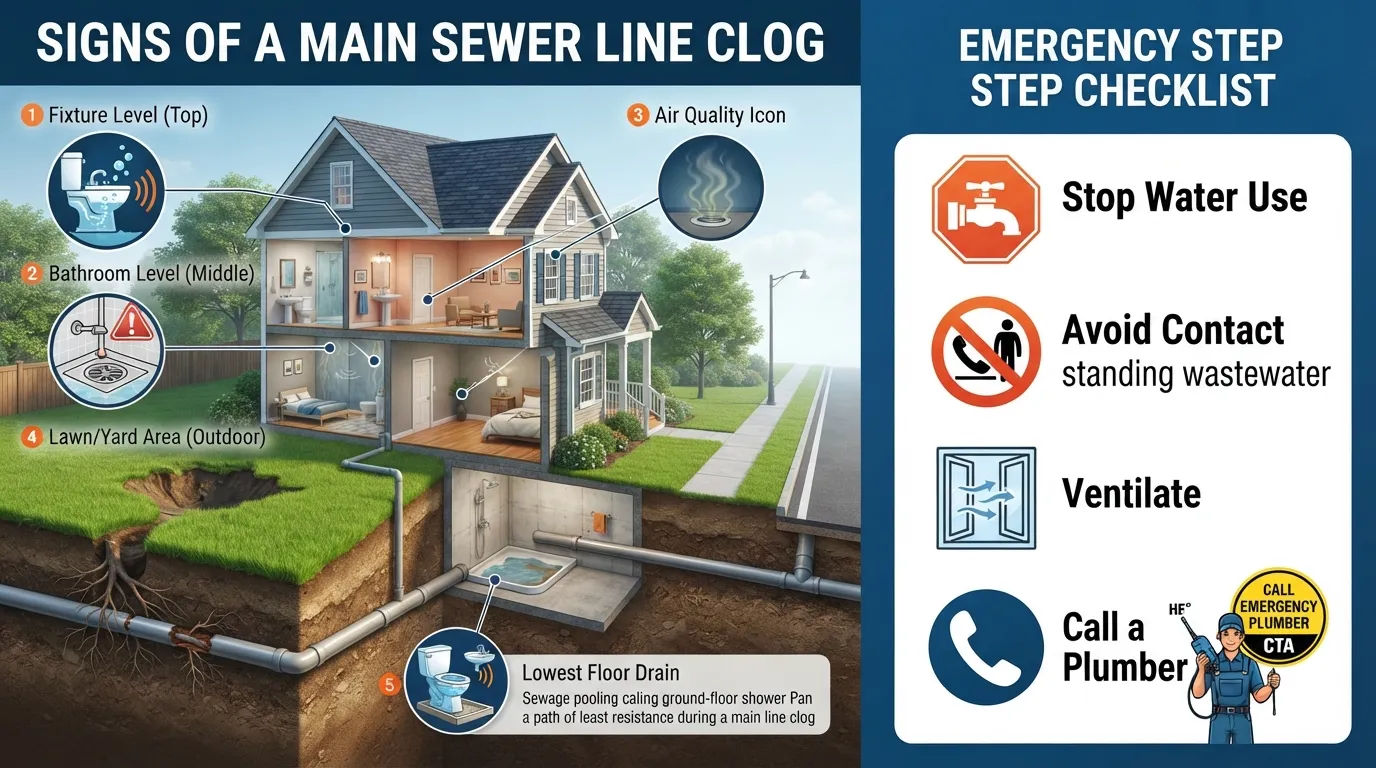
Recognizing early warning signs of a failing main line prevents minor drain obstructions from spiraling into hazardous home sewage backups. Key indicators that your sewer system requires professional attention include:
Multiple Slow Drains: Simultaneous sluggish drainage across sinks, showers, and toilets indicates a main line clog rather than an isolated fixture blockage.
Persistent Sewage Smell: Persistent sewer gas odors inside living areas or around your yard point to cracked drain lines, dry P-traps, or broken vent stacks.
Gurgling Fixtures: Trapped air escaping through standing water traps causes gurgling or bubbling sounds in toilets, bathtubs, and bathroom sinks.
Lush Patches or Yard Sinkholes: Abnormally green grass, soggy soil, or sudden depressions over your lateral pipe point to an underground sewer line break.
Backups in Lowest Drains: Raw sewage pooling in low-lying shower pans or floor drains when flushing toilets confirms a downstream main line blockage.
What to Do During a Sewage Backup
If wastewater begins backing up into your home, taking immediate action minimizes health risks and limits property damage:
Stop Using Water: Turn off main water valves and refrain from flushing toilets, running sinks, or operating washing machines.
Avoid Physical Contact: Keep children and pets away from standing wastewater to prevent exposure to harmful biological pathogens.
Ventilate the Area: Open doors and windows to dissipate airborne sewer gases while taking care not to run central air conditioning units.
Contact an Emergency Professional: Call a licensed emergency plumber in Miami to inspect the system, isolate the blockage, and clear the line safely.
How a Plumber Finds the Problem
Modern plumbing diagnostics rely on high-definition video camera inspections to locate and assess pipe damage without non-destructive digging. Technicians feed a flexible cable equipped with a high-resolution camera down cleanout access points to view internal pipe conditions in real time.
Field Insight: During a recent diagnostic call in Miami, a video inspection revealed that what appeared to be a routine main line clog was actually a structural offset in an older clay pipe caused by shifting coastal soil. The high-definition camera footage allowed our sewer line team to pinpoint the exact location and depth of the damage, saving the homeowner thousands in unnecessary excavation costs.
Business Sewer Problems
Commercial properties face unique drainage demands, high usage volumes, and strict municipal FOG (fats, oils, and grease) regulations. A commercial sewer backup can halt business operations, create health department violations, and harm your business reputation. Partnering with specialized commercial plumbing services ensures your business maintains compliant grease traps, free-flowing main lines, and minimal operational downtime.
Book a Sewer Inspection
If you are experiencing slow drains, unusual plumbing noises, or suspect a hidden lateral leak, do not wait for a full system failure. Proactive maintenance and early video diagnostics protect your property value and ensure your home’s wastewater flows smoothly. Contact our expert team today to schedule an inspection or book a plumber online for prompt, reliable service.
Frequently Asked Questions
Where does sewer water go after the sewer?
After traveling through municipal sewer pipes, raw sewage enters a regional wastewater treatment plant. There, it undergoes multi-stage physical, biological, and chemical processing to extract solids, pathogens, and chemical pollutants. The purified water (effluent) is then safely discharged into regional waterways, pumped deep underground into sealed geological formations, or recycled for agricultural and landscape irrigation.
Where does wastewater go from your house?
Wastewater leaves your fixtures through curved P-traps, flows into internal drain stacks, and exits your foundation via a private lateral pipe. From there, it enters gravity sewer mains under the street. Strategically placed municipal lift stations pump the sewage across flat terrain until it reaches a centralized treatment facility or an on-site septic drain field.
Do we eventually drink sewage water?
In most municipalities, you do not drink treated sewage water directly from your household tap. Instead, purified wastewater is discharged into rivers, oceans, or deep injection wells, or recycled for non-potable irrigation. However, through natural water cycle recirculation or indirect potable reuse programs, purified effluent can eventually replenish downstream surface water or aquifer sources over time.
Does sewer water go to the ocean?
In South Florida and many coastal communities, direct raw sewage is never dumped into the ocean. While treated effluent historically discharged through ocean outfalls, environmental regulations mandate phasing out coastal outfalls. Municipalities now prioritize deep well injection thousands of feet underground into isolated geological zones, alongside expanding reclaimed water programs to protect fragile marine ecosystems and coral reefs.
What is the purpose of treating wastewater?
The primary purpose of treating wastewater is to eliminate dangerous biological pathogens, toxic chemicals, and excessive nutrients before water re-enters the environment. Proper treatment protects public health from waterborne diseases, prevents environmental degradation in rivers and coastal bays, and safeguards precious freshwater resources like underground drinking aquifers from harmful organic and chemical contamination.
What are some examples of wastewater?
Wastewater includes greywater from household showers, washing machines, and bathroom sinks, as well as blackwater containing human waste from toilets and kitchen disposals. It also encompasses commercial industrial wastewater containing manufacturing chemicals and urban stormwater runoff collected from streets and parking lots, which carries oils, heavy metals, and debris into local drainage basins.
Does laundry water go to the sewer?
Yes, washing machine drainage flows directly into your home’s sanitary sewer system through a dedicated vertical standpipe and P-trap assembly. Because laundry discharge contains high volumes of detergent, microplastics, and fabric lint, plumbing codes require washing machine drain lines to maintain a minimum diameter to prevent suds backpressure from backing up into adjacent household fixtures.
Where does storm sewer water go?
Unlike indoor sanitary drainage, storm sewer water enters street drains and flows directly into local canals, rivers, lakes, and coastal bays without undergoing wastewater plant treatment. Because street runoff bypasses filtration facilities entirely, dumping chemicals, motor oil, fertilizer, or trash into storm drains directly pollutes surface waters and harms surrounding aquatic ecosystems.
Conclusion and Next Steps
Key Takeaways
The Complete Journey: Household wastewater travels through private laterals, municipal sewer mains, and lift stations to regional treatment facilities for multi-stage purification.
Separated Systems: Indoor wastewater undergoes extensive physical, biological, and chemical treatment, whereas outdoor storm drain runoff flows directly into local waterways untreated.
Environmental Safeguards: Modern wastewater management utilizes deep injection wells and expanded water reuse programs to protect fragile ecosystems like Biscayne Bay and the Biscayne Aquifer.
Preventive Pipe Care: Keeping grease, “flushable” wipes, and non-biodegradable items out of your drains prevents costly lateral blockages and main line backups.
System Awareness: Recognizing early signs of drainage failure—such as slow drains, gurgling fixtures, or sewage odors—allows you to resolve minor issues before emergency pipe repair becomes necessary.
Need Help With Your Plumbing?
Whether you are dealing with sluggish drains, suspect a main line obstruction, or need routine maintenance on your home’s wastewater system, our expert team is here to assist. Contact us today to learn more about our comprehensive plumbing services in Miami and keep your home’s drainage running smoothly.
About the Author / Reviewer
This guide was written and reviewed by our master plumbing technical team at Miami Florida Plumbing. With over 20 years of hands-on field experience and state licensing (CFC1428592), our certified specialists handle complex residential and commercial wastewater, sewer line, and septic challenges across Miami-Dade County. We are committed to protecting South Florida’s clean water supply through industry-leading diagnostics, code-compliant repairs, and reliable local service.
Main Services
Related Posts
Need a Plumber in Miami?
Schedule service online or speak directly with the EZ Plumbing team.
Owner-Led Local Service
Know who is behind the business before you request service. The owners, contact line and Miami service pages are published clearly.
- Named business owners
- Direct phone and social channels
- Local Miami service information
Clear Help Before You Book
Review the relevant service page, contact the team directly and use the booking page when you are ready—without relying on vague claims.
- Service-specific information
- Direct questions before scheduling
- Clear online booking route